The Back Four: Eleventh Heaven
On an Indy shape change, persistent Spokane, and more

Welcome in to The Back Four! Need more USL content? Make sure to:
- Visit Backheeled for 10,000+ words of analysis on the Championship and League One every matchweek.
- Check back on Backheeled for a topical end-of-week feature on big USL-wide stories, plus attendance and depth chart tracking.
- Listen to This League! and The USL Show to catch up in podcast form.
Without further ado, let’s get to it.
Velocity variety
We interviewed Spokane Velocity manager Leigh Veidman on The USL Show toward the end of July, and Veidman emphasized the variability innate to his tactical approach during our conversation. Spokane values the ability to play (1) through, (2) around, and (3) over their opponents, and they try to do so while maintaining danger through the five lanes 0f the pitch – both sidelines, both channels, and the central stripe.
The Velocity are fourth in League One for passes per possession this season, and they're seventh-ranked with an average possession share of 52%. At the same time, they're going long on more than 50% of their goal kicks – a far greater share than peers like Omaha, Boise, and Antelope Valley that are similarly good at sustaining long passing plays.
The long initiation and fiery counter led by wingers Shavon John-Brown and Medgy Alexandre represents the “over.” The incision through thirds represented by attacking mid Luis Gil and box-to-box players like Andre Lewis and Jack Denton – which has yielded a second-ranked average of 25.6 box touches per game – is the “through.” What defines the “around” piece of the puzzle?
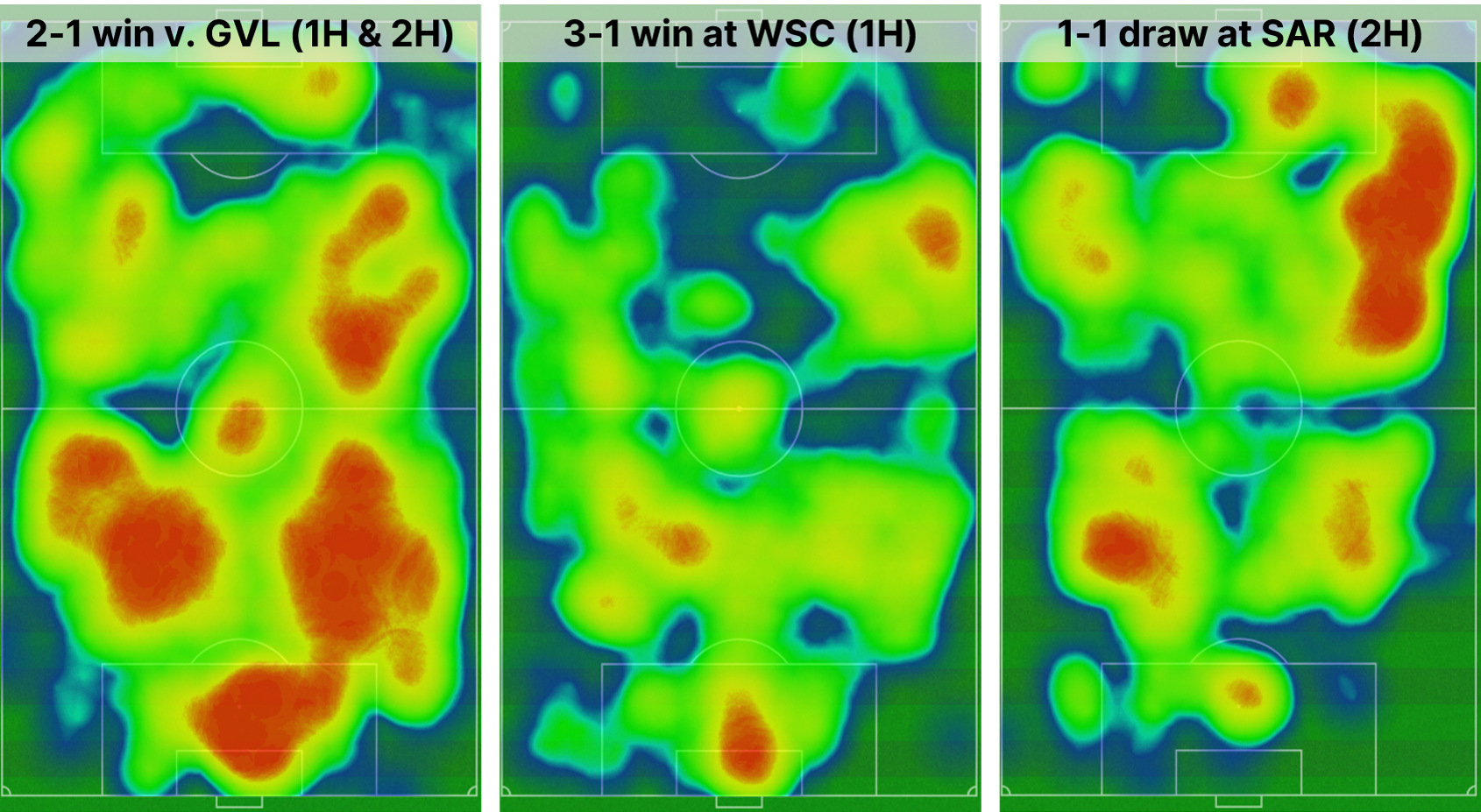
I’ve excerpted the heatmaps from Spokane’s last three matches here, time-limiting the graphics from positive results against Westchester and Sarasota to the halves where the Velocity scored. Across the heatmaps, there’s a clear trend: Spokane lean to the right.
Why is that the case? Personnel decisions have multiplied that rightward tendency. Veidman has often used Derek Waldeck as an elbow-y left back throughout the 2026 season (and years past, while we’re at it) by sitting him low as a table-setter and rest defender. On the wings, John-Brown is more involved than Alexandre and offers better one-on-one quality in tight spaces. In the last three weeks specifically, the choice to start Denton as an explicitly right-leaning No. 8 has added yet another weight to the scales.
Often, that tilt has allowed Spokane to generate crossing opportunities from the right side. This year, Velocity have put up 8.7 final-third passes per cross. That’s the fifth-lowest mark in the league, and it’s evidence of Spokane’s ability to use sharp interplay to seek out the final ball. In last weekend’s late-run draw against Sarasota, the Velocity put a spin on that formula. The rightward tilt was still there, but it was punctuated by an ability to quickly move the ball from side to side and generate passes from dangerous spaces.
(As an aside: AV Alta is, by far, the most patient team in League One with a ratio of 18.3; the next closest is Westchester SC at 12.2.)
You get two examples of that sensibility here, with Veidman’s personnel choices and substitutions proving highly influential in each case. Spokane began this match in their usual 4-2-3-1, with Waldeck at left back and Denton sharing the pivot with Collin Fernandez. In the final half-hour, that changed. Nil Vinyals – who’s comfortably played as a winger and No. 10 throughout his League One career – replaced Fernandez as the deepest-lying midfielder and brought a massive boost in ball-moving vivacity. Shortly after Vinyals came on, Spokane moved Waldeck into a highly unusual winger role, trusting his ability to play narrow (especially compared to Alexandre) through the halfspace.
Spokane’s 4-2-3-1 shape didn’t change, but the axis of Vinyals, Waldeck, and overlapping fullback Moses Mensah gave the left flank new life. Above, you see two examples where the Velocity start on the right but use Vinyals as their hinge player to switch the point.
In the first case, Vinyals is able to receive with the ball moving from right to left and immediately push through the halfspace. Positionally, Denton is essentially filling the left back’s spot in an attacking 2-4-4; his presence and the higher position taken up by an off-screen Waldeck freeze Sarasota’s wing, whilst a narrow Alexandre also helps preclude a close-down. Vinyals makes the most of the space and time, playing a give-and-go off No. 9 Neco Brett to open a shooting angle.
The second example comes after the full suite of changes. This time, Waldeck is the narrow winger, and he’s highly responsive when Vinyals pokes the ball his way after a 50/50 recovery. Meanwhile, Mensah opens up on the left wing and forces Sarasota to send a defender upfield. Vinyals cuts against the grain of that rotation, using a third-man run to receive in behind and cross toward the penalty spot.
Across each of the plays, Spokane’s side-to-side offense is highly effective, largely due to the other point of emphasis for Veidman: occupying every lane of the pitch. Since the Velocity have players at the sideline, through the channel, and in the central stripe, they’re able to force Sarasota into space-conceding decisions time and again. It’s a perfect example of the principles that make Spokane such a dangerous attacking side.
Indy’s new XI
Indy broke out a surprise 5-3-2 away to New Mexico this weekend, and you can get some overarching thoughts on how it affects the Eleven's season in the Backheeled power rank. Here, I want to focus on the attacking upside of the system.
It should be said: Indy started the game really poorly. Out of the gates, wingbacks Aodhan Quinn and Joe Hafferty had no impact in the run of play, and the Eleven's flat back five couldn't figure itself out. United consistently generated four-on-three advantages through the midfield, leveraging those advantages to create a 2-0 lead.
That punch in the mouth – perhaps unexpectedly – brought the Eleven to life.
Traditionally, Sean McAuley has set this team up in a 4-4-2. For most USL clubs, that shape is a springboard into an offensive shape with two resting center backs, another "plus one" protector (think a low fullback or deep No. 6), and a flood of attackers ahead of them. Hyper-direct Indy often bucked that trend, failing to get their fullbacks forward, playing in 4-2-4 mode, and ending up with a fairly henpecked defensive line with an excess of resting numbers.
By contrast, Friday's shape played like a proper 3-3-4 with real zhuzh emanating from the midfield on the comeback trail. No. 8s Cam Lindley and Jack Blake were resplendent, combining to create seven chances on 36 final-third passes; Quinn and Hafferty also grew into the game, attempting six cross and taking four box touches.
Here, you see Lindley (blue, as a midfielder) essentially take up the right wingback role while Hafferty (red, as a defender) possesses through the halfspace. Meanwhile, midfielder Mohamed Omar has popped into the front line beside forwards Loic Mesanvi and Malik Henry-Scott (both in white). It's a funky pairing, but it gives Indy a five-on-four edge on the opposing back line.
Hafferty is able to play Henry-Scott through, creating a crossing opportunity. The serve across the box doesn't take, but Mesanvi's counterpressure creates a loose ball and sets Quinn up for a dangerous look. It's a prime example of Indy throwing numbers forward and turning their direct, vertical style into genuine final-third dominance.
This time, Lindley starts low in more of a build situation, nestling between defenders to create parity against New Mexico's four-at-the-front press. He hits center back Nabi Kibunguchy at the sideline; ahead of Kibunguchy, Quinn has taken up a narrow position in the channel and, thus, bent United out of shape. That movement is subtle, but it makes Mesanvi available in a wide one-on-one.
Mesanvi is able to dribble inside, with Quinn making a halfspace run to his inside to pin a potential closing defender. Off-ball, multiple runs develop. Henry-Scott fills the central lane, Hafferty overlaps up the right, and Blake provides the overloading run from the midfield that Omar made in the previous instance.
From there, New Mexico commits narrow against Mesanvi-Blake interplay, thus opening Hafferty on a run into the box. The wingback's cross creates a rebound, and Blake crashes the net to score.
Indy didn't get away from their identity all the while; relentless directness was still definitional. The Eleven's average pass this year has travelled 11.0 yards upfield with an expected completion rate of 70.1%. In Albuquerque, those numbers were more extreme than usual, coming in at 12.2 yards and a mere 67.8%. Nevertheless, that profile gave Indy a launching pad to bully their hosts.
Here, a long goal kick from Reice Charles-Cook – unexpectedly preferred to Eric Dick – sets up a high claim. Mesanvi find the ball, turns upfield, and our familiar patterns are back again. Hafferty pushes up the flank to stretch the defense, Blake pops through traffic, and Henry-Scott looms on United's back shoulder. When Blake receives, he's able to play the striker through and generate another dangerous look.
This is the intensity we've been looking for, and it's a terrific example of Indy taking risks with numbers. If the Eleven can bring this intensity for 90 minutes going forward, it'll change the way we assess this team as a contender.
Some charts!
I never shut up about field tilt – the share of final-third passes you play compared to your opponents – as a way to measure who’s controlling territory, and I’m equally fascinated by the connection between field tilt and possession. You’d assume that keeping a greater portion of the ball would mean you’re dominating territory, but the numbers bear out a more complicated relationship.
Entering Week 28 in the USL Championship, 33% of the variation in field tilt was explained by possession – a large share, but not everything. Looking at the breakdown across the landscape…
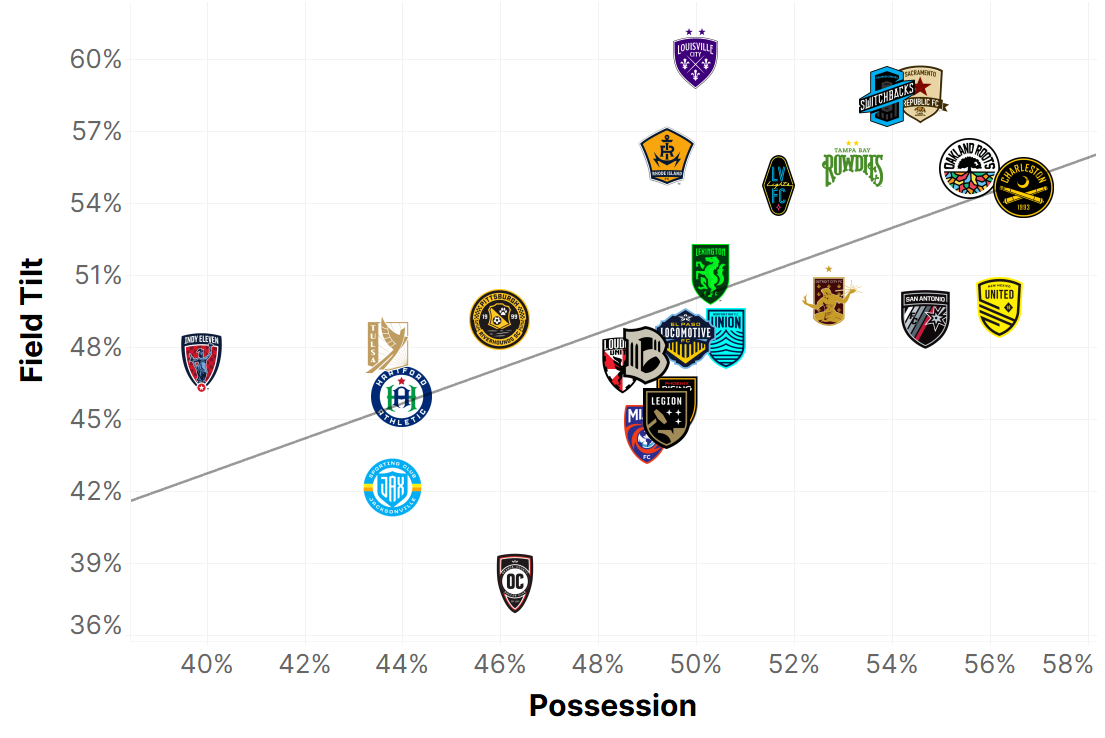
...a few clubs stand out.
Louisville City is the biggest overperformer in the division, posting a league-best field tilt on bang-average possession. That’s the classic LouCity formula; this team presses and counterpresses with extreme vigor, limiting opponents’ ability to advance upfield. At the same time, Louisville is inefficient in the attacking third, lacking the ability to score goals in quick-strike fashion. You could make a (less extreme) case in the same mold for Colorado Springs and Rhode Island.
Indy Eleven’s hyper-direct system and willingness to sit in a low defensive block creates a low-end outlier. On the high end of the possession spectrum, New Mexico United’s predilection for short build from the back and comfort in allowing back-end players like Kris Shakes, Kipp Keller, and Niko Hamalainen to play sideways creates the opposite effect. I talked OCSC a few weeks back, so I’ll spare you the repetition.
What about USL League One? There, the relationship is more linear; there’s a 60% R-squared and less extremity in terms of outliers.
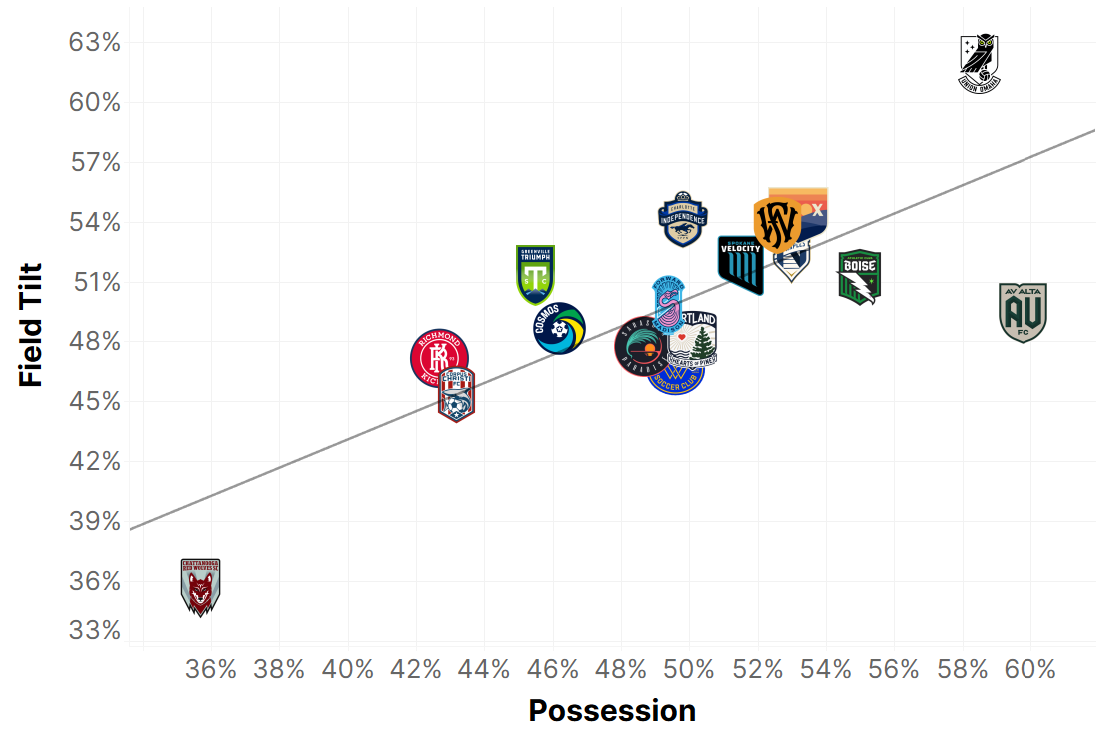
Again, I’d direct you to last week’s newsletter for a discussion of Chattanooga’s style – and their approving attack therein. The more interesting distinction exists among League One’s two possession kings, Union Omaha and AV Alta.
Omaha and Alta like to build out short, but they diverge immediately thereafter. Samuel Owusu and his partner in central defense (Brent Kallman and Blake Malone tend to split minutes) are stupendous line-breakers; only 23% of Los Búhos’ pass attempts come in their own third, the lowest share in League One by a comfortable distance. From there, Omaha dominate games by throwing numbers forward ahead of a “2+1” resting base. Alta couldn’t be more different. They often keep five outfield players low, and a league-worst 38% of their passes take place in their own third.
Possession and field tilt aren’t everything; even a team as stylish as Omaha has struggled in recent weeks to actually create chances around the opposing 18-yard box. Nevertheless, it’s a useful exercise to consider the delta between the two numbers in assessing the success of any club’s style.
Carolina ascending
This is an excerpt from my Super League recap, which comes out each Monday (or thereabouts). Find the Week 5 edition here.
In last year’s USL Super League championship game, Lexington SC and the Carolina Ascent essentially cancelled each other out, going press-for-press at each end of the field. Eventually, LSC broke through because of their excellence on set pieces to win a trophy. Friday night’s rematch was just as much of a chess match four months on – though it ultimately inverted the result of the 2025-2026 title bout.
Fresh off a week’s bye, LSC saw star defender Regan Steigleder (who scored the winner over Carolina in May) and midfielder Darya Rajaee (just recalled from a loan to Tampa Bay) enter their lineup. Against the league’s best press, tightrope-walking was the order day. By manipulating their 4-4-2, playing through lines, and then quickly hitting left winger McKenzie Weinert over the top, Lexington tried to string the Ascent along before instantly ratcheting up the tempo.
As always, 4-4-2 was a misnomer for the “three-box-three” in which LSC attacks. Reaching that point was, at times, a struggle. Moments where center mid Katie Murray dropped between the center backs rarely forced the Ascent’s own 4-4-2 to bite; instead, they left Lexington without a central presence and created turnovers.
This example is better. Kimura’s side stays disciplined in their shape, starting in a back three before, for all intents and purposes, reverting into a 4-4-2 mold to keep parity against Carolina’s six-player press. Here, right back Alyssa Bourgeois peels up the wing and isn’t in frame; in her place, Hannah White (neon green as a mid) drops in like a pseudo-defender (the rest of whom being marked in white).
As Steigleder receives, she carries the ball toward the left sideline in the face of pressure. There, left back Ally Brown holds steady in a deep position, forcing the Ascent’s midfield high and creating a gap through lines. By the time Brown receives and beats her marker, the Ascent’s back line is torn asunder; center back Reese Tappan and right back Addisyn Merrick have both stepped to fill space, creating a misalignment.
The result? Lexington is able to recycle into Rajaee as Tappan remains high against forward Addie McCain (dark green). Since fellow center back Jenna Butler is equally occupied by striker Catherine Barry, there’s room to play Weinert over the top. The winger receives, crosses to a crashing Bourgeois, and nearly earns her side a penalty.
That battle – containing Lexington’s “play medium passes to force reactions and open the long ball” offense – defined the game. It should be noted that Carolina had real success for the most part. Tappan (nine aerial duels) and Butler (four interceptions) did well to take up a more interventionist mantle. Beyond the occasional lapse, they ably protected their box when, say, Merrick stepped up within the bounds of manager Phillip Poole’s pressing system.
In their own right, Carolina struggled to find a reliable pattern to create chances (at least outside of press-driven breaks). At times, it seemed like halfspace-centric overloads – think Mackenzie George, a center mid, and a winger – bolstered by mid-height fullback play might do the trick against LSC’s 4-4-2. Even so, the vivacity and variability driven by Merrick and Jill Aguilera last week was far less viable against the Lexington press.
Here, you see why. With the fullbacks upfield, Carolina bend their build shape without actually creating an overload. The familiar use of Lily Nabet (orange) as a proxy defender should, theoretically, forge an edge on the opposing strikers; instead, LSC shift into a 4-2-3-1 where Barry goes at Nabet and the wingers can match the Ascent’s center backs.
Though Carolina drop wingers Rylee Baisden and Audrey Coleman into the middle third, the McCain-Rajaee-Murray trio mark those players out of viable existence. The Ascent try to squeeze a pass through their left channel, but Murray dislodges it and the break is on. That sequence was, ultimately, exceptional. Lexington stymied the Ascent to be sure, but Carolina was the team that made more high recoveries and caused more trouble close to goal. Poole’s side ended the night with eight recoveries in the final third against just one for LSC.
Kimura’s attempts to freshen his lineup as the match went on fell flat. Weinert’s exit in the 62nd minute cut out Lexington’s most reliable over-the-top option, and Hannah Richardson failed to match her verve. Carolina didn’t change the game with their changes, either, though substitute center mid Emily Morris would be crucial when the Ascent found their late winner.
There, Morris took a left-footed corner kick, swinging it in toward a crowded far post. There, Audrey Coleman and Riley Parker held steady as Butler curled between the two; free for a header, Butler would come good and beat goalkeeper Ryan Campbell.
That the match was decided in near-identical fashion to May’s title game created a real sense of rhyme, but it also goes to show just how even these two teams are. Lexington isn’t off to the start they’d want in 2026, but they can hang with the best of the best – a group that Carolina has firmly established themselves as being a part of.
In other news…
When Tyson Espy gets sold for a six-digit fee in the next two years, don’t say you weren’t warned. Good interview with the young defender on Orange & Black SoccerCast.
Ryan Keefer had a great talk with Loudoun loanee (and longstanding USL favorite) Jordan Farr, check it out on Data Center Soccer.
American Soccer Analysis' Road to 75 game is unreal, I cannot stop playing the USL mode.
United by the Numbers has a very fun interview with Niko Hamalainen, who's been nothing short of splendid in his first season with New Mexico. (I'm referenced, but the piece is worth your time regardless.)
I’m a martyr on a cross of my own creation, but putting six League One games – two of which start midday! – and two further Championship games on the day of the U.S. Open Cup semis is cruel and unusual. (Thus ends the biannual self-pity segment.)