USL Super League, Week 11
DC's press, Alyssa Bourgeois, and more from the Super League

You know the drill: every Monday (or thereabouts), I'm recapping what went down in the USL Super League from a tactical lens. Let's dig in.
Fort Lauderdale (0) - Carolina (0)
Over the last month of the Super League season, the Carolina Ascent have scored seven goals. Only one of them has come in the run of play; the rest are from dead balls. I’m not here to question Carolina’s bonafides, but I am registering that the Ascent’s nil-nil draw in Fort Lauderdale on Thursday is probably meaningful.
Manager Phillip Poole was finally forced to make a lineup change 10 games into the year, using Meaghan Nally in place of absent right back Addisyn Merrick. On the other side, interim coach Paul Jennison largely stuck to his script for United. Grace Cutler stayed underneath primary No. 9 Sh’nia Gordon; though the ever-versatile Abi Hugh took back over at left back in place of Kelsey Oyler, it felt like Fort Lauderdale left money on the table amidst her staid deployment.
In rare moments, United let Hugh (and the proper wingers) push up the sideline while right back Maggy Henschler sat in, basically shifting from 4-4-2 mode into a 3-2-5. The sample size wasn’t big enough to adjudicate the effect of that change, but it forced the Ascent to drop Rylee Baisden low as a defensive makeweight – thereby limiting Baisden’s potential on the counter.
For their part, the Ascent were heavily reliant on the counterattack to create chances. That suited them in a rampant first half, where a 4-4-2 with an extremely high midfield line continuously disrupted Jennison’s side.
Baisden actually sits below the level of the center mids at the start of this play; Mia Corbin and Lily Nabet (who’s just off screen) are touch-tight to the opposing No. 8s. Because those centering options aren’t available, United is pinned within their own box. There, forward Mackenzie George has curled her closing run to force Fort Lauderdale goalkeeper Haley Craig toward her right.
Haley Thomas is able to receive from the right-sided center back spot, but she’s out of viable options. A long ball is the only answer – one that tests the gaping acreage between Carolina’s midfield and defensive lines. The response from the Ascent in that space is picture perfect. Gordon is the target, and Jenna Butler tracks her across the halfway line; in response, left back Jill Aguilera drops deep to replace the central defender, while Reese Tappan sticks on Gordon. Both keep the back line steady and deny a potential flick-on.
While Gordon gets a touch, there’s no control. The ball squeaks loose, and Nabet boxes out to successfully claim the second ball. From there, Carolina break forward instantly. Corbin and Baisden push, striker Shea Groom receives in the left channel, and a cross comes in. If not for an intervention by Fort Lauderdale No. 6 Taylor Smith, it’d be a clean look at goal.
Carolina used similar breakaways to feed Groom and Baisden again and again. An 11th minute move saw them pounce on a backpass to get in behind; another in the 26th forced a terrific double save from Craig. United started shaky, but their goalkeeper bailed them out; Craig ultimately made stops, raising her season-long goals prevented to the 3.0 mark.
For Fort Lauderdale, two routes to success existed: playing long over the press, or keeping play on the ground but upping the ante in the counterpress to mitigate inevitable turnovers. The latter route produces a half-chance here.
Fort Lauderdale start in 4-2-4 mode with Hugh receiving at left back. Immediately, Baisden closes to force the defender inside. Hugh is strong with her right foot, but she’s short on options against Carolina’s elevated midfield. In an attempt to squeeze a pass inside, she tees up Corbin for an interception.
The Ascent gain possession through one of their No. 8s again, but the response is better. Corbin is pressed by Kelli Van Treeck out of United’s pivot and has to take a touch before she forges ahead. That delay allows Cutler to drop in and help create a trap. By the time Baisden receives, she’s got nowhere to go but backwards. Her pass is aimless, leading to a takeaway for Sh’nia Gordon and a look at goal. (Not a good look at goal, but a look nonetheless.)
What’s important here is the denial of the Ascent transition game. As the match settled, Fort Lauderdale did better to keep a grip on the pace of play. Craig started to play more vertically in the second half, and United often adopted a low forwards, high wingers “Y”-shaped front end to try and stretch their guests. Turnovers were less common. A takeaway and shot by Carolina sub Emily Morris in the 81st minute was the exception that proved the rule; the Ascent posted just 0.21 xG on three shots in the second half.
Fort Lauderdale will be heartened by an improving ability to shut matches down, though they’re badly in need of wins with just four matches to play. Carolina provides a more interesting conundrum. The Ascent remain the best defensive and dead-ball side in the Super League, but is their attack doing enough in the run of play? Improving in that phase will be critical down the stretch.
Lexington (3) - Jacksonville (3)
Catherine Barry and Addie McCain score the goals. Regan Steigleder anchors the back line. For my money, however, it’s Alyssa Bourgeois that really makes Lexington SC tick. That was true in the 2025-2026 season, where her relentless overlapping from right back fueled LSC’s shifty shape. It’s becoming true again this fall, with Bourgeois reinvented as a midfielder.
Lexington played host to Sporting Jax on Friday night in a battle between last season’s Players’ Shield rivals, and the ability for the Bourgeois-led right side to manipulate Jacksonville’s structure was paramount. To make it happen, manager Kosuke Kimura rotated his lineup to ape what worked against Tampa Bay last weekend. Namely, that meant McCain operated as a center mid while Sarah Griffith started off the left and Hannah White held down a striker spot next to Barry.
What LSC lacked early on against the Sun in terms of off-ball movement, they found in Week 10. Jacksonville’s defensive 3-1-4-2 largely did what it intended in terms of denying the central midfield. Still, a handful of rotational errors and an ineffective high line in front of goalkeeper Jamie Gerstenberg were fatal.
In this example, Jacksonville get their coverage right. Initially, their 3-1-4-2 hedges so that Baylee DeSmith and Paige Kenton are face-up to the opposing center backs; behind them, the pressing No. 8s are man-to-man through the pivot, and wingback Meg Hughes addresses Bourgeois as a narrow winger.
Still, there needs to be rotation as the ball moves toward the sideline. Hughes peels off toward fullback Hannah Johnson, pointing and yelling before she does so. In response, Jacksonville center back Grace Phillpotts steps to Bourgeois, Hughes puts her weight against the ball, and LSC is cornered. Bourgeois gets a touch, but there’s no progression through the middle third.
Lexington quickly reset and switch the point into left back Ally Brown, but Sporting wingback AJ Hennessey is on her case. The result? An errant pass out of touch.
Compare that sequence to this one. Here, Jacksonville is slightly less organized, but they’re still able to hold a loose approximation of their shape. However, the close we just saw from Phillpotts doesn’t arrive. Instead, Hughes has to wait for No. 6 Sophie Jones to help her out.
For their part, Lexington have made the coverage situation far trickier in this instance. Instead of keeping Johnson deep, she underlaps into the halfspace and almost becomes a No. 8. Bourgeois, by contrast, fills on the sideline like a fullback. That switch-up addles the visitors, creating the delayed response.
Thus, when Bourgeois receives in space, she can look ahead and play Johnson through with momentum. While Johnson’s cutback to Cat Barry doesn’t land, the entire sequence is a strong representation of LSC’s successful offensive patterns.
Those two sequences set the stage for the matchup to come. The more that Lexington could play in front of the press, go into their 4-3-3 or 4-4-2ish mode with interchange up the right, and play over the top, the better they fared. Jacksonville had answers, too; midfield turnovers were commonplace, and they almost always routed right to the feet of Ashlyn Puerta.
The new kits are bringing the heat 🔥@catbarry25 doubles @LEXSCwomen's lead with a finish to make it 2-0 😮💨 pic.twitter.com/0iLrP7Arya
— Gainbridge Super League (@GainbridgeSL) October 24, 2026
Still, Lexington’s marauding offensive sensibility was irresistible. When LSC took a lead in the 11th minute, they varied their long game. Instead of playing over the defensive line with a leading pass to a runner, they let Barry contest a header from the No. 9 spot. Though the striker lost out, her side won the ensuing second ball, gave it right back to Barry, and let her play over the top to White. In the ensuing scramble after Barry’s wonderful chipped pass, Griffith was in position for a rebound goal.
That sequence was all about intentional verticality, as was the play that put LSC up 2-0 just five minutes later. There, McCain received through lines with her side in 3-3-4ish mode; Johnson stayed level with the pivot while Bourgeois pushed high, meaning that Jacksonville couldn’t double-team McCain with their No. 8s without leaving a receiver open. Given time on the turn, McCain could pick Bourgeois out over the top and tee up a terrific assist.
Jacksonville didn’t go down without a fight. Wide interplay and a Puerta-to-Paige Kenton give-and-go swiftly cut the deficit to just one goal. In possession against Lexington’s mid block, Sporting kept a minimal “2+1” resting shape with Jones protecting the remnant of the defensive line as Phillpotts pushed on the underlap. Danger felt ever-present, best felt when Puerta and Phillpotts traded passes to set up a Kenton finish before halftime.
Good side-to-side action and the impact of subs like Mya Swinton eventually earned Jacksonville a 3-3 draw, but LSC’s return to attacking form was the development of the weekend. If Kimura and co. can maintain this level while staying firmer at the back, it’ll be a major development in the title race.
Brooklyn (1) - Tampa Bay (0)
Make it five winless games in a row for the Tampa Bay Sun, whose offense is running drier than the Sahara. This team has just three goals on an already-bad 5.5 xG during the skid, and Brooklyn's ability to play bully ball at Maimonides Park only deepened the malaise on Saturday afternoon.
From the jump, Alex Smith’s side set the tone. Brooklyn kept 58% of possession despite playing fairly vertically. They won 62% of the match’s duels, and they attempted 24 tackles against just six for the Sun. “Want it more” is a silly concept to try and assess from afar, but Brooklyn came out firing where their guests looked flat.
Entering the match, Tampa Bay had slightly tweaked their lineup. Typically left-sided Syndy Nasello took over on the right wing, while Sam Kroeger got the call in a No. 6 spot against her former club – an occasion that Kroeger very nearly celebrated with a long-range goal off a corner in the 15th minute. Even so, chances were few and far between as the Sun played on the back foot.
How’d Brooklyn control the flow of play? Here, goalkeeper Bre Norris initiates from goal with Jennifer Cudjoe as the lone No. 6 in Brooklyn’s 2-3-2-3 build shape. The Sun keep strikers Shea Connors and Eleanor Dale high, but they aren’t closing to the ball or trying to trap the center backs. Instead, right-sided Lauren Gogal is allowed to receive, take a touch, and play a diagonal over the Sun’s 4-4-2.
Tampa Bay is fronting Brooklyn’s No. 8s (usually Jessica Garziano and Jilly Shimkin, though Garziano and Carlee Giammona have swapped here) when the ball is hit, so the onus is on Kroeger and partner Jordyn Listro to circle the wagons and get back. That doesn’t happen quickly enough. As such, Shimkin is able to tear through lines unmarked, slicing behind Sun fullback Sabrina McNeill as she closes against the diagonal.
Winger Ashlyn Miller’s receiving touch isn’t the cleanest, but she’s able to circle the wagons and bounce off Shimkin. Meanwhile, Sara D’Appolonia overlaps from right back. Though D’Appolonia is marked, she still draws defensive attention and helps to create an iso for Catherine Zimmerman at striker, who receives and turns toward goal. Thus, Zimmerman can dish wide once more and set Miller up for a dangerous (if ultimately errant) cross.
Zimmerman ended up with a robust 39 touches, and while only three of them came in the box, the No. 9’s activity provided a constant threat. Notably, Brooklyn only used one sub across the whole 90 minutes; Tziarra King brought a nice presence off the wing for the final half-hour, but Smith largely trusted the process and was rewarded for it.
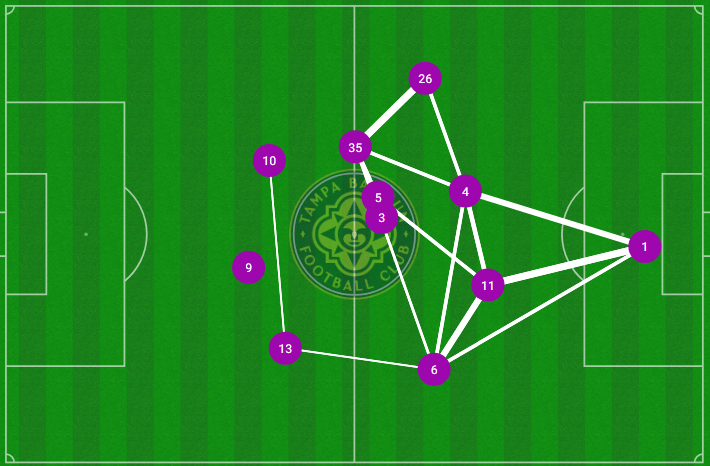
Tampa Bay, by contrast, had a mare of a time trying to connect with their attacking line. Pass maps can only tell you so much, but the Sun let their starting lineup ride for two-thirds of the match had elapsed before making a change. In that time, Connors (one shot and three pass completions in 90 minutes) and Dale (zero shots, six passes) were almost entirely disconnected from the rest of the squad. Even left-sided Erika Zschuppe was uninvolved, indicative of Tampa Bay’s inability to get out on the break as they’ve become accustomed to.
While the Sun looked more fearsome when Kennedy White replaced Dale and Jordan Zade took over off the right wing, Tampa Bay still ended up with less than 1.0 xG. Credit where credit is due: Brooklyn’s stingy back line was just as responsible for the tepid attacking returns as Tampa Bay’s own faults. In center defense, Gogal and Sophia Lowenberg hardly put a foot wrong – most notably in the run-up to Brooklyn’s winner.
There, Connor’s was targeted on the end of a long ball that Lowenberg was able to cut out. Gogal instantly stepped to the loose ball, cleared it upfield, and suddenly put Brooklyn onto the attack. Miller received in behind from there, crossed, and let Zimmerman finish to produce a 90th minute winner. In a battle of pragmatic systems, that moment – and the kinds of offensive successes it embodied – is what set Brooklyn apart.
DC (1) - Dallas (0)
Entering Week 11, DC Power had put in 31 tackles and interceptions per game to comfortably lead the Super League. Likewise, DC ranked second with 5.8 final-third recoveries per match. Coming into the fall campaign, I focused on Power’s ability to dictate matches with the ball, but it’s been their ferocious press that stirs the drink.
That defense-first aggression remained key this Sunday, with DC playing host to Dallas Trinity at Audi Field. In many ways, it was a battle of Omid Namazi’s unstoppable force (the Power high press) against Lee Nguyen’s immovable object (the Trinity possession game). With a chance to gain important ground in the race for a playoff spot, both clubs stuck to their guns.
Two matches winless entering Sunday, Dallas made just one lineup change in swapping Carissa Boeckmann – the Super League’s leading center mid in terms of xA (0.23 per 90), touches (80.6), and passes into the box (3.4) – for the more staid Aria Nagai. The numbers paint the picture well enough for Boeckmann, but her real utility is in her fluid movement through the midfield. Whether deployed as a tucked fullback or roving No. 8, you can rely on her to find touches. Nagai wasn’t bad by any means, but she, Sofia Cedeno, and Felicia Knox struggled to find space through lines in the nation’s capital.
That shouldn’t have been the case – at least on paper. DC pressed in a 5-2-3, whereas Dallas tended to build in a 3-3-4 or 3-5-2 that naturally offered a man advantage through the midfield. Throw in the now-typical “Sophia Braun is a center back, but we push her up as a No. 6” tic, and there should’ve been a way through.
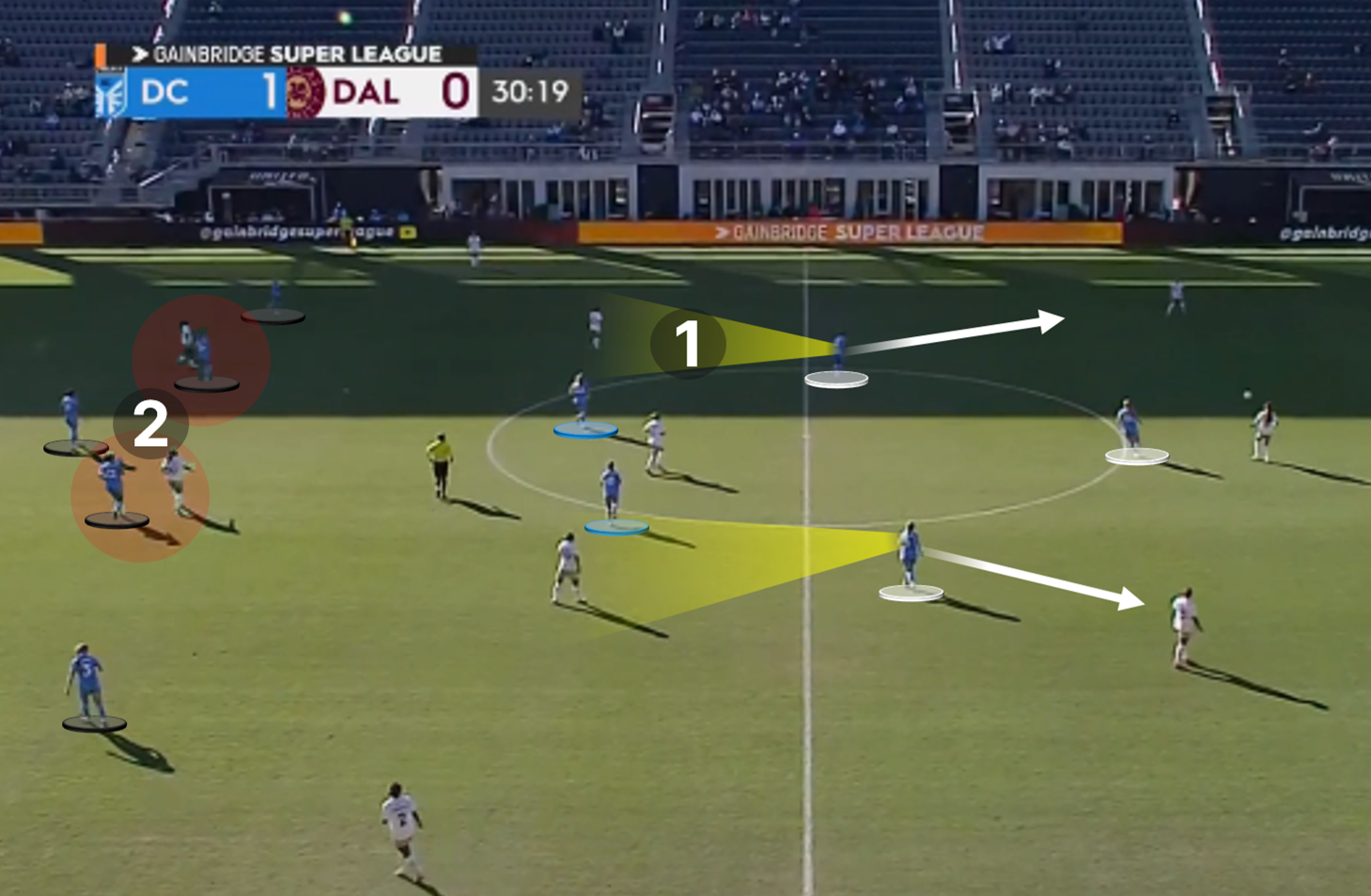
Instead, DC’s layered coverage did the job. That was true on two planes, as you see above in a mid-block situation.
- Up high, Power have three forwards that can go three-on-three against the opposing defensive line, but they aren’t committing all the way up. Instead, the No. 10s (and/or narrow wingers) sit deep and use their pressing shadows to restrict midfield access. Yeah, Abby Boyan and Justina Gaynor (blue) are strictly outnumbered through the pivot, but they’ve got a layer of protection to help deny any sort of central overload.
- At the back, meanwhile, there’s essentially man coverage behind the ball. On either side of centermost defender Sydney Cummings, you can see Hallie Augustyn (left) and Claire Constant (right) step against Seven Castain and Jasmine Hamid within the opposing front line.
The marking didn’t stop there; if either Dallas forward dropped in, their assigned defender would follow. Likewise, Cummings’ ability to cover from side to side let her defensive partners step into the midfield whenever Dallas began to generate a central break.
With those principles in tow, DC gave their guests a heck of a challenge. The press had variety, too. Jaskaniec – usually more of a center mid since joining Power over the offseason – could drop into a midfield spot if Trinity pushed Sophia Braun up. The wingbacks were active as well, choosing moments where Trinity had committed short (and, thus, lost the ability to play wide toward Giulianna Gianino and Onyeka Gamero) to step up and trap their guests.
Eventually, the success of the press yielded a semi-transitional goal. DC starts here in 5-2-3 mode, and while Nagai (the left-sided No. 8) is open to potentially receive on the end of a chipped pass, goalkeeper Neeku Purcell instead opts for a straight-line ball into forward Seven Castain. There’s no room to breathe; Castain is marked touch-tight by Cummings, who slows the striker down and lets No. 6 Abby Boyan slide inside for a takeaway.
Boyan’s touch is heavy and Trinity begin to regain, but a recovering Jaskaniec is there to make a tackle out to the forward line. Suddenly, Power are back in business. Striker Gianna Gourley finds the ball and initiates a quick passing sequence that ends at Boyan’s feet. Boyan pushes ahead, lines up a shot, and rings her attempt of the woodwork. Though Trinity have the core of their defensive line in position, they’re asleep to the fact that attacker Emily Colton is crashing the net for a rebound goal.
That goal didn’t really change the tenor of the match. Even as Power sat back more and more late in the game, they brought a level of physicality and aggression that never abated. Their mentality led to a slew of yellow cards, but it never let Dallas establish a useful rhythm.
Nguyen eventually got Boeckmann into the game at right back, whilst Camryn Lancaster added real verve off the left wing later in the second half. Still, DC held. In a battle of diametrically opposed systems, it was Power’s in-your-face defending that won the day.
(Semi-related Dallas note: we got a really useful breakdown of their roster's contract terms from the folks at 3rd Degree.)