USL Super League, Week 9
Regime change in Florida, cruising Carolina, and more from the Super League

Brooklyn (1) - Dallas (1)
On both the men’s and women’s sides, Maimonides Park has become one of the toughest away venues in the league. That’s a boon for Brooklyn FC, and it provided a challenge for Dallas Trinity in Week 9 – thus creating the most tactically interesting of the matchweek.
Dallas manager Lee Nguyen’s big swing was to bring Giulianna Gianino, a midseason signing, into his back line. Gianino was a perennial all-conference selection at Boston University, putting up seven goals and 15 assists in her senior year as a midfielder. The former Terrier fit like a glove in Trinity’s system, defending like a right back in a 4-2-3-1 before bombing up the sideline in possession.
Brooklyn made life difficult for their guests by leveraging their narrow pitch. With manager Alex Smith back on the sideline and Carlee Giammona – the game-winning goalscorer from last weekend’s victory over Fort Lauderdale – leading the line, Brooklyn was content to sit in their 4-1-4-1 and absorb Dallas’ possession. Midfield organization was key; though Smith’s side ostensibly had the numbers to match Carissa Boeckmann, Felicia Knox, and a low-dropping Sofia Cedeno, doing so was difficult with No. 6 Jennifer Cudjoe away on international duty.
Those central spaces were a flashpoint. Trinity tried to make Cedeno their quarterback in transitional situations, but generating transitions in the first place wasn’t easy against Brooklyn’s mid-low block. In more settled situations, Dallas was far more clever in their approach – though that cleverness came with risks.
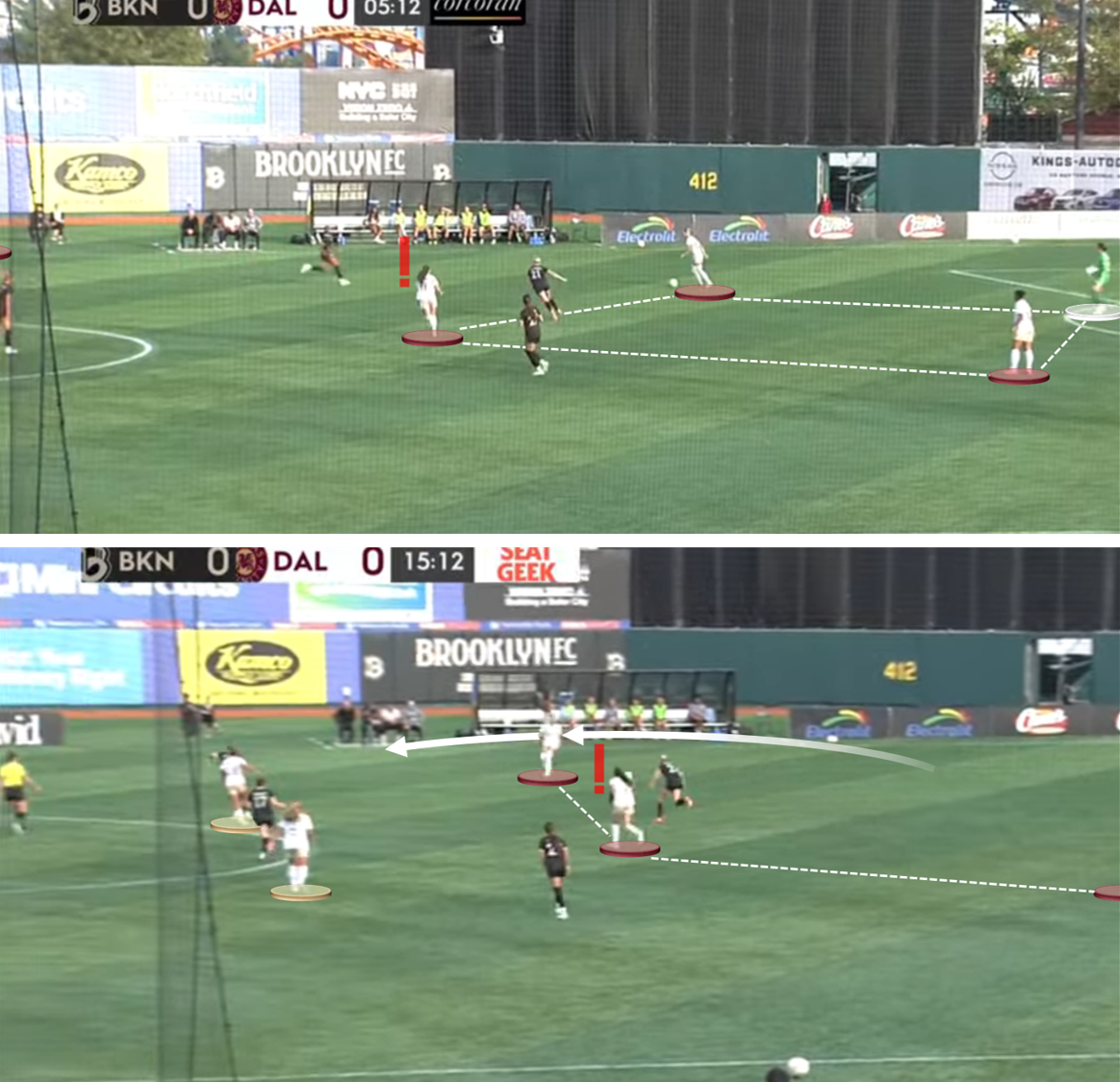
In particular, the use of center back Sophia Braun was a completely novel development. Braun was a true No. 8 during two years with Spokane, but she’s often played as a central defender with Argentina on national duty and filled that spot for Trinity in the 2026 season. That remained true on Saturday, but with a twist: Braun stepped up like a No. 6 in possession, almost forming a diamond with linemates Sydney Cheesman and Cyera Hintzen and goalkeeper Neeku Purcell.
You see two frames above which illustrate that construct. In the first, wingers Tziarra King and Ashlyn Miller push up against the outer vertices of the so-called diamond. Meanwhile, Giammona’s reaction against the ball is delayed because, by design, she’d initially sat low to shadow Braun and deny a centering pass. You like the reactions from the wings, but they won’t be in time to stop a line-breaking ball.
The second frame is an iteration on the theme. This time, Giammona is dribbled around by Sydney Cheesman, but the wingers don’t step. Still, No. 8s Jilly Shimkin and Jessica Garziano hold firm against the pivot, forming a line with the deeper wingers. Giammona, meanwhile, curls her closing run toward Cheeseman to limit her options. It’s a trade-off to be sure, but it forces Trinity into a sideline trap while Brooklyn maintains their midfield structure.
The more that Brooklyn could stop those patterns, break forward into players like King and Shimkin, and create chances, the better they fared. One such sequence turned the match.
Here, Dallas start build with Braun already nestled into the midfield line. Giammona marks her, and Trinity know better than to try and jam through. Instead, Purcell lofts a long ball to the right toward a waiting Gianino.
The fullback receives cleanly enough, but she’s marked by left back Laila Booker – a center back for most of the year who did extremely well in a new spot. Because Booker shows Gianino into the maw of three waiting No. 6s and No. 8s, there’s nowhere to go. Braun receives on the end of a sideways pass, but Giammona is on top of her in an instant.
That’s the beauty of the ostensibly passive front end of the Brooklyn press, which is set up to clamp down around halfway. Thanks to that setup, Giammona’s tackle turns into a dribble for Garziano with three runners – Miller, King, and Shimkin – pushing ahead. Dallas only have two resting center backs in place, so the three-on-two spells trouble. King is able to receive, stepover her way into the box, beat Cheesman with an endline step, and hammer home a go-ahead shot.
Dallas wasn’t exactly rampant in the second half, but swapping Gianino for Juliet Moore – who started at striker in the not-too-distant past – helped earn a 70th minute penalty (missed by Jasmine Hamid) and a late equalizer for Sveen Castain. Notably, Moore provided the assist on that tying goal, evidencing her speed of thought against Brooklyn’s block late-on.
In the end, that spark was exactly what was needed to get over the line. Brooklyn played their game, but we got to see Dallas grow into the speed of play necessary to earn a crucial point.
Tampa Bay (0) - Carolina (3)
Exiting Week 9, the Carolina Ascent have scored 15 goals in total, and seven of them have come from set pieces. There have been seven teams in the USL Super League’s short history that haven’t hit that mark in full 28-game seasons; Carolina have done it in seven games. Their dominance in dead-ball situations carried the day away to Tampa Bay this weekend.
It’s one thing to dominate when the game becomes staccato, but you’ve gotta earn the set pieces in the first place. Against the Sun, manager Phillip Poole’s defensive system was terrific at stymieing the home side, creating quick opportunities to advance, and earning touches in important spaces.
For their part, Tampa Bay – ever willing to switch it up – bent their attacking shape in a different direction than usual. This team has often elbowed Jordan Zade and Taylor Chism up the right to create matchup problems and, by proxy, free Sydny Nasello off the weaker left wing. This time around, manager Denise Schilte-Brown’s out-of-possession 4-4-2 became a left-slanted 3-2-5 with fullback Samar Guidry given license to push.
The aim of the system remained the same: spread the field, open the long ball, and let players like Nasello and Shea Connors cook. In practice, it wasn’t so simple. Amidst plays like this…
…and this…
…the Ascent’s ability to match up player-for-player through the midfield was a constant thorn in Tampa Bay’s side.
Being a vertical team doesn’t mean you’re always vertical. Often, you’ll want to move the ball around the back, probe the midfield a bit, and generally Trojan horse your way into defensive overreactions. Carolina’s mix of discipline and intensity through the thirds rarely let that happen.
In the first case above, the Sun are recovering into that aforementioned back three with Guidry upfield, and they’re allowing the pivot pair of Jordyn Listro and Sam Kroeger to stack high-low. Crossing runs occur, but Carolina isn’t addled. Instead, Lily Nabet and Mia Corbin stick tight while maintaining the bones of the 4-4-2 shape. There’s no access through lines, and Tampa Bay’s only recourse is to play a bold, driven pass that fullback Addisyn Merrick cuts out.
To my eye, Carolina played a slightly deeper defensive line than usual while still preserving moments like that where intervention could occur. That didn’t stop the Sun from trying to play long. In the second example, their initial foray toward Chism and Zade is cut out by localized man marking, so goalkeeper Cristina Roque goes long to the left. A wide-hewing Nasello’s initial flick beats Merrick, and Guidry’s follow-up bests a rotating Reese Tappan. Even so, there’s still Jenna Butler to contend with, and she’s able to do her job as the literal last line of defense.
Even in ostensibly stressful moments, Carolina always brought that level of poise. Mix the defensive composure with an ability to bend Tampa Bay’s matching 4-4-2, hit players like Mackenzie George in space, and earn set pieces, and you had the recipe for a positive result.
Here, you get two examples of Carolina set pieces. Both are free kicks from roughly comparable spots on the edge of the attacking third; one is taken by left-footed Jill Aguilera, and the other is taken by right-footed Mia Corbin. In each case, the initial serve isn’t meant to create a shot. Instead, Butler becomes the target at the far post, where she’s supposed to head the ball back across the face of goal.
Aguilera’s dish in the 10th minute meets Butler’s head, though her header against the grain doesn’t lead to a controlled shot. The second example, from the 38th minute, is more successful. Butler’s header meets Shea Groom, and Groom’s hit creates a rebound chance for none other than Aguilera in full fox-in-the-box mode. It’s a terrific example of how this club’s patterns are so well-drilled.
Corbin assisted a second post-set piece goal in the 44th minute to put the game on ice, and Carolina never wavered from there. What the Ascent are doing right now is undeniable; no one else in the Super League is as tactically aligned.
Fort Lauderdale (2) - Lexington (1)
Tyrone Mears, we hardly knew ye…again. Fort Lauderdale’s manager saw his second stint at the helm end ahead of Sunday night’s match against Lexington, and it’s not hard to understand why. United had limped to a six-loss, one-win start to the season while posting a -7 goal difference and -0.73 per game xG margin. In every sense, the results hadn’t been up to snuff.
Thus, Fort Lauderdale rolled into Week 9 with Paul Jennison taking the mantle for his second interim spell in two years. It was the ultimate “put up or shut up” moment for this club, and United rose to the occasion.
Jennison didn’t make sweeping changes to Mears’ 4-4-2, instead opting for subtler tweaks across the lineup. Maggy Henschler did make her first start of the year at right back, but no other new starters joined the fray. Still, the front line was rearranged. Sh’nia Gordon (usually the right winger) paired with Grace Cutler at striker, Kiara Locklear (best as a No. 9) replaced her on the right, and Abi Hugh filled out the final wing spot. The philosophy behind the changes was fairly clear: Gordon is your best transition threat, so why not keep her front and center?
The shape featured a flat back four across phases, a choice that was meant to (1) open the wings in possession and (2) deny Lexington a sense of verticality on the other side of the ball. While that approach was passive, it meant that LSC – who had none of Sarah Griffith, Allison Pantuso, or McKenzie Weinert in the starting XI – had only mustered 0.57 xG on seven shots by the time Fort Lauderdale went up 2-0.
Containment was the name of the game, and you can see that here. Initially, Lexington build around the back and start to flex into their typical three-defender mode. As the ball finds Ally Brown off the left, Fort Lauderdale close to her via Locklear. That starts a chain reaction. There’s now a gap on the sideline as Locklear blitzes, and we know Henschler won’t close down. Thus, center mid Kelli Van Treeck must rotate over.
While her rotation is fairly timely, LSC still hit attacker Addie McCain on the turn and instantly look upfield. At this moment from the Lexington perspective, the shape is a wonky 3-4-3 in essence – one that’s got the numbers to force the wing reaction we just saw while also retaining three vertical runners. That in media res shape means that winger Hannah Johnson is available in behind, having made a sharply vertical run.
McCain plays through to Johnson, and center back Haley Thomas gives chase; around her, the rest of Fort Lauderdale’s back end responds in kind. As soon as Thomas pushes wide, Henschler fills for her in central defense. Meanwhile, both Van Treeck and Taylor Smith responsibly track Lexington’s crashing center mids. There’s a cutback pass to Lexington No. 8 Nicole Vernis that squeaks through, but it comes amidst so much traffic that the half-chance is harmless.
Manager Kosuke Kimura’s LSC side ended the night with a 67% field tilt, but they struggled to break down that block. Moreover, Vernis and Darya Rajaee – two players that began 2026 on loan and were recalled amidst injury troubles – struggled to make a dent through United’s lines. Rajaee completed 42 passes, but only four met Lexington’s front four; Vernis completed six attempts into Addie McCain alone, yet she was susceptible to Fort Lauderdale’s tight midfield pressure.
Picked that one out 🎯
— Gainbridge Super League (@GainbridgeSL) October 11, 2026
A moment of magic from Sh’Nia Gordon puts @FTLUTD ahead ✨ pic.twitter.com/LBBvH2OuKd
Fort Lauderdale set themselves up to be opportunistic, and moves created by midfield turnovers became the best way forward. A Van Treeck tackle and instant through to Gordon in the 18th minute were an appetizer for United’s opener in the 37th minute; there, Van Treeck and Gordon combined again to break lines. This time, Gordon played the part of a connector, threading Hugh in behind and setting up a wonky cross-turned-recovery situation. The first serve didn’t hit, but Hugh’s second attempt to find Gordon resulted in an assist.
That goal changed the dynamic of the match, and that suited United. LSC needed to commit more numbers forward; that meant Gordon had more space on the counter. Another break goal arrived in the 50th minute, handsomely paying off Jennison’s personnel realignments.
In every sense, the result was a season-saver for Fort Lauderdale, but what’s up with Lexington? In short…I don’t know!
Gracie Falla, in for Pantuso, had a handful of bright moments as a carrier and progressor off the right side of the back line. Johnson was perfectly adequate as a pseudo-Weinert up the left. Writ large, Lexington still maintains the best expected goal difference in the Super League – though results like Sunday’s ultimate 2.4 to 0.7 edge feel like empty calories.
This is a good soccer team, but even good soccer teams can struggle in small samples. The nature of the 2026 season means that short runs of poor form could be decisive. LSC is only a point back of the playoff cut line with half the schedule yet to go, but I’d earnestly tell you that a postseason berth isn’t a guarantee.