The Back Four: Bubble bonanza
On the knotty East, action height data, Brooklyn, and more

Welcome in to The Back Four! Need more USL content? Make sure to:
- Visit Backheeled for 10,000+ words of analysis on the Championship and League One every matchweek.
- Check back on Backheeled for a topical end-of-week feature on big USL-wide stories, plus attendance and depth chart tracking.
- Listen to This League! and The USL Show to catch up in podcast form.
Without further ado, let’s get to it.
Defensive aggression and attacking position
Pressing without the ball is a great way to kill two birds with one stone. On one hand, you’re actively disrupting the opposing team by weaponizing the out-of-possession phase of play. If you press well, you’re also helping yourself in an in-possession sense by regaining the ball closer to the opposing goal. On paper – and pending your team’s overall principles – it’s the best of both worlds.
Reality isn’t so simple. There is a link between possession start positions and defensive action heights across the USL Championship and USL League One. That doesn’t mean a given team is actually putting up results by virtue of their style.
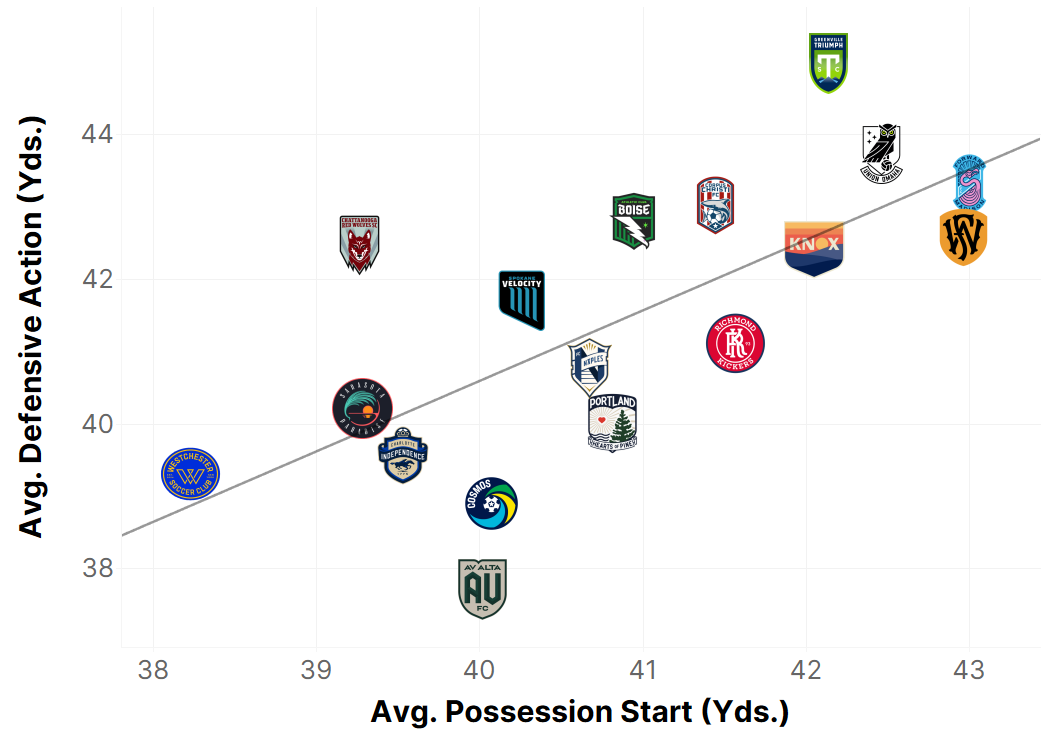
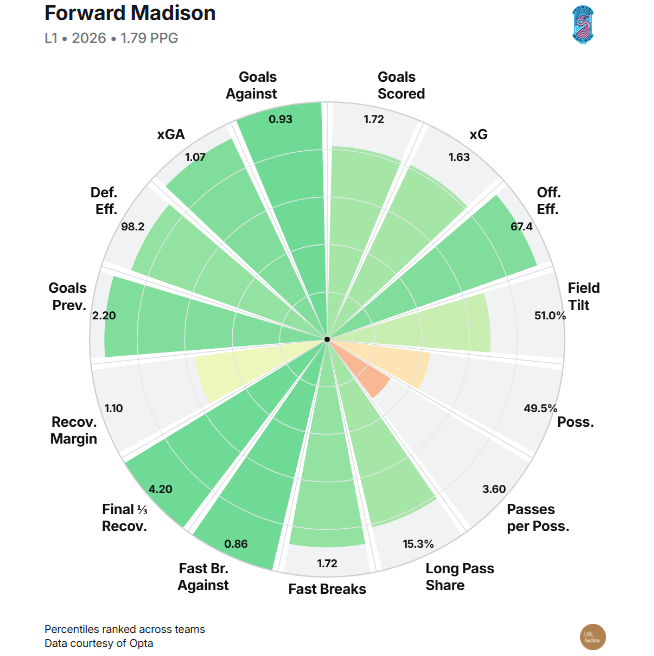
In League One, for example, the fivesome of Forward Madison, One Knox, Union Omaha, Fort Wayne FC, and the Greenville Triumph all start their average possession and put in their average defensive action more than 42 yards upfield. Madison is a direct team when the initiate, and they back it up with strong counterpressure; Knoxville, Fort Wayne, and Omaha are much more grounded and bring a conventional pressing approach against opposing restarts.
Those four look like playoff teams and Greenville…uh…don’t. The Triumph are undeniably aggressive and have instilled a vertical passing system throughout 2026, but they’ve utterly failed to implement Madison-style organization in the counterpress, in second-ball situations, or against transition. Style isn’t success.
Boise is an effective pressing team that's not afraid to go full-blown 3-1-4-2 mode, but they're also committed to a shorter-oriented build approach. What tilts them in the direction of League One's higher-starting sides is a strong commitment to the counterpress.
At the start of this clip, Boise try to play a chipped pass into wingback Nick Moon as he runs into the box, but the attempt doesn't connect. While forwards Thomas Amang and Jesus Barea don't bear down on the ball, the fact that they're lingering in position to make a recovery forces Corpus Christi to hit a rushed clearance. As such, Boise gets a second bite at the apple and starts a possession deep in the opposing zone.
Phillip Mayaka, a No. 6, is the player who claims the Sharks' clearance, and he instantly resets toward underlapping center back Josh Yaro through the right channel. Yaro and forward Tumi Moshobane's ensuing interplay draws Corpus Christi's attention, setting the table for another ball into the box. Again, Boise can't control play in the 18-yard zone; again, however, they've got so many bodies forward that Corpus Christi can't hit a decent clearance.
The cycle repeats once more. Boise circulates, tries a cross, and lets Mayaka partner with fellow center mid Dominic Gasso to retain possession. It's an endless cycle of self-perpetuating possession.
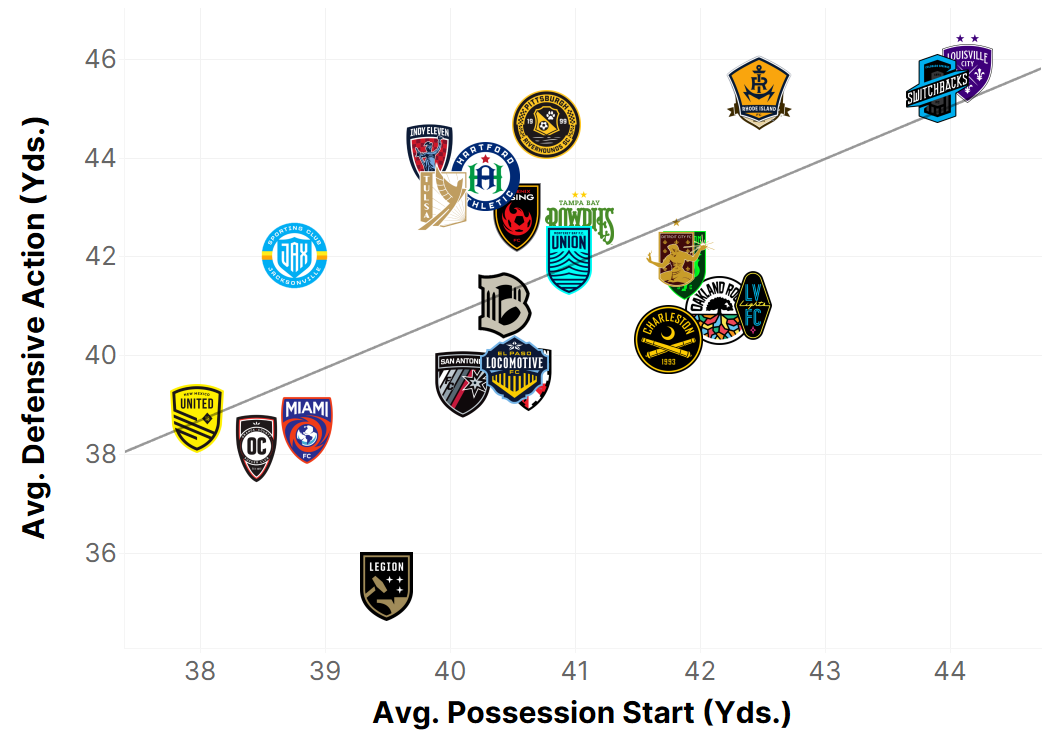
What about the Championship? There’s far more crowding around the middle of the pack in the second division, though clubs like Louisville and Colorado Springs exist as high-end outliers that both initiate vertically and use elevated defensive lines to wreak havoc. There’s distinction at the opposite end of the chart, too. New Mexico possesses and possesses and possesses in their own third, while Orange County spends most of their time defending without the ball in those same spaces.
Across both leagues, the Birmingham Legion may be the biggest outlier. Their peers in the “start your possessions about 40 yards upfield” bucket are all defensive-minded teams that play aggressively against the ball, prefer vertical passing, and aren't afraid of spending time in low block. The Indys, Tulsas, and San Antonios of the world are swashbuckling and create a stop-start tempo that’s utterly distinct from the methodical Legion. Why is that the case?
Birmingham starts this play in 4-4-2 mode, with forwards Romario Williams and Peter-Lee Vassell holding a line of confrontation below the level of their own center circle. While the Legion did choose moments to press toward opposing Brooklyn's box in restart situations in this game, their baseline posture is well-represented here. For the most part, Birmingham was happy to sit low and keep a deep-seated defensive line behind the ball.
In this case, that setup forces Brooklyn around the edge. Even there, you don't see aggressive pursuit of the ball. Winger Tyler Pasher and right back Sebastian Tregarthen hedge to trap, but they're using the sideline as a pressure point rather than seeking out a bold tackle. Thus, the guests are forced to reset and attempt a low-percentage long ball.
That's the utility of using a pressure-light system: it limits space and goads risky, wasteful passes. Here, Legion center back Nico Brown is able to cleanly head the pass down into Tregarthen's feet, and the break is on. The link between a lower-seated defense and a deeper starting point is apparent, but it doesn't stop Birmingham from breaking with speed. The Legion play through Vassell, work side to side, and let winger Gevork Diarbian go at goal.
Now, is there a link between Birmingham's poor results in 2026 and their uniquely passive style? Likely so. Still, they’ve hit the ground running in recent weeks (weekend loss to Detroit notwithstanding) by leveraging a fast-paced counter and the transitional abilities of distinct players like Williams and Vassell to become a potent offense. The improvement came too slowly, but the late-season Legion are a roundabout example of how a deeper, more patient side can succeed.
Bubble potpourri
The most interesting race in the USL Championship is on the Eastern bubble, where Rhode Island FC, Indy Eleven, and red-hot Miami FC are vying for the conference’s last two playoff spots. I hit all three teams in detail in the usual Backheeled breakdown, but I want to dig into their recent attacking form.
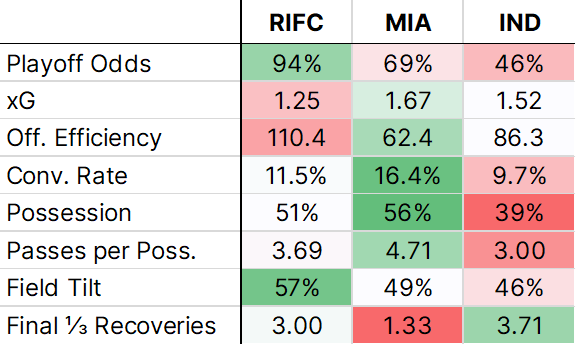
Since the first week of September – the point at which Miami sold superstar striker Jurgen Locadia – there's been an enormous divergence among the three attacks. Manager Gaston Maddoni’s Miami side has come alive; they’re among the East’s leaders in xG, possession, passes per possession, and conversion rate. In centering Arthur Rogers as their quarterback and leaning into the rangy, clever movement of Mason Tunbridge, Arney Rocha, and Rodrigo Da Costa, Miami has spread the love beyond a singular focus on a talismanic No. 9.
By that high standard, Rhode Island and Indy have paled in comparison; that’s why we’ve got a genuine playoff race! The way in which the two clubs have struggled is instructive. Indy have kept a tiny minority of the ball and have been inefficient in the attacking zone. Yes, there’s been success on the break and from set pieces, but a sudden lack of formational clarity, an injury to Bruno Rendon, and a season-long finishing problem have all come to a head.
RIFC sold JJ Williams around the same time that Locadia left Miami, and their rebound has been more gradual. Manager Khano Smith’s side is absolutely dominating territory, but they’ve faltered in the 18-yard box without the USL’s best presser and target man – who, by the way, also happened to be an elite hold-up striker on the counter. Still, we got a glimpse of Rhode Island’s new blueprint (and Indy’s deeper-rooted problems) when the two sides met last Wednesday.
Rhode Island starts this sequence in 4-2-4ish mode, but you can see their upfield patterns click into place. Indy is held through the midfield by the double pivot of Hugo Bacharach and Zach Herivaux (blue as mids), and right back Frank Nodarse (white as a defender) is thus able to break past a closing No. 8 on the dribble. Once Nodarse gets free, he's facing down a slew of teammates through the halfspace.
The geometry of RIFC's combinations deserves note. Against Indy in particular, Leo Afonso willingly dropped into deeper spaces and operated like a linking midfielder more than a forward; that's the case here. Afonso draws midfield attention, meaning that the Eleven can't rotate Aodhan Quinn, their No. 6, to help against forward Stas Korzeniowski (orange) and winger Yu Tsukada.
Osman Foyo, of course, nabbed an assist in a similar situation earlier in the Indy game by stutter-stepping past his defender and breaking in behind up the right wing. This time, with Foyo and Tsukada having swapped sides, Indy jump a passing lane to intercept. Still, they don't get far. Instantly, Rhode Island clamp down. Nodarse closes to the ball, Afonso puts in the defensive dirty work, and Herivaux is in position to intercept.
"Plan A" doesn't work for RIFC, but Indy's half-hearted transition leaves them vulnerable after the counterpressing takeaway. Bacharach sees open space and uses his long stride to glide through lines, drawing the attention of no less than three Eleven defenders; thus, Foyo is free to receive in the box and whip in a cross.
Again and again, Rhode Island found moments to break lines, quickly advance toward the attacking third, and tee up their wingers. Sans Bruno Rendon, Indy had no such luck.
This is the post-Williams version of RIFC at their best. Bacharach is the powerhouse, but there’s a strong sense of structure the instant the ball turns over and an undeniable sense of verticality on the wings. We’re still waiting for consistency, but the vision is clear. If this team stays dominant on set pieces, much as they were amidst Saturday’s rout over Brooklyn, it’ll also help their cause enormously.
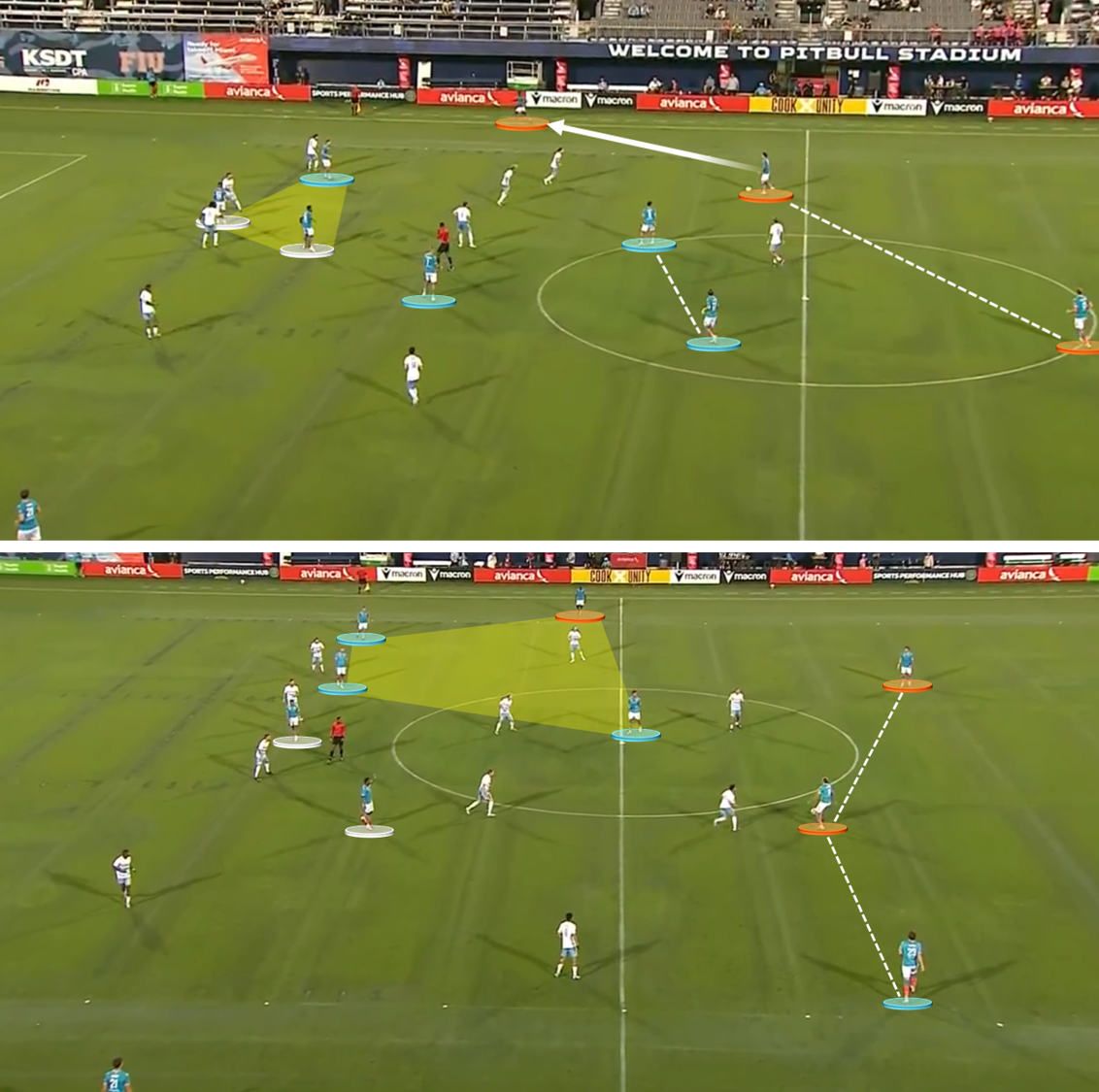
Miami has been every bit as organized, shapely, and impressive in their own way. Over the last month, this club has suddenly become one of the most incisive possession teams in the USL – and one of the most attractive teams to watch, while we’re at it.
Both frames here are taken from Wednesday night’s no-nonsense victory over Jacksonville, where Miami put up four goals and 2.1 xG. Yeah, they played up a man for the vast majority of the match, but they controlled the game from the moment the opening whistle blew. Varied, principled build play made it happen.
In the top frame, you’re seeing center back Arthur Rogers (who I highlighted last week in this column) flex upfield while partner Daltyn Knutson sits low. The center mids don’t drop all the way into the back line as a makeweight, but there’s essentially a “2+2” backstop ensuring a keen sense of resting structure. Upfield, Miami’s choice to keep Tunbridge and the two forward compact forces Jacksonville to get compact in turn. The result will be easy progress up the right through fullback Bachir Ndiaye.
The shape looks different in the second example. This time around, defensive mid Tommy Musto drops all the way into the back line, leaving Miami with four resting players but extra flexibility at the base of their shape. Knutson uses it to get active; this screenshot sees the defender having carried the ball around a pinned presser, about to pass upfield. Jacksonville isn't quite as wide-spread this time, but there’s still a four-man bloc toward the right channel that has the numbers to do damage.
Miami has hammered these patterns over and over, trusting the Rogers and Knutson types to interact with the 4-4-2’s pivot, bait opponents up, and then progress play into what’s suddenly the USL’s most exciting attacking group. The offense is narrow until it isn’t, largely due to Ndiaye and Alessandro Milesi at the fullback spots. It’s patient, but then a like break instantly speeds the game up. Miami only got faster on Saturday against Tampa Bay, where Da Costa and Denilson Milanes ate the Rowdies alive in break situations.
With a handful of matches yet to play, my odds model now fancies Miami to edge out Indy as a playoff team. It’s not hard to see why. Miami are rampant, and Indy constant let the game come to them. We’ll see how those trends shake out over the next three weeks, but there isn’t a more fascinating battle in the USL.
Brooklyn's finest
This is an excerpt from my Super League recap, which comes out each Monday (or thereabouts). Find the Week 8 edition here.
I’m not gonna tell you Friday night’s match between Brooklyn FC and Fort Lauderdale United was a “playoff eliminator” game; anything can happen for either club with seven matches yet to play. That said, there was a punchiness at Maimonides Park that proved both sides – who’d combined for just two wins entering Week 8 – understood the moment.
Given the combatants’ shared attacking issues, Friday could’ve devolved into “stoppable force meets movable object” territory. Instead, both clubs were clever in how they approached the match. Brooklyn used natural center back Laila Booker as a deeper-seated left back, thus opening that flank for Tziarra King. The more that Brooklyn could play over the top into King and let her combine with striker Catherine Zimmerman, the better they fared – especially given a fairly tight defensive scheme on United’s part.
United, for their part, lacked the presence of starting fullback Maggie Mace and started Abi Hugh (who’s mostly been a left winger this year) in her stead. Hugh didn’t have a perfect night marking King, but her overall effort ensured that the Brooklyn winger rarely found her right foot without a marker close by. Likewise, Kelli Van Treeck’s help out of the 4-4-2’s defensive pivot was a boon.
Much like Brooklyn, Fort Lauderdale needed to figure out how to quickly break lines going in the other direction. Daniela Todd’s ability to pop into space as a mid-long outlet from second striker helped, but their best sequences tended to run through Sh’nia Gordon.
Here, Fort Lauderdale start through goalkeeper Haley Craig and play into Ella Simpson. Within United’s 2-4-4ish build shape, the double pivot sticks close to the defensive line and forces Brooklyn’s attacking mids up in response. By begging the pressure, Fort Lauderdale necessarily invite trouble, but Taylor Smith is comfortable enough at the No. 6 spot to shrug off backside pressure and keep the ball circulating.
As Haley Thomas receives on the return pass to central defense, Brooklyn blitzes Jilly Shimkin from one of the No. 10 spots in their 4-1-4-1 – creating a gap in the process. Shimkin won’t reach Thomas in time to wreak havoc, but left winger Tziarra King still takes a half-step inside to cover for her teammate. As such, Hugh is wide open at the sideline.
Now, there’s room to breathe. Hugh will take one touch, play into low-dropping striker Kiara Locklear, and draw a defensive marker high upfield in the process. Further progression is a tightrope walk, but Locklear is able to knock the ball into an advancing Gordon with a Brooklyn center back out of position. Though Jennifer Cudjoe recovers from the No. 6 spot and central defensive help arrives, Gordon’s got the speed to play a dangerous cross.
Fort Lauderdale’s attack tended to be fly-by-night in that manner for most of the 90 minutes, whereas Brooklyn had better luck finding controlled methods of advancement. We start this example of that trend in media res, with Brooklyn playing through Garziano from their right side to their left. You can see Sara D’Appolonia hedging out of frame from right back as soon as the clip starts; conversely, Booker stays low on the left, almost forming up into a resting back three.
Immediately, Fort Lauderdale have a numerical problem. As they recover into their pressing shape, United commit Locklear up to the proper Brooklyn center backs, leaving Gordon and a stepping Treeck to mark two ball-side players. The rub? Cudjoe and Shimkin are unmarked in the dead center of the pitch.
From there, progression is easy; Cudjoe receives, picks her head up, and sees a front line of King, Zimmerman, Ashlyn Miller, and an overlapping D’Appolonia challenging the United back four. All it takes is one clean pass toward King to put Brooklyn into the box. King’s cutback to Shimkin and an ensuing rebound chance don’t end up on frame, but this is a prime example of Brooklyn at their attacking sharpest.
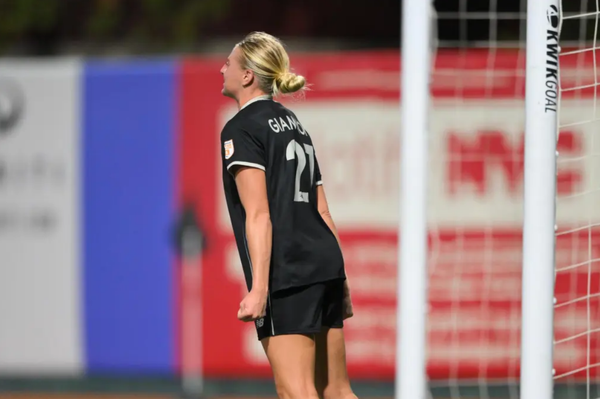
Combined, Fort Lauderdale and Brooklyn mustered just 1.8 xG, and half of it came from Carlee Giammona’s winner. There, United tried to build out from the back through Simpson and Craig, only for a bad backpass to unsettle the play. Miller’s curled closing run from the wing helped make it happen, setting the table for Giammona – a halftime sub, in for Zimmerman – to pounce for a tap-in.
Was it an especially spectacular goal? No, but this game was always going to be won on the margins. Brooklyn is increasingly finding the ways to grit out results, and Friday’s victory was a perfect case in point.
In other news…
I’m guesting on 608 Soccer this week to talk about a delightful Forward Madison team, so check that out. You'd be hard pressed to find a team that's executing on their principles more completely than the Mingos:
Late-season loans from MLS can be a crapshoot, but Malcolm Fry has been absolutely electric in Lexington. This weekend alone, the New England loanee put up seven box touches and an assist against El Paso. Fry is quick, good on the dribble, and offers a verticality that LSC simply didn't have at the right wing position pre-acquisition. Crucially, Fry knows how to interact with Xavier Zengue; the overlapping right back was the only player with zhuzh for most of 2026, but their complementary movement is a major reason why Lexington now look like a bonafide title threat.
(Possibly unanswerable question: was this Lexington post a Freddie Gibbs reference?)
Guy we aren’t talking about enough: Jeorgio Kocevski for FC Tulsa. Signed off MLS Next Pro’s Ventura County over the winter, the 24-year-old is Tulsa’s team leader in minutes played and is an absolute rock in the pivot. Kocevski’s underlying numbers are somewhat modest, but he’s got six goal contributions because of a growing ability to push into the box as a third-man runner and is a consistent defensive presence. Every team needs a No. 8 that can do the dirty work, and Kocevski is elite in that role.
In my August mailbag, I was asked about my most anticipated fall and winter movies, and I'm glad to report that I saw three of the six last week. In order of preference...
- Behemoth!, the new film from Tony Gilroy (Andor, Michael Clayton) is phenomenal. Pedro Pascal has never been better, and Gilroy's making some bold, experimental editing choices that perfectly complement the narrative. Watch it on the best sound system possible when it's in theaters.
- Digger is 50% annoying and 50% inspired, and I haven't stopped thinking about it. An Asteroid City-ish framing device structure is surprisingly potent, Tom Cruise is absolutely going for it, and there's a sickly animatronic cat. Truly the best way for a studio to burn $180 million.
- Ryusuke Hamaguchi's All of a Sudden is perfectly fine, but it doesn't hit the ecstatic highs of his best work. It's also 200 minutes along and feels like it. For a director that’s usually subtle, there's an oddball didacticism to the script that’s saved by the tenderness of the performances. Very life-affirming, nonetheless.
(Jesse Eisenberg's The Debut is happening for me on Thursday at NYFF, also.)