The Back Four: Playoffs, Part II
On the second weekend of the postseason, plus Hugo Bacharach and the Super League

Welcome in to The Back Four! Need more USL content? Make sure to:
- Visit Backheeled for 10,000+ words of analysis on the Championship and League One every matchweek.
- Listen to This League! and The USL Show to catch up in podcast form.
Without further ado, let’s get to it.
Playoff Potpourri
Another week, another set of terrific playoffs matches. You can find full recaps of everything on Backheeled – six games, nearly 6,000 words covering the Championship and League One. Here, I want to highlight a few sequences and tactical themes that caught my eye on Saturday and Sunday.
Let’s start with Athletic Club Boise, who hung more than 800 passes and 2.7 xG on the Chattanooga Red Wolves. Those numbers are clear indicators of dominance, but Boise didn’t have it easy. Their victory required 120 minutes of concentrated attacking soccer to break down Chattanooga’s 5-4-1. How’d they get it done?
Boise starts this play at the feet of just-named all-USL center mid Philip Mayaka, who lets the play develop until Chattanooga blitzes him with one of their No. 8s. Suddenly, there's a domino effect through lines. On the weak side, Charlie Adams – Mayaka's pivot partner – is higher up; Denys Kostyshyn, a No. 10, is level with Adams, helping to overload the Red Wolves' remaining No. 8.
You can see the Red Wolves send help out of their back five, but Kostyshyn is able to receive and instantly hit striker Tumi Moshobane on the drop. The sequencing here is crucial. Because Moshobane has come low, there's ostensibly no No. 9 to test the box. Thus, left winger Jesus Barea makes a diagonal run to fill that void – and to leverage the fact that two center backs have stepped.
In essence, Boise have created a localized three-on-two. Adams, wingback Blake Bodily, and a slashing Barea have a plus-one edge on Chattanooga's two proximate defenders, and they use it to forge ahead. While Bodily's ensuing cross misses the striker by mere inches, this is a splendid example of Boise's pace of play.
This time, Boise quickly moves up the wing, slicing into Bodily by way of defender Jake Crull (who, we should note, joined Mayaka on the all-league second team). Bodily's dribble forces wingback Yanis Lelin to track inside and freezes both No. 8s; though Chattanooga gets a wide rotation from their ball-side winger, they're suddenly undermanned at the sideline.
In most cases like this, a team would keep pushing wide right to switch the point. Here, though, Boise reverse directions. Bodily drops the ball to Mayaka, who subtly feints as he receives to keep the Red Wolves guessing. Thus, a quick juke back in the other direction is devastating, allowing Mayaka to hit Kostyshyn and Crull to quickly swing the ball against the grain.
In the end, there’s a persistent sense of structure. Bodily might’ve cut inside, but Adams is there to receive as a replacement wingback in a practical 3-2-5. Adams eventually hits Crull on a return pass in space, and that tees up a pot-stirring cross.
A similar left-centric move with ample halfspace involvement is what won the match through Barea in the 114th minute. Time and again, Boise probed, innovated, and showed why they're a wonderfully impressive possession team.
In the Championship, the Charleston Battery pulled off yet another comeback – indeed, their ability to reverse a 3-0 deficit against Hartford was the biggest single-game recovery in postseason history. For a second straight match, Ben Pirmann’s tactical changes saved the day at Patriots Point.
Charleston lived and died by their substitutions, and their ability to stretch Hartford's defense from sideline to sideline was critical in the second half. Nathan Messer's entrance at left back and the use of Langston Blackstock off the right wing proved to be the perfect complements – in terms of their individual skills and their ability to connect with their teammates.
Here, the Battery start in 4-2-4ish mode on paper, but the bend of the midfield creates a pseudo-back three. No. 6 Kirill Pakhomov, another sub, drops low into the defensive line to outnumber Hartford's two striker, and he's able to pay off that edge by passing through lines into Emilio Ycaza. As slick as ever, Ycaza lets the pass run to clear an opposing mid and gets his foot on the ball just in time to clear the rest of the Hartford line.
(You can also see left winger Jeremy Kelly tucked into a center mid role on the weak side, though he doesn't receive here. As always, his ability to space out and give Messer room was key.)
Though Hartford get a foot to Ycaza's pass, it still ends up hitting Blackstock in stride, and that's when the full-bore nature of the Battery shape reveals itself. Centrally, Colton Swan and Miguel Berry help Blackstock to create a three-on-three against the heart of the defense. On either flank, Messer and right back Martinez arrive on the overlap. It’s basically a front five, and Charleston have the numbers to make good. Blackstock is ultimately able to create his own shot by looking off Martinez – an echo of the combination play that earned the Battery’s penalty to cut the deficit to 3-1.
While this opportunity doesn't come through, it's a terrific example of how Pirmann re-shaped his offense to (1) maximize his weapons and (2) create a more variable shape that could pick Hartford apart. While Charleston's later goals were miraculous and physical, this play evidenced the cerebral considerations behind it all.
The Sacramento Republic have been a controlled, almost surgical team throughout 2026, and that made Saturday’s win over El Paso a fascinating change of pace. The Locomotive forced a very end-to-end style on their Western Conference semifinal match, and the onus was on the Republic to adjust in kind.
That ability to evolve was crystal clear in the final 45 minutes on Saturday. Sacramento sprinted out of the gates after halftime, grabbed a goal in the 56th minute, and never looked back. Along the way, they conceded just 0.36 xG and nine box touches while maintaining a 57% tilt. The pace stayed high, but Sacramento adapted their defensive approach to make El Paso deeply uncomfortable.
That’s clear here, where the Republic’s 4-4-2 initially focuses up the left wing. There, substitute Ryan Spaulding – a career left back but a killer game-closing option off the wing – harries an El Paso carrier and forces a backpass. It's impressive one-on-one defending, and it allows the rest of the midfield to sink into position.
Sacramento is giving up a four-on-two edge against the opposing "3+1" build base, but that's a meaningless advantage for a Locomotive team seeking a goal. El Paso have time to hit a long pass, but it's lacking any amount of intentionality. Thus, center back Jared Timmer is able to cleanly claim the ball, knock it to No. 6 Mark-Anthony Kaye, and let Sacramento drive forward.
So far, so good: the Republic have denied wide combinations and goaded a bad long ball. The rub? Kaye is instantly dispossessed, allowing El Paso to break.
Above all else, these immediate post-giveaway moments highlighted the Republic’s unflappable poise. Many a team would fold here; instead, Timmer is already in position to pinch against a forward running through his seam, the back four is aligned, and No. 6 Danny Crisostomo has dropped low to jam up the space on the edge of the attacking third.
With all those numbers back, Sacramento slow their guests down and let Kaye assert himself with a recovering tackle. The zone exit fails yet again, but you know the rest. The Republic are in position, and even though El Paso finds yet another opportunity to squeeze through lines, they settle for a wasteful attempt from well outside the box.
"Prevent defense" is much-maligned for a reason, but Sacramento's version on Saturday night was crucially able to keep a high-ish line of confrontation and avoid the malaise of pure low-block defending. That was probably the difference between the Locomotive finding an equalizer and what actually happened – namely, a statement win for the Sacramento Republic.
Loss aside, I’m a huge fan of the way Forward Madison manipulated their pressing shape all year long. Dropping winger Josh Bolma from the front end of the 3-4-3 into a deeper position was a common pattern throughout 2026, but manager Matt Glaeser went much further against Charlotte on Sunday night.
Here, the Mingos undergo a tremendous amount of rotation with the goal of (1) denying any touches for Independence star Jon Bakero while (2) loosely maintaining the skeleton of a 3-4-3ish backstop. You can see the shifts immediately; Eddie Munjoma (blue) steps from right wingback to a position amongst the forwards (pink) in order to track Bakero.
As the Spaniard explores from side to side, Munjoma gives chase without regard for his native deployment. Off screen, No. 6 Mark Segbers – one of the USL Championship’s best right backs for half a decade – replaces Munjoma in the back line.
Charlotte eventually try to push up the Mingos’ left channel, but active steps from wingback Geni Kanyane and center back Collin McCamy repel the move. Suddenly, it’s a reset, and you can see the outline of the shape. Two natural forwards and center mid Roman Torres (white) are in something like a front three. Munjoma – who can peel off a completely displaced Bakero after that successful bout of marking – and striker Hakim Karamoko are essentially a double pivot, holding down the midfield as McCamy recovers to his defensive spot.
It’s messy in theory, but it’s perfectly organized in practice. Forced to switch the point, Charlotte will end up losing possession by way of a Karamoko tackle. Suddenly, there’s a chance to break forward post-recovery.
This level of aggressive, fluid pressure didn’t hold for the 90 minutes on Sunday night, but it’s a great example of Madison’s growth in 2026. You can’t say enough about how Glaeser instilled complex ideas in a young, fresh group – one that should only get better in 2027.
Guys I Like (Eliminated Edition)
I want to use the spare space in the column over the next few weeks to highlight a great player from an eliminated team, and we'll start today with Rhode Island FC's Hugo Bacharach.
Bacharach was a star at Indiana University during his college years, splitting time between the No. 6 and central defensive spots. That profile made the native Spaniard the ninth overall pick in the 2024 MLS SuperDraft, but it didn’t actually earn Bacharach a shot with Minnesota United. The Loons’ loss quickly became Rhode Island’s gain.
Bacharach signed for Khano Smith’s side ahead of the 2025 season, where he didn’t make an appearance until July. His first matches were full of varied deployments; Bacharach debuted as a substitute left-sided center back, his first start came as a No. 6, and his second saw him play as a right-sided center back.
This year, Bacharach locked down a midfield role for the entirety of the 2026 season, and he looked the part of a truly elite No. 8. Blessed with 6’4” size to rival any central defender and the gliding, smooth gait of a premium ball-carrier, the 25-year-old was paramount for a Rhode Island side that had to rebuild on the fly throughout the campaign.
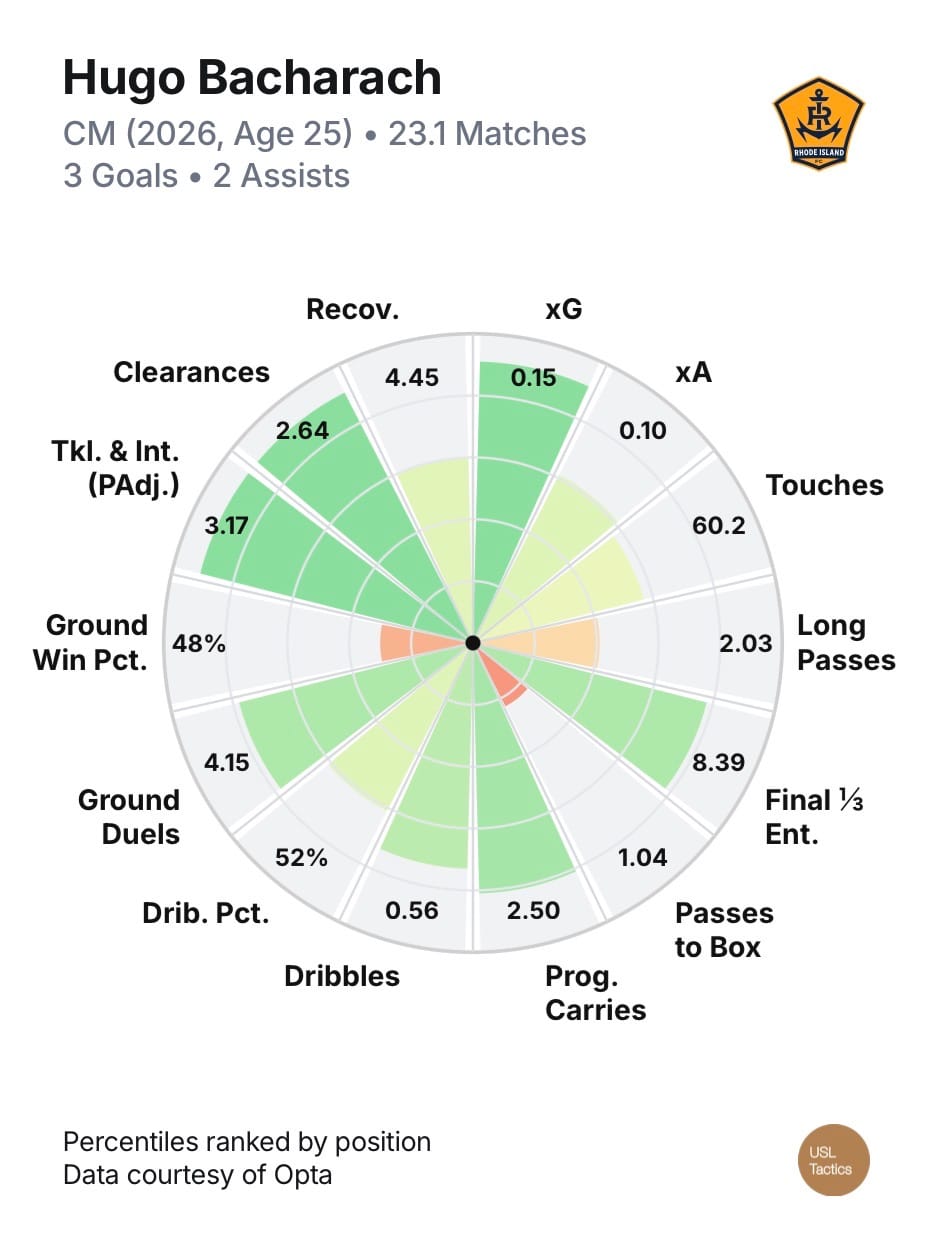
What does Bacharach give you? Here, you can some of his more defensive-minded contributions from last weekend’s defeat in Charleston. In the first sequence, the No. 6 hedges against the sideline to protect against a throw-in, peeling from one Battery player to another to help chase down the ball. That intensity dislodges Charleston – no surprise for a midfielder that put up 3.2 takeaways per match on a possession-weighted basis.
Bacharach is strong as a front-foot, aggressive defender, but his physical profile also plays well in a more direct setting. The second clip sees RIFC build out long, only to miss out on a midfield recovery; it’d be a break for Charleston, but Bacharach laps the carrier, gets a touch, and allows his side to reset. That same “let Bacharach be an anchor” sensibility is hinted at in the third clip, where the midfielder becomes a target man on the edge of the box as Rhode Island try to tilt the field.
This year, Bacharach ranked second in the Championship with 140 aerial wins – on a 66% success rate, no less. An unusually high number of those aerial duels came in the middle third, giving Rhode Island a totally unique anchor in the heart of the pitch.
Bacharach, who put up 2.5 progressive carries per game on top of five total goal contributions, also knows how to make his presence felt on the ball. In the first example here, you see him receive, carve between two defenders, and corral a slightly heavy touch to keep his momentum aimed firmly ahead. When the window opens, the No. 8 is able to squeeze the ball wide, only to receive on a quick return pass. Bacharach doesn’t stop; instead, he keeps play moving and charges into the box to become a target.
That same idea is clear in the next example, where Bacharach initially starts low as a rest defense backstop behind the brunt of Rhode Island’s offense. As soon as he finds the ball, the Spaniard beats a defender on the dribble and pushes into the 18-yard box yet again. That same forward impetus is abundantly clear in the third play, where Bacharach pushes ahead and plays a teammate in for a clear shooting opportunity.
It’s rare to find a player in the USL who’s got the tools to dominate the midfield in both directions. Hugo Bacharach is that caliber of player. Between the physical gifts, the defensive instincts, the aerial prowess, and the unmatched forward drive, Bacharach is making the case that he’ll be the core piece in Rhode Island for years to come – if another MLS shot doesn’t present itself, that is.
Sunshine State showdown
(This is an excerpt from my Super League recap, which comes out each Monday. Find the Week 13 edition here.)
Stoppable force: a Tampa Bay Sun attack without any ability to hold onto the ball and play through zone 14.
Movable object: a Fort Lauderdale United team with the ability to drive through the middle third and a major lack of connectivity after doing so.
Friday night put the spotlight on two struggling offenses – see 0.80 goals per game apiece since the start of October – and it also served as a practical elimination game for the postseason. Both Tampa Bay’s Denise Schilte-Brown and Fort Lauderdale’s Paul Jennison needed to circle the wagons to stay alive. It’s unclear that either did enough to make it happen.
The Sun’s defensive 4-4-2 tended to set the terms, and spirited support from Vivianne Bessette out of central defense was an effective stopgap against tertiary drops in from the United front line. Tampa Bay knew that they were giving a plus-one edge to the trio of Kelli Van Treeck, Daniela Todd, and Grace Cutler through the opposing midfield. Still, their gamble was that (1) the front end of the 4-4-2 would deny forward passing with sheer intensity and (2) Bessette et al. would do the rest.
Jennison, for his part, continued to skew toward 4-3-3 (and occasionally diamond-ish) territory, stacking Todd and Cutler as No. 8s ahead of a deeper Van Treeck. While plain-ol’ build through that trio was a mixed bag, that setup gave Fort Lauderdale real equity in transitional moments where the Sun’s midfield had broken down. An early chance where Todd picked up possession and narrowly played striker Sh’nia Gordon offside in the 9th minute was an informative shot across the bow.
What’d that dynamic look like? The Sun begin this play at the feet of goalkeeper Cristina Roque and build into center back Kelsey Hill, who’s swarmed by opposing forward Kiara Locklear. If Hill were quicker with the ball, she’d have the chance to either pass sideways to fullback Sabrina McNeill or skip a line. Instead, she dallies, and that gives Locklear the chance to curl her closing run and force Hill inside.
There, trouble arrives. The key frame sees Tampa Bay center mid Brooke Hendrix man marked by Cutler (light blue, center) whilst Jordyn Listro receives similar attention from Daniela Todd through the other channel. Because neither No. 6 is available, Hill’s pass is aimless, and that allows Van Treeck to step up, claim possession, and charge forth.
This is a good chance. The rub? Van Treeck rushes her pass into a back-to-goal Gordon, leading to a sloppy incompletion. This dynamic – a lack of central control for the Sun and transition wastefulness for United – was preeminent on Friday night.
Tampa Bay weren’t much sharper. Where United had a strong (if sloppy) ability to charge forward, the Sun felt like they were rudderless breaks. Listro brought poise and a veteran’s ability to play sideways or backwards to let things develop, but she was on an island. Even when Tampa Bay settled into a more moderate pace, they were simply too wide-oriented.
Ex-Sun midfielder Erika Tymrak was on the Peacock call with Sean St. Jacques, and she astutely pointed out that this team just doesn’t have a No. 10 to connect play in the attacking third. That was abundantly clear in South Florida. Tampa Bay’s profiles on the flanks, meanwhile, didn’t bend United out. Right winger Samar Guidry – a defender in Dallas last year – rarely pushed ahead to complement forward Erika Zschuppe. Sydny Nasello’s narrow, inverted tendencies limited her impact all the same.
(Per Opta, Sydney Nasello has just three shots, 0.37 xG, and one solitary assist from fast breaks in three years with the Sun. For comparison, Locklear has 21 shots and 6.50 xG in 1,100 less minutes. Crazy!)
Getting Jordan Zade onto the wing in place of Guidry helped Tampa Bay speed things up off the right; United tried to improve their flow in turn, bringing Lexington loanee Amber Nguyen for Cutler to add a more connective, less gritty presence at the No. 8 slot. The Sun, for all the warts, remained the aggressors and were eventually awarded with a penalty. Still, substitute striker Eleanor Dale wasted that opportunity in the 80th minute, caroming her shot off the woodwork and allowing Fort Lauderdale goalkeeper Haley Craig (who dove the right way) to scramble back across the face of goal to claim the ball.
Nasello had a shot ring off the crossbar by way of a Zade dribble-and-cross burst in the 87th minute; seconds later, she received off a long ball and forced a full-stretch save out of Craig – who entered the weekend with a Super League-high 3.7 saves per game – to preserve the nil-nil stasis. Neither side will be happy with the result on a must-win occasion.
In other news…
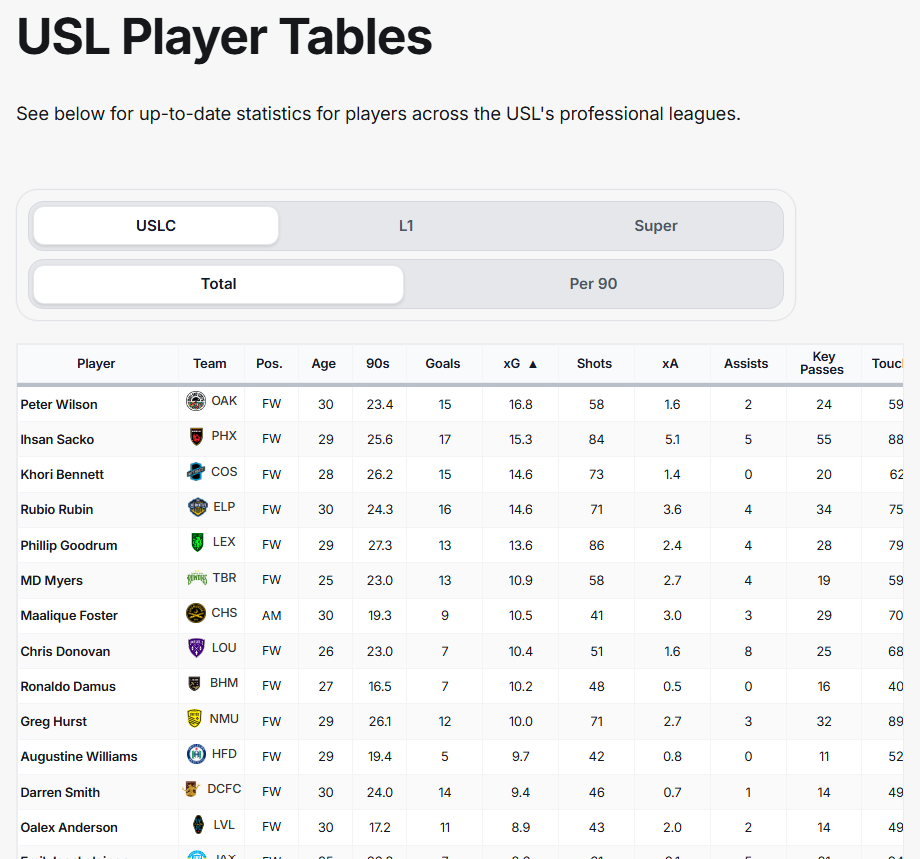
New data tool available on the site for high-level player stats across the Championship, League One, and the Super League! Go check it out.
The nature of the beast (the "beast" in question being my own self-inflicted publishing schedule) is that this newsletter will go live before Atletico Dallas announces their second signing on November 10th, but I am so excited to see who they're getting. Seems like it's a Dallas native, but I'm curious about the extent to which manager Peter Luccin and sporting director Brian Corcoran try to poach from within the USL versus working from the outside.
I've never felt as electrified as I did at about 8:30 on Saturday night when the Eastern Conference went haywire, and Nicholas Murray did splendidly to place their comebacks in context.
Martin McDonagh did it again: Wild Horse Nine is a lovely little combo of In Bruges and Banshees of Inisherin. You've got a hitman plot that's quite similar to the former, an idyllic setting that's aping the latter, and a gentle, haltingly delivered lead performance from John Malkovich that makes the whole blend feel unique. I admittedly don't think it's McDonagh's very best, but it's a great addition to what's essentially a thematic trilogy. (Rewatch Malkovich in In the Line of Fire before seeing it to get the real meta experience.)