USL Super League, Week 13
On DC's statement, gritty Brooklyn, and all things Super League


You know the drill: every Monday (or thereabouts), I'm recapping what went down in the USL Super League from a tactical lens. Let's dig in.
Also, see my Super League playoff odds here.
DC (2) - Lexington (1)
For DC Power, the stakes of Friday night’s match against Lexington SC were clear: drop points, and you give Carolina the chance to clinch the Players’ Shield. Lexington’s side of the equation was yet more drastic; this team entered Week 13 tied for fourth with a real need to solidify their spot in the postseason. In the end, it was Power’s year-long consistency that carried the day.
It’s been a layered press for DC as of late, but manager Omid Namazi went for a somewhat more straightforward 5-2-3 against LSC’s elbowed back three this time around. Within that pressing shape, Emma Jaskaniec shifted over to the right wing from her usual No. 8 or No. 10ish deployment, where she was charged with marking the low left back in Lexington’s build shape.
Kosuke Kimura brought tricks of his own. Lexington still began in a loose “three-box-three” setup, but they essentially used Hannah Johnson (the starting right back in weeks prior) as a “3;4 wingback ahead of proper left back Ally Brown. Rather than keep Brown pinned low in possession, she had freedom to roam upfield and combine. At their best, Lexington showed a keen understanding of how to mix up their lines, bend the Power press, and advance.
Here, Lexington reset in possession through Katie Murray (bright green as a pivot player), who backpasses to Regan Steigleder (dark green) in the remnant of the defensive line. You don’t see Brown in her typical resting position; instead, she’s bombing upfield while Darya Rajaee pops low from the No. 6 spot. LSC retain their usual three-at-the-back structure via Rajaee, and DC’s 5-2-3 has to mix their coverage.
Because of that deep gravity and the presence of both Hannah White and Addie McCain (white) as probing attackers, DC is drawn up and tightened narrow. McCain is able to receive, draw pressure from a stepping center back, and thus isolate Susanna Fitch as DC’s only ball-side defender.
Fitch has a choice, and she opts to close on Brown toward the sideline – thus leaving a go for Johnson. This Lexington has the chance to play their wingback through in behind. Johnson’s eventual cross won’t connect, but the idea is terrific.
Many of Lexington’s less successful moves were more transitional in nature, often targeting center back Hallie Augustyn and wingback Tatum Thomason – two rookies – off DC’s other side. Augustyn was tremendously poised in the face of that challenge, best seen when she prevented a clear shot on goal with a last-ditch slide tackle in the 11th minute. Thomason was admirably reliable, showing gusto when dropping deep as Power settled into their mid-low 5-4-1 stance.
Given the variability of Johnson on their left side, Lexington’s press was somewhere between a 4-1-3-2 (with Murray holding) and a 5-2-3 that matched Power shape for shape. Still, staying aligned in either case wasn’t a cinch.
As DC start to build out in the clip above, you can see Lexington essentially operate in a back five, with Johnson sitting deep. Power are theoretically under pressure against a man-for-man pressing scheme, but a clever sideways run from center mid Justina Gaynor (white above) and a great turn from attacker Emily Colton (blue) amidst back-side closure get the job done to break lines.
Suddenly, DC are turning upfield with a head of steam against a compromised defense. Emma Jaskaniec – ostensibly the right winger – drops to get a touch, attracts yet more pressure, and can play striker Loza Abera. The No. 9 entered the weekend with a sizzling 36% conversion rate, and she showed why to take a lead in the 18th minute.
Lexington stayed alive thanks to flashing runs from Hannah White, the novel deployment of Gracie Falla as an attacker, and the quality of their back line’s passing, but Power did extremely well to maintain an elevated line of confrontation within their 5-4-1. The shape deepened out and became less interested in keeping the ball, but that didn’t give LSC free reign to attack close to goal. Players like Colton and substitute Tyler Lussi did well to constantly show their guests wide.
Power added a semi-transitional goal at the end of the match to seal the win, never blinking along the way. While it’s still highly unlikely that DC will push on to the Players’ Shield, the victory over the reigning champs felt like a major statement. Lexington, for their part, are still likely enough to make the playoffs – provided they can match the consistency that’s powered Power in 2026.
Fort Lauderdale (0) - Tampa Bay (0)
Stoppable force: a Tampa Bay Sun attack without any ability to hold onto the ball and play through zone 14.
Movable object: a Fort Lauderdale United team with the ability to drive through the middle third and a major lack of connectivity after doing so.
Friday night put the spotlight on two struggling offenses – see 0.80 goals per game apiece since the start of October – and it also served as a practical elimination game for the postseason. Both Tampa Bay’s Denise Schilte-Brown and Fort Lauderdale’s Paul Jennison needed to circle the wagons to stay alive. It’s unclear that either did enough to make it happen.
The Sun’s defensive 4-4-2 tended to set the terms, and spirited support from Vivianne Bessette out of central defense was an effective stopgap against tertiary drops in from the United front line. Tampa Bay knew that they were giving a plus-one edge to the trio of Kelli Van Treeck, Daniela Todd, and Grace Cutler through the opposing midfield. Still, their gamble was that (1) the front end of the 4-4-2 would deny forward passing with sheer intensity and (2) Bessette et al. would do the rest.
Jennison, for his part, continued to skew toward 4-3-3 (and occasionally diamond-ish) territory, stacking Todd and Cutler as No. 8s ahead of a deeper Van Treeck. While plain-ol’ build through that trio was a mixed bag, that setup gave Fort Lauderdale real equity in transitional moments where the Sun’s midfield had broken down. An early chance where Todd picked up possession and narrowly played striker Sh’nia Gordon offside in the 9th minute was an informative shot across the bow.
What’d that dynamic look like? The Sun begin this play at the feet of goalkeeper Cristina Roque and build into center back Kelsey Hill, who’s swarmed by opposing forward Kiara Locklear. If Hill were quicker with the ball, she’d have the chance to either pass sideways to fullback Sabrina McNeill or skip a line. Instead, she dallies, and that gives Locklear the chance to curl her closing run and force Hill inside.
There, trouble arrives. The key frame sees Tampa Bay center mid Brooke Hendrix man marked by Cutler (light blue, center) whilst Jordyn Listro receives similar attention from Daniela Todd through the other channel. Because neither No. 6 is available, Hill’s pass is aimless, and that allows Van Treeck to step up, claim possession, and charge forth.
This is a good chance. The rub? Van Treeck rushes her pass into a back-to-goal Gordon, leading to a sloppy incompletion. This dynamic – a lack of central control for the Sun and transition wastefulness for United – was preeminent on Friday night.
Tampa Bay weren’t much sharper. Where United had a strong (if sloppy) ability to charge forward, the Sun felt like they were rudderless breaks. Listro brought poise and a veteran’s ability to play sideways or backwards to let things develop, but she was on an island. Even when Tampa Bay settled into a more moderate pace, they were simply too wide-oriented.
Ex-Sun midfielder Erika Tymrak was on the Peacock call with Sean St. Jacques, and she astutely pointed out that this team just doesn’t have a No. 10 to connect play in the attacking third. That was abundantly clear in South Florida. Tampa Bay’s profiles on the flanks, meanwhile, didn’t bend United out. Right winger Samar Guidry – a defender in Dallas last year – rarely pushed ahead to complement forward Erika Zschuppe. Sydny Nasello’s narrow, inverted tendencies limited her impact all the same.
(Per Opta, Sydney Nasello has just three shots, 0.37 xG, and one solitary assist from fast breaks in three years with the Sun. For comparison, Locklear has 21 shots and 6.50 xG in 1,100 less minutes. Crazy!)
Getting Jordan Zade onto the wing in place of Guidry helped Tampa Bay speed things up off the right; United tried to improve their flow in turn, bringing Lexington loanee Amber Nguyen for Cutler to add a more connective, less gritty presence at the No. 8 slot. The Sun, for all the warts, remained the aggressors and were eventually awarded with a penalty. Still, substitute striker Eleanor Dale wasted that opportunity in the 80th minute, caroming her shot off the woodwork and allowing Fort Lauderdale goalkeeper Haley Craig (who dove the right way) to scramble back across the face of goal to claim the ball.
Nasello had a shot ring off the crossbar by way of a Zade dribble-and-cross burst in the 87th minute; seconds later, she received off a long ball and forced a full-stretch save out of Craig – who entered the weekend with a Super League-high 3.7 saves per game – to preserve the nil-nil stasis. Neither side will be happy with the result on a must-win occasion.
Brooklyn (2) - Carolina (2)
Entering Week 13, the Carolina Ascent hadn’t conceded a goal since late September and had kept seven clean sheets in their last eight matches. Just to be clear: that is ridiculous. The Ascent weren’t dominant from start to finish away to Brooklyn on Saturday afternoon, but the same grit behind that defensive record let them control most of the 90 minutes – and, crucially, withstand a late rally – to draw ever closer to the Players’ Shield.
Phillip Poole’s 4-4-2 was in bend-don’t-break mode away at Maimonides Park, and relatively deep deployments for wingers Audrey Coleman and Rylee Baisden were meant to solidify the flanks on a narrow pitch. Whatever the Ascent lacked in terms of high-pressing zhuzh and ball dominance, they made up for with the quality of their defensive block.
Early, the verticality of goalkeeper Sydney Martinez’s service in build let Brooklyn take a stranglehold on territory. Jennifer Cudjoe was lights-out as a ball-winning No. 6, and the central defensive duo of Sophia Lowenberg and Lauren Gogal was clean as a whistle when claiming possession against those passes over the top. Once settled, Brooklyn tended to adopt more of a 2-3-2-3 – a shape that provided strong regional advantages against the Ascent 4-4-2, though those edges were hard to leverage against such a compact foe.
Where Brooklyn lingered on the ball, Carolina was all about pushing upfield quickly and hammering crosses into the box. There needed to be balance; flooding the attacking zone could overload the home side, but it came with transition defense risks.
That loose dynamic – Ascent push quickly to cross, Brooklyn try to manufacture a break in response – plays out here. Initially, Carolina switch play into Coleman via defender Jenna Butler, finding the winger in a one-on-one. Brooklyn’s whole back four is in position, but the Ascent cleverly stack their attackers at the far post in triplicate; it’s almost like a set piece setup. Shea Groom’s flash across the face of goal proves the most dangerous of the three runs, but the Coleman serve is still cleared by center back Sophia Lowenberg.
Brooklyn isn’t out of danger yet. Instead, left back Jill Aguilera easily makes a recovery against the home side’s withdrawn numbers, allowing for a soft reset in possession.
Circulating through Taylor Porter at the No. 6 spot, the Ascent quickly hit right back Emily Moxley, who combines with Baisden and attempts to go one-two with a slick follow-up run. However, Brooklyn are wise to it. The back line holds firm, but you can see No. 6 Jennifer Cudjoe hedge toward the edge of the box as winger Jackie Richards directly mark Moxley’s run.
Carolina is able to reset again and try another right-sided give-and-go, but it, too, is repelled. This time, there’ve been one too many bites at the apple. Richards and No. 8 Jilly Shimkin are able to pin their guests at the sideline…
… and take the ball away. It’s off to the races, with Shimkin carrying behind striker Catherine Zimmerman and winger Ashlyn Miller. This should be a golden look for Smith’s side. Instead, Shimkin’s leading pass into the box slows play down, Carolina get numbers back, and it’s a safe clearance for Reese Tappan.
This was about as dangerous as it got for Brooklyn, but you get the sense for the Ascent’s ability to clamp down close to goal. The quicker things went, the better; that initial serve from Coleman post-diagonal was the real point of danger.
In the 42nd minute, a long ball from Tappan served a similar purpose. That initial pass didn’t connect, but it set up Nabet counterpressure to forge a quick regain. Upon recovering, Nabet played Baisden up the right flank, where she could look up to find Groom, Coleman, and Mackenzie George probing. This time, it was Coleman’s side-to-side slash that did the most damage, putting Brooklyn under duress and forcing a handball.
Aguilera would come good on the ensuing penalty kick, putting the Ascent up 1-0. Out of halftime, you could feel Carolina arrive in their comfort zone as Brooklyn strained to equalize. Groom and George remained sharp atop the press, and the 4-4-2 block didn’t blink. Brooklyn generated a few half-chances by way of direct service and their usual fullback-to-winger wide play, but it didn’t do much to trouble Martinez.
Then, the final 10 minutes happened.
An errant Martinez punch after yeomanlike setup play from Zimmerman and Miller let Brooklyn equalize in the 88th minute. Another Aguilera penalty made it 2-1 in the 90th, but then Brooklyn scored again; this time, a Carlee Giammona finish did the trick. The sudden burst of activity was highly unexpected, to say the least – neither Brooklyn nor Carolina attempted a single shot between the halftime break and the first Brooklyn goal, a 43-minute dry spell.
Brooklyn deserve their flowers for the late rally. Now, they’re on the precipice of jumping into the playoff field. Still, it’s the Ascent’s defensive system – occasional wart notwithstanding – that continues to define the 2026 season.
Dallas (1) - Jacksonville (1)
This year, Sporting Jax’s average field tilt is up almost seven percentage points to nearly 60%. In turn, they’re allowing twice as many fast breaks per game. Whatever Stacey Balaam saw in the tea leaves, it’s allowed Jacksonville to control territory while also leading to a number of bad breakaway concessions. That dichotomy was evident away to Dallas on Sunday night.
You wouldn’t accuse Lee Nguyen’s hyped-possessive Trinity of being a particularly lethal transition team, but their ability to dictate the pace in Week 13 was key. Dallas stuck to their usual ball-on-the-ground style. Their shape was as slippery as ever, flowing from a pressing 4-2-3-1 into a wonky 2-1-4-3 (or thereabouts) in possession. Still, a refreshing ability to up the tempo in transition was key given the matchup.
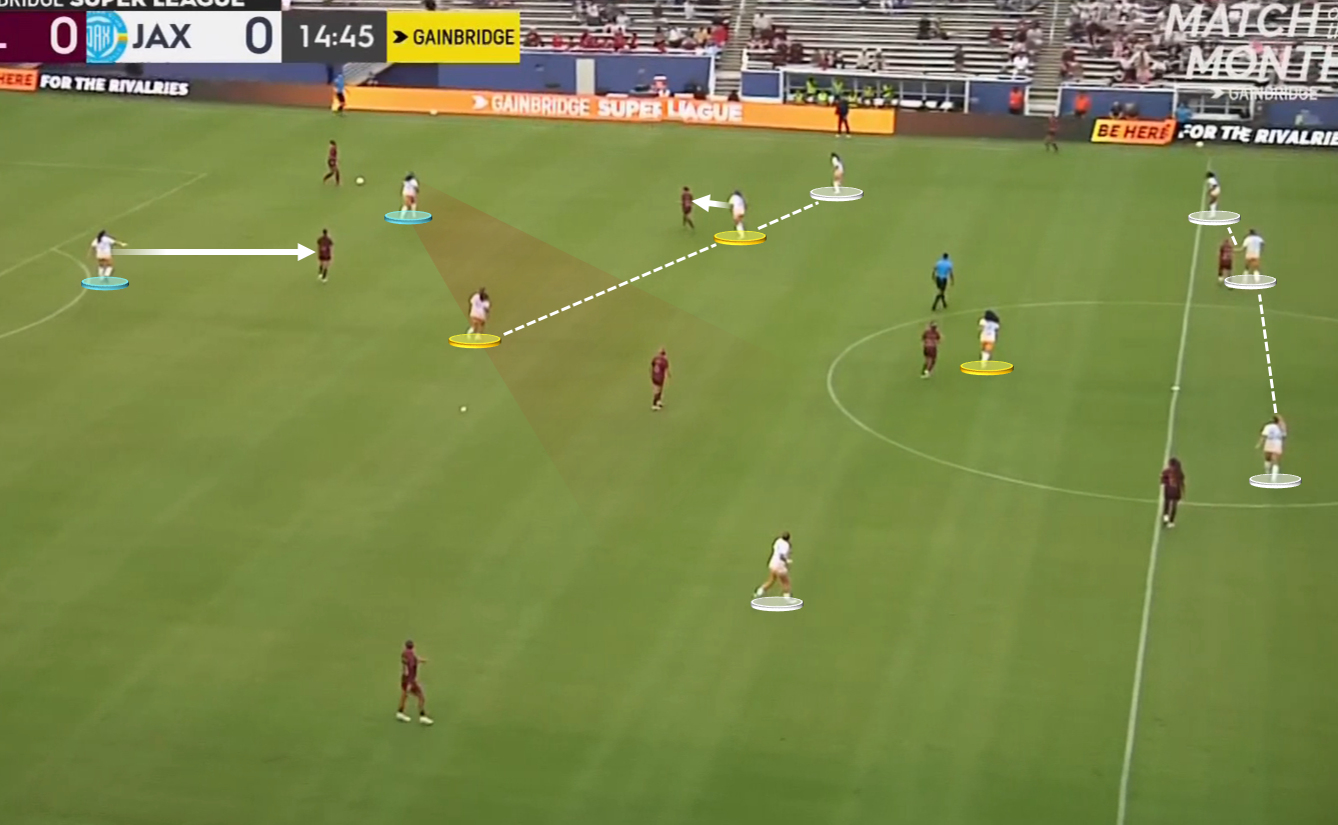
That opportunism was vital given how Jacksonville’s press looked in more settled situations. We’ve seen Balaam stick to a 3-1-4-2 press for the better part of the last two seasons, but there was variation at the Cotton Bowl. Typically, Baylee DeSmit began the pressing phase as a lone No. 9 with Paige Kenton tucked underneath her – a move meant to stymie Sophia Braun’s mixed center back-No. 6 deployment. As build progressed, Sporting responded in kind and then found their 3-1-4-2 as a mechanism to trap.
Above, you see Cyera Hintzen on the ball as Trinity’s tucked-in left back, which finally draws Kenton (blue) up high. Crucially, Kenton angles her run to shut off the entire midfield behind her shadow. Sophie Jones and Ashlyn Puerta (yellow) are in decent enough positions, but it’s the striker’s run – and DeSmit’s hedging presence toward the left side of the frame – that pins Dallas to the sideline.
The wingbacks hedge their bets. On the stronger right side, AJ Hennessey stays high enough to deny Hintzen space as a carrier while also maintaining the ability to scramble back to the sideline should winger Camryn Lancaster receive. On the opposite flank, you can see Meg Hughes dropping in, giving Jacksonville a rotational backstop and strengthening their spine in the case of a switch.
Flexible pressure in this mold didn’t bear fruit in terms of high turnovers until the second half, but it ensured Dallas wouldn’t have it easy. Still, Trinity did extremely well to quickly turn the pitch around when Jacksonville tried to build out. Nguyen’s 4-2-3-1, led by Juliet Moore with support via second striker Seven Castain, didn’t reinvent the wheel, but it stayed compact and continually goaded the guests long.
✨ 𝘽𝙀𝘼𝙐𝙏𝙄𝙁𝙐𝙇𝙇𝙔 executed ✨
— Gainbridge Super League (@GainbridgeSL) November 8, 2026
Sofia Cedeño picks out @jasminehamidd, who finds the back of the net to open the scoring for @dallastrinityfc! 🥳 pic.twitter.com/GoGWubOCkn
In the 10th minute, Trinity were able to win a header at the back on the end of one such long ball, instantly pivoting into attack mode. Lancaster made the initial recovery, but Castain and right winger Jasmine Hamid both got touches in quick succession. In the end, a Hamid cross missed Moore’s feet by mere inches.
That shot across the bow anticipated Dallas’ go-ahead goal in the 24th minute. There, Jacksonville was able to reset after another long pass was repelled, but defender Ginger Fontenot – in for usual starter Maggie Illig – took a heavy touch and let Lancaster take the ball away. That tackle created an instant break, with Moore and midfielder Sofia Cedeno connecting into a slashing Hamid, who rounded the goalkeeper and made it 1-0.
In an otherwise low-event match, those breakout sequences were models of team-centric, concerted offense. Dallas used their press against a straining Sporting side to generate two more chances in the same vein; one was sparked by a Hintzen carry in the 51st minute and required a Grace Phillpotts goal-line stop, while the second began with a Hamid interception and was only halted by a slim offside call.
Still, Jacksonville kept probing, and their own press eventually bore fruit. Sporting got on the board in the 58th minute by creating a high turnover, feeding Kenton, and letting her cut back to Puerta for a goal. Seconds later, Jacksonville’s 5-1-3-1ish look forced a bad pass into the midfield, let DeSmit get in behind off the takeaway, and would’ve made it 2-1 if not for a last-ditch stop by Sydney Cheesman. The chances on both ends came in quick succession; Dallas and Jacksonville felt like mirrors of one another.
While Jacksonville held the momentum late-on, it was yet another week where they felt like the team that was answering to the beck and call of their opponent. Credit Nguyen and this Trinity side. In spite of the occasional bobble, their pressing shape and ability to pick out transition moments has them in the driver’s seat for the #4 seed as we look ahead to Week 14.