The Back Four: Playoffs!
Standout takeaways from the USL postseason's first round, plus Super League notes

Welcome in to The Back Four! Need more USL content? Make sure to:
- Visit Backheeled for in-depth analysis of the Championship and League One every matchweek.
- Listen to This League! and The USL Show to catch up in podcast form.
Without further ado, let’s get to it.
Playoff potpourri
The USL Championship and USL League One playoffs are here, so what stood out? I would direct you to Backheeled for the lowdown on every single club, but I want to highlight some standout themes and key numbers here. Let’s dig in.
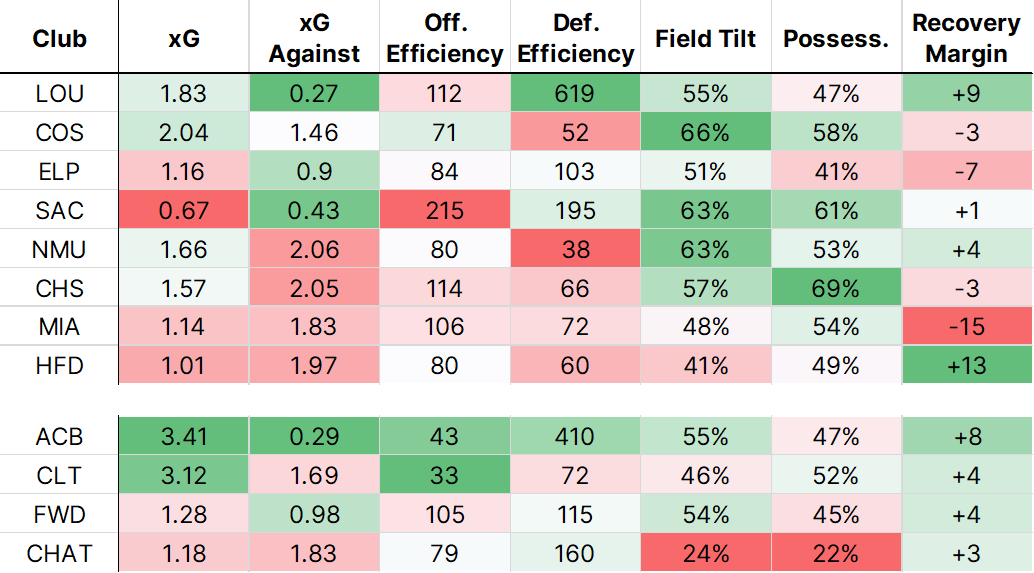
At the Championship level, six of the eight teams that advanced ended up with a majority field tilt, meaning that they attempted more final-third passes than their opposition. One exception – a Miami team that scored first away to the Players’ Shield winners – makes total sense. The other – a Hartford side that played up a man for 70 minutes – is ostensibly baffling, but that’s what you get from Brendan Burke’s fiercely against-the-ball system.
Four of the eight teams to advance in the Championship lost their xG battle, but the opposite was true in League One; there, Madison, Boise, and Charlotte all put in dynamic attacking performances while shutting their opposition down, and Chattanooga was the lone holdout that went fiercely defensive-minded.
The average winner in League One ended up with a +4.8 recovery margin, evidencing the importance of second-ball control. In the Championship, by contrast, that number was -0.1 – a surprise, given the usual link between dominance in fifty-fifty situations and overall success. That deficit can’t be explained by clubs going up big and taking a foot off the gas, either; round one’s matches were uniformly tight-run.
If there was one overarching theme from the weekend it was this: the most successful teams (1) controlled the pace of play and (2) where the game was played, agnostic of second-ball dominance. Even a Chattanooga side that barely touched the ball had Omaha on a string. The Red Wolves are happy to defend in block, and they set themselves up to successfully do it for 120 minutes; you could say the same for Hartford, who kept inviting pressure to tee up the counter even while up a man.
LouCity put in the standout defensive showing off the weekend, putting a lid on Pittsburgh in spite of holding just 47% of possession. It was Simon Bird’s ability to modulate his pressing shape and key in on certain Riverhounds patterns that did the trick.
As this play begins, Louisville is in 5-4-1 mode and readily allows Pittsburgh to possess at the back. You can't see all three of the Riverhounds' deep defenders by the time Jackson Walti receives through the pivot, but there's a rock-solid base underlying the possessive sequence for the visitors.
Still, as Pittsburgh hits Beto Ydrach at the left back-slash-rest defender spot, Ray Serrano (here shifted to the right wing) closes down hard, angling his run to deny a centering ball through the heart of the LouCity shape. When Charles Ahl receives up the wing, meanwhile, he's closed down by wingback Manny Perez and immediately has to hit a return ball to Ydrach. There’s no actual progress!
Pittsburgh keep probing, finding Danny Griffin and one-touching their way through the midfield. Still, look at Louisville's reaction: the moment the 'Hounds start to break a line, Aiden McFadden and Kyle Adams – the outside members of the back three – step to deny easy turns toward the box. As a result, Pittsburgh has to play sideways, right into the feet of a lurking Evan Davila. Time and again, LouCity used these timely defensive interventions to stymie their opposition.
If Louisville was all about mid-block solidity, then Forward Madison was the flip side of the coin. Their press extended high upfield, and they looked to push the pace with big switches seemingly every time they recovered possession. Against a Spokane side known for their mid-low pragmatism in the postseason, that choice paid dividends.
Spokane is on the front foot here, with left winger Derek Waldeck having hewn right to receive behind one elevated center back (Collin McCamy, trailing the play) and challenge another (Kerfalla Toure). Even so, Madison aren't in bad bad shape despite their press being broken. Kevin Carmichael rounds out the center back trio on the weak side, wingback Eddie Munjoma is hauling it to recover from the right, and there's ample support just behind the play.
Crucially, Toure is able to slow Waldeck down, encouraging him to hit an overambitious cross to striker Neco Brett on the far side. There, the ball is dislodged, allowing Carmichael to play forward.
Suddenly, the momentum has flipped entirely. Forward Hakim Karamoko receives on the end of Carmichael's half-clearance, and he's goalside of both Spokane No. 8s. Meanwhile, the Mingos have attackers Josh Bolma (sprinting) up the central seam and Ryan Carmichael (ahead of the play, just out of frame) ready to pounce.
Center back Nick Spielman has no choice but to step to Karamoko, but that allows Bolma to underlap on past him. Bolma's run, in turn, distracts Camron Miller as the last viable Spokane defender. Thus, Karamoko is able to look off Bolma and find Carmichael in behind to generate a shot. Those kinds of quick-twitch chances were Madison’s lifeblood in round one.
For as good as the Mingos looked, they only put up about one-third as many expected goals as Athletic Club Boise, who made a statement as they dismantled Knoxville on Sunday night. There was a lot to like at the business end of the pitch from Nate Miller’s side, but I want to focus on Philip Mayaka and Jake Dengler – two players I named to my hypothetical all-USL team last week – in the build phase.
During the regular season, Dengler outstripped his expected completion percentage by 4.3%, while Mayaka was at 3.4%. By American Soccer Analysis’ reckoning, they rated as two of the four best passers in the league in terms of completing attempts against their given degree of difficulty. That poise was impossible to miss against One Knox.
Here, Boise start the build phase against Knoxville’s 4-2-3-1 and work into Dengler (the centermost member of their back three) with the opposing striker bearing down. Dengler's preferred option – a right-footed pass into center mid Charlie Adams – is denied by that close-down and man pressure to Adams, but he doesn't blink. Instead, the defender cuts onto his left foot and finds Mayaka showing toward the ball.
Mayaka is eventually addressed by Knoxville's late-arriving No. 6 after receiving, but he's unflappable under duress. That poise pays dividends. Knoxville must close to Mayaka, but they lose their structure between lines and leave multiple Boise attackers wide open as a result. Of course, it takes a slick juke from Mayaka to leverage that newfound advantage, but he’s got the skill to pull it off.
In the end, Dengler and Mayaka's ability to play through pressure puts Boise on the front foot and allows them to work side to side in the attacking zone. Time and again, their setup play caught One Knox out and laid the groundwork for chance after chance after chance.
New Mexico United brought a similar level of press-breaking excellence, and I continue to be enamored with the shape of their attack from one end of the pitch to another. I’m unsure how to weigh Sunday night’s win over a Phoenix team that played their worst, least disciplined match of 2026, but I’m feeling very confident that Valentin Noel and Greg Hurst have what it takes to take over a playoff match.
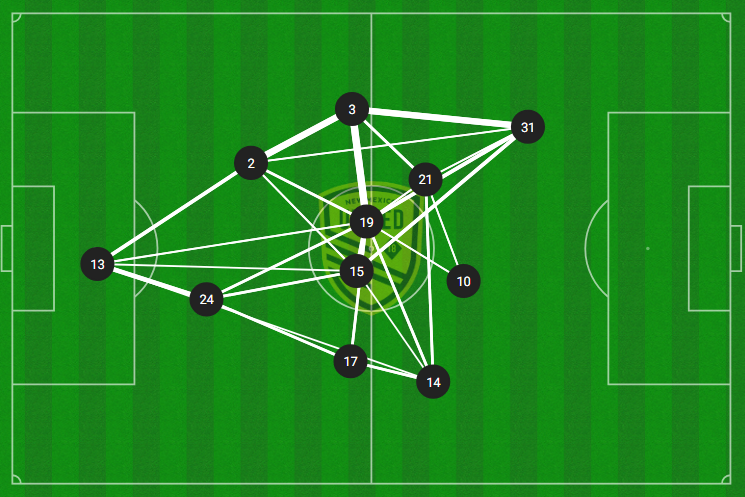
If you think about Noel (#21) and Hurst (#10) in a positional sense, they're the line-breaking connectors that receive through a press and wreak havoc. New Mexico's shape against Phoenix, for lack of a better term, was a "four-box-two" where both players had the freedom to probe behind Rising’s pivot to receive. Meanwhile, wingers Joseph Melto and (to a lesser extent) Charlie Dennis pushed ahead.
Left-sides combos were especially useful, with Noel, Melto, and left back Chris Gloster connecting through lines. In practice, that led to opportunities like this…
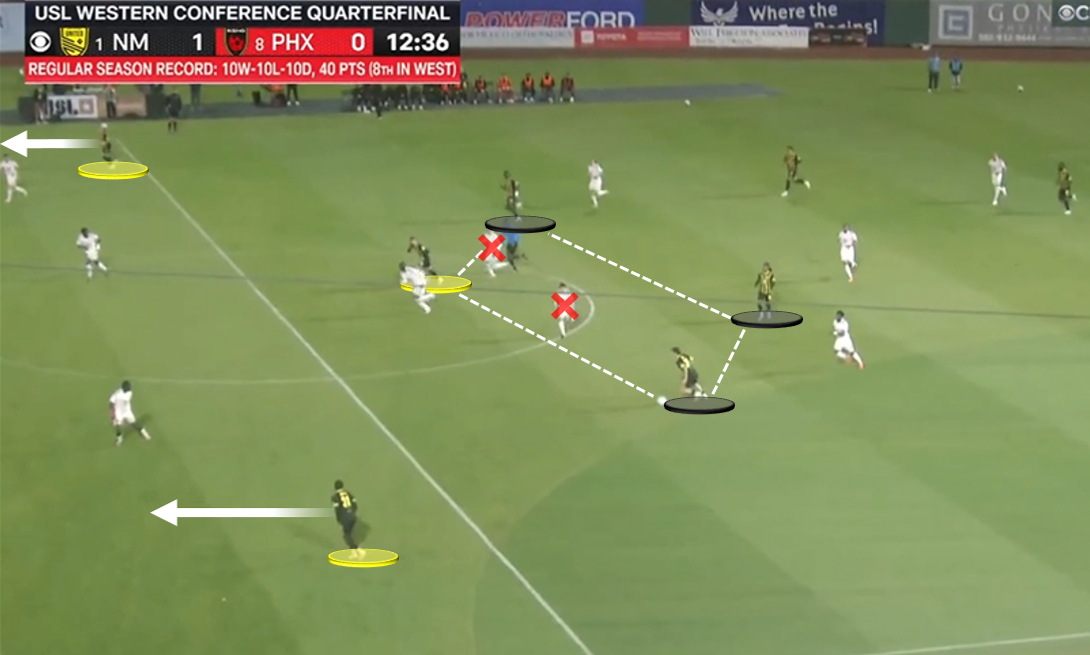
…where a first-time Hurst layoff could draw Phoenix’s defense out of shape and loose Noel to carry play up through the left halfspace. You can see both Rising No. 8s crossed out; they’re completely taken out of the play, and New Mexico can get out on the run.
Now, did Rising offer up a particularly advantageous matchup? Sure. Their man-centric 4-4-2 badly overindexed against the pivot pairing of Ousman Jabang and Zico Bailey, thereby giving the upfield weapons all the more room to receive. That dynamic was worsened by virtue of a sloppy early concession. Even so, New Mexico’s ability to quickly build through lines was the reason they took just 80 final-third passes to generate their average expected goal – the second-best efficiency mark in the Championship over the weekend.
I was very rightfully called out on Twitter for being too bearish about New Mexico over the last three years despite the club’s regular-season success, and I hope that United proves me wrong. We’ve seen ball-on-the-ground possession teams flame out in postseasons past, and Saturday’s upcoming matchup against Colorado Springs’ incredible composed 3-1-4-2 press – a setup that’s allowed just one goal in the run of play in the last 660 minutes – will be a terrific test.
Super League quick hits
No full Super League recap this weekend; when you've got your first free Saturday in 34 weeks, you need to take advantage. In lieu of that, I've got some quickfire thoughts.
Jilly Shimkin!
In their eight games against non-Jacksonville opponents this year, Brooklyn FC have scored five times. In two matches against Sporting Jax – including Saturday’s 4-4 barn-burner – Brooklyn have scored six times. Manager Alex Smith has found the formula to break Jacksonville down, pure and simple.
Last time around, it was combination play driven by right back Sara D’Appolonia that stirred the drink for Brooklyn at Maimonides Park. This time around, left winger Jackie Richards, left back Laila Booker, and No. 8 Jilly Shimkin – who put up three assists and got the hockey assist on Brooklyn’s other goal – were the center of gravity. Time and again, those three forced overreactions from the wingbacks and center mids in Jacksonville’s 3-1-4-2ish pressing shape, creating chances to work in behind.
Shimkin is actually taking about 10 less touches per match this year as compared to her 2025-2026 campaign in Tampa Bay, but her xA is up by 21% per match, and she’s creating an extra 0.9 chances per 90 minutes. On Saturday, her service from set pieces was uniformly excellent. In the 14th minute, for instance, Shimkin’s first ball didn’t beat the nearest Jacksonville defender, but she stayed ready to receive from a recovering Jennifer Cudjoe and had the second chance to hit a left-footed cross for Catherine Zimmerman to finish. In the 56th minute, a far-post serve from another corner let defender Lauren Gogal head the ball back across goal for Richards to convert.
MILLER IS ON THE BOARD! 🎯
— Gainbridge Super League (@GainbridgeSL) October 31, 2026
Ashlyn Miller finds the back of the net for her first goal of the season with @_BrooklynFCw 🔥 pic.twitter.com/lxBBRz0pE5
That second corner saw Jacksonville center back Maggie Illig lose out to Gogal, putting her more zonal-oriented teammates under duress at the heart of the box. That same focus – pull wingback AJ Hennessey out and go at Illig – underpinned Brooklyn’s night in the run of play. When the New Yorkers scored in the 25th minute, for instance, Jacksonville’s defense overreacted to a throw-in, thus allowing Shimkin to sneak behind Illig, beat rotating No. 6 Sophie Jones, and play crashing winger Ashlyn Miller through to score.
Brooklyn's next step – figure out how to score against literally any other team – is clear. Jacksonville's situation is muddier. Sporting are allowing less than 10 shots per game, the best mark in the Super League. Even so, their xG against (1.44 per 90) is third-worst in the division. It's rare to see Sporting concede chances, but the chances are uniformly dangerous. Bad goalkeeping hasn't helped, but it's clear that manager Stacey Balaam has a puzzle to solve at the back.
Carolina's modus operandi
The Carolina Ascent have forced 123 high turnovers this year; when the final whistle blew at the end of their 1-0 win over Lexington on Saturday evening, no other team in the Super League was in triple digits. This club's average possession starts more than 46 yards upfield – a full yard further than any of the other seven teams in the division. There are a lot of reasons the Ascent are running away with the Players' Shield race, but the dominance of their press-and-push, defense-turns-to-offense system is the primary cause.
Manager Phillip Poole has finally been forced into lineup changes over the last two weeks, and it’s hardly made a dent in the Carolina gameplan. This time around, Mia Corbin missed out and was replaced by veteran center mid Taylor Porter. At right back, meanwhile, Emily Moxley – who scored the game-winning goal – got the nod in the stead of Addisyn Merrick.
How’d that goal come about? I want to break down the full minute before Moxley scored to contextualize what the Ascent are doing right.
Here, Carolina begin their pressing sequence by tilting their 4-4-2. Off the left, Audrey Coleman sits somewhat deeper, whilst Rylee Baisden pushes up the right – a construct we’ve seen again and again when the Ascent play against back three and pseudo-back three sides. Here, the positioning of Porter and Lily Nabet at the No. 8 spots is especially prominent, given that they’re playing up to deny Lexington’s pivot.
LSC are able to hit an entry pass through lines, but there’s no egress into the attacking zone. Instead, the guests are directed toward the sideline, where striker Mackenzie George is waiting to close down. The structure behind the ball is pristine; Carolina’s 4-4-2 hedges Coleman against fullback Hannah Johnson, covers all viable central outlets, and (just off screen) positions left back Jill Aguilera against Alyssa Bourgeois in the halfspace pocket.
Cornered, Lexington give the ball away and set up an instant Carolina attack. Porter recovers and plays forward Shea Groom through; Groom lets the sequence develop on the dribble and hits George in a left-sided position. While George can’t complete a cross after driving to the endline, the ensuing clearance…
...is claimed by center back Jenna Butler, who chips the ball away from closing LSC striker Catherine Barry toward a waiting Aguilera at the sideline. Suddenly, Carolina can jam the ball right back into the mixer.
Counterpressure from Coleman and two fearsome tackles from Groom eventually settle the ball down, and the heat is on. Baisden is able to receive in a narrow position, drawing LSC’s attention and giving Moxley the time to get upfield. Eventually, the right back will receive and finish with a tremendous right-footed effort.
From the variability of the defensive scheme to the speed of the attacking move, this is classic Carolina. The Ascent kept just 38% of the ball on Saturday, but they only gave up 0.5 xG because of plays like this – plays that have defined a stunningly successful 2026 campaign.
Trinity’s possession game
Dallas Trinity notched a 3-0 win over Fort Lauderdale this weekend, yet it took a red card from United center mid Taylor Smith to really turn the match. In the 58 minutes up to that sending-off, Trinity had mustered just 0.61 xG. Credit where credit is due: Dallas got the job done. Even so, there’s room for improvement.
Here, Dallas start with the ball at Carissa Boeckmann’s capable feet off the right flank, where the fullback has posted up in a moderate position. The Cotton Bowl’s camera angle captures the full extent of Trinity’s 2-1-5-2 shape: behind Boeckmann, you can see natural center back Sophia Braun (in red) operate as a single pivot as right-sided Syndey Cheesman and left-sided Cyera Hintzen sit in like proper center backs behind her.
Dallas’ ability to stretch the field is undeniable, but what does it actually generate? Not much! Fort Lauderdale essentially bends into a diamond-shaped 4-4-2, giving them the perfect alignment to deny both center backs while going man-for-man against the heart of the Trinity midfield. There’s ostensibly a route up the left sideline once Hintzen receives, but a wonderful closing angle from forward Kiara Locklear denies it.
Suddenly, Trinity are forced back inside, where Fort Lauderdale are waiting to pounce. A turnover and break ensue, and it takes a nice save from Neeku Purcell to avert danger.
The good thing? Dallas won the soccer game! That’s what the sport is about, folks. Trinity are currently tied for fourth place in the table, and their avenue to improvement is clear. The shape and the patterns are there, but the ball needs to move more quickly, and there needs to be a smidge more boldness when Dallas is moving the ball forward. Check those boxes, and I’m feeling very good about Trinity’s late-season hopes.
The DC press
What’s so delightful about DC Power is their absolute refusal to let you play your game. The Tampa Bay Sun, for instance, are a vertical offensive team that’s focused on activating stars like winger Syndy Nasello and drifting forward Shea Connors through the channels. Many clubs would opt to shell up against that approach and take the Sun out of their comfort zone; DC fought them tooth and nail on Sunday night and picked up a major three points as a result.
I've excerpted a long defensive sequence here, beginning with a Tampa Bay goal kick and a carry by right-sided defender Taylor Chism. The DC shape is essentially a 5-2-1-2, with forwards Emily Colton (ball side) and Loza Abera (weak side) taking up positions meant to deny clean progress up the flanks. Though Colton is initially rounded to her left, she gives chase with a real sense of gusto and trusts the defenders behind her.
You can see why. As Chism nears halfway, she's got nowhere to go. Left wingback Sam Cary Angel tightens the screws with a step against Nasello off the wing; in the pivot, both Abby Boyan and Justin Gaynor hedge to deny easy central access to multiple Sun outlets. Forward-slash-mid Emma Jaskaniec – the "one" in the 5-2-1-2 – stands her ground between lines, ready to crash toward a receiver if need be.
The Sun are forced to turn tail, and while they successfully find a center mid after the soft reset, Jaskaniec and Colton force a backpass posthaste. Another reset yields to yet more DC pressure; you can see the Power No. 8s stepping up every time that Tampa Bay move backwards, ensuring that the Sun can't elevate their line of possession. In the end, the result is a wanton long ball that drifts out of touch for a Power throw.
Though Tampa Bay narrowly won the xG battle, they ended up with just 0.86 expected goals and failed to dictate the terms against DC’s rampant defense. For their part, Power chose the right moments to flood forward and got a splendid bit of individual skill from substitute forward Alyssa Walker to win the match – solidifying their place in the Super League’s top three.
In other news…
Devin Rensing, we hardly knew ye. Las Vegas parted ways with their manager last week after his first full season in charge, meaning that 2027 is going to be a hard reset in a lot of ways.
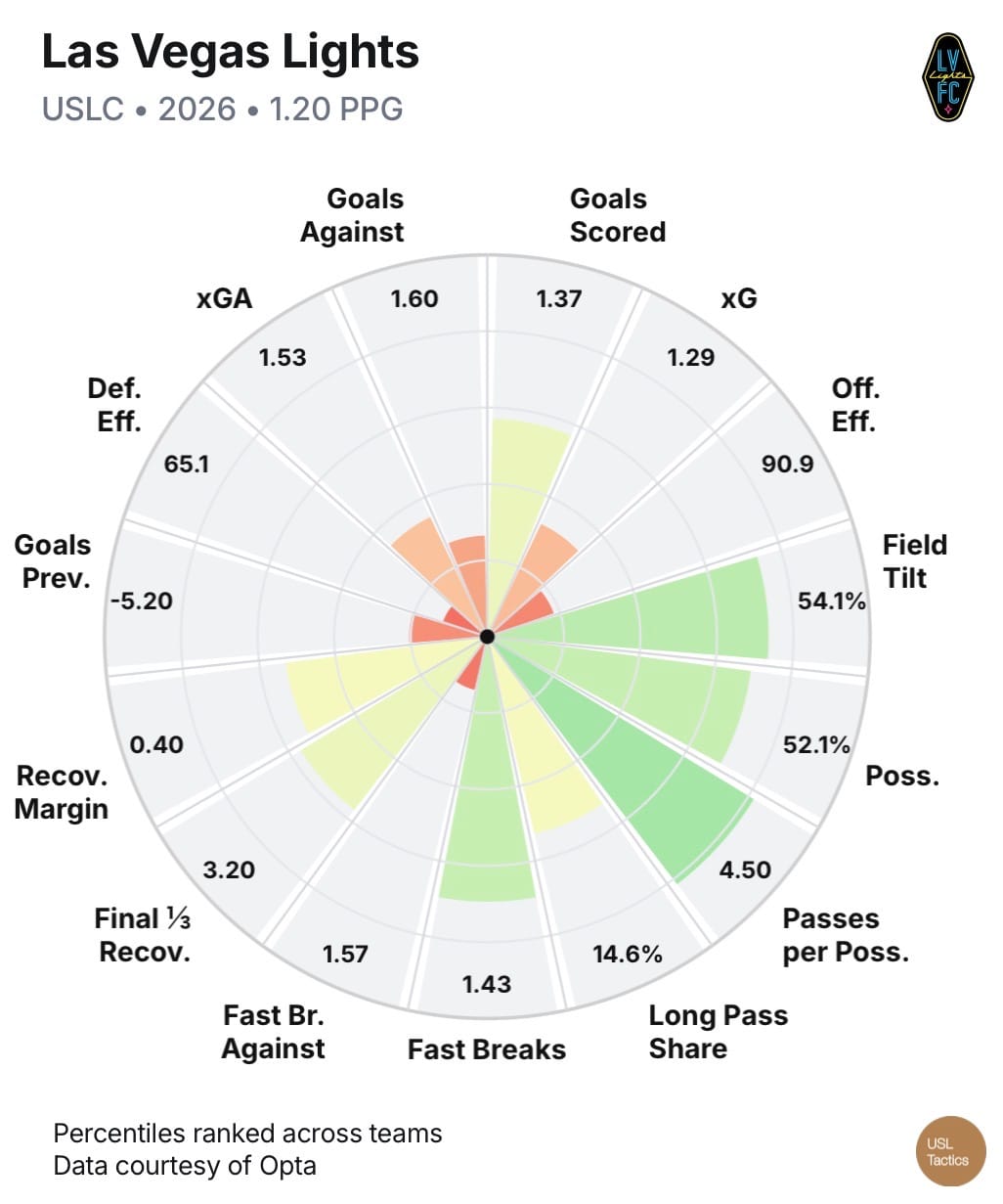
Am I in love with the choice to move on from Rensing? Not particularly. Las Vegas’ outcomes on both sides of the ball were poor, but their sense of style was genuinely admirable. Rensing took the raw clay of an overhauled squad and molded it into a possession-minded 4-4-2 offense – one that was undone by the unexpected fall-off of star midfielder Kyle Scott and bad goalkeeping above all else. None of that was the manager’s fault; for my money, he was incredibly good about squeezing every last drop from players like Giorgio Probo and Carson Locker with limited-yet-useful skillsets.
Great recap from Nicholas Murray about the standout themes from the first round of the Championship playoffs. The numbers about the El Paso Locomotive‘s win over San Antonio FC are eye-popping.
My friends over at Orange & Black SoccerCast compiled a wonderful list of USL Championship-focused websites and shows, so go explore the world of local coverage.
My gym played Michelle Branch and Carlos Santana's "The Game of Love" the other morning, and I think we should make it the national anthem.