The Back Four: Pacing, Paradise, Puerta
On attacking patterns in the Championship, Sarasota’s form, and more


Welcome in to The Back Four! Need more USL content? Make sure to:
- Visit Backheeled for 10,000+ words of analysis on the Championship and League One every matchweek.
- Check back on Backheeled for a topical end-of-week feature on big USL-wide stories, plus attendance and depth chart tracking.
- Listen to This League! and The USL Show to catch up in podcast form. (Both of this week’s episodes are out already!)
Without further ado, let’s get to it.
Attacking efficiency and maintaining space in behind
In astrobiology, there’s a concept called the “Goldilocks zone” (too hot, too cold, just right – you get it) that describes how far a planet can be from a sun in order to support life. If you’re too close or too far away, you’re not going to have any water. It’s all about finding the happy medium. There’s something to be said for that same idea relative to efficient attacking soccer.
There isn’t a hard and fast rule, but the more time you spend spinning your tires in the final third, the more time you give a defense to get set. Controlling territory is a good thing, but it can come at the cost of productive offense.
Sometimes, it pays to be less involved close to the 18-yard box. If you can possess out from the back, draw the press forward, and then strike into open space, you’ll have an easier time.
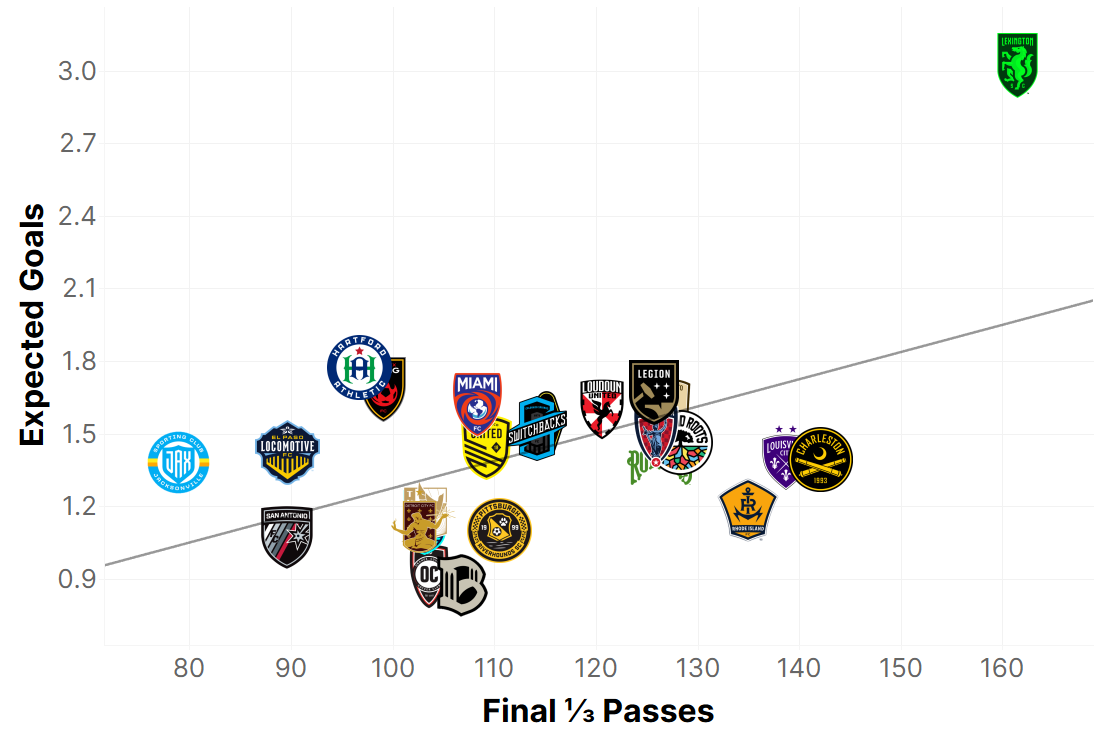
When you think about the teams that have generated the most expected goals, they’ve tended to spend less time in the final third. Since the start of September, we’ve seen that broad pattern play out across the USL Championship – with one enormous exception that we’ll get to shortly.
As exemplified during last weekend’s win against Las Vegas, Phoenix Rising has figured out how to play vertically through striker Ihsan Sacko. Miami FC is far more ground-based, but they’re a quick-strike attack once their 4-4-2ish shape breaks a line. Recent downturn aside, a hyper-vertical Hartford Athletic team has consistently found opportunities to create without necessarily controlling territory; they do it through transition moves and set pieces.
The outlier here is Lexington. Manager Masaki Hemmi’s side entered Week 33 attempting almost 20 more final-third passes per game than any other Championship club, and they’d produced more than 3.0 xG a match all the while. An outlier performance against an undermanned El Paso team skews the numbers to some degree, but the eye test confirms that LSC has figured things out.
Lexington’s read on the tempo of the game has been masterful as of late. This team can slam on the gas when they need to; Malcolm Fry’s ascension as a transition weapon off the right wing has been key to the recent uptick. Even so, LSC is equally adept at slowing the game down just enough to get numbers upfield and do damage.
This sequence starts with goalkeeper Oliver Semmle on the ball and Lexington loosely in 3-4-3 (i.e., Aaron Molloy deep like a proxy center back, Xavier Zengue overlapping up the right) mode. Instead of play through the middle, however, Semmle opts to skip a link with a dinked pass into left back Jacob Greene.
Because left winger Marcus Epps stays high and pins the opposing wingback, there's room to run for Greene. After a few dribbles, he's able to see striker Phillip Goodrum making a diagonal run, Zengue and Fry moving off the weak right side, and a trailing Blaine Ferri charging forward from a No. 8 spot. Still, is the moment right? Greene says no, waiting a beat for Molloy to join the fray as a late-arriving runner.
Most Lexington breaks take place with Molloy deep; when they settle upfield, that's when the USL's best player asserts himself. Here, Molloy knows that he wants to pick Epps out, but he isn't rushing it. He allows No. 10 Nick Firmino to underlap, distract a defender, and loose the winger one-on-one.
Epps is an elite dribbler, and he shows it. His advance toward the sideline pairs with net-centric runs from Zengue and Goodrum to occupy all three opposing center backs. Thus, there's space for a cutback to Fry at the heart of the box. It's wonderful, patient soccer – a sequence that features sustained control in the final third and a good chance.
If you think about teams that have occasionally struggled to match that penetration, New Mexico United – the USL's patron saint of possession – may come to mind. With Valentin Noel fit and Charlie Dennis having arrived on loan, however, that status deserves a re-think.
Positionally, Dennis has offered something new and different off the right wing in Albuquerque. Where alternatives like Dayonn Harris or Cristian Nava are highly vertical players that tend to operate in one direction (forward!), Dennis has been more of a connector. That's not to say he can't play over the top, but he's more likely to tuck inside, force a defensive reaction, and open space for his teammates.
Here, New Mexico asks the Phoenix Rising loanee to stretch the right wing, and he's got enough of a presence to get that job done. United basically builds in a 2-4-3 here, using their extended midfield line to stretch opposing Monterey and open lanes up the central stretch of the pitch. Every pass is progressive; defender Tyler Blackett hits Zico Bailey, Bailey hits Noel, and Noel tries to play Niall Reid-Stephen – the direct complement to Dennis off the left wing – into the box.
Though that first pass doesn't connect, New Mexico is immediately able to shift into their pressing posture. The fullbacks sink low, but the pursuant 4-1-2-3 marks through the opposing pivot and sends a man against the opposing goalkeeper. When a turnover results, Dennis is there for a finish.
We know New Mexico can be a bait-and-switch passing team, but they've evolved as of late. It doesn’t always come together – this weekend’s loss to San Antonio saw United stumble against a well-drilled midfield press. New Mexico could still nab the West’s top seed in Week 34, but they Also serve as a reminder: as we get to the most important part of 2026, finding that balance between control-first principles and pragmatic efficiency has never been more crucial.
Sarasota‘s step up
It’s the time of year where we (rightly) are focused on the impending USL postseason, but that’s what the Backheeled pieces are for. Here, I want to implore you to pay attention to a Sarasota Paradise side that – while still technically alive in the playoff hunt – hasn’t been above 10th place since mid-June.
Being an expansion team is hard, and the recent successes of organizations like Portland Hearts of Pine, Athletic Club Boise, and Fort Wayne FC should be seen for what they are: exceptional outliers. Sarasota’s slow-if-promising start is normal. Under manager Mika Elovaara, Paradise had clear tactical ideas from the very moment they kicked off in League One. Over the last two months, those ideas have evolved into something greater.
Elovaara quickly keyed in on a 2-3-2-3ish build shape that gave left back Anderson Rosa the freedom to push up like an underlapping No. 10. The relationship between Rosa (16 goal contributions) and sideline-hugging left winger Jonathan Bolanos (12 goal contributions) has been this club’s engine all year long. There was help from the central midfield, but inconsistently so. Likewise, the No. 9 spot was a letdown for the lion’s share of 2026.
Now, the totality of the Sarasota system has come together.
Three big things have changed Paradise’s fortunes. First, right back Kisa Kiingi and winger Romain Gall joined the club as midseason additions and created balance opposite the Rosa-Bolanos axis. Second, attacking mid Sander Roed was re-cast as a drifting, connective striker. Third, goalkeeper Alex Sutton was allowed to take on a more involved possessive role, thus freeing his teammates to flow more freely.
Sarasota is still a 2-3-2-3 offense on paper, but Sutton’s role as a proxy outfield player in build has been enormous. In his first 18 games of the year, the goalkeeper played 26 passes per 90 minutes on a 62% completion rate. In the last eight games, he’s up to 45 passes with a 71% completion rate – all while going long 16% less often. Now, defenses must press with Sutton in mind.
With the goalkeeper involved, Kiingi and Rosa are that much freer to push up – a big difference from the start of the year, where players like Reid Valentine and Jorgen Pettersen (both good!) usually sat in as elbow-y right backs. The extra oomph has meaningfully stretched defenses.
Throw in Roed’s ability to operate as a facilitator through zone 14, and Sarasota have become more dangerous at every level. The No. 9 demands constant attention as a line-breaking outlet, one that naturally finds space against overdrawn, Sutton-aware presses. Try too hard to mark Roed, however, and you’re liable to leave Kiingi, Gall, or Bolanos open. All the while, Rosa has remained an all-USL lock from left back.
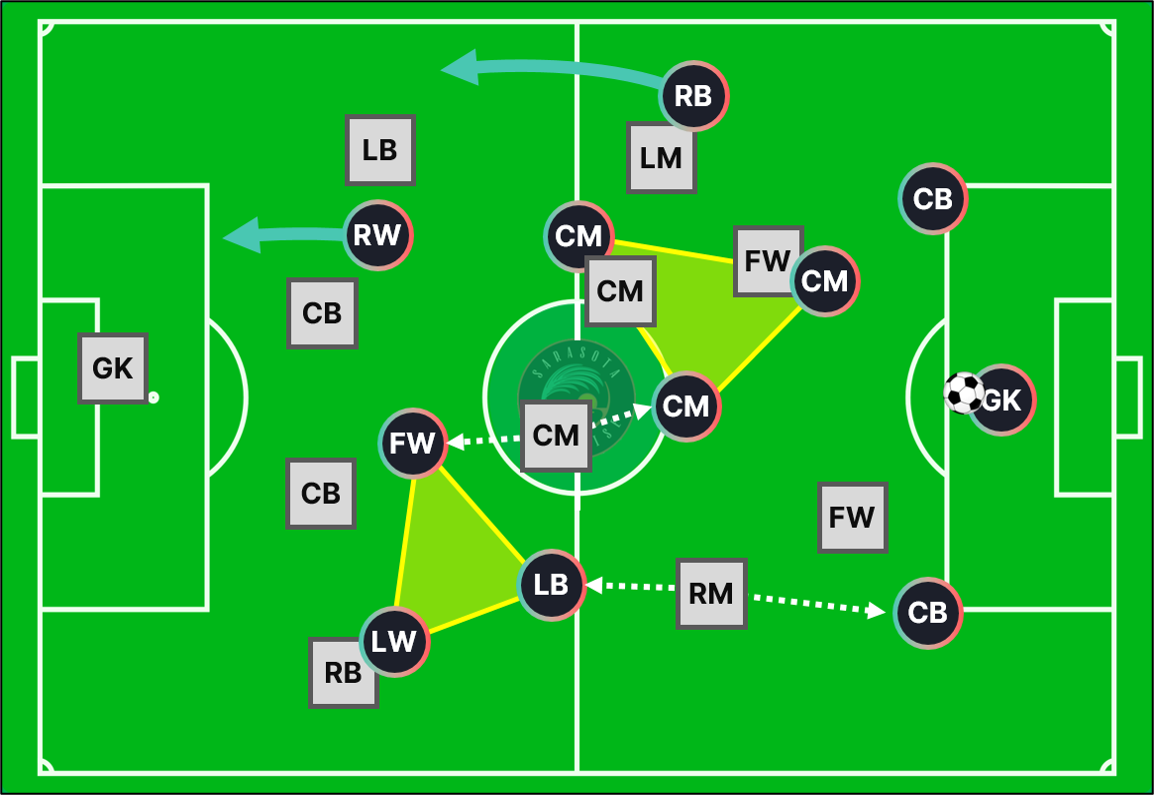
What does this version of Sarasota look like? Here, Rosa stays low and Aaron Walker essentially sits in as a single pivot player; it's vaguely 2-3-2-3ish, but that changes as the sequence develops and Paradise reset into Sutton.
By the time center back Declan Watters is on the ball, you can see the runs start to develop. Through the middle, No. 8 Ethan Bryant slices into the right halfspace, whilst Roed shows low and fills the gap Bryant vacated. Meanwhile, Gall slips inside between defenders, basically becoming a No. 9 through his run. It's a triangle of movement, and it completely sucks the momentum of the opposing defense toward Sarasota's right.
Thus, the switch is on. Because Rosa is low, a winger can't track low as a supporting defender. Because of that overload on the right, there's no help to send toward the left. As a result, Bolanos can receive on a stellar pass and get to the endline. His one-on-one control does the job, opening up a cutback to a trailing Roed for a shot.
Paradise kept up that same intensity at the weekend against Fort Wayne, and they also showed off an ability to shut the match down with a lead. That’s the final piece of the puzzle for Elovaara. Since the start of September, Sarasota are dead-last in League One with 3.6 high turnovers forced per game and have seen their total pressing sequences drop by 22%. That’s not a reflection of passivity; instead, it’s a byproduct of the fact that Paradise’s attack is consistently earning early leads that allow the club to see games out in block.
Success can be a poisoned chalice in League One, and I’d be stunned if players like Roed and Rosa didn’t have suitors coming their way. That said, what we’ve seen from Sarasota ought to be a blueprint for 2027.
Puerta power-up
This is an excerpt from my Super League recap, which comes out each Monday (or thereabouts). Find the Week 10 edition here.
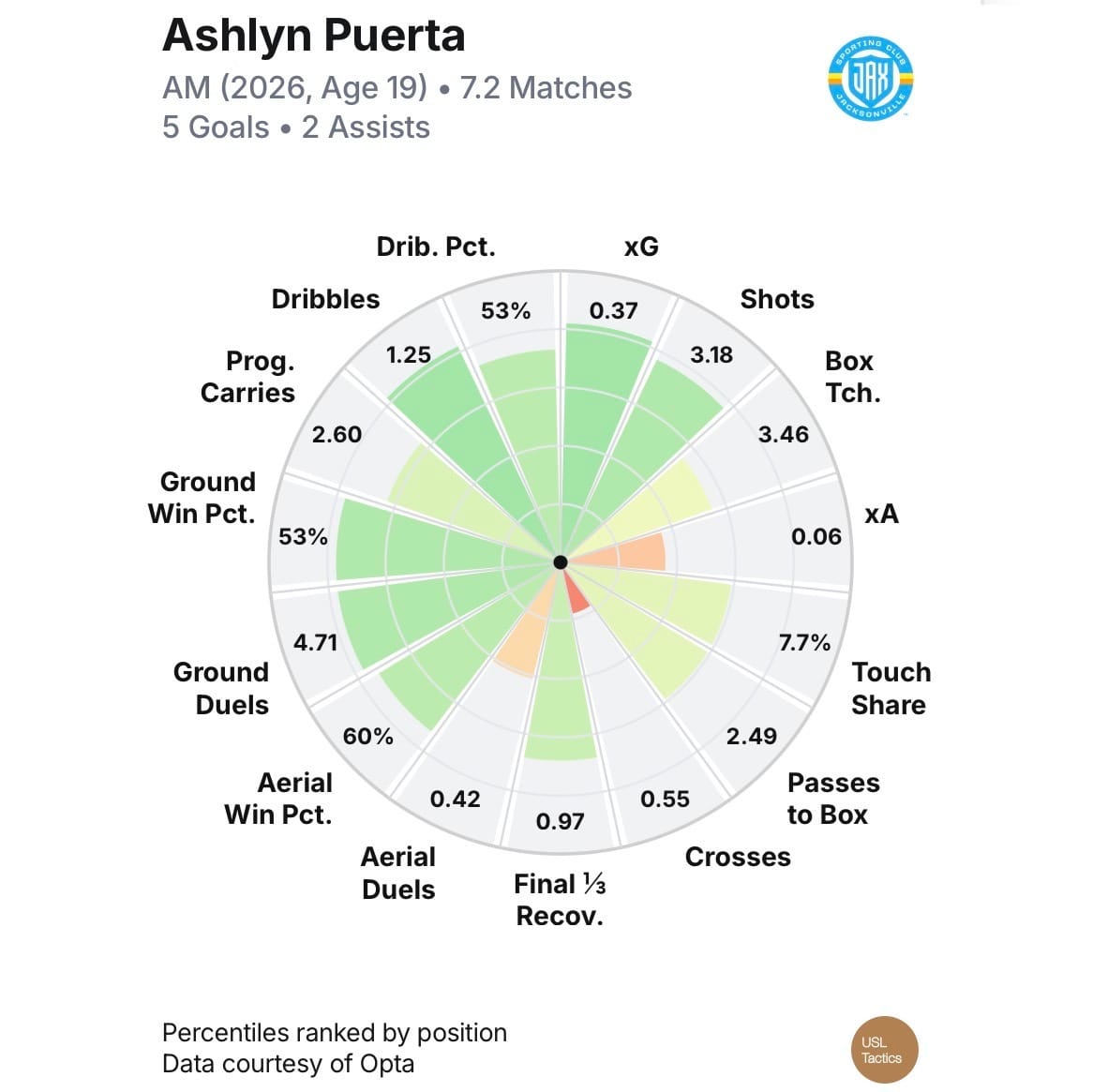
Coming into Week 10, I would’ve told you that Ashlyn Puerta – the Super League’s reigning Player of the Year – was having a down season. That’s to be expected from a 19-year-old who’s become the focal point of any defensive gameplan, of course. Putting in elite performances is hard when you’re regularly facing marks and double-teams!
With that challenge in mind, what Puerta did on Friday night against Fort Lauderdale is even more remarkable.
Jacksonville entered the match having enjoyed almost a full month off, whereas United had stayed warm and secured a galvanizing Week 9 win in interim manager Paul Jennison’s first match back at the helm. Fort Lauderdale didn’t rest on their laurels in any sense; Jennison kept Sh’nia Gordon as his primary No. 9 and got a goal from her, and he also redeployed Grace Cutler as an explicit marker against Sophie Jones, Jacksonville’s No. 6. Those changes earned Gordon a goal off a truly shocking throw-in sequence just seven minutes in, but they didn’t addle Sporting in any meaningful way thereafter.
Indeed, Jacksonville was barely phased by the goal and constantly dictated the tilt of the field. From the jump, Sporting – who returned Jamie Gerstenberg to goal and tended to initiate long against United’s press – settled into their possession game with aplomb. In the press, Jones and Sophia Boman flipped the script on Cutler by applying man pressure of their own.
Control belonged to Jacksonville, but the challenge was to dislodge Fort Lauderdale’s 4-4-2 block. Varied positioning from Puerta and wingbacks Meg Hughes and AJ Hennessey made it happen. If those players stayed deep, it opened lanes through lines into forwards Paige Kenton and Baylee DeSmit. Follow-up movement was key; if, say, Hughes squeezed a pass up the left to DeSmit, she needed to push upfield around her marker after releasing the pass to create a two-on-one against Fort Lauderdale’s rotating center back.
Jacksonville internalize that lesson here. As the clip begins, Jones drops below the level of Sh’nia Gordon at the primary striker spot, thus pulling Cutler high with her. Thus, when Ashlyn Puerta drops low from one of the No. 10 positions in Jacksonville’s 3-1-4-2, it demands a mark out of the pivot. The same thing happens at the sideline; Hughes holds a moderate height, so right back Molly McDougal steps to her.
The result? There’s space to be had through Fort Lauderdale’s overdrawn lines. From the back line, Grace Phillpotts is able to hit Kenton with her back to goal, shrugging off pressure. Meanwhile, Puerta doesn’t rest. As the No. 9 holds play up, Puerta darts upfield into open space.
Though it takes an extra touch or two for Kenton to find Hughes and Hughes to play Puerta through, the result is the same: Sporting are in the box. There, DeSmit can receive on the cutback from Puerta and fire at goal.
Puerta’s gravity is key here. She knows a deep drop will bend the defense, but she’s savvy enough to turn that positioning into the opportunity to make a third-man run. The teenager didn’t miss a beat all night; she finished with a sub-50% pass completion rate but put in six box passes and five progressive carries on top of the goals.
Brace yourself 😱
— Gainbridge Super League (@GainbridgeSL) October 17, 2026
Ashlyn Puerta grabs her second goal of the night to double @sporting_jaxw's lead ✌️ pic.twitter.com/3xjVj7Fsn6
The goals themselves oozed quality. The first, which equalized the game in the 23rd minute, came from the penalty spot but was a byproduct of excellent team play. Boman and Hennessey were able to connect up the right and spread Fort Lauderdale out, allowing for a criss-cross of runs in the right halfspace. There, Puerta was able to receive, backheel Kenton into the box, and force United to give away a lethal foul.
Puerta’s second and third goals were a byproduct of Jacksonville’s territorial dominance. The second saw center back Georgia Brown atone for her early mistake by tackling Gordon at the onset of a counter, allowing Sporting to work in behind to Hughes and create a cutback cross to their star No. 10. Less than 20 minutes later, Puerta did the dirty work. Jacksonville’s shape funneled the ball inside amidst a Fort Lauderdale build sequence, allowing the 19-year-old to make a tackle, dribble central, and right-foot a driven shot into the near corner.
The record-setting fourth goal came off a long restart and a series of headers by Kenton and substitute forward Andrea Fernandez. In the end, Puerta was set up for a lifted left-footed finish against a backtracking defense. You couldn’t have asked for a cleaner move.
Yes, 2026 started slowly by Puerta’s impossible standard – something you could say of Sporting Jax more generally – but Friday made it clear that she’s back and better than ever. If she can keep it up, it’ll take Sporting from the level of a club grinding out results to the dominant form we saw last spring.
In other news…
Friend of the newsletter Alex Ashton is up on League One Updater with a nice roundup of League One’s expansion landscape.
Chris Donovan was briefly credited with four assists for LouCity this weekend (Four assists!) before Opta changed their minds, but that’s still a good reason to discuss Donovan:
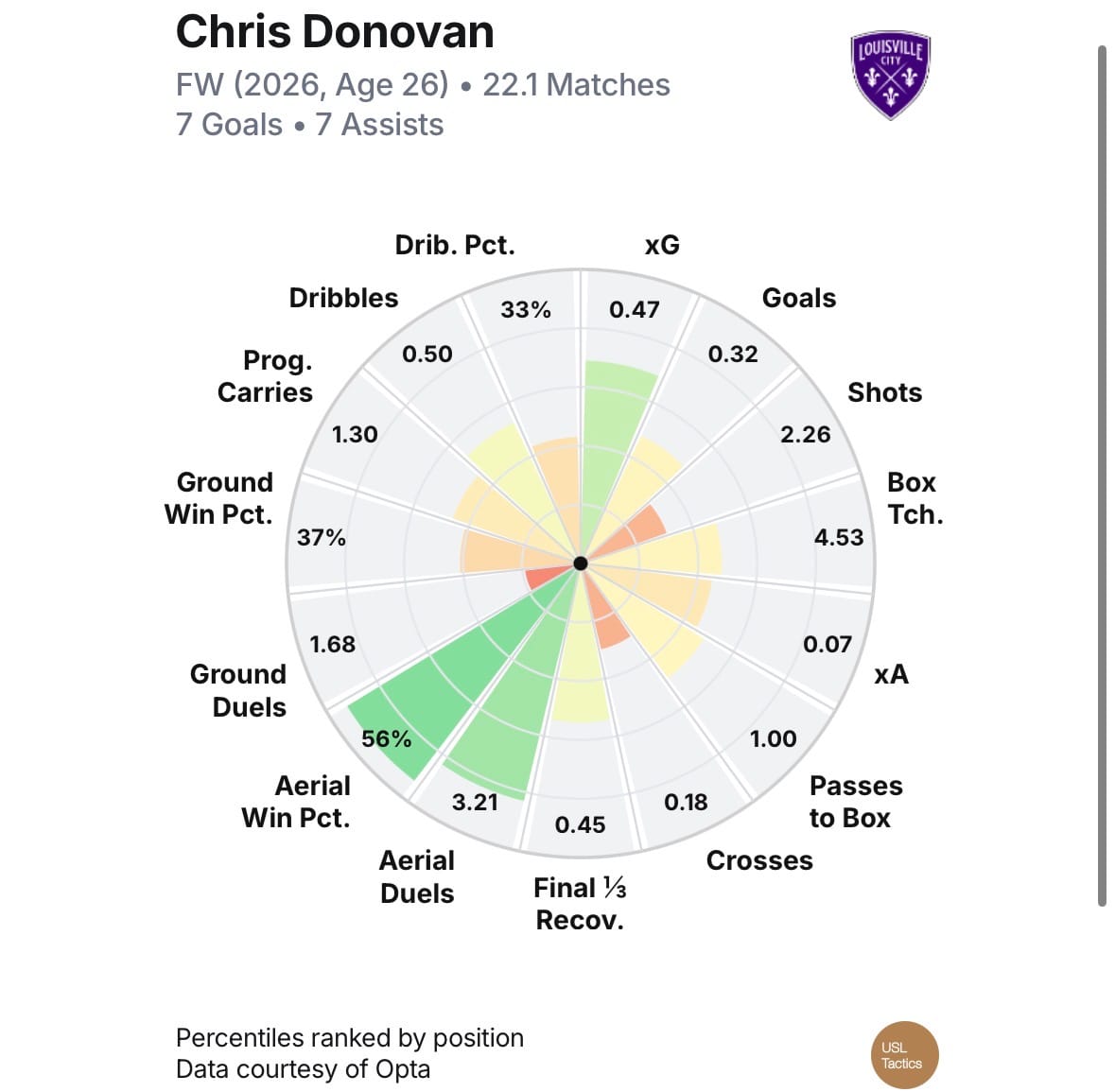
As a pure scorer and in-box presence, the No. 9 has been perfectly decent – if not the game-changing target we’d hoped for in the preseason. What’s been awesome to see is how Donovan has evolved his game as of late.
LouCity are dominating territory, but they’ve found a moderate “Plan B” that’s a lot more transitional. In those moments – as was clear to see in Saturday’s rout against Indy – Donovan is one of the best set-up players in the USL. He’s got the size to shrug off defenders plus the vision to connect with teammates, and those are hugely valuable traits.
No feeling in the world compares to the sensation of getting one like from a total stranger on a Letterboxd review. (Unrelated: quite liked the new Sense and Sensibility adaptation, which does nicely to look at the polarity between the titular “sense” and “sensibility” with a romantic, emotional valence.)
The Lowdown is back on FX/Hulu, and all people interested in neo-noir, Ethan Hawke, and/or the city of Tulsa should be checking in.
And finally, the Indiana Pacers are back.