The Back Four: Fall Mailbag
You asked, I answered


Welcome in to The Back Four! Need more USL content? Make sure to:
- Visit Backheeled for 10,000+ words of analysis on the Championship and League One every matchweek.
- Read my weekly Super League recap.
- Listen to This League! and The USL Show to catch up in podcast form.
Without further ado, let’s get to it.
Mailbag!
Jon Hunt came in with a two-parter. First, he asked: Can you explain the criteria and voting process of the end of year USL individual awards?
There's a pool of 25ish media members (that I'm aware of) who get a vote. The vast majority are local media that bring the perspective of having watched the USL through the eyes of their club. I'm in the "at large" bucket, I suppose? Each of us gets an email around this time of year and are invited to submit our ballots.
On the ballot itself, you start with the all-league section, where you get to name:
- Three candidates in an "open category," which I typically fill with three players I’m also considering for Most Valuable Player.
- Two goalkeepers, ranked in descending order. Your selections are weighted by rank for the sake of the all-USL compilation process.
- Three players each in the forward, midfielder, and defender buckets with that same ranked weighting.
Then, there are individual categories for Most Valuable Player, Coach of the Year, and Young Player of the Year where you can input one person’s name.
The criteria isn't strictly defined, other than Young Player of the Year's obvious age cap. My personal philosophy is to choose players who have been the most successful at contributing to winning soccer within their specific role. Someone like a Jacob Greene, for instance, has been absolutely stellar in a tucked left back role in Lexington; he won’t put up big counting stats, but he’s a model of excellent performance within a tactical concept. (Not saying I'm voting for Greene, but he's a good example of my preferred type.)
Of course, I’ll have the stars like Rubio Rubin (16 goals at striker) and Sebastian Anderson (six assists as a fullback), but I try to be all-encompassing to the best of my ability.
Jon’s second question was: What would East versus West USL Championship All-Star teams look like?
I’ll cop out to a certain degree and circle back to the data-centric Team of the Year selections I wrote about a couple weeks ago. Based on that “points added” modeling – and subjective position labels to help make a coherent XI – I ended up with this for the East:
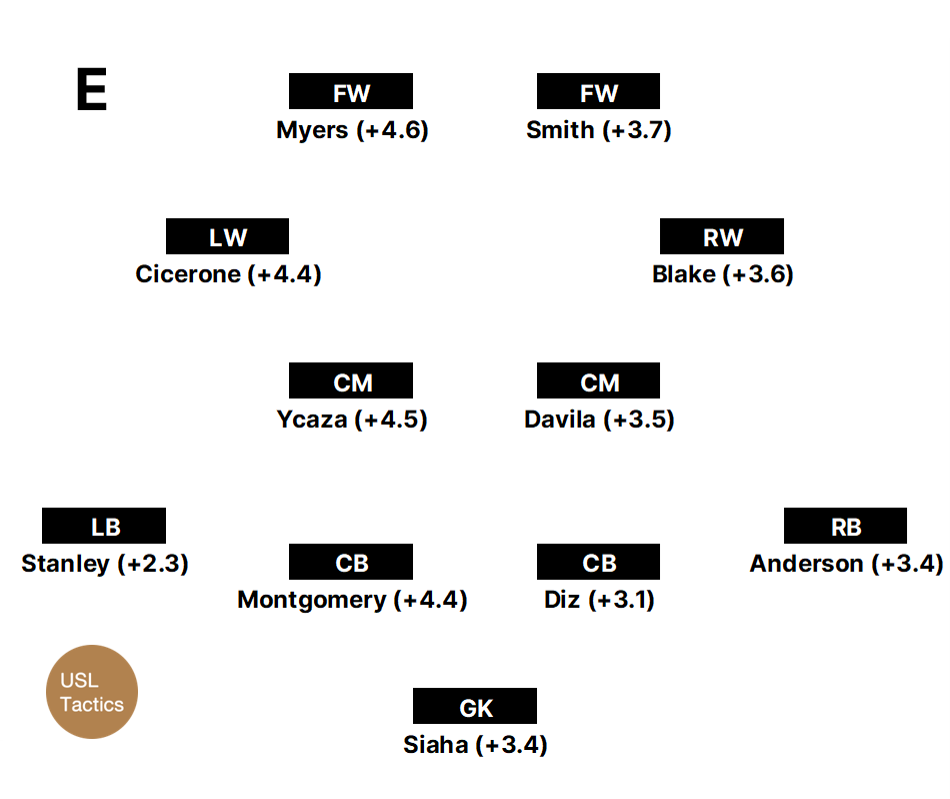
And I got this for the West:
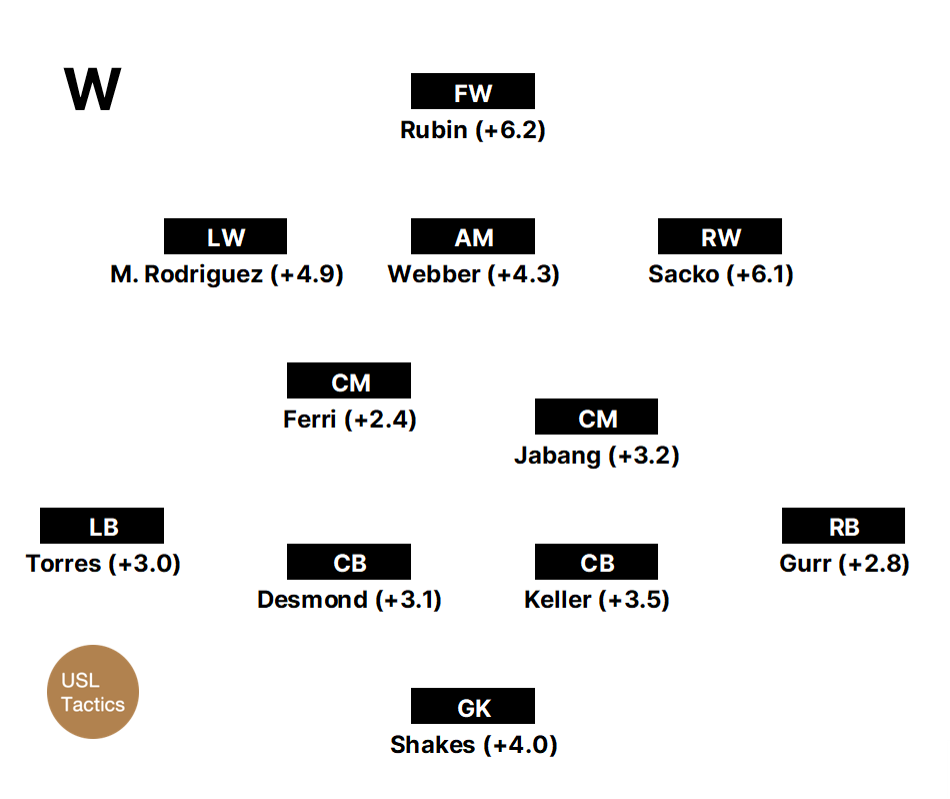
I don’t want to be too reductive, but I think the West would absolutely blow the doors off the East? There are a lot of players from Tampa Bay, Charleston, and the like that have been excellent within team concepts, but the West has individual skill out the wazoo. All-star games tend to be very end-to-end, competitively lax affairs, and the West’s stars – think Ihsan Sacko, Jack Gurr, Jamie Webber, et al. – are built to do Harlem Globetrotter things.
Griffin Shelor asked: Are there any goalkeepers who have shown meaningful improvement over the season, and are there any teams who might make the playoffs because of it?
To go about this, I consulted American Soccer Analysis' goals prevented data to compare performances for Championship and League One goalkeepers between the first and second halves of the season. Using that as the litmus test, we can highlight goalkeepers that have improved and regressed across 2026.
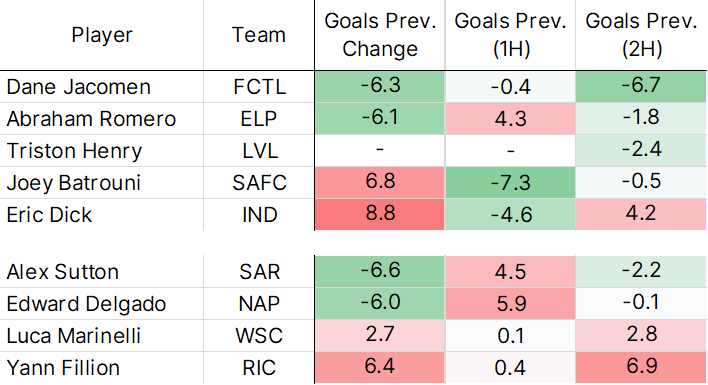
Let's start with the good. In the Championship, Dane Jacomen's ascension to the starting role in Tulsa has been a considerable boon for the defending Western Conference champs. Jacomen could never quite land the job with Loudoun, struggled immensely on loan with Westchester in 2025, but has come good in place of Alex Tambakis since the summer. I’ve carved out Triston Henry for a similar reason: the guy wasn’t even on the Las Vegas roster for the opening months of the campaign, and he’s been fairly excellent since claiming the starting position. The Lights might fall short of a postseason berth, but Henry has lived up to the level he once showed off in the Canadian Premiership.
Abraham Romero has been every bit as good as those two. The 28-year-old finally feels like El Paso's undisputed No. 1 after platooning with both Sebastian Mora-Mora and loanee Pedro Cruz, and he's a huge reason why the Locomotive will likely top their conference.
On the flip side, the fact that San Antonio and Indy have been dragged into the thick of their respective bubble races owes, in part, to declining performances in net. I’m not overly harsh on Joey Batrouni (who’s been let down by a shaky, uncontrolled tactical concept at a team level for SAFC) or Eric Dick (still the USL’s best box controller for the Eleven), but neither player’s shot-stopping has held up.
What’s fascinating in League One is how relatively inconsequential the goalkeeping swings have been. Sarasota’s Alex Sutton and Naples’ Lalo Delgado have both been elite down the stretch, but their clubs are going to fall a few points short of the eighth seed. Likewise, collapses from Westchester’s Luca Marinelli and Richmond’s Yann Fillion killed off any hopes at a late charge. Among League One’s top teams, performances have been fairly consistent.
My friends at The Union Report also came up with a two-parter. We’ll start near and dear to their hearts with: What pieces from the 2026 team should Monterey Bay use as a foundation to try and reverse their fortunes in 2027?
We have to start with the state of Monterey to set the context. I've liked the eye test from MBFC since Alex Covelo took over in May, but Monterey are still last in the West in terms of points (19 in 21 games) since he took charge. Along the way, they’ve somehow managed to overperform their expected margin; Monterey is 14 goals underwater under Covelo with a -14.3 xG difference.
When you think about a returning core in an ever-improving USL, you can't ignore those results. It's a dereliction of duty if this team's first XI on opening day isn't mostly composed of new faces.
That said, we should consider who's a viable piece among this club's long-term signees. (Wouldn't it be cool if someone was tracking contracts across the Championship and League One?) In terms of starter-level pieces, that gives us a baseline core of:
- Center backs Nico Gordon and Zack Farnsworth
- Fullback Stuart Ritchie
- Defensive midfielders Ryuga Nakamura and Nick Ross
- Attacking mid-slash-forward Sebastian Lletget
If you're being really generous, you could count young goalkeeper Fernando Delgado and utility center back Kelsey Egwu, but it's a red flag if either is a day-one starter in 2027.
Among other pieces with expiring deals, there are still names to like. If Ilijah Paul (five goals, five assists) is willing to be a rotation player, bring him on back. If Omari Glasgow and Quinton Eliot – two MLS loanees – are on the market, they feel like they could be useful. Even so, I genuinely think Monterey needs half-a-dozen impact signings to really be a competitor.
(Top of the shopping list: an elite, USL proven goalkeeper. Like, please grossly overpay for one of those guys to raise your floor.)
The second part of that inquiry was: What impact could the upcoming offseason being only one season away from promotion/relegation have on USL movement?
I’m going to lump the impending start of USL Premier into the same bucket, because I think it’s more impactful than pro-rel in a pure roster-building sense. We saw it last offseason from Lexington in particular: clubs with real aspirations to be in the first division need to spend money on stars like Phillip Goodrum and Aaron Molloy, and then they need to lock ‘em down on long-term contracts.
To that end, it’s no coincidence that Sacramento extended Freddy Kleemann and Jack Gurr through 2028 or that Pittsburgh has signed Robbie Mertz, Danny Griffin, and Bradley Sample with 2028 options. Both clubs have concrete stadium plans, both have been the class of the Championship for years, and both want to be day-one Premier organizations.
That’s a roundabout way of saying that contract term – something that isn’t always clear from the outside – is going to change, especially at the top end of the USL’s food chain.
The increasing linkage between the Championship and League One is an existing trend, one that I've tied to the existence of the USL Cup a handful of times in my writing. I suspect that pro-rel will also boost that phenomenon. From the Championship perspective, the more you're playing against League One teams and League One grads, the likelier it is that you'll recognize the quality of that level. There is, of course, a financial incentive for Championship teams to sign a cheaper League One stars than to, say, poach an MLS 'tweener or add a foreign import on a richer deal; that draw isn't going away, either.
Brendon Kearns asked: Should USL League One and the USL Championship hold a neutral-site finals weekend?
No! The appeal of that model for, say, the Super Bowl is that the NFL has millions of fans that would travel for a big event. The USL simply doesn’t. You can make the “fairness” argument, but being able to earn the right to host a title game based on your regular season performance is a good thing. If we’re playing 30 games pre-playoffs, it should count for something beyond the Players’ Shield.
The financial component of hosting is the interesting piece here. Per the franchise agreement signed by each club, “any costs or expenses associated with hosting, promoting and operating the championship Match in the manner required by League Rules shall be borne exclusively by the Team Operator.” In practice, that means the host club often ends up losing money!
Even so, being able to host a title game is a valuable marketing tool – one that clubs are happy to have, even if it results in a small loss. Tulsa drew a club-record crowd of 9,500 fans last November, and One Knox set a full-blown League One high at 7,500. An event of that magnitude allows clubs to significantly expand your reach.
In other words, being able to showcase your club to fans drawn in by the shiny, exciting idea of a championship bout is a big deal. We shouldn’t get rid of it in favor of a neutral venue model.
A Portland-centric double question, courtesy of ShadowWulf, began: Which of the Hearts of Pine No. 9s could develop to a 10 or 15 goals per season forward and why?
Let’s not reinvent the wheel here, folks. The answer is Titus Washington, even as he comes off a season-ending injury.
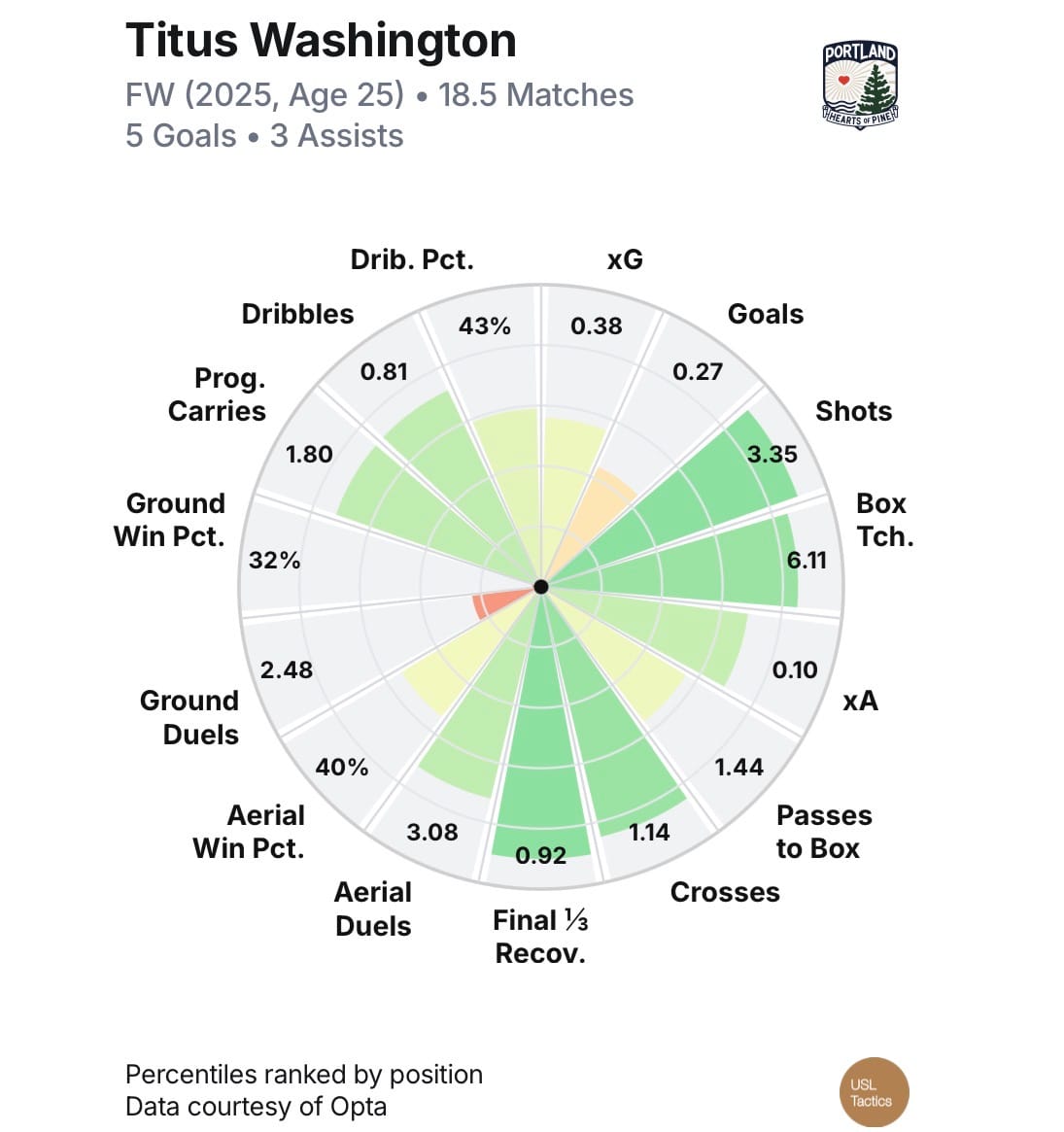
Washington was nothing less than immense in his rookie season in 2025, showing off all the traits you want to see from a No. 9. The box touches, shots, and aerial wins were all there; turning that involvement into consistent scoring was going to be the next step. The forward will still only be 26 when the League One season kicks off next March, and he’s the only Hearts forward I trust to make the leap – especially if Masashi Wada is fit and creating chances behind him.
The second question from ShadowWulf was: With League One [teams] not getting a full round of Open Cup tickets and Hearts probably missing, which arguments speak for Bobby Murphy to stay coach for 2027? Do you think he should stay?
As I wrote about in Backheeled this week, Hearts are getting back to their core tactical identity from the highly successful 2025 expansion season. Over the last two months, Portland have made 32% more recoveries in the final third per 90 minutes than they did to start the season. Their count of pressing sequences and high turnovers forced have also increased. Likewise, Portland’s average pass in the defensive third has moved play an extra 1.1 yards further upfield.
All of those changes are a credit to Bobby Murphy. If 2025 was built on verticality and high pressure out of the 4-4-2, 2026 – fueled by Hearts’ significant, ultimately unsuccessful offseason haul – was an attempt to get more moderate. That shift didn’t work, but early injuries to Wada and Washington completely changed the game for Portland before Murphy’s big ideas got to gestate.
I answered a similar question in the last mailbag in the affirmative: Murphy should be back. Continuity matters in the USL, and starting over from square one after an unlucky year would be unduly harsh.
It’s easy to see how things could improve, too. With Ray Saari in as Hearts’ sporting director, the onus of building a squad won’t be Murphy’s alone. Moreover, the experience of 2026 will hopefully encourage the manager to stick to the pragmatic ideas that worked in the first place. Throw in better injury luck, and I’m seeing the vision.
If next year starts slowly? We can have the conversation. For now, I’m trusting the process.
From StoppageTime on Twitter, we’ve got: Which USL club do you see going the farthest in the next Open Cup? Which USL League One club will surprise us in the Open Cup/USL Cup?
The fact that Tampa Bay couldn’t participate in this year’s Open Cup is a shame, and they’re the (extremely!) obvious pick here. We’ll see what happens for the Rowdies in the playoffs, but Dom Casciato made a habit of Cup-sets back in his Union Omaha days. With another offseason to keep leveling up, I imagine that Tampa Bay will be even more threatening in 2027.
For a dark horse candidate – in more ways than one – Lexington SC (ya know, dark horse?) feels like a potential threat. They’ve gone apoplectic in Championship play since the start of September, putting up just over 3.0 xG per 90 minutes. I don’t necessarily expect the form to remain that hot into next year, but I do trust that LSC will keep spending to put together the best roster possible. Say what you will about tactics or anything else, but maximal talent is the thing that wins trophies.
For a surprise club out of League One, why not Sarasota Paradise? Over the last month, Sarasota has a +9 goal difference and a +1.6 xG margin on a per-game basis. Adding Romain Gall off the wing and relocating Sander Roed to striker finally made this attack click; it came too late for a 2026 playoff push, but it’ll be “Plan A” from the jump next March. It’s always a question as to whether a League One team can keep their core together, but I could see Paradise advancing to the USL Cup knockouts next summer.