The Back Four: Build styles, Las Vegas, and more
Catching you up on USL ephemera

Welcome in to The Back Four! Need more USL content? Make sure to:
- Visit Backheeled for 12,000+ words of analysis on the Championship and League One every matchweek.
- Check back on Backheeled for a topical end-of-week feature on big USL-wide stories, plus attendance and depth chart tracking.
- Listen to This League! and The USL Show to catch up in podcast form.
Without further ado, let’s get to it.
League One's attacking styles
I love, dear reader, to pull together a chart whenever I dig up a previously undiscovered stat. That’s what we’re here to do.
Per the good folks at Opta, a “build up attack” is a sequence featuring 10 or more passes that ends in a shot, while a “direct attack” is a shot-creating sequence where a majority of ball movement is forward instead of sideways or backwards. If you pair the two together, you can get a decent idea of (1) how teams create chances at either extreme of possessive style and (2) whether or not an attack is succeeding creatively in the first place.
It’s worth noting that the majority of chances fall into neither bucket. Set pieces are the obvious exception, but a plurality of shots come from plays that are either quicker than 10 passes or don’t meet the extremity of Opta’s “direct” criteria. Still, the chart of League One’s data…
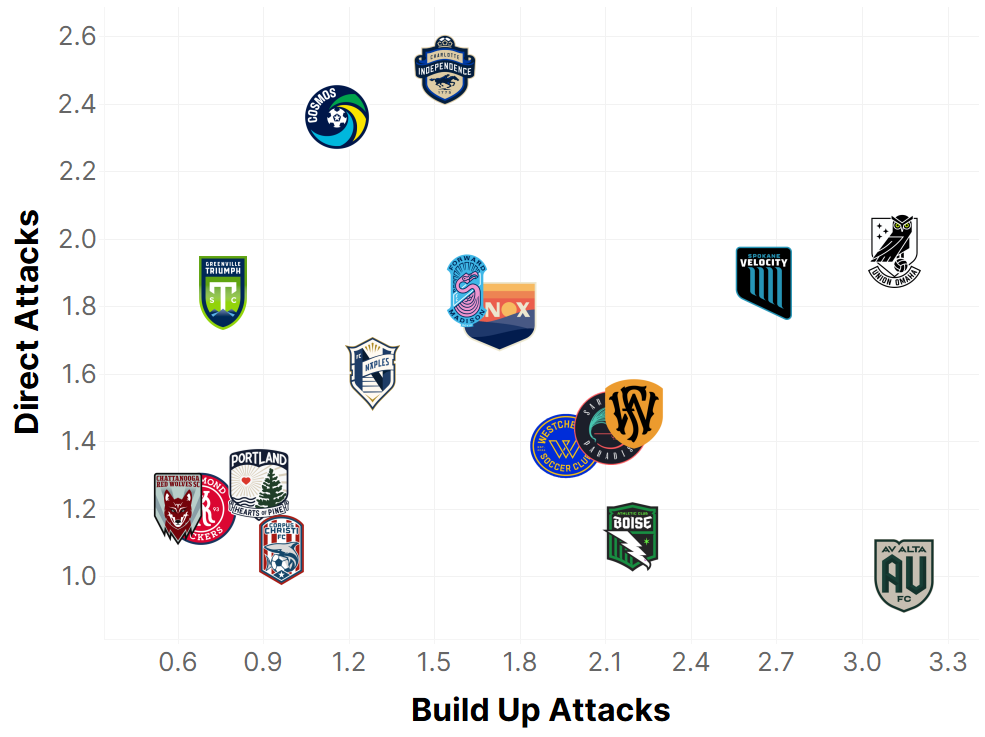
…paints a fascinating picture.
Omaha (more on them in a moment) and Spokane are the two most varied teams in the division, trailed by slightly more direct rivals in Madison and Charlotte. Elsewhere, Alta and Boise skew heavily toward ground-based build; Chattanooga, Richmond, and Portland barely create any chances, irrespective of category.
This chart doesn’t capture the full extent of efficiency, either. The Red Wolves are actually successful at creating a shot at the end of 23% of their 10-passes-or-more sequences, but they don’t keep the ball on the ground. Portland and Charlotte roughly attempt the same amount of 10-passes-or-more sequences per game, but the Independence convert 24% of their moves into shots against just 14% for Hearts.
What does a successful build up look like? We can start with a peek at Greenville, fresh off the (somewhat unexpected and controversial) firing of manager Dave Dixon. The Triumph are a moderate team in terms of initiation; they don’t necessarily want to be vertical right off the bat. In practice, they haven’t been able to turn those principles into genuine output.
Here, Greenville possess from the back, starting with a "2-4" build base featuring low fullbacks and a double pivot. Even as Chapa Herrera flows low and right back Toby Sims pushes high, the Triumph have a two-man edge over the front end of Corpus Christi's press.
That doesn't help Greenville break lines. A responsive rotation from the Sharks' wingback denies defender Anthony Patti as he finds the ball, cutting out a potential return pass to an advancing Herrera. Meanwhile, fellow center mid Ivan Agyaakwah barely moves; he's holding a presser in place, but there isn't enough motion around him. Eventually, winger Muba Nour and No. 10 Connor Evans drop in to help, but they're too late. Patti has already hit an aimless pass over the top, and a turnover ensues.
That’s Greenville’s season-long issue in a nutshell. They’re too slow, too static, and erratic when they try to break lines. By contrast, league-best teams like Omaha paint an entirely different picture.
Omaha starts this move at the feet of center back Blake Malone, who plays catch with Samuel Owusu across the pitch. Owusu's foray upfield doesn't take, but he safely resets into the feet of center mid Gabriel Cabral within Omaha's 4-2-3-1ish shape.
Cabral also has the chance to push right upfield with pivot partner Edrey Caceres, No. 10 Laurence Wootton, and striker Pato Botello Faz probing. Rather than jam between the tight lines of Spokane's 4-4-2, Cabral elects to pass backward into a waiting Sami Guediri at left back.
Guediri isn't in a good position on paper; Omaha is higher upfield than Greenville got in our prior example, but this is roughly equivalent to the point where the Triumph opted to hoof it long. Instead of doing that, the left back takes on his nearest man with a clever inside dribble. That move – which relies on individual skill, of course – splits Spokane's lines, and it happens in tandem with movement across the central foursome. Botello Faz curls upfield, Cabral splits wide, and Wootton shows as a progressive receiver.
The end result? A break into zone 14 that looses Adrian Billhardt for a shot on the edge of the box.
If you're looking for an exemplary "build attack," this is it. Omaha have a wonderfully keen ability to turn their ideas into output – the marker of any successful attacking unit at this level. Their approach isn’t any more valid than the next club’s, but Los Búhos execute on their system to the utmost.
Bright Lights
Speaking of success in build, the Las Vegas Lights have become one of the hottest teams in the West this fall on the back of their improving offensive game. From the start of manager Devin Rensing’s first full season at the helm, the Lights have tried to build through lines within a 4-2-2-2ish structure. They’ve stuck to that gameplan, and they’re rapidly growing more effective at getting the job done.
Personnel choices have informed that success. Some of the glow-up owes to patience; it took time for striker Oalex Anderson to settle in Nevada and add a defense-stretching presence at the No. 9 spot, for instance. Rensing’s bold choices have been equally important. Giorgio Probo’s rise as a No. 6 and the decision to nail on teenager Carson Locker as a narrow winger have improved Las Vegas on the ball – even if that means star addition Kyle Scott is on the outside looking in.
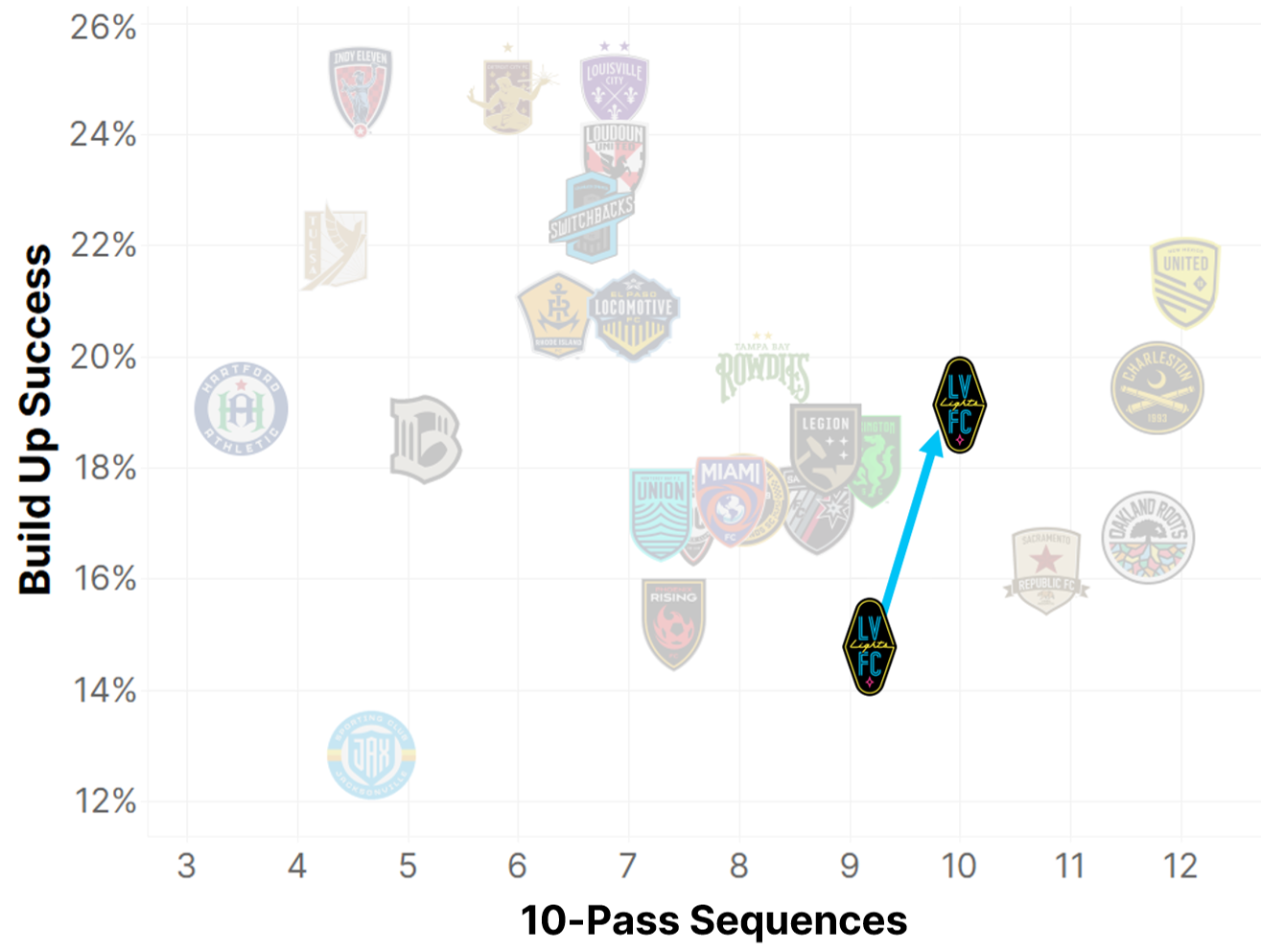
The result? Since the start of August, Las Vegas has put in about 10% more 10-passes-or-more plays per game while significantly improving their success during those sequences. At the end of July, the Lights had the second-worst rate of shot creation on those moves in the Championship. Since then, their 19% success rate has been miles better – in the neighborhood of clubs like Charleston that're famous for their possessive efficiency.
The newfound sharpness has allowed Rensing’s game model to come together. This year, Las Vegas' average possession has begun 42.4 yards upfield, the fifth-highest mark in the league. The Lights might not be a pressing juggernaut, but their off-ball structure has been highly conducive to fairly advanced recoveries. Now, they can get possession back, circulate passes for long spells, and still challenge the opposing box.
What does that look like in practice? Here, Las Vegas begins an attacking sequence extremely high upfield through center backs Nate Jones and Ben Ofeimu (teal), who are in close proximity to Probo and Marc Ybarra (black) through the pivot. The Lights’ offensive shape is somewhere between 3-1-4-2 and 2-2-4-2, but the driving construct is this: you’ve got four build players behind two narrow No. 10s, two wide fullbacks, and a pair of forwards ahead of them.
In this case, striker Johnny Rodriguez tries to drop between lines and bolster the dual No. 10s. Earlier in this very match against Orange County, Rodriguez used such a run to receive through lines and score a goal; he’s less successful here, but he still creates a three-on-two against the OCSC pivot between Locker and Christian Pinzon.
Nonetheless, Las Vegas get a second bite at the apple. This time, Locker is able to receive on the turn with Anderson forging ahead to buy space. The gambit is successful, and while the teenager’s shot doesn’t test the opposing goal, it’s a nice evocation of the Lights’ principles.
Saturday’s 1-1 draw against Hartford saw Las Vegas continue to do what they do best. The Lights ran up a 69% possession share and a 65% field tilt. Even with a hobbled Rodriguez limited to sub duty, Las Vegas ran up 1.7 xG. Pinzon starred; he’s the most exploratory of this club’s attackers, liable to cover the whole range of the midfield out of his baseline right wing position. That held true in Week 29, where Pinzon took 76 touches.
My objective playoff odds still give Las Vegas a one-in-three chance of making the postseason, but my subjective brain feels like the Lights have momentum compared to peers like Orange County, Phoenix, and San Antonio. If Las Vegas do, in fact, return to the playoffs, it’ll owe to Devin Rensing’s tactical clarity and intelligence man management.
Dallas Trinity's heat check
This is an excerpt from my Super League recap, which comes out each Monday (or thereabouts). Find the Week 6 edition here.
One of our foremost poets said that “real Gs move in silence like lasagna,” which I’m assuming was a nod to Lee Nguyen. The Dallas manager basically threw up the lineup choice version of a heat check in Week 6, and it paid off handsomely.
In the midst of a two-game winning streak where the offense finally began to click, you’d have expected Dallas to stick to their guns. If it ain’t broke, don’t fix it – right? Instead, Nguyen altered his XI to add even more variability than usual to the mix.
If this is your first USL Tactics Super League column, congratulations! You get an oft-repeated explanation that Carissa Boeckmann has defended like the right back in a 4-4-2 but shifted inside as a No. 8 on the ball, taking Trinity toward 3-5-2 or 3-3-4 territory. That wasn’t the case on Saturday. Instead, natural defender Sydney Cheesman – displaced last weekend by teenaged starlet Meila Brewer – took over as the right back and took up much wider (and more conventionally fullback-ish) positions.
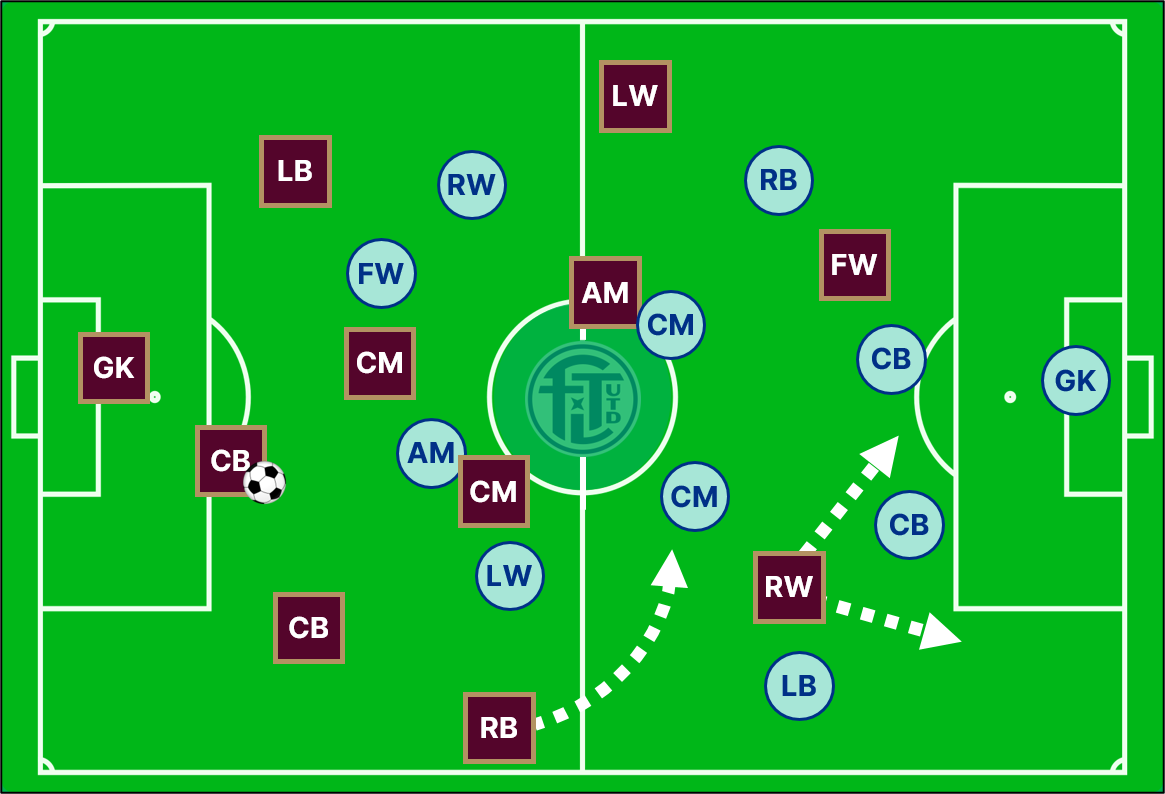
There was more to the setup than met the eye. Even though Sofia Cedeno and Seven Castain had breakout performances carving through the middle third against DC last weekend, both gave way in Fort Lauderdale. Boeckmann replaced Cedeno in one of the No. 6 spots, whilst Aria Nagai provided a No. 10-coded sensibility in place of the forward-tilting Castain. The true No. 9 spot changed hands as well, with Juliet Moore taking up that mantle.
The result? A 3-3-4, but one with more room to get wonky. Cheesman’s natural width constantly created match-up problems for Fort Lauderdale’s 4-2-4 press. The right back forced a reaction whenever she received: either defender Kelsey Oyler had to step (thus leaving Jasmine Hamid open on the right wing) or a center mid had to crash Cheesman’s way and hope she wouldn’t get played around.
Delightfully, Cheeseman also made her fair share of central runs to isolate Hamid on the right. When that happened, Boeckmann took chances skewing to the left sideline; there, her right-footed passing and Onyeka Gamero’s speed created problems for fullback Maggie Mace. Suddenly, Dallas had a symmetrical threat that could pop up on either side.
Nguyen did extremely well to mix up his XI, but manager Tyrone Mears’ shapely defense didn’t make things easy. The pivot of Nicole Vernis and 18-year-old Taylor Smith was good at denying space. In central defense, Ella Simpson continued to look like a potential all-league candidate, providing support behind Oyler and deftly managing crosses. Nonetheless, the choice to use a 4-2-4 that provided a “plus one” edge on Dallas’ back three without actually pressing felt like a major faux pas.
Air traffic controlled ✈️@dallastrinityfc rises to the occasion and takes the lead! 🚨 pic.twitter.com/2kCer9BW6U
— Gainbridge Super League (@GainbridgeSL) September 19, 2026
When Dallas went up on a corner kick in the 32nd minute, you felt the goal coming. There, Trinity used two high-in-the-box runners (Brewer and Hamid) to draw attention. Closer to the net, they positioned Nagai at the near post, Cheesman on the goal line, and center back Sydney Braun between the two. The multi-leveled runs caught Fort Lauderdale sleeping, allowing Braun to rise up and finish a truly perfect serve from Boeckmann.
So, what did Fort Lauderdale offer in response? Not much! Their 2-4-4 build look was as flat (in terms of formational geometry and…uh…vibes) as their defense, and Dallas’ off-ball 4-4-2 gave them no quarter.
United were at their best when they stirred the pot. In the fourth minute, for example, a few passes around the back were a Trojan horse that drew pressure up and opened a diagonal to right winger Sh’nia Gordon. The pass was low-percentage, but it caught a Dallas defender slipping on a wet pitch and forged a half-chance. Any sort of verticality was welcome; second balls won by Vernis and then routed toward Gordon were the best way to shake up Trinity’s mid-height defensive block. Fort Lauderdale’s consolation goal was a prime example, with an Oyler header freeing space through lines and teeing up a Gordon finish in the 59th minute.
Still, that sequence was the exception that proved the rule of Dallas’ dominance. Even as United upped the ante in the press while trailing, they struggled to disrupt Brewer (whose right-sided carriage relieved pressure) and Braun (excellent as a line-breaking passer) at the back. Trinity even maintained a long threat of their own, as seen in the 46th minute when Braun played over the top to Hamid, forced a slip, and put Fort Lauderdale to the sword.
By the time they went up 2-0, Dallas had allowed just 0.03 xG; this thing was entirely one-sided. That’s a massive credit to Lee Nguyen, who’s quickly converted this Dallas Trinity team from a club with clear-if-ineffective principles into a consistent winner.
In other news…
The data model that I use to run my playoff odds is run off player grades (alongside other inputs like strength of schedule, underlying performance, and things of that nature), so which players have been the best in 2026? I give you the Championship's Team of the Season according to my "points added" scoring:
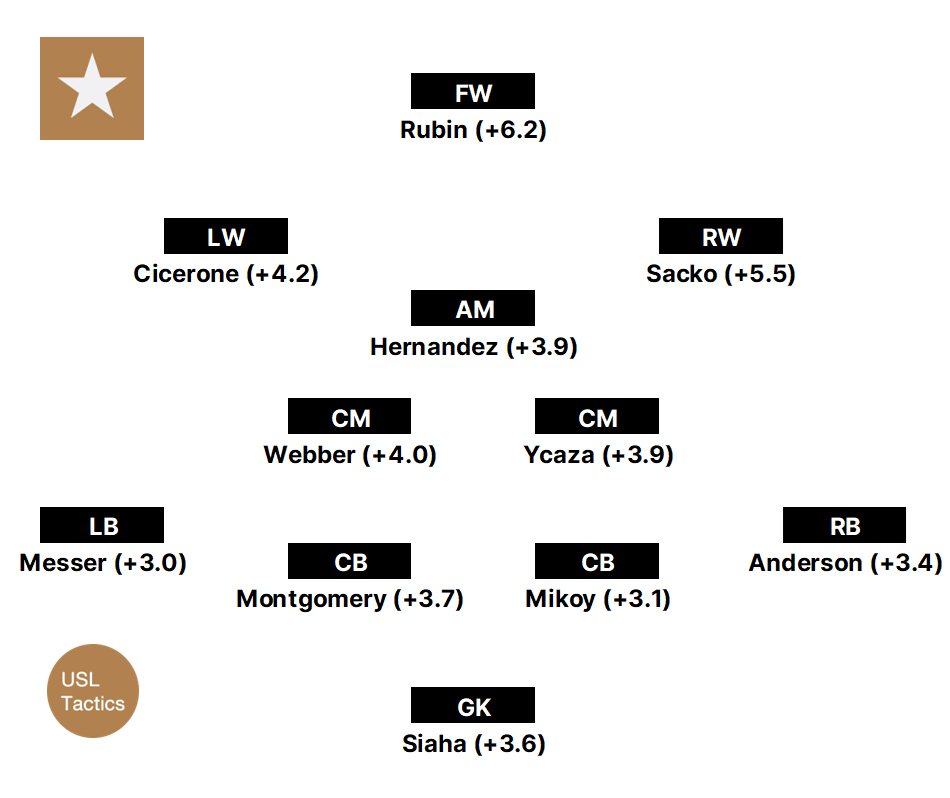
There are plenty of names you’d expect, ranging from MVP favorite Rubio Rubin to Phoenix star Ihsan Sacko to perennial all-leaguer Jorge Hernandez. Hartford goalkeeper Antony Siaha, my first-team all-league pick until further notice, beat out New Mexico’s Kris Shakes by a few decimal points.
Cards on the table: I'm broadly happy with the output at most positions on the field, and I'm still shaky about the defensive spots. Rating defenders is hard when you just have counting stats, though the fact that Detroit’s Callum Montgomery is the league’s best center back by the points added metric is inspired. As ever, No. 6s don’t get enough love as compared to more offense-minded midfielders.
In terms of snubs, striker Khori Bennett, center backs Tom Brewitt and Joey Akpunonu, and midfielder Blaine Ferri narrowly missed out.
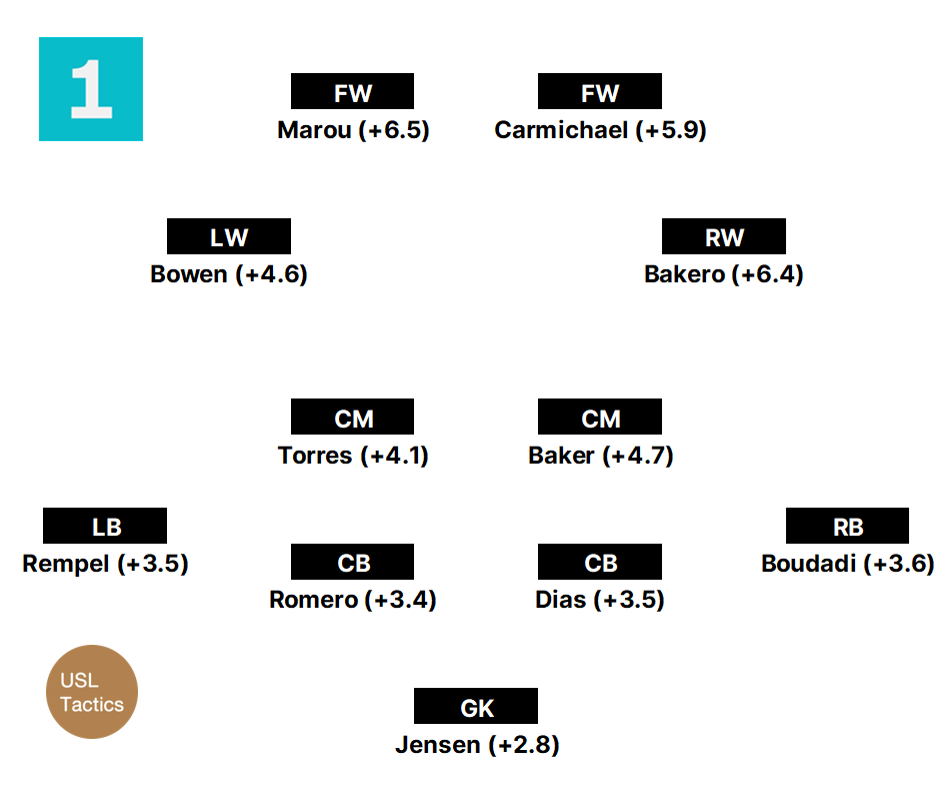
In League One, Charlotte’s star attackers (Souaibou Marou and Jon Bakero) and Madison’s main drivers (Roman Torres and Kevin Carmichael) lead the way. Fort Wayne’s devoted build-from-the-back style and leftward tilt have helped Michael Rempel and Tiago Dias build all-league cases. Notably, Omaha’s Cole Jensen rated as the best goalkeeper in the division despite splitting time with Rashid Nuhu.
New York’s Ajmeer Spengler and Westchester’s Conor McGlynn just missed out at their positions. Defensively, Madison’s Kevin Carmichael and the pair of Jonathan Ricketts and Blake Bodily from Boise were also slim omissions. Again, though, I’m broadly happy with the output.
On the injury comeback front, Arthur Rogers is back and going things for Miami FC:
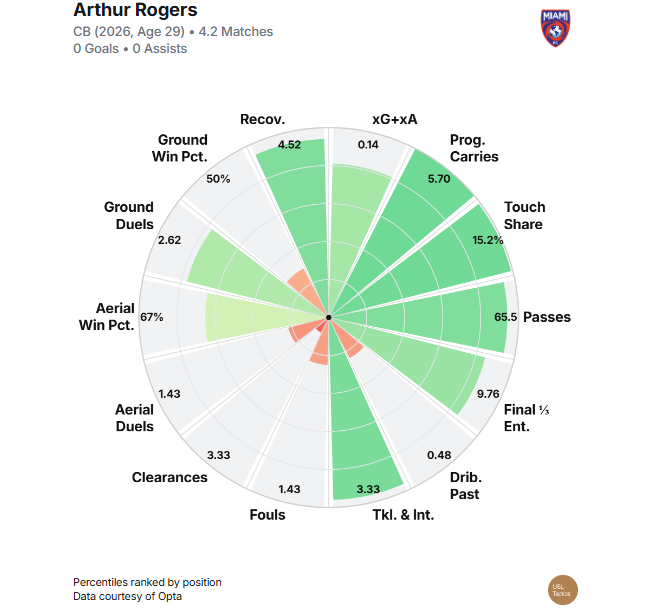
In Miami's season-saving win over Rhode Island on Saturday, Rogers took 88 touches against just 63 for starting center back partner Daltyn Knutson and completed 16 passes into attackers Arney Rocha, Denilson Milanes, and Mason Tunbridge. If he's clicking, it changes the game for this club.
Good context from Nicholas Murray about Phillip Goodrum's run of form.
If you’re looking for more Super League coverage, my friends at Protagonist are killing every week on The Super Show.
I don’t shout New York Soccer Journal out enough, but Michael Battista’s boots-on-the-ground coverage of Westchester’s rivalry win over the New York Cosmos is a great example of the work they’re doing.
I have the musical taste of a moody teenage girl at heart, so the song of the week is Beabadoobee “Satellite,” which exists on the line between TikTok-era bedroom pop and grunge. (Also, going to a concert this week for a group that literally got introduced to me based on this newsletter.)