USL Super League, Week 6
Carolina's dominance, Dallas' winning streak, and more

DC (1) - Tampa Bay (1)
I intended to start this section talking about the famous “don’t fire until you see the whites of their eyes” order given to the American revolutionary troops at Bunker Hill, but apparently that’s apocryphal? (Shoutout Swedish king and noted Civ character Gustavus Adolphus.) Still, that basic idea – bait your opponent in, then strike hard and fast – defined Tampa Bay’s approach away to DC on Friday.
Both sides leaned into squad rotation to try and gain an edge. Power manager Omid Namazi kept to a highly pressureful 5-2-3, with Gianna Gourley entering the forward line and Sara McCoy making her first start in central defense. As a result, star forward Loza Abera slid to the left wing, whilst versatile center back-pivot combo piece Justina Gaynor started as a No. 6.
Against Tampa Bay’s “3+2” build base, Power’s high press was ready-made to cause trouble. Unless Cristina Roque wanted to possess from goal, DC had even numbers up high, and they used them to shunt the Sun into wide traps.
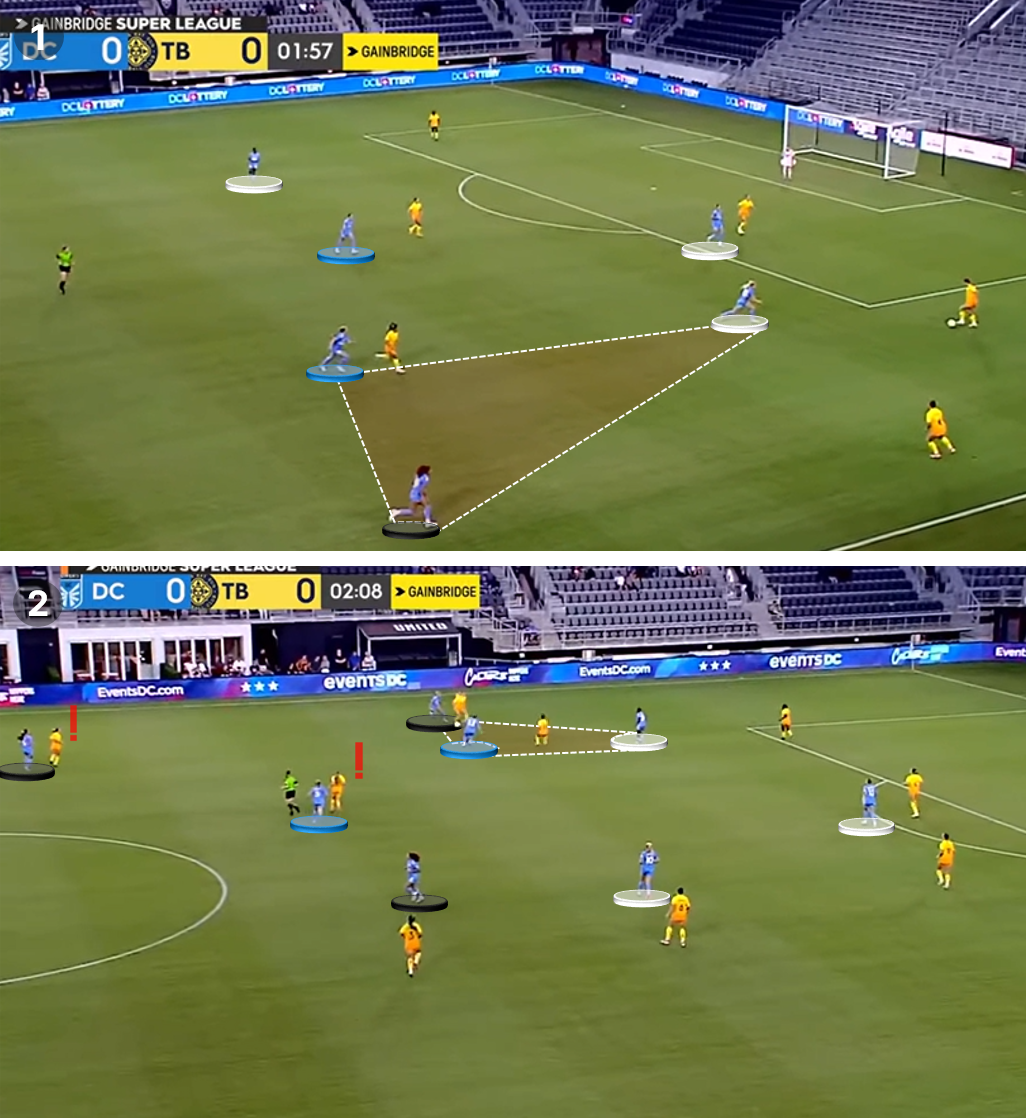
That’s the case here, where you see a typical Tampa Bay initiation sequence broken down into two frames. Up top, center back Kelsey Hill is on the ball with limited options. Left back Sabrina McNeill is deep here, but she’s about to face a close-down from wingback Kayla Colbert (black). Likewise, center mid Sam Kroeger is marked by Emily Colton (blue). Even with an extra Sun player deep, DC’s shifting 5-2-3 holds steady.
The second frame sees play swing toward the right sideline, where DC clamps down even further. Tampa Bay right mid Parker Goins is on the ball, but Power defender Sam Cary Angel breathes down her neck. As Goins tries to dribble inside, a high-tilted Gaynor is ready to stonewall her. There aren’t options upfield, either; Colton and McCoy both stick tight to Tampa Bay runners.
Much of the match played out like a cat-and-mouse battle in Tampa Bay’s own half. DC finished the first half with a 70% field tilt (i.e., played 70% of the total final-third passes between the two teams) and barely dropped below that level after the break. Still, Power’s persistent inability to generate quick chances and avoid stasis against the opposing block remained a problem.
In that sense, manager Denise Schilte-Brown deserves her flowers. By bringing Goins onto the right side of her midfield, deploying Tori Zierenberg as her second striker, and getting Sam Kroeger in at the No. 6 spot, Schilte-Brown gave the Sun the personnel they needed to shut DC down while retaining a threat going forward.
Defensively, Tampa Bay tended to press in a 4-4-1-1 with Shea Connors leading the line ahead of Zierenberg. Those two shifted to deny easy lanes into the midfield, but the Sun’s midfield line was rather nonconfrontational. That was by design; a deep midfield and high defensive line completely shut down a DC team that’s averse to long passes over the top. Space between lines was at a premium.
Here, Tampa Bay has shifted into their deep posture, and you can see Goins effectively operating like a wingback. The Sun are so compact, and they’ve got ample coverage on the edge of the box via Kroeger and Jordyn Listro. DC has no choice but to hit a low-percentage cross – one that tees up an instant break for Sydny Nasello on the weak side.
The more that Tampa Bay could open up in zone exit situations, the better they fared. Throwing up 50-50 balls to Nasello or Zierenberg against the aforementioned Power press was fine, but it was inefficient. Trusting the low block, waiting for takeaways, and breaking with intensity fared better.
Tampa Bay’s go-ahead goal was a variation on that theme. Out of halftime, Goins gave way for Taylor Chism (who took over in the defensive line) as Samar Guidry took over the hinge winger-wingback spot. When Chism put in a tackle against a Power break in the 62nd minutes, the fruits of that change were clear. Chism’s stop allowed Listro to squeeze through the midfield, where she played Connors through into the box. One slick finish later, and the Sun led 1-0.
Not to be outdone, Namazi brought midfielder Emma Jaskaniec and forward Alyssa Walker into the game and saw them equalize just 54 seconds after the changes. That 70th minute goal, a long free kick served to Walker at the far post and played back across into a Jaskaniec backheel, still didn’t erase a feeling of disappointment for Power. DC controlled territory and won the xG battle yet were inefficient around goal and sloppy enough in rest defense to settle for a single point.
What DC needs is less clear. More one-on-one capability in the wide areas would help, and extra third-man movement out of the pivot would also be welcome. Emily Colton feels like the natural option to provide that latter thing; she’s been active around the final third, but more box-centric running has to come from someone.
The contrast against the Sun’s pragmatism shouldn’t go unobserved. Tampa Bay are so good at hunkering down, playing their game, and scraping away tough results. They did so again Week 6, and they keep on looking like a team that’ll be a nightmare to play should they qualify for the postseason.
Fort Lauderdale (1) - Dallas (2)
One of our foremost poets said that “real Gs move in silence like lasagna,” which I’m assuming was a nod to Lee Nguyen. The Dallas manager basically threw up the lineup choice version of a heat check in Week 6, and it paid off handsomely.
In the midst of a two-game winning streak where the offense finally began to click, you’d have expected Dallas to stick to their guns. If it ain’t broke, don’t fix it – right? Instead, Nguyen altered his XI to add even more variability than usual to the mix.
If this is your first USL Tactics Super League column, congratulations! You get an oft-repeated explanation that Carissa Boeckmann has defended like the right back in a 4-4-2 but shifted inside as a No. 8 on the ball, taking Trinity toward 3-5-2 or 3-3-4 territory. That wasn’t the case on Saturday. Instead, natural defender Sydney Cheesman – displaced last weekend by teenaged starlet Meila Brewer – took over as the right back and took up much wider (and more conventionally fullback-ish) positions.
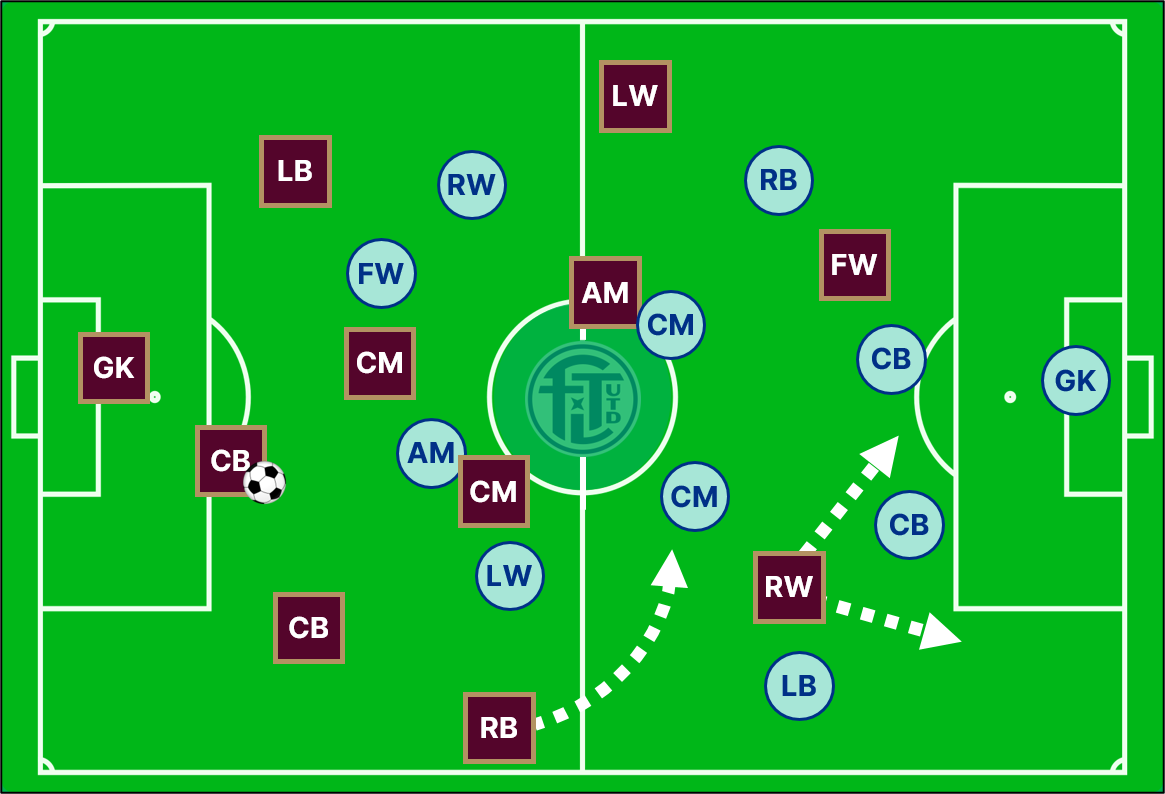
There was more to the setup than met the eye. Even though Sofia Cedeno and Seven Castain had breakout performances carving through the middle third against DC last weekend, both gave way in Fort Lauderdale. Boeckmann replaced Cedeno in one of the No. 6 spots, whilst Aria Nagai provided a No. 10-coded sensibility in place of the forward-tilting Castain. The true No. 9 spot changed hands as well, with Juliet Moore taking up that mantle.
The result? A 3-3-4, but one with more room to get wonky. Cheesman’s natural width constantly created match-up problems for Fort Lauderdale’s 4-2-4 press. The right back forced a reaction whenever she received: either defender Kelsey Oyler had to step (thus leaving Jasmine Hamid open on the right wing) or a center mid had to crash Cheesman’s way and hope she wouldn’t get played around.
Delightfully, Cheeseman also made her fair share of central runs to isolate Hamid on the right. When that happened, Boeckmann took chances skewing to the left sideline; there, her right-footed passing and Onyeka Gamero’s speed created problems for fullback Maggie Mace. Suddenly, Dallas had a symmetrical threat that could pop up on either side.
Nguyen did extremely well to mix up his XI, but manager Tyrone Mears’ shapely defense didn’t make things easy. The pivot of Nicole Vernis and 18-year-old Taylor Smith was good at denying space. In central defense, Ella Simpson continued to look like a potential all-league candidate, providing support behind Oyler and deftly managing crosses. Nonetheless, the choice to use a 4-2-4 that provided a “plus one” edge on Dallas’ back three without actually pressing felt like a major faux pas.
Air traffic controlled ✈️@dallastrinityfc rises to the occasion and takes the lead! 🚨 pic.twitter.com/2kCer9BW6U
— Gainbridge Super League (@GainbridgeSL) September 19, 2026
When Dallas went up on a corner kick in the 32nd minute, you felt the goal coming. There, Trinity used two high-in-the-box runners (Brewer and Hamid) to draw attention. Closer to the net, they positioned Nagai at the near post, Cheesman on the goal line, and center back Sydney Braun between the two. The multi-leveled runs caught Fort Lauderdale sleeping, allowing Braun to rise up and finish a truly perfect serve from Boeckmann.
So, what did Fort Lauderdale offer in response? Not much! Their 2-4-4 build look was as flat (in terms of formational geometry and…uh…vibes) as their defense, and Dallas’ off-ball 4-4-2 gave them no quarter.
United were at their best when they stirred the pot. In the fourth minute, for example, a few passes around the back were a Trojan horse that drew pressure up and opened a diagonal to right winger Sh’nia Gordon. The pass was low-percentage, but it caught a Dallas defender slipping on a wet pitch and forged a half-chance. Any sort of verticality was welcome; second balls won by Vernis and then routed toward Gordon were the best way to shake up Trinity’s mid-height defensive block. Fort Lauderdale’s consolation goal was a prime example, with an Oyler header freeing space through lines and teeing up a Gordon finish in the 59th minute.
Still, that sequence was the exception that proved the rule of Dallas’ dominance. Even as United upped the ante in the press while trailing, they struggled to disrupt Brewer (whose right-sided carriage relieved pressure) and Braun (excellent as a line-breaking passer) at the back. Trinity even maintained a long threat of their own, as seen in the 46th minute when Braun played over the top to Hamid, forced a slip, and put Fort Lauderdale to the sword.
By the time they went up 2-0, Dallas had allowed just 0.03 xG; this thing was entirely one-sided. That’s a massive credit to Lee Nguyen, who’s quickly converted this Dallas Trinity team from a club with clear-if-ineffective principles into a consistent winner.
Carolina (1) - Brooklyn (0)
On November 2nd, 2024, Fort Lauderdale United put up just two shots in a 1-0 loss to Dallas Trinity. That match had gone down as the worst offensive performance in the young history of the Super League – at least until this Saturday. Fresh off a statement win last weekend, Brooklyn FC headed to Carolina, tied the record with just two total shot attempts, and lost 1-0 while putting up a meager 0.19 xG.
Like a python strangling its prey, manager Phillip Poole’s ascent gradually enveloped Brooklyn, denying them the patterns that worked so well in Week 5. Likewise, Carolina never rushed things in possession. Their attacking game was slow and steady, culminating in a 63rd minute set-piece winner – one that came without having needed to use a single substitute.
Though Brooklyn lacked the presence of left winger Tziarra King, a goalscorer last time out, they reprised the 4-2-4ish attack that used a double-layered presence on the wings and sharp movement from striker Catherine Zimmerman to light up Jacksonville. The difference this weekend? Jacksonville was one-deep on the sidelines by nature of their 3-5-2 shape; by contrast, the Ascent’s ability to stack, say, winger Audrey Coleman and left back Jill Aguilera added a crucial layer of security.
Brooklyn tended to be direct in build, recognizing from the jump that they couldn’t hang when trying to build on the ground. Goalkeeper Bre Norris’ long goal kicks targeted an upfield shape that was basically in 4-1-4-1 mode, with the attacking mids and an elevated No. 6 forming a diamond. The ideas weren’t bad, and Brooklyn had the aerial prowess to win 70% of the match’s headers. However, first-ball wins rarely led to second-ball control; Carolina ended the night with a +6 recovery margin.
Thus, the stakes were clear: the Ascent controlled the game, but they needed to break through Brooklyn’s block to make it happen.
A varied approach to build made it happen, usually centered around Mia Corbin and Lily Nabet’s ability to drop amidst the center backs, draw Brooklyn out, and allow for progress upfield. Here, Carolina are basically in 2-3-2-3 mode; Nabet is so low that she isn’t even on screen, whilst pivot partner Mia Corbin (white) connects play between right back Addisyn Merrick and advancing defender Jenna Butler (purple).
That three-player build line stretches Brooklyn’s 4-4-2 at its front end, allowing for a touch pass to loose Butler for a give-and-go move toward halfway. Meanwhile, you can see attackers Shea Groom and Rylee Baisden (orange) start to push forward into space. As Butler and Corbin play catch, Brooklyn has to respond. Carolina’s attackers take advantage of every inch that becomes available.
By the time Corbin plays through to forward Audrey Coleman and re-establishes possession in the attacking zone, all the momentum belongs to the Ascent. They’re able to play toward Baisden and Merrick against a tightened Brooklyn defense, and while a chance doesn’t arrive, it’s a well-worked move.
The same ideas apply here. This time, you see Carolina start in “3+1” mode with Corbin between the center backs and Nabet a line ahead. Brooklyn commit to those two and right-sided center back Reese Tappan, leaving Butler open to advance once more.
As Butler pushes, Aguilera takes the chance to overlap; forward Mackenzie George complements her with a drop into the channel, daring Brooklyn left back Sara D’Appolonia to mark her. That help doesn’t arrive, and George can thus link play through a passing triangle at the heart of the opposing shape.
George is able to turn and shrug off pressure from her back side, and you get a similar set of runs to the ones we saw in the prior example. Baisden’s charge pins a fullback, Merrick gets forward, and Coleman cleverly holds up her run. While a through from George to Baisden doesn’t connect, you’re still getting the gist of the Ascent attack.
Brooklyn’s center back duo of Jordan Thompson and Sophia Lowenberg did extremely well, all things considered. Thompson is the player to intercept above. In total, she won five of her seven duel attempts and added eight clearances. Lowenberg, meanwhile, was wonderfully supportive behind D’Appolonia whenever Aguilera received. Still, they couldn’t stop Carolina from running up 84 final-third entries.
In the end, a break chance is what put Carolina at the corner to find their winner. After a Brooklyn free kick, Coleman and George were able to rip upfield before Brooklyn could reset. On the ensuing set piece, Corbin’s right-swinging inswinger met Groom at the near post, and her powerful header across the face of goal decided the game.
That’s now three wins in a row for Carolina, who haven’t allowed a goal in 285 minutes. Saturday’s performance was pragmatic rather than prolific, but Poole’s ability to nail down specific patterns and build variety into his system was everything.
Jacksonville (0) - Lexington (1)
You know the really dull part of a boxing match where the combatants just kinda hug until the referee separates them? For the uninitiated, that’s called “clinching,” and it’s a terrific way to disrupt the rhythm of a bout. Blame the intelligent tactics of Stacey Balaam and Kosuke Kimura or the familiarity bred by the Super League’s repetitive schedule, but Jacksonville and Lexington’s matches – inclusive of Sunday’s slim Lexington win– feel very clinch-y.
Balaam continued to be proactive at the back this weekend, using Grace Phillpotts, Meg Illig and Grace Fontenot ahead of goalkeeper Katelyn Parks within Jacksonville’s 3-5-2 shape. Phillpotts and Fontenot have both played fullback at this level, and they showed it when they pushed up to mark midfield outlets or blow up line-breaking passes. The important thing was the balance Balaam imbued; Illig and deep-seated No. 6 Sophie Jones actively covered ground in the rare instances where those two overstepped.
In that sense, Sporting’s aggressive-yet-structured posture cut a contrast against last weekend’s letdown against Brooklyn, who consistently created wide overloads. Lexington had a far more difficult time repeating the trick. Kimura’s baseline 4-4-2 continued to bring an Animorphs sensibility in possession, with midfielder Darya Rajaee, left back Ally Brown, and winger Sarah Griffith driving a variable attacking system.
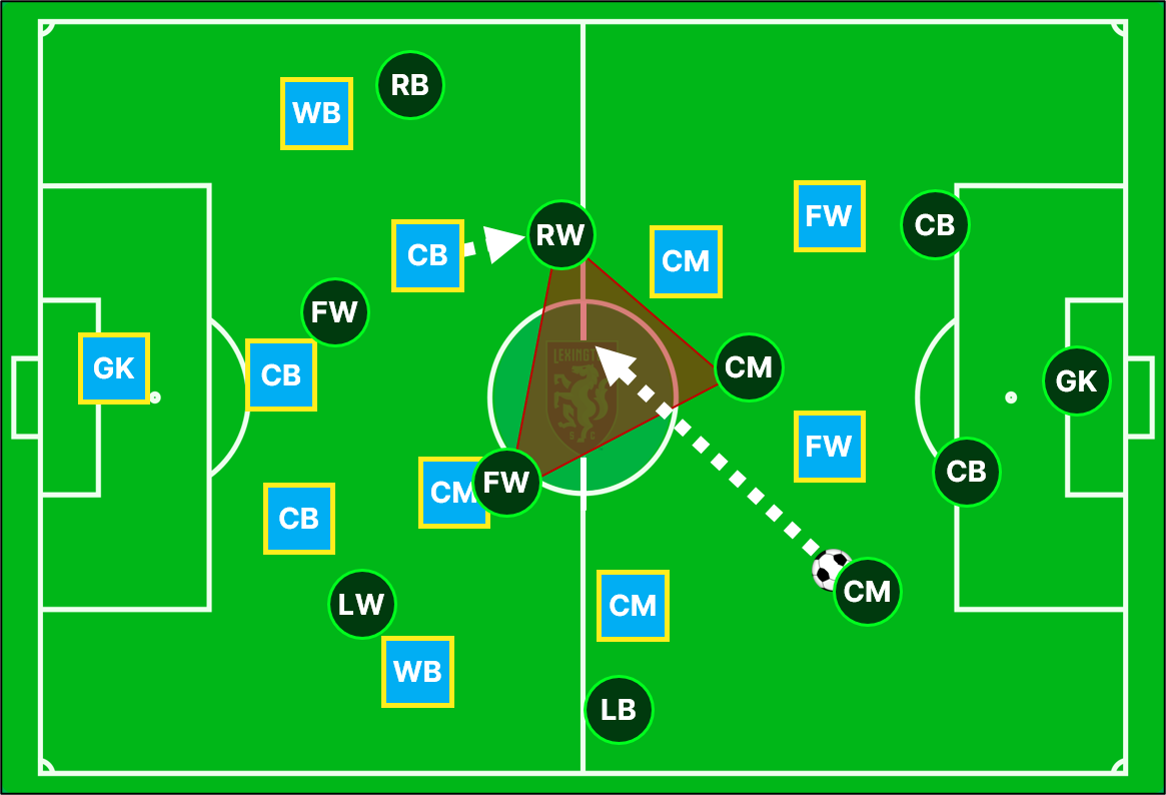
Lexington’s baseline preference was to stick to their usual “three-box-three” shape, keeping Brown low as a pseudo-center back, tucking Griffith in, and ripping up the sidelines via left winger McKenzie Weinert and right back Alyssa Bourgeois. Doing so often attracted Phillpotts, Jacksonville’s left-sided center back, high opening up line-skipping drives into striker Catherine Barry and switches to Weinert.
Still, those sequences were somewhat rare, and Sporting smartly picked moments to peel out of the high 5-1-2-2 press into a mid- or low-block posture – the kinds of situations that bait-and-switch LSC like to avoid. That’s where creativity was needed. The more that, say, Rajaee could drop in and allow Brown to push, the more confused Jacksonville’s marks became.
In their own right, Sporting struggled to build through Lexington’s off-ball 4-4-2. The best of their chances came in transition, namely when that mid-block structure forced the visitors to give the ball away. At that point, star No. 10 Ashlyn Puerta came alive as a carrier in tight spaces, forcing central overreactions and opening overlaps from wingbacks Meg. Hughes and AJ Hennessey. Full-field transitions were also on the menu; if, say, Fontenot stonewalled a carrier and could quickly turn the ball around, it let Sporting advance before the defense could set.
Coming out of halftime, Jacksonville grew markedly more vertical in that same vein. They didn’t waste time on the ball in the first half, necessarily, but Hughes and Phillpotts took particular pleasure in playing long or carrying the ball forward immediately after recoveries. A number of half-chances ensued thanks to that ability to quickly activate forwards Paige Kenton and Baylee DeSmit at their feet.
As the game opened up, Lexington found chances to be opportunistic in their own right. That was eminently clear as they found their go-ahead goal in the 58th minute. The sequence began post-recovery, with Phillpotts trying to drive forward and run the two-man game alongside Hughes.
This time, however, LSC was set in 4-2-4 pressing mode. A closedown from Griffith forced the ball wide, where Bourgeois had already begun to sprint forward and disrupt play. Behind here, Lexington’s No. 6s rotated to provide cover at the same time. The flood of concerted movement forced Hughes into a bad pass – one that center back Allison Pantuso turned into a towering header deep into the opposing zone. There, Barry and the rest of LSC’s forwards were ready to punish the mistake.
In every sense, it was the kind of systematic, talent-driven look that Lexington has made their calling card. Jacksonville tried to refresh their system with a number of like-for-like subs after the concession, but they couldn’t overcome Lexington’s irresistible pragmatic streak. It might’ve been functional and close-run, but it’s the kind of win that LSC stacked up again and again on the way to the 2026 title.