How Fort Wayne FC built a club to last
What Fort Wayne has done to find short-term success within a long-term project

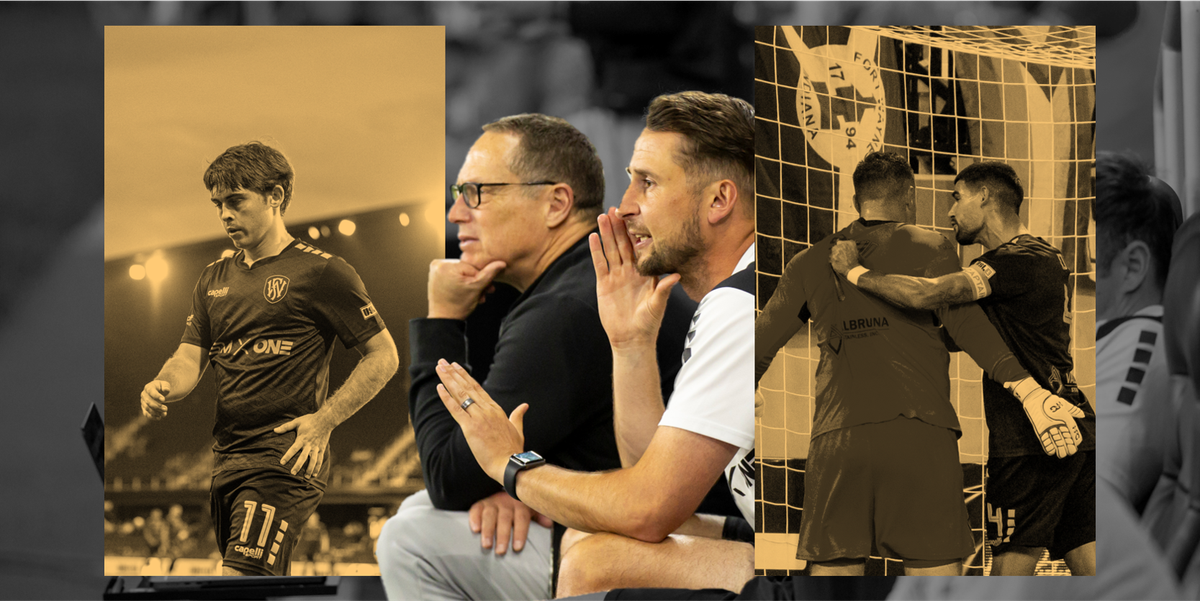
Ask anyone at Fort Wayne FC to describe their mission, and you’ll inevitably hear one word: bravery. On the field, this team will take risks in order to control games. Off it, they've boldly invested in Fort Wayne’s future as a soccer city. If bravery is the bar, Fort Wayne FC is clearing it.
What’s behind Fort Wayne’s success in their first fully professional season in USL League One? Head coach Mike Avery and assistant coach Keelan Barker spoke with USL Tactics to explain their pathway to the pro ranks – and what comes next.
Fort Wayne FC was founded ahead of the 2020 NPSL season, with a local ownership group spearheaded by spearheaded Ruoff Mortgage CEO Mark Music. Avery was hired in anticipation of what became a pandemic-delayed season; later in 2020, the club announced their intention to join USL League Two while adding USMNT legend (and Hoosier soccer hero) DaMarcus Beasley to their ownership group.
For Avery, the chance to join Fort Wayne couldn’t have come at a better time.
“I was a college coach for 30 years or something like that. I had one of those days where I got called into a meeting and five minutes later, I was out of a job because they dropped the program – not because of performance, it was just one of those business decisions,” he recalled. “On that same day, I got a call from a guy named Greg Mauch, who was then the general manager of this Fort Wayne FC project that they were starting. He offered me the job on that same day.”
Avery, 58, played in the NAIA during his college career, staying close to home in California. He earned his first head coaching job in 1994 at the NCCAA’s Bethel State in Mishawaka, Indiana, and he stayed connected in the state through the end of his dozen-year run as the head coach at Valparaiso.
After making the jump to USL League Two, Avery needed to build out a staff, and he brought on a volunteer assistant for the 2021 season: Keelan Barker.
Barker, a native Englishman, played at Missouri’s Coffeyville Community College and Indiana’s Purdue Fort Wayne (née IPFW) during his collegiate career and later returned to Coffeyville as a coach. During Fort Wayne’s League Two days, he continued to manage at the college level, most notably with the NAIA’s Fort Wayne-based Indiana Tech.
Ahead of the 2026 USL League One campaign, Barker joined Avery’s staff on a full-time basis; the assistant runs training sessions while focusing on matchweek-centric opposition scouting under his head coach’s watchful eye. "It's probably the first time in my career where I had someone [like Barker],” said Avery. “I’ve had a lot of talented coaches, but he’s someone I felt was really ready to run the lion's share of training and take things off the plate.”
Barker concurred. “A lot of stuff I do is with the football and the tactics side of things – running the session,” he said. “Sometimes, you catch yourself watching the session, and Mike will come make a point that you miss when you're in the middle trying to run the session, you know. We're fortunate – I've benefited a lot from Fort Wayne.”
That give-and-take relationship flourished during the pair’s five-year run in League Two. Fort Wayne missed the postseason in their first two seasons but won the Valley Division in each of 2023, 2024, and 2025. Over those last three years, the club lost just four games in total. Still, Fort Wayne’s brain trust had bigger aspirations in mind beyond immediate success.
“The goal for us wasn't to be the best USL [League] Two team. The goal was to prepare ourselves for League One.” Avery said. “Our goal was to find how to run this as best as we could – put in systems, processes, ways of doing things so that when we made the jump…we wouldn’t have to start all over when we got to League One.”
Now, that leap has come to fruition, style and all. Fort Wayne plays like they did in League Two. Their core is full of League Two holdovers and first-year college talent. Paired with the nous of sporting director Oliver Gage – a data-savvy executive with experience in the Canadian Premiership and with the USL Championship’s Loudoun United – Avery and Barker were able to build a squad distinct from the rest of League One.
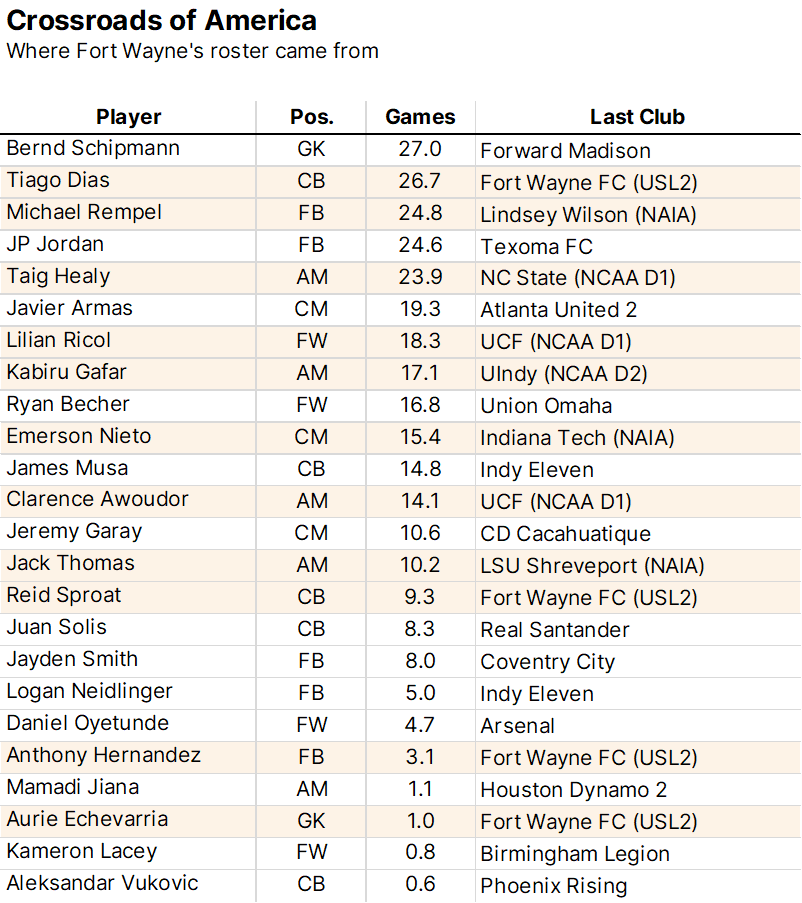
This year, the average team in League One signed 4.3 players from the college ranks or the sub-USL lower leagues. Among expansion teams with a fully blank slate, that average number was essentially unchanged. Fort Wayne FC zigged where every other organization zagged; 11 of their players came from those comparatively under-scouted levels, including multiple additions from the NAIA.
Nearly 200 men’s teams compete in the NAIA, and there’s plentiful talent available for clubs with the expertise to mine it. Fullback Michael Rempel and winger Jack Thomas, for instance, have become stalwarts in the Fort Wayne lineup this year after making the jump from the NAIA. Rempel, who starred at Lindsey Wilson in Kentucky, may be an all-USL player. In Avery’s words, “we watch, we know how strong Lindsey Wilson is; some other places have never heard of Lindsey Wilson.”
Around those new faces, keeping players like Tiago Dias and Reid Sproat (among others) from the League Two roster was essential – and not just because of their obvious talent.
“When we say things to the group, Tiago Dias can go in the locker and say, ‘here's what they mean.’ He can translate for us and reinforce messaging for us. In how we run the club, how we play, some of the terminology that we use might be specific to us,” Avery said. “Having guys who have been around is really, really important because we've been very determined to be Fort Wayne FC. If you watched us play five years ago, we still look like the same team. If you just turn on the TV, see two teams, you don't know who’s playing – you could pick out Fort Wayne FC.”
Both coaches cited Dias as a fan favorite and a model of the club’s ability to tap into existing relationships. Barker brought Dias, a native of Portugal, to the United States at Coffeyville and kept him coming back to Fort Wayne’s League Two program year in and year out. Said Barker: “I remember being there with him and a lot of Division I coaches telling me he's not good enough for Division I. Now, you see him growing up. He's a very, very assertive center back – and one of the best in this league.”
While Fort Wayne intentionally skews young – their average age this season is 25.2 years old, third-lowest in the division – they understood the need for veteran poise. 32-year-old Bernd Schipmann brought three years of starting experience in Madison and a decorated youth pedigree from clubs like Schalke and Eintracht Frankfurt. 34-year-old James Musa played at the 2012 Summer Olympics for New Zealand and spent most of his stateside career as one of the USL Championship’s most reliable defenders. The duo has been a useful resource for the youthful core.
Gage’s no-stone-unturned ability to find unsung talent was also core to Fort Wayne’s 2026 approach. Players like Javier Armas (an MLS Next Pro standout), Jeremy Garay (a former Loudoun midfielder), and Jayden Smith (a Coventry City prospect) have all blossomed in Indiana. Their fits in the Avery-Barker system have been picture-perfect, and that’s no surprise. As Gage told Backheeled over the winter: “You have to be better at realizing how a player is going to fit into everything. I've had some success at finding a guy that's not great in the current team he's in. If you bring him to a different system, then you can strike gold.”
With that spine in place, the coaching staff quickly instilled a sense of style. Fort Wayne are confident on the ball; they’re fifth in League One for possession (53%) and second in terms of field tilt (54%). They're pressureful at the defensive end of the pitch, too. Entering Week 32, Fort Wayne are a top-five side in terms of high turnovers forced (7.0 per game) and final-third recoveries (3.9) alike. None of those numbers are accidental.
“Whether it’s on or off the ball, the very small basics of winning our duels, winning the 50-50s, or the very minute details of throw-ins at the halfway line, a perfect game for us is control for 90 minutes,” explained Barker. “We heard from a lot of coaches around the league that you had a better chance of winning if you didn't have the ball. We’re maybe doing something different, having a young team and a very unique style of play, being brave in how we do it.”
Fort Wayne's been the class of the 2026 expansion class for a lot of reasons, and their ability to lock down the midfield with their 4-4-2 press has been terrific. They flow from mark to mark here, getting support from a CB when needed until they can force a turnover and break. pic.twitter.com/g8uZkdlUyQ
— John Morrissey (@USLTactics) May 31, 2026
From the moment they kicked a ball in their expansion season, Fort Wayne operated with a clear sense of principles. The press is usually based out of a 4-4-2, one that’s relatively man-centric through the middle stripe of the pitch. On the ball, the 4-4-2 bends into more of a 3-2-5 – one in which the personnel are given freedom of expression. Rempel usually releases up the left sideline on the overlap from left back, while right back JP Jordan tucks into the pivot; the dual No. 6s take turns dropping in like proxy center backs.
It sounds complex, but Fort Wayne makes it look graceful. More importantly, the club has improved in their ability to address specific opponents on a week-to-week basis.
“From the get go, the first drills we had on the first training session, it was about overloading centrally. It's a big thing for us to gain control in the middle of the pitch. How we do that is very fluid, and so we try and work on that in training through certain patterns, certain possession drills,” Barker said. “We're talking about principles and recognition. If they step with one player, this is how we build out. If it's two players, this is how we build out. And how does the keeper get involved in that? Now we're at a point where it's a very common language in the locker room."
Between opening day and the first week of May, Fort Wayne played on the road as Ruoff Mortgage Stadium neared match readiness. The season began slowly, but that changed in short order. From May 2nd to July 15th, Fort Wayne ripped off 10 consecutive unbeaten matches in league play – a run that took them from the expansion doldrums to the outside of the top-four race.
Even as Fort Wayne’s form has come back down to earth, player development has provided victories that don’t necessarily show up in the table.
Lillian Ricol provided a near-instant example of what the club is trying to accomplish on that front. The 23-year-old scored 13 goals in 21 college appearances at UCF, having previously competed in the French lower tiers. Ricol hit the ground running in Indiana, putting up 0.79 xG and 5.4 shots per 90 with Fort Wayne – results so impressive that San Antonio FC purchased the forward for a “near-record” League One-to-Championship fee in August.
Did the loss sting in the short term? Of course. Nevertheless, Fort Wayne wants to be a platform for burgeoning talent.
“Every single player that we have, when I'm on a Zoom call with them for the first time, we promise them that this is what we're trying to do. We don't want to be your last club. We just want to be your next club,” said Avery. “Whether it's six months in Lillian's case, or maybe it's six years down the road, whatever comes, we're excited about it. We want to help you get on a platform, give you opportunities to develop. And then when it's time, we're going to help you go and we're going to celebrate it.”
Taig Healy is the likeliest candidate to earn a Ricol-esque move in the near future. The 22-year-old scored 11 goals and notched 14 assists in two years at NC State and was widely considered a surefire MLS SuperDraft prospect. Instead, Healy went undrafted.
From there, Healy had a choice. MLS clubs did have interest, but Healy would start in MLS Next Pro should he sign with one of those suitors. Fort Wayne offered something different.
“For a player like Taig, it's a hard decision whether they go to MLS Next Pro or come to League One. I understand the attraction of the other pathway of going because you're close to a first team, but if you do the math on that, you look at the numbers, the graduation rate from MLS Next Pro to MLS is a very, very small percentage,” said Avery. “We sat down and said, ‘okay, listen, you didn't get drafted. It's not fair. I don't understand it, but it is what it is, right? Let's get over the ego part of it, let’s identify the things that you can do to fix why you didn't get drafted and then add those to your game.’”
Clearly, those lessons have been taken in stride. “When he's done a defensive action, he's going to let the room know that he's done it,” Barker joked. “But he's got the X factor to him, right? I think this environment, this league has been great for him – playing against lads similar to Musa, training with lads like Musa and Bernd [Schipmann] who can tell him it's not always guaranteed that you do well in college and have a 10-year career where everything's great and easy.”
Fort Wayne’s essential strength is that ability to build with multiple time horizons in mind. Healy and Rempel and Dias are contributors now, but they’re being groomed for bigger futures. Ricol has been missed, but he sends a message to any player Fort Wayne wants to recruit in the future: this club won’t stand in your way of big-ticket opportunities.
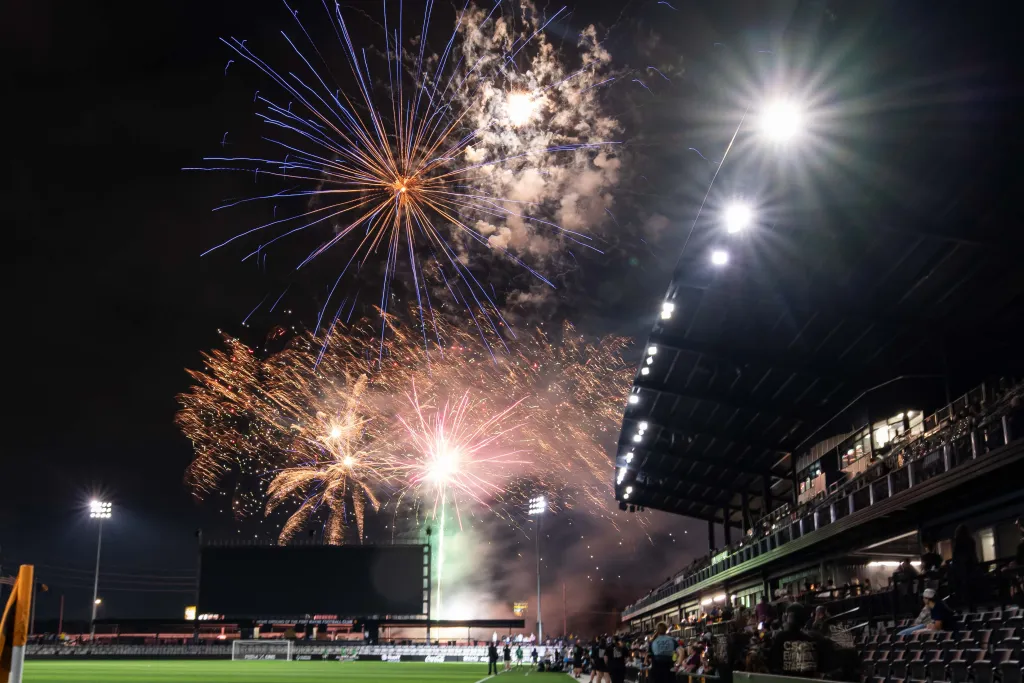
Ruoff Mortgage Stadium, which seats 9,200 fans, operates in that same register. Unlike most USL venues, the stadium was privately funded by Music, who personally contributed roughly $70 million to the project. Cutting-edge features abound; the stadium's video board is the second-widest in the state of Indiana, there's a dedicated section for Fort Wayne FC supporters, and multiple tiers of premium seating were included in the stadium's design. In every sense, Ruoff Mortgage Stadium sets this organization above their USL peers.
In a division like League One, clubs shut up shop every single year. Long-term consistency is rare thing. Building a self-owned, soccer-specific stadium is the most important step a USL club can take to secure their future, and Fort Wayne FC has done just that.
“It's a statement of intent,” Avery affirmed. “We're not a club that's going to fold next year because of financing. Obviously, you wouldn't build that kind of a facility if that was the case. It gives you some stability. It also shows some ambition. You're probably not building a stadium of that size if League One was your final destination, at least down the road.”
More importantly, the venue sets Fort Wayne FC up to be an institution in the local soccer scene well into the future. For a young player in northern Indiana, Ruoff Mortgage Stadium is proof of a pipeline to the pro ranks – one that didn’t previously exist. Prospects like Fort Wayne’s own Emerson Nieto have rarely made the jump in a state that’s known for its basketball mania; investing in soccer's infrastructure and making it a part of the community’s fabric is a game-changer.
For now, Fort Wayne's goal is to close the gap on the top of the League One pile – a gap that both Barker and Avery willingly acknowledged. In the long term, the sky is the limit.
“We use the word brave an awful lot around here. We have to be brave in how we play, how we defend, holding a high line, playing into a crowded middle to the six and bouncing off them. That all takes some bravery in how we play,” said Avery. “It takes some bravery to spend however many millions of dollars on a stadium too, in a place that never had a professional soccer team before. Right from the very top, all the way down through, we're trying to approach this with courage. I'm proud of the fact that we are still who we are.”