The Back Four: Independence Day
On Charlotte's title, conference finals, Rida Zouhir, and the Super League playoff hunt

Welcome in to The Back Four! Need more USL content? Make sure to:
- Visit Backheeled for thorough analysis of the Championship and League One playoffs, plus the offseason transfer and roster tracker.
- Listen to This League! and The USL Show to catch up in podcast form.
Without further ado, let’s get to it.
Playoff Potpourri, Part III
I dug deep into the highs and lows of the Charlotte Independence's title-game win over Athletic Club Boise in Backheeled, but I want to look at the mechanics of their attack for one last time in 2026. This was a match where the flow between left back Joey Skinner and a midfield rife with intelligent movers won Charlotte a trophy, full stop. It's worth considering what the Independence did so, so right.
If you read my coverage of League One throughout 2026, you're already tired of hearing that Boise's defense was "underrated" compared to the attention their possession game merited. That doesn't make it less true!
There were large portions of Saturday night's match where Boise' defensive shape – which often bent into 4-5-1 mode thanks to ball-sided actions from the wingbacks – kept a lid on Charlotte. For a Boise side that gave up just 1.02 xG per 90 minutes in the regular season, that stability was far from a surprise.
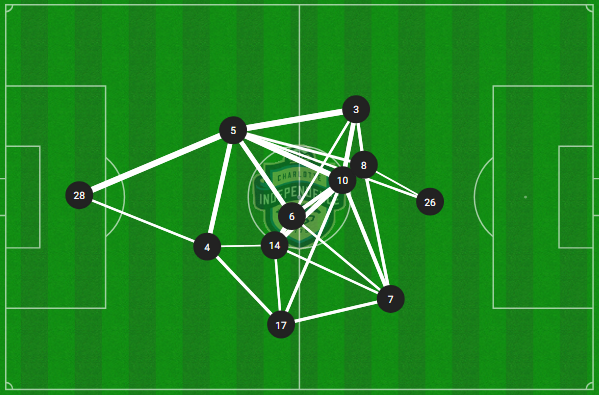
It's a credit to Charlotte manager Mike Jeffries, then, that the Independence ran up 2.2 xG – above their season average – while doubling Boise’s box touches and controlling the flow of play.
Across 2026 as a whole, Boise played more than 470 passes per game, of which 27% ended in the final third. On Saturday night, they underperformed that average by 120 attempts and only played 17% of their passes in the attacking zone. Charlotte, meanwhile, essentially fought to a fifty-fifty draw in terms of possession.
The Independence’s measured approach on the ball – defined by an ability to keep players like right back Clay Dimick or the No. 6s low to maintain a strong resting base – gave Charlotte the tools to limit Boise while holding a 63% field tilt. Even when the Independence gave possession away, Boise wasn't allowed to break forward. This year, Jeffries’ side played 31% of their total passes in the final third. That mark was 29% in the title game – a clear indicator that Charlotte were able to execute on their system as desired.
What made Charlotte so dangerous on Saturday night (and through the season as a whole) was the variety endemic to their attack. As you can see in the pass map a bit above, their offense had something of a leftward tilt by virtue of Skinner’s high positioning and the passing of center back Javen Romero. Nevertheless, drifting, fluid actions up the right were equally able to devastate Boise.
Here, the Independence start build through their right side, activating Dimick while dropping winger Prince Saydee low. There are two main nodes amidst the action:
- Boise starts this play with wingback Blake Bodily high against Dimick, and the showing run from Saydee forces center back Jake Crull to step from the back of the 3-1-4-2ish shape. That wouldn’t be a problem, but No. 10 Christopher Jaime has made a terrific run toward the sideline to replace Saydee and fill the space behind Boise’s bent defense.
- On the weak side, there’s even more motion. Left winger Jon Bakero has sliced toward the center circle, drawing attention as befitting the best player in USL League One. Thus, the flank is wide open, allowing Skinner to overlap with an acre of room ahead of him.
By the time Jaime receives, he’s able to lead what’s almost a five-on-three against Boise’s two remaining center backs and lingering No. 6 Philip Mayaka. Meanwhile, Saydee recovers to become a threat, Bakero trails the play, Skinner is a weapon up the left, and No. 9 Souaibou Marou charges into the heart of the box. Charlotte ultimately get multiple looks at goal, and it takes a stellar bit of work from goalkeeper Jonathan Kliewer to avert disaster.
When you think about the three late goals that won Charlotte their title, the same ideas were at play. Drifting movement from Jaime and Bakero pulled Boise out of shape, putting their wide center backs in impossible situations. Skinner, rightly named an all-leaguer last week, had the absolute confidence to leverage those advantages time and time again. In the end, the performance felt like the platonic example of the patterns and tactical tics that made the 2026 Charlotte Independence the greatest attacking team in League One history.
You’ll catch me dead before I disavow the utility of expected goals, but Louisville City’s wire-to-wire win over the Charleston Battery was a wonderful example of how xG can mislead. Simon Bird’s side put in a genuine defensive masterclass against a Battery team putting on a possessive attacking clinic, limiting Charleston where it counted the very most. Even as they gave up 2.4 expected goals, Louisville never made life easy for their hosts.
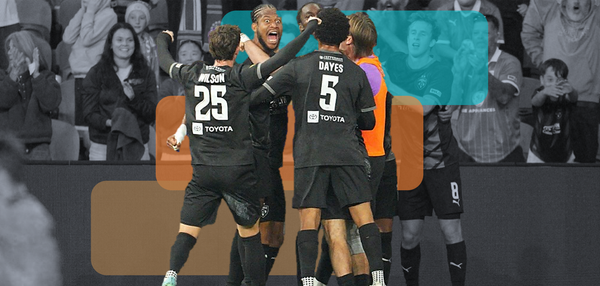
I was worried about a Kevon Lambert-less setup for LouCity, but Brandon Dayes stepped up to the plate. There were a few early moments where the 17-year-old got mixed up in transition prior to Ray Serrano’s opener, but you couldn’t have asked for a more poised performance in terms of in-box defending. Dayes finished the night with 10 clearances, five of which were headed; his positioning next to Kyle Adams and the Aiden McFadden-Sean Totsch platoon couldn’t have been better.
LouCity’s strength was their ability to consistently keep the game in front of them. The Battery were slick, but they almost never found chances to play over Louisville – much less to beat them on the dribble and, thus, force debilitating rotations. Even in more transitional moments, Bird’s side was wonderfully organized and constantly knew how to lower the temperature.
That’s abundantly clear here, where LouCity give the ball away in a somewhat awkward alignment. Initially, you can see right wingback Manny Perez caught high. Off the left, Amadou Dia is so advanced that he isn’t even in frame. Even so, it’s an abundance of small choices that make all the difference.
Immediately after the giveaway, you can spot forward Jansen Wilson press against the ball, stalling Charleston while giving his teammates time to recover back. The Battery are able to work through the counterpress, but No. 8 Taylor Davila takes up an immaculate position in the midfield; he’s hedged at an angle that denies a centering pass into forward Colton Swan, forcing Charleston wide as a result. There, you can see McFadden hedging his bets in case Perez can’t track back in time.
Perez does get back, and that effort denies the hosts a chance to play a quick cross. As Charleston try to cut back and switch the point, the moment has passed them by. LouCity recover into their deep 5-4-1 structure, force a rushed shot from outside the box, and rely on their ultra-compact setup to block that attempt. There’s no egress toward net.
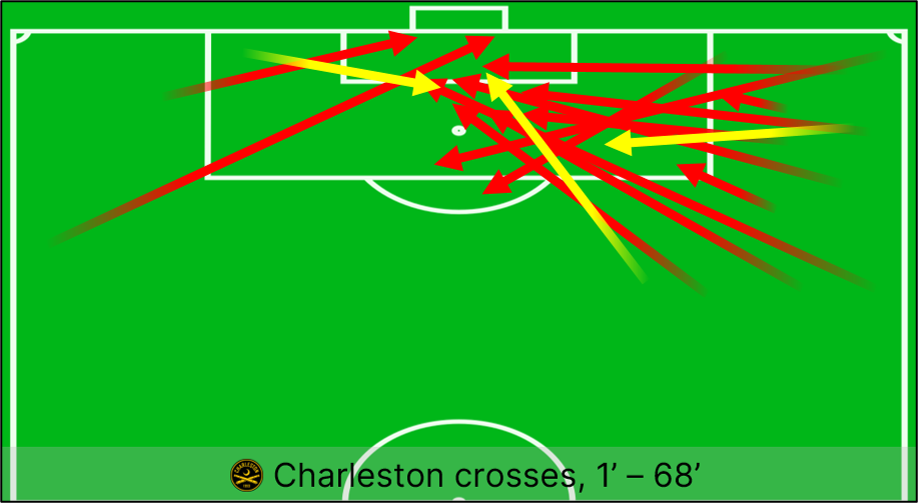
By the time Perez doubled up to put the game on ice, Charleston had gone 3/16 on their crossing attempts – almost all of which came in from the Dia-Adams side of the pitch. Meanwhile, the Battery had attempted just two take-on dribbles in the attacking half. Blame a static lineup or the positional brilliance of LouCity, but there was simply no way to goad Louisville out of shape.
We'll see what gives in the title game next weekend, but Louisville is playing tremendous defensive soccer. It's been true November after November, but the team that figures out how to lock down their box in the postseason is usually the team that takes home the title. Simon Bird's LouCity is looking like the 2026 version of that historic precedent.
Monday night’s win for the Sacramento Republic over New Mexico United was a tale of two halves, but not in the way you’d think. For 70 minutes, United knew how to speed up the game, find an edge in second ball situations, and put Sacramento on the back foot. Then, Kyle Edwards arrived.
In the first half of the match, New Mexico ended up with a +2 recovery margin, won five tackles against just two for the Republic, and held their guests without a shot on target. United had the tools to make stops and break out of their zone. Sacramento didn't.
Dennis Sanchez’s defensive shape – which began in 4-4-2ish mode with Valentin Noel as a second striker but was flexible across the front line – stymied the Republic in build. Off the right wing, Charlie Dennis’ tucked-in physicality was a key tool going in both directions. Above, it's a splendid second-ball win and carry from right back Jake LaCava that does the heavy lifting.
LaCava's individual talent is undeniable here, but consider the before and after. Up front, United's 4-4-2 is able to hew against all-USL center back Lee Desmond, hedging Dennis and Noel in support of striker Greg Hurst at the front of the press. The only choice is to play long, teeing up LaCava to break out.
LaCava's drive and dish to Noel are splendid, but they're also backstopped by a keen counterpress. When Noel receives and hits an ultimately unsuccessful cross, he immediately circles the wagons to mark star No. 10 Memo Rodriguez. Bailey steps from the pivot to deny a lane up the middle, and LaCava – advanced as he is – puts a body on Mark-Anthony Kaye in Sacramento's midfield.
Most of the Republic's early breakouts routed through Kaye or forward-slash-No. 8 Pep Casas, ending with searching balls toward Mayele Malango off the left wing. Malango, who scored in the 70th minute to equalize and, thus, bifurcate the momentum of the match, had an up-and-down night; his lack of defensive tracking was a real problem. Moreover, the tendency for Sacramento to instantly pin themselves against the sidelines by finding the Malawi international was deleterious. That all changed when Edwards arrived.
A HUGE stop from Kris Shakes to keep @NewMexicoUTD level! 🙅♂️ pic.twitter.com/5RRJjbkRYU
— USL Championship (@USLChampionship) November 17, 2026
Prior to Edwards’ entrance off the bench in the 70th minute, Sacramento took just six total touches in the box. In the 50 pursuing minutes, that count was 12. Crucially, Edwards gave the Republic ability to attack directly up the middle of the pitch.
Why does that matter? For one, Sacramento’s central service regularly forced goalkeeper Kris Shakes off his line – something that didn’t happen when the long balls were aimed toward the left sideline.
This year, Shakes led the USL with 32 sweeping attempts and succeeded on every single one of them, per Opta. If there’s a goalkeeper in the Championship that you trust coming off his line, it’s Shakes.
Still, no goalie is comfortable when they’ve got a striker charging at them in a one-on-one, and Edwards’ ability to break out, beat the center backs, and do so from central angles put Shakes under constant duress. This year, the 29-year-old led all USL strikers with 4.8 shots, 1.0 xG, and 1.2 goals per 90 minutes. That voracious quality was impossible to miss on Monday.
Of course, Sacramento wouldn’t have been able to platform without their bend-don’t-break defensive identity. Desmond (15 clearances) was splendid as the left-sided center back, constantly corralling Dennis and limiting the quality of his chances. Jared Timmer was under even more duress in open-field situations and only gave up one truly memorable chance, an early shot for winger Joseph Melto; after he went down, Freddy Kleemann was implacable, putting in a game-saving stop just before the final whistle. As always, Danny Vitiello stepped up to the plate in net. The veteran prevented 1.1 full goals above expected, and he even got the game-winning assist to Edwards in the 102nd minute.
All of it was recognizable for this Republic team. Sacramento is undefeated since early August for a reason! This team grinds you down, never makes bad mistakes, and knows when to fall back on their defensive base. When push comes to shove, Edwards has been the difference-maker late in games. It’s pragmatic work, but it’s got Sacramento in position to win it all.
Guys I Like (Eliminated Edition)
Another week, another check-in with some of my favorite dudes from eliminated clubs. This time around, I want to take a look at a player from a close-but-no-cigar non-playoff team: Loudoun United’s Rida Zouhir.
Zouhir was a mid-season addition at Segra Field, and he only played about 500 minutes. Still, you saw the pedigree from a 22-year-old that was highly touted as he came through the Montreal system and tore up the USL on loan with both San Antonio and Birmingham. Now locked down in Virginia through 2027 – under sporting director Alen Marcina, who coached him with SAFC – the sky is the limit for Zouhir with Loudoun.
Zouhir’s arrival coincided with that of breakout star Eddy Davis (a loanee striker) and Akil Watts (a Zouhir-esque MLS ‘tweener) in the second half of the campaign. Within the revitalized United lineup under manager Anthony Limbrick, Zouhir usually sat in the double pivot of a 4-2-3-1ish formation next to either Watts or James Murphy.
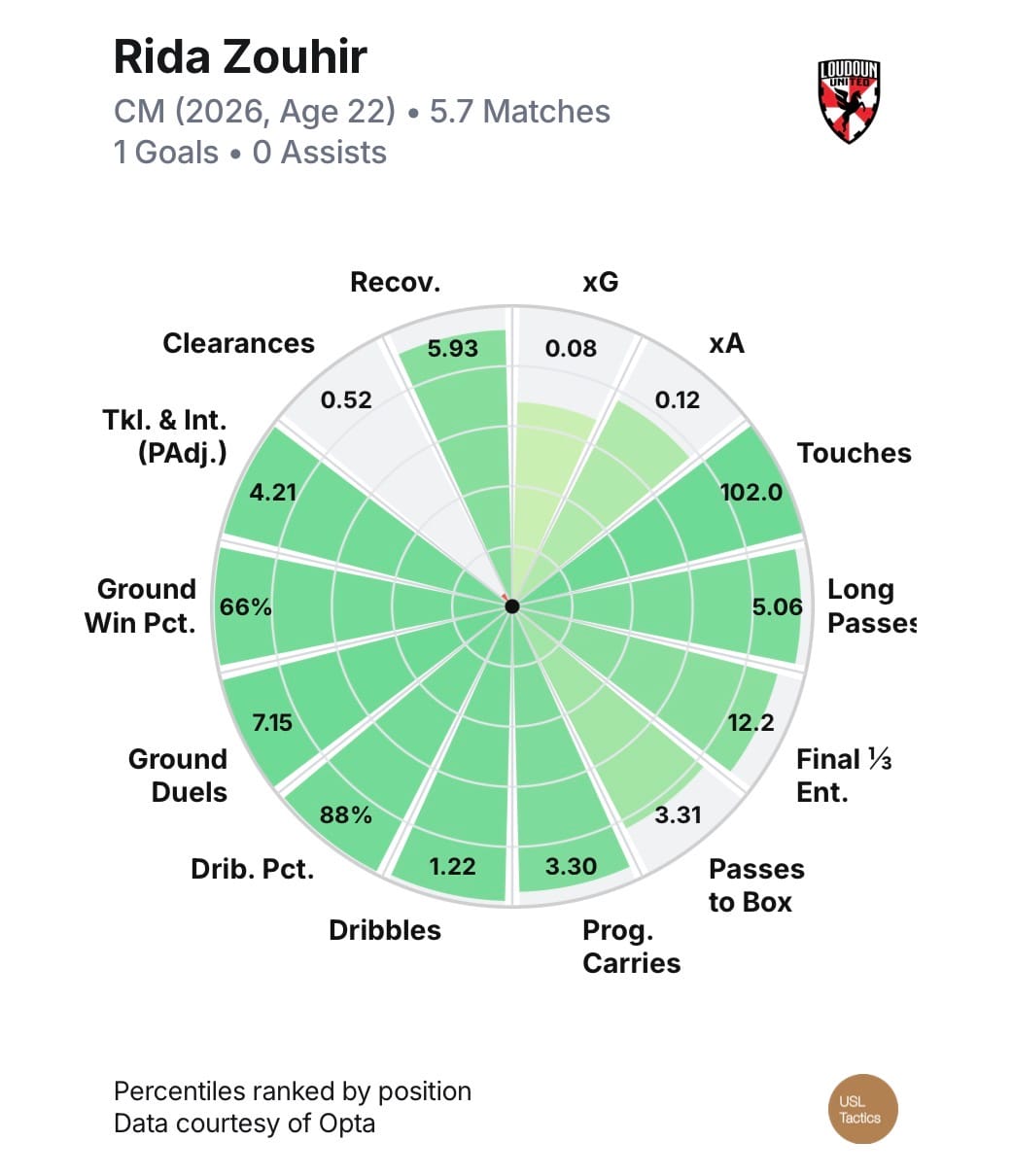
Pace of play and ground-based passing were key to the Loudoun identity; as much as possible, Loudoun wanted to press high and take the fight to their opponents. Zouhir’s ability to keep the ball on a string, vary his passing choices, and backstop a retentive final-third setup powered a fairly strong finish to 2026. The numbers make that clear. The small sample size mattered, but Zouhir put up numbers that would’ve landed him in the all-USL conversation if blown out over a full calendar year.
Zouhir’s set-up play from deeper spaces is his calling card, but he’s also capable of pushing forward into the attacking zone. A return of 0.20 xG+xA and 3.3 non-cross box passes per 90 is far above what you’d expect from a typical holding mid. We saw Zouhir’s physical, caroming profile pay dividends in San Antonio – where he had full license to be a wrecking ball – and hints of that skillset also shone through with Loudoun.
Above, for example, you see the 22-year-old’s thunderous goal in United’s season finale against Brooklyn. The goal is all about two things: Zouhir’s hammer of a right foot, and his ability to pick out space while properly timing his run. Still, the No. 8 is judicious; the second example illustrates his mixed-length passing and smart, complementary movement close to goal. It isn’t just about the glory on the scoresheet for Zouhir.
Loudoun usually possessed with, at minimum, a “2+2” base where both No. 6s sat in to interface with the center backs; help from deeper fullbacks often arrived to increase those numbers. Against more lax mid-blocks, then, it often took moments of real skill to break the opposing shape or beat a defender to move the ball forward. Zouhir regularly made those things happen.
You get a menagerie of the Montreal native’s tics and tricks above. From cross-field switches to one-touch passes and strong give-and-go instincts, the midfielder always brings an understanding of when to push the envelope and when to keep things safe. That Zouhir took an eye-watering 102 touches per 90 in 2026 was no mistake; he’s got the complete game to effectively bear such a burden.
Loudoun’s ability to get back into the playoffs in 2027 won’t ride solely on Rida Zouhir, but the fact that he’ll be this club’s anchor through the center of the park is a major boon. The 22-year-old still has plenty of room to keep improving, and that should be a scary proposition for the rest of the league.
Super League!
Doing another quick-hit segment, insert "I became important at work..." tweet here. I’ll be back to the normal tempo for the final week of the regular season, I hope.
Playoff odds!
As with any other USL league, I’ve got the playoff odds model running. The short nature of this Super League season has been a bit wonky, but this is what my numbers make of the current postseason race:
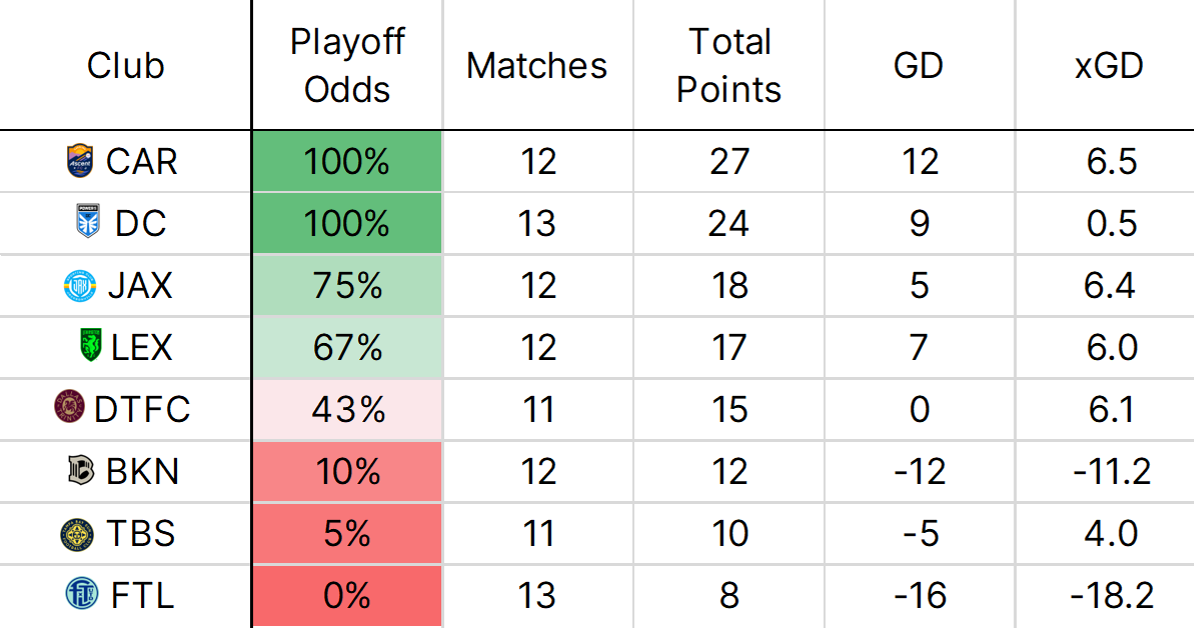
Entering the matchweek, Carolina was the only club to have clinched their spot. Week 14 was full of developments; a midweek game for DC saw Power clinch, while Jacksonville and Lexington also picked up big results to stake their claim on playoff places. Still, there’s everything to play for between now and November 28th.
DC (4) - BKN (0)
The managerial version of a heat check is winning four games from your last five and then changing shapes. That's what Omid Namazi’s DC Power pulled off on Wednesday night against Brooklyn FC. Rather than stick with the 5-2-3 variations that had proved dominant throughout October and early November, Namazi elected to go blow-for-blow against Brooklyn by matching their 4-4-2.
If you’re looking for the player who best embodies Power’s flexibility, it’s Emily Colton. Last year, she mainly played as a right-sided No. 8, a position from which she earned three assists in the run of play. After a three-assist night against Brooklyn, Colton – who’s been reinvented as a left winger-slash-forward – now has four assists in the run of play amidst a truncated schedule.
Colton’s pseudo-striker abilities have been essential to DC’s sharpened attack throughout the fall, but she’s also a keen presser. That No. 8’s instinct hasn’t fallen by the wayside. Against Brooklyn, a team that’s done well to build around the back and exploit wide combos against overdrawn defenses, that quality continued to shine through. Colton and partner Loza Abera did splendidly to pinch against Brooklyn’s build game; one would go at the on-ball center back, the other would mark lone No. 6 Jennifer Cudjoe, and Brooklyn would be trapped.
Loza's 𝙊𝙉𝙀-𝙏𝙊𝙐𝘾𝙃 strike ⚡
— Gainbridge Super League (@GainbridgeSL) November 12, 2026
Six on the season for @LozaAbera, who's making it three straight games on the scoresheet for @DCPowerFC! 🚀 pic.twitter.com/9dxXhDS9J0
DC needed just 10 minutes to open the scoring at midweek off a well-worked corner, one where a far-post serve from Abby Boyan and a nice header back by Sam Cary Angel teed up Emma Jaskaniec for a gritty finish. Then, Colton took over.
In the 27th minute, Abera dropped deep to facilitate, playing left winger Kayla Colbert into space to push DC forward. All the while, Colton probed the left halfspace, waiting to receive. As Power worked their way into the box, the forward was able to find a touch, receiving with her body at an angle that made a sideways pass into a late-breaking Abera a viable option. The Ethiopian international struck true from there.
Stellar Abera-to-Colton-to-Colbert interplay made it 3-0 just minutes later, and DC added a fourth goal (off the final Colton assist) via substitute Tyler Lussi late-on to seal a crushing four-goal win. That victory locked up Power’s first-ever playoff berth and highlighted everything that Namazi has got right in 2026.
LEX (4) - FTL (0)
Coming into Friday night’s match against Fort Lauderdale United, Lexington SC ranked last in the Super League for pressed sequences (113), last for high turnovers forced (81), and second-to-last for average start position of possessions (42.3 yards upfield). That’s a nerd’s way of saying that LSC rarely pressed high upfield.
A lot went right for manager Kosuke Kimura and his Lexington side in Week 14, but a renewed commitment to high pressure was crucial. LSC’s 4-4-2 shape didn’t change, but a focus on pushing into Fort Lauderdale’s box to disrupt build felt novel. As a result, the defending champs shut down what’s been a strong, structured possession team led by center backs Haley Thomas. In the end, Lexington forced 11 high turnovers – 50% above their season average – while also making 10 recoveries in the final third.
Lexington’s opening goal was a perfect example of how that shifted approach could pay dividends. There, in the 20th minute, LSC flexed into more of a 4-2-2-2 or 4-2-4 mode, with striker Catherine Barry and winger Alyssa Bourgeois closing to the ball side. When Fort Lauderdale passed back to goalkeeper Haley Craig, that triggered a hard close from weak-side striker Addie McCain, who intercepted a panicked Craig pass and furnished Barry with a tap-in.
Above all else, it was left winger Hannah White that set a hard-edged tone for Lexington. We’ve seen White split time between second striker and wing roles this year, and her ability to do a two-way job off the flank underpinned LSC on Friday. White attempted a game-high 21 duels, never giving United a chance to breathe.
That sensibility is clear above. You get some classic “three-box-three” attacking from Lexington at the start of the play, with both Barry and McCain dropping in as connectors. Bourgeois breaks through, but she’s stonewalled; it should be a prime moment for United to break. Watch White’s response from there. Lexington’s No. 8s overcommit, but White’s work rate allows her to get back, stop the break, and completely gum up the works.
White was eventually rewarded for her effort with a peach of a goal in the 39th minute, and LSC never looked back. In a match with major playoff ramifications, the response across the board was hugely promising for Lexington.
(Other note: rookie goalkeeper Marz Josephson looked assured after getting the nod over Gotham loanee Ryan Campbell. While Campbell had posted a 71% save rate to start the year, she’d allowed 0.7 goals above expected; the change felt like a statement on Kimura’s part, and you can’t argue with the results.)
JAX (1) - DC (1)
Sporting Jax have won but a single soccer match since the start of September, and that’s inclusive of Sunday’s 1-1 draw against DC Power. That stretch of nine matches has yielded just nine points overall, yet Jacksonville remain the #3 seed in the Super League with just two matches left to play. It might not be the prettiest soccer you’ve ever seen – nor the most controlling – but it’s probably going to be enough to get Sporting back into the playoff field.
Power reprised the 4-4-2ish off-ball shape that was so effective at midweek, making only slight changes to their system. Anna Bagley’s presence off the left wing was a welcome one; she tended to sit narrow in possession, giving Sam Cary Angel room to overlap from her left back-turned-winger position.
Still, Sunday was all about Jacksonville’s ability to break their guests down. Stacey Balaam’s side was somewhat more patient than usual. We still saw goalkeeper Jamie Gerstenberg hoof it long in restart situations fairly often, but she was willing to step out of her box and become a human reset button in the build-out phase. Gerstenberg played a season-high 67 passes, pairing with Keeley Dockter – a new starter replacing the recently up-and-down Maggie Illig – to underpin Sporting’s approach. (That a fairly left-leaning Jacksonville side generated a 40% plurality of their offense up the right was a testament to Dockter’s impact.)
That prevailing pattern is clear here, where you see a sequence play out as Dockter receives amidst a side-to-side passing play. As she receives, the defender draws a close-down from Bagley as DC flex into 4-2-4 mode. Still, Doctor is able to find low-seated wingback AJ Hennessey, who’s one-on-one against Angel in supporting rotation.
A less fluid team would stall out here. Instead, Jacksonville No. 8 Sophia Boman makes a splendid diagonal run toward the sideline, replacing Hennessey and drawing a mark in the act. Power’s response at every single step of this play is exactly what Omid Namazi will’ve wanted, yet there’s still an opening for Hennessey to receive on a return pass in full-blown 3-1-4-2 mode and play striker Paige Kenton through on the turn.
Think about Sporting’s 60th minute equalizer, and you’ll see those same patterns. There, Hennessey found Ashlyn Puerta making a near-identical run to the one we just saw from Boman, slicing through lines on the diagonal. Puerta, in contrast to the early play, was able to find her own pass into the box, cause havoc, and set striker Baylee DeSmit up to score. That goal was key for Jacksonville, and it provided tangible pay-off to the changes they brought to the table on Sunday.
In other news…
People in Sacramento, say hi to me on Saturday!
My friends at The Union Report invited me to answer a few offseason preview questions about Monterey Bay FC, and I responded with like 1,200 words of thoughts. If you need the lowdown on where I’m at with MBFC, check that out.
In “monitoring the situation” news, Brooklyn FC and Sporting Jax both parted ways with sporting execs after disappointing debut seasons. Neither Brian McBride (the sporting director in Brooklyn) nor Mark Warburton (president of soccer in Jacksonville) could build a winner in 2026 at the USL Championship level, though the latter put together an extremely successful Super League side in Florida. I’ll be fascinated to see where both clubs go; it’s increasingly necessary to have a layer of front office expertise beyond your manager, and most USL teams have tended to hire execs with intra-league or Next Pro tenure that neither McBride nor Warburton brought to the table.
Supremely gutted for all of the staff, players, and fans for the Sarasota Paradise after last week’s announcement that the club won’t be participating in the 2027 League One season. This club looked like they were doing things the right way on the pitch, and it seemed like they were extremely well-positioned to make a leap in their second season. Instead, Paradise became a reminder of how tumultuous League One can be.
(This division has launched 10 new clubs since 2024 – the first full season after Paul McDonough joined USL HQ. Four of those clubs have already folded, and more trouble could be on the way if rumors are to be believed. McDonough told Backheeled in the fall that the USL is re-thinking its approach; 2027, the first season where McDonough and the new private equity-aligned leadership in Tampa Bay have full command over the expansion strategy, will be a major litmus test for the truth of that assertion.)
Always read Nicholas Murray: excellent look at LouCity's defense, simpatico with my breakdown in the newsletter.