The Back Four: Summer Mailbag
In which you guys asked more questions than I expected


Welcome in to The Back Four!
As always, visit Backheeled for more USL content, including deep dives into all things Championship and League One. Also, listen to This League! and The USL Show to catch up in podcast form.
Next week, I’ll be back with an in-depth Super League preview. For now, let’s get to a special mailbag edition of the newsletter.
Mailbag!
With love to Patrick Blanton and Turner Hawkins across social media platforms, I'm combining two questions – why won't LouCity sign a center back, and who are realistic targets? – into one.
The “why” here is tricky and multifarious. On one hand, I think that Louisville reasonably expected Kyle Adams and Sean Totsch to, uh, not be bad. Who needs extra defenders when your stars are surely gonna regress to the mean…right?
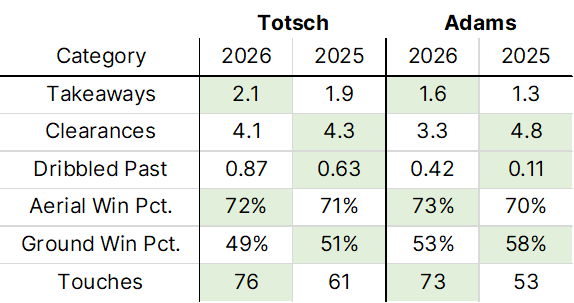
That hasn’t happened. This year, Totsch and Adams' numbers have evolved in identical ways. The changes are indicative of a stylistic change that's harmed both players.
Totsch, 34, and Adams, 29, have both seen their ground duel win rates plummet (-3.5% combined) and their dribbled past numbers (+0.5 times more per game) increase. Both metrics are good proxies for one-on-one defending. Though each defender has maintained their aerial win rate, that's come alongside a significant drop in overall clearances (19% less per game). LouCity is tilting the field to a greater degree, yes, but the decline isn’t commensurate. As a cherry on top, both players are taking way more touches in 2026.
What story does the data tell? The two vets are being asked to possess the ball higher upfield and intervene more aggressively in dangerous territory. Those new responsibilities have, in turn, prevented Totsch and Adams from focusing on their usual cleanliness around the 18-yard box.
That's a roundabout way of saying that Simon Bird thought his good defenders would stay good – even as the LouCity system evolved. As the regression became clearer, I suspect that Louisville convinced themselves that they had sufficient depth and still didn’t need reinforcements. (Let’s be real: I would've done the same!)
Josh Jones – my preseason pick for Defender of the Year – surely wasn’t expected to miss virtually all of 2026 due to injury. The health waiting game precluded any big swings, and options seemed to abound behind Jones. Brandon Dayes has looked good in his stead; Amadou Dia has been fine as a backup central defender over the years, and clearly the staff saw something out of Carlos Moguel in the preseason. Throw in Kevon Lambert as the “break glass in case of emergency” guy, and it’s not hard to understand why the LouCity front office has been complacent about their situation at the back.
That Simon Bird changed goalkeepers twice-over is a meaningful data point. Louisville conceded 6.5 goals above expected from opening day through May 23rd, when Hugo Fauroux was the primary starter. The defense wasn’t bad bad at that point, but the goalkeeping was. We’ve seen Fauroux and Danny Faundez split minute since then, allowing a still-terrible 3.2 goals above expected. If you’re starting from the position of “our center backs are actually fine and goalkeeping is the problem,” the inactivity becomes more explicable.
Still, the xG can only tell you so much at a certain point. That’s become achingly clear. On-paper chance quality might look low in a crowded box, but finishing is far easier when the Adams and Totsch types aren’t putting a body on an opposing No. 9.
Who, then, should Louisville be looking at? My galaxy brain take is that they should throw, like, $35,000 at the Sarasota Paradise and get Declan Watters to run the show. Watters was an all-league pick for Chattanooga last season and is one of the best set piece options in the USL across both boxes. He’s comfortable in a physically demanding role as part of a back three from his days with the Red Wolves, but he’s shown more nous than you’d expect from a 6’5” battering ram in Sarasota’s back four this season.
MLS loans are another attractive proposition. I don’t claim any deep knowledge of Next Pro ‘tweeners, but why not knock on New England’s door and ask if Gabe Dahlin (6’3”, comfortable across a back three, 54% aerial win rate) is available? Shoot a text to Danny Cruz and see if Alpha Kabia (hyper-athletic, 2.3 tackles per game, 0.95 interrupting g+) is ready for the big leagues on loan from Minnesota. Maybe Wes Charpie is up for a last dance! (I’m only 60% joking.)
Andrew Bolte hit me with a double-barrel question. We'll get to the second, less soccer-y question at the end. First, Andrew asked: "Which Eastern and Western Conference playoff contender would have the highest ceiling if they added one more piece to their roster?"
I put this question here for a reason: Louisville needs center backs, and you can read about it above. To recap, LouCity’s reliable stalwarts have regressed, their depth options have been shaky, and the problem wasn’t taken seriously enough. Throw in bad goalkeeping and a lack of transfer action, and you’ve got a 3-4-3 that’s never looked so shaky at its back end.
The answer in the West is equally clear. San Antonio needs a big, reliable striker. Christian Sorto has done an admirable job as a fill-in-the-blank No. 9 this season, but he’s an attacking mid at heart. SAFC is currently 20th in the Championship for box touches (17.1 per 90) and 15th for conversion rate (10.9%) because they don’t have enough of a presence up top. Maybe Santiago Patino or a healthy Alex Greive can be the man; the lack of an answer is what’s holding San Antonio back.
Jon Hunt, whose Substack on Lexington SC (and all things soccer ) you should be subscribed to, asked: "What player is the most unsung or overlooked in USLC, USL1, and last season's Super League?"
Championship-wise, my gut instinct was Emilio Ycaza, but I just named him a Top 50 player in the USL. Likewise, I thought about Jean-Eric Moursou in Phoenix, but we haven’t shut up about him over the last 15 months across a slew of This League! episodes. That leaves Pittsburgh defender Lasse Kelp as my pick.
Kelp, 23, is a rookie out of Maryland that defies an easy positional designation. He defends like a left back in the Riverhounds’ 4-4-2, but he sits in as a resting central defender when Pittsburgh has the ball. That sort of deployment is demanding for any player, but Kelp has managed it with the utmost poise. The defender’s duel numbers are off the charts, and he’s shown elite instincts asserting himself in the counterpress. Moreover, Kelp is attempting nearly 12 final-third passes per 90; he knows when to hit a riskier ball upfield, leveraging his deep gravity to find attackers in space.
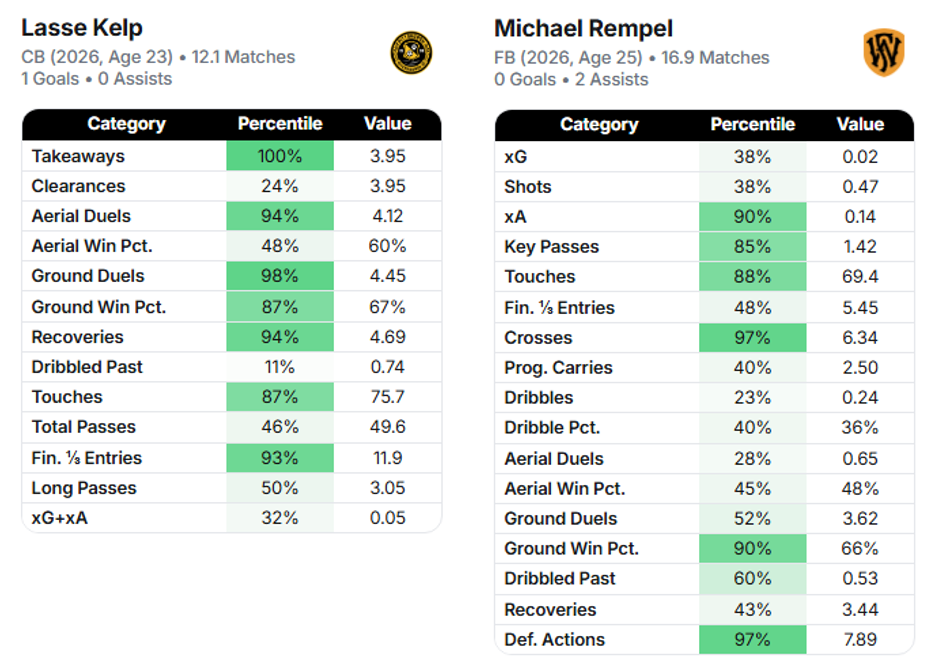
In League One, I considered a few attacking players (most notably including AV Alta’s talismanic Jerry Desdunes) but ended up with Fort Wayne left back Michael Rempel. If Kelp is a defense-first player at that same ostensible position, Rempel is the yin to his yang. A first-year player fresh off a historically great college run in the NAIA, Rempel is already an elite attacking fullback at the USL League One level.
This year, Rempel has only two assists in the league but is creating 1.4 chances per game on elite xA numbers. Though the 25-year-old’s stats are inflated by his set piece responsibilities – Rempel hits a sweet left-footed inswinger – that’s a feature rather than a bug. I briefly highlighted the fullback’s comfort jumping passing lanes in this week’s League One column, and that’s a growing part of his game. If you want a left back that can play on the front foot across phases, Michael Rempel is your man.
Because this has accidentally turned into left back show-and-tell, I’ll stay on theme in the Super League with Dallas Trinity’s Cyera Hintzen. Now entering her third year with Trinity, the Garland native had a cup of coffee with Gotham FC in the NWSL before moving to the Super League. Hintzen, 28, played as a forward in her first season and notched a perfectly respectable five goal contributions, but she leveled up last year at the back end of Dallas’ system.
Hintzen, like the other players I’ve highlighted here, is a thoroughly modern fullback. Often, she’d defend low in a back four but rip forward like an out-and-out winger during the stretch run in the 2025-2026 campaign. At other points, she’d take up supporting positions in more of a possessive 2-3-2-3. Along the way, Hintzen put up 2.6 progressive carries, 5.2 recoveries, and 0.14 xA per 90 minutes. We’ll see how manager Lee Nguyen remakes Dallas, but Hintzen feels like a big piece of the puzzle.
Caroline Stefko, who's an essential read and listen for any fellow Spurs supporters, asked: "Thoughts on Joey Batrouni’s first season as starting keeper for SAFC?"
In a word, Joey Batrouni has been excellent. Batrouni, 24, was a glorified backup last season that only figured into USL Cup action behind a resurgent Richard Sanchez. I don’t know what Carlos Llamosa and his staff saw over the offseason, but the choice to hand the job over to Batrouni has been inspired.
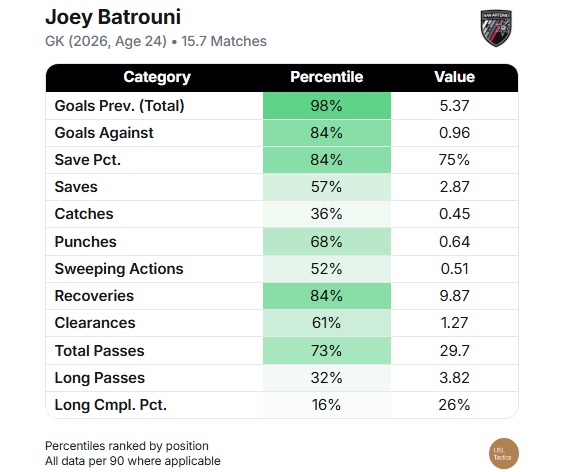
Batrouni has posted more high-save games (i.e., four or more stops) than all but six other starting USL goalies. He’s a very strong rhythm goalkeeper; when he finds the zone, you aren’t getting past him.
The workload has been difficult, too. According to American Soccer Analysis’ data, the average shot Batrouni has faced has been worth 0.38 xG – the fifth-highest number of any goalie that’s started 10 or more matches this year. In a season where San Antonio has overperformed relative to their xG numbers, Batrouni is the primary reason why it’s happening.
Luke Martin, America’s favorite Tormenta beat reporter, asked: “Who is/are the best dribbler(s) in USL1, and can you incorporate Ini Kamoze's ‘Here Comes the Hotstepper’ into your response?”
To be clear right off the bat, I think every successful dribble is a hotstep in its own special way. In terms of an actual answer, there are a few ways to go here. If you're brute-forcing it according to the historical data, then the top five dribblers in League One history are:
- Nil Vinyals, 262 successful dribbles
- Rafa Mentinzen, 197
- Jay Tee Kamara, 142
- Derek Gebhard, 137
- Adrian Billhardt, 121
With all due respect to the excellent Nil Vinyals, elite one-on-one dribbling isn't the first thing I associate with his game. What if we limit the scope to single-season performances? If you (a) limit the player pool to those who tried at least 50 dribbles and (b) prorate on a per-game basis, you get:
- Ilias Aoumaich (2026), 5.1 successful dribbles per 90
- Jayden Nelson (2019), 4.7
- Jay Tee Kamara (2026), 3.7
- Jay Tee Kamara (2025), 3.7
- Jayden Nelson (2021), 3.6
Beyond the fact that we should be paying more attention to the Aoumaich brothers at AV Alta, there's a clear trend emerging. Jayden Nelson (who starred for Toronto FC II and played for Canada at this year's World Cup) and Jay Tee Kamara (in his second year with Portland) have been historically prolific. Kamara also owns the seventh-best dribbling season of all time, the 2021 campaign he spent on loan in North Carolina. For my money, he's the answer.
Still, there's a nagging thought I need to address. If we're really doing justice to Ini Kamoze, we should pick dribblers in the "lyrical gangster" and "murderer" buckets alike.
Kamara is firmly in the former camp; he's bold, fast, and loves to take players on anywhere on the pitch with a real sense of panache. If you want a "murderer," the answer is Mayele Malango. No player in League One history has completed more drives into the box than Malango, per Opta. His ability to do damage close to goal eventually earned a move to the USL Championship, where he's become a defining piece of the Sacramento Republic system.
Daniel Poulter, who provides terrific local coverage of the Oakland Roots, asked: "What do you think the Oakland Roots need to do to turn this around? Is it the system or the players?"
I love watching Wolfgang Prentice, and I think he's an excellent player. That said, if you compare his heatmap off the left wing in 2026...
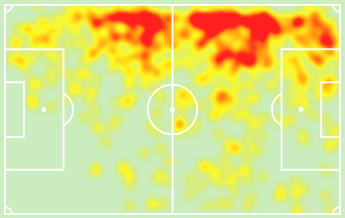
...with Loudoun winger Abdellatif Aboukoura's under Ryan Martin in 2025...
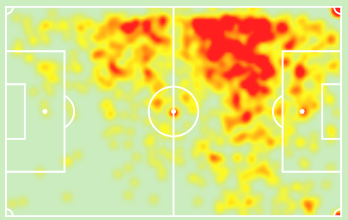
...you can immediately spot the difference. Prentice isn't the problem on his own; in fact, his something-out-of-nothing verticality is a major boon for the Roots. Nevertheless, he's the best representation of a team that doesn't have an Aboukoura-esque talisman between the lines.
We know that the Ryan Martin system can work, but it’s less clear that it can work with this specific Oakland roster. The Roots are very good in the build phase, and they’re very good at getting into 2-2-4-2 attacking mode with two center backs and two center mids – usually Tommy McCabe and Bobosi Byaruhanga – running the show. Without a bonafide defensive progressor (a la the injured David Garcia) and given Byaruhanga’s somewhat limited passing, connecting the dots from back to front has been a chore even when the structure is there.
In that sense, the problem is one of system and personnel in equal measure. Has Martin stuck to his tactical guns for too long? Probably! Still, this roster isn’t hitting its potential. Neither Danny Trejo nor Florian Valot have lived up to their track records as between-the-lines threats. Faysal Bettache has been fine, but he isn’t a game-changer. In lieu of a nailed-down linking player, Oakland has tended to overextend and put themselves in bad defensive positions. It’s a hornet’s nest of small-yet-interconnected issues that are compounding into something bigger.
(Will Bruno Lapa – just added via transfer – be the solution? We'll see! I think he's a great fit as a between-the-lines guy, but he looked like a terrible fit in Tulsa. Real coin flip addition there.)
Orange County Soccer Cast's Bluesky account asked: "Is Orange County's 'Bend Don't Break' stat-breaking season sustainable through the post-season?"
Firstly, the audiovisual learners in the crowd should check out our discussion of this point on last week's This League! episode to get the statistical context.
Second, I think the answer to the actual question is an unwavering yes. Just look at the run Pittsburgh went on last year! That team scored one single goal across their final 540 minutes of 2025, yet they used a bend-don’t-break defense to win it all. Admittedly, the comparison isn’t one-to-one. Pittsburgh was vicious in the way they tried to tilt the field; during that aforementioned five-match run, they averaged a 58.3% field tilt. Right now, Orange County’s season-long average is 35.9% – one of the lowest we’ve ever seen in the USL.
In other words, I’d feel better if Orange County were a smidge more moderate, but November is designed for defensive soccer. As long as Lyam MacKinnon and Ousmane Sylla can come up with some magic, I think the system is complete enough to get it done.
ShadowWulf, the undisputed king of German-speaking USL fans, asked: "Is Bobby Murphy still the right coach for the Hearts of Pine – in your data and opinion?”
His question came alongside some of the pertinent data, noting that Hearts have dropped 15 points from winning positions this season while allowing nearly a third of their goals after the 80th minute. That’s nerd-speak for “Portland cannot finish games.”
Right now, my model gives Hearts a 23% chance of making the postseason. For a club that entered 2026 with genuine title aspirations, that’s unacceptable. The poor results aren’t a fluke, either. Portland is putting up just 1.25 xG per 90 while allowing 1.50. They’ve flitted between formations without any sense of clarity along the way. Yes, there’ve been extenuating circumstances – the loss of Masashi Wada can’t be overstated, and Titus Washington's injury has been similarly devastating – but it simply hasn’t been good enough at Fitzpatrick Stadium.
Results aside, Portland’s change of style has been baffling to see. Manager Bobby Murphy’s press has lost its teeth, hence why Hearts’ final-third recovers are down 37% year-over-year. Moreover, Portland has kept the ball on the ground more often (see a 14% long pass share, down from 17%) and tried to string together more intricate passing sequences (see a 19% jump in passes per possession). Along the way, the rough-and-tumble swagger that gave Hearts an identity in their expansion campaign has fallen away.
With all that in mind, I still think Bobby Murphy is the man for the job.
𝐎𝐟𝐟 𝐚𝐧𝐝 𝐫𝐮𝐧𝐧𝐢𝐧𝐠🏃➡️@hearts_sc’s Aboubacar Camara fires home on the doorstep! pic.twitter.com/UNLpJWV43c
— USL League One (@USLLeagueOne) August 1, 2026
Put aside the fact that this back line is held together by duct tape and yarn, and you can see Murphy's new ideas starting to come together. Last weekend's blown lead in Greenville was a great representation of Portland's "can't close games" dilemma, but it also put their improving possession game on show. Matteo Kidd – a Murphy acolyte dating back to their MLS Next Pro days – looked enlivened, and a rejiggered midfield around him took the Triumph to task.
To some extent, Portland's problem is one of recruitment. Brecc Evans has been good in central defense, but he hasn't been the absolutely perfect fit that pundits (like me!) anticipated; Serigne Mbacke Faye and Esteban Espinosa have been downright shaky. Expected improvement at the fullback spots in the 4-2-3-1 has been tepid at best; it’s insane that Mikey Lopez is filling in at right back in the back half of 2026.
Because of the aforementioned injuries, new attackers that were expected to be complementary pieces have been burdened with undue responsibility. Other additions, like Emiliano Terzaghi, were plainly bad fits from the moment they put ink to paper. The fact that Diego Gonzalez (while excellent) and Dylan Sing have been recruited as emergency bandages is telling.
Every time Portland has dammed one hole, another has started leaking water. Maybe Murphy's attempt at evolution has exacerbated those issues, but he's been dealt a bum hand. I'm a huge believer in giving coaches the runway to actually build a program, and I still think Murphy deserves that grace. Say 2027 starts this poorly? Then we can have the hard discussion.
Brett Mullenix, part of the extended The USL Show family as a co-host of KitSzn, asked: "Will McAuley be able to turn around this Indy team? Their attack seems to have halted, and their defense remains a liability after improvements in June. Team is also winless on the road all season."
Here's every USL Championship club from the last five years mapped out according to their vertical passing distance (i.e., how many yards are you covering per pass) and expected goal difference:
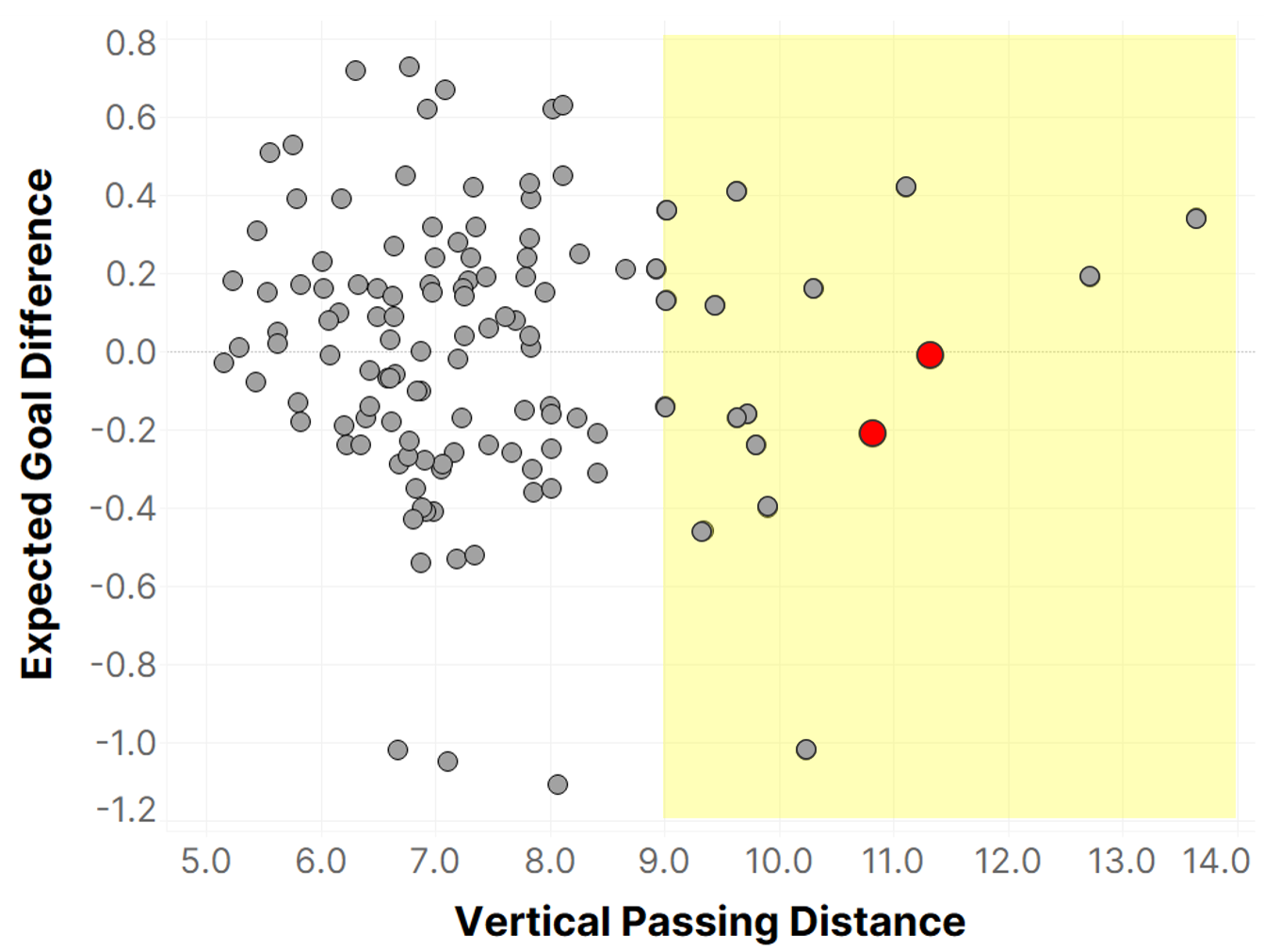
For the sake of this exercise, I've called out two things: Indy's last two seasons (marked in red) and the historical set of clubs that've finished with a number above 9.0 yards per pass (emphasized in yellow).
To me, the bifurcation of the USL's vertical sides is remarkable. Every club above the nine-yard line of demarcation has either ended the season with an xG margin higher than +3.0 or lower than -3.0. This year's Indy Eleven team is hovering at the "zero" mark. For a team playing such an extreme style, that’s aberrant.
To put it more simply: when you're constantly playing long balls, either you’re a hyper-intentional juggernaut, or you’re flailing without a sense of identity. We've rarely seen a team be (1) super direct and (2) also kinda mid.
What does that mean for Sean McAuley?
Historically, the clubs that’ve succeeded within the “oops, all long balls” tactical vein – think Alen Marcina’s San Antonio or 2025 Hartford – have relied on a deep stable of athletic, physical central defenders. Indy’s injury-stricken back line is the exact opposite of that. Maybe Nabi Kibunguchy is the answer, but it didn’t look like it when he played fullback last Friday. Even so, a four-at-the-back that features both Logan Neidlinger and Aodhan Quinn will always be an uncomfortable fit given the way McAuley wants to play.
On the offensive side, the best long-ball teams of years past have typically paired an elite No. 9 and a gifted playmaker with a midfield designed to win knockdowns. San Antonio had Tani Oluwasyei, Santiago Patino, and Samuel Adeniran playing ahead of Jorge Hernandez and a slew of strong No. 8s; Hartford had a pre-sale Mamadou Dieng and Kyle Edwards doing the dirty work ahead of Michee Ngalina and Emmanuel Samadia. Indy doesn’t have anywhere close to that level of No. 9, and their midfield is all creativity without enough of the muscle.
My take? McAuley probably needs to moderate to get this team back on track. Indy has all the talent to be a very good possession team. A core with Cam Lindley, Jack Blake, Quinn, and Neidlinger hosted a playoff game in 2024 on a moderate 49% possession share! The Eleven don’t need to be playing the way they’re playing.
Naomi Infield earned brownie points for being a repeat questioner from the May mailbag, asking: "Not to rehash the 'why is Hartford not scoring goals,' but why is this team not scoring goals? It feels like everything is right up until they make it into the final third. Is it just this injury bug or do they need to consider adding another forward after Adedokun?"
I've positioned this question after the Indy one for a reason; these clubs are the "Spider-Man pointing" meme of the 2026 USL Championship season. Hartford's average vertical distance of 9.8 yards is a magnitude less extreme than Indy's 11.3 mark, but it still comes with its own set of complications.
If we’re working off the same blueprint I delineated above, Hartford is in decent shape. Defenders like Adrian Diz Pe, Jordan Scarlett, Britton Fischer, and TJ Presthus are trustworthy. Michee Ngalina can be a sparkplug, and newly-added Michael Adedokun has the makings of an elite transition player. Augi Williams hasn’t lived up to his billing at the No. 9 spot, but he didn’t suddenly forget how to finish. In the midfield, the Moreira and Makangila types are nothing if not workmanlike.
If the pieces are there, why isn’t the puzzle coming together?
For one thing, we simply haven’t seen Hartford’s first-choice group play together for any extended stretch of time. Williams missed Saturday’s loss to Loudoun and has only started three times since the start of July in league play. Ngalina hasn’t appeared in the Championship since July 8th. Samadia has barely appeared at any point throughout all of 2026. Availability has loomed large, and it’s limited Hartford’s chemistry.
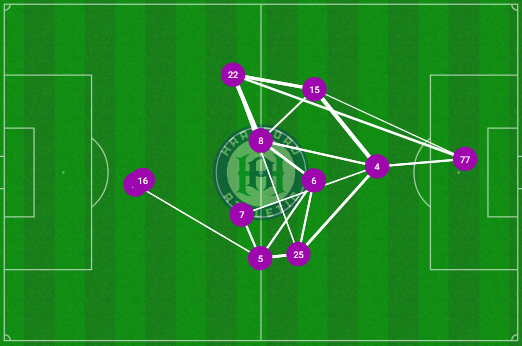
Among the players that have appeared, there’s been a major disconnect between the forwards and everybody else. The passing map from the aforementioned Loudoun loss makes that point abundantly clear. Left wingback Baboucarr Njie completed a handful of passes into forward Sadat Anaku, and that was all she wrote. No other mid-forward pairing combined for more than three pass attempts back and forth.
Using Adedokun as a No. 8 struck me as bizarre on Saturday night, and it’s even more beguiling upon reflection. The former Ohio State star does a lot of things well, but he’s not a linking player! Likewise, shifting Barry Coffey to an out-and-out No. 9 role limited his elite late-arriving movement.
If I really want to nitpick, it feels like Hartford has a poor read on when they want to speed the game up. Say what you will about Indy, but they’ve been successful in longer stretches of possession play when the game slows down. Hartford, a team that’s averaging just 2.9 passes per possession this year, is all verticality without an intermediate gear.
That’s a lot of hemming and hawing to say that (1) injury issues and (2) a Samuel Careaga-sized hole in the midfield have exacerbated (3) innate tactical facets of Brendan Burke’s style.
In an incredibly well-observed question, Meghan asked: "Why has it taken like 7.5 seasons for Republic to figure out how to score on a corner?"
The data backs that idea up. Between 2020 and 2025, Sacramento put up just 0.17 set piece goals per match on 0.28 set piece xG per match. That tells you something already: the Republic actually generated quality chances at the exact median level in the USL, but the finishing was never there.
In 2026, that's changed. Sacramento is posting 0.40 xG per match from dead balls, turning the underlying quality into 0.44 goals a game. With a mark 0f 0.14 xG per shot on set pieces, no team in the USL has generated a more dangerous average chance in the last eight seasons.
The numbers back up the observation, but why's it happening? At risk of oversimplification, the credit belongs to two key people: Memo Rodriguez and Kyle Edwards.
Rodriguez has created seven chances and 0.64 xA from dead balls this year, and he lit it up against Jacksonville over the weekend. His first assist was a right-footed outswinger with perfect weight, arc, and placement; Jared Timmer couldn't help but finish the ensuing header. Rodriguez's second set piece assist was heavily pixelated, but it seemed like an equally lovely inswinger.
Edwards wasn't on the pitch for those goals, but he's the team leader in Championship play with two goals from set pieces. In terms of a physical presence that'll doggedly pursue knockdowns and stay ready in case a second-ball chance arrives, you can't do better. Scoring off a quality serve is the goal, but Edwards is the human embodiment of a set piece "Plan B."
The good folks from All is Quail, whose Sacramento Republic coverage is always illuminating, asked: "I know it’s a small sample size right now. But any thoughts on Wolff leading the line for the Republic?"
As is rightly acknowledged, we’re only two games into the “Tyler Wolff is a striker now” era, but there’s been a lot to like. The Real Salt Lake loanee is only 5’9” – making him far less of an aerial threat than Edwards or Forster Ajago – but has a top speed that’s 0.7 miles per hour faster than those other No. 9s, per Opta. He’s used that athleticism to spearhead the press (see five recoveries in 159 minutes at striker) and stretch the field (12 box touches) from the striker spot.
The breakaway goal that Wolff scored in the middle of his Saturday hat trick against Jacksonville was a great encapsulation of what the 23-year-old brings to the table. You could make the same argument around the press-driven goal that put Wolff on the board in the first place. I'm not necessarily saying that, say, Ajago wouldn't have put himself in position to convert those chances, but they'd come less naturally within his profile.
For my money, it's the way that Wolff fits within the broader Republic system that makes him an especially good fit. At full tilt, Sacramento wants to be in a “three-box-three” formation with Wolff, left winger Mayele Malango, and right back Jack Gurr providing a vertical threat in the three big lanes of the pitch. You see what that looks like above; the Republic get a stop in their box, Gurr leaks out, and it’s nearly a tap-in for Wolff. That play says everything about the instinct that sets Tyler Wolff apart.
My friends at The Union Report – the place for thorough Monterey Bay FC coverage – asked: "Monterey Bay has brought in a ton of new players this season– who do you think have the greatest potential out of the bunch?"
1. Among everyone who's played for Monterey this year, the answer might've been Chris-Kevin Nadje. Of course, his loan is now over. Nadje, 25, brought plenty of European pedigree to the table at Cardinale Stadium, and while he only notched two goal contributions during his time in California, his return of 97th percentile progressive carries (5.5 per 90) and 81st percentile take-ons (1.5 per 90) were indicative of his skill on the ball.
2. I think Fidel Barajas is the answer in terms of raw talent? He, too, is a loanee, though I wouldn't be stunned if he ended up back in Monterey on a permanent transfer over the winter. (That's a take, not intel.) Though the left-footer has only played two games thus far, he's putting up 0.59 xG+xA per 90 and looks like an improved player in open, transitional moments as compared to his previous run with Charleston.
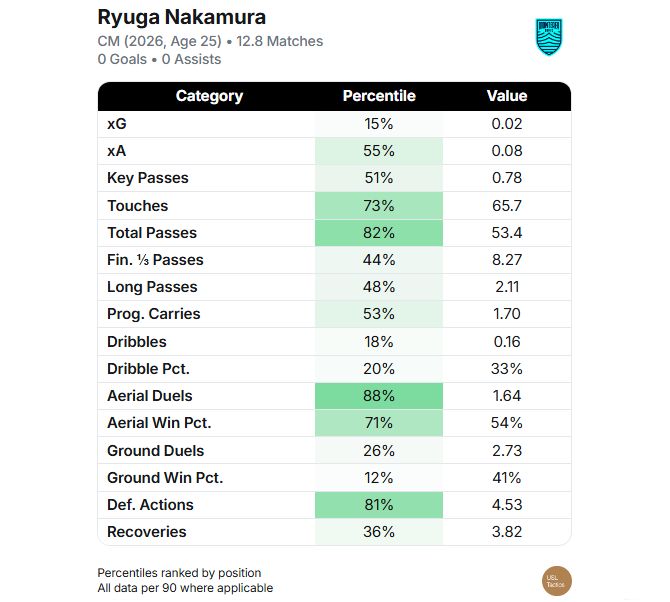
3. To put a spin on the idea of potential, Ryuga Nakamura might have the greatest upside in the realm of "player you could build around for the next half-decade." Nakamura, a holding mid signed out of Latvia, doesn’t light up the stat sheet but is solid at all the things you’d want from a No. 6 – defensive coverage, ball retention, and an ability to slip through the press on the half turn. I love watching the 25-year-old play, and I hope he becomes an anchor for this club.
4. Season-ending injury aside, I want the answer to be Facundo Canete.
If there were an all-USL team for communications directors, Ben Clemens would be on it. He understood the unspoken assignment of “John actually wants non-soccer questions” and He asked something that’s important for my health: “How many steps do you get on matchdays?”
The beauty (and the downside!) of the USL schedule is that the action kinda doesn't get going until 7:00 at night on the Eastern seaboard. That gives me most of the day to try and be active. I’m anal about hitting the arbitrary 10,000 steps mark – who would’ve guessed that the guy who self-appointed his responsibility to talk about every USL game is compulsive? – and that doesn’t change on Saturdays.
The benefit of living where I live in New York is that I’m basically a 20-minute walk from four terrific parks. Not to dox myself too heavily, but I’ll make it a habit to mosey over to one of them, bask in the sun, and read a book midway through my average Saturday unless I’m seeing a movie or grabbing a bite with friends.
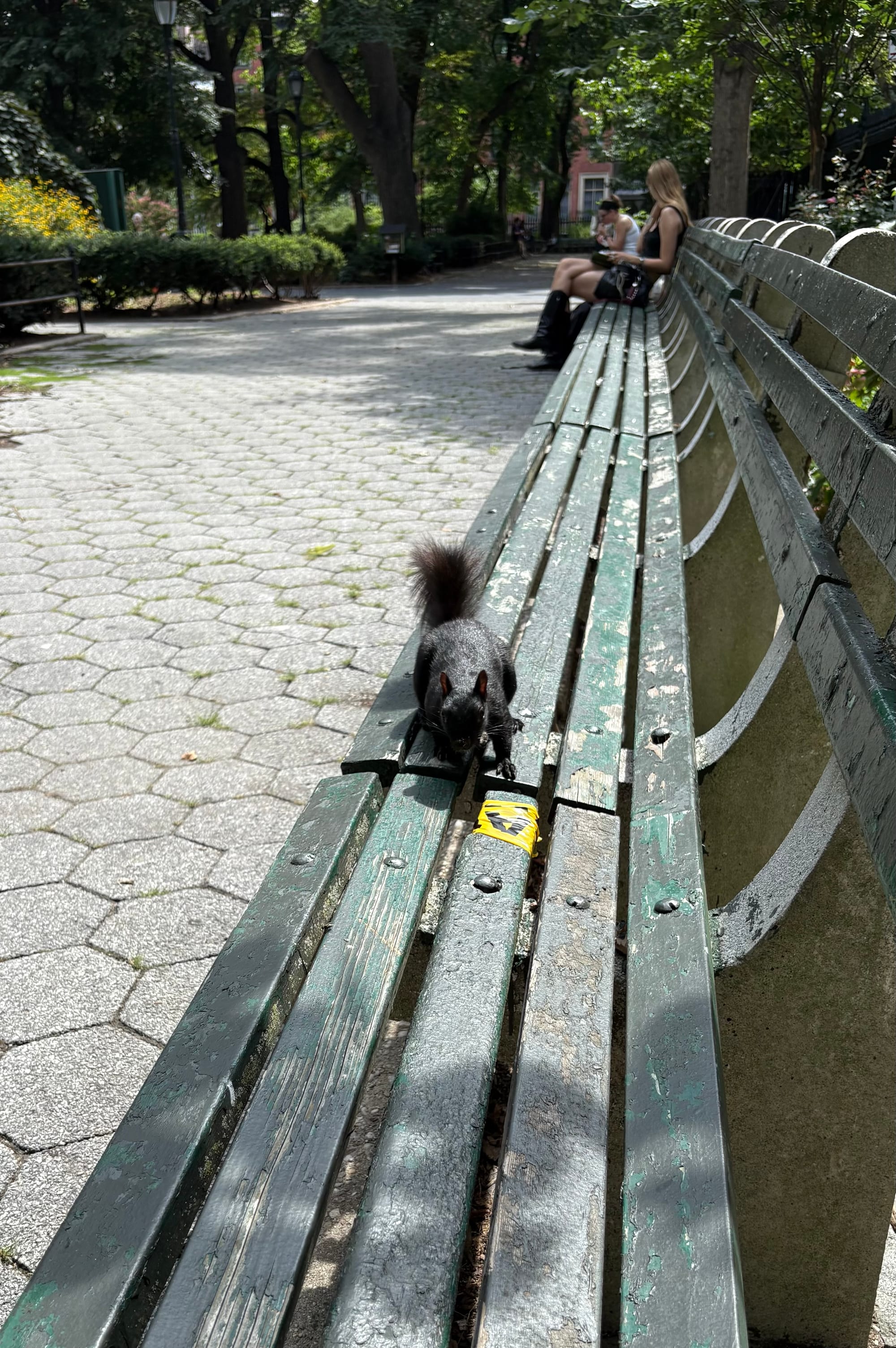
New York City (and the neighborhoods right around me in particular) are home to prodigious numbers of black squirrels – a trait that’s found in just 1 out of 10,000 squirrels in the broader population. If I can go chill in a park and see one of those lil’ dudes on a given matchday, I’ve done well for myself.
So, to circle back: 10,000 steps or I’m gonna be cranky.
Finally, we're returning to Andrew Bolte's second question – the real good stuff. He asked: "What movies should we be on the lookout for in the second half of 2026?"
What is this mailbag, if not a desperate attempt to let me talk about movies? I'm gonna rank my entries in order from most approachable to the average moviegoer to the most arcane, and I’m also gonna provide a “what to watch to be prepared” recommendation.
1. Dune: Part Three – This is my Super Bowl. I’m not a huge Denis Villeneuve guy (he leaves me cold) and haven’t read the Dune books, but I’m compelled by our most famous young actors giving themselves over to “Lawrence of Arabia in space.” The Dune movies are spectacle done right. My companion piece here is Akira Kurosawa’s Throne of Blood (1957), a retelling of Macbeth in feudal Japan. It’s moodier, to be certain, but it traces a very similar arc about the dangers of political ambition and shares “manipulated by larger, quasi-religious forces” plot structure in a way that’s ripe for comparative analysis.
2. Werwulf – A lot of people would level my criticism of Villeneuve (all genre exercise, no heart) at Robert Eggers, and I couldn’t disagree more. His last film, Nosferatu, was a masterclass of direction that revitalized classic horror themes, and cast members Aaron Taylor-Johnson, Lily-Rose Depp, and Willem Dafoe are all back for Werwulf. Given Eggers’ track record, there’ll be plenty of gore that’s balanced out by some level of an auteurist vision. For a palate cleanser relative to Eggers’ dreary vibe, go watch Brian De Palma’s Phantom of the Paradise (1974). It’s another “guy transformed to a monster” movie, but it’s also a silly rock opera. There’s a character named “Beef,” and I think that’s neat.
3. Behemoth! – Writer-director Tony Gilroy’s follow-up to Andor, Behemoth! stars Pedro Pascal as a cellist dealing with the emotional fallout of his return home to Los Angeles. Gilroy is one of the sharpest writers in the game; there’s a cynicism and bleakness to many of his characters, but it’s peeled away to reveal something emotionally relatable through his razor-sharp sense of pacing. Pascal was tremendous in Materialists last year, and I’m amped to see him in another drama. The prep pick here is Bob Rafelson’s Five Easy Pieces (1970), another “coming home” movie that centers around Jack Nicholson’s career-best performance. It’s Nicholson in a quieter register, and I suspect it’s a far thornier film than Behemoth! will be.
4. The Debut – You know Jesse Eisenberg from The Social Network and Zombieland, and he’s behind the camera as the director of The Debut. Firmly in the dramedy camp, it stars Julianne Moore as a woman who joins a local theater production led by Paul Giamatti during a mid-life crisis. It looks like the kind of movie that’s going to make me cry. For a companion, check out Shall We Dance? (1996) – the Japanese version, not the J-Lo one. Koji Yakusho, one of our greatest living actors, features as a discontented office worker who’s enlivened by joining a ballroom dance class. It’s *confirmed* as a movie that makes me cry.
5. Digger – Cards on the table: I think Digger – featuring Tom Cruise in heavy prosthetics as a southern oilman that needs to stop an apocalyptic climate disaster – is gonna be an absolute mess. That’s part of the charm! The fact that image-obsessed Cruise is going to debase himself is miraculous, and he’s surrounded by an all-star cast including John Goodman, Sandra Huller, Riz Ahmed, and Jesse Plemmons. A lot of folks are seeing Digger as a latter-day Dr. Strangelove; that’s probably too kind. Instead, I’d rewatch Francis Ford Coppola’s Megalopolis (2024), a movie that’s bursting with earnestly dumb ideas and half-baked stylistic choices that I absolutely adore.
6. All of a Sudden – Ryusuke Hamaguchi’s last movie, Evil Does Not Exist, might be my favorite of the 21st century. It’s beautifully shot and gently observed; it lulls the audience into a state of contemplation but ends with a powerful, highly interpretable swing that I haven’t stopped thinking about in two years. Hamaguchi’s follow-up, All of a Sudden, debuted at Cannes in the spring and follows the relationship between a French nurse and her terminally ill patient, a Japanese author. I won’t claim that the premise thrills me, but Hamaguchi is a genius. My out-of-left-field companion pick is Clint Eastwood’s Honkytonk Man (1982). There, Eastwood directs himself as a washed-out, dying musician on the road with his nephew. (Hamaguchi has written about his admiration for Eastwood’s Hereafter, a triptych about death and the afterlife starring Matt Damon; much-maligned but secretly good!)
Honorable Mentions – The year of Robert Pattinson being a sicko continues unabated in Primetime, where he's playing Chris Hansen; one of the best trailers of the year on that one. Hong Sang-soo – who's made 18 movies in the last 10 years – has teamed back up with Kim Min-hee (she of The Handmaiden fame; blacklisted in Korea for her affair with Director Hong) for Nowhere to Lay My Eyes, and I will be deeply upset if I can't see it at the New York Film Festival.
While we're on the movies thing, the Song of the Week™ pick featured in One Battle After Another. That song, of course, is Sheck Wes' "Mo Bamba."