The Back Four: September ender
Center back passing, Jon Bakero, and more USL chicanery

Welcome in to The Back Four! Need more USL content? Make sure to:
- Visit Backheeled for 10,000+ words of analysis on the Championship and League One every matchweek.
- Check back on Backheeled for a topical end-of-week feature on big USL-wide stories, plus attendance and depth chart tracking.
- Listen to This League! and The USL Show to catch up in podcast form.
Without further ado, let’s get to it.
Progression from the back
Measuring the impact of a central defender is difficult on both sides of the ball. A center back for, say, an Orange County team that spends maximal time in low block will have more opportunities to put up defensive counting stats. Conversely, a player at that same position for New Mexico United and their high-possession system won't be as likely to rack up clearances and tackles.
I adjust players' takeaway (i.e., tackle and interception) numbers in my various data tools by possession, but the eye test remains crucial. Passing and ball-movement metrics exist in a similar state of flux. More than any other position group, defenders' passing profiles are highly influenced by team system.
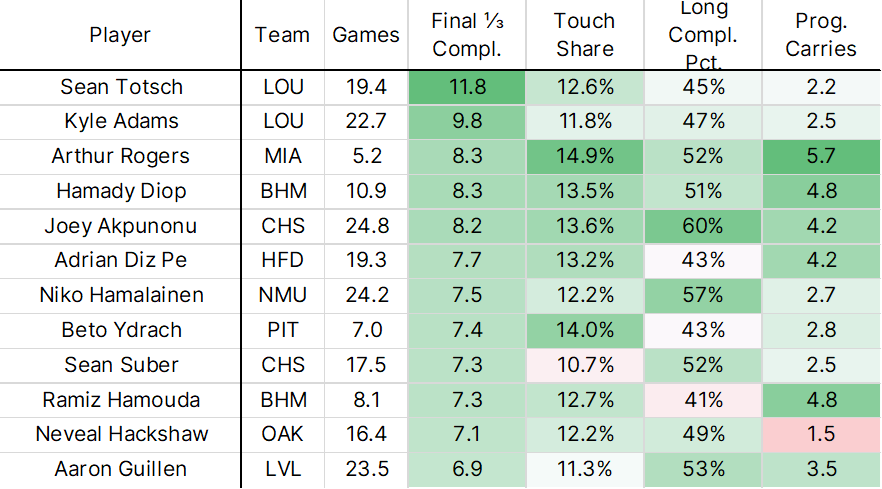
Here, we've got the 12 center backs that are completing the most final-third passes per game this season – a subset that nicely illustrates the systemic variety around the Championship, even with tactical influence in mind. Sean Totsch and Kyle Adams are accomplished passers, but they’re the top two because of LouCity’s extreme field tilt. Adrian Diz Pe’s completion percentage on long passes is comparatively low, but that’s part of the rough-and-tumble design in Hartford.
Long completion percentage can be a misleading number, insofar as “long passes” is a vague phrase. A lofted hoof over the top and a driven 30-yard ball through lines necessarily will have different outcomes! Even so, players like Joey Akpunonu (60% long completion rate), Niko Hamalainen (57%), and Aaron Guillen (53%) all pass the eye test in terms of their precision.
Does the presence of one or more elite play-drivers lead to a dominant field tilt? Not exactly. When you examine defensive-third passing directness against field tilt…
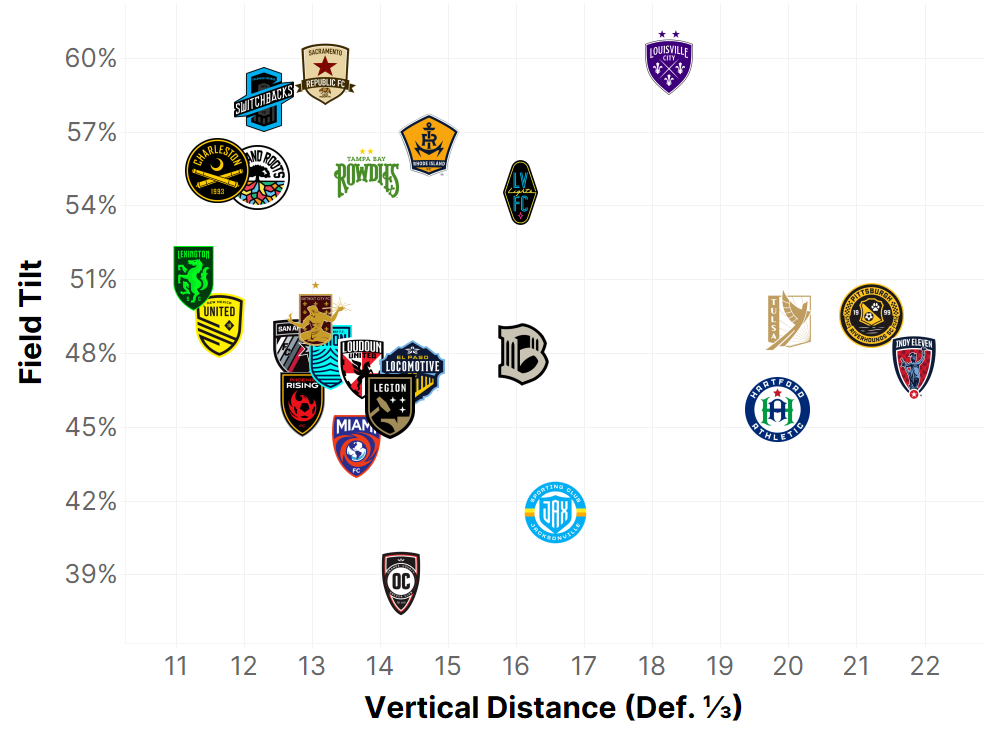
…you’ll note that domineering clubs like Sacramento, Colorado Springs, and Rhode Island are all short-oriented teams without leading center backs. Their respective methods for pitch control vary. The Switchbacks tend to be vertical through Matt Mahoney and Talen Maples, but theirs is a mid-range style; goalkeeper Christian Herrera has the big boot. Sacramento are fiercely focused on building through lines, 3-2-4-1 style, while Rhode Island applies that same idea within more of a 4-4-2 context.
The progressive carry piece adds additional context; not all progression happens via pass! In Detroit, for instance, Devon Amoo-Mensah is putting in more carries of 10 yards or more (4.0 per game) than final-third completions. Mahoney and Garven Metusala are also in that 4ish progressive carry per game range for the Switchbacks.
If you’re looking for a triple threat that can (1) handle high-volume engagement, (2) complete passes into the final third, and (3) add a dribbling threat, there’s nary a player better than Arthur Rogers. The defender was sidelined by injury trouble at the end of last season with FC Tulsa, and the same problem had led to a choppy start to 2026 after a move to Miami FC. Now, Rogers is back at peak form.
A week ago against Rhode Island, Rogers held down a classic “sideways passer and progressor” partnership with Daltyn Knutson in central defense. In what became a 1-0 win, Rogers took 40% more touches than Knutson and attempted seven extra passes into the final third. In total, Rogers completed 28(!) forward passes into Miami’s five most advanced players (i.e., the front four and high-tilted No. 8 Rodrigo Da Costa).
The Englishman’s return is a wonderful A/B test for the value of an elite progressive defender. Entering Week 29, Miami had posted the third-lowest field tilt in the USL and needed 79 final-third passes to generate their average expected goal. Against RIFC, Miami still played against the ball, but Rogers’ ability to speed up the game with vertical passing vastly improved that efficiency number. Miami put up 2.2 xG on 86 final-third passes – twice as efficient as their season average.
You see why in the example above. Miami initially work the ball around the back, circulating until they can find Rogers a few yards beneath the halfway line. The defender takes one controlling touch with his vision trained upfield, waiting to identify space. When he pushes the ball forward, Rogers clearers the pivot, hits striker Denilson Milanes, and sets the table for quick interplay that catches Rhode Island's 4-4-2 before it's settled. A dangerous shot ensues.
(Rogers kept it up in a massive win over Indy, too. He completed 11 final-third passes against three for Knutson and put in a genuinely staggering 11 progressive carries.)
These kinds of chances – let a center back possess, break a line, and go – are impossible unless you've got a center back that can speed the game up. Rogers is just one (very good!) example of a burgeoning class of defender that's emerged in an ever more technical USL.
Jon Bakero, space invader
Here are two player profiles, which I’m briefly going to anonymize:
- Player A: 62 touches, 2.5 key passes, 0.34 xA, and 14.1 final-third passes per game
- Player B: 61 touches, 2.5 key passes, 0.40 xA, and 14.1 final-third passes per game
The trick here? Both players are Charlotte Independence star Jon Bakero. The “A” case captures Bakero’s numbers from the 2025 season, while the “B” case describes his current campaign. What I’ve elided is Bakero’s actual goal contributions. The former Phoenix Rising star put up three goals and nine assists last year. In 2026, by contrast, the 29-year-old has generated eight goals and a staggering 14 assists in league play.
Beyond the fact that assists are a fluky number, the point is this: Bakero is rightly getting MVP attention this year, but he’s been spectacular.
Entering this weekend, Bakero had created 52 chances and generated 8.7 expected assists. Of those contributions, 64% of the chances and 61% of the xA had come amidst the run of play; the remainder had come from set pieces. The unsung thing about Bakero is his eye for space – his ability to (1) carve out dangerous touches and (2) immediately set up teammates or challenge goal after receiving. The Spaniard is fifth among League One midfielders with +0.72 goals added from receiving (per American Soccer Analysis) for a reason.
What do those receptions look like? Between plays like this...
...and this...
...and this...
...Bakero is constantly exploring the full width of the pitch. He’s low and then he’s high; he’s dangerous from the right but also skews to the left. When a teammate breaks free out wide, he’s willing to charge into the box to become a goal threat. Few players in League One can match Bakero’s preternatural read on the game.
In the first sequence here, Bakero starts from his baseline in the right halfspace but meanders across the pitch, essentially becoming a second No. 6 next to Reudd Manin. As Manin pushes right, Bakero becomes available to receive. Rather than playing into the feet of a back-to-goal attacker, he waits a beat; that lets underlapping left back Joey Skinner get open through lines. Bakero plays Skinner through, and a goal ensues.
Bakero might as well be a right back at the onset of the second play, where his spacing complements an overload through the left channel. As Charlotte move upfield, however, Bakero responds in kind. When the Independence break through, he's taking up a classic No. 10's position and can give-and-go with forward Christy Manzinga to set up another goal. Still, not every instance of No. 10ish operation from Bakero is creation-minded. In the third clip, he begins in that spot but crashes the box for a dangerous header.
Across the plays, it becomes evident why Jon Bakero has been so crucial for this Charlotte team. Manager Mike Jeffries’ possession system is fairly free-flowing, but it needs a hub to connect the spokes. Bakero, in his ability to attack open space and facilitate, is the perfect player to serve that all-important role.
DC Power-up
This is an excerpt from my Super League recap, which comes out each Monday (or thereabouts). I accidentally published this week's edition as an email, but find it in full here.
DC Power are off the schneid at Audi Field, and a cathartic ability to quickly create and finish chances made it happen. Tuesday morning’s 11:00 AM win over Fort Lauderdale United saw DC take risks with their shape, rely on substitutes to change the game, and ultimately get their just desserts for the effort.
You order French onion soup for the cheesy bread blob on top, not the actual soup. If we’re talking in food terms, Power had spent 2026 caramelizing a ton of onions without garnishing the top of the bowl; the build game had been there, the defensive principles had been good, and something hadn’t clicked in the box. DC entered Week 7 leading the Super League for shots per game (16.2) and ranking second for field tilt (55%), yet their xG per attempt (0.10) was third-worst in the division.
At midweek, manager Omid Namazi pressed in a 4-4-2 or 4-2-3-1ish formation and initiated in a similar structure, but he flexed his lineup into a 3-1-5-1 once settled into advanced possession. Within that shape, Abby Boyan held down the single pivot spot, while Susanna Fitch (who’s been in and out of the lineup thus far) started as an explicitly offense-first right back. As Fitch flew upfield, left-sided Sam Cary Angel sat deep like a resting center back.
Against an intransigent 4-4-2 on Fort Lauderdale’s part, the question was whether Cary Angel and Claire Constant could break lines into players like No. 10 Emily Colton against United’s tight core. In their first starts of the season, Abi Hugh and winger Daniela Todd added fresh energy at the front end of that shape. Progression wasn’t easy, though it’s telling that Colton managed an 8% touch share – high for an explicitly final-third-oriented midfielder.
Here, you can see Power set up in their “3+1” base, with Cary Angel low off the left and Abby Boyan operating as a single pivot. As the game wore on, DC had more and more success using Emma Jaskaniec (a No. 8) and Colton through the halfspaces a line ahead of Boyan; if they could triple up, it created a natural edge on the opposing pivot.
That isn’t the case across this play. Fort Lauderdale’s 4-4-2 holds firm, with backpressure via Todd and a step from center mid Kelli Van Treeck disrupting Boyan on the turn. Suddenly, United is bearing down in a four-on-three situation with late help trailing the break.
Todd’s initial pass leads Hugh (the left winger) a few yards astray, but the break is still on. Even as Boyan gets a knock on Hugh’s cross and Cary Angel half-hits a clearance, Fort Lauderdale keep flooding forward. By now, Van Treeck and pivot partner Nicole Vernis have arrived; the former makes a recovery, the latter crashes the box at a wide angle, and a shot ensues.
The more that manager Tyrone Mears’ Fort Lauderdale could create these kinds of odd-man breaks, the better they fared. Hugh’s breakout presence was a boon, and right back Maggie Mace put in a handful of snaking dribbles to break lines. Likewise, forward Kiara Locklear brought a sharp presence relative to Todd’s more rough-and-tumble engagement. Between a 10th minute shot that rang off the woodwork and a narrow miss off a 60th minute three-on-three, Locklear’s finishing (or lack thereof) turned the game.
DC, to their credit, mostly stayed on the front foot by virtue of their 3-1-5-1, occasional breakdown aside. Eventually, Namazi’s changes gave Power what they needed to break through – a stark contrast to United, who had to slide talismanic winger Sh’nia Gordon into their back line out of the break. Conversely, DC got winger Tatum Thomason onto their right side, shifted Tyler Lussi to their left, and gave Cary Angel a bit more freedom to challenge the repositioned Gordon.
Welcome to the scoresheet, @tatumthomasonn! 🥳
— Gainbridge Super League (@GainbridgeSL) September 22, 2026
𝙁𝙄𝙍𝙎𝙏 𝙋𝙍𝙊 𝙂𝙊𝘼𝙇 for Tatum Thomason, and @DCPowerFC are in front ⚡️👏 pic.twitter.com/Sb2ms2TJo0
Despite her substitute role, Thomason led Power with three take-on dribbles and paired that one-on-one drive with intelligent movement at the weak post. When DC took a lead in the 62nd minute, that was abundantly clear. There, Cary Angel and Lussi worked the ball to drifting striker Loza Abera; Gordon was completely taken out of the play, forcing the entire United 4-4-2 to rotate.
In prior games, DC didn’t always get the runs they needed to punish such rotations. This time, Colton came up big. Her knifing run into the box allowed for a dangerous reception and a cutback to Thomason, whose tap-in was a just reward at the end of a stellar passing play.
(I’m rarely right about these things, so I’ll take a brief victory lap: In last week’s column, I noted that “Emily Colton feels like the natural option to provide…more box-centric running” out of the midfield for DC. Et voila!)
Getting Mak Whitham onto the left wing only helped Power’s cause late-on. The 16-year-old Gotham FC loanee mixed in right-footed curlers with left footed crosses and kept Fort Lauderdale on a string after she spelled Lussi. Though United had managed to score off a set piece, they couldn’t hold on against DC’s continued momentum. In the 89th minute, Whitman’s pressure in a second-ball situation helped force a giveaway, setting the table for another Thomason finish. This time, the former Arizona State star connected on a looping header that floated over goalkeeper Haley Craig to seal the victory.
On the way there, Power racked up 14 shots worth 0.15 xG apiece – 50% better than their season-long average. For my money, the energy that players like Colton and Thomason provided as in-box runners made all the difference.
In other news…
I don’t talk about Aidan Rocha enough, but the Switchbacks defender has quietly emerged as one of Colorado Springs’ most important players. He’s completely comfortable covering either fullback spot, and he spent the past two weeks looking just as good as a full-blown wingback – once on the right, once on the left. On the year, the 25-year-old has won 55% of his ground duels and attempted 9.2 final-third entries passes per game, reflecting what’s often an initiation- and rest-minded deployment. Good player!
I think Mackenzie George is one of the very best players in the Super League, and her effort on both sides of the ball is the thing that gives Carolina their identity. She’s also bizarrely hesitant to shoot by the standard of a No. 9.
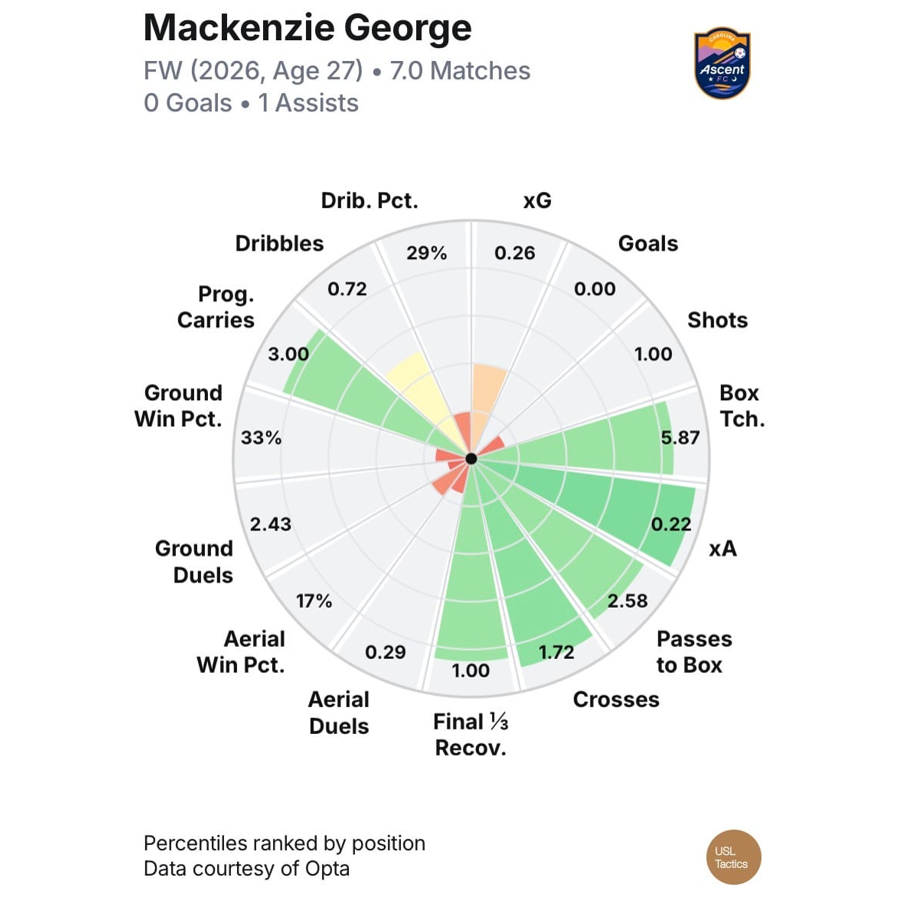
Part of the oddness owes to George’s deployment in the Ascent’s 4-4-2. She’s a striker on paper, but that front line plays with absolute fluidity and often sees the 27-year-old drop into the middle third for touches. George is a spectacular one-on-one dribbler, and Carolina lets her show that skillset off. Even so, getting 5.9 box touches per game and attempting just one shot is wild. I’m not here to say that Carolina are a poor attacking team, but a little killer instinct from George would go a long way.
It’s Digger week, so I revisited what's maybe the greatestTom Cruise movie: The Color of Money. If you’re looking for the “best” Martin Scorsese movie, I’d point you to Goodfellas or Killers of the Flower Moon. If you’re looking for my personal favorite, this is probably it. (The Departed notwithstanding.)
Cruise stars as a young hot shot with a gift for nine-ball pool that’s taken on the road by Paul Newman’s “Fast” Eddy Felson, a role reprised from 1961’s The Hustler. Newman won the Oscar for an utterly suave, sagacious performance; no one ever looked better in a long-sleeve polo or a sweater vest. That presence feels dialectical against Cruise’s over-acted cockiness, smashing youthful joie de vivre against wizened, self-protective scheming.
Scorsese has plenty of movies that show off a greater totality of stylistic tics, but The Color of Money is downright cool. It’s all whip pans and long dissolves and circling camera movements that make back-of-the-bar pool look like Game 7 of the NBA Finals. There’s a gorgeous marriage of form and function; how can Newman not get drawn out of his shell in a film that moves like this?

Anyway, dudes rock.