USL Super League, Week 7
Lexington rolls, DC maximizes their bench, and more

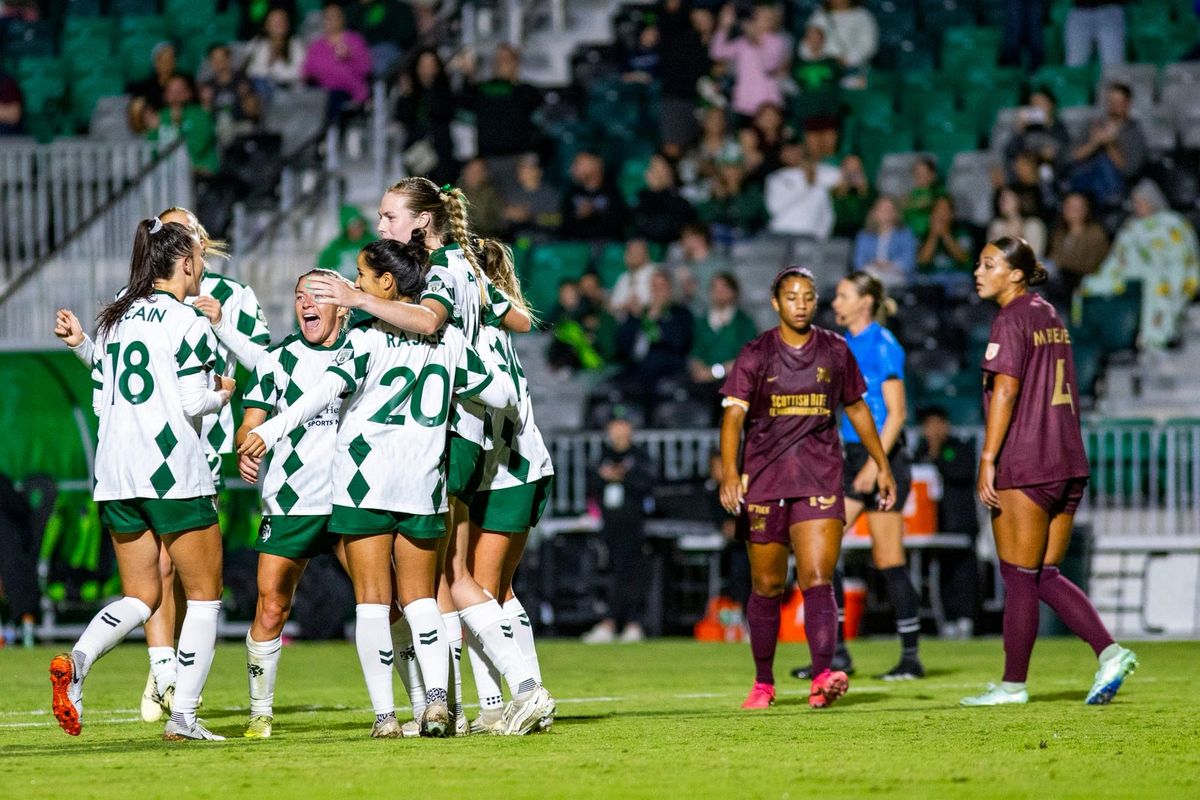
DC (2) - Fort Lauderdale (1)
DC Power are off the schneid at Audi Field, and a cathartic ability to quickly create and finish chances made it happen. Tuesday morning’s 11:00 AM win over Fort Lauderdale United saw DC take risks with their shape, rely on substitutes to change the game, and ultimately get their just desserts for the effort.
You order French onion soup for the cheesy bread blob on top, not the actual soup. If we’re talking in food terms, Power had spent 2026 caramelizing a ton of onions without garnishing the top of the bowl; the build game had been there, the defensive principles had been good, and something hadn’t clicked in the box. DC entered Week 7 leading the Super League for shots per game (16.2) and ranking second for field tilt (55%), yet their xG per attempt (0.10) was third-worst in the division.
At midweek, manager Omid Namazi pressed in a 4-4-2 or 4-2-3-1ish formation and initiated in a similar structure, but he flexed his lineup into a 3-1-5-1 once settled into advanced possession. Within that shape, Abby Boyan held down the single pivot spot, while Susanna Fitch (who’s been in and out of the lineup thus far) started as an explicitly offense-first right back. As Fitch flew upfield, left-sided Sam Cary Angel sat deep like a resting center back.
Against an intransigent 4-4-2 on Fort Lauderdale’s part, the question was whether Cary Angel and Claire Constant could break lines into players like No. 10 Emily Colton against United’s tight core. In their first starts of the season, Abi Hugh and winger Daniela Todd added fresh energy at the front end of that shape. Progression wasn’t easy, though it’s telling that Colton managed an 8% touch share – high for an explicitly final-third-oriented midfielder.
Here, you can see Power set up in their “3+1” base, with Cary Angel low off the left and Abby Boyan operating as a single pivot. As the game wore on, DC had more and more success using Emma Jaskaniec (a No. 8) and Colton through the halfspaces a line ahead of Boyan; if they could triple up, it created a natural edge on the opposing pivot.
That isn’t the case across this play. Fort Lauderdale’s 4-4-2 holds firm, with backpressure via Todd and a step from center mid Kelli Van Treeck disrupting Boyan on the turn. Suddenly, United is bearing down in a four-on-three situation with late help trailing the break.
Todd’s initial pass leads Hugh (the left winger) a few yards astray, but the break is still on. Even as Boyan gets a knock on Hugh’s cross and Cary Angel half-hits a clearance, Fort Lauderdale keep flooding forward. By now, Van Treeck and pivot partner Nicole Vernis have arrived; the former makes a recovery, the latter crashes the box at a wide angle, and a shot ensues.
The more that manager Tyrone Mears’ Fort Lauderdale could create these kinds of odd-man breaks, the better they fared. Hugh’s breakout presence was a boon, and right back Maggie Mace put in a handful of lsnaking dribbles to break lines. Likewise, forward Kiara Locklear brought a sharp presence relative to Todd’s more rough-and-tumble engagement. Between a 10th minute shot that rang off the woodwork and a narrow miss off a 60th minute three-on-three, Locklear’s finishing (or lack thereof) turned the game.
DC, to their credit, mostly stayed on the front foot by virtue of their 3-1-5-1, occasional breakdown aside. Eventually, Namazi’s changes gave Power what they needed to break through – a stark contrast to United, who had to slide talismanic winger Sh’nia Gordon into their back line out of the break. Conversely, DC got winger Tatum Thomason onto their right side, shifted Tyler Lussi to their left, and gave Cary Angel a bit more freedom to challenge the repositioned Gordon.
Welcome to the scoresheet, @tatumthomasonn! 🥳
— Gainbridge Super League (@GainbridgeSL) September 22, 2026
𝙁𝙄𝙍𝙎𝙏 𝙋𝙍𝙊 𝙂𝙊𝘼𝙇 for Tatum Thomason, and @DCPowerFC are in front ⚡️👏 pic.twitter.com/Sb2ms2TJo0
Despite her substitute role, Thomason led Power with three take-on dribbles and paired that one-on-one drive with intelligent movement at the weak post. When DC took a lead in the 62nd minute, that was abundantly clear. There, Cary Angel and Lussi worked the ball to drifting striker Loza Abera; Gordon was completely taken out of the play, forcing the entire United 4-4-2 to rotate.
In prior games, DC didn’t always get the runs they needed to punish such rotations. This time, Colton came up big. Her knifing run into the box allowed for a dangerous reception and a cutback to Thomason, whose tap-in was a just reward at the end of a stellar passing play.
(I’m rarely right about these things, so I’ll take a brief victory lap: In last week’s column, I noted that “Emily Colton feels like the natural option to provide…more box-centric running” out of the midfield for DC. Et voila!)
Getting Mak Whitham onto the left wing only helped Power’s cause late-on. The 16-year-old Gotham FC loanee mixed in right-footed curlers with left footed crosses and kept Fort Lauderdale on a string after she spelled Lussi. Though United had managed to score off a set piece, they couldn’t hold on against DC’s continued momentum. In the 89th minute, Whitman’s pressure in a second-ball situation helped force a giveaway, setting the table for another Thomason finish. This time, the former Arizona State star connected on a looping header that floated over goalkeeper Haley Craig to seal the victory.
On the way there, Power racked up 14 shots worth 0.15 xG apiece – 50% better than their season-long average. For my money, the energy that players like Colton and Thomason provided as in-box runners made all the difference.
Lexington (3) - Dallas (0)
For a team that’s been so afflicted by absences in the central midfield, you’d never know that Lexington was at a deficit. LSC started Week 7 by recalling Nicole Vernis from her heretofore successful loan to Fort Lauderdale; they still ran with a short bench on Friday night against Dallas. In what became a decisive 3-0 win over Trinity, the central heart of Lexington’s shape undeniably won the day.
To some extent, Lee Nguyen’s Dallas and Kosuke Kimura’s Lexington both want to work inside-out on the ball. LSC did so by keeping Katie Murray and Darya Rajaee together under proving attacking mids. Trinity remade their lineup to make it happen in Kentucky, using Sofia Cedeno and Jamie Shepherd in the pivot behind forwards Camryn Lancaster and Seven Castain within their 4-4-2.
Dallas still went 3-2-4-1 (or “three-box-three”) in possession, and their defensive shape was equally feisty ahead of a high back line. What started as a two-striker shape often bent into a 4-2-1-3 when Lexington pushed around the edge; by dropping Lancaster to mark the nearest midfielder and flexing the wingers high, Dallas could match LSC’s three at the back build shape while centering outlets. If there was an odd tic, it was the occasional use of left winger Onyeka Gamero as a deep-ish marker against Lexington right back Alyssa Bourgeois stood out.
Why that tilt? By addressing Bourgeois via the “Gamero is a free safety” deployment, Dallas could retain five central players to stop Lexington from advancing up the middle third, all while keeping a lid on a terrific overlapping runner. Still, the success of that gambit varied.
Here, Lexington have reset around the back with Gamero staying deep off the left. Knowing that Dallas’ remaining front three can be overloaded, forward Addie McCain drops in and drags center mid Sofia Cedeno (gold) along with her.
I’ve highlighted the space behind Cedeno here, and you can see how it becomes the focal point. Cedeno is fully committed upfield, and neither Lancaster nor Castain cover deep for her; they need to shadow Lexington’s actual No. 6s. Thus, when the ball skirts toward right-sided center back Allison Pantuso, the reigning all-leaguer can ping a gorgeous pass into the open pocket. There, Catherine Barry is waiting to receive and lay off to McCain.
LSC’s shot quality from there is lacking, but this is a perfect example of their principles – and their ability to pin Gamero and create overloads as a consequence. On a night where long balls to Bourgeois and McKenzie Weinert were rarely accessible, the ability to leverage small pockets (namely through McCain) was absolutely vital.
Dallas had success in the same center-centric manner, though their patterns differed after lines were broken. Lexington’s progression mostly drove through the halfspaces; Trinity tended to skew more toward the sidelines, hence why they attempted 18 crosses against just eight for their hosts.
(I screwed up the colors, don’t mind me.)
You can see Dallas forming into their advanced “three-box-three” look in this example, ultimately creating a wide one-on-one that would typically end in a cross. As Trinity reset into center back Sophia Braun at the heart of the back three, Sofia Cedeno and Jamie Shepherd (the pivot players, red) sit at the base of the midfield. Higher, Carissa Boeckmann (right back turned No. 10, gold) and Camryn Lancaster (a forward, white) hedge toward zone 14.
When Braun hits Cedeno, there’s an immediate step from the left side of LSC’s defense. At that point, Boeckmann is free between lines and winger Jasmine Hamid is in a potential one-on-one against fullback Ally Brown. A give-and-go move eventually sees Hamid receive.
This is the kind of situation that Hamid – who entered Week 7 attempting just under two take-ons per game – lives for. Instead of beating her defender, however, the winger gets stonewalled. Brown’s agility and keen reactions show Hamid to the endline, where she’ll knock the ball harmlessly out of play. Similar chances (and an inability to convert them) defined Dallas’ night. In the 52nd minute, for instance, Gamero beats Bourgeois, crossed far post, and saw Hamid fluff an all-important tap-in. Trinity put up 2.2 xG in terms of their shot locations, but they only put 0.2 xG on target – another consequence of playing difficult-to-finish crosses.
(With that in mind, fascinating quote from Nguyen via Dallas’ press notes: "I think we had trouble today trying to find the spaces, and our switch point of attack could be better. We had chances in the second half to get one. There were crosses in the box that we weren't able to get on the end of.")
Clinical execution in the box decided the night in Lexington’s favor. When LSC scored in the 56th minute, they’d tilted forward through Brown at left back at the expense of their typical “always have three defenders low” resting construction. With Brown and Weinert doubling the presence up the left, it was far easier to isolate the fullback for – admittedly! – a low-percentage cross. The difference here? McCain waits in the box to attack it with the very intensity Dallas lacked.
The game changed with that goal, allowing Lexington to generate more chances on the break and furnish Barry with a late brace. The scoreline was misleading, but the result – a win for the side that controlled more dangerous attacking territory – wasn’t. That ability to manipulate space has been LSC’s calling card throughout the Kimura era, and it held on Friday night.
Carolina (3) - Jacksonville (3)
Through the first six weeks of the 2026 season, the Carolina Ascent conceded just three goals. They matched that total within the span of 90 minutes on Saturday night, with Sporting Jax rolling into American Legion Memorial Stadium and picking up a 3-3 draw.
This game was…uh…weird. The highlight goal was a Jill Aguilera free kick from the halfway line that gently bounced into the net. Jacksonville put up 2.0 xG, but a plurality of it came from a single Baylee DeSmit penalty kick late-on. Despite what the scoreline said, this was a rather defensive-minded match in tenor.
Manager Phillip Poole ran out the same starting lineup for the seventh match in a row, a streak that’s largely fueled Carolina’s immaculate defensive organization throughout the year. The Ascent’s challenge was to stay shapely in their 4-4-2 block, frustrate the visitors, and get upfield with a sense of tempo – a task that proved challenging in practice.
At their best, Carolina used striker Mackenzie George as their water-carrier in breakout situations. George consistently had the mix of hold-up strength and one-on-one guile to round Jacksonville defenders – no small feat against a back line with Georgia Brown back into the mix. If she could isolate, force a rotation, and create an odd-man advantage against the remainder of Sporting's center backs alongside teammates like winger Riley Baisden and second striker Shea Groom, the Ascent were in business.
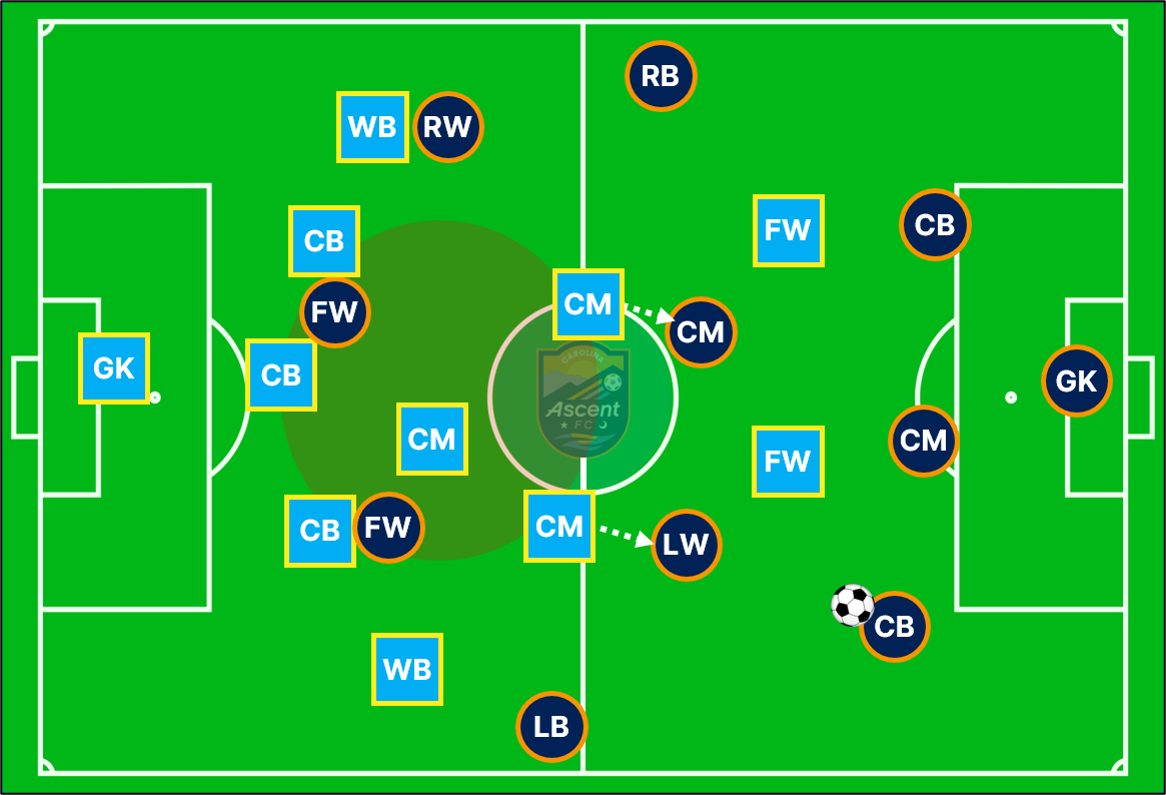
On a night where Carolina attempted just two shots in the run of play – neither of which came on the break, per Opta – that was a challenge. Beyond the lack of counter success, Jacksonville’s layered press brought a mix of zonal and man principles upfield that stopped the Ascent from comfortably settling as they initiated.
That concept is loosely mapped out above. As usual, Carolina often dropped No. 6 Lily Nabet between their center backs in build, but Jacksonville didn’t bite. Manager Stacey Balaam usually stuck to her typical 5-1-2-2, trusting forwards Paige Kenton and Baylee DeSmit to hedge from side to side as needed to cover the pseudo back three. Behind them, the intensity ratcheted up. Ashlyn Puerta and Sophia Boman marked remaining No. 6 Mia Corbin and whichever attacking mid dropped into join her; left-sided Audrey Coleman often did the job.
Carolina’s intention was clear: they wanted Coleman, George, or whoever popped low to confuse the opposing defense. If, say, defensive mid Sophie Jones or rookie wingback AJ Hennessey peeled upfield to double up against Boman’s mark, it’d open space through lines. It’s a testament to Jacksonville’s discipline that their defenders rarely made such mistakes.
The Ascent weren’t entirely feckless, of course. Strong interplay anchored around a drifting Corbin helped open the seam and loose George over the top ahead of Shea Groom’s game-tying 39th minute corner goal. Excellence on set pieces was a theme; all three Carolina goals came from dead balls, including center back Reese Tappan’s late equalizer. That said, Jacksonville largely dictated how the match was played.
No lead is safe tonight 🙅♀️
— Gainbridge Super League (@GainbridgeSL) September 27, 2026
AJ Hennessey smashes home her first pro goal to put @sporting_jaxw back on level terms 💥 pic.twitter.com/UR2Gj6qFAx
Sporting’s best chances of the game arrived when they could create high turnovers or win second balls and then immediately break upfield. In those situations, Hennessey was key. The wingback attempted 10 duels in 72 minutes – one of which dispossessed the Ascent in a recovery situation and allowed for a 20th minute break. After the takeaway, Hennessey quickly hit Puerta through lines, creating a three-on-two against Tappan and Jenna Butler that ended in a goal. Another similar chance arrived shortly thereafter; the same front-three trident bore down on Carolina, but a leading pass between Kenton and Puerta slowed the play down just enough for Tappan to intervene.
As Carolina refreshed their lineup, more holes emerged. The Ascent substantially altered their midfield as the match went on, bringing Taylor Porter and Emily Morris into the heart of a 4-2-3-1ish block later in the game. A sieve it wasn’t, but Jacksonville started to find more holes by way of their combination play – most notably in the run-up to Hennessey’s 71st minute equalizer.
There, Jones shifted all the way toward the wing, away from her native No. 6 position. While Carolina tried to send help against the wonky overload that Jones created, it didn’t stop her and DeSmit from combining through the channel and entering the box. With a runner flashing toward the net and fullback Ashlynn Merrick taken out of the play, no one was in position to stay home against Hennessey at the far post. On a night full of goals, none was sharper.
Amidst all the havoc, what should we take away? I’m not overly concerned on either side, frankly. Carolina will’ve wanted to be deadlier in breakout situations, but they played their game and came away with a solid point. Jacksonville will rue their sloppiness against dead balls, but they’ll take heart in the various ways they picked the Ascent apart. In other words, both teams still feel like prohibitive favorites halfway through the 2026 campaign.