The Back Four: Lauding Lexington
On the Super League final, plus Championship and League One potpourri


Welcome in to The Back Four!
As always, visit Backheeled for more USL content, including deep dives into all things Championship and League One. Also, listen to This League! and The USL Show to catch up in podcast form.
Without further ado, let’s get to it.
On Lexington's Super League title
In front of 7,715 fans on Saturday night, Lexington SC capped off a truly historic worst-to-first season by hoisting the USL Super League’s playoff trophy in a win over the Carolina Ascent. The matchup was a showcase for Lexington as a program, a deserved victory for an organization that’s put their money where their mouth is relative to their Super League peers.
It’s easy to forget how dire things were in the 2024-2025 season, where Lexington finished in last place with a -1.2 xG margin per 90 minutes. All that changed in the 2025-2026 campaign. Under Masaki Hemmi and then Kosuke Kimura, Lexington flipped the script. LSC marched to the Players’ Shield, improved their per-game xGD by a staggering +1.8, and did so with an entirely remade roster. Only two returning players featured in the final, and they were late substitutes. In every way, Lexington leveled up.
In the title game itself, both Kimura and Carolina manager Phillip Poole used unchanged starting lineups from their respective semifinal wins. The Ascent arguably made the biggest tweak, swapping their wingers from side to side. Tyler Lussi, who scored four goals as a midseason acquisition this year, shifted to the right side to offer an inverted scoring threat. Meanwhile, the more defensive-minded Riley Parker (4.7 duel wins, 1.5 takeaways per 90) moved to the left wing.
Carolina toyed with new defensive orientations in back-to-back wins over Jacksonville ahead of the final, and they kept iterating on Saturday. Poole returned to a fairly classic 4-4-2 on paper, but he remixed it to address LSC. Lussi played high off the right and almost operated like a third forward to match the home side’s resting back three. Parker, meanwhile, camped in the left halfspace in a deployment that bordered on “defensive mid” territory.
Poole’s intention was to deny straight-line passing lanes while also jamming up the central spaces. Lexington typically attacks in a 3-2-5 of sorts, keeping three probing forwards between the halfspaces. In theory, stacking Parker next to Lily Nabet and Mia Corbin (the No. 8s) was meant to prevent passes into those players.
Still, as the key frame above illustrates, pulling that scheme off was a high-wire act. Above, you see why. Carolina bends into their tilted 4-3-3, but their first line isn’t tight enough. Because Nabet is shadowing against striker Catherine Barry, there also isn’t enough heat coming from the second line. Lexington suddenly has time to work, and that allows defender Regan Steigleder to split the press, initiate a quick passing play through Darya Rajaee and Taylor Aylmer in the pivot, and help her side push toward the box.
Throughout that move, Barry presents a problem. Her gravity occupies Carolina’s No. 6s, and it also forces center back Meaghan Nally to step – the key choice that, in the end, allows a Lexington runner the space to burst in behind. This final ball falls incomplete, but LSC used similar diagonal runs over Barry to cause trouble all night. In the 17th minute, for instance, McKenzie Weinert nearly helped open the scoring by bursting over the top off a left-to-center diagonal.
Carolina was able to break up the possessive dominance with a handful of semi-dangerous counters, but they struggled to overcome Aylmer as a resting No. 6 or find room beyond Steigleder, Allison Pantuso, and Ally Brown in Lexington's back line. Lussi found a half-chance on the break in the 3rd minute to claim the match’s first chance, but such opportunities were few, far between, and of low quality.
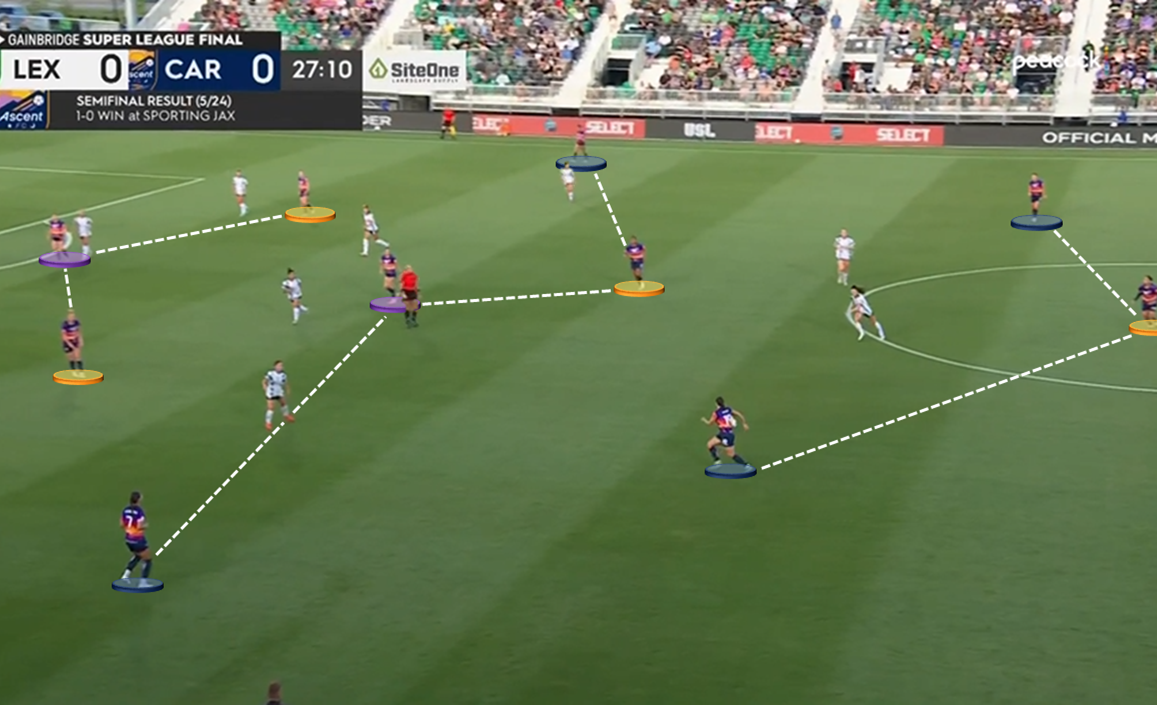
In possession, Carolina reprised a soft back three, dropping Nabet in like a central defender. The Ascent’s attacking shape was somewhere between a 3-1-5-1 and 3-4-3 at full tilt, and you see the latter above. Because the three players in the deepest line outnumber Lexington’s two pressing strikers, Nally can carry the ball around the edge and potentially hit Parker (orange, left halfspace) or left back Jill Aguilera (blue, left sideline) with space to operate.
Still, Carolina’s best looks came outside of that set context. When Mia Corbin struck a minute into first-half added time, the Ascent operated outside of their staid in-possession setup. A long restart was won in the midfield by a hard-charging Nabet, who had license to dribble forward post-recovery instead of dropping into the defensive line. Upfield, Nabet would connect with Mackenzie George, set up a cross, and leave Corbin the space to collect a loose ball and fire from the edge of the box.
The go-ahead goal might’ve come against the run of play, but it illustrated Carolina’s bend-don’t-break opportunism. From there, the onus was on Kimura to pull the right strings to get his side back on top. Lexington didn't make a single change until after the 90th minute, but they leaned into a more direct offensive approach. Searching balls into Weinert on the left were especially key; one to Griffith off the right side, hit before the transition into a Bourgeois-powered 3-2-5, is what set up LSC's equalizer.
By the time the extra 30 minutes arrived to break the 1-1 deadlock, both sides had refreshed their midfield pivots, and Lexington went one step further, boldly subbing out Barry – the Super League's Golden Boot winner – for Hannah White. One of LSC's returners from their inaugural season, White spent the year as a super sub but notched two assists in her roughly 350 minutes. Moreover, she won 10 duels and took 6.2 box touches per 90 in her offense-first role.
As Lexington pushed their advantage, set pieces became a major battlefield. Per American Soccer Analysis' data, Carolina allowed just three set piece goals (i.e., from corners, free kicks, and immediate post-set piece sequences) in their first 29 matches; Lexington ranked fifth in the division with a modest 9.0 xG from dead balls. However, what projected like a "stoppable force versus immovable object" matchup didn't play out that way.
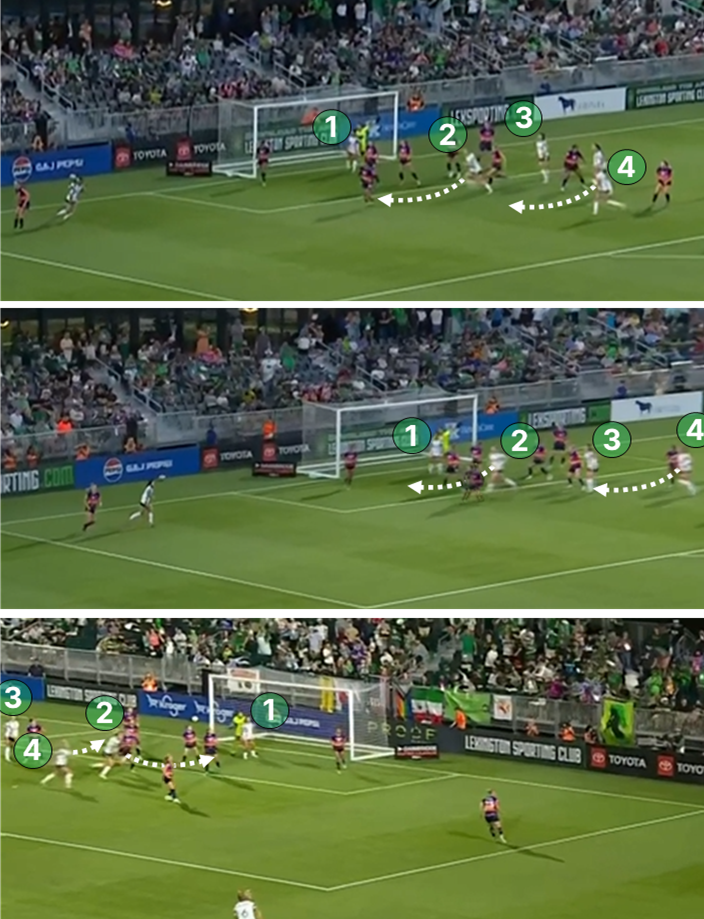
Outside of a few short corners aimed at Taylor Aylmer, Lexington tended to iterate on a standard play from corner kicks. Here, you see four main actors involved in exemplary sequences from the 67th, 71st, and 96th minutes:
- A smaller midfielder like Darya Rajaee or Tatiana Fung stands on the goal line, obscuring goalkeeper Sydney Martinez’s range of motion.
- The primary No. 9, either Barry or White, flashes to the near post.
- Addie McCain holds a position at the far side, roughly level to that of the curling striker. She’s ready in case there’s a deflection or the cross is overhit.
- Regan Steigleder makes a later-arriving run, splitting the horizontal distance between players #2 and #3.
When Steigleder headed the winning goal in off one of those designed sequences, it was the deserved pay-off for Lexington’s superior attack and consistent dead-ball patterns. Across phases of play, they proved themselves to be the sharper team. McCain got a goal of her own in the 104th minute to seal the deal, and that cemented a final 3-1 scoreline in Lexington’s favor.
More than anything else, the title was a testament to Lexington’s top-down trust in their process. From the moment this team began their star-studded rebuild in the offseason to the final whistle on Saturday night, Lexington had absolute clarity on where they wanted to go and how they were going to get there. That quality was obvious in action, and it’s why Lexington lifted the first trophy in their club’s short history.
Potpourri
The Pittsburgh Riverhounds were back in action after an extended bye, making it three wins in their last four Championship matches. Along the way in that victory over Miami, the strength of their defensive system was a standout.
Rob Vincent stuck to a fairly typical 4-4-2, electing to use Danny Griffin and Robbie Mertz as his pivot pair. Up top, Sam Bassett flexed ahead like a striker next to Albert Dikwa. Miami has been somewhat chameleonic in terms of their shape this season, but Pittsburgh’s ability to flex into 4-2-4 or 2-4-4 mode and trap against the ball was sublime.
Here, the ‘Hounds shape up and pounce after a Miami reset. Bassett and Dikwa prevent clean central possession, and the guests try to work up Pittsburgh’s left to find relief. It doesn’t come; Ahl closes down hard, Dikwa cuts off a No. 8 as a moderate passing option, and Bassett is ready to either double up on that center mid or close against a return pass to a Miami center back.
The ball is funneled up the sideline, where left back Lasse Kelp is waiting to disrupt the play. Instantly, Pittsburgh can route through Ahl and earn a dangerous foul. Many of the Riverhounds’ best moves came from these sideline-centric actions, and it’s no coincidence that Ahl and right-sided Eliot Goldthorp combined for 22 duel attempts and 14 recoveries.
Phoenix Rising coasted to a 2-0 win over Sacramento over the weekend, but I want to put the spotlight on a player I haven’t lauded enough: forward Ihsan Sacko.
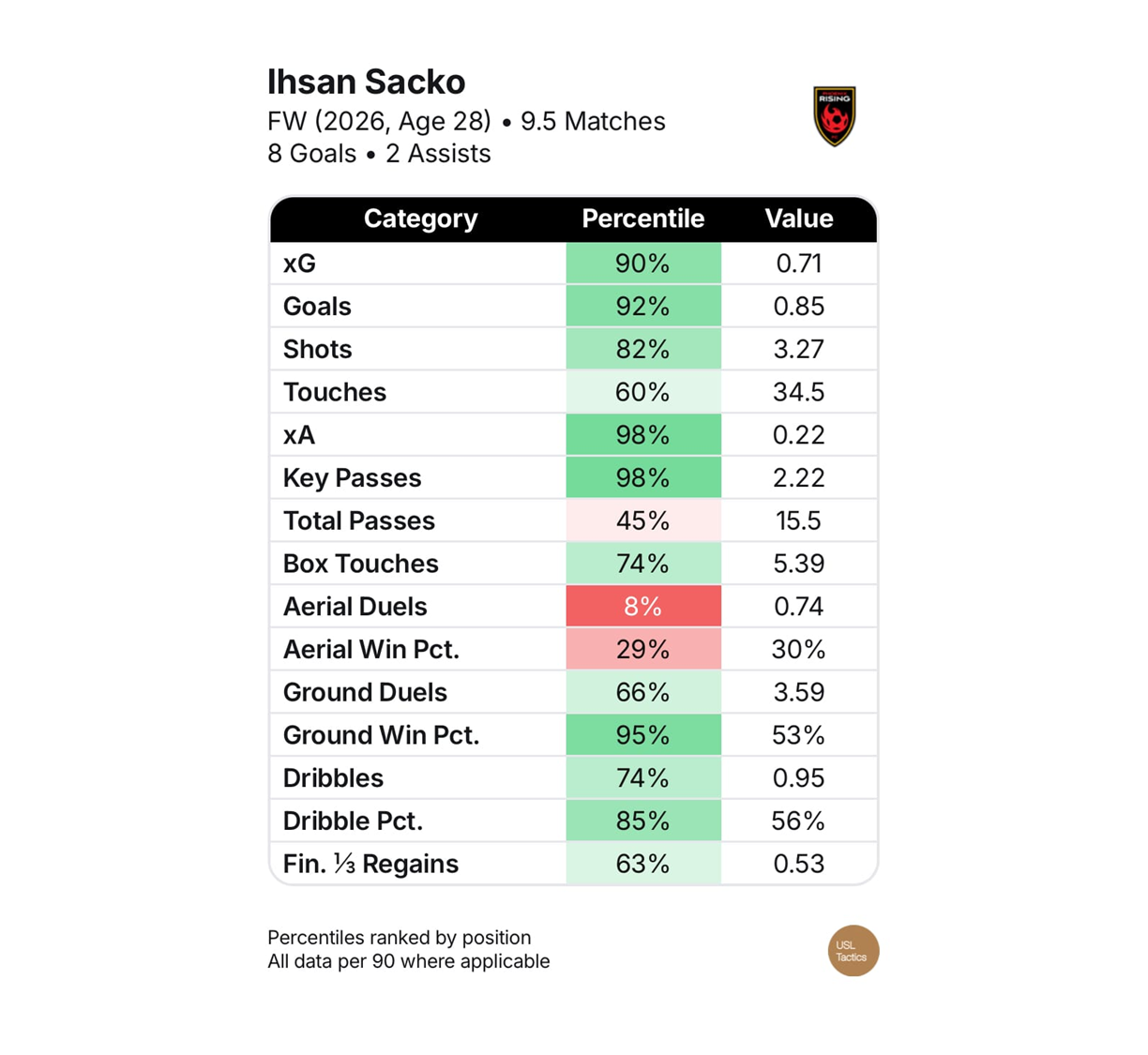
Yeah, both of Sacko’s goals in Week 13 came from the spot, but his numbers all year long have been MVP-caliber. Rising haven't always looked comfortable in their skin while trying to implement an in-possession back three in 2026, but Sacko has risen to the occasion whether he’s serving as a No. 9 or a right winger.
Over in League One, I continue to love what Union Omaha is doing with the ball…
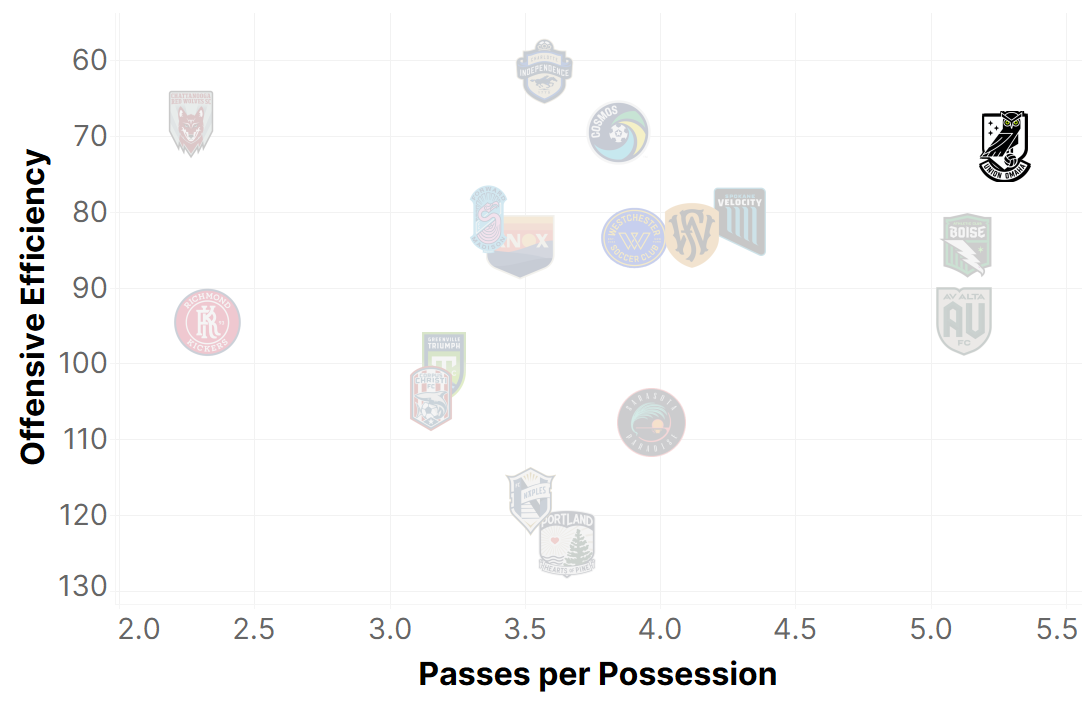
…as they continue to nail down their status as the division’s premier possession team. Los Búhos are the League One leaders in passes per possession, but they’re the rare side that mixes high-volume passing with strong efficiency.
I went long in this week’s Backheeled column on the tactical changes Vincenzo Candela is rolling out, and part of that calculus is an ability to manipulate the personnel in his midfield. Omaha has an overarching structure, but they’re willing to switch up the personnel running it and the specific details therein. On Saturday against Naples, for instance, Kempes Tekiela and Diego Gutierrez were re-cast as midfielders in the second half.
The result? Plays like this where Omaha had an overwhelming presence in the middle of the park. Here, Candela’s side is loosely in 4-3-3 or 2-5-3 mode, but there’s ample movement afoot.
Tekiela (neon, as a midfielder) and Sergio Ora Navarro (black, as a forward) both drop a line from their preferred spots, and that forces Naples to collapse narrow. Thus, Gutierrez can find a pocket on the far side of the frame. Omaha work side-to-side, hit Gutierrez, and let him play an overlapping Ryen Jiba through to hit a dangerous cross. None of it happens without that initial overload or without Omaha’s league-best comfort in knocking the ball around.
Forward Madison trounced Corpus Christi on Friday night, and the win was a testament to their changing system. Once upon a time, Matt Glaeser was one of League One’s patron saints of patient passing. In 2026, his Mingos have arguably been the most effective “punt and press” team in the division.
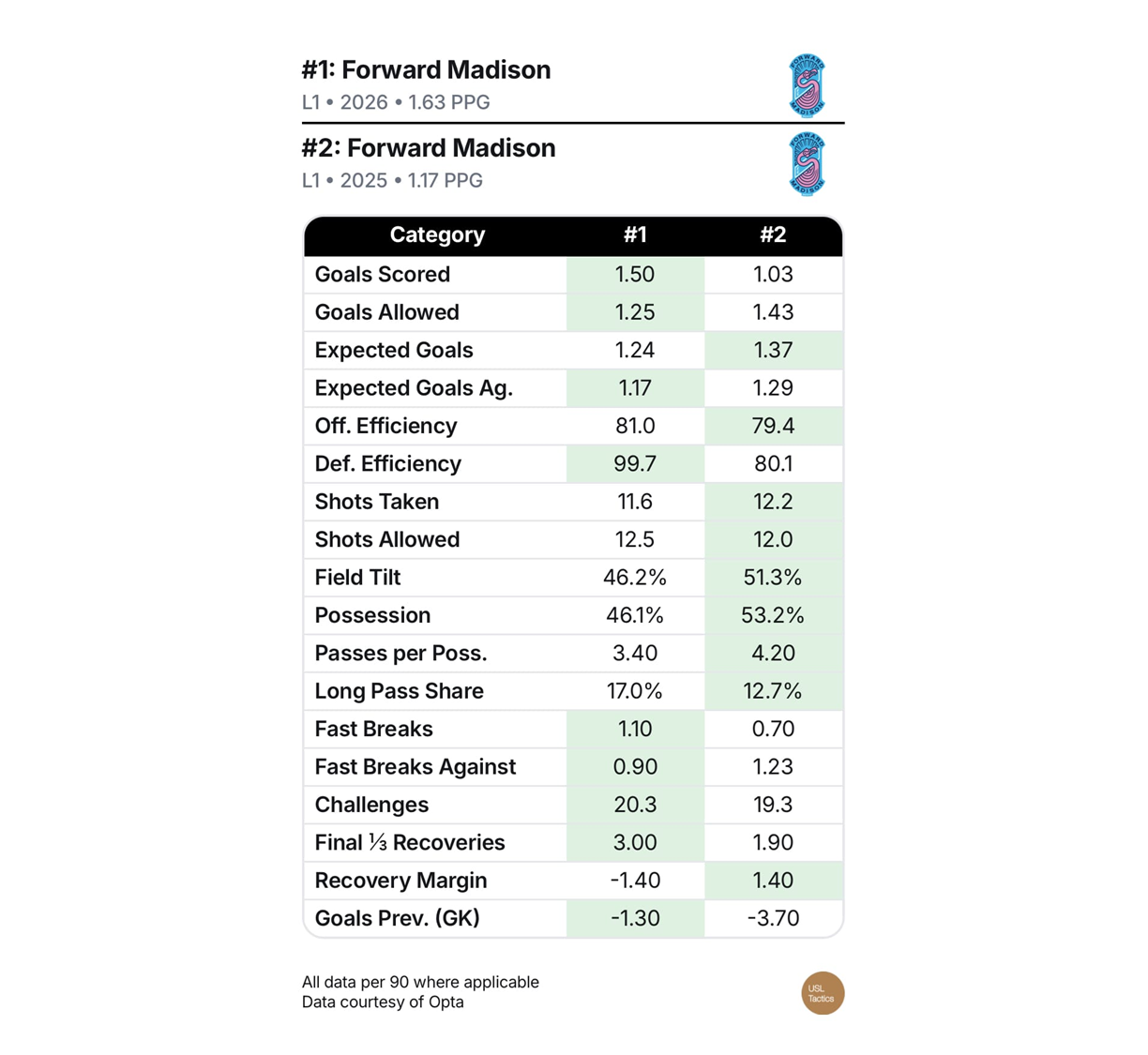
Madison’s numbers are up or holding steady by most outcome-centric metrics, and the style numbers show how they’ve changed tactically. This club’s possession average is down 7% year-over-year. Their share of passes hoofed long is up by 4.3%. Crucially, Madison’s final-third recovery numbers (a proxy measure for pressing success) are up from dead last to a far more moderate level. This team is going long, winning the ball upfield, and doing dangerous things while there.
In other news…
For more on the Super League final, go read Nicholas Murray's Three Things that Mattered... recap. Nice context on the McKenzie Weinert performance there.
Luke Martin has a terrific interview with ex-Tormenta manager and current Charleston assistant Ian Cameron. Choice quote on the Battery system: "You remember at Tormenta, sometimes we had high possession, but not enough penetration...we have those same kind of possession stats, but we’re able to turn it into more chances."
I guested on the always-excellent Raising Anchor podcast to preview RIFC's loss to Indy Eleven, but I'd encourage y'all to check in with the Q&A session at the end of the episode.
Pressure, the movie where Andrew Scott gives the weather forecast for D-Day, rocks. It's less of an explicit war movie and more of a "process" movie, in the vein of something like Spotlight. Scott – who should've won an Oscar last year for his supporting turn in Blue Moon – is absolutely terrific. (Brendan Fraser is legitimately awful as Dwight Eisenhower, but it is what it is.)