The Back Four: Lexington, long balls, and more
A Kentucky glow-up, plus League One's direct tactics

Welcome in to The Back Four!
As a reminder: make sure you're subscribed to Backheeled for all things USL Championship and USL League One. Also, listen to This League! and The USL Show to catch up in podcast form.
Without further ado, let’s get to it.
Lexington's Goodrum-less glow-up
Back at the end of May, Lexington travelled to Indianapolis and suffered a 3-1 defeat at the hands of an Eleven team whose direct, physical style suffocated their guests. Yes, an instant red card for LSC derailed the match, but it was yet another example of how things hadn’t clicked into gear for an erstwhile 2026 favorite.
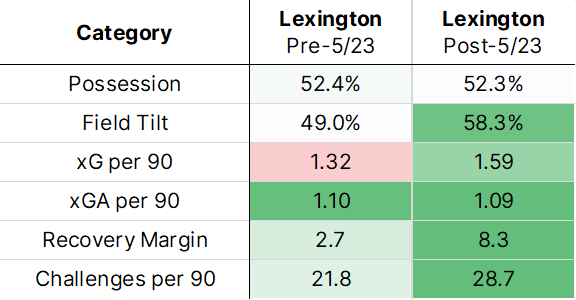
Since then, things have improved markedly. LSC is undefeated in their pursuant four matches, racking up a +18 margin for shots on target and a + 2.9 xG edge. The numbers have been dominant. Yes, two of those games came in the USL Cup and another saw Lexington play up a man for 71 minutes. It’s still undeniable that manager Mac Hemmi has made meaningful tactical changes – all while juggling the absence of $100,000 striker Phillip Goodrum.
Goodrum has scored two league goals in nearly 1,000 minutes to date, and he’s often been asked to chase longer service within the run of the Lexington attack. In the box, his presence has run hot and cold. Even so, to say that LSC is an outright “better” team or has a higher ceiling without a No. 9 that’s scored 14 goals a season since 2022 would be naive.
What’s undeniable is that Lexington’s numbers have improved in his absence, even though they’re holding the exact same share (52%) of possession. In terms of tilting the field, supporting that tilt with defensive interventions, and turning the control into chances, Lexington has sharpened. A rematch against the Eleven in Week 16 showed how this club has improved.
To my eye, the re-structuring of the shape around Braudilio Rodrigues as a false No. 9 has done the job. Rodrigues looked like the best player in League One (or, at least, the best non-Luis Alvarez player) while on loan in Knoxville, and he hasn’t missed a beat after his recall. While Hemmi’s 3-2-2-3 or “three-box-three” tendencies haven’t necessarily changed, Rodrigues’ positioning has added more variety to the LSC attack and given them an extra man to help claim 50/50s. Those shifts are paying off in spades.
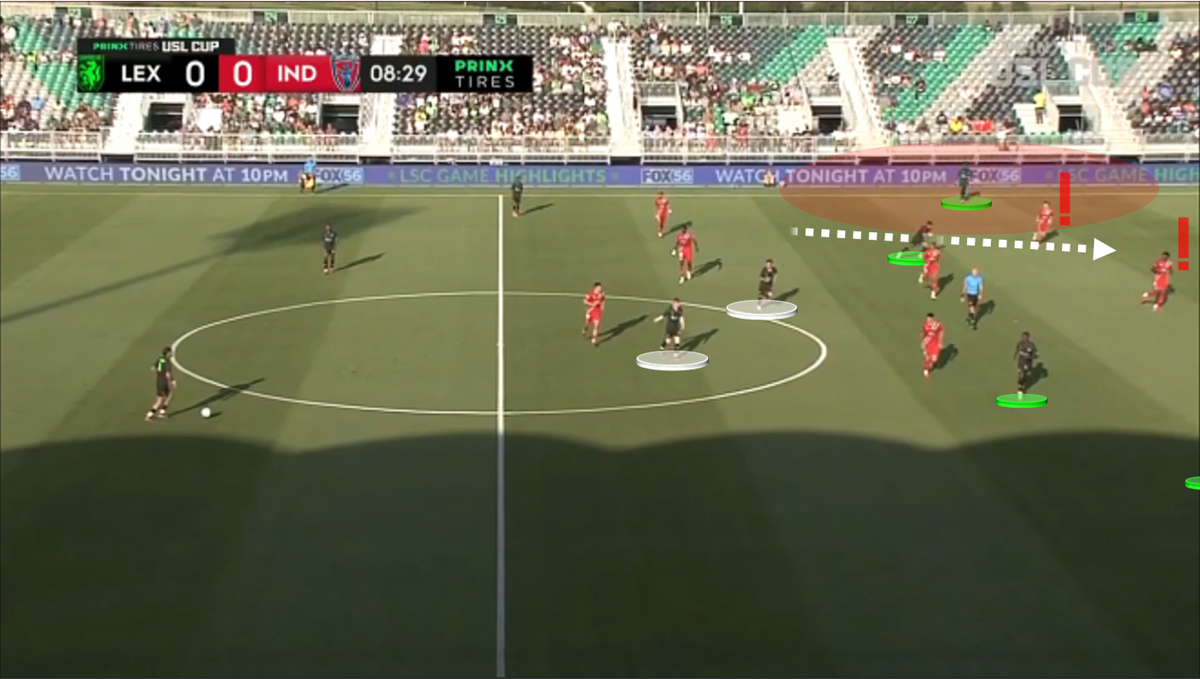
Here, center back Arturo Ordonez is on the ball with the 3-2-2-3 (or 3-2-5-0?) forming ahead of him. Aaron Molloy and Blaine Ferri (white) sit in the pivot positions, whilst Rodrigues (green, near side) and Nick Firmino (green, making a run) are taking up central positions.
Indy has bent their shape to deny a centering pass, but Firmino’s run opens space over the top of the midfield. Because he targets the seam between a fullback and center back within the Eleven’s 4-1-4-1, half of the defense is sucked into the channel. Ordonez knows that Indy is going to get too narrow, and he hits an anticipatory switch into a now-open Marcus Epps off the left wing.
The other layer here? Note where Jacob Greene, the Lexington left back, is positioned. Because he’s close to the level of the defensive line, the Indy winger on Epps’ side of the pitch has to stay high. As such, no one is in position to recover and help double up against the eventual diagonal. At every level, it’s a wonderfully composed offensive move.
This play starts differently, with Molloy having dropped between the center backs. In isolation, that move from the all-league midfielder wouldn’t bend Indy’s mid-low shape. However, it’s paired with two things: (1) a low drop from Firmino in the left-central pocket and (2) a skewing run from Ferri to fill the right back spot.
Simultaneously, Indy is forced to step their No. 6 toward Firmino and send one of their No. 8s at Ferri. The problem for the Eleven? The coverage isn’t organized enough. Within their five-man midfield, two players both ball-watch as Ferri receives, giving him the space to look upfield and pick out a pass.
This time, LSC targets the other side of the Indy back line. A deep Rodrigues, narrow Michael Adedokun, and overlapping Xavier Zengue have an odd-man advantage on the two proximate Eleven defenders. Again, the result is danger around the 18-yard box.
Across the two examples, it’s the speed of Lexington’s attack that stands out. This team is spending less time tilting at set defensive blocks, using their high rate of possession to work the ball around until gaps emerge. When LSC moves upfield, it’s happening quickly. Along the way, players like Rodrigues, Ordonez, and Ferri have been better able to express themselves. We’ll see if it can hold up for a team that’s still ranked 11th in the West, but the recent vibes couldn’t be better.
Punt-and-press in League One
I’ve said it before, and I’ll keep on saying it: there’s not one specific way to win at the USL level. Spending is only lightly correlated with success. You can play long, play short, press high, or bunker in and still end up atop the table. The challenge is to pick a lane, maximize the talent you’ve got, and make sure your squad is bought in.
The rise of patient offenses and midfield-driven scoring was the throughline of my Backheeled League One column this week, but I want to focus on a different blueprint here. In Week 16 in particular, clubs that want to play long, minimize their time in the middle third, and press in support of those ideas stood out.
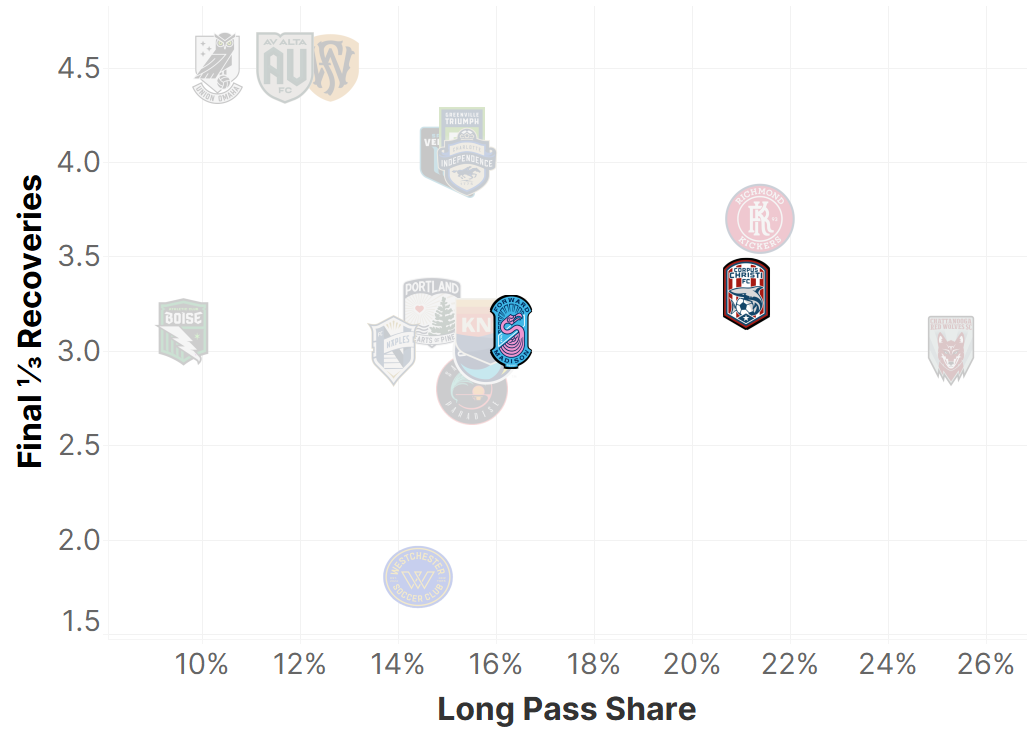
Right now, Forward Madison (16%) and Corpus Christi FC (21%) are ranked fourth and third in League One in terms of their long pass share. Likewise, both are winning the ball back in the attacking zone at least three times per match. The exact flavor of their systems can vary. Madison is a bit more patient on the ball and a bit more dogged in terms of their man-oriented pressing game; Corpus Christi is more passive without possession, but they’re incredibly intense in pursuit of second balls.
Here, you see Madison in action from last week’s draw against Fort Wayne. This sequence starts after a turnover in the attacking zone, so the Mingos’ upper lines aren’t in their baseline defensive positions. Even so, manager Matt Glaeser’s 5-2-3 still forms up. Center mid Roman Torres fills on the right wing; left winger Derek Gebhard takes up the striker slot. Behind them, Ryan Carmichael and Josh Bolma pair up as mixed-line No. 6s.
Initially, Madison patiently finds their shape, but you can see the moment where they decide to turn up the heat. Once Gebhard is certain that Bolma and Carmichael are in position to mark Fort Wayne’s center mids, he blitzes the defender on the ball. The Bees tries to swing right, but forward Claudel Ngoubou and wingback Geni Kanyane extend from the left side of the 5-2-3 to trap against the sideline.
With that trap in place, Madison forces a difficult pass into the seam, creates an interception, and drives the ball out of play. While you don’t get a taste for the Mingos’ long game here, the aims of their press are unmistakable. Madison has become a side that’s increasingly good at pinning their foes and disrupting their rhythm. Getting direct is what pushes play into the opposing zone in the first place.
The field-tilting allows Madison to retain their structure further back, hence why this club leads League One with a defensive efficiency mark of 111. In other words, it’s taking more than a hundred final-third passes for Madison’s opponents to generate each of their expected goals. If the Mingos weren’t slowing opponents down as such, that simply wouldn’t be possible.
On the flip side of the coin, Corpus Christi has used a similar mien toward offensive ends. In their first seven matches of the regular season, the Sharks posted a dismal attacking efficiency mark of 106. Since then, that number is down to 74 – better than league average. Manager Eamon Zayed has found the right personnel to move upfield apace, win 50/50s, and avoid logjams close to goal.
The boldness with which Corpus Christi sets up to win a second ball is obvious here. Defender Jack Keaney waits for his teammates to get set upfield and then chips a pass toward the attacking zone; there, defensive midfielder Patrick Langlois has taken up a pseudo-forward’s position to become a target man. Though Langlois doesn’t win the initial header, the structure around him is pristine. Striker Jake Keegan (red) drops low to the weak side, attacking mids Nacho Abeal and Bubu Medina (blue) sit under and to the right, and Enock Kwakwa (white) provides a pivot backstop.
The Sharks battle for possession, then quickly drive into Abeal and a cross-cutting Blake Bowen off the left wing. The pace of play never abates, and it nearly ends with a clean pass into the box to create a scoring chance.
It’s very easy to assume that direct, vertical teams are less tactically sophisticated than their grounded peers, but that isn’t the case. Clubs like Madison and Corpus Christi use the long ball as a hyper-specific tool to generate very particular outcomes. While the slick Charlottes and Boises of the world are succeeding in their own right, there’s something to be said for the more pragmatic side of the League One spectrum.
In other news…
We did a “Midseason Best XI” episode on This League! on Monday night, and I went to bat for Nathan Messer as the best left back in the USL Championship. What Messer has done as an attacking option is unmatched, but I also love sequences like this…
…where his defensive and transitional instincts are on show. Here, the Charleston fullback cuts out a pass toward the sideline, and he does so with a curling body position that allows him to immediately push the ball upfield. Everything from there is classic Charleston – Jeremy Kelly receives, Colton Swan facilitates, etc. – but none of it happens without Messer.
Speaking of guys I chose for my midseason all-USL team, you should go check in with Nico Benalcazar's interview on Orange & Black SoccerCast. I think the do-it-all midfielder and/or defender has legitimate European potential, and he's a major reason why OCSC is second in the West.
I’ll admit that I’m waiting for the other shoe to drop on AV Alta after their late collapse in 2025, but things feel different this time around. Brian Kleiban hasn’t completely overhauled his system, but his side’s defensive outcomes have improved significantly. While Alta’s return of 19.5 xG against thus far isn’t stellar, it’s a far cry from the 25.0 mark that should’ve been a humongous red flag at this point last season. Because of the defensive improvement, this club’s xG margin is three times better year-over-year.
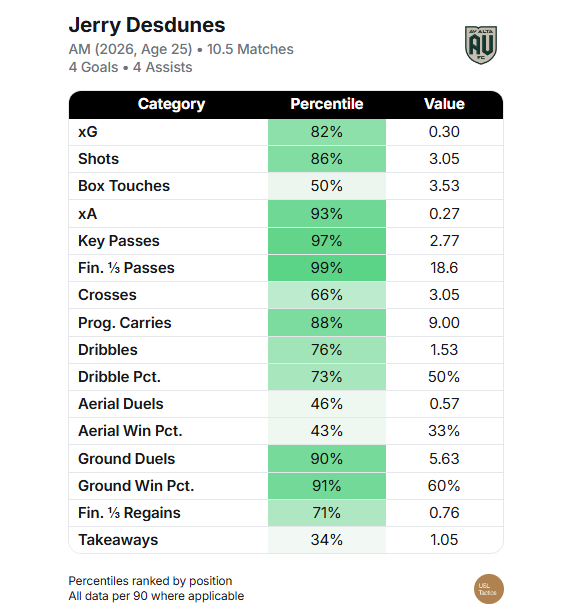
The other big piece? Jerry Desdunes has stepped up to borderline star status. While Alta is still a patient possession team, Desdunes – who’s comfortable up and down the left wing and at the No. 9 spot – has added quick-twitch production to their offense. He’s got eight goal contributions already on stellar underlying numbers. Put his glow-up and the defensive improvements together, and the narrative for Alta becomes clear.
I wrote about Christian Pinzon in the big Backheeled column, but I’m loving plays like this…
…that highlight his movement off the right wing relative to Oalex Anderson off the left. There’s been a ton of discourse during the World Cup about a trend towards left-dominant attacking patterns – including by FC Tulsa defender-turned-Twitter impresario Ruxi – and the use of the two-footed Pinzon in such narrow positions is Devin Rensing’s take on the model. I’m interested to see how the relationships keep developing for the Lights, who have real potential to jump out of the bubble in the second half of 2026.
If Duke Lacroix, Carl Sainte, and/or Garven Metusala don’t play in Haiti’s final group game at the World Cup, I will be very upset. Related: go read Nicholas Murray as he sets the context for Eloy Room’s historic shot-stopping performance for Curaçao.
FYI: Travelling next week, so there'll be no newsletter.