The Back Four: Boise, Miami, and more
On wingback excellence, rest defense, and a Super League friendly

Welcome in to The Back Four!
As always, visit Backheeled for more USL content, including deep dives into all things Championship and League One. Also, listen to This League! and The USL Show to catch up in podcast form.
Without further ado, let’s get to it.
Boise’s secret weapon
Wherever Nate Miller has been on the staff, crosses have rarely been an emphasis. Whether helming Lansing Ignite or serving as an assistant (and, later, head coach) in San Diego, Miller-ball has helped foster intentional passing patterns that produce controlled moves into the box.
Athletic Club Boise hasn’t gone away from those principles, and their offensive returns are broadly in line with what we’ve seen at the manager’s prior USL stops. Still, Boise stands out compared to other Miller sides:
- Lansing, 2019: 72 final-third passes per xG, 8.0% cross share
- San Diego, 2021: 78 final-third passes per xG, 12.1% cross share
- San Diego, 2022: 63 final-third passes per xG, 11.9% cross share
- San Diego, 2023: 69 final-third passes per xG, 11.8% cross share
- Boise, 2026: 75 final-third passes per xG, 14.0% cross share
Boise has put up above-average attacking efficiency numbers, firmly in line with prior San Diego and Lansing sides. They’ve done so in a familiar 3-4-3 shape to boot. The big difference is how wingback-driven Boise has looked. Between Blake Bodily, Nick Moon, and Jonathan Ricketts, this team centers on that position in a way that’s unique in Miller’s managerial history – and in the USL writ large.
By virtue of their short passing style – this is the only team in the USL to go long less than 10% of the time in 2026 – Boise often come up against set defensive blocks. Plenty of teams would meet that challenge with hopeful crosses toward a big target man; by contrast, Miller’s side brings a real sense of intentionality with their inside-out and outside-in patterns. There’s poise aplenty, and that sets Boise’s crossing game apart.
Here, you see center back Josh Yaro on the ball in what I’ve often liked to call a “1-4-5” formation. As opposed to other teams that’ll attack in a 3-2-5 shape, Boise allows wide defenders like Yaro and Jake Crull to become active participants in the attacking zone. In this case, Yaro uses that freedom to dance through the midfield; Portland is attentive to the proper No. 8s, so the St. Louis City loanee has the space and time to push forward and whip a pass across the pitch into Moon’s feet.
When Moon receives, he’s looking at a potential two-on-one. To help out, Crull loops toward the left sideline to create a moment of hesitation for Hearts. Thus, Moon can create separation, look up, and spot Ricketts at the far post. The three forwards are all in the middle of the box; that frees the right wingback in space.
Ricketts started the season as a central defender, one that would often move up a line late in games. He hasn’t missed a beat in recent months as an out-and-out wingback, winning 2.4 aerial duels and creating 0.10 xA per game. Here, he’s able to corral Moon’s cross, setting up a quick-twitch sequence between forward Timo Moshobane and midfielder Philip Mayaka to manufacture a shot.
The use of Moon as a one-on-one turnkey and Ricketts as a wonky target man sets Boise apart; plenty of teams attack with a front five, but few are as dangerous and idiosyncratic from sideline to sideline. Here, that point of distinction is clear once more.
You see Boise bend forward through Crull up their left side, working through stay-at-home Jake Dengler and climbing the ladder to Moon. Boise’s first attempt at creating an overload doesn’t take, so they reset back into Dengler without sacrificing the numbers they’ve thrown upfield.
At second pass, Dengler skips the middle man and plays directly into Moon’s feet. The pace and verticality of that ball puts Portland on the back foot; they overcommit to Moon, then scrambled to address Denys Kostyshyn’s third-man run through the channel. When Kostyshyn receives, he knows Hearts are overdrawn and cuts the ball back to Mayaka in oodles of space.
What this second play gets at is the reality of the Boise offense: yeah, they’re cross-heavy by Nate Miller’s historical standards, but they’re keeping the ball on the ground 86% of the time in the final third. That Boise spends so much of the game around the 18-yard box and remains an efficient offense is remarkable, and the contributions of Moon and Ricketts are key. I used my League One column in Backheeled this week to propose ways Boise might get even sharper, but they’re already one of the division’s best attacking sides for a reason.
Miami beachhead
Generally, the more time you spend in the attacking zone, the more likely you are to give up a counterattack. It’s basic: if you’re throwing numbers at the opposing 18-yard box, giveaways become that much more dangerous because you’re less protected downfield.
This year, Miami FC has defied that logic.
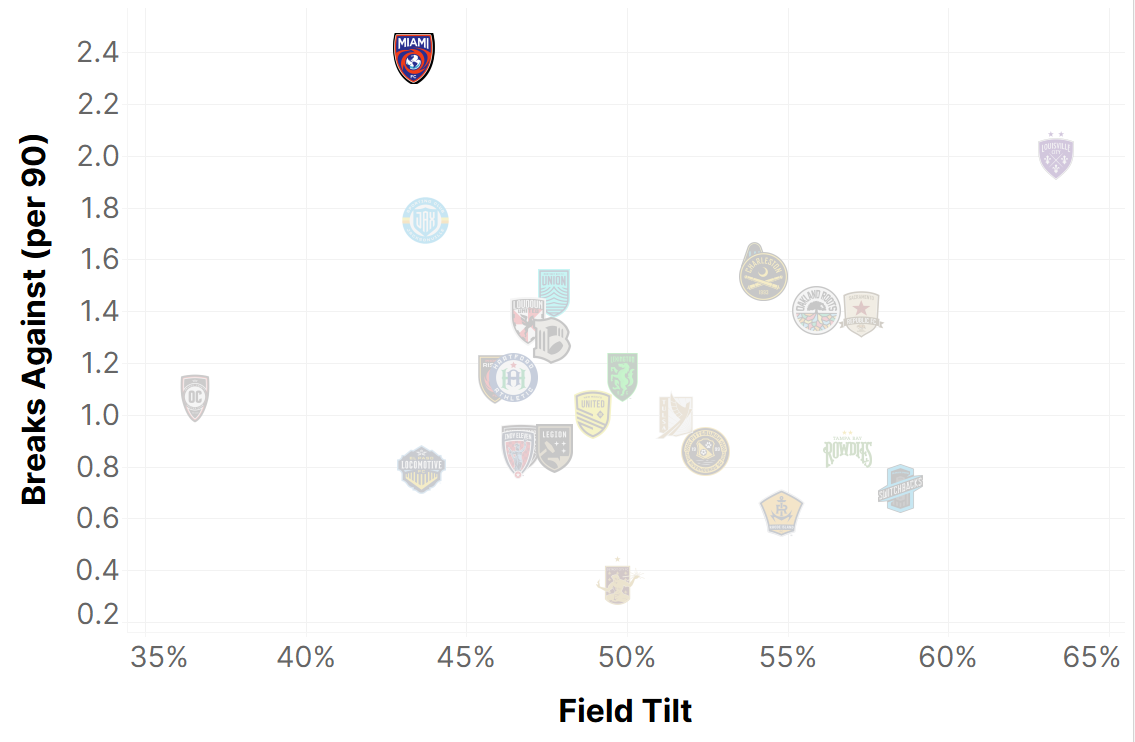
When you exclude Miami and Jacksonville, there’s a mildly positive connection between field tilt and fast breaks conceded. The R-squared is about 10% – small, but not nothing. Louisville City is the extreme example of a team that lives in the final third and opens themselves up to the break, but they’re sharing that territory with clubs like the high-possession Oakland Roots and oft-trailing Las Vegas Lights.
With all 25 clubs considered, the variation in fast breaks conceded explained by field tilt is a stunningly low 0.06%. The connection disappears. Not to oversimplify, but Miami offers up such a bizarrely extreme mix of “don’t control territory, allow a ton of transition chances” results that it obliterates the statistical trend.
In Week 20 against Indy Eleven, that changed. Manager Gaston Maddoni has run variations of a hybrid three- and four-at-the-back all year long, but it’s rarely felt as organized as it did against Indy. Miami still wanted to build in 3-2-5ish mode by releasing left back Alessandro Milesi into the attacking zone, but they put a far greater emphasis than usual on control through the middle third. Combined, Matias Romero, Rodrigo Da Costa, and Arney Rocha – the attacking mids in Miami’s off-ball shape – took nearly 30% of their touches in the space between the defensive box and zone 14.
As a consequence of that center-skewing movement, Miami had an easier time climbing the ladder through thirds and remained steadier when they turned the ball over. Riyon Tori was a constant at the No. 6 spot, but he had much-needed help whenever a Sonora or Da Costa type dropped in.
Above, the attacking upside of the tweaked shape is clear to see. The on-paper formation is almost like a 3-1-6, but it never played out that way; attack–first players always dropped low to steel the midfield. You see Tori in the pivot as expected, but he’s joined by Sonora and Rocha to make weight. The trio has an edge on opposing Indy’s double pivot, and that allows Sonora to receive, turn, and find an open teammate up the right wing.
While the ensuing cross doesn’t connect, Miami’s structure lends itself to a high recovery. Rocha bursts back upfield, Indy’s clearance only reaches as far as zone 14, and Maddoni’s side gets a second bite at the apple. Milesi – who’s got four goal contributions in his first USL season – imposes himself at this point, swooping from the left to attempt a shot. What you aren’t seeing is the resting structure; as the left back goes for goal, there are still four players deep providing a solid resting base.
Maddoni didn’t reinvent the wheel in Week 20, but the slight structural changes made a world of difference. We know that goalkeeper Eloy Room and forward Jurgen Locadia are going to be key in the post-World Cup portion of 2026, but it’s the rest of the squad that needs to find their level if Miami wants to make the postseason. What we saw last week could be a major step in that direction.
Jacksonville-Wrexham takeaways
Overreacting to preseason friendlies is my favorite activity, and I’ve rarely got to do it for the USL Super League. That changed last week. Jacksonville travelled to take on Wrexham’s women’s team in a game streamed on X (the everything app™), downing the Welsh side 5-0. What’d we learn?
Sporting currently ranks second in the Super League with an 81% minutes retention rate this offseason, trailing only the Carolina Ascent. In other words, Stacey Balaam’s side isn’t going to look all that different in the fall season. Jacksonville ran back last year’s 3-5-2 and remained a patient build side. The real point of interest came in terms of the new faces that appeared in the starting lineup rather than any tactical innovations.
Melina Descary, 22, started as the right-sided No. 8, showcasing an immediate ability to connect play between lines. In her final season at the University of South Alabama, Descary completed 5.3 progressive passes and made 2.4 progressive runs per 90. That skillset shone through immediately.
Jacksonville used Sophia Boman as their No. 6 in Wales as Descary filled her usual position, and there wasn’t a hint of a drop-off. That’s exemplified above. Goalkeeper Kaitlyn Parks begins the play on the ball, sliding a pass to Georgia Brown in the heart of the back three. Brown sees a lane upfield, skipping a pass between lines into Descary’s feet.
When she receives, the rookie is exploiting two overloads. On one hand, she, Boman, and Ashlyn Puerta have a plus-one edge on the Wrexham double pivot at the heart of Jacksonville’s 3-5-2. On the other hand, Descary is pairing with forward Paige Kenton and wingback Ginger Fontenot – another new addition – to outnumber Wrexham’s wingback and ball-side center back through the channel.
Kenton drops in as the play develops, dragging that central defender with her. Meanwhile, Descary moves toward the sideline to bend the midfield; she’s replaced by a high-stepping Boman from the No. 6 spot to ensure that Sporting retains their shape. The combinations change through the move, but the end result is a through ball to Fontenot in a crossing position. (At this point, the stream glitches. Eat your heart out, Ryan Reynolds.)
Mya Swinton was the other new player that stood out. A rookie out of the University of West Florida, Swinton was an attacker in college that notched 53 goal contributions across her four years at the D-II level. Clearly, Balaam had something else in mind when she signed Swinton: the right-footed winger started as a left-sided center back against Wrexham.
Here, Jacksonville inverts their setup in the box, with Parks (who passed left 55% of the time in 2025-2026) sitting inside of Brown. Sporting don’t skip lines immediately through Brown this time, instead playing into Swinton’s feet toward the left sideline. Now, it’s time to speed up the sequence. Swinton has a moderate option in wingback Caroline Murray, but she opts to right-foot a pass into Kenton over the top instead.
Upfield, Kenton deftly chests the long ball down to her feet, immediately laying off to an advancing Murray. The wingback is free to dribble in behind, and she’s got options in the box; noticing that Kenton has dropped to hold play up, Baylee DeSmit makes a diagonal run from the other No. 9 spot to present herself in front of net.
Both of these plays will be familiar to Super League followers, but the new faces that’re making it happen is what’s exciting. Descary adds creative upside in the halfspace, and Fontenot is a proven attacker at either wingback spot. Swinton genuinely could play 10 different positions this season. For a Jacksonville side that was a tiebreaker away from the Players’ Shield in their expansion campaign, the mix of consistency with newfound upside looks promising.
In other news…
I focused on Ihsan Sacko in my Phoenix Rising Backheeled blurb this week, but everything about Pa-Modou Kah’s reinvented 4-4-2 impressed me. Ostensibly, Sacko and Hope Avayevu respectively filled out the right and left wings. In practice, their positioning…
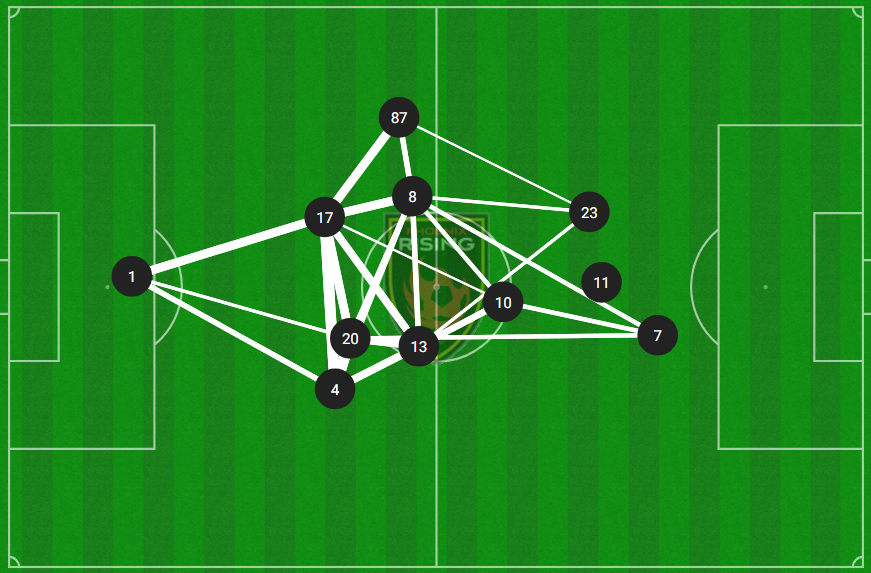
…played out as so. You’re seeing Avayevu (#10) look like an out-and-out No. 10, whilst Sacko (#7) is the most advanced Rising player. Time and again, Phoenix’s ability to play through lines and activate Sacko in the right channel tore opposing Monterey apart.
Credit to commentator Ryan Le, who pointed out on the Richmond-Spokane broadcast that Marky Hernandez – who featured on the Velocity’s right – has only started in 37 of his 129 career appearances in USL League One. Hernandez’s ability to star off the bench for the better part of six years is remarkable; I’m struggling to think of another player that’s been so workmanlike in such a specific role. As a cherry on top, Hernandez was terrific against Richmond, using his varied movement off the right to help run the show in a comfortable Velocity win.
Song of the week: "Every Which Way but Loose," which is also the opening track of the Clint Eastwood movie of the same name. I'm avowedly ignorant about country music, but there'll be a '70s or '80s banger that worms its way into my head every now and again. (Underrated movie, also; a classic of “guy drinking beer with an orangutan” cinema.)
Meh on The Odyssey.