The Back Four: Monitoring the situation
Bendy shapes, second ball structure, and other Week 21 USL notes

Welcome in to The Back Four!
As always, visit Backheeled for more USL content, including deep dives into all things Championship and League One. Also, listen to This League! and The USL Show to catch up in podcast form.
Without further ado, let’s get to it.
Potpourri!
Sometimes, I come into this column with a clear theme in mind. This week, I’ve got nothing of the sort. Instead, I want to highlight a few stray things that stood out in Week 21.
We’ll start with the Charlotte Independence, whose 5-2-3 I discussed in detail in my weekly Backheeled column. I’ll save the hemming and hawing on how they’ll move forward with a fit Luis Alvarez, but it’s still worth examining their right-sided patterns.
Here, you see the Independence work from left to right through their center backs, targeting Clay Dimick on the right side of the threesome. Whenever Charlotte go 3-4-3 – a tactical tic over the last few years – the standout feature of the shape is Dimick’s ability to flex ahead from central defense. The 31-year-old hasn’t slowed down a bit, and he shows it here.
As Dimick receives, Spokane bend his way and start to leave space open through the midfield. Charlotte sees it happening and moves to exploit the gap. One of their No. 10s (marked in tan) drops in, thus freeing Jon Bakero (blue) from his pivot responsibilities and allowing him to push upfield.
Together, Dimick, Bakero, and wingback Miles Lyons are able to give-and-go their way through the channel to produce a shot. In a simpler system where the center back wasn’t allotted the freedom to push high, that manner of overload simply wouldn’t be possible. While Charlotte ended up losing this game to Spokane, their upside was clear to see; things looked better against Richmond, and their momentum is pointed upward with Alvarez returning to full fitness.
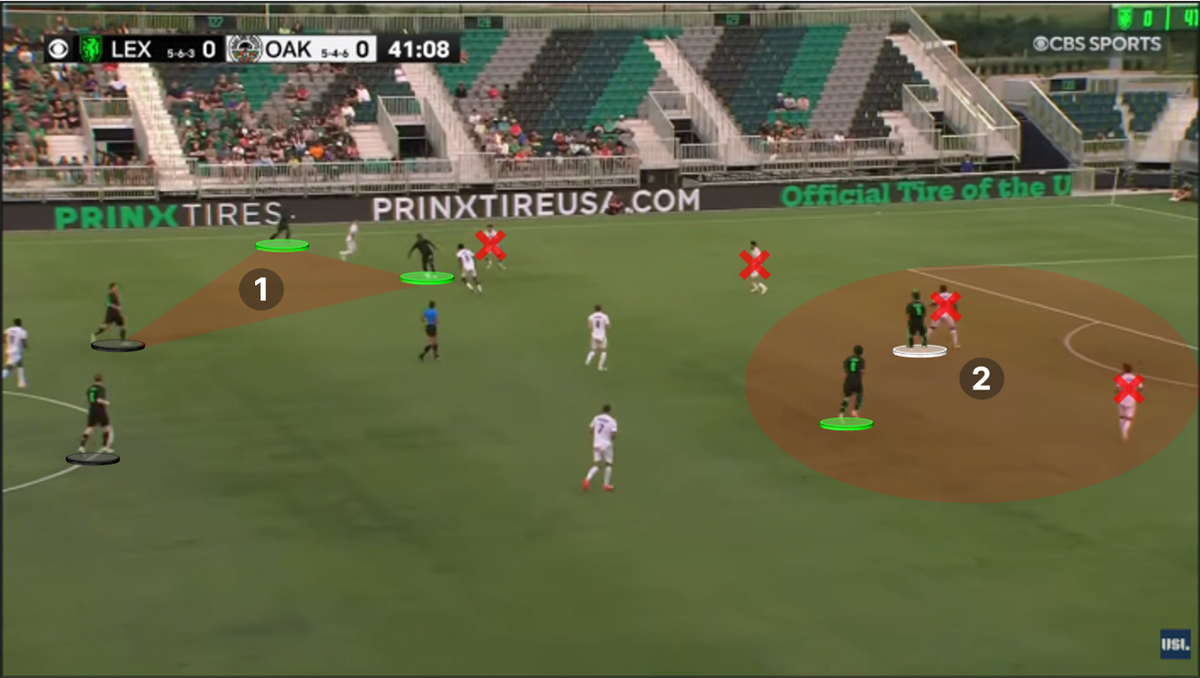
Up in the Championship, Lexington have been the kings of the flexible three-at-the-back throughout 2026 and showed it at midweek against Oakland. I continue to be smitten with what Braudilio Rodrigues provides this club, and LSC built around him throughout Week 21.
Lexington quickly works toward their left side here, finding a tucked-in Jacob Greene at left back. Though he's bent up by a few yards, Greene is effectively filling the third role at the bottom end of a 3-2-4-1 – and, in doing so, giving Marcus Epps free reign up the left flank.
When Epps receives, he can immediately look inside to find Rodrigues. As the second striker receives, Oakland is forced to react in two zones. Rodrigues' presence and the potential for a supporting run by Blaine Ferri out of the pivot draw defensive attention, freezing one side of the Roots' back four. Thus, Phillip Goodrum and Nick Firmino are two-on-two against the remainder of the defense toward the center of the park. Those two zones occupy Oakland; as a result, Xavier Zengue is wide open on an overlapping run from right back just out of the frame.
Rodrigues is able to bounce his way through traffic, and by the time the ball gets to Firmino, you can see Zengue getting ready to pounce. That threat freezes Oakland's near fullback, giving Firmino the time to pick out a shot.
Between the combinations across the pitch and the pace of play, there's so much to like in the sequence. It was harder to repeat the trick on Saturday against FC Tulsa, who used their mid-block 5-2-3...
...to deny Lexington the chance to rip through lines and challenge the defense. That’s par for the course for a Tulsa team that’s allowing just 1.16 xG per 90 on a positive field tilt, but it’s what comes after the stop in this example that’s so encouraging.
You can see Lexington initiating through their center mids and potentially looking to swing through the halfspace once more, but aggression from Jamie Webber and Jeorgio Kocevski in the Tulsa pivot stops that from happening. When LSC hit a 50/50 pass through lines, that same aggression is there at the back; AB Cissoko steps from central defense, possession turns over, and Tulsa immediately slams on the gas.
Webber has better vision in transition than 99% of midfielders that have ever appeared in the USL, and you see it here. With Bailey Sparks, Kalil ElMedkhar, and Logan Dorsey running ahead, Webber is able to play his teammates into a dangerous three-on-two that creates a tap-in opportunity. For an offense that’s generating just 1.2 goals per game (11th in the West) and taking 83 final-third passes to generate each of their xG (9th in the West), these kinds of breaks are an oasis in the desert.
I don't know how most teams in the USL would feel, but this sequence is what the Chattanooga Red Wolves would consider a win:
In Saturday’s derby win against One Knox, the ball was in play for 55 of 99 total match minutes – above average for the famously staccato Red Wolves. With that somewhat open, flow-y game state in mind, the moments where Chattanooga could repel Knoxville and line up dead-ball opportunities were key.
This example sees Scott Mackenzie’s side start from the back through goalkeeper Jason Smith, who’s proximate to both center backs and a low-seated Angelo Kelly out of the midfield. They won’t be targets for a short pass. Instead, they’re backup in case Knoxville can quickly win back possession and tilt the field.
Here, Chattanooga does lose out on the first challenge, but they’ve immediately got six men behind the ball. Even as left back Jordan Ayimbila and central midfielder Wynand Wessels step to apply pressure, Kelly and three-quarters of the defense (including an initially unseen Josh Ramos) are in position. When One Knox go long to one of their strikers on a diagonal run, he's marked by central defender Tobi Adewole; as Adewole chases, he’s replaced by linemate Eric Kinzner and supported by Ramos from behind.
Through it all, Chattanooga’s structure never wavers. The mix of organization and pressure is always there, allowing the Red Wolves to recover the ball, fend off the counterpress, and earn themselves a throw-in. Mackenzie-ball is a game of inches, and you see that in detail across this play.
Goalkeeper check-in
I did a mini Goalkeeper of the Year check-in to intro this week’s League One column, and I wanted to dig into the numbers across both men’s divisions here.
(Quick note: the goals prevented numbers I use, which are calculated by comparing "goals allowed" and "expected goals on target" faced by a player according to Opta data, differs slightly from American Soccer Analysis’ value. It’s a small gap, but do with it you will.)
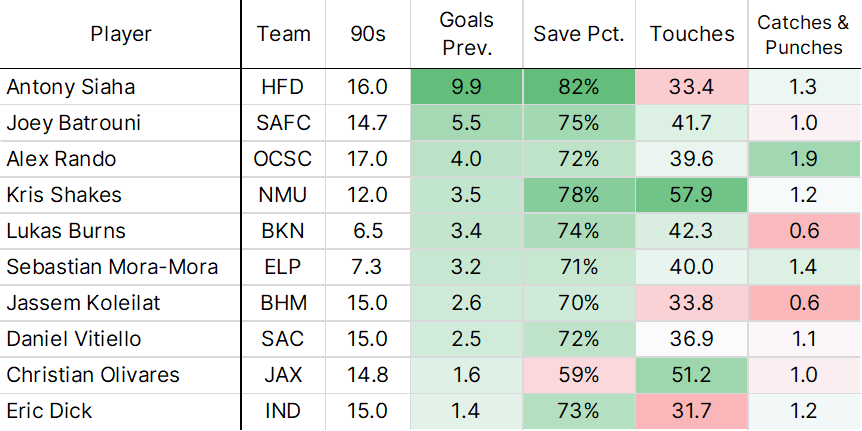
In the USL Championship, Antony Siaha is putting up one of the best goalkeeping seasons we’ve ever seen. Agnostic of position, he might be the most impactful player in the division. Between unmatched shot-stopping numbers and solid box control, Siaha underpins everything Hartford is trying to do. Orange County’s Alex Rando is in a similar camp – while having anchored a far more organized defensive structure, of course.
New Mexico’s Kris Shakes has taken the starting job in Albuquerque and run with it, growing from a sometimes-shaky backup into the USL’s most modern goalkeeper. A state over, Joey Batrouni has been an immensely pleasant surprise in San Antonio. The 23-year-old’s underlying numbers are among the best in the Championship; he’d be top-three on my hypothetical awards ballot, probably behind Siaha and Shakes.
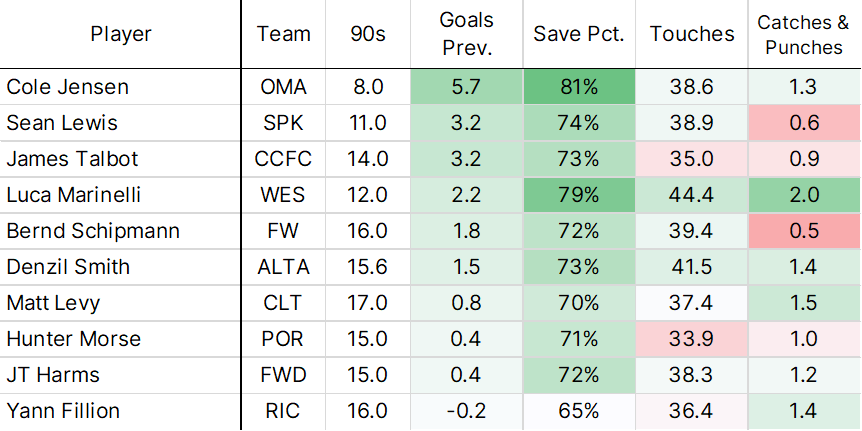
League One is in the funny position where a platoon goalkeeper – Omaha’s Cole Jensen – is lapping the competition by the numbers. I suspect this would still be Rashid Nuhu’s job to lose if the playoffs started tomorrow, but the 25-year-old is making it a very hard decision.
I covered a handful of other names in the Backheeled intro, so go read that. One player that deserves a shout: Madison’s JT Harms. The former Next Pro standout has performed at a level that the numbers fail to wholly capture, both as a shot-stopper and long distributor. There are a lot of reasons why Madison has improved so much in 2026, and Harms might be chief amongst them.
Super League miscellany
Continuing the theme of a theme-less newsletter, let’s talk Super League.
Firstly, I’m incredibly high on Ally Perry arriving in Lexington from Juventus. While the 23-year-old only played a handful of games in Italy, her college track record at Mississippi State (SEC Midfielder of the Year, all-American, etc.) was unassailable.
Perry tended to play as a No. 10 with something of a left tilt in school, owing to her left-dominant footedness. In her final season, the midfielder put up double-digit goal contributions on top of 4.4 progressive completions and 90th percentile box entrance passes per 90.
She’s got it all – and you see as much above, where a keen eye for space, progressive passing instincts, and an ability to fire off the right foot are all visible.
Elsewhere, the excellent friendly recap that 3rd Degree offered up on Dallas Trinity has me excited about the direction of this club. Lee Nguyen’s first-choice XI featured Sophia Braun – almost exclusively a center mid for Spokane but a defender with the Argentine national team – amidst a high defensive line. Given the numbers that Dallas put up last season, that’s a significant change – one that positions Trinity to sharpen their pressing numbers in 2026.
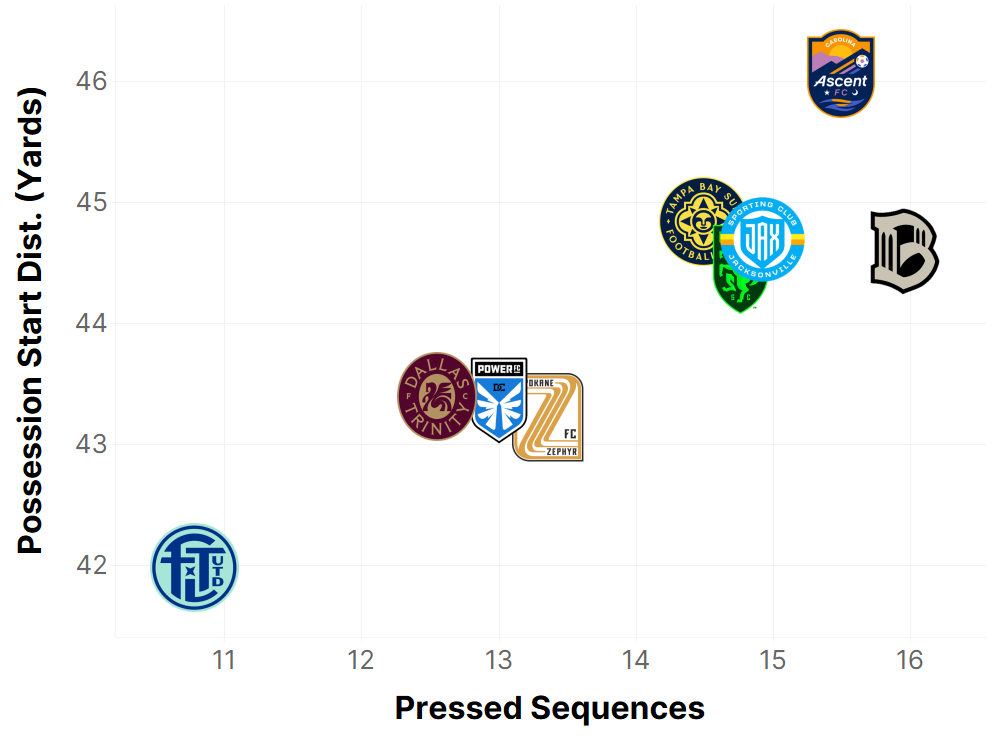
On a per-match basis last year, only Fort Lauderdale pressed less often than Trinity. Relatedly, Dallas tended to recover possession fairly deep downfield – particularly in respect to top-of-the-table contenders like Carolina, Jacksonville, and Lexington.
If Nguyen is looking to change things up in Texas, he isn’t alone. DC Power have the tools to be more aggressive by way of their summer business. Ex-Spokane midfielder Emma Jaskaniec put in more takeaways (72) than any other player currently on the DC roster; she and new winger Tyler Lussi were both in the top 33% at their position for defensive actions last year. The blueprint in the nation’s capital is clear, should Omid Namazi opt to execute on it.
Fort Lauderdale’s direction is more mysterious yet. United have skewed younger in their attacking additions (Farrah Walters, Grace Cutler) and gone very Spokane-y at the back (Kelsey Oyler, Haley Thomas) – neither of which screams “manic pressing system inbound.” More than anything else, it’s Tyrone Mears’ return to full-time management that could lead to a re-think. When he took United to a final in the 2024-2025 campaign, Mears’ version of Fort Lauderdale yielded the third-most pressing sequences in the Super League and an average start distance a full 1.5 yards further upfield than in 2025-2026.
That the league would look so homogenous in terms of approach is unlikely, but we’re two-for-two in terms of gritty defensive teams winning silverware at the end of the season in the Super League. How clubs like DC, Fort Lauderdale, and Dallas change their shapes and systems in respect to that nascent trend is something to watch.
In other news…
I’ll be talking about Chicharito quite a bit in the next two-ish years, so I want to mention another Dallas-related transfer: Clay Holstad’s loan from Rhode Island FC to FC Dallas.
Holstad joined RIFC for their expansion season after a starring run with Columbus in MLS Next Pro, going on to make 96 appearances in all competitions. Elite as a ball-winning center mid with a dangerous sensibility around the box, Holstad also filled minutes in central defense and at right wingback over the years. He’s impossible to wholly replace – at the No. 8 spot or otherwise.
Fortunately, Rhode Island already has answers in-house. Since his 2025 debut, Hugo Bacharach has continued to blossom into an elite holding mid. Now, he has to be the guy. If, as recent lineups suggest, Bacharach will pair with the more offense-minded (if cerebral) Amos Shapiro-Thompson, then the onus is on that duo to find balance. Maybe that means less ball carriage from Bacharach; maybe not. Either way, the fact that RIFC is in this situation is a testament to the developmental platform they’ve built.
If you are in the market for the Chicharito convo, go check out the USL All-Access interview with Brian Corcoran, Atletico Dallas' Sporting Director.
Shoutout to Tumbleweed Times, who keep coming up with essential reading if you want to keep up with AV Alta. Love seeing tactical analysis of League One, and no one’s doing it better.
We had a great interview with Leigh Veidman on The USL Show, which I'd highly recommend you go listen to. Veidman noted how his Spokane teams want to (a) maintain an attacking threat through all five lanes of the pitch and (b) sustain an ability to play through, around, and over their opponent. Given that the Velocity are going long on more than 50% of their goal kicks yet fourth-ranked in League One with 4.5 passes per possession signifies that he's accomplishing the latter goal.
Song of the week: for some reason, Twitter keeps showing my live versions of "Rock Lobster," so I'm side-stepping that and going for The B-52s' "Private Idaho."