The Back Four: Prinx Potpourri, plus beguiling Sacramento
Catching up on all things USL amidst the dog days of summer

Welcome in to The Back Four!
As always, visit Backheeled for more USL content and listen to This League! and The USL Show to catch up in podcast form.
Without further ado, let’s get to it.
USL Cup catch-up
Let’s keep it simple: what stood out across the USL Cup weekend? I’m rambling about some takeaways across the 20-match slate that ended the group stage.
The Commonwealth Cup between Louisville and Lexington was one of the best matches of the weekend, punctuated by star performances on both sides. Early, it seemed as if Braudilio Rodrigues might run the game – at least until Phillip Goodrum was sent off. Instead, Elizabethtown’s own Jansen Wilson decided the Kentucky derby.
Within interim manager Simon Bird’s 3-4-3, Wilson made a rare-ish start in the left halfspace, thus accommodating Mukwelle Akale on the right. You would’ve expected the right-footed Wilson to mostly hew narrow; instead, his ability to run against the grain, create separation, stretch Lexington, and find shooting angles on his right foot was remarkable. LouCity was uncharacteristically good at quickly moving the ball from side to side against the LSC mid-block, and the winger’s verticality punctuated those patterns.
Here Lexington is set at the halfway line, not yet in a low-block 4-4-2. Because the move is inside-out, LSC’s initial instinct is to get narrow, thus allowing left wingback Jake Morris to receive in space and immediately look up to play Wilson through one-on-one. A similar ability to isolate characterized Wilson’s first goal – a throw-in sequence where striker Chris Donovan attracted attention and let Wilson find another one-on-one. The 25-year-old ultimately nabbed a brace off nine shots and nine box touches.
For Lexington, you’ve gotta wonder how differently things might’ve gone if Phillip Goodrum stayed on the field at his old changing room. Instead, a second yellow banished the No. 9 to the sidelines roughly 30 minutes in. The effect on Lexington was instant – duh! – and undermined their ability to bend LouCity’s defense.
Up to that point, LSC had looked various shades of rampant. Braudilio Rodrigues’ ability to interchange with a markedly narrow Marcus Epps while left back Jacob Greene stretched the sideline was a standout feature. The 2-2-4-2ish setup stopped Louisville’s wingbacks from stepping inside as help defenders, putting players like Sean Totsch in difficult situations.
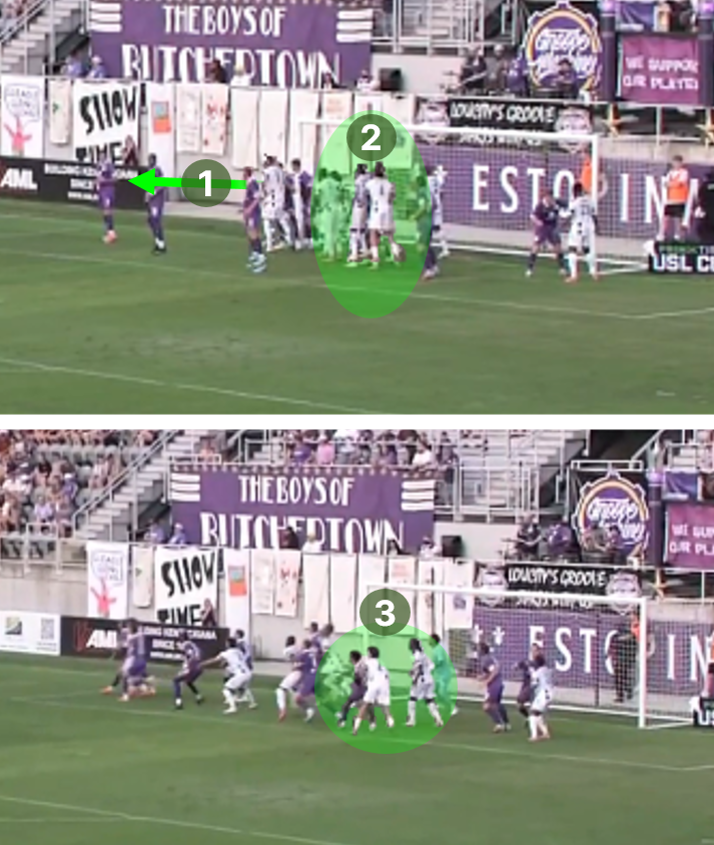
The go-ahead corner that Rodrigues finished was cleverly designed to boot. As broken down above, you see…
- A mass of runners slide in the direction of Aaron Molloy’s in-swinging serve, dragging bodies with them.
- Arturo Ordonez follows that track, making sure to latch tight to his marker. Initially, Ordonez was closer to the corner than Rodrigues; here, Ordonez steps ahead and Rodrigues steps back into the now-vacant space.
- Thus, Rodrigues is free to launch into a powerful header.
Super clean all around. The rivalry loss is what it is, but I’m still feeling very good about Lexington’s form.
Arthur Rogers coming off after 18 minutes for Miami is such a bummer. Rogers didn’t make his season debut until April, then he got hurt after two appearances. After returning to health in May, the former USL League One Defender of the Year left a start against Tampa Bay after just 28 minutes; his early exit against Sarasota this weekend was yet another false start among many. Genuinely dreadful luck for one of the most technical defenders the USL has ever seen.
I like Loudoun United’s direction quite a bit, but they simply aren’t getting the job done. This weekend’s trip to FNB Stadium was admittedly low-stakes, but those two traits – pretty soccer, bad results – continued to loom.
The good? Whenever Loudoun’s mid-low 4-4-2 imposed itself, the results tended to be positive. Anthony Limbrick reprised the Thor Ulfarsson-Quimi Ordonez striker partnership, and he tended to let Noah Adnan sit in at right back to (a) protect fish-out-of-water Andres Souper up the wing and (b) loose Kwame Awuah from left back as a counterweight. When those ideas operated in concert, good things happened.
You see Loudoun in their 4-4-2 here, defending Pittsburgh fullback Junior Etou on the ball. Souper is there to cover him, and an ensuing sideways pass is closed by James Murphy from the pivot. Forced backwards, the ‘Hounds still don’t have room to breathe; Ordonez closes, creating a four-man trap.
On the weak side, Abdellatif Aboukoura sees the play developing and chooses his moment to push. In theory, the winger is preparing to intercept yet another sideways pass; in practice, he’s in position to receive and lead a breakaway after a Murphy recovery. With Awuah and Ulfarsson to either side, Aboukoura can push ahead with even numbers against the defense.
Still, Loudoun rarely showed such intensity, and Souper was constantly under the gun against longer passes into Junior Etou. It took a penalty for Loudoun to concede 19 minutes in, and the offending play was the exact opposite of what we just saw. Lax midfield pressure let Pittsburgh play long into striker Trevor Amann, who held play up, laid the ball off, and then curled to make a vertical run into the box. There, Amann would get cut down by a sloppy foul. More than anything else, those are the plays Loudoun needs to avoid.
(Speaking of strike pairs: Albert Dikwa and Trevor Amann! Rob Vincent, cooking.)
Up in Connecticut, Barry Coffey continued to look revelatory for Hartford Athletic after a midweek brace against Orange County. That game let Coffey – late-arriving runs and all – surpass Augi Williams for the club’s Championship scoring lead. That lead is “three goals” over “two goals,” which probably tells ya something about the Hartford attack. Nevertheless, Coffey’s fox-in-the-box nous continued to be influential against Westchester in USL Cup play.
 John Morrissey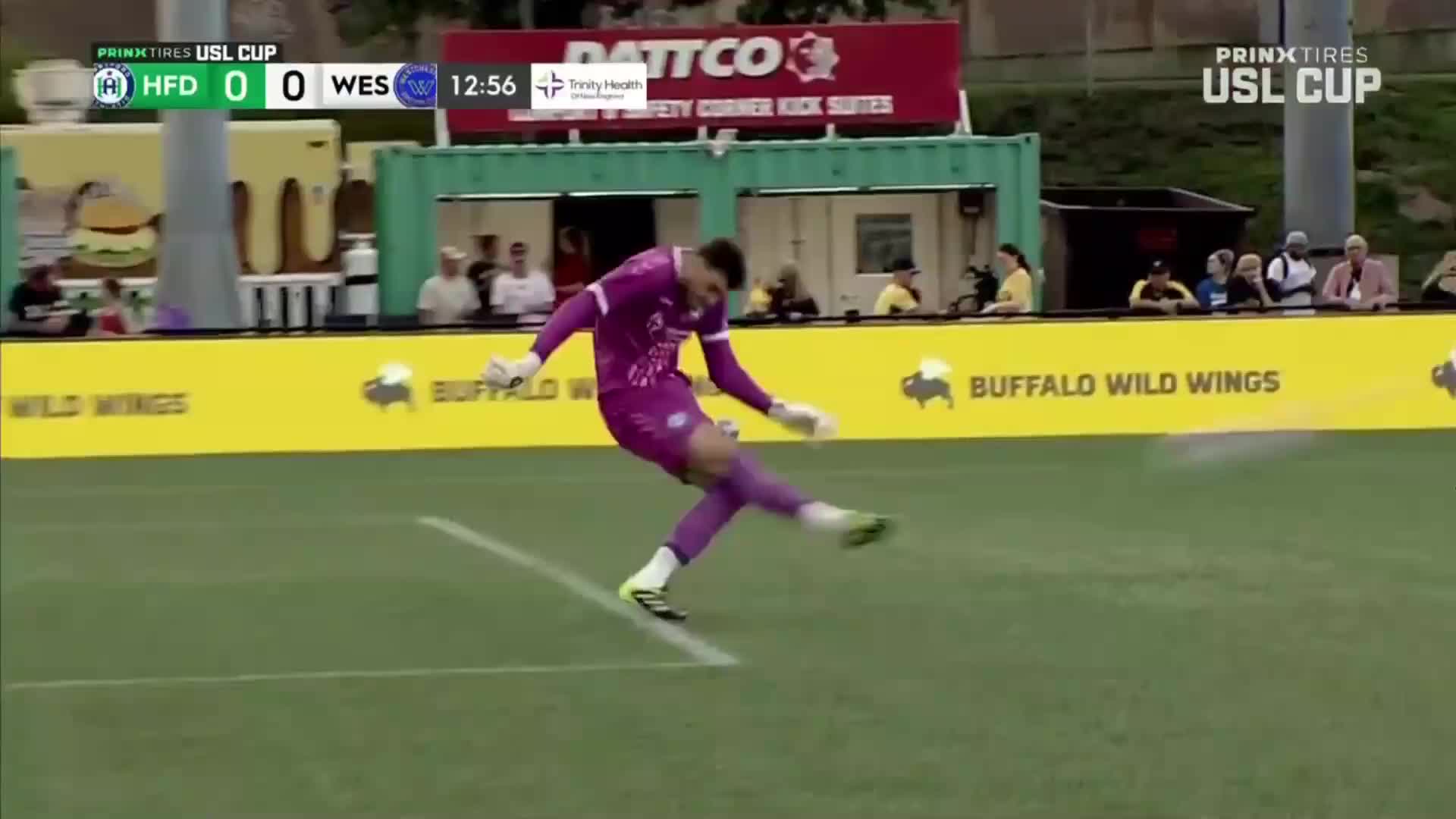
The third Coffey goal of the week began off a long goal kick, where the hybrid No. 8 was in position to collect a header down from wingback Emmanuel Samadia in Hartford’s 3-1-4-2ish shape. Immediately, the Irishman looked ahead to play forward Michee Ngalina through. Ngalina and Samadia would trade passes from there to test the WSC defense; meanwhile, Coffey snuck back into the box. When push came to shove, he was there to clean up and finish – the kind of gritty goal that Hartford has lacked at their meekest in 2026.
I had absolutely no idea that Matt Bolduc signed on for his third stint in Richmond, but that rocks. I vaguely expected that Sarasota would extend his 25-day deal earlier in the spring, but them’s the breaks in the USL, and Paradise seem to have a real player in Sean Karani. In any event, we’ve got the first win for manager Brian Ownby.
I’ll have more on FC Naples’ coaching change next week (hold yourself over with a post™ for now), but I’m here for the arrival of Omar Ciss into interim manager Zak Gordon’s midfield. While Ciss never stuffed the stat sheet in Charlotte, he’s a wise-beyond-his-years kind of No. 8 or No. 6 that takes up smart positions. If Saturday’s trip to Tampa Bay was any indication, that’ll carry forward during his time in Florida.
Without Marc Torrellas on the team sheet and with Kevin O’Connor rested, Gordon re-made his midfield with Ciss at the heart of the action. The ex-Independence stalwart was the holding player in a 4-1-4-1; ahead of him, Aiden Mesias and William Arevalo brought the gusto. Ciss’ awareness was apparent from the jump, in terms of his “help without selling out zone 14” defensive positioning, savvy against the counterpress, and ambitious (if connectively nascent) line-breaking vision.
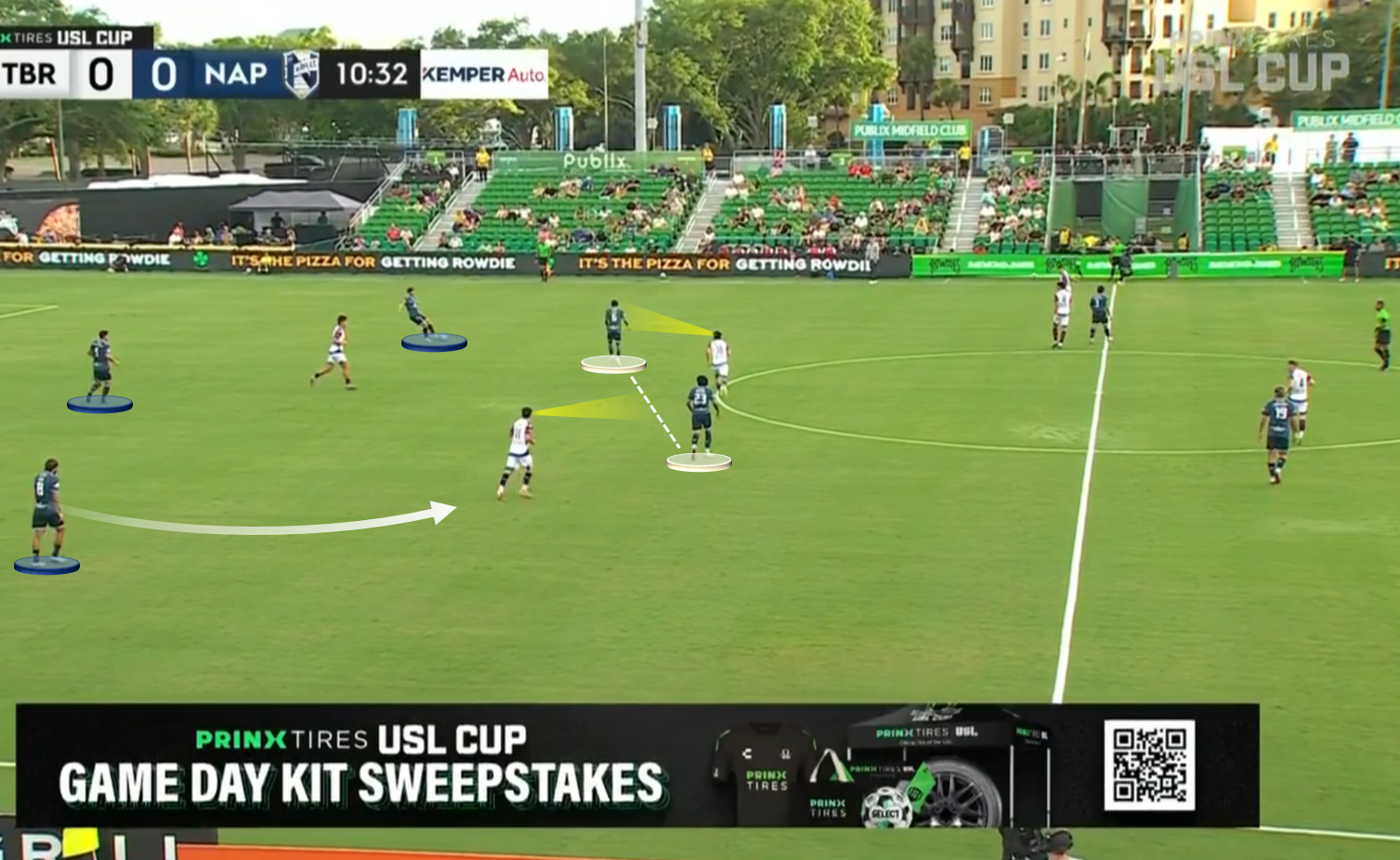
Naples’ most interesting sequences came in “3+2” or “2+2” mode in build. Ciss was a guaranteed option ahead of the center backs, but Gordon gave Juan Osorio – little-used between the fullback and No. 6 spots in 2026 – real freedom to step inside from right back. That, in and of itself, was the clearest break from manager Matt Poland’s more staid tendencies.
Above, Osorio can take advantage at the end of a chain reaction. Tampa Bay’s No. 10 steps to Ciss, and their left winger hedges inside against a deep Mesias. Suddenly, there’ll be room on that winger’s back side for Osorio to leverage. While Naples wasn’t often in possessive control against the juggernaut Rowdies, the Ciss-driven ideas that Gordon is already integrating are a positive sign.
Really good direct attacking between lines for Rhode Island, who were stunningly good working through a very fluid and technical front four. Conventional knowledge would dictate that you need a big No. 9 against a defense like Brooklyn’s, but Noah Fuson, Pity Rodriguez, Leo Afonso, and Jojea Kwizera were wonderfully opportunistic on Saturday. Oh, and Koke Vegas penalty!
The Chattanooga Red Wolves looked a step slow in their ESPN2 match against San Antonio FC, and that downturn coincided with Tobi Adewole’s return to starting action in central defense. The 30-year-old shunted Jordan Ayimbila to left back against his former club, but the end result wasn’t what manager Scott Mackenzie will’ve wanted.
To Chattanooga’s credit, their 4-4-2 (mostly) remained compact in the face of SAFC's width; you never saw them bite and sell out their structure when a wingback like Akeem Ward or Nelson Flores Blanco received. Conversely, transition was a problem, and bone-headed mistakes doomed the Red Wolves. The goal Chattanooga gave up in the 45th minute where a completely unmarked Nicky Hernandez could drive a pass into Santiago Patino’s feet? A prime example of those lapses – and ditto for the break they leaked less than two full minutes later. I’m not saying all the errors fell on Adewole in a tough matchup, but the balance was off.
(Also, go read Nicholas Murray on the various Hernandezes involved in Saturday’s match.)
Forward Madison’s 4-3 win over Union Omaha was the “defense optional” game of the weekend, good for 6.4 xG between the two sides. Naturally, then, I want to give credit to the Mingos’ defense.
As we’ll see later in the newsletter, Madison has leaned heavily into the press in 2026. They’re top-four in League One for the numbers of build sequences they’re pressing and the number of high turnovers they’re forcing per game. That’s good! Executing that kind of style is difficult against a team as good as Omaha, particularly when you’ve rolled out a semi-rotated lineup. That give and take – and the ability for Madison’s back line to make up the difference – defined Saturday’s matchup.
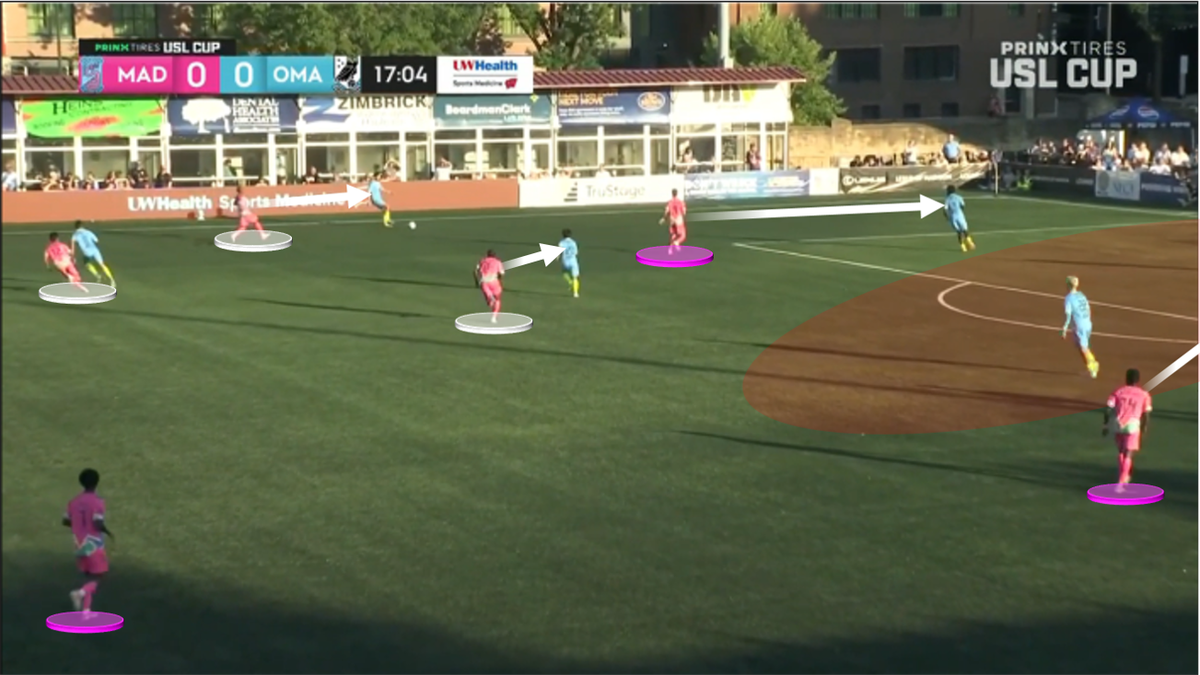
Matt Glaeser’s press was highly variable against Omaha’s back four look, Madison could skew from a 3-4-3 into a 4-4-2 by dropping the right winger (either Josh Bolma or Ryan Carmichael) low while flexing left wingback Geni Kanyane ahead, thus creating something closer to parity against Los Búhos’ lines. The transition into that shape is what’s seen above.
Madison is admittedly recovering here, but there are still gaps up high. Center mids Mark Segbers and Roman Torres (white, part of the 3-4-3’s midfield line) pick up their marks; Carmichael and striker Stephen Annor Gyamfi (pink) do the same against the opposing center backs. Still, Omaha is wise to the marking scheme and keeps Kempes Tekiela low to overload the midfield. When Tekiela receives, he isn’t addressed, and Madison initially flails in the face of Los Búhos’ forward progress.
At the defensive end, however, the composure of the remaining back four is impeccable. Omaha tries to switch the point, but Jahlane Forbes – just signed off the Las Vegas Lights – is there to disrupt the play and cleanly navigate through the counterpress. Suddenly, Madison is back in control.
Walking the tightrope as such was the name of the game for the Mingos. Better yet, Madison turned those kinds of recoveries into lightning-quick bursts upfield; Carmichael was tremendous in those situations, showcasing a highly intelligent read on space in transition. The attacker scored off a long pass from defender Kevin Carmichael (no relation) in the 35th minute, and he nearly doubled up off a golden chance in the 61st. When Madison turned a midfield recovery into a winner in the 96th minute, it was the deserved reward for successfully riding the lightning.
In “Zico Bailey rules and two-striker New Mexico is fun” news, United went to El Paso and bagged a 2-0 win in Derby del Camino Real. Even with Justin Rennicks as a late scratch, Luther Archimede did enough to bend the Locomotive and set the table for a 1.8 xG night. That New Mexico only needed 73 final-third passes to run up that number is yet more evidence of their improving offense.
Great example here. Initially, Bailey’s backpressure helps restrict the field and cover for the trailing left back, setting the table for center back Niko Hamalainen to recover the ball. United turns the momentum around instantly, allowing Bailey to carry the ball upfield.
Upon nearing halfway, Bailey connects on a deceptively difficult pass between multiple defenders to a narrow Dayonn Harris, and that’s where the fun begins. Harris and Cristian Nava (yellow) are the wingers, but their positions vary; to make weight, Archimede (white) fills leftward as fellow forward Greg Hurst trails the play. New Mexico basically creates a three-on-three, and a half-chance ensues. It’s the kind of opportunity this club simply wasn’t manufacturing a month ago.
State of the Republic
I haven’t written a whole lot about the Sacramento Republic this year for two reasons: (1) they’ve played the least games of any team in the West and (2) I haven’t known what to make of them. Sacramento began the year as an unexpectedly committed four-at-the-back team, and injuries across every position group have forced Neill Collins to regularly amend his style. Now, however, things are starting to come together – at least regarding the clarity of Collins’ vision.
All throughout 2026, this club has been beguiling. Sacramento’s goalscoring is down in 2026, but they’re generating 0.13 more xG on superior efficiency as compared to last season. Meanwhile, the Republic have maintained elite defensive numbers despite injury struggles for all-league Freddy Kleemann and a (relative) drop-off from Danny Vitiello, who’s “only” prevented 1.8 goals above expected to date.
Now, with players like Jack Gurr and Memo Rodriguez fit, things are settling down. Wednesday’s win over Rhode Island was emphatic; Saturday’s loss in Boise was less so, but Sacramento still ended up with a +0.32 xG edge in a USL Cup game where the motivation might not’ve been there.
The Republic have flirted with “three-box-three” principles all year, even as recently as in their end-of-June match against New Mexico. That wasn’t the case against Rhode Island, where that 3-2-2-3ish formation gave away to more of a 2-4-3-1. Shape descriptions aside, the change was simple: add more width to the mix, trust that your structure can hold with less rest defenders in place, and put the pedal to the metal.
Here, that formula plays out to perfection. Initially, Sacramento is resetting from the midfield, with Memo Rodriguez (the No. 10) and Ryan Spaulding (the left back) having harried RIFC into a giveaway. As soon as the Republic find their shape, it’s off to the races through Mark-Anthony Kaye in the pivot.
Kaye’s forward pass into Spaulding puts the defender into a one-on-one, forcing the Rhode Island midfield to step; that Kaye continues his own progressive run after releasing the pass has a similar effect. With the opposing 4-4-2 caught between options, there’s room for Rodriguez to make an exceedingly clever move toward the left sideline. Rodriguez is an immediate progressive outlet – and, more importantly, the hub at the heart of two distinct passing triangles.
In one sense, Kaye, Spaulding, and Rodriguez create a plus-one edge against RIFC’s ball-side winger and forward. In another, Spaulding, Rodriguez, and attacker Mayele Malango – seen waiting to sprint up the left sideline – are creating an edge on the opposing winger and fullback. The speed of the passing play lets Sacramento leverage those advantages, pushing through into Malango to earn a corner.
Kaye ended Wednesday with two assists, one of which ended with a Malango goal in the 44th minute. Throughout the match, their ability to read the game through the left halfspace was definitional – even more so because of the way that axis complimented Kyle Edwards’ movement at striker.
You get a sense for that phenomenon here. This sequence starts with a Spaulding recovery deep in the Republic’s own zone, which could spell trouble. Instead, the defender picks his head up and sees that Malango is unselfishly showing deep. In one fell swoop, Sacramento is able to break the counterpress and play into an open Kaye through the midfield through a Malango lay-off.
Because Malango has dropped in, a runner needs to push left to replace him. Sacramento makes it happen. Arturo Rodriguez slides inside to a No. 10ish position, which frees Memo Rodriguez to push toward the left. Edwards occupies center backs all the while, choosing the right moment to skew rightward before snaking back inside. The play ends ignominiously, but the process is pristine.
For my money, Pep Casas was the secret sauce in the performance. The Spaniard was Kaye’s partner in the pivot, and he opted to take up deeper positions to help set the tempo in a match that was otherwise fast-paced. Whenever Casas received, he wanted to keep the ball moving; 53 of his 59 touches (90%) ended in a pass, as compared to 53 of 72 (75%) for Kaye.
An adjusted lineup against Boise failed to re-create those highs. Kaye featured at left back, and the shape was neither fish nor fowl when it came to the three- or four-at-the-back question. Meanwhile, opposing manager Nate Miller’s 3-4-3 press emphasized the lack of a Casas-esque metronome in the Blake Willey-Danny Crisostomo pivot.
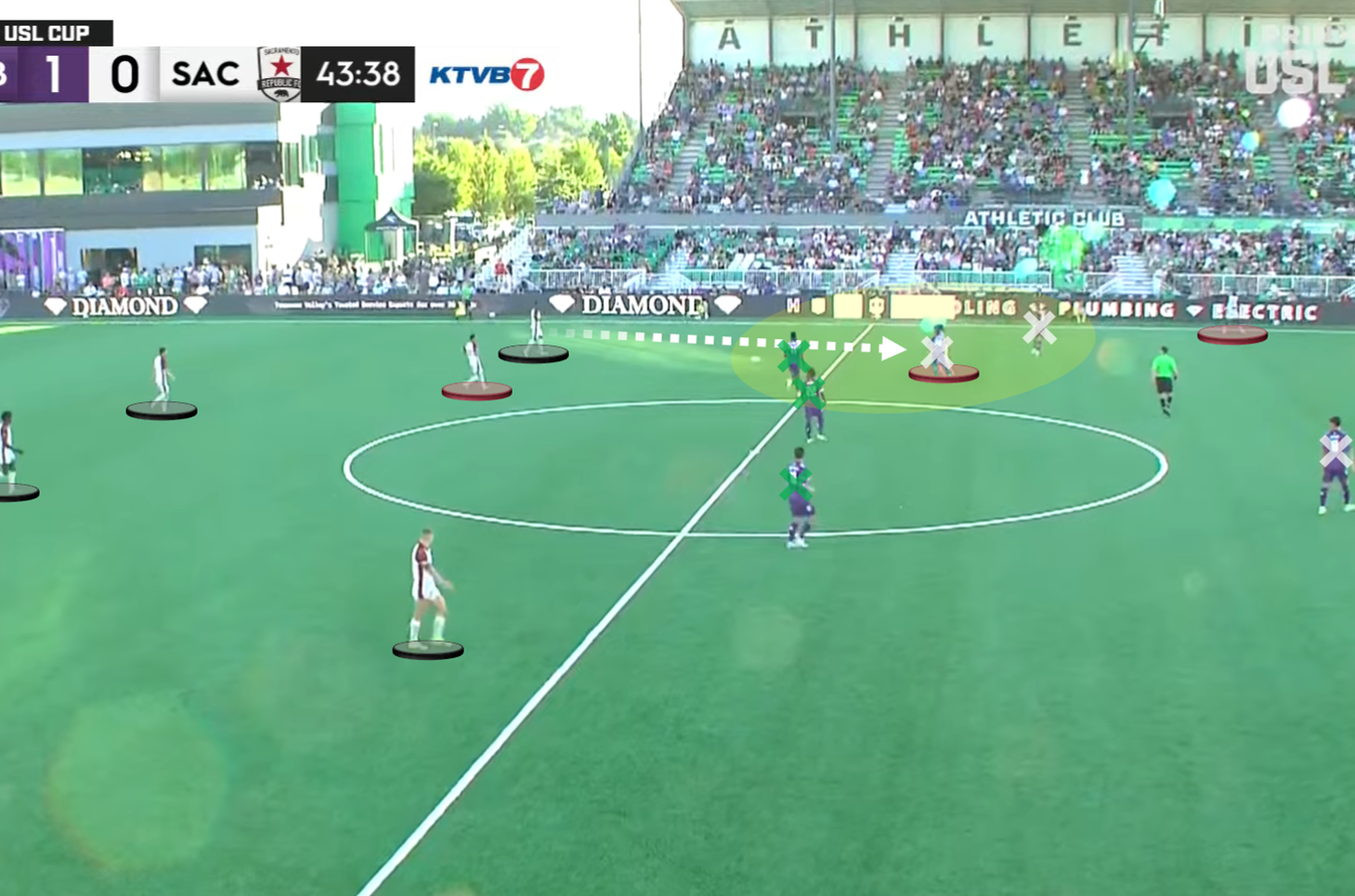
You get a sense for the dilemma here. This is essentially a re-run of the first play we broke down; Sacramento tries to hit a center mid in the left pocket to break into the halfspace. Still, the difference is immediately apparent. Kaye is low at left back, so there’s no gravity against the midfield line. Memo Rodriguez receives while moving backwards instead of forwards, and you can hardly even see him amidst Boise’s tight marking.
(To be clear: this is all a credit to Boise. Look at their shape! All three forwards, marked in green, refuse to bite toward the ball; they deny central access, and that allows Philip Mayaka and Jonathan Ricketts to trap from deeper within the 3-4-3.)
There were moments where Malango dropped in and dragged defensive markers with him, and they were highly productive. Likewise, Edwards’ deft first touch and decisive choices in the 18-yard box were a plus. It didn’t yield a goal in a 2-0 loss, but it underlined that the individual talent is still there for the Republic.
Now, the challenge is to keep highlighting that talent in a systematic fashion. The Rhode Island win laid out the blueprint, and – provided that Spaulding is good to go at left back – this Republic roster is finally fit enough to run Collins’ system on a consistent basis. With 17 league games yet to play, there’s ample promise for the back half of 2026.
Some charts
Thanks to the good folks at Opta, I’ve got access to some extra pressing stats. While measures like final-third recoveries are a useful measure of defensive activity upfield, they can be noisy for direct teams that create more second-ball situations in the attacking zone. By contrast, a stat like “pressing sequences” is an objective way to look at defensive intensity. Likewise, “high turnovers” – the number of times a club recovers the ball within 40 yards of the opposing goal – widens the aperture of what a press might actually yield.
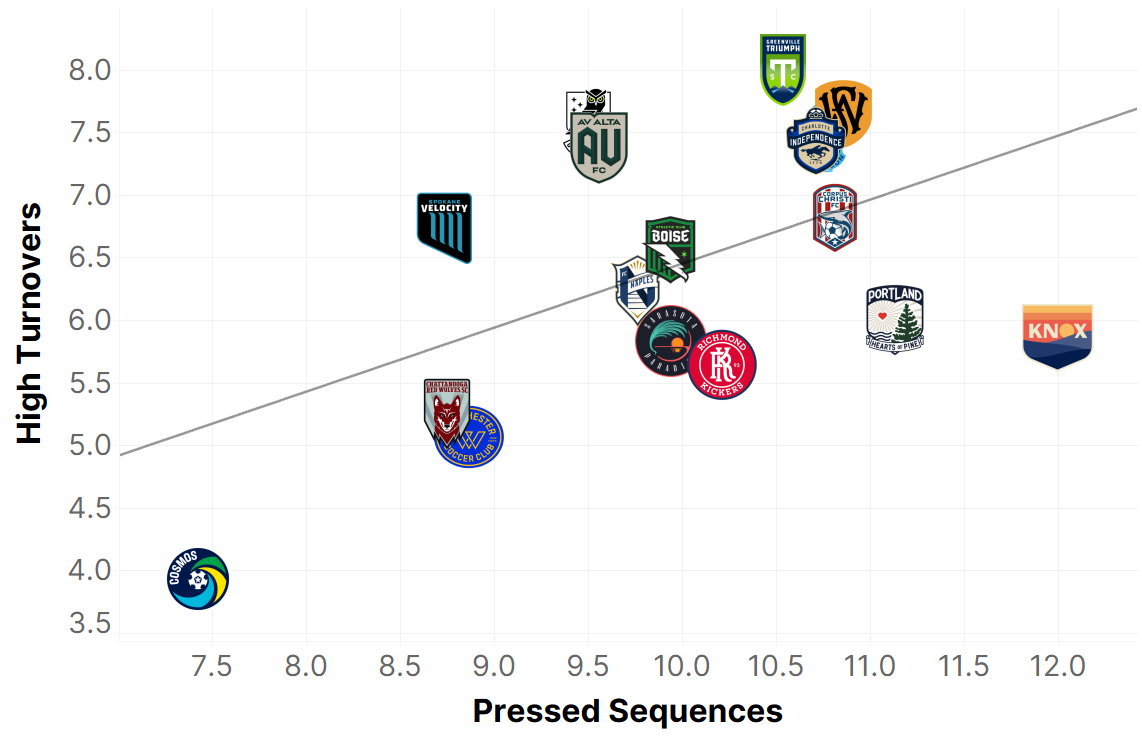
The connection between the two numbers is relatively loose in USL League One; pressed sequences per game only explain 26% of the variation in high turnovers produced. Greenville ranks seventh in pure pressure but first in high turnovers; conversely, Knoxville is comfortably the most aggressive pressing team in the division but is bottom-half at getting the ball back close(ish) to the opposing goal.
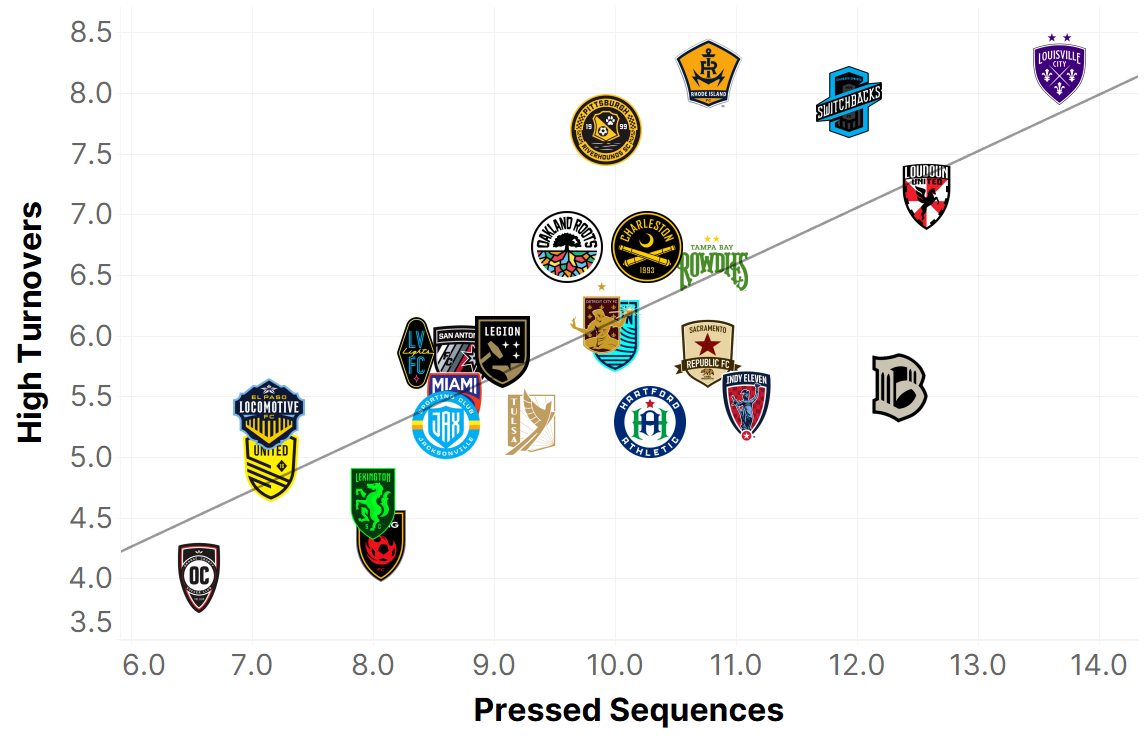
It’s a different story in the USL Championship, where the R-squared is 52% – literally twice as high. While clubs like Brooklyn and Indy have underperformed expectation in terms of turning aggressive pressure into high turnovers (or vice versa for Rhode Island and Pittsburgh), the trend is far clearer in the second tier. I have no idea why that might be!
In other news…
I wouldn’t have looked at the Carolina Ascent and said that goalkeeping was an especially clear problem, but any time you can sign a player like Hope Hisey…
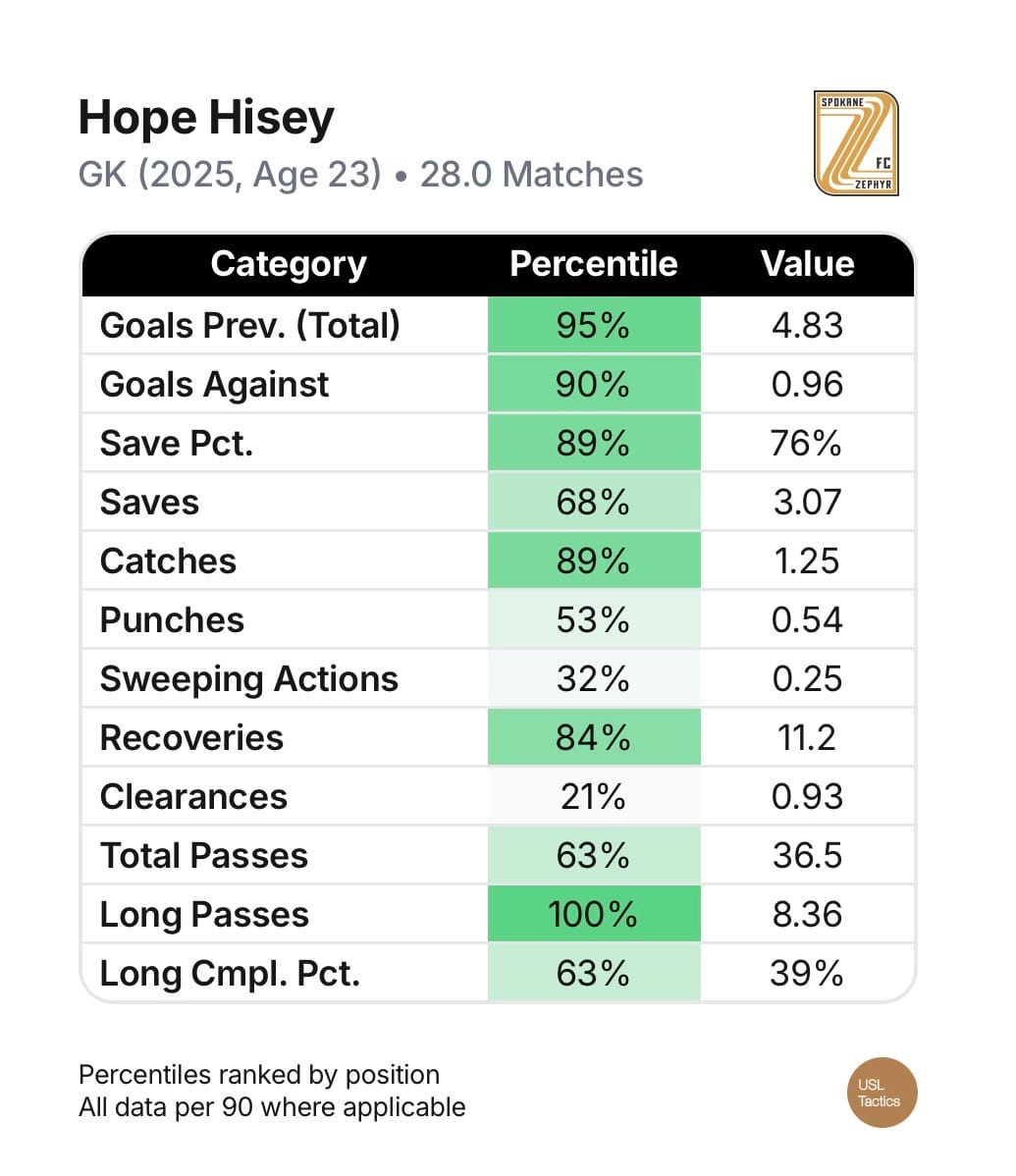
...you gotta do it. Carolina already returned most of an elite defense, but getting a shot-stopper at Hisey’s level will be a book in the context of the short fall season.
Go read my friends at The Union Report on the Fidel Barajas loan. Big get!
Note to reader: only off-topic rambling hereafter.
I’ve ended watching the five Western collaborations between Jimmy Stewart and director Anthony Mann over the last two-ish years, and I couldn’t recommend them more highly. The Western is essentially a dead genre in the popular culture, but that doesn't mean it's lost any resonance. Stories about frontier expansion and local justice and economic development inherently have something to say about America, and there's no genre with such a long history of self-reflexive, revisionist introspection; Mann knew as much. Putting Stewart’s all-American presence at the heart of that architecture – while often subverting his persona – heightened the impact.
The beauty of the Mann collaborations is their ever-increasing thematic scope. Winchester ‘73 is all personal vendetta, and The Man from Laramie extends that theme to examine property rights, Native American relations, and a dad who's really disappointed in his chud son. Bend of the River pits modern economic structures against aw-shucks frontier culture, and The Far Country asks what the limit of that expansionary project might be. In any event: great films! I'm dipping my toes into the physical media world and would kill for a box set.
Song of the Week: Snail Mail's "Pristine." Maybe gonna try and make this a regular segment.