The Back Four: Passing patterns, plus the Knoxville-Fort Wayne ascendancy
On build trends in the Championship and League One’s hottest clubs

Welcome in to The Back Four!
As always, visit Backheeled for more USL content, including deep dives into all things Championship and League One. Also, listen to This League! and The USL Show to catch up in podcast form.
Without further ado, let’s get to it.
The Championship’s possession landscape
Part of why the USL Championship intrigues me is the variety of tactical identities you find across 25 clubs. That's especially true on the ball. What can passing data in the defensive and attacking thirds – how far you're trying to progress play in each zone with the average pass – tell us?
There is a tie between the two numbers, of course. If you’re direct from the back, you’re trying to sew chaos and create lanes upfield; naturally, your passes in the attacking zone are going to be more vertical to leverage that space. Likewise, a team that’s more patient in build is likelier to meet a set defense around the 18-yard box, meaning that they’ll need to remain patient.
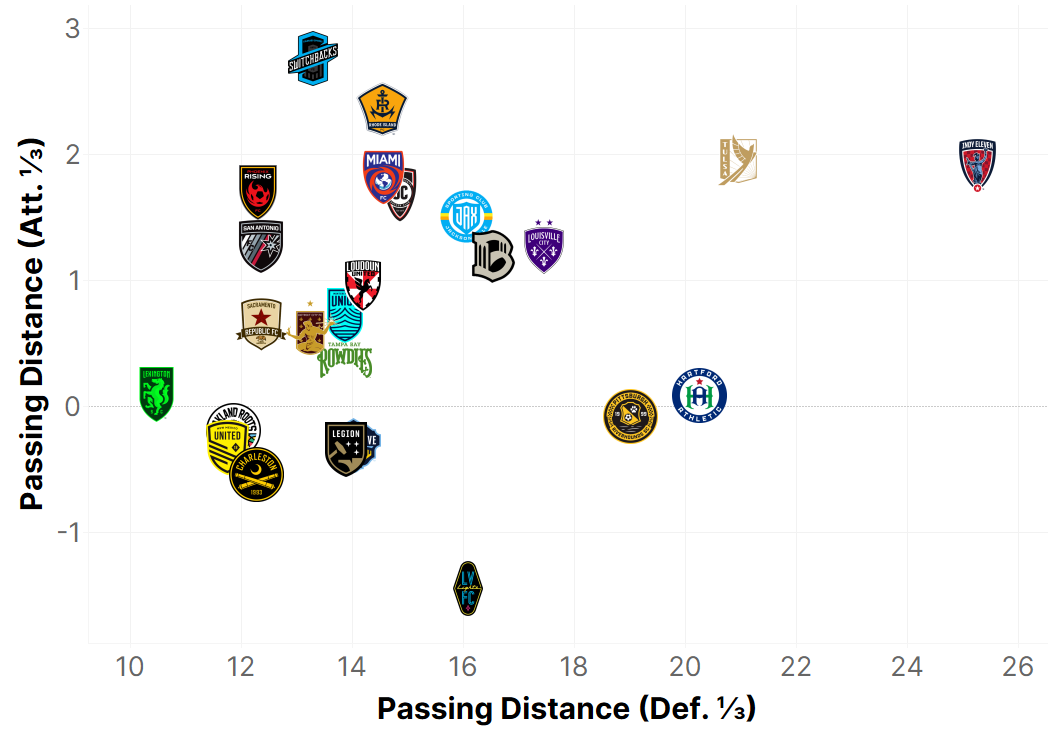
Still, that isn't universal. There's a correlation between the two numbers, but variety reigns across the Championship.
This season, Indy Eleven and FC Tulsa are the only two clubs that have been extremely vertical across zones. Both tend to restart long, and both lean into longer-distance crosses that can create problems for opposing defenses. At the opposite pole, clubs like the Charleston Battery, New Mexico United, and Lexington SC represent the “short-short” extreme – many of their passes in the final-third move backwards.
Las Vegas is the least progressive team in the Championship in the attacking zone, and it’s no coincidence that they’re taking 99 final-third passes to generate each of their expected goals. That’s the worst efficiency mark in the West, and it’s representative of an offense that gets bogged down far too easily. Against set blocks, the Lights’ 4-4-2 often has to reset or attempt high-risk cutbacks.
Adrien Perez slams home the equalizer for @SwitchbacksFC 🔥 pic.twitter.com/Axs5aH9ZJy
— USL Championship (@USLChampionship) July 5, 2026
Compare that profile to Colorado Springs’. The Switchbacks are advancing play by nearly three yards per pass in the final third, the highest number in the league. Not coincidentally, their 67 final-third passes per xG mark represents the fourth-best efficiency in the West.
Colorado Springs is especially good at using their press to create high-impact offensive opportunities. By taking the ball away in advanced areas, the Switchbacks give themselves more room. Often, it only takes one progressive pass in the attacking zone to get a look on goal. Indeed, Colorado Springs scored two such goals over the weekend against Phoenix, skipping the build phase entirely along the way.
For mid-length teams, a healthy mix of long and short distribution across phases of play is the way forward. In 2026, Detroit City has exemplified that kind of attacking. Le Rouge play the 10th shortest passes in the attacking zone and the 8th shortest in their defensive zone; they’re on the safe side of moderate most of the time, and that allows for off-ball patterns to develop.
In the example above, you see it happen in real time. Detroit’s baseline 4-1-4-1 becomes more of a 3-1-5-1, with left back Tommy Silva opting to drop in. Because Silva stays low, Detroit is able to create an overload up the right side and access narrow winger Rafa Mentzingen in the halfspace.
Mentzingen’s first pass is backwards, but his run has a strong gravitational effect that pulls the opposing defense out. Suddenly, there’s room upfield, and overlapping right back Haruki Yamazaki uses it to rip toward the box and receive from midfielder Kobe Hernandez-Foster. The chance is on from there – all thanks to the healthy mix of passes that underpin the move.
While passing averages can be instructive, they’re just that: averages. Some teams hew closely to their numbers when they create chances, but others subvert expectations. Indy often belongs in that latter bucket.
The Eleven are, undeniably, one of the most direct teams in the USL. At the same time, their best chances are far more composed than you might expect. Indy starts long to tilt the field and relies on set pieces to score a large portion of their goals, and those factors can skew the numbers. Likewise, forward Bruno Rendon is good for plenty of Colorado Springs-esque breakaways. Still, the heart of the Indy attack close to goal is interplay through players like Jack Blake, Aodhan Quinn, and Josh O’Brien.
Here, a direct upfield pass has earned Indy a throw-in, which is taken into central midfielder Cam Lindley. The Eleven aren’t looking to aimlessly punt the ball upfield; instant, a drifting Rendon drags the opposing defense out, allowing him to connect with right back Logan Neidlinger and backheel a slick pass between lines.
Throughout the move, Indy is decisive but controlled. By the time Lindley receives on the return pass, he’s got ample space, and he’s able to leverage a stellar third-man run from Jack Blake to find an open Noble Okello on the right side. It’s great possession soccer, but a lot of the passes are sideways – the kind you might not anticipate looking at a graph in isolation.
The best teams in the USL use their passing profile to achieve specific ends. Indy wants to tilt the field and set the table for quick, composed passing plays, but they’re equally happy to score off set pieces; Detroit wants to maintain possession and use a mixed profile to spotlight their star players. There isn’t one “best” way to skin the proverbial cat, and that’s why the USL Championship maintains the capacity to surprise each week.
I don't have a clever title but I want to talk about Knoxville and Fort Wayne
As the section header gracefully implies, I’m jazzed about the way One Knox and Fort Wayne looked in Week 18. Both clubs notched statement wins against ostensible League One contenders, and both did so by controlling play through the midfield.
I used the “A” block of my weekly League One column to talk about Fort Wayne’s 4-4-2-in-name-only shape, and that creates an instant contrast to Knoxville’s truer execution of the same formation. That’s not to say Ian Fuller is fundamentalist; it’s the ability for players like Mikkel Goling to press like a forward before exploring in possession and moments of fluid 2-4-4ish expression that make One Knox tick.
This sequence paints the picture of why Knoxville has been so effective this season – even after their recent loss of star creator Braudilio Rodrigues after a loan recall. Instantly, the 4-4-2 bends into an attack-minded posture, with fullbacks stepping up a line; out of the midfield pivot, Teddy Baker also advances.
Really, the shape functions like a 2-4-2-2 that's designed to create triangular combinations all over the pitch. You can see that in the frame, where no less than three three-man sets are giving Boise issues. From top to bottom, you've got:
- Winger Kyle Linhares, Baker, and Goling
- Defensive mid Abel Caputo, Linhares, and Baker
- Left back Christopher Tiao, Caputo, and Linhares
With Caputo setting the tempo amidst that final triangle, Boise is drawn excessively high upfield. Suddenly, there's room to work, and the front end of the shape is able to use combination after combination to enter the box. While striker Denis Krioutchenkov is corralled, the geometry that sets him up in the first place is remarkable.
If Knoxville is chock full of strong attacking ideas, it's a sense of balance that's their real calling card. This play starts with Linhares in the pocket once again, only this time he can’t play through. Still, watch the reaction across the pitch from One Knox after his turnover.
As opposing Boise tries to break, Baker immediately steps to the ball – a riff on the advanced positioning he took up in the prior clip. With Baker high, there’s space to fill, and Tiao is the man to do it out of the left back spot. Those two slow the transition move, thus allowing Linhares to recover. Behind it all, Caputo stands like an obelisk, ready to stonewall any danger that might escape the counterpressing swarm. All the intensity furnishes Caputo with an interception, and it’s off to the races anew.
In every sense, it’s the kind of field-tilting stop that’s made Knoxville so formidable. The traits that make One Knox special – strong off-ball movement, a center-focused offense that’s adept at generating overloads, strong rest defense, shapely transition recoveries – are shared by Fort Wayne.
The 10 outfield players for Fort Wayne have already shifted into 3-3-4 mode here, completely blurring the 4-4-2 starting point. Left back Jayden Smith (gold) takes up a wide spot in the front line; defensive midfielder Jeremy Garay (black) replaces him deep. Right back JP Jordan swoops into the midfield like a No. 10, intending to create an overload against opposing Spokane’s double pivot with help from tucked-in winger Jack Thomas.
Fort Wayne was able to connect in these situations throughout most of their 3-0 win, but a turnover ensues in this case. As we saw above with Knoxville, however, there’s a sense of structure as soon as the ball changes possession. Tiago Dias and James Musa stay home in central defense; in front of them, Garay, Javier Armas, and No. 10 Taig Healy all collapse to the ball. As the center compresses, you can see both Smith and Jordan sprinting to get back at the fullback spots.
The speed of the recovery forces Spokane to pass sideways, and by the time they’re able to go forward again, Smith is in position to addle the receiver. Support arrives from the central midfield to create a double-team, and the ball is tackled harmlessly out of bounds. Fort Wayne doesn’t sweat.
Together across all competitions, Knoxville and Fort Wayne have taken points from 12 of their last 13 matches since May 23rd. Both clubs look like well-oiled machines, capable of starting in a boilerplate 4-4-2 and using that formation as a jumping-off point toward more complex ideas. That tactical understanding is why both clubs are major Players’ Shield threats.
In other news…
Go check out my Backheeled feature on how clubs like Louisville and Charleston have bucked the trend of declining attendance across the USL. Fascinating stuff on how clubs can try and tailor their messaging to their market.
I recapped the USMNT’s loss to Belgium. For actual smart takes, go check out Joe Lowery and Sanjay Sujanthakumar's Backheeled coverage.
Thanks again to the terrific folks at Loudoun United for hosting The USL Show! At the game, we were collectively impressed with Bolu Akinyode’s ability to run the show after a somewhat unexpected relocation into the pivot of a 4-2-3-1. Akinyode has made a career of dominating games between the No. 6 and central defensive spots, and he was so good against Jacksonville. His best play – a tackle at halfway that set the table for Loudoun’s equalizing fast break goal – wasn’t even caught on the broadcast!
In case you missed the social posts, I’m up with a new-look roster tracker for the USL Super League. Borrowing a page from FanGraphs’ Roster Resource section, I’ve laid out each team with a predicted starting lineup, player retention statuses, and a host of statistics.
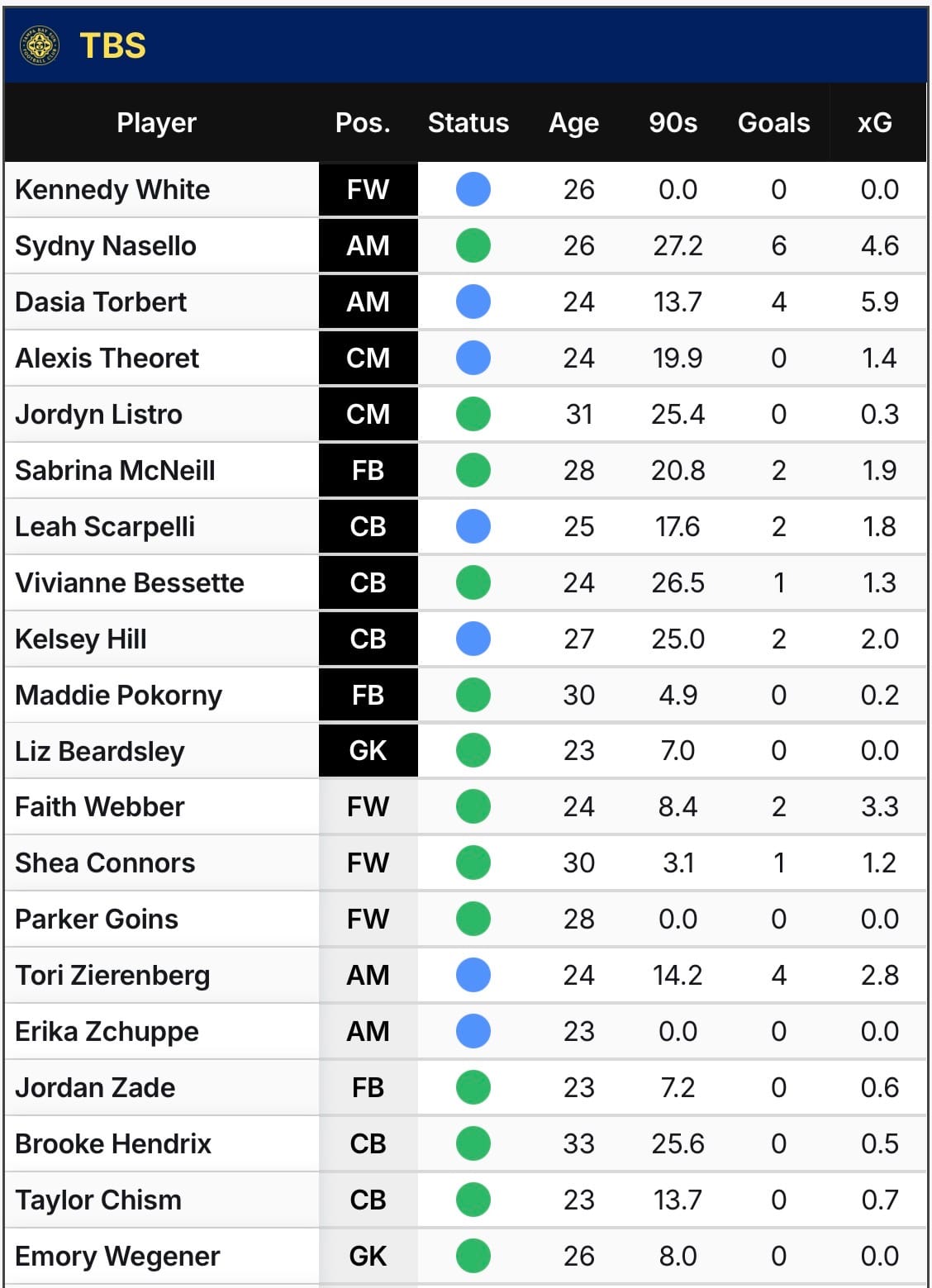
You get a partial look at the Tampa Bay Sun’s view here, and that’s because they’ve been the early winners this offseason. Tampa Bay has hunted in packs, snatching midfielders Alexis Theoret and Dasia Torbert from DC while adding defenders Leah Scarpelli and Kelsey Hill from Brooklyn. I’ll be fascinated to see how they fit and whether manager Denise Schilte-Brown sticks to the 3-4-3ish shape in which she ended 2026. No matter the look, Tampa Bay is going to be miles more efficient while trying to build through lines.
Good interview from the 3rd Degree team with Matt Valentine and Sam Morton, the new owners of the Dallas Trinity.
For more on Fort Wayne, Alex Ashton has a terrific longform piece on their expansion season. Likewise, fellow The USL Show co-host Kaylor Hodges has been making some terrific video breakdowns on the issues for the Birmingham Legion.
I'm delighted to inform you that (1) I'm a grown man who saw the new Minions movie and that (2) it's good.