The Back Four: Monterey, Westchester, and more
Two ascendant five-at-the-backs, plus other USL takeaways

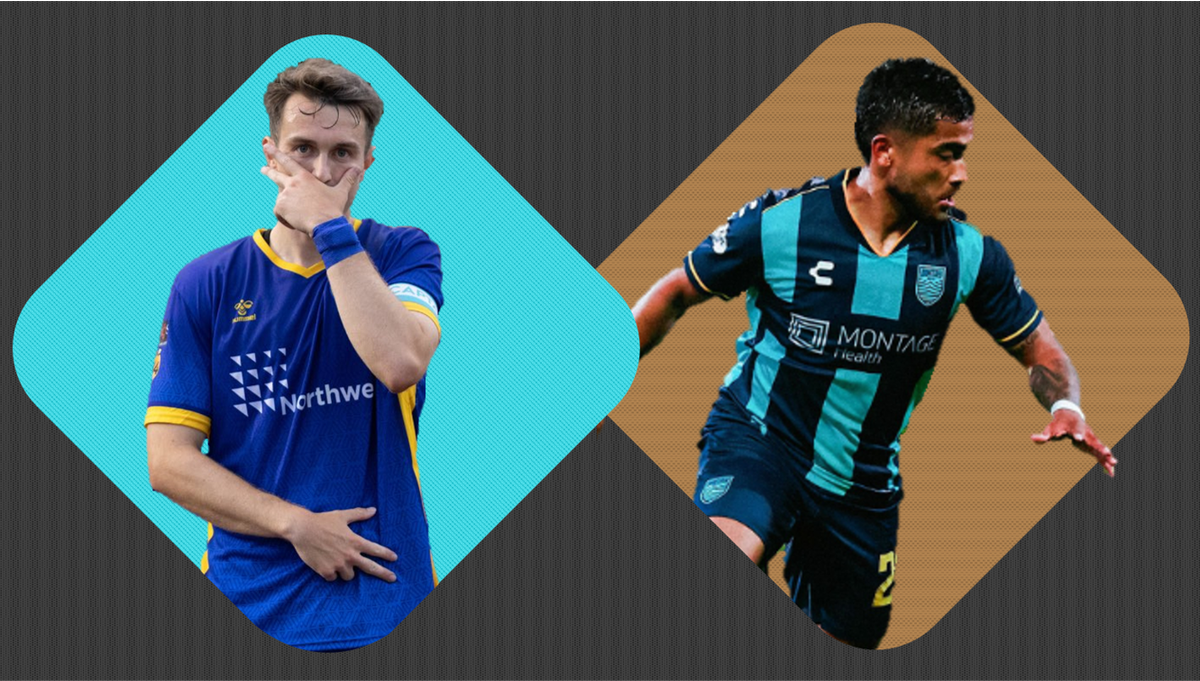
Welcome in to The Back Four!
As always, visit Backheeled for more USL content, including deep dives into all things Championship and League One. Also, listen to This League! and The USL Show to get caught up in podcast form.
Without further ado, let’s get to it.
Monterey’s improvement
In-season coaching changes rarely provide a quick fix. Last year, none of Oakland, Tampa Bay, and Birmingham could turn the tide after firing their manager – and that’s despite all three of Benny Feilhaber, Dom Casciato, and Mark Briggs being various shades of excellent as replacements.
More often than not, a new coach has to deal with a disengaged roster that’s not motivated enough to make up a large gap in the table. Turning things around is hard. With that context in mind, it’s remarkable what Alex Covelo is accomplishing in Monterey.
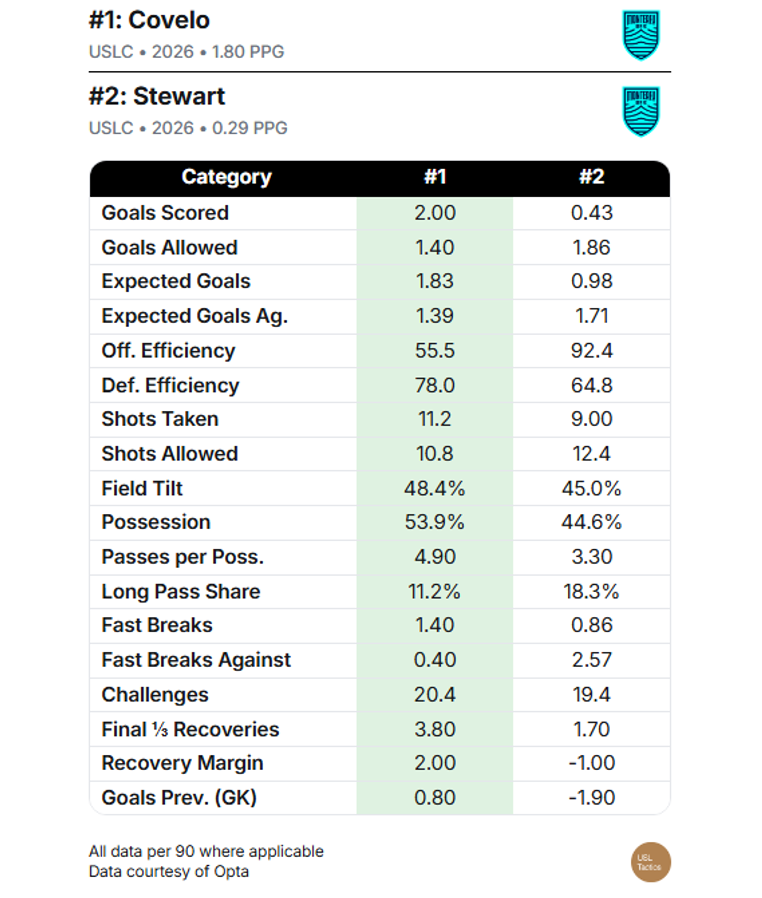
A longtime member of the San Jose Earthquakes staff, Covelo took over Monterey in early May as a replacement for Jordan Stewart. The Spaniard has only managed a handful of league games to date, but he’s suddenly got MBFC within two wins of the playoff cut line on the back of astoundingly good underlying numbers.
In five league games, Covelo-era Monterey has improved by every conceivable metric. They’ve also adapted stylistically, playing long 7% less often, upping their possession share by almost 10%, and more than doubling their final-third recoveries per match.
How’s it happening? Covelo has stuck to a system throughout his reign, avoiding the tactical roulette wheel that often defined Stewart. Monterey is defending in a back four that matches its pressing numbers to the opposing back line. They’re shifting into a back three with the ball, giving star talents like Ilijah Paul, Sebastian Lletget, and Omari Glasgow real freedom.
Here, you’re seeing the attack kick into gear in 3-4-3 mode, with Glasgow having pushed from left back all the way up the sideline. At the start of the play, fellow defenders Joel Garcia, Nico Gordon, and Zack Farnsworth sit back, buttressed by the double pivot of Nick Ross and Ryuga Nakamura. Their collective presence freezes opposing Jacksonville, opening space for left mid Chris-Kevin Nadje to drop into the channel to receive.
As Nadje turns upfield to pass, you see the construction of the offense. The shape has essentially become a 3-2-2-3, and the passing triangle between Nadje, Lletget, and Nick Ross (all light blue as midfielders) draws all manner of defense-bending attention. Out wide, a drifting Paul (dark blue, on the right) and overlapping Glasgow (white since he’s a native defender, left) lend MBFC their horizontal aspect.
This move is full of inside-out trickery and sharp interchange, and it eventually results in a longer pass that puts Paul in a one-on-one. The attacker is able to leverage that space and hit a third-man run from Nadje, who never stops moving without the ball. The end result? A dangerous shot off a give-and-go. In every sense, it’s emblematic of Monterey’s ability to use short passing and on-ball rotation to challenge defenses and then play vertically.
Here, the direct pass arrives more quickly. Garcia goes long to Paul, Lletget pushes on the underlap from his No. 10ish spot, and a cross to Riley Bidois ensues. It’s a golden chance, emblematic of the speed with which Monterey can play when they want to.
Among a spate of standouts, Bidois may take the cake as the most improved player of the Covelo era. The New Zealand international made just one start under Stewart after signing late; now, he’s got five goals in his last four games across all competitions. In about 400 minutes in Championship play, Bidois leads all forwards in xG per 90 (1.03) and ranks in the 72nd percentile for box touches (5.12). His ability to get open close to goal buys space for everything else the offense is trying to accomplish.
Monterey’s improvement goes deeper than the attacking upgrades. Their press is more intense and more adaptive. Covelo went 4-4-2 against Jacksonville, using Lletget as one of his pressing strikers to match a team using two center backs in build. A week prior against Loudoun’s back three, the alignment was different. Lletget played as a midfielder in a 4-3-3, while Paul, Bidois, and Wesley Leggett held down a quicker front line that could go man-to-man in the high press.
Put it all together, and you’ve got a team that’s taking a major step up. Under Alex Covelo, Monterey has clarified their system while adding more room for expression. They’re a slicker passing team, but they’ve also clarified their understanding of when to take risks. The balance is right, and it’s got MBFC back into the thick of the playoff hunt.
(Counterpoint to all this: I got ruthlessly negged on This League! regarding Monterey's recent strength of schedule, which is a very good point.)
The Westchester upturn
Across their Week 15 double against Fort Wayne and Greenville, Westchester SC ended up with a +3.5 xG margin. There's dominance, and then there's what WSC just pulled off against two in-form League One sides. Amidst it all, Westchester's ability to balance offensive overloading with a reliable back-end structure stood out.
There have been frustrating moments this season, where 2026 Westchester looks a bit like 2025 Westchester. By Opta’s reckoning, this team has made 0.55 errors leading to a shot in their average match, down only slightly from a last-place mark of 0.68 last year. Still, WSC has allowed just 0.8 xG per 90 in their last four games, and they're cutting out the mistakes in a major way. Few clubs have grown as much as Westchester over the course of the year.
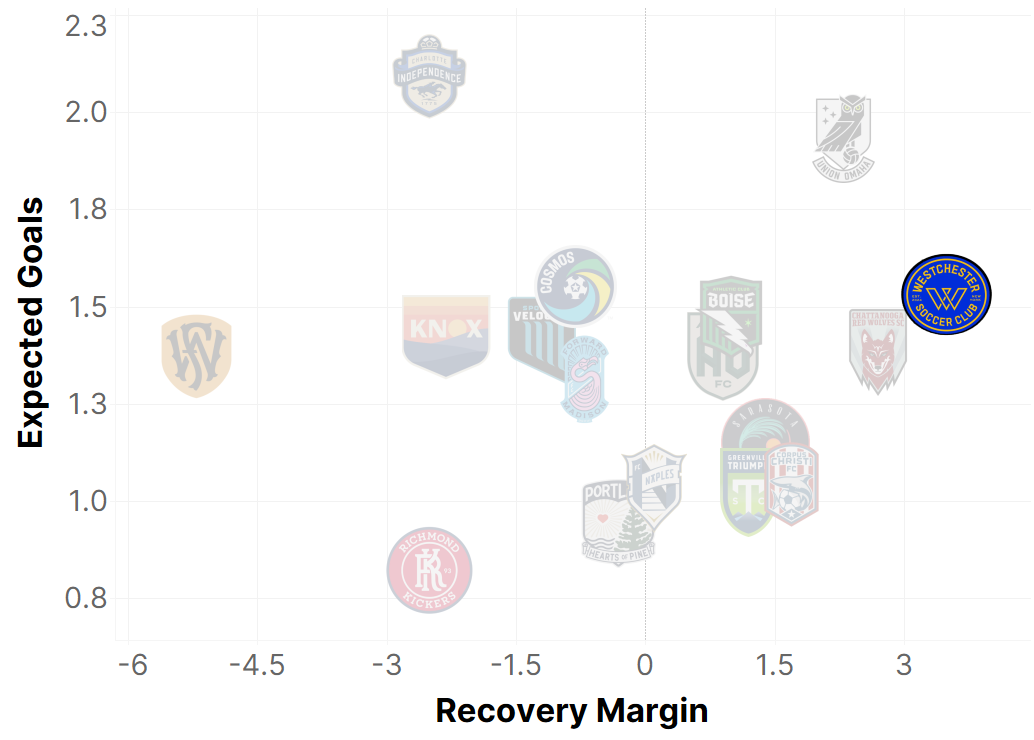
The occasional error is what it is; the fact that Westchester leads League One with a recovery margin of +3.5 is far more emblematic of what they’ve done right. For the uninitiated, a “recovery” represents the moment where a player claims a loose ball to establish possession. As laid out in the seminal Jamon Moore piece in Backheeled, there’s a fair correlation between recovery margin and actual outcomes. The more 50/50s you claim, the better off you are. On that front, Westchester excels.
Manager George Gjokaj has taken a young core and imbued it with a sense of responsibility. No matter whether they’re going four- or five-at-the-back, Westchester has consistently maintained a strong resting base that’s often looked like a “3+1.” Usually, that look has kept a left back and a No. 8 low to support the center backs. Week 15’s switch into a true 5-2-3 aided that process; by using three true center backs, Westchester cut out a decision point and eased their phase-to-phase transitions.
Health has also aided the Westchester cause. Across Week 15, Tim Timchenko’s stabilizing presence in central defense and Miguel Diaz’s do-it-all versatility across the midfield and attacking lines underpinned the Gjokaj system. Timchenko mixes in-box solidity (see 88th percentile clearances) with good passing under duress (97th percentile long completions), while Diaz is a dynamo with an unmatched work rate. He’s advancing play by 99 meters per game on progressive carries, and he fit like a glove in the Westchester front three against Greenville on Sunday night.
Here, Westchester’s overarching structure couldn’t be clearer. With Timchenko anchoring the back line and the pair of Conor McGlynn and Aleksei Armas holding down the pivot spots, the base of the formation is extremely firm. Trusting that base, WSC is able to get five attacking players forward to challenge the opposing defense.
Because Greenville wants to press against the back end of the shape, there’s room between the lines. Kyle Evans (blue, as a forward) drops in to receive and connect play, doing so while the wingbacks (yellow) push up the sidelines. Up the left channel, Evans, Diaz, and Jonathan Jimenez create what’s essentially a three-on-two.
Because of that overload, Evans is able to play the wingback through and create a dangerous crossing opportunity. The movement in the box is sublime; Dean Guezen cuts toward the top of the 18-yard area, creating space for wingback Max Jennings at the post. It should be a goal.
The other piece here? By the time the cross comes in, McGlynn has sprinted into the box to either receive on a pullback or put himself in position to collect a rebound. As a counterweight, Armas stays low to underpin the “3+1” base; the run from his partner is a perfect encapsulation of when and how this team is choosing moments to throw bodies forward without risking their structure.
This play is a bit more transitional, but it highlights a more expansive version of the Westchester formula. Here, Daniel Bouman – someone that’s played every position on the field in 2026 – dribbles from the center back spot, trusting the fact that Timchenko and Bobby Pierre will protect the space he’s vacating should a turnover occur.
While Bouman’s quick pass to a dropping Armas is dislodged, he continues his run upfield and forces Triumph to skew toward the near side of the pitch. WSC knows that’s happening, and as they reset in possession, they switch the ball against the momentum of the Greenville defense. McGlynn finds Jimenez on a switch to create a shot, and Jennings is there to pursue a rebound. It’s a great opportunity, one where Westchester continually manipulates space and lets their wingbacks lead the way in the attacking zone.
Westchester has been similarly explosive at times in 2026, but the way they dominated the field tilt and combined organization with dynamism in Week 15 felt like a step up. We’ll see if it can continue in the weeks to come, but the last seven days could be a major marker in WSC’s season.
In other news…
You should go subscribe to Data Center Soccer, where Ryan Keefer is providing really great beat coverage of Loudoun United.
Sporting Cascades’ choice to buy out Darren Sawatzky is probably the craziest story of the month in the USL, and the good folks at RiverCity 93 did splendidly to contextualize it from the Richmond side of things.
Lexington is the latest Super League club to announce their roster news, which my value metric assesses as follows:
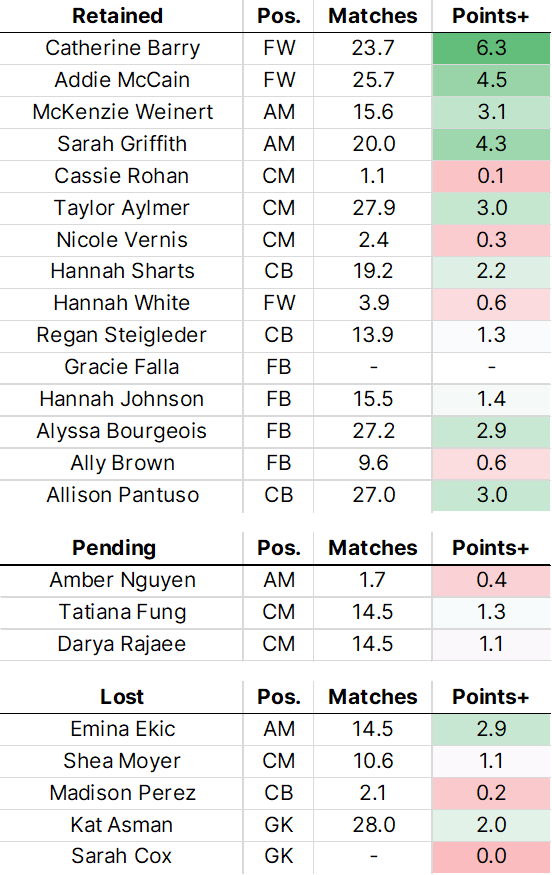
Yeah, that’s what a repeat title contender looks like. Lexington will need to add a new goalkeeper to replace Kat Asman, and they’re probably in need of some attacking depth. Still, those are nitpicks; LSC is in high gear.
(As I forgot to explain last week: the Points+ model takes inputs like xG, xA, defensive actions, and recoveries to grade players, then that raw grade gets scaled to a club's points. It's literally "Points Added." Take it with a grain of salt!)
Carolina announced their first batch of departures, with goalkeeper Meagan McLelland as the only notable loss. The 25-year-old played 1,440 minutes and ranked among the worst shot-stoppers in the Super League by allowing 3.3 goals above expected. Down the stretch, she was displaced by Sydney Martinez. Jacksonville also announced departures, with starting wingback Kacey Smekrud (0.11 xG per 90) and regular substitute forward Jade Pennock (three goals, 5.5 box touches per 90) representing their biggest losses. I’m curious to see what becomes of the rest of a roster that very, very nearly took home the Players’ Shield.
At risk of excessive Louisville posting, I loved this bit of interplay from their win over Phoenix last week:
Here, you see LouCity flowing in a transitional moment, knowing exactly when to switch the point through an overwhelmed midfield. Zach Duncan is in perfect position to shepherd the move forward, while the right-sided pair of wingback Aiden McFadden and winger Mukwelle Akale illustrate a give-and-take relationship that forces the Rising defense into isolation.
The game state is as important as the attacking movement; Louisville effectively leverages a moment where their opposition has pushed forward out of block. That, more than anything else, is what LouCity hasn't done consistently enough in 2026. (Related: I'll be on Soccer City Radio this week to talk more about Louisville.)
A post:
If LeBron James played soccer as a kid he wouldn’t have made it bc he woudlve been priced out by age 12 when his mls next club ramped up annual fees to 3500 and added a 5000 dollar tournament dues demand on each family.
— kang (@jaycaspiankang) June 16, 2026
Apropos of nothing: whatever production stuff is happening in Olivia Rodrigo's "Expectations" and Lime Garden's "23" is the summer vibe.