USMNTactics: Waffling against Belgium
On the U.S.'s crash-out against Belgium

Throughout the World Cup, I'll (probably) be breaking down the USMNT with instant reaction articles. Today, I’m finishing up with perspective on the U.S.’s loss to Belgium.
There’s something about Belgium, the U.S., and the player that wasn’t supposed to be there.
12 years ago, Julian Green was the controversial man of the hour, having been chosen for Jurgen Klinsmann’s squad as a 19-year-old over the legendary Landon Donovan. The debate over that choice dominated the American soccer conversation, but Green was seemingly unaffected by the chatter; he’d score against the Belgians with a volley that forever imprinted itself on my young brain.
Fast forward, and the Folarin Balogun situation has gone far beyond collegial debate; it’s a firestorm in international relations. Say what you will about the red card foul that saw Balogun sent off and suspended in the Bosnia & Herzegovina match, but the ensuing intervention by the Trump administration to get the No. 9 back in action was astounding – both in its jingoistic, me-first brashness and in FIFA’s supine accedence.
The Green-to-Balogun throughline shows how far the USMNT has come, in good ways and bad. With status comes expectation, and the world’s eyes were on the U.S. performance against Belgium this Monday night.
These teams actually met back in March, a match that ended 5-2 in favor of Rudi Garcia’s Belgian side. That game can only tell us so much; rather than bend Alex Freeman from “4-4-2 right back” into “possessive center back,” Mauricio Pochettino was still toying with a more midfield-driven version of his phase-based formation. In the interim, the U.S. has grown into a near-dominant pressing team by keeping it simple, allowing Tyler Adams to sit in the No. 6 spot, and letting Malik Tillman and Weston McKennie go hog-wild as mark-first options further ahead.
Belgium needed a dramatic late comeback to get past Senegal in their first knockout game, and they struggled to find balance between their pressing 4-2-3-1, a bent attacking shape, and denial in block. At best, support from players like Youri Tielemans at the No. 6 spots stopped Senegal from using the halfspaces; at worst, Timothy Castagne – the right back, Freeman-esque in his deployment – was isolated against Sadio Mane.
With Balogun back in action, the task for the U.S. was to repeat the Senegalese trick: rely on the No. 9’s central gravity to occupy bodies, and let Christian Pulisic find looks one-on-one against Castagne.
The problem for Pochettino? Activating those patterns was far from easy, and Garcia made a number of bold lineup changes to focus on defensive denial. Kevin De Bruyne and Jeremy Doku were dropped; Dode Lukebakio came onto the right wing, and Amadou Onana entered the pivot as a right-tilted No. 8. From the jump, their ability to pass off Pulisic between lines stunted the USMNT’s left side. When he did get touches, Pulisic felt too passive. His movement was stilted, often clashing with Jedi Robinson’s over- and underlaps to create body positions where a forward pass was impossible.
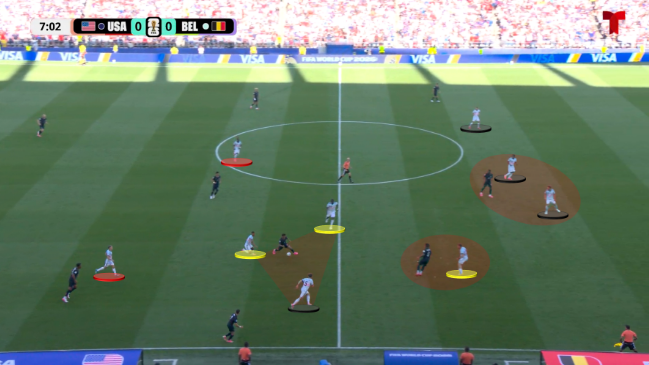
Of course, that was the Belgian intention. Their system slowed the U.S. down high upfield without committing heavy numbers or risking their overarching structure further back. The energy of Belgium’s 4-2-1-3ish press turned potential breakthroughs like this…
…into stonewall stops deeper downfield…
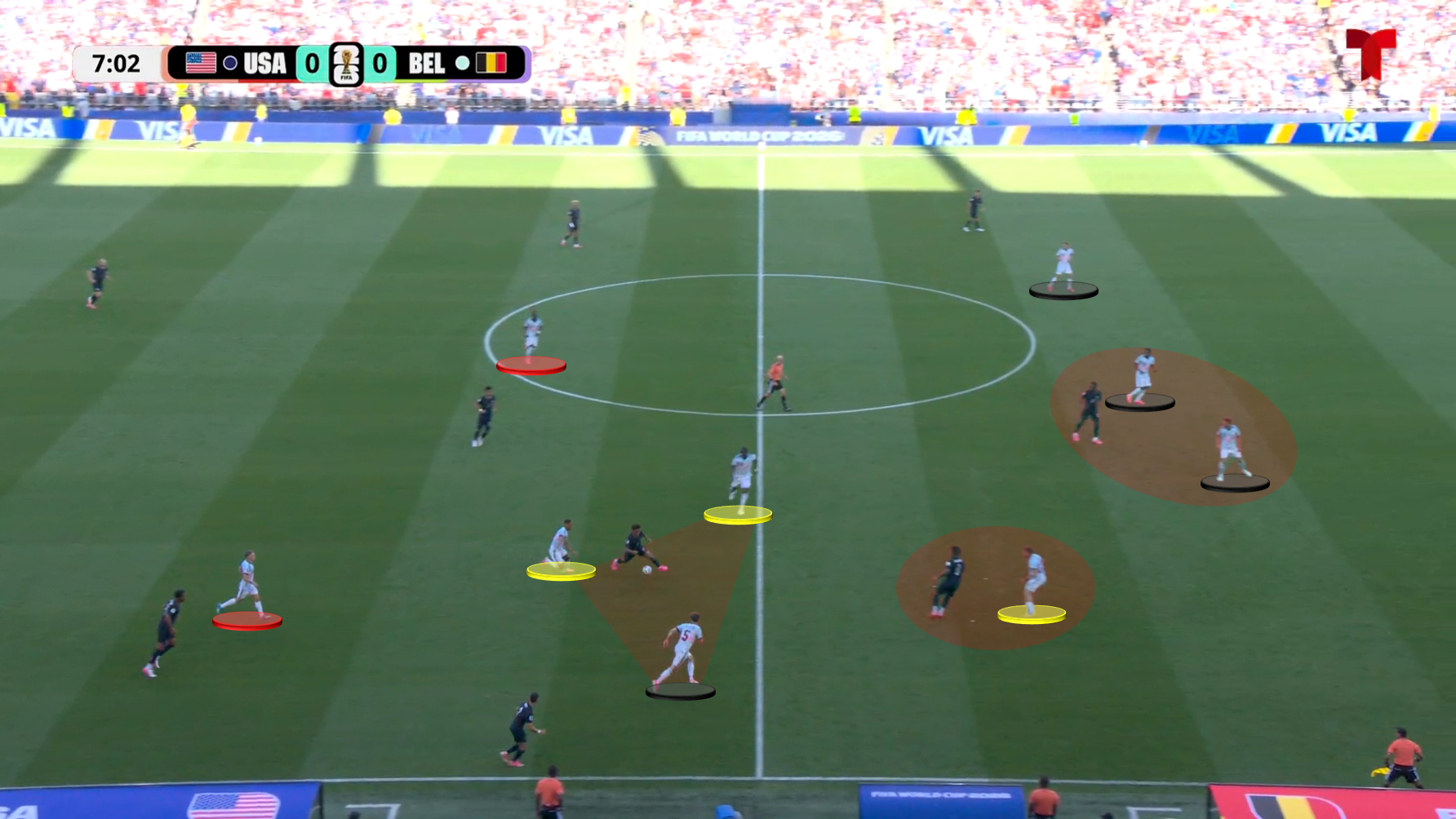
…with a surprising level of ease.
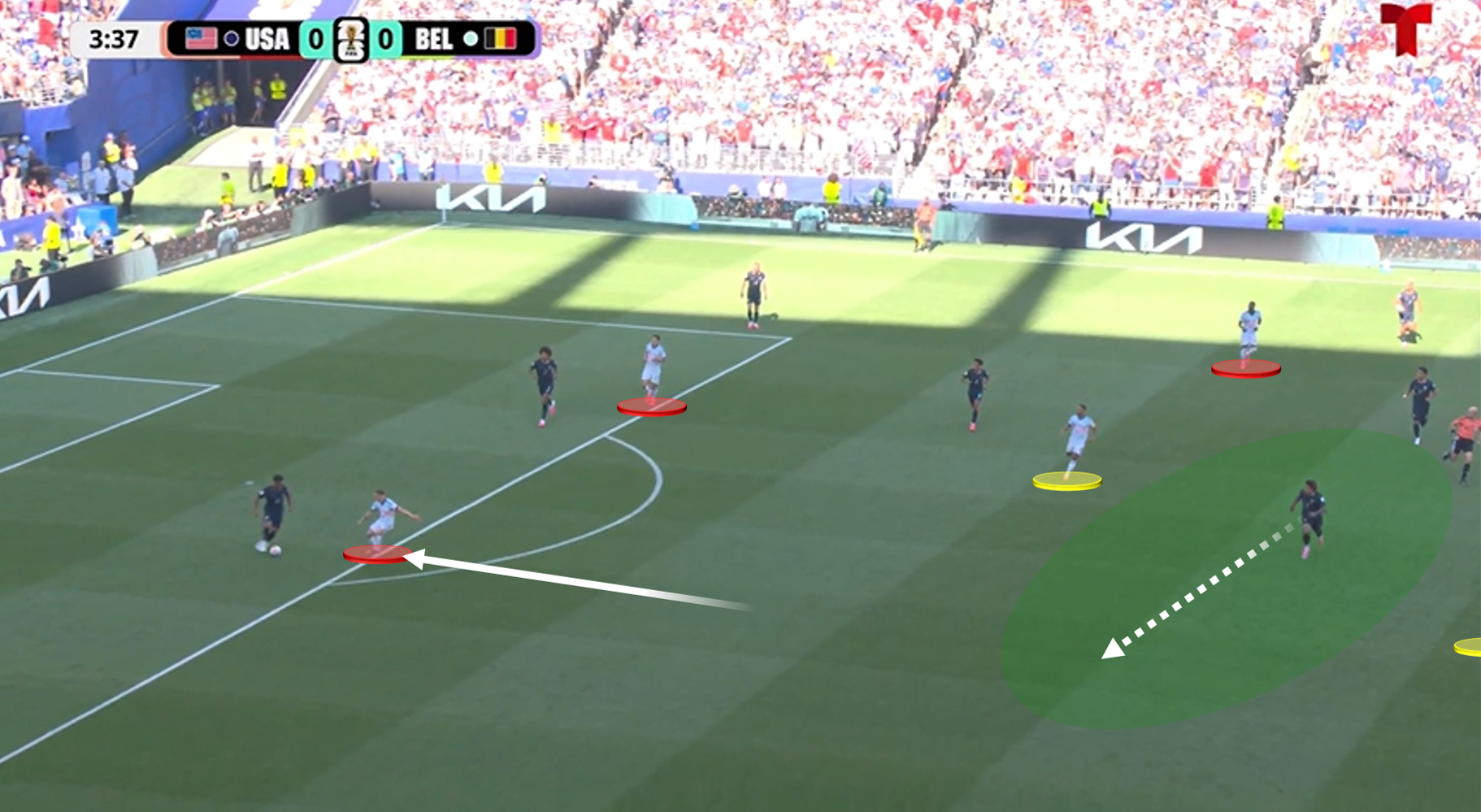
Tactically, Belgium used face-up pressure from the striker spot to force the ball into Freeman and Tim Ream in the wider central defensive positions. When Chris Richards passed to either, it triggered the wingers in the 4-2-1-3ish shape to close to the ball, thereby denying easy lanes through the center of the park.
That’s seen in the first example, where the U.S. is only able to play forward when Weston McKennie makes a sliding run toward the right sideline; off-screen, an elevated Sergino Dest stays high to stop a Belgian fullback from closing. It’s a good first step, but – as we’re about to see – the rest of the staircase wasn’t there.
Belgium’s waterfalling rotation stopped that kind of reception from causing any meaningful damage. Consider the second screenshot for a clear example. Here, that wide-skewing midfield receiver dribbles into a wall. Onana (in yellow; replaced early by a similarly stout Hans Vanaken) denies a centrally snaking dribble, Tielemans (yellow, higher upfield) closes on the back side, and No. 6-right back interchange means that there are three Belgians against one American. Importantly, the rotations don’t break Belgium’s back closer to goal; Balogun is also at a deficit against two central defenders.
When the U.S. gave the ball away in the midfield, Garcia’s side delighted in quickly advancing play through those elevated wingers. Likewise, Belgium didn’t take risks in build. If the trap was on, Belgium was happy to hoof it long, contest a second ball, and reset in the press. They went long just under 20% of the time, a high mark at any level of soccer.
Pochettino eventually learned his lesson, allowing his side to get more direct in turn. The run-up to Tillman’s equalizing free kick was a case in point. There, a switch toward Robinson up the left side drew attention, let Pulisic drop into space, and gave him the requisite runway to cut inside on a gravitational dribble. The front-foot Belgian scheme was broken, and an all-important foul ensued.
Tillman’s second free kick goal in as many matches was splendid; don’t get me wrong. It still couldn’t patch over real defensive issues that plagued the U.S. – especially in a first half where Belgium won 57% of the match's ground duels and ended up with a hard-fought +2 recovery margin.
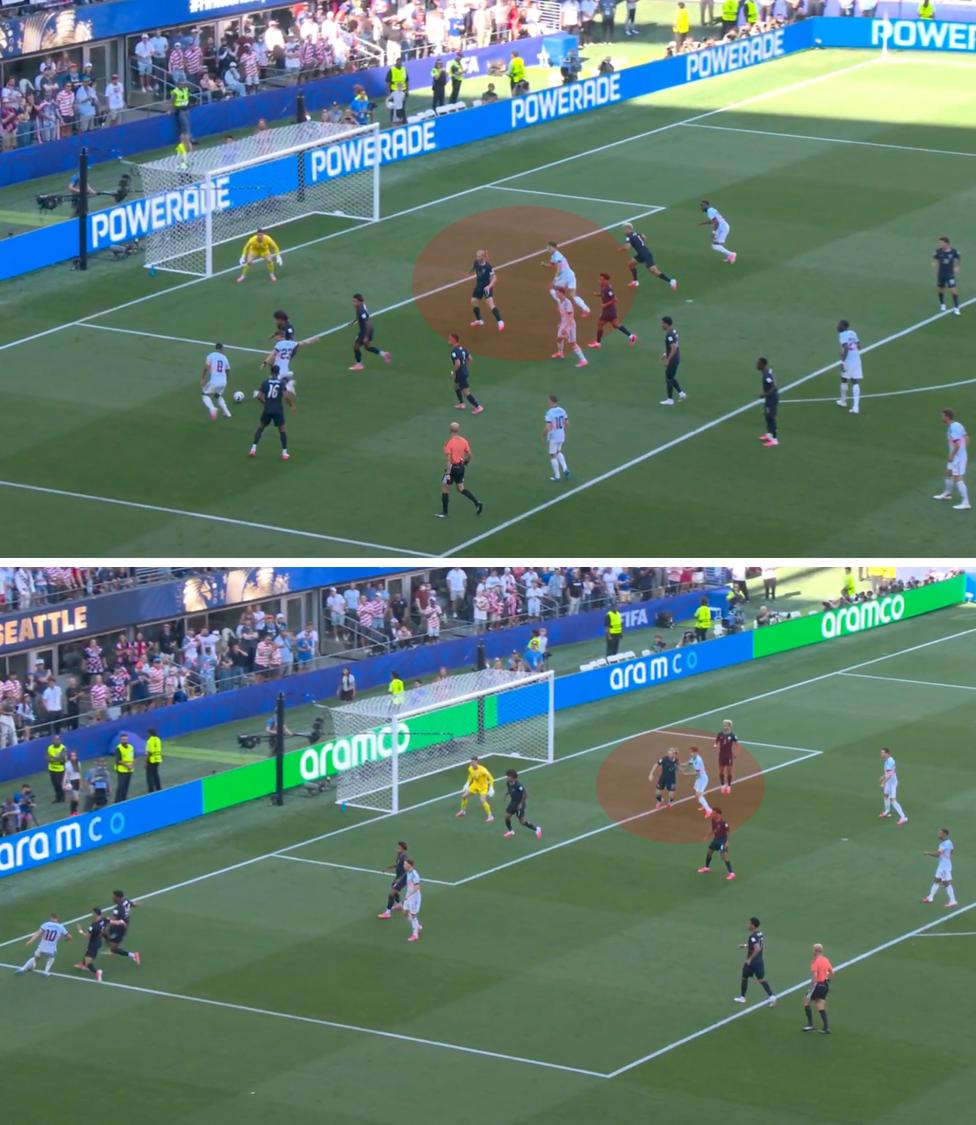
It would be easy to start with Tim Ream’s individual shortcomings…so I’m gonna. Ream has been impressive as a left-sided passer throughout this World Cup, and his ability to set a composed tone in block was key while shorthanded last time out. The Charlotte FC star didn’t get enough support from his teammates on Monday, but his loss of focus and physical failures defined both of the USMNT’s first-half concessions – as seen above, where Ream is about to lose runners on his backside twice over. Ultimately, the 38-year-old went 1/5 in his duel attempts.
What of the lead-up to the concessions? The first, scored by Charles De Ketelaere in the 9th minute, was the result of non-committal coverage against Leandro Trossard on the right wing. While Freeman was able to block the Arsenal star’s first serve, neither Dest nor McKennie communicated to clear the ball as it fell back down to earth. As such, Belgium could recover possession in the 18-yard box and generate the cross that beats Ream in the top screenshot.
The second goal for De Ketelaere was more free-flowing, but the same culprits were at play. This time, Belgium was able to switch from their right to their left without any modicum of intervention from McKennie or Adams. With a third-man runner slicing into the channel, Dest and Freeman were delayed by a split second in picking up Trossard; that meant danger. Trossard would beat Dest to the endline, creating the quagmire in the second screenshot.
There was blame to go around. Ream seemed lost in his own zone. Dest was too easy to beat and far too timid in multiple situations. No one in the central midfield did much of anything to stop Belgium – a problem that also prevailed in second-ball situations and let Garcia’s side tilt the pitch in the first place.
At risk of being a hack who talks about “grit,” the U.S. simply didn’t have it. Pochettino tapped Gio Reyna as his game-changer coming out of halftime, but he was another violinist on a sinking Titanic. Granting Freeman more freedom to push up in a 2-2-5-1ish shape did have a positive impact, but the unending laxity of the American performance was inescapable.
Belgium finds a third pic.twitter.com/0m1Hu4qzwR
— FOX Sports (@FOXSports) July 7, 2026
Every U.S. response felt delayed. The fact that the U.S. was responding was notable; this team made an identity out of setting the tone against opponents like Paraguay, Australia, and Bosnia & Herzegovina.
No play better encapsulated the bemusement than Matt Freese’s colossal error to put Belgium up 3-1. As mentioned, the Belgians were happy to play passes over the American defensive line all night, but the repositioning of that line’s height out of halftime created new responsibilities for the goalkeeper. Asked to sweep, Freese made a meal of what should’ve been a relatively easy play, gifting Vanaken an empty-netter.
It's hard to be positive now, especially in the wake of the clusterfuck that enveloped the Balogun situation. It’s especially hard to be positive after seeing that performance. 12 years ago, the U.S. Men’s National Team crashed out against Belgium in the Round of 16; devoid of context, an identical result in this year’s World Cup – and an embarrassing one at that – could be seen as a stall-out.
To make that judgement would be unfair. Back then, the idea that a Julian Green – a young player plying his trade for Bayern Munich – could be the future of the U.S. was a thrilling concept. Now, this squad has a dozen players who are actually living that potential. As bad as Monday might’ve been, this tournament has painted the picture of a mature American side – mature in its ability to command national media attention, mature in executing Mauricio Pochettino’s tactics, and mature in terms of a multifarious talent development pipeline.
That’s cold comfort in the moment, but the future of the U.S. feels bright.
Odds & Ends
- Alex Freeman innocent? His passing under pressure remained extremely strong, and his ability to jump passing lanes gave the U.S. their only moments of transitional spark. In the second half, he was even willing to cheat upfield as a diagonal outlet, liberated as a truer right back. Impossibly bright future in store for the Villareal man.
- Truth bomb:
If Christian Pulisic is really the best USMNT player of all time, he has to do 𝑠𝑜𝑚𝑒𝑡ℎ𝑖𝑛𝑔 against a top team in a match that means something.
— Ben Wright (@benwright) July 7, 2026
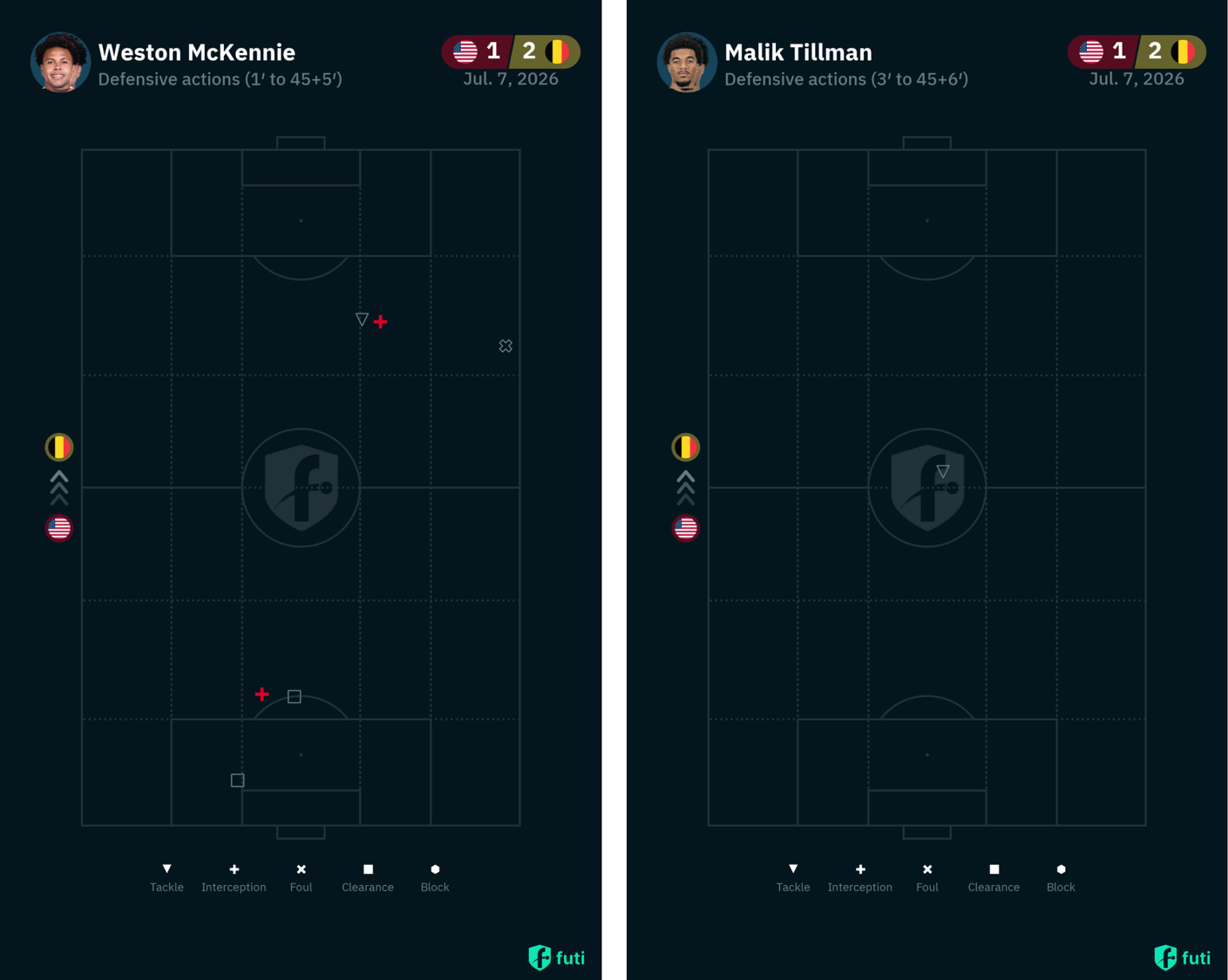
- Courtesy of the Futi app, here's a look at Malik Tillman and Weston McKennie's first-half defensive actions. If you want an example of the U.S.'s meekness, this is a very good place to start.
- Matt Freese made an absolutely terrific full-stretch save less than a minute into the match, and then everything else was vaguely nightmarish. Put aside the 57th minute gaffe, and it still ain't great. I’m far from a goalkeeping expert, but to my eye, he was a bit too lax in his positioning on both first-half goals. You’ve gotta trust the Reams and Jedi Robinsons of the world to some extent, but the balance felt off.
- Romelu Lukaku shoved us to the ground, rubbed our face in the dirt, and laughed the whole time. Gotta love the big man.
- I need someone to love me unconditionally like Jesus Perez loves Mauricio Pochettino.