The Back Four: Is OC OK?
On Orange County’s defense, League One pressing patterns, and more

Welcome in to The Back Four! Need more USL content? Make sure to:
- Visit Backheeled for 10,000+ words of analysis on the Championship and League One every matchweek.
- Check back on Backheeled for a topical end-of-week feature on big USL-wide stories, plus attendance and depth chart tracking.
- Listen to This League! and The USL Show to catch up in podcast form.
Without further ado, let’s get to it.
What's wrong with Orange County?
I like to bring an analytical perspective to the table. If a team's performance changes, there's gotta be an underlying tactical reason for it – right?
Orange County SC is testing that assumption. A club that spent most of the summer looking like the best defense in the USL suddenly can't make a stop. OCSC have allowed 3.0 goals and 2.3 xG per game in their last five outings, a run that featured 11 concessions across back-to-back-to-back matches against Tampa Bay, Louisville, and Tulsa. The tricky thing? Orange County hasn't made a big swing; they're simply playing worse soccer.
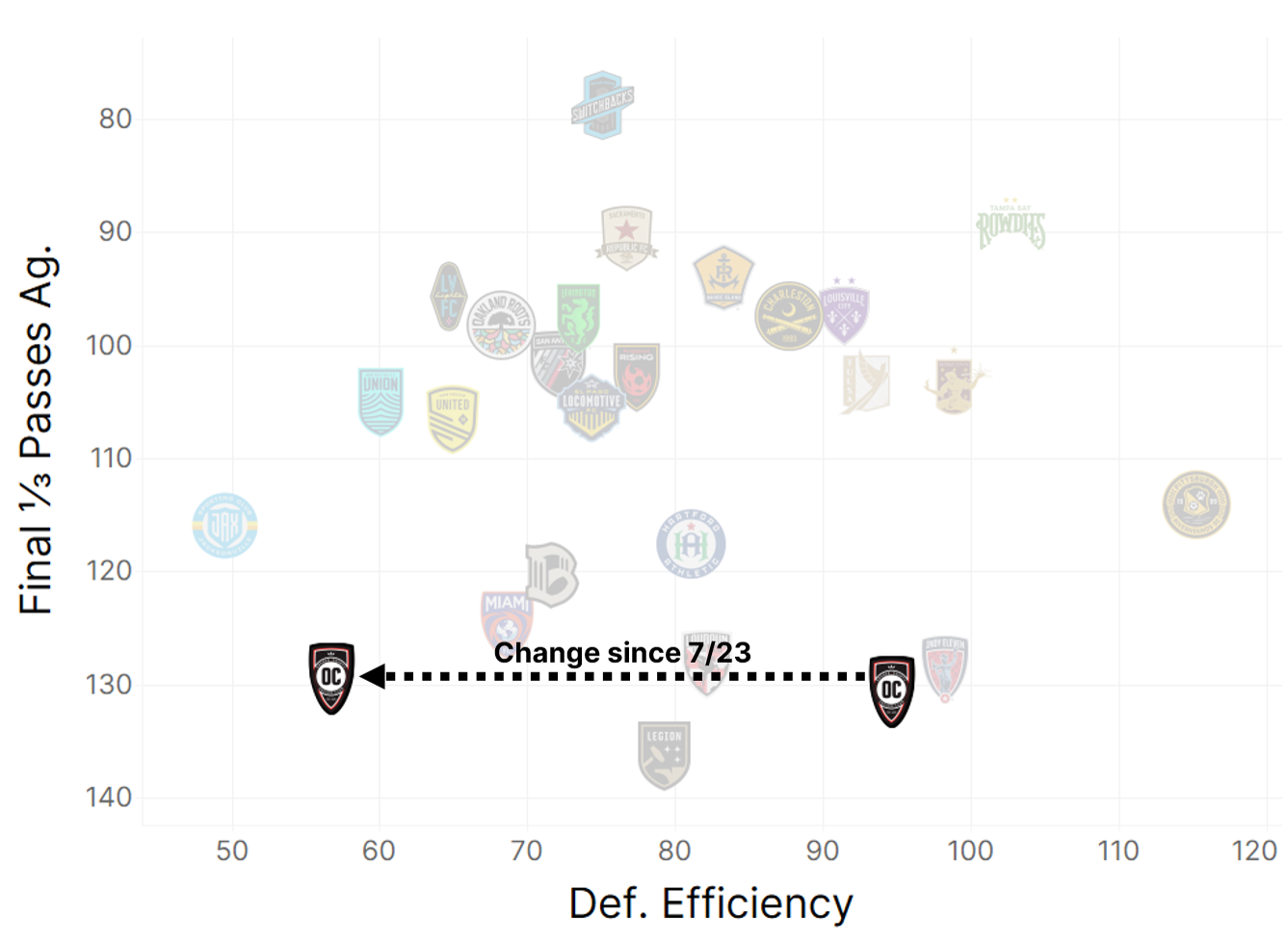
I like to frame defensive performance around two things: where you're allowing opponents to get the ball, and how you perform in those areas. Orange County's field tilt has actually improved over the last month, and they've conceded slightly fewer touches in their defensive third. However, OCSC's performance in their zone has fallen off a cliff. Until the end of July, opponents needed an average of 95 final-third passes to generate an expected goal. Since then, that number has plummeted to 57 – the second-worst in the USL Championship.
Even when Orange County was winning matches, their low-tilt style necessarily tempted fate. Defending around your own 18-yard box is difficult! Doing it for long stretches of time is inherently risky. While Danny Stone successfully settled on a "core four" of Garrison Tubbs, Tom Brewitt, Stephen Kelly, and Efren Solis that could successfully walk that tightrope, the balance is no longer in place.
Small mistakes have made a major mark. Consider this play from the Louisville loss...
...where every single line of OCSC's 4-2-3-1ish shape is at fault. Initially, Louisville is resetting in possession and working from Orange County's left toward their right. Along the way, Ousmane Sylla – this club's star No. 10 – delays a closing run into the midfield by a split second, hedging against a centering pass. As such, he can't intervene when LouCity finally play through into their pivot.
At this point, you'd expect one or both of Kelly and Solis to put in a tackle. They don't. That gives Louisville time and space to keep driving forward, picking out their No. 9 and left winger close to goal.
Without a proper shield in place, OCSC's back line is in trouble. Tubbs and Brewitt both half-heartedly mark the opposing striker, and that leaves a winger wide open. You'd optimally want Nico Benalcazar to slide over from right back, but he's between a rock and a hard place – you can't see a LouCity wingback in the frame, but his responsibilities are split. As such, it's stunningly easy for the guests to get one-on-one against goalkeeper Alex Rando to score.
(It should be noted that Rando has been surprisingly error-prone as of late. He prevented 2.5 goals above expected during the first 16 matches of the year, and he's at -0.3 during the recent downturn. That shot-stopping metric doesn’t address a handful of ill-advised charges off his line.)
Let's take a step back. Orange County is making mistakes while dug deep in their own zone, but why are they in their own zone in the first place? Part of the dilemma is a marked inability to win second balls.
If you take a naive view of duels, OCSC looks fine. In fact, they lead the Championship with a 53.2% duel win rate this season. Still, that mainly corresponds to winning the first ball – think about the initial header after a long punt, for instance. The problem arises in the ensuing chaos, where Orange County struggles to claim control of possession. This year, OCSC is dead last in the league with a -5.4 recovery margin per game. That number is -6.8 over the last five matches, meaning that opponents are getting seven extra chances to break this defense down.
Consider this sequence from the Tulsa loss. Orange County's press (and the natural directness of the visitors) encourages a pass over the top, and Benalcazar – who started at left back in this case – wins the first header. The problem? The gulf between the midfield and defensive lines is enormous. Tulsa fits three players in that space and easily wins the second ball.
From there, the defense is under the gun. Tulsa drives directly at Brewitt and Tubbs, and while there's an initial takeaway, disaster still strikes. Once again, it's a one-on-one that Rando can't stop.
While Week 26 saw OCSC improve to some extent, they still conceded first against Oakland and finished at a deep deficit in field-tilt terms. Orange County won 60% of the duels, and recoveries ended at an even 39-to-39 parity.
The arrival of fullback Jaylin Lindsey will help the cause (if only because it’ll allow Nico Benalcazar to play centrally), but it’s not a panacea. I don’t expect Orange County to keep playing this poorly down the stretch, but it’s going to be difficult to put the genie back in the bottle to re-create the high points of June and July. That was always the risk of OCSC’s tactical choices, but it’s narrowed this club’s path with just two months to go in 2026.
League One’s pressing landscape
Pressing high isn’t the only way to win games, but aggressive pressing teams have topped the table in the 2026 USL League One season. Five of the top six teams in the table – Charlotte, Omaha, Madison, Knoxville, and Boise – all rank as top-six teams in terms of their pressing sequence per match. That quintet varies greatly in how they press, but they’re all set on disrupting their opponents.
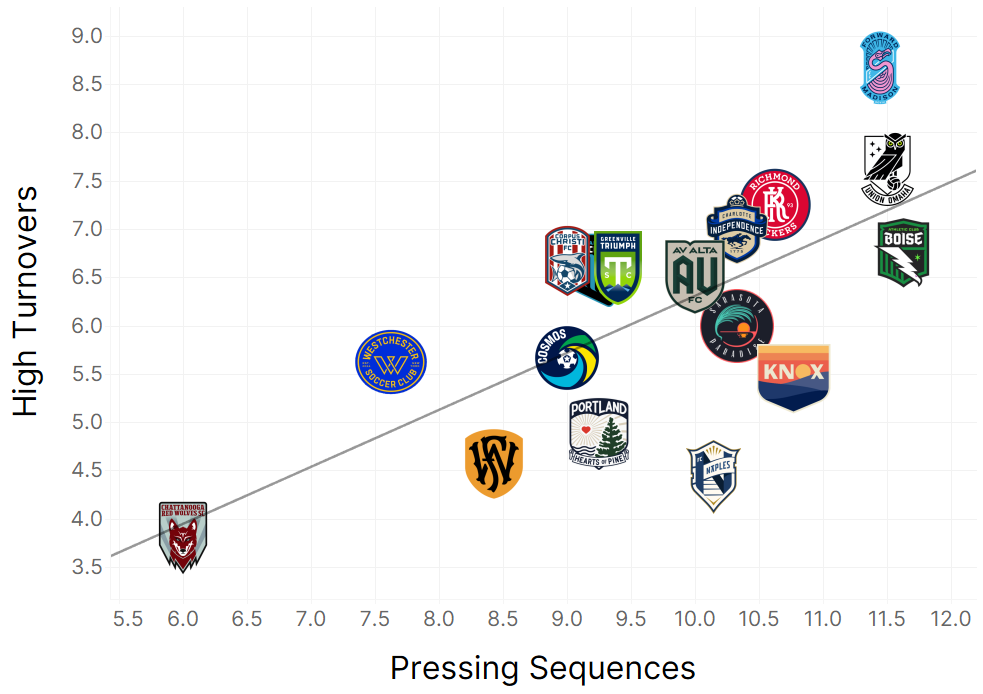
Unsurprisingly, there’s a strong link between pressing more often and forcing more high turnovers, but that isn’t universal. Charlotte basically create a high turnover for every 1.5 pressing sequences they execute; Naples press just as often, but they only produce a high turnover for every 2.3 pressing sequences. There are plenty of reasons why the Independence are a Players’ Shield favorite and Naples are being managed by an interim coach, but that gulf helps explain their disparate outcomes.
Crucially, pressing exists fairly independent of on-ball choices. Boise and Omaha are extremely high-possession teams, but they go hard whenever they give the ball away; conversely a similarly passing-oriented Alta is a middling pressing side. The bottom-two possession teams in League One, Chattanooga (38%) and Richmond (43%), are polar opposites when it comes to their defensive approaches.
Madison skew toward the lower-possession, direct-minded end of the spectrum, and they use that profile as a springboard to lead League One in high turnovers. Time and again, Matt Glaeser’s 3-4-3 has bullied opponents in the first phase, aggressively pursued backpasses, and wreaked havoc.
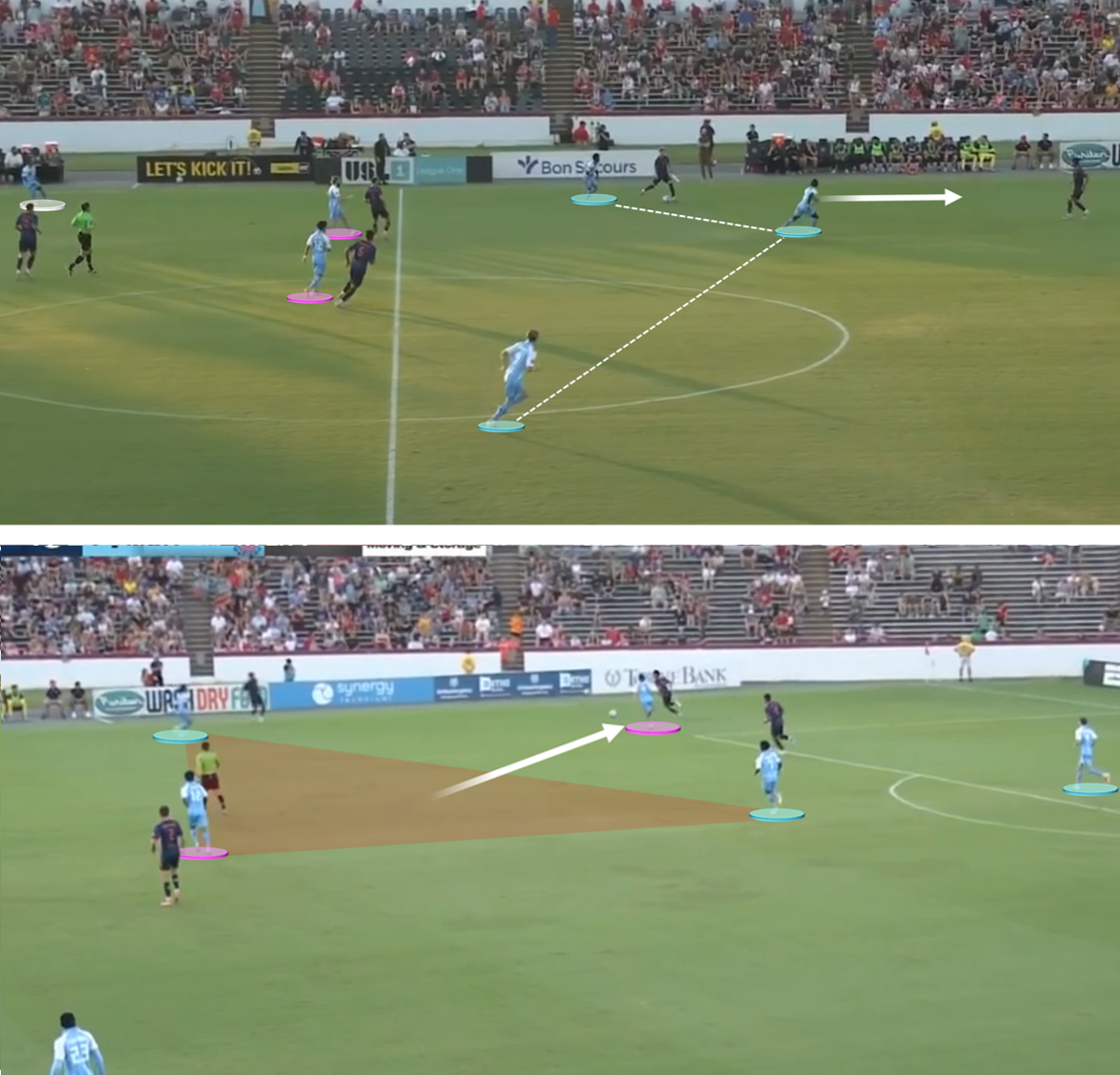
You see the Mingos pressing against opposing Richmond’s right-sided center back in two situations here. The first features Madison in more of a mid-block 5-2-3, with ball-side winger Josh Bolma hedging against the Kickers’ right back, the pivot staying firm, and striker Stephen Annor Gyamfi sprinting to close down. There’s nothing complicated here; Madison commit to the press, stays shapely, and force Richmond backward under duress to set up Annor Gyamfi for an interception.
In the second frame, Richmond are building out from the back and drop one of their No. 6s low. Madison mark through the pivot again, so center mid Collin McCamy (pink) tracks that player upfield. This time, Annor Gyamfi is off the left wing, while Ryan Carmichael replaces him as the No. 9 and presses up against opposing goalkeeper Yann Fillion. When the ball moves from Fillion to a center back, Carmichael isn't in position to close; instead, McCamy peels off his mark, curls his closing angle, and harangues that Kickers defender. There’s tight coverage behind McCamy's closedown, and Richmond will be forced into a giveaway.
Madison is so good because they use the long ball to tilt the field and are intense from endline to endline. Their No. 8s have been excellent as markers, and their defensive line has patched over the (rare) moments where things have been less organized.
Still, you don’t have to be as committed to an all-pressure, all-the-time identity to make noise in the defensive phase. I was shocked to see Fort Wayne so low in the numbers; I would’ve expected them to be toward the front of the pack. Manager Mike Avery’s high press is aggressive, but it’s often focused on containment more than in-your-face disruption.
Fort Wayne tends to be more situational than the Madisons of the world; they’ll go after a backpass, but they aren’t going to throw a No. 6 upfield with abandon unless there's a real opportunity.
Here, you see the expansion side cause trouble with just two real pressers engaging. Opposing Portland takes a throw-in, but they’re rather lax about it. Within their 4-2-3-1ish shape, Fort Wayne has already positioned striker Ryan Becher between the opposing center backs and marked Hearts’ No. 6 with a higher-tilted Taig Healy. Meanwhile, JP Jordan steps from the pivot to fill space – he’s clogging lanes, not aggressively looking to turn play over.
The shapeliness of the structure goads Portland backwards, and that’s when the heat turns up. Becher skips from man to man, eventually pressing the opposing goalkeeper; Healy fronts the midfield, setting himself up for an interception. At no point have Fort Wayne risked their structure, but they’ve chosen the perfect moment to apply hard pressure and force a dangerous turnover.
There isn’t a “correct” way to approach the press, but you’re doing something wrong if you aren’t using it as an arrow in your tactical quiver. That’s been true all year long in League One, and it’ll remain so as the game slows down and defense becomes all the more valuable in the postseason.
Two-striker Tampa Bay
I wrote about the Karsen Henderlong-MD Myers duo fairly positively in this week’s Backheeled power rank, and I kinda don’t care that Tampa Bay got blanked away in Pittsburgh. We’ll see what gives from here on out, but I wanted to break down a couple plays that highlight what the strikers bring to the table for the Rowdies.
Against Pittsburgh's mid-block 4-2-4, the Rowdies tended to build in 3-5-2 mode, keeping at least one wingback at a moderate height to stretch the opposing press. Meanwhile, a triangular midfield with Max Schneider as a single pivot under Russell Cicerone and Marco Micaletto was meant to overload Pittsburgh through the central third.
Here, that construction lets Charlie Ostrem receive at the left wingback spot, forcing a reaction from the Riverhounds’ back line. As the Pittsburgh right back advances, Myers and Henderlong are left two-on-two against the opposing center backs. Thus, there’s space. As soon as Ostrem hits a pass toward the No. 9s, Micaletto curls upfield to find a gap past the closing fullback.
Pittsburgh’s response is deft. Micaletto draws a marker, so when Myers tries to play behind, his pass is cut out. Nevertheless, Micaletto immediately commits in the counterpress, setting the table for Ostrem to make a recovery and fire off a shot.
The big takeaway here? The No. 9 pair effectively bought space for marauding teammates. Particularly against back-four defenses, it’s easy to see how Myers and Henderlong can be a major matchup problem.
This time, Tampa Bay starts up the opposite flank, with defender Laurence Wyke playing into right wingback Dion Acoff. Though he’s closed down, Acoff is able to go one-two with a right-shifted Cicerone to burst in behind.
Acoff’s movement forces rotations from the left back and left-sided center back, leaving Myers, Henderlong, Micaletto, and far-post Ostrem in a four-on-three on the weak side. When the wingback serves in, Henderlong receives on the cross, holds play up, and dishes to a curling Micaletto. The shot is blocked, but Tampa Bay resets nicely.
Even against a defense as elite as Pittsburgh’s, the Rowdies still looked mighty dangerous pairing two No. 9s together. Most teams in the USL aren’t as organized as the Riverhounds in the box, and that bodes well for Myers and Henderlong going forward. I don’t anticipate the 3-5-2 to be Tampa Bay’s go-to by any stretch, but it’s a very useful option in specific matchups across October and November.
(For the record: my real “wake up sheeple” take is that the Rowdies should try Myers next to full-blown striker Pedro Dolabella.)
Super League, Week 3
Trying something new by breaking out the Super League coverage into a separate article. In The Back Four, I'll excerpt one game blurb. Enjoy a look at Jacksonville's win over Dallas here, then dig into the full piece for everything else that defined Week 3.
There have been six individual games in USL Super League history where a club has played 600 passes or more. Dallas Trinity have done it twice this season. Manager Lee Nguyen’s possessive style is among the most extreme systems we’ve ever seen at this level; of that, there’s no doubt. What’s less sure after a 2-0 defeat against Sporting Jax is whether that system can start picking up wins.
What we saw from Dallas on Saturday was far from surprising. Trinity defended in a 4-4-2, shifted into more of a 3-3-4 on the ball with right back Carissa Boeckmann as the fullback-to-No. 8 hinge piece, and tried to pass their way through Jacksonville’s narrow front three. It simply didn’t work – something that’s become a trend between the Sporting loss, Week 1’s draw with Tampa Bay, and last weekend’s defeat against Carolina.
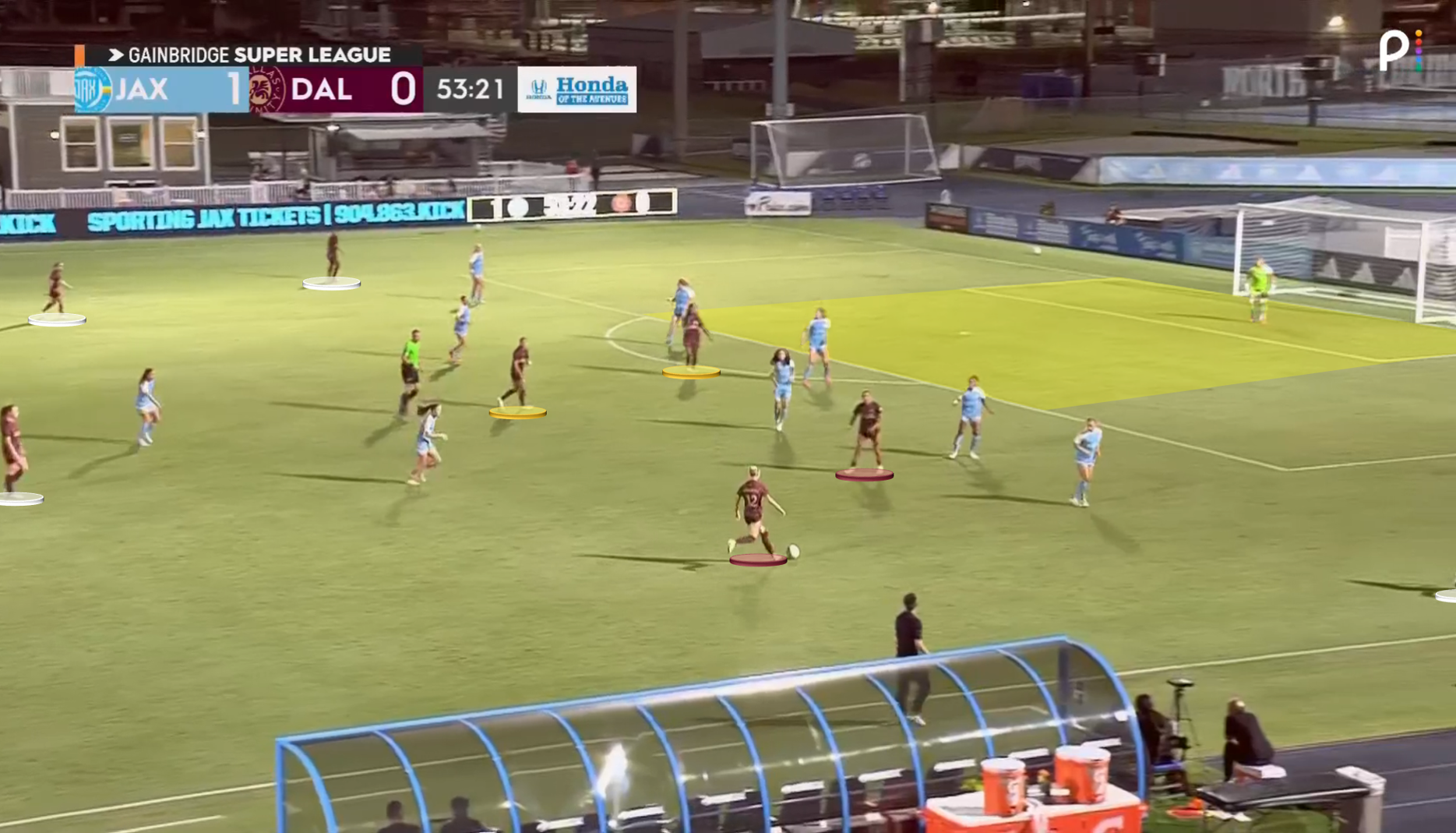
What’s the problem? For my money, the ball isn’t moving quickly enough in build, and the expansive nature of Dallas’ shape isn’t providing enough spark in the 18-yard box.
Consider the frame above. Here, Trinity have already reset after one foray into the final third, where right winger Camryn Lancaster rejected a crossing opportunity for want of runners. Here, defender Sydney Cheesman (maroon) pushes high with Dallas trailing 1-0, almost making the shape a 2-3-4-1 in the process. The problem? Dallas’ wide players aren’t tempting Jacksonville out of shape in the slightest, and there’s still no motion in the box. Credit Sporting for the organization, but the lack of any movement – vertical or horizontal – has been a major drag on Dallas.
By contrast, Jacksonville used a mixed passing profile to get over the line. This has been more of a long ball team in the 2026 season, and that didn’t entirely change in the win over Trinity. Nonetheless, Jacksonville proved willing to play at Dallas’ tempo and initiate with more patience before hitting a pass over the top.
Goalkeeper Jamie Gerstenberg (who’s been the catalyst for the new build approach) was key to the adaptation on Saturday. Often, she’d step into the back line like a fourth defender, forcing Dallas to commit more numbers forward. Manager Stacey Balaam reprised the usage of Ginger Fontenot as a center back and Grace Phillpotts as a wingback in Week 3, and that choice paired with Gerstenberg’s positioning to refresh Jacksonville in build.
You see that here. Gerstenberg finds Georgia Brown at the heart of the back line, whilst Fontenot lingers and forces winger Onyeka Gamero to stay high in case a trapping situation arises. Because Jacksonville drop midfielder Sophie Jones (marked as the “plus one” to the practical back four) below the level of the press, Dallas can’t easily close on a defender without leaving a short option wide open through the middle.
Those competing forces give Brown time to think, allowing her to switch up the left sideline toward Phillpotts. The wingback’s reception isn’t the cleanest, but she’s still able to squeeze the ball toward a drifting Ashlyn Puerta. A crossing opportunity ensues.
Jacksonville’s pragmatism cut a clear contrast against the dogmatic possession game Dallas offered up. Sporting played forward more quickly, platformed their stars, and benefited for it. The goal that won Jacksonville the game – a 45th minute effort from Baylee DeSmit – might not’ve involved beautiful build, but the field tilt wrought by their passing style earned the throw-in that made it happen.
While we’re talking offense and outcomes, it’s a useful time to level-set according to the numbers. As we sit after three games, here’s where the eight teams in the Super League land:
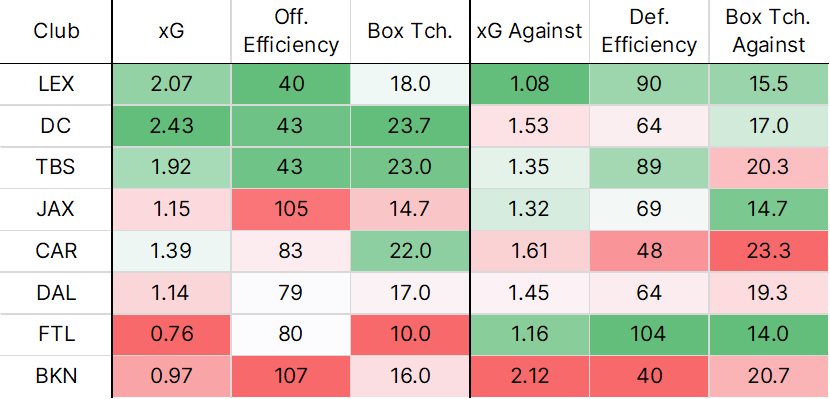
Three teams – Lexington, DC, and Tampa Bay – have been a model of attacking efficiency so far. Among that trio, only Lexington backs it up with comparable dominance against the ball. Jacksonville has been suffocating, but their offense is still lagging; the opposite is true for Fort Lauderdale.
On both sides of the ball, Dallas is stuck in the muddy middle. The offense isn’t doing enough with its high passing volume and fair share of final-third control, and the defense has been slightly below average. Whether Nguyen goes for a lineup change or moderates his system, something’s gotta give at the Cotton Bowl.
In other news…
There are a million little things that a center back is responsible for, and zone exit passing doesn’t get enough love as an important skillset. The premise is this: when you’re a defender that makes a recovery, what do you do with the ball to put your side onto the front foot?
In a year where Brooklyn has been rather up-and-down, Thomas Vancaeyezeele has continued to look like a tremendous zone-exit passer. You see that above; in each case, Vancaeyezeele is able to make an interception or recovery and find a teammate in a useful upfield position. It’s easy to forget that the 32-year-old was once an all-USL awardee, but he’s still showing it in 2026.
Alex Ashton put up a great piece on the Most Valuable Player race in League One that you should go check out. After a week where Jon Bakero played the game of his life for Charlotte, the midfielder may have the inside track to the trophy. I don’t have a League One ballot (and I don’t think there’s a media component to the voting?) but would probably be going for Roman Torres because of his play-driving progressivity, strong set piece production, and active contributions to the Madison press.
I love talking about awards way too early, and if we were giving away the Super League’s Defender of the Year award right now, it would probably go to DC Power’s Sydney Cummings.
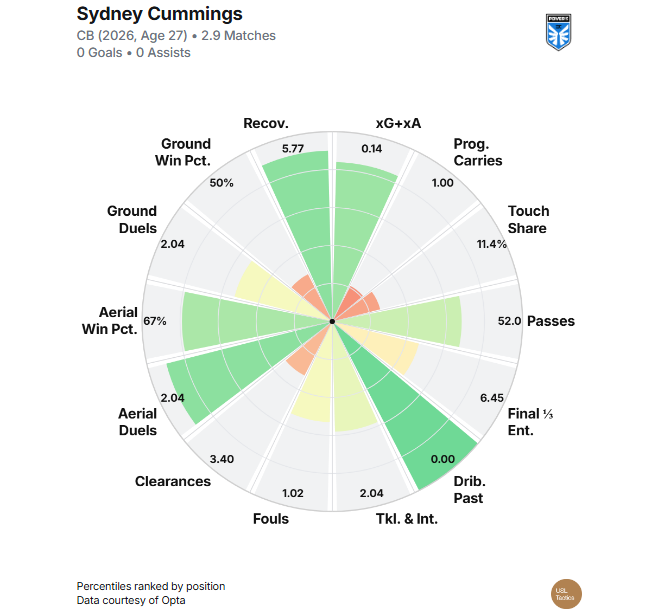
DC’s use of a high, fairly tight-marking back line was key in their win over Lexington and has defined a highly successful start to 2026. Cummings has been utterly vital at making it happen. The 27-year-old hasn't been dribbled past in three starts, and she's dominant in the air. Her line-breaking passing is good, too; Cummings' 10.6% touch share is the highest in the Power defensive corps, and her average vertical passing distance (15.6 yards) is 50% higher than Claire Constant's and more than twice as direct as Justina Gaynor's. Great player!