USL Super League, Week 3
On Fort Lauderdale's subs, the Tampa Bay revival, powerhouse DC, and more

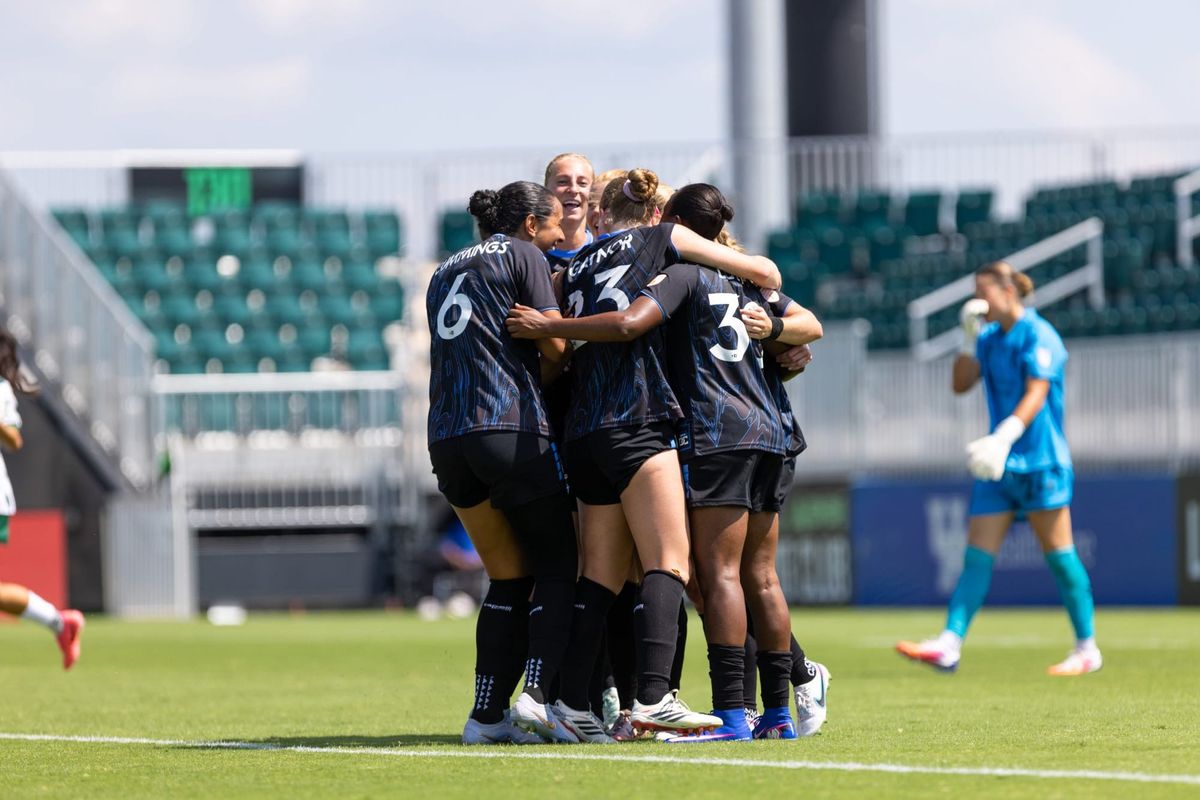
Fort Lauderdale (1) - Brooklyn (0)
To say that Fort Lauderdale was a “first half team” in the 2025-2026 season would be a misnomer; they were a neither half team. Still, United posted a -11 expected goal difference in first halves last season, as opposed to a truly dismal -18 expected (and -17 actual mark) in second halves. The gulf was meaningful.
Maybe a win over Brooklyn isn’t a game-changing data point, but Tyrone Mears’ side made all the night changes in Friday night’s 1-0 victory. Despite Brooklyn posting a 78% field tilt in the first 45 minutes, Fort Lauderdale held them to just 0.4 xG. Mears was decisive after the break, United scored quickly, the defense held thereafter, and that was that.
How’d we get there? After last weekend’s debacle against DC Power, Alex Smith overhauled the Brooklyn lineup around defensive mid Jennifer Cudjoe. The No. 6 spent the start of August away with Ghana for WAFCON, and it’s already clear that she’ll be a key piece at Maimonides Park. Last year, Cudjoe put up 3.8 takeaways and 6.9 recoveries per 90; on Friday night, that holding presence made Brooklyn look like a competent defensive team for the first time all year.
With the pivot settled, Smith could move Sophia Lowenberg into central defense, where she paired with another new starter in Jordan Thompson. The refreshed center backs were refreshingly mistake-free. Ahead of them in what often looked like a 4-1-4-1 pressing shape, Carlee Giammona and Jilly Shimkin operated as hard-nosed No. 8s that helped deny Fort Lauderdale.
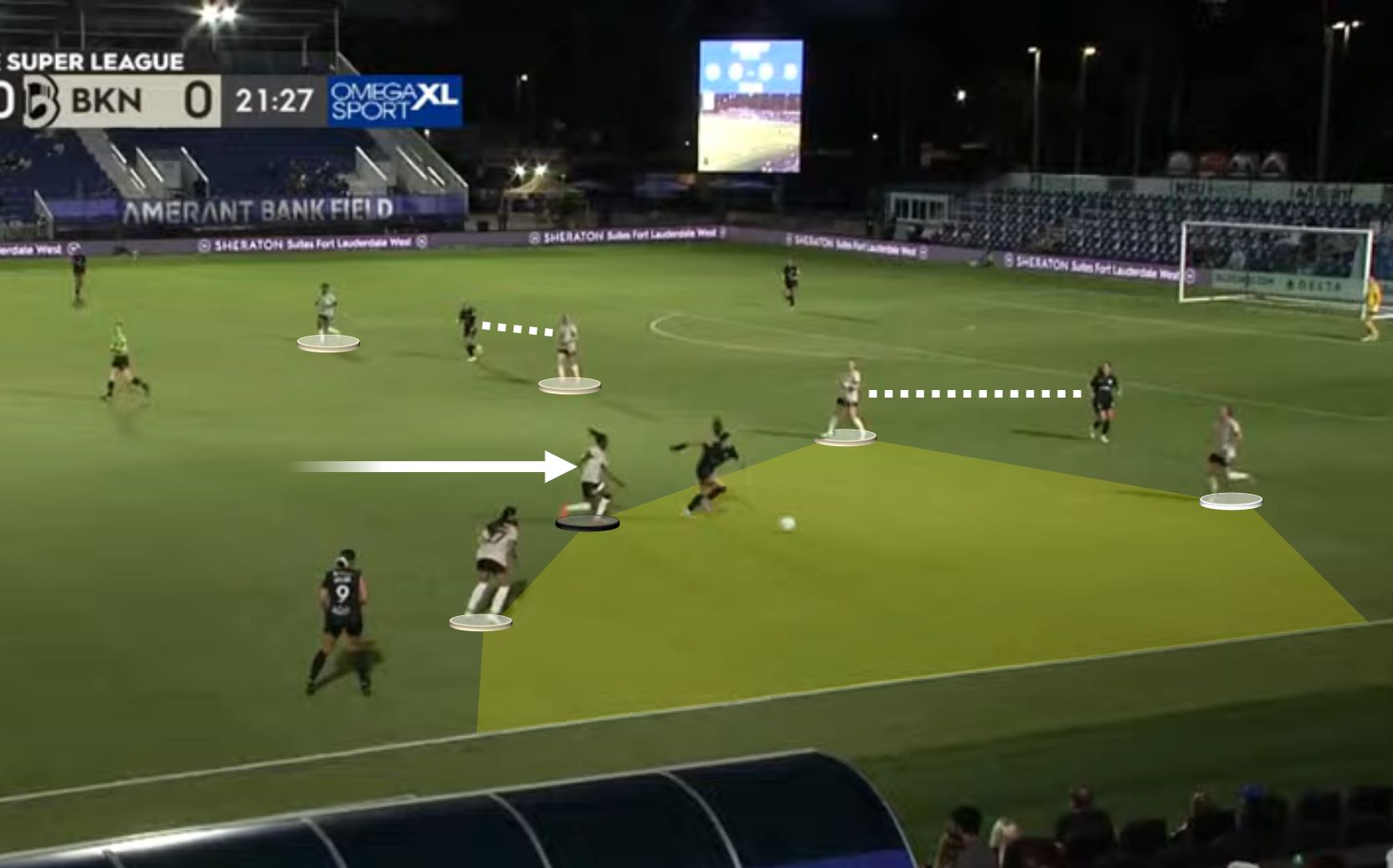
How’d the shape work for Brooklyn? Here, Shimkin and Giammona (slate-toned) have stuck tight to Nicole Vernis and Shea Moyer in the opposing pivot. A line ahead, striker Catherine Zimmerman (white) is skewed toward the sideline, having cut off a Fort Lauderdale defender just before this frame. Numbers abound on the wing.
In response, Fort Lauderdale drop striker Grace Cutler into the channel to try and overload the shape; having a No. 9 show while left back Kelsey Oyler (seen in the #9 shirt) hedges up is actually quite clever. However, Cudjoe (black) flies ahead to mark Cutler, ensuring that she’ll be driven into a trap. Time and again, these timely reactions kept Brooklyn on the front foot.
Still, Brooklyn badly lacked that success going in the other direction. Brooklyn tended to keep their fullbacks low to support the press, and that neutered their ability to break forward with sufficient numbers. The chemistry across the still-new attacking line remains nascent. When, say, winger Tziarra King was on the ball and needed a short passing option, she was often met with a vertical run over the top; Smith’s side completed just 56% of their final-third passes in Week 3, a sign of the dysfunction.
In other words, Brooklyn left money on the table, and Fort Lauderdale picked it up. Mears’ offense may’ve been feast-or-famine in the face of the press, but patterns gradually began to emerge.
Dropping Moyer low toward the level of the defensive line created a domino effect, drawing players like Giammona and Cudjoe forward and, thus, ripping open space through lines. Meanwhile, Vernis’ side-to-side movement had the same effect on a different plane.
Fort Lauderdale relished the ability to play line-breaking balls into Emily Thompson at the No. 10 spot, but Thompson’s touch wasn’t always there. That changed out of halftime, when Kelli Van Treeck subbed on in her position. Van Treeck completed five passes into the all-important Sh’nia Gordon off the right wing; Thompson did so just once. Fort Lauderdale always had the “hit a big ol’ diagonal toward Gordon” option in their back pocket, but Van Treeck added a new arrow to the quiver and created chances like this…
…and this…
…that broke Brooklyn’s back.
In each case, Van Treeck receives through lines thanks to the space-opening movement of the pivot. From there, the attacker decisively turns forward and picks out a teammate. The first example turned into a game-winning goal; after Van Treeck hit Gordon, she charged toward the net, occupying defenders and giving Vernis the space to receive on the cutback for a shot.
That manner of concerted attacking was the big difference on the night. Fort Lauderdale’s defense was uniformly organized; it was just a matter of time before their attack came good. Mears’ use of Van Treeck catalyzed the glow-up. For their part, Brooklyn never found that extra gear – something that's becoming a theme in this young season.
Lexington (0) - DC (1)
If you’d told me three weeks ago that DC Power would be looking like a solid playoff team, I wouldn’t be shocked. It’s the way they’ve done it that’s so outstanding. Between Loza Abera’s line-leading excellence, the stellar chemistry between Sydney Cummings, Claire Constant, and Justina Gaynor in defense, and Omid Namazi’s tactical nous, Power have been among the most impressive teams in the league.
That didn’t change away to Lexington on Saturday afternoon. The intensity of DC’s press carried the day, and when the moment arose, Abera made her mark.
After last weekend’s dominant win in Brooklyn, Namazi shifted into a 5-2-3 shape in place of a back four. Tyler Lussi and Susanna Fitch, neither of whom started in Week 2, held down the right side. For their part, LSC also looked different. Sarah Griffith wasn’t in the squad, so manager Mac Hemmi shifted Addie McCain to her wing position and brought Hannah White on as a second striker.
From the opening whistle onward, Lexington’s ability to shift from their baseline 4-4-2 into a full attacking posture was put to the test. For every moment where right back Alyssa Bourgeois flew up the wing, there were two more plays where DC forced a high turnover and produced a snap shot for Lussi or midfielder Abby Boyan.
Here, Lexington’s “three-box-three” alignment – featuring a flexible double pivot and two between-the-lines No. 10 types – can’t work through. In this case, it’s White and reigning Golden Boot winner Catherine Barry showing in front of the defense. They’re available to receive at their feet, but Constant and Cummings step to mark them.
Center back Allison Pantuso hits White, and she’s able to lay off toward Barry, but there’s no time to think. Barry sprays a pass toward an overlapping Bourgeois, but the arc of the ball leads Bourgeois’ path too far wide. Wingback Sam Cary Angel is there to make a stop, and Gaynor is in the box as a supporting presence.
This sequence is better for Lexington. Instead of battering their way through the midfield, LSC initially work around the edge and keep White deeper, almost like an extra No. 8. As left back Ally Brown receives at the sideline, DC can’t be as aggressive in closing down between lines.
The result? McKenzie Weinert can receive off the wing and help play outside-in. Barry gets a touch with more time to breathe; Gaynor and Angel are drawn inside, meaning that they can’t recover as easily toward the inevitable Bourgeois overlap.
Still, the nature of LSC’s “let the forwards facilitate” offense bred limitations. Here, McCain and Barry turn back upfield after the switch is hit, but they aren’t in the box in time for Bourgeois to hit a cross. As such, Angel and winger Emily Colton have the grace period to get back, double up, and stonewall the home side.
Now, it’s not like Power were any more consistent going the other direction. Lexington’s 4-4-2 did well to restrict the central spaces, and Pantuso’s steady post-turnover positioning limited DC after press-driven chances began to foment. At their best, DC were able to find either Angel or Fitch off big switches, isolating the wingbacks one-on-one against their opposite numbers. The diagonal game was a useful pitch-tilting tool; just before the half, a pass toward Fitch earned a throw deep in LSC territory, leading to a chain reaction that culminated in a Bourgeois handball off the ensuing throw. From there, Abera would rebound her own saved penalty kick to claim a 1-0 lead.
To call DC’s defense “bend-don’t-break” wouldn’t be wrong, but it undersells their level of control. Even as Lexington tried their darnedest to get back into the game, Power remained resolutely in control.
What felt like the first mistake we’ve seen from Pantuso put the game on ice in the 67th minute. There, an innocuous long ball from DC goalkeeper Kate Cappelletti landed at the center back’s feet, with only light pressure being applied by Abera. Still, Pantuso blindly played a backwards pass, allowing Colton to claim an interception, charge at goal, and make the margin 2-0. By then, McCain had moved into the pivot for greater involvement, and rookie forward Mac Midgley had just entered the pitch. (Those shifts were rendered moot, but it should be noted that Midgley put Lexington with a nice off-ball run and scored in garbage time.)
Three weeks in, it’s clear that Power are a title threat. Everything that went right for Namazi in year one still applies, and that quality has been punctuated by a league-best defensive setup. No one in the Super League looks better.
Carolina (1) - Tampa Bay (2)
The Tampa Bay Sun might just be back, and this weekend’s 2-1 win over the Carolina Ascent in front of the biggest crowd of the nascent Super League season in Charlotte made that clear. Between a gritty defensive performance and Denise Schilte-Brown’s in-game changes, the Sun shone in Week 3.
Tampa Bay have blended shapes all year, but Saturday’s look featured the Sun’s truest 4-4-2 of 2026. Jordan Zade was the hinge player, basically operating like a true right mid (as opposed to a wingback) in the pressing and attacking phases. That choice allowed the Sun to match Carolina’s baseline shape player-for-player, and it facilitated an aggressive defensive approach meant to stymie the Ascent’s ability to control the game through their fullbacks.
On the ball, Carolina wasn’t as expansive as we saw a week ago against Dallas, where Jill Aguilera and Addisyn Merrick fanned wide in a possessive 3-1-5-1. This time around, the fullbacks took up narrower, support-minded positions. Carolina still went for a pseudo-back three with Lily Nabet dropping low from the pivot, but they needed the extra help against the press.
Here, Tampa Bay doesn’t blink. As soon as the Ascent hit center back Jenna Butler toward the sideline, she’s trapped and denied easy escape routes. Strikers Shea Connors and Erika Zschuppe both slide right, and Zade hedges toward Aguilera. In the pivot, Jordyn Listro and Sam Kroeger split high-low; Kroeger’s hedge toward the weak side is an important stanchion against a diagonal pass.
The result of the trap? Aguilera receives but has to pass backwards, allowing Connors to pounce. Tampa Bay break, a cutback finds Zschuppe, and Carolina midfielder Mia Corbin cuts her down to give away a penalty.
This specific play went the Sun’s way, but not every defensive sequence was so clean. Overreactions against the fullbacks allowed players like Butler to turn into ball carriers with some regularity. The Ascent tended to use Shea Groom and Audrey Coleman as narrow No. 10ish players underneath their proper forwards, and that central gravity created a number of dangerous breakthroughs.
Things grew more and more one-sided as the match went on; as they chased the game in the second half, Carolina ran up a 78% field tilt. Nabet slid higher, passes toward Mackenzie George into the channels were a consistent way to overload the seams, and a set piece goal eventually drew things level. Sun center backs Kelsey Hill and Vivianne Bessette combined for a staggering 17 clearances in the face of that challenge.
𝙏𝙝𝙚 𝙎𝙪𝙣 𝙨𝙩𝙧𝙞𝙠𝙚 𝘼𝙂𝘼𝙄𝙉 💥
— Gainbridge Super League (@GainbridgeSL) August 30, 2026
Sydny Nasello restores @TampaBaySunFC 's lead! 🫨 pic.twitter.com/iexBvLiTwT
Schilte-Brown knew a change was needed to strengthen Tampa Bay’s counter, and she acted. Darya Rajaee entered the midfield in place of Kroeger to add more of a forward impetus, whilst Tori Zierenberg came on as more of a No. 10 to connect play between lines. The Sun suddenly could work through Zade up their right and have two players looking to facilitate through the middle.
In the 73rd minute, a breakout led by the right mid opened Waldeck in zone 14. There, she received against a panicking defense and slid the ball toward a crashing Sydny Nasello off the left. It looked like a perfect one-on-one, but Nasello was ruled offside. Three minutes later, that wouldn’t be the case. This time, Waldeck worked from the right sideline into Rajaee, who found Nasello open yet again. From there, the superstar winger won the game.
Those right-to-left moves cutting against the grain of the Carolina defense were exactly what the doctor ordered. At every step, Tampa Bay found just enough quality – whether in their pressing shape, their low block, or their counter – to stay above water. The Sun’s pragmatism was highly reminiscent of the 2024-2025 campaign, and that should breed excitement in Florida.
Jacksonville (2) - Dallas (0)
There have been six individual games in USL Super League history where a club has played 600 passes or more. Dallas Trinity have done it twice this season. Manager Lee Nguyen’s possessive style is among the most extreme systems we’ve ever seen at this level; of that, there’s no doubt. What’s less sure after a 2-0 defeat against Sporting Jax is whether that system can start picking up wins.
What we saw from Dallas on Saturday was far from surprising. Trinity defended in a 4-4-2, shifted into more of a 3-3-4 on the ball with right back Carissa Boeckmann as the fullback-to-No. 8 hinge piece, and tried to pass their way through Jacksonville’s narrow front three. It simply didn’t work – something that’s become a trend between the Sporting loss, Week 1’s draw with Tampa Bay, and last weekend’s defeat against Carolina.

What’s the problem? For my money, the ball isn’t moving quickly enough in build, and the expansive nature of Dallas’ shape isn’t providing enough spark in the 18-yard box.
Consider the frame above. Here, Trinity have already reset after one foray into the final third, where right winger Camryn Lancaster rejected a crossing opportunity for want of runners. Here, defender Sydney Cheesman (maroon) pushes high with Dallas trailing 1-0, almost making the shape a 2-3-4-1 in the process. The problem? Dallas’ wide players aren’t tempting Jacksonville out of shape in the slightest, and there’s still no motion in the box. Credit Sporting for the organization, but the lack of any movement – vertical or horizontal – has been a major drag on Dallas.
By contrast, Jacksonville used a mixed passing profile to get over the line. This has been more of a long ball team in the 2026 season, and that didn’t entirely change in the win over Trinity. Nonetheless, Jacksonville proved willing to play at Dallas’ tempo and initiate with more patience before hitting a pass over the top.
Goalkeeper Jamie Gerstenberg (who’s been the catalyst for the new build approach) was key to the adaptation on Saturday. Often, she’d step into the back line like a fourth defender, forcing Dallas to commit more numbers forward. Manager Stacey Balaam reprised the usage of Ginger Fontenot as a center back and Grace Phillpotts as a wingback in Week 3, and that choice paired with Gerstenberg’s positioning to refresh Jacksonville in build.
You see that here. Gerstenberg finds Georgia Brown at the heart of the back line, whilst Fontenot lingers and forces winger Onyeka Gamero to stay high in case a trapping situation arises. Because Jacksonville drop midfielder Sophie Jones (marked as the “plus one” to the practical back four) below the level of the press, Dallas can’t easily close on a defender without leaving a short option wide open through the middle.
Those competing forces give Brown time to think, allowing her to switch up the left sideline toward Phillpotts. The wingback’s reception isn’t the cleanest, but she’s still able to squeeze the ball toward a drifting Ashlyn Puerta. A crossing opportunity ensues.
Jacksonville’s pragmatism cut a clear contrast against the dogmatic possession game Dallas offered up. Sporting played forward more quickly, platformed their stars, and benefited for it. The goal that won Jacksonville the game – a 45th minute effort from Baylee DeSmit – might not’ve involved beautiful build, but the field tilt wrought by their passing style earned the throw-in that made it happen.
While we’re talking offense and outcomes, it’s a useful time to level-set according to the numbers. As we sit after three games, here’s where the eight teams in the Super League land:
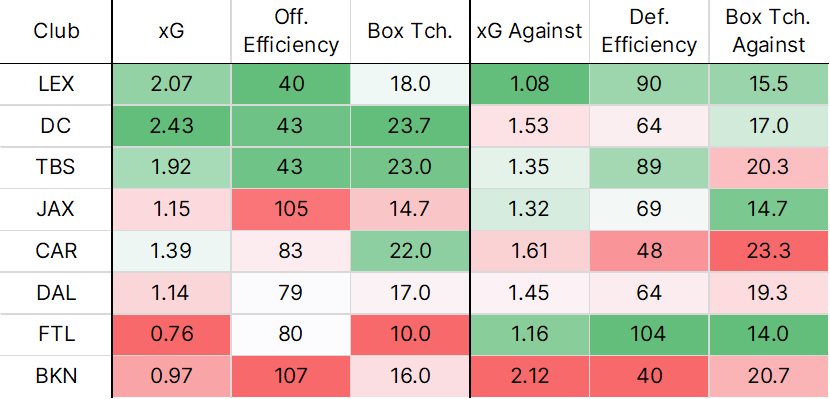
Three teams – Lexington, DC, and Tampa Bay – have been a model of attacking efficiency so far. Among that trio, only Lexington backs it up with comparable dominance against the ball. Jacksonville has been suffocating, but their offense is still lagging; the opposite is true for Fort Lauderdale.
On both sides of the ball, Dallas is stuck in the muddy middle. The offense isn’t doing enough with its high passing volume and fair share of final-third control, and the defense has been slightly below average. Whether Nguyen goes for a lineup change or moderates his system, something’s gotta give at the Cotton Bowl.