The Back Four: Pittsburgh, Power, and Carolina's press
On Super League Week 2 and much more

Welcome in to The Back Four! Need more USL content? Make sure to:
- Visit Backheeled for 10,000+ words of analysis on the Championship and League One every matchweek.
- Check back on Backheeled for a topical end-of-week feature on big USL-wide stories, plus attendance and depth chart tracking.
- Listen to This League! and The USL Show to catch up in podcast form.
Without further ado, let’s get to it.
Super League Round-up
Making sweeping conclusions after two games is a fool’s errand, but DC Power’s 4-1 win over Brooklyn FC cemented what started to become clear after opening weekend: DC is a major playoff threat, and Brooklyn isn’t up to snuff. Friday night’s match underlined Power’s vast season-over-season improvements. On the flip side, it also emphasized what’s becoming a major defensive conundrum at Maimonides Park.
From the very moment the match kicked off, DC put their foot down in the press. Manager Omid Namazi changed shapes after starting the year in a 5-3-2 against Carolina, opting for a 4-1-4-1 away in New York. In practice, the press was really a 2-3-4-1, defined by the ability to mark Brooklyn’s double pivot and get aggressive support from Justina Gaynor and Sam Cary Angel at the fullback spots.
The beauty of the approach was its give-and-take chemistry at every level. Let's say that Kayla Colbert – a new starter on the right wing – pressed up against the ball. In response, right-sided No. 8 Emma Jaskaniec would mark the nearest central passing option, while left-sided Emily Colton would rotate underneath her to keep the structure sound. The same principle applied deeper downfield; if Angel or Gaynor stepped, Abby Boyan would stay home at the No. 6 position and block out any line-breaking angles.
That intensity had a twofold effect. Firstly, DC completely broke Brooklyn’s sense of rhythm from the back and, thus, neutered their attack. Secondly, the press forced manager Alex Smith’s side to play long, thus opening the game up for the Power break.
Those ideas come together here. As soon as Antoinette Williams receives at the Brooklyn right back spot, DC flexes from flat 4-1-4-1 mode into their full-throated pressing shape. Tatum Thomason closes from the wing, Colton and Angel fill behind her, and you get the hedging rotations from Jaskaniec and Boyan. Brooklyn is stonewalled.
Left without options because of striker Loza Abera’s lurking presence, Williams is turned over. Colton recovers, two through passes ensue, and it’s nearly a DC chance.
That ability to push the tempo after regaining was Power’s calling card. When DC opened the scoring in the sixth minute, a feckless long ball allowed Gaynor to find a touch as Brooklyn scrambled. The right back used it to dribble around Jackie Richards (Brooklyn’s left back), play through to Colbert, and create an in-box scramble. Just two minutes later, Boyan would do the disrupting before pushing upfield and finding Abera for a goal.
If post-giveaway breakdowns at the fullback spots put Brooklyn down 2-0, central defensive misfortune was the reason they ended up shipping four goals. Even after subbing returning defender Jordan Thompson on after halftime, Shine Na-yeong gave away two penalties to doom her side.
What can we take away for Smith’s side that’s remotely positive? For one thing, Thompson got on the board, and I’d be stunned if she didn’t start on Friday in Fort Lauderdale. Moreover, Brooklyn flashed an aptitude for building through lines by mixing up their midfield.
Here, Brooklyn lets attacker Jessica Garziano (nominally the No. 10 in a 4-2-3-1) drop low to make a recovery. In doing so, she draws Gaynor out before DC can settle into their pressing shape. Winger Tziarra King recognizes that there’s space available, so she shows between lines to receive. Crucially, Brooklyn doesn’t just stop after the pass into King. There’s a domino effect; as soon as the line-breaking ball is released, Sophia Lowenberg pushes from the No. 6 spot to receive on the lay-off.
Suddenly, Brooklyn is on the move. Lowenberg picks her head up, plays winger Ashlyn Miller through, and a box entrance ensues.
Is the half-chance cold comfort? Of course. Center back Sydney Cummings is never remotely bothered. She and Constant haven’t been dribbled past yet in 2026, and they’re combining for more than 6.0 takeaways per game. Every good press needs an even better backstop, and DC’s got it. It’s hard to poke a hole in this roster right now, and that’ll surely have Namazi feel confident heading into a heavyweight Week 3 bout against Lexington.
Apparently Paige Kenton and Ashlyn Puerta came into Week 2 under the weather? You wouldn't have known it watching Sporting Jax in the back half of their 3-2 win over the Tampa Bay Sun. As soon as Puerta entered at halftime, Jacksonville reminded us why they were such a titan last season.
Of course, that meant Tampa Bay was in control for most of the first 45 minutes. Against a Sporting side using Sophia Boman (an elite box-to-box mid) at striker while giving Macie Teater and Melina Descary their first-ever USL starts in the midfield, the Sun ran rampant. Tampa Bay’s 3-4-3ish press denied Jacksonville the ability to cleanly play through lines, and their rightward bend on the ball proved highly effective.
To an extent, Jacksonville’s turn toward longer initiation via goalkeeper Jamie Gerstenberg exacerbated the problem. Gerstenberg kept the starting spot over Kaitlyn Parks, but her long service rarely unsettled the Sun or generated high-tempo chances over the top. In the first half, Tampa Bay won 52% of duels and ended up with a +3 recovery margin.
When the Sun were in control, they essentially bent into a 2-4-4 by pushing right-sided center back Taylor Chism to the elbow and letting wingback Jordan Zade operate as a winger. That choice spread Jacksonville's defensive shape, and the moments where midfielder Jordyn Listro explored space to take advantage were devastating.
Paired with a pure holding mid like Sam Kroeger, Listro was liberated to be far freer as a ball-mover than she ever was in 2025-2026. Above, you see the captain hedge toward the sideline to triple up with Zade and forward Shea Connors. Meanwhile, Chism table-sets further downfield. Because Listro is wide, she forces a wingback to close down and, thus, can play a through ball in behind to create danger against Jacksonville’s rotating defense.
Those in-possession patterns paired with the verticality we saw last weekend against Dallas to make the Sun shine – particularly in comparison to arrhythmic Jacksonville. (Quick carve-out for Connors, who’s putting up five shots and 1.1 xG per 90 so far while being the league’s best long-ball receiver.) All that changed in the second half.
Manager Stacey Balaam knew that Sporting weren’t up to snuff, and she acted coming out of the break. Most crucially, Puerta came into the attacking midfield. The defensive line was remade; left wingback Meg Hughes moved to the right, center back Grace Phillpotts replaced her on the sideline, and substitute Ginger Fontenot – an attack-first player in her prior USL stops – filled out the back three. The changes were bold, and they instantly gave Jacksonville more intensity, technique, and athleticism.
It took only about 50 seconds for the changes to pay off. With Hughes leading the high press, Jacksonville stopped Tampa Bay from moving into their right-sided overload and forced a risky pass into the midfield. Descary (who looked far more comfortable amidst the evolving lineup) picked it off, immediately moving the ball upfield. Puerta got her look from the edge of the box, and the game was tied in a flash.
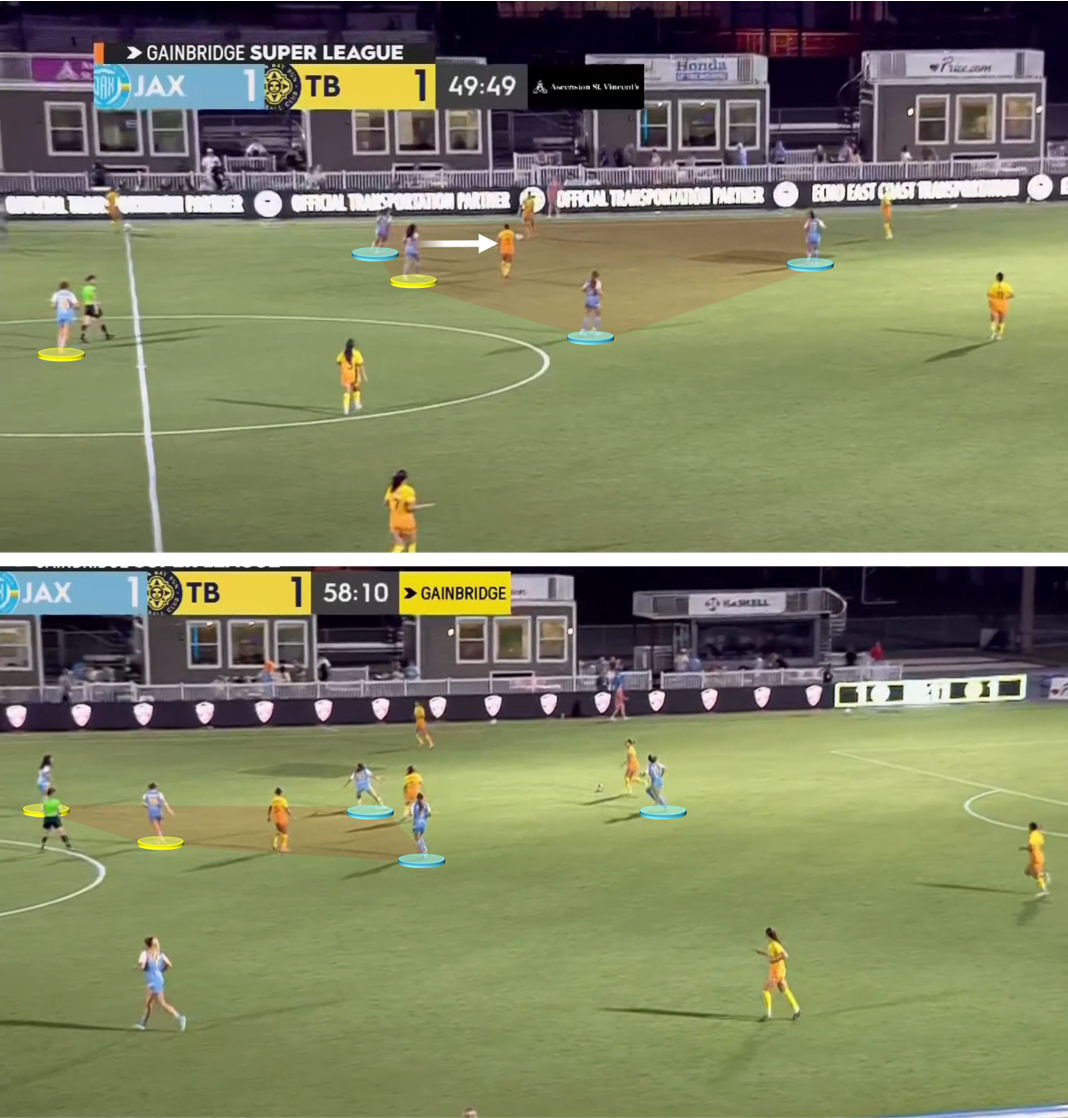
Generally, Jacksonville did far better to restrict Tampa Bay and control the match’s flow post-substitutions. Yes, the three-goal outburst is the headline, but the fact that Sporting won 62% of duels and claimed a majority of recoveries in the final 45 minutes is what let the goals happen.
Under Balaam, this club has almost always pressed in a 5-1-2-2 shape while giving the wingbacks freedom to plug holes up the sidelines. That changed against the Sun. Rather than using a single pivot, Jacksonville doubled up with Descary and Sophie Jones operating as a pair – though Jones could step as a man marker against Listro. The new look, more like a 5-2-3, provided a better response to the Sun’s build shape, tightened the midfield, and facilitated the comeback win.
Baylee Desmit would add two more goals to seal the deal, giving Jacksonville an emphatic result after a comparatively staid Week 1. We may look back on Saturday’s glow-up as the moment where Sporting really hit the ground running.
The Carolina Ascent continued to show off their masterful ability to play against the ball, beating Dallas Trinity by a 3-1 margin despite keeping just 32% of possession. You might look at a stat line where Carolina scored three times on four total shots and feel like they got lucky; that couldn’t be further from the truth. The Ascent’s high back line earned them a 47% field tilt (basically at par) and still limited Dallas to just two fastbreak sequences. The shot numbers are what they are, but Carolina controlled where the match was played and the tempo at which it took place.
What went so right for Phillip Poole’s side? From the jump, the compact nature of his 4-2-2-2 press limited Dallas’ ability to play through lines. Trinity brought a complex system to the table, but they rarely found chances to make it sing.
Essentially, Lee Nguyen lined his side up in a baseline 4-2-4 that flexed into a possessive 3-3-4 through the movement of right back Carissa Boeckmann. Most of the time, Boeckmann stepped into a No. 8ish role through the halfspace, with Jamie Shepherd as the lowest holding player. In rarer instances, Boeckmann overlapped while winger Camryn Lancaster popped into the midfield. The setup was clearly intended to outnumber Carolina’s two-forward, two-No. 6 shape, but the Ascent didn’t cede enough central space to make it a reality.
Thus, Dallas’ best recourse was to skip lines into Jasmine Hamid at the No. 9 spot – a tactic that center back Reese Tappan systematically denied in a stellar individual performance.
You see Tappan’s contributions in two instances here. In the first case, Carolina’s compact defensive shape does its job well, closing to Cyera Hintzen in what’s essentially the left-sided center back spot for Dallas. As Hintzen looks upfield, Ascent right back Addisyn Merrick man marks Onyeka Gamero on the wing, whilst Tappan gives chase against Hamid. The No. 9 receives, but she’s never given one moment to breathe as Tappan drives her to the sideline and tackles the ball out of play.
The second example is less exemplary, but it shows Carolina’s structure equally well. This time, the Ascent press more players forward, and Merrick decides to peel off of Gamero to try and support Tappan. That decision leads to a turnover and a potential breakaway for the winger. The solution? Tappan uses her long stride to get back into the play, meaning that Gamero can’t cut inside. Meanwhile, Jenna Butler and Jill Aguilera track back on the weak side to tighten the screws. There’s a shot, but it hardly troubles goalkeeper Sydney Martinez.
On the flip side, Carolina wasn’t prodigious with the ball, but their attacking setup still challenged Dallas. By keeping their midfield narrow and dropping Lily Nabet from the No. 6 spot into the back line, the Ascent often operated in 3-6-1 mode. That shape forced Trinity to tighten horizontally, thus opening space for wide switches toward Merrick and Aguilera.
Here, that shape plays out to perfection. A very low-seated Shea Groom (white, given her role as a pressing forward) is on the ball initially, and she spots Merrick (orange, nominally a defender) about to push up the right sideline. You’d want either Hintzen or Gamero to track her run, but Baisden’s positioning and the threat of a Tappan carry freeze the Trinity shape.
Merrick is able to receive on the diagonal, sucking Dallas extremely deep. Instead of playing a cross into the mixer immediately, Carolina wisely decide to reset. Tappan receives on a backwards pass and hits a splendid cross-field ball to an overlapping Aguilera, whose ensuing first-time pass is an absolute peach. Just like that, it’s 1-0 via a Baisden tap-in.
Carolina’s ability to spread the field, win second balls, and push the envelope defined their night in the attacking phase. The contrast against Dallas’ possessive-yet-meek setup couldn’t have been sharper. That, in the end, is how Carolina ended up with a statement win.
Potent Pittsburgh
In my midweek Backheeled column sorting the USL Championship into title contenders and pretenders, I found myself feeling really, really optimistic about the Pittsburgh Riverhounds. Despite what a good-not-great slot in the table might tell you, Pittsburgh is looking like a team with a realistic shot at repeating.
Now, "realistic" is a bit of a cop-out. Winning back-to-back titles in this league is incredibly difficult; it's been nearly a decade since it's happened. Nevertheless, Pittsburgh's resilient defensive identity and increasingly diverse attack feel like they're designed for November soccer.
The extent to which the ‘Hounds nailed their offseason recruitment at every level can’t be overstated. In the attacking half, Eliot Goldthorp has held down both wing positions while putting up elite returns for both shots (2.9 per 90) and final-third recoveries (0.8). He’s the consummate two-way winger. Sam Bassett, fresh off a terrific free kick goal against Brooklyn, has brought similar quality across midfield positions. Above all else, Trevor Amann’s re-emergence has been key.
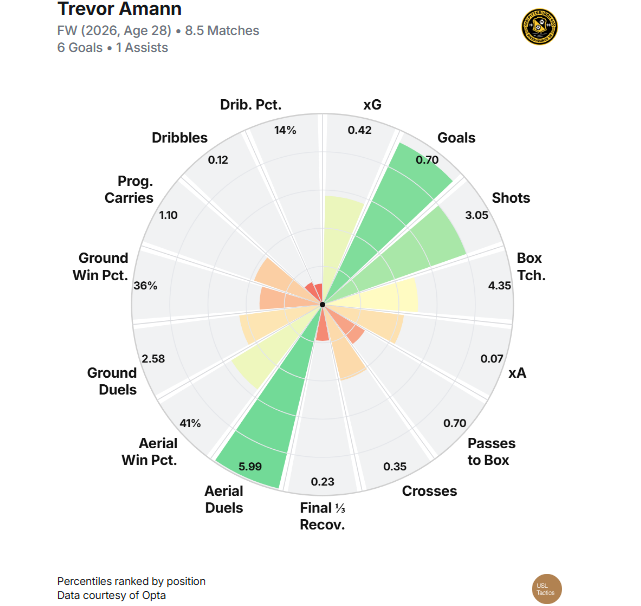
Amann lit League One aflame while with Northern Colorado, but he wasn't given consistent minutes amidst Championship stops in Sacramento and Tulsa. Finally, the 28-year-old has found his place in 2026. Pittsburgh typically uses Amann with a partner (often Albert Dikwa), offering the freedom to seek open space and provide target-man size without nullifying the Riverhounds’ in-box threat. So far this year, Amann has seven goal contributions in less than 1,000 league minutes.
Now, I’m not here to say that Pittsburgh is an offensive juggernaut. They aren’t. The Riverhounds are a functional attacking team who’ve added key players that can single-handedly win games, but defensive solidity is still their calling card.
This year, Pittsburgh is one of two clubs allowing less than 1.0 xG per 90. Opponents require, on average, 115 final-third passes to generate each of their expected goals; that’s the best efficiency mark in the USL Championship. The Riverhounds are extremely good at slowing their opponents down and denying quality chances.
Here, you get an example of that from last weekend’s win over Charleston. The Battery rolled out a surprise three-at-the-back in this match, but Pittsburgh didn’t waver. Here, the Battery start moving leftward, with their center backs addressed by Dikwa, Amann, and weak-sided Bassett across the front of the flexing 4-4-2. Charleston find one of their pivot players, but Goldthorp (the ball-side winger) doesn’t immediately close down. Instead, he and center mid Danny Griffin both hedge to address the next pass.
Thus, the Battery advance into their wingback but can’t get around Goldthorp or work outside-in toward the center of the pitch. Charleston then reset, with star creator Jeremy Kelly dropping below the level of the Pittsburgh defense for a touch. Kelly picks up possession and dribbles across the pitch, but he’s never presenting a real threat to penetrate Pittsburgh’s lines.
When the Battery finally try to progress, they’re stonewalled yet again. Pittsburgh usually allow fullbacks like Lasse Kelp and Max Viera to step into the channels to deny incisive passes, and that’s what happens here. Kelp steps, Jackson Walti helps from the No. 6 spot, and a scrum ensues. Charleston try to squeeze through, but help from Bassett stops a break and turns the ball over.
The best defensive teams have clear principles and, more importantly, know how to repeat them again and again and again. Pittsburgh embodies that truism – and, now, they’ve increasingly got the offensive variability to adapt against any foe. We know this club is built for November soccer, and they keep on proving it.
League One Guys I Like™
I updated my completely free-to-use USL player card generator with a fancy radar feature, so I wanted to put it to the test. If you’re reading my weekly Backheeled columns on League One, you’ll hopefully have a sense of star players across the division. Here, I want to highlight some guys with a very particular set of skills.
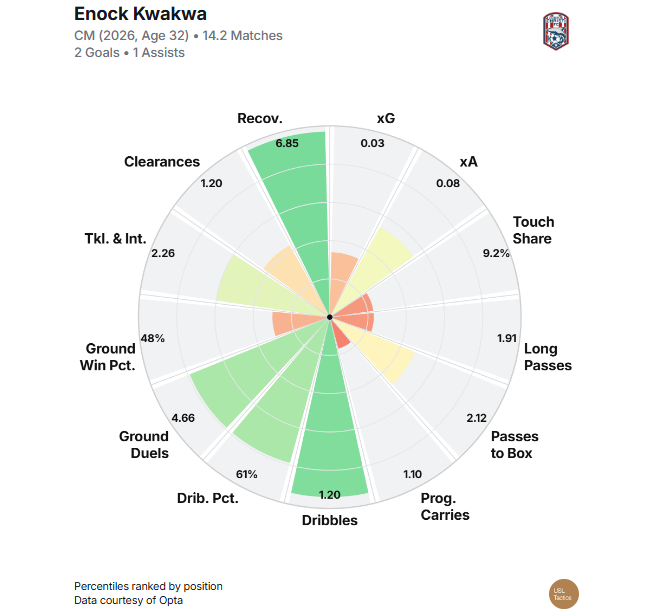
I went long on Corpus Christi’s up-and-down week in the column, but I didn’t get a chance to hit on the Enock Kwakwa renaissance. The midfielder was a regular for Eamon Zayed in Northern Colorado, and the same skills that made him useful for the Hailstorm – a magnetic sense for second balls and strong carriage – are shining through in Texas.
Saying that Corpus Christi is “reliant” on Kwakwa might feel strong, but he’s the No. 8 that makes their vertical style sing. The Sharks want to be direct, so they need a center mid that can (1) win knockdowns and (2) drive with the ball in chaotic moments after doing so. Bubu Medina is great at the first thing; Jackson Dietrich and Tomas Pondeca are solid at the second. Enock Kwakwa does both at a high level.
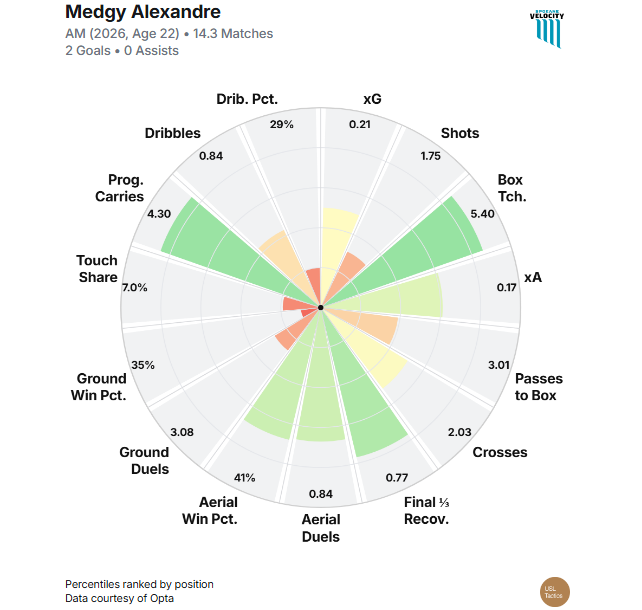
With Shavon John-Brown and Luis Gil in the team, Spokane has two attacking mids that (rightly!) suck up much of the oxygen. We shouldn’t overlook what Medgy Alexandre provides alongside them. Added on loan from Charleston early in 2026, the 22-year-old has been a constant source of verticality for this team.
So far across about 1,400 league minutes, Alexandre ranks in the 80th percentile or better for progressive carries and box touches. When the left winger receives in space, he’s incredibly good about moving play forward and getting into the box. Great attacking teams need multiple ways to push through a defense. Spokane has always been sharp in possession, but being able to stretch both wings via John-Brown and Alexandre gives them a new dimension.
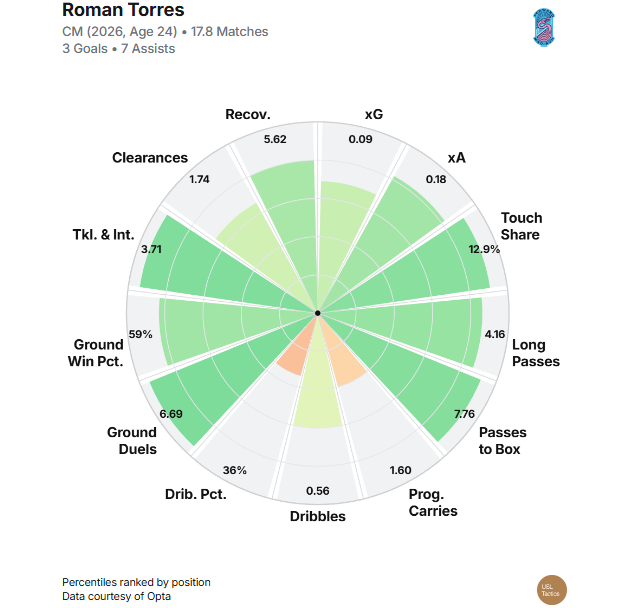
Across his rookie season in 2025, Roman Torres split time between Minnesota United 2 and the Birmingham Legion. In the end, Birmingham was too much of a mess to find a fit for Torres, while Minnesota seemingly decided that he didn’t have MLS upside. Their loss has been Forward Madison’s gain; the 24-year-old might be the best midfielder in League One this year.
Within Matt Glaeser’s newly vertical system, Torres has blended energetic off-ball contributions with multi-level creativity. Torres is just as capable of finding a touch in front of his defense and breaking multiple lines as he is at serving into the 18-yard box. His numbers are off the charts. Whatever Glaeser and sporting director Matt Cairns saw that gave them the confidence to hand Torres the keys to their midfield, that choice has paid off in spades.
(Not to be too overzealous, but Torres reminds me of a rawer Jamie Webber – who, I’ll note, would be on my Championship MVP ballot for what he’s doing in Tulsa.)
In other news…
I’ve not talked about New Mexico United enough given that they’re unbeaten since May! Let’s take a look about an attacking sequence I liked from United this weekend:
The play starts with a low-split Zico Bailey having just received from goalkeeper Kris Shakes. Immediately, Bailey turns upfield to find striker Greg Hurst on the drop. Hurst knows he's under pressure and first-times the ball to Ousman Jabang, who dribbles low to essentially replace Bailey's initial position.
It might seem like New Mexico are moving in circles, but they've forced multiple opposing defenders to step up and lose shape. By the time Jabang releases a pass into center back Niko Hamalainen, there's suddenly room to dribble into the channel and look upfield.
There, Hamalainen splits lines into the feet of Justin Rennicks, Hurst's strike partner. Both forwards have dropped in, but United still has presence; wingers Joseph Melto and Niall Reid-Stephen move inside to provide it, and overlaps from the fullback spots offer width. While a pass back to Hamalainen and ensuing switch don't come off, you can see how United is constantly stressing defenses.
Good piece from The Union Report on Monterey Bay's best candidate for a move up the pyramid.
I was in love with Indy Eleven's performance over the weekend, and Nicholas Murray has a nice breakdown of their win over Louisville City on the league site.
In content recommendation corner, I've got a few things:
- The project to fill my literary gaps continues, and I'm absolutely adoring East of Eden at the one-third mark. I have no qualifications to call anything "the great American novel," but we're in that zone. Steinbeck's prose is so sharp, and there's a rhythm to his storytelling that's expansive and discursive with a real sense of intention in mind. (Apparently there's a version with Florence Pugh coming to Netflix soon?)
- Similarly, the new Matthew McConaughey vehicle The Rivals of Amziah King is worth your time. It's got that same discursive energy, which works because of confident (and sometimes impressionistic) editing choices. Ambitiously messy, Amziah King is, at once, a bluegrass musical, heist film, murder-revenge movie, and family drama all wrapped into one. I’m in the tank for McConaughey – his supporting turns in The Wolf of Wall Street and Magic Mike are two of the most electric performances of the 2000s – and he’s utterly compelling as a honey entrepreneur and dispenser of folk wisdom.
- The new Denzel Curry album rules, rap is back.