The Back Four: Labor Day edition
On Barry Coffey, the Red Wolves attack, and more

Welcome in to The Back Four! Need more USL content? Make sure to:
- Visit Backheeled for 10,000+ words of analysis on the Championship and League One every matchweek. The League One column is free to read this week for those of you that aren't paying subscribers.
- Listen to This League! and The USL Show to catch up in podcast form.
Without further ado, let’s get to it.
Chattanooga’s attacking change-up
Throughout 2026, the Red Wolves have struggled to find consistency at the No. 9 spot – even as their goalscoring record has held steady. Year over year, Chattanooga’s xG is basically unchanged, down a tick to 1.24 per game from last season's 1.30 mark. Even so, they’ve already scored 44 times, two more than 2025's total in seven(!) less matches.
While Matt Bentley has been a regular presence atop manager Scott Mackenzie’s 4-4-2 with 17 starts and more than 1,500 minutes played, indecision has reigned next to him. Greyson Mercer has been a super sub above all else; Ropapa Mensah, expected to be a major addition, has made just six starts. Over the last week or so, Mackenzie has done something else entirely, starting Pedro Hernandez and Omar Hernandez – the Red Wolves’ best two wingers – as a wonky No. 9 combo.
What’s become apparent is how comfortably the two Hernandezes fit within Chattanooga’s vertical, predatory style. Take this example from last Wednesday’s 1-0 win at Westchester – a match where Omar Hernandez, #7, won the game with a tidy goal in a semi-transitional breakout.
Here, Chattanooga waste no time in build, going long over the top toward winger Yanis Lelin off the right. Pedro Hernandez, #14, skews Lelin's way to help set up in the counterpress in anticipation of an incompletion. Meanwhile, center mid Angelo Kelly skews toward the halfspace to fill the gap created by Lelin’s vertical run.
Because Chattanooga have speed and intensity across their 4-4-2’s midfield and forward lines, they never let WSC settle. Even on the weak side, you can see winger Dylan Clapier and a lower-seated Omar Hernandez hedge to keep the pressure up. The Red Wolves apply fairly man-centric aggression as Westchester switch the point; eventually, Pedro Hernandez climbs the ladder and forces the opposing goalie into a rushed upfield pass.
There’s never any sustained possession for Chattanooga in this clip, but Westchester is unable to settle down. You’d look at this as a spell of possessive control for WSC on the stat sheet, but it’s anything but. In the end, the Red Wolves are nearly able to play through once Michael Knapp – Kelly’s partner in the pivot – finally makes a decisive takeaway.
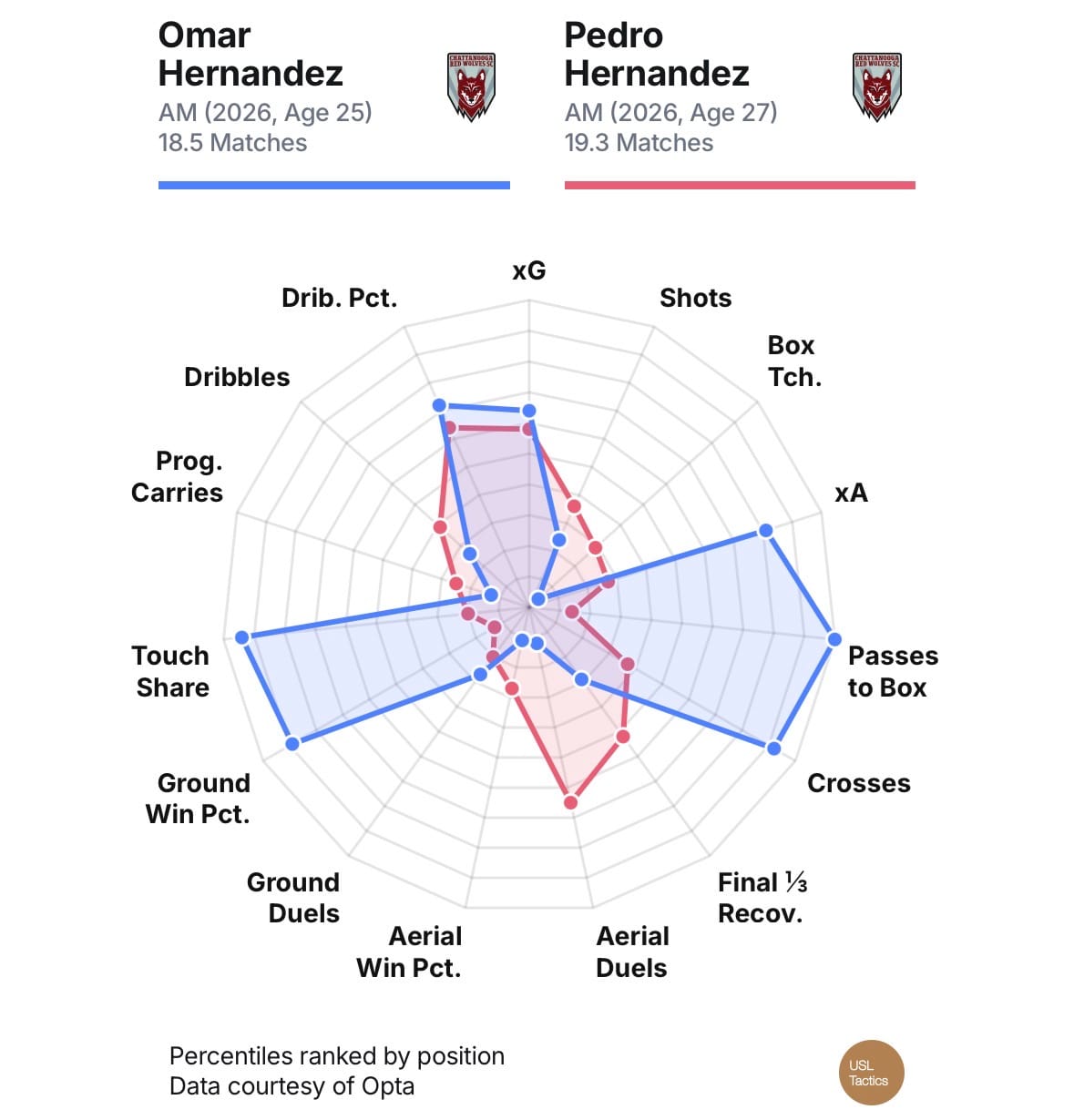
What’s interesting about the pairing of Omar and Pedro Hernandez is how their profiles are fairly similar according to the data. The former has been far more engaged on the ball and more decisive as a creator (see 0.22 xA per 90 and 15 goal contributions), but the latter is basically equivalent in terms of his dribbling and in-box shooting profile.
2026 has been something of an inversion for the two attackers. Last year, Pedro Hernandez scored 10 times and put up a sizzling 0.43 xG and 4.2 box touches per 90; this year, he’s been willing to do the dirty work while Omar Hernandez takes up the mantle of flashy final-third creation. That give-and-take has been readily apparent in the duo’s appearances together as No. 9s.
What does #7’s typical pass-to-box service look like? This example from last weekend’s heartbreaker against Boise is a prime example.
The motivating sequence starts up the right once again, with fullback Josh Ramos playing toward Lelin. Once again, Kelly and Pedro Hernandez are there to lend a hand, helping to work through Boise’s back five. A cross results, and though it’s overcooked, Omar Hernandez is there to collect at the far post.
With left back Jordan Ayimbila pushing upfield, Boise’s weak side is caught in rotation by what’s essentially a switch of point (and an accidental one at that). Hernandez immediately picks his head up, cuts onto his right foot, and launches another cross into the box. This one comes through, hitting Lelin for a shot on goal. It’s a nice encapsulation of the rapid-fire, somewhat manic style that Chattanooga brings to bear.
So, can the Hernandez partnership persist? Saturday's resounding 3-1 win over Greenville was evidence of its viability. There, Mackenzie brought Bentley back into the 4-4-2, but he used the natural No. 9 as a left winger. The Hernandezes still did their thing – Pedro Hernandez attempted 13 duels! – but the offense looked even stronger with an extra finisher in the mix.
Chattanooga's offensive glow-up hasn't been a fluke, but their new attacking balance feels more sustainable than anything else we've seen in 2026. With the Red Wolves pushing for a home playoff game, the usage of Pedro Hernandez and Omar Hernandez together has reinvigorated this side.
Cup of Coffey
Among new-to-the-USL signings in the Championship, Hartford's Barry Coffey is tied for fifth place with six goals scored. That total is double any other player on the Hartford roster; Augi Williams is second with just three league goals in 2026. It's hard to overstate just how vital the 25-year-old Coffey has been in Connecticut.
With Hartford in the semifinals of the USL Cup and sitting comfortably in the East's top eight, it’s worth examining the midfielder's impact.
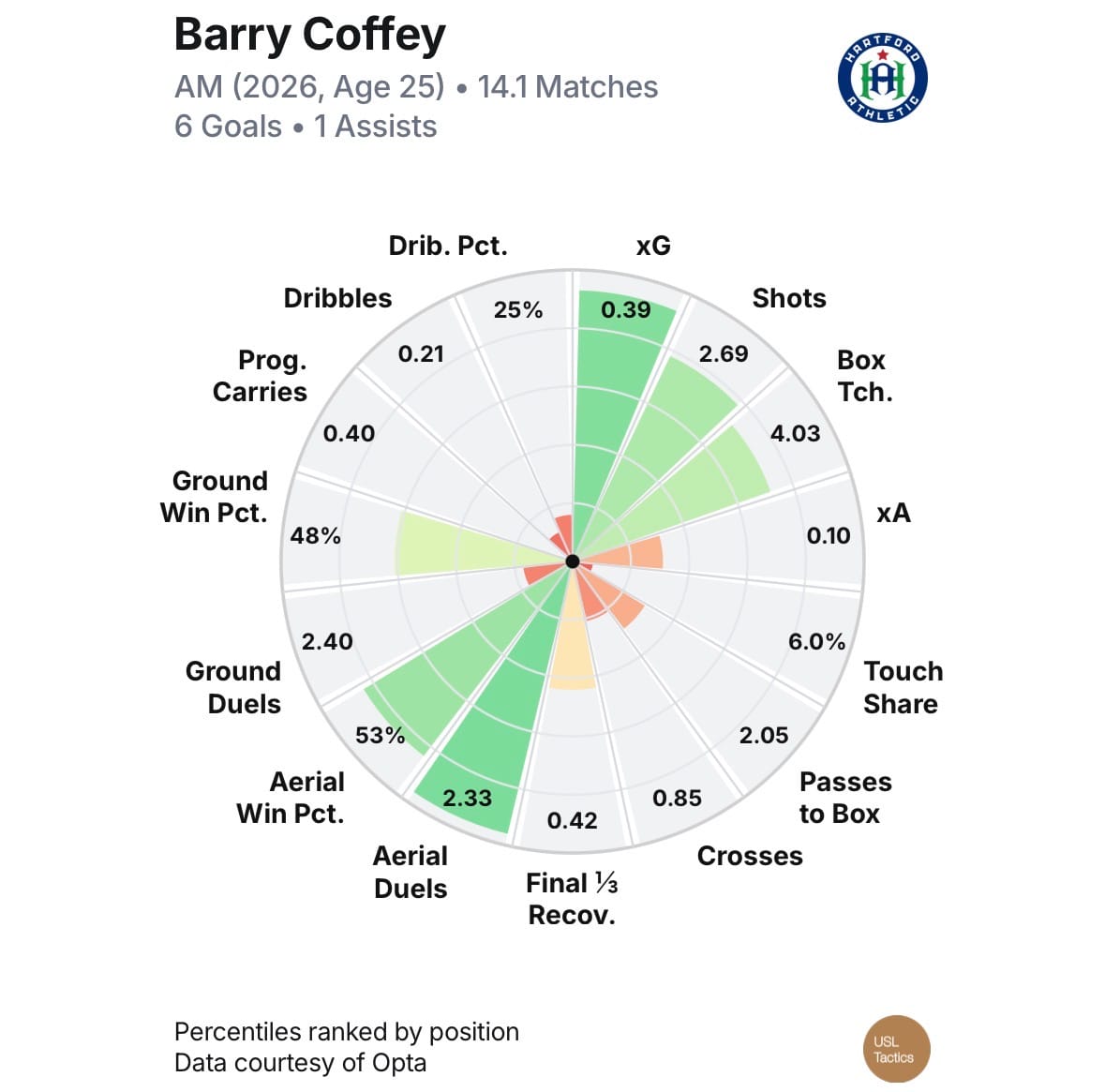
Prior to his USL move, Coffey split time between the first- and second-tier leagues in Ireland with Cobh Ramblers and Corky City. Up until 2025, he primarily served as a box-to-box center mid.
That changed last year. Moved upfield into more of a second striker role, Coffey scored 26 goals in 2,900 minutes while taking Cobh to a promotion playoff final. In the face of surefire interest from Irish first-tier clubs, Coffey elected to come stateside.
Within Hartford’s 5-1-2-2ish base shape, the midfielder has often played as a No. 8 or No. 10 underneath two primary forwards. That deployment has allowed Coffey to shine as a run-of-play target man within manager Brendan Burke’s direct system; he's sneakily key to Hartford's build. In the final third, that deployment has also leveraged his capabilities as a later-arriving crashing runner. Coffey has put in 90th percentile returns for aerial wins and xG for those reasons – yet the 6’1” attacker’s game goes beyond mere headers and brute force.
Here, you get two flavors of Coffey as a threat close to goal. In the first case, Hartford is in the middle of a reset after a dead ball, but they’re able to retain possession around the 18-yard box. By the time the ball ends up at a right-shifted Emmanuel Samadia’s feet, Coffey is at the near post with support from defenders Jordan Scarlett and Britton Fischer on the far side. Coffey is able to rise and make contact with the ball; it’s not the best shot, but it’s proof of his aerial prowess.
The second clip is more instructive. Hartford has been a middling break team this year; they’ve scored just one fastbreak goal, per Opta, even though 12% of their total xG have come in such situations. The path toward more efficient, decisive attacking for Hartford must come on the break.
Here, Samadia is the fire-starter yet again, playing upfield from the left sideline. Upfield, Williams and Ngalina – the starting strikers – win the first and second balls, allowing play to find the feet of right wingback Sebastian Anderson on the leak-out.
Given space to drive forward, Anderson looks off a diagonal run from Williams and plays Coffey through in behind. The off-ball movement couldn’t be better, and it allows the Irishman to find his right foot. The ensuing shot isn’t on frame, but this is the kind of creative move that Hartford need more of – and the kind that Coffey’s runs are designed to make happen.
With Hartford having rested their starters over the weekend, it's clear that they're putting major stock into Tuesday's USL Cup semifinal against the Colorado Springs Switchbacks. Given what we've seen from Colorado Springs' back line throughout 2026, a player like Coffey that's full of verve and idiosyncratic movement will be of major import. If Hartford win a trophy for a second straight year, Barry Coffey must come up big to make it happen – something that he's consistently shown the potential to accomplish.
Super League!
This is an excerpt from my Super League recap, which comes out each Monday (or thereabouts). Find the Week 4 edition here.
Friday night’s 1-1 draw between DC Power and Sporting Jax was, in my mind, the grudge match between the two leading lights of the nascent 2026 season. DC had used a masterful pressing system and tactical variability to dominate their opponents through August; Jacksonville had lacked that same consistency but used wise in-game changes and sheer star power to take nine points from their first three games. How’d they match up?
Perhaps looking to prove that their form was no accident, manager Stacey Balaam’s Sporting side came out swinging. With Paige Kenton back to full health at the No. 9 spot next to red-hot Bailee DeSmit and the usual Puerta-Jones-Boman triumvirate restored through the midfield, Jacksonville returned to their classic 3-1-4-2ish high press. This has been the year of a more expansive Jacksonville attack, and that remained true; long balls toward Grace Phillpotts (58 touches, seven final-third entries) at left wingback drove the offense.
DC, for their part, went for a 4-2-3-1 that varied on the themes of Week 2’s rout over Brooklyn. That match was a full-blown statement of dominance; this weekend’s tactics were more measured, with Kayla Colbert and Tyler Lussi pressing on either side of striker Loza Abera to match Jacksonville’s back three player-to-player. When it worked, it worked. When it didn’t, those switches to Phillpotts and ensuing throughs to a drifting Kenton were a real threat.
Every soccer game is a field-tilt battle in some sense, but that truism was especially true on Friday. The more Jacksonville could control territory and stay in the Power third, the better off they’d be.
Here, man-centric pressure through the kid field makes it happen. At the start of the play, you see Ashlyn Puerta (1) on Abby Boyan and Sophia Boman (2) on Emma Jaskaniec to address the opposing pivot. Meanwhile, Sophie Jones (3) marks a more advanced Emily Colton at the No. 10 spot. Even as those DC midfielders change sides and rotate, they’re hugged tight. Power try to escape wide through a fullback, but Phillpotts is ready to fly ahead with Boman’s support. Eventually, the press will create a turnover and a crossing opportunity.
Between the move we just broke down and a 30th minute transition sparked by right wingback Meg Hughes into a drifting Kenton, press-driven offense was the name of the game. That said, DC found ways to break through in build. At times, Jaskaniec and Boyan would both shift right, allowing Lussi to drop into vacant space off the left wing. At other points, Abera would show, daring Jones to abandon her mark from the No. 6 spot.
In general, the Power press – and the second-ball control imbued by the Jaskaniec-Boyan double pivot – let DC control the match’s momentum. Likewise, hard-nosed pressure from Abera prevented the guests from settling into their Jamie-Gerstenberg-out-of-the-box rhythm that was so dangerous a week ago.
HOW BOUT' THAT?! 😤@claire_constant breaks the deadlock and gives @DCPowerFC the lead! pic.twitter.com/tBUagQKGi9
— Gainbridge Super League (@GainbridgeSL) September 5, 2026
Abera’s nous was a theme. Whether in the press, in build, or in her halfspace-to-halfspace roaming throughout the final third, the Ethiopian international was a living, breathing matchup problem. Paired with manager Omid Namazi’s clever substitutions, that unselfishness was key to DC (briefly) taking the lead.
In the 54th minute, left back Sam Cary Angel came out of the game for Susanna Fitch. At that point, Justina Gaynor swapped sides as an inverted left back, whilst Fitch held down the right flank. DC often used Gaynor deep in the opening stages of the match, but both fullbacks had greater license to push post-change. That choice put more pressure on Jacksonville’s defensive line, helping to set the table for Claire Constant’s go-ahead goal in the 59th minute – one where the center back advanced all the way through the halfspace, dished toward Fitch, and crashed into the box to clean up off a deflected cross.
Jacksonville countered with a set piece goal mere moments, but they put up just 0.3 xG in the second half. The broader dynamic of the match continued unabated; Sporting held 54% of the ball, but they only secured 43% of the field tilt. Breaks and switches were there, but DC dictated where the game was played.
The big takeaway? Both these clubs are for real. Power made it back-to-back weeks securing major results against last season’s top two, while Jacksonville played it even against an ascendant contender. I’m not in the business of power ranking in the Super League, but these clubs feel like 2026’s standouts in lieu of Lexington finding their form.
In other news…
This League! programming note for our tens of listeners: we're going live on Wednesday because of the Labor Day holiday and the USL Cup.
Speaking of the USL Cup semifinals, Nicholas Murray has an excellent piece talking to Mitchell Taintor and Sean Totsch about the 2022 title game ahead of San Antonio and Louisville's upcoming duel. That was my first full year covering the league beyond the scope of Twitter shitposter (i.e., I'd been writing for Backheeled but hadn't yet moved the power rankings over), so that game will always hold a warm place in my memory.
Relatedly, we should all be talking about Mitchell Taintor being amazing more often:
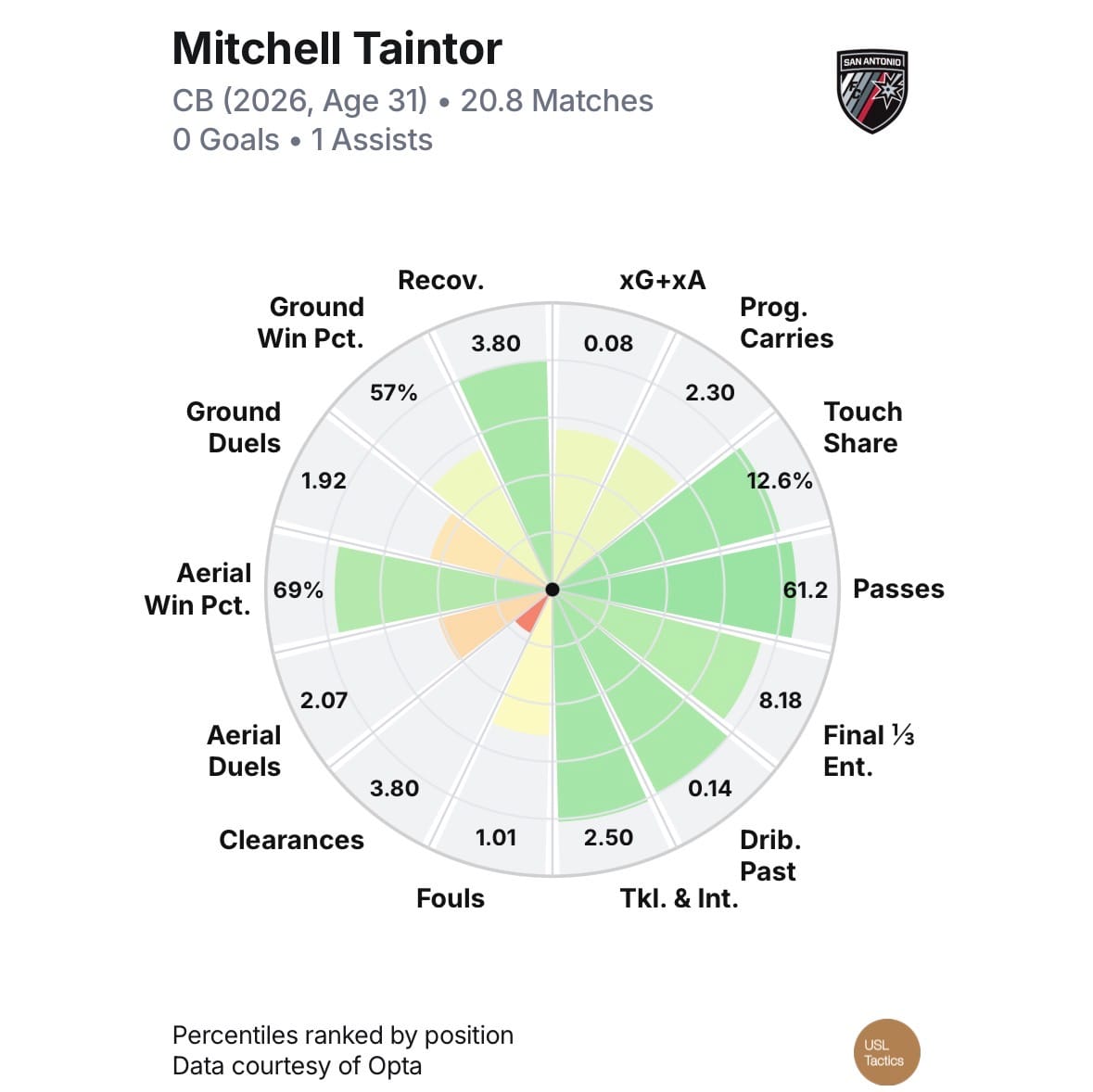
I’ve run hot, cold, and hot again regarding San Antonio’s chances as a contender, and that’s largely due to the rudderless attacking style they bring to the table. There's never been a question about their defensive quality. At age 31, Taintor remains an elite one-on-one stopper, a strong aerial battler, and one of the USL’s very best long passers. It doesn’t get any better at this level – and we probably should be recognizing the center back in the MVP discussion, much as we did back in 2022.
We are living in the Lamin Jawneh-ssaince. The New York Cosmos winger, signed in mid-May after spending 2025 with Texoma, has been absolutely lights-out on the wing as of late. The left-footed goals scored off the dribble have been Jawneh’s calling card, but he’s in the 90th percentile or better among attacking mids for progressive carries (6.2) and open-play crosses (3.7) per 90. I went long on New York in this week’s Backheeled column, but this team has gone from “sneaky fun” to “maybe kinda good.”
The #content recommendation of the week is Costa-Gavras’ film Missing. Starring Jack Lemmon and Sissy Spacek as, respectively, the father and wife of an American journalist who’s disappeared in the midst of the 1973 Chilean coup. Missing is successful as a tense mystery, a story of political awakening for Lemmon’s character, and an inter-generational family drama centered on Spacek winning her stepfather over. Beyond the layered story, the Santiago-by-way-of-Mexico setting feels so tactile and explosive. Good movie!
(Unless you've got access to indie theaters in downtown Manhattan, this one is useless, but people should seek out Filipiñana whenever it streams. It's shot like a Wes Anderson joint if Wes Anderson made exceedingly slow movies about labor exploitation in Southeast Asia.)