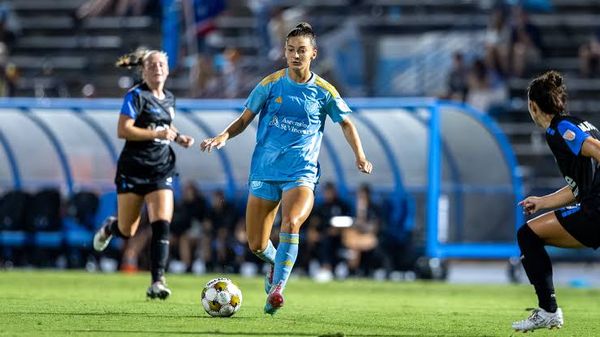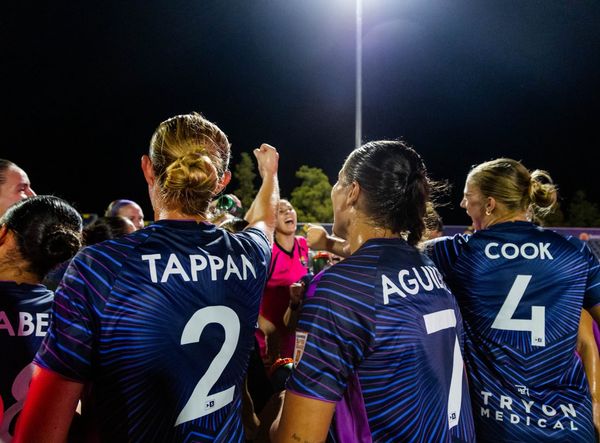
USL Super League, Week 4
On a heavyweight DC-Jacksonville battle, plus Dallas and Carolina blowouts

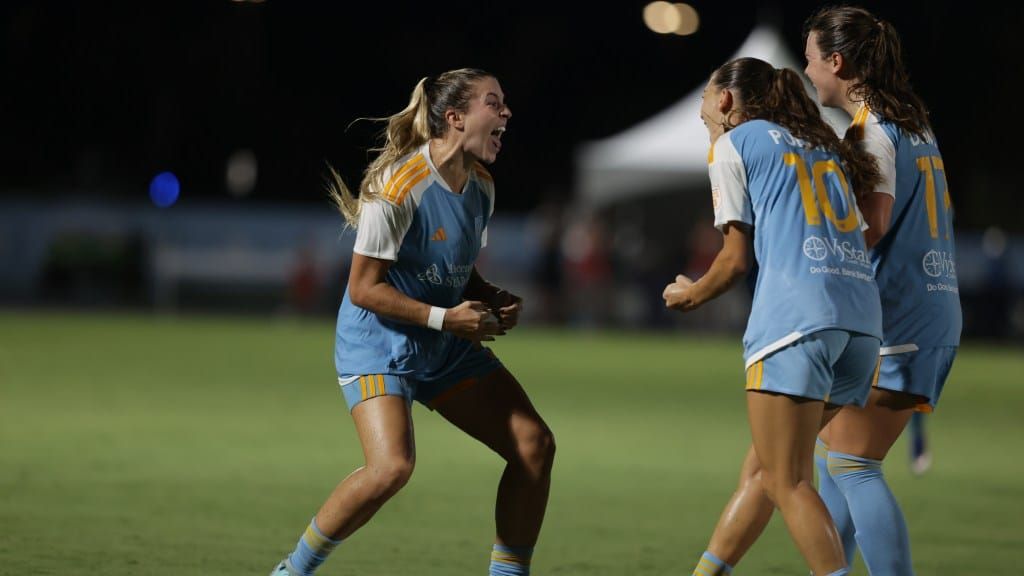
Every week, I'll be recapping the Super League in detail. While you're here, head over to Backheeled for the latest attendance numbers from across the division.
DC Power (1) - Sporting Jax (1)
Friday night’s battle between DC Power and Sporting Jax was, in my mind, the grudge match between the two leading lights of the nascent 2026 season. DC had used a masterful pressing system and tactical variability to dominate their opponents through August; Jacksonville had lacked that same consistency but used wise in-game changes and sheer star power to take nine points from their first three games. How’d they match up?
Perhaps looking to prove that their form was no accident, manager Stacey Balaam’s Sporting side came out swinging. With Paige Kenton back to full health at the No. 9 spot next to red-hot Bailee DeSmit and the usual Puerta-Jones-Boman triumvirate restored through the midfield, Jacksonville returned to their classic 3-1-4-2ish high press. This has been the year of a more expansive Jacksonville attack, and that remained true; long balls toward Grace Phillpotts (58 touches, seven final-third entries) at left wingback drove the offense.
DC, for their part, went for a 4-2-3-1 that varied on the themes of Week 2’s rout over Brooklyn. That match was a full-blown statement of dominance; this weekend’s tactics were more measured, with Kayla Colbert and Tyler Lussi pressing on either side of striker Loza Abera to match Jacksonville’s back three player-to-player. When it worked, it worked. When it didn’t, those switches to Phillpotts and ensuing throughs to a drifting Kenton were a real threat.
Every soccer game is a field-tilt battle in some sense, but that truism was especially true on Friday. The more Jacksonville could control territory and stay in the Power third, the better off they’d be.
Here, man-centric pressure through the kid field makes it happen. At the start of the play, you see Ashlyn Puerta (1) on Abby Boyan and Sophia Boman (2) on Emma Jaskaniec to address the opposing pivot. Meanwhile, Sophie Jones (3) marks a more advanced Emily Colton at the No. 10 spot. Even as those DC midfielders change sides and rotate, they’re hugged tight. Power try to escape wide through a fullback, but Phillpotts is ready to fly ahead with Boman’s support. Eventually, the press will create a turnover and a crossing opportunity.
Between the move we just broke down and a 30th minute transition sparked by right wingback Meg Hughes into a drifting Kenton, press-driven offense was the name of the game. That said, DC found ways to break through in build. At times, Jaskaniec and Boyan would both shift right, allowing Lussi to drop into vacant space off the left wing. At other points, Abera would show, daring Jones to abandon her mark from the No. 6 spot.
In general, the Power press – and the second-ball control imbued by the Jaskaniec-Boyan double pivot – let DC control the match’s momentum. Likewise, hard-nosed pressure from Abera prevented the guests from settling into their Jamie-Gerstenberg-out-of-the-box rhythm that was so dangerous a week ago.
HOW BOUT' THAT?! 😤@claire_constant breaks the deadlock and gives @DCPowerFC the lead! pic.twitter.com/tBUagQKGi9
— Gainbridge Super League (@GainbridgeSL) September 5, 2026
Abera’s nous was a theme. Whether in the press, in build, or in her halfspace-to-halfspace roaming throughout the final third, the Ethiopian international was a living, breathing matchup problem. Paired with manager Omid Namazi’s clever substitutions, that unselfishness was key to DC (briefly) taking the lead.
In the 54th minute, left back Sam Cary Angel came out of the game for Susanna Fitch. At that point, Justina Gaynor swapped sides as an inverted left back, whilst Fitch held down the right flank. DC often used Gaynor deep in the opening stages of the match, but both fullbacks had greater license to push post-change. That choice put more pressure on Jacksonville’s defensive line, helping to set the table for Claire Constant’s go-ahead goal in the 59th minute – one where the center back advanced all the way through the halfspace, dished toward Fitch, and crashed into the box to clean up off a deflected cross.
Jacksonville countered with a set piece goal mere moments, but they put up just 0.3 xG in the second half. The broader dynamic of the match continued unabated; Sporting held 54% of the ball, but they only secured 43% of the field tilt. Breaks and switches were there, but DC dictated where the game was played.
The big takeaway? Both these clubs are for real. Power made it back-to-back weeks securing major results against last season’s top two, while Jacksonville played it even against an ascendant contender. I’m not in the business of power ranking in the Super League, but these clubs feel like 2026’s standouts in lieu of Lexington finding their form.
Dallas Trinity (3) - Brooklyn FC (0)
There’s a famous riddle about getting predator and prey animals across a river; you need to make certain choices in a certain order to successfully get the job done. I don’t think that Lee Nguyen was thinking about wolves, goats, and cabbages ahead of this weekend’s match against Brooklyn FC, but his simple choice to move Camryn Lancaster to striker and shift Jasmine Hamid to the right wing showed an intelligent understanding of sequencing and chemistry within his own roster.
Now, we need to get a confounding variable away: Brooklyn cannot defend. This team is conceding an expected goal for every 39.7 final-third passes against – a defensive efficiency mark that’s 26% worse than any USL team over the last six years in the Super League, Championship, or League One. Manager Alex Smith’s 4-1-4-1 was no better in Week 4, and his overstretched midfield was a sieve in Texas.
With the “I come to bury Caesar…” misdirection out of the way, let’s focus on Dallas.
By using Lancaster and Castain as their No. 9s, Trinity maintained a better sense of gravity around the 18-yard box. Where Hamid tended to drift for touches and run the channels, the new forward pair was more restricted. Ironically, that gave Hamid the very room she was looking for; the ex-Fort Lauderdale star attempted nine duels and took a season-high nine box touches because of her ability to receive wide with an actual presence occupying other defenders.
Of course, Dallas’ calling card remained their team-wide structure in elevated possession. Nguyen’s 3-3-4 (or, sometimes, “three-box-three”) setup continued to spotlight Carissa Boeckmann as a tucked-in right back. Her presence in the pivot next to Jamie Shepherd demanded the attention of Brooklyn’s No. 8s, making it easy to ping through lines and put defensive mid Jennifer Cudjoe at a deficit.
Here, you see Dallas flourish in multiple ways. Against a deep throw from Brooklyn left back Jackie Richards, Sofia Cedeno (a center mid) closes hard against the sideline, while Hamid stays home to deny a forward angle. Brooklyn give the ball away, and you can see Trinity form up into their attacking shape instantly. Boeckmann and Shepherd are low in the pivot, Hamid and Lancaster are essentially working as No. 10s, and all the attention is drawn toward the middle of the park.
Because Brooklyn is undermanned and sucked central, left winger Onyeka Gamero is wide open on the weak side. Dallas plays her way; meanwhile, Lancaster and Castain both push toward goal and draw attention. Gamero is able to beat her marker one-on-one, and while her shot rings off the crossbar, Dallas doesn’t quit. The resting No. 6s are there to recover, and Trinity thus maintain control.
(At risk of being too one-sided in the assessment here: right back Antoinette Williams has to be better, but the lack of support from Carlee Giammona in rotation from the No. 8 spot ain’t helping anyone.)
Opening her @dallastrinityfc account 🤑
— Gainbridge Super League (@GainbridgeSL) September 6, 2026
Onyeka Gamero finds the back of the net for the first time in Trinity colors to put her side on the front foot! 🔥 pic.twitter.com/kw0cRRl3ql
Dallas made 13 recoveries in the attacking half on Saturday, and they used them to dominate the field tilt to the tune of a 69% first-half mark. It took just eight minutes to take a lead, paying off that territorial control in style. Hamid found a wide one-on-one while Castain pushed toward the net; with the center backs occupied, Lancaster was wide open a few steps behind the penalty spot. Rather than take a crowded shot, Lancaster unselfishly slid the ball toward Gamero, who put Dallas up 1-0.
Similar dynamism up the right put Dallas up 2-0 off a 28th minute throw. There, Hamid sat low and forced Richards to step, opening a gap in behind for Shepherd to burst into. With their center mid free in space, it was relatively simple for Dallas to pick out Castain for a far-post finish – one that yielded a spirited, disappointed reaction out of Brooklyn defender Sophia Lowenberg. You can’t blame Lowenberg; Dallas had her team’s number from start to finish.
Dallas is finally in the “W” column under Nguyen, but now the challenge is to keep it going. Brooklyn is Brooklyn; if Trinity look this sharp next Sunday against DC Power, it’ll be a real statement of competitive intent for the rest of 2026.
Carolina Ascent (3) - Fort Lauderdale United (0)
As we’ve seen, Week 4 featured separation of wheat from chaff (Dallas crushing Brooklyn) and…uh…confirmation of a lot of wheat (DC drawing Jacksonville). The Carolina Ascent’s blowout win over Fort Lauderdale United fell firmly into that former camp. Between their ability to progressively overload Fort Lauderdale’s lines and their extremely aggressive defensive approach, Carolina put their foot down across Saturday’s 3-0 win.
The Ascent lead the league with a 57.7% average field tilt and are tied with Brooklyn with a Super League-best 47 high turnovers forced. Again and again and again, that quality showed against Fort Lauderdale.
Mia Corbin and Lily Nabet served as tight markers through the heart of Carolina’s 4-4-2, denying United any easy access through lines. Ahead of them, forwards Mackenzie George and Shea Groom were similarly effective applying face-up pressure against the opposing center backs. Fort Lauderdale found the occasional slip pass through to Kelli Van Treeck (ineffectively re-deployed as a No. 6) and tried to walk the tightrope up the sidelines, but they spent much of the match under the gun.
Here, Fort Lauderdale is moderately successful at bending the Ascent. United’s build move starts through center back Ella Simpson, who’s able to hit left back Kelsey Oyler at the far sideline in the face of the press. Carolina’s No. 8s are committed and can’t help, and neither can ball-side winger Rylee Baisden. Because United drop attacker Farrah Walters into the halfspace, they force Baisden narrow and, thus, free Oyler.
The effective passing triangle forces Carolina fullback Addisyn Merrick to step. There’s open space behind her, which Oyler then uses to hit a progressive pass in behind to forward Kiara Locklear. The rub? Carolina’s three remaining defenders have held a high line to perfection. Locklear is called offside, and the break is over before it’s ever really begun.
That outcome above was comparatively good for Fort Lauderdale. Too often, their turnovers were quickly turned into counters in the opposite direction. Extension up the wings was a double-edged sword, and Carolina regularly punished it through Merrick and Jill Aguilera.
Carolina’s third goal in the 38th minute was indicative of the Ascent’s ability to turn pressure into offensive success. There, United were goaded to a long pass up the sideline, forcing a reaction like we saw above from Merrick. This time, however, she and Corbin are able to force a giveaway. Immediately, the ball is worked back inside toward a slashing Audrey Coleman off the left wing, and a goal ensues.
That speed of play was a constant for Carolina. Again and again, the “2+2” base of Corbin, Nabet, Reese Tappan, and Jenna Butler gave the Ascent comfort while building out against the first line of confrontation. Whether Nabet dropped between the center backs or, say, Corbin slid wide like a pseudo-fullback, a slew of combinations prevented United from exerting themselves in the press.
The Ascent worked to stay fresh in build. At times, both Aguilera and Merrick stayed deep as moderate passing outlets while Baisden and Coleman provided upfield width. At other points, the opposite was true. Here, you see how a left-sided build sequence featuring a lower Aguilera did damage.
Carolina starts the clip with that aforementioned “2+2” build base, forcing United tight. When Aguilera receives, she necessarily draws the defense into rotation, and that creates the possibility of a halfspace overload driven by George, Groom, and Coleman. The passing play from there isn’t the cleanest, but George’s individual brilliance – no No. 9 in the Super League is sharper or more industrious in one-on-ones – still creates a shot.
Compare that breakthrough to the goal that gave Carolina a 1-0 lead in the 10th minute. There, Aguilera did the attacking job herself, spreading up the sideline to receive from Butler and score. If you want an example of the Ascent’s varied offensive game, you’ve got it. This Carolina team can hurt you in a million ways, and the excellence of their press means that a quick transition is always on the horizon.
(Also, the penalty call where Simpson picked up the ball in her own zone was…unfortunate.)