The Back Four: Super League Final, Louisville's skid
How we got to a Lexington-Carolina final, plus the LouCity defensive question


Welcome in to The Back Four!
As always, visit Backheeled for more USL content, including deep dives into all things Championship and League One. Also, listen to This League! and The USL Show to catch up on all things USL in podcast form.
Without further ado, let’s get to it.
Super League Playoffs!
And just like that, we've got our final. Lexington SC and the Carolina Ascent took care of business to reach next weekend's Super League title game, doubling down on the ideas that got 'em there in the first place. How'd it happen, and what will define next Saturday’s matchup? Let's dig in.
Last weekend, Lexington trusted their ability to manipulate a high-tempo, pass-first environment against Dallas Trinity. In a match where more than 900 passes were played, Trinity only managed to generate 0.85 xG and finished well below their season-long efficiency numbers. As has been the case throughout 2026, Kosuke Kimura’s blend of a 4-4-2ish defensive look with a 3-2-2-3 attacking shape carried the day.
Kimura’s rest defense base deserves note. I highlighted Trinity’s reliance on the break in my preview column, and Dallas simply couldn’t tap into that phase of play in practice. Indeed, they weren’t credited with a single fast break shot on Saturday.
Typically, Dallas wants to start short in build, draw defenses, and then drive passes through the lines. Alternatively, they’re looking to break out of their own 4-4-2 or 4-5-1 block to activate players like Jasmine Hamid and Camryn Lancaster. LSC’s penchant for a mid-block defensive shape stopped the former from happening. Meanwhile, their use of Ally Brown, Regan Steigleder, and Allison Pantuso never let Dallas’ front line counterattack into a cheaply-earned advantage. Hamid and Lancaster combined to put up just 0.07 xG on five box touches.
On the ball, Lexington’s structure was equally critical. Their front four – namely, McKenzie Weinert, Catherine Barry, Addie McCain, and Sarah Griffith – consistently tested Dallas’ seams. In full-tilt 3-2-5 mode, they tended to use McCain and Griffith as soft No. 10s while Alyssa Bourgeois overlapped from right back. You see that construction in the top frame below, with Bourgeois so advanced that she’s just off screen.
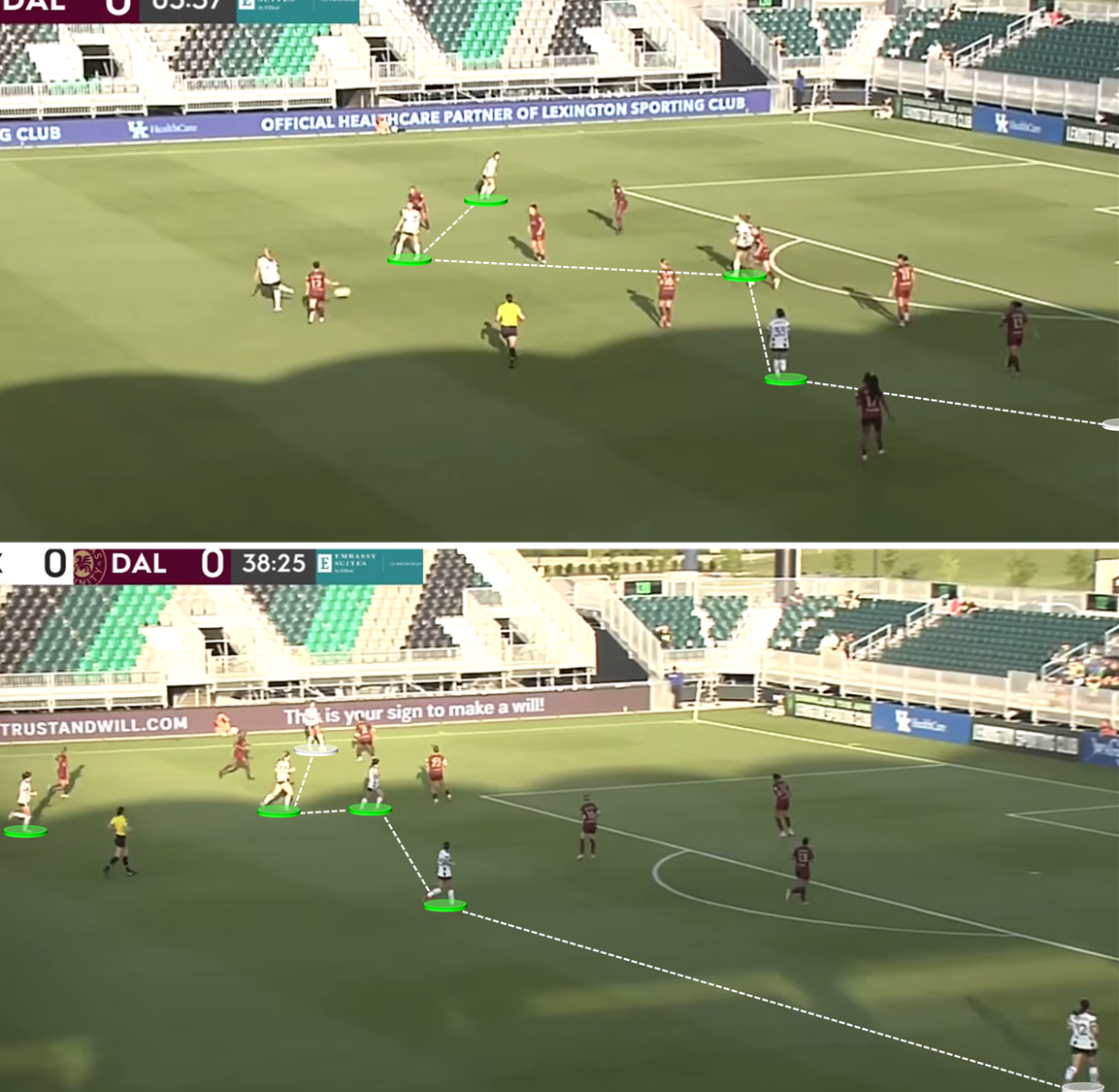
Kimura’s structure wasn’t tightly prescribed, and the ability to riff gave LSC their edge. You see that develop in the second frame, where a different set of five players form the attacking line. At the start of this play in the 39th minute, McCain found the ball on the left, lingering toward the sideline. Meanwhile, Weinert replaced her in the central pocket, making a vertical run that forced Amber Wisner (Dallas' No. 6) to mark her.
As McCain held the play up, Brown – usually a rest defender – took the opportunity to overlap, and that's what you see above. Brown has the ball in a crossing position, McCain is a shade deeper, and the rest of the front line is putting the cherry on top of what’s essentially an 2-3-5 alignment. Ultimately, this bottom frame will end with an open shot for Griffith – one that'll force a save and produce LSC's go-ahead corner.
Barry doubled up just after halftime, paying off a cross from Bourgeois to seal the deal. In every sense, it was a complete win for an LSC team that leveraged their innate tactical advantages. You could make a similar claim about the Carolina Ascent, who went to Jacksonville and nabbed a 1-0 win on Sunday.
As in their Week 31 season-ender, Carolina and Jacksonville's rematch was all about Phillip Poole’s defense. The Ascent maintained the direct style they instituted a weekend ago (their 17.4% long pass share was above a 15% regular season average) and punctuated it with layered defending. Because of that organization, Sporting couldn’t find a rhythm and took 34% more final-third passes than usual to create each of their expected goals.
It’s useful to contextualize the game around Carolina’s opening goal, which came six minutes in and changed the face of the semifinal. There, the Ascent’s verticality took on a different tenor off a throw, but the result – bending Jacksonville’s 3-5-2 out of shape – was the same. With one toss of the ball, Carolina was able to activate McKenzie George and Riley Parker past the ball-side wingback (Meg Hughes) and center back (Grace Phillpotts). From there, it was easy to give-and-go past Georgia Brown to furnish George with a tap-in.
Most of Carolina’s best sequences were similar, leveraging restart situations and wide combos to do damage. A 24th minute play that ended with a Mia Corbin shot was similar. After a set piece, Carolina reset into a mixed-and-matched attacking shape, and they were able to get Parker on the ball once more. After she beat Hughes one-on-one, a through to fullback Addisyn Merrick was on, which created the cross that ended at Corbin’s feet.
The fact that Carolina scored early immediately gave them a tactical edge, forcing Jacksonville to chase the game. The Ascent flashed into a 4-1-4-1 at times, but protecting a lead let them base their shape out of a 4-2-3-1 – itself a variation on the two-striker look Phillip Poole preferred for most of the year.
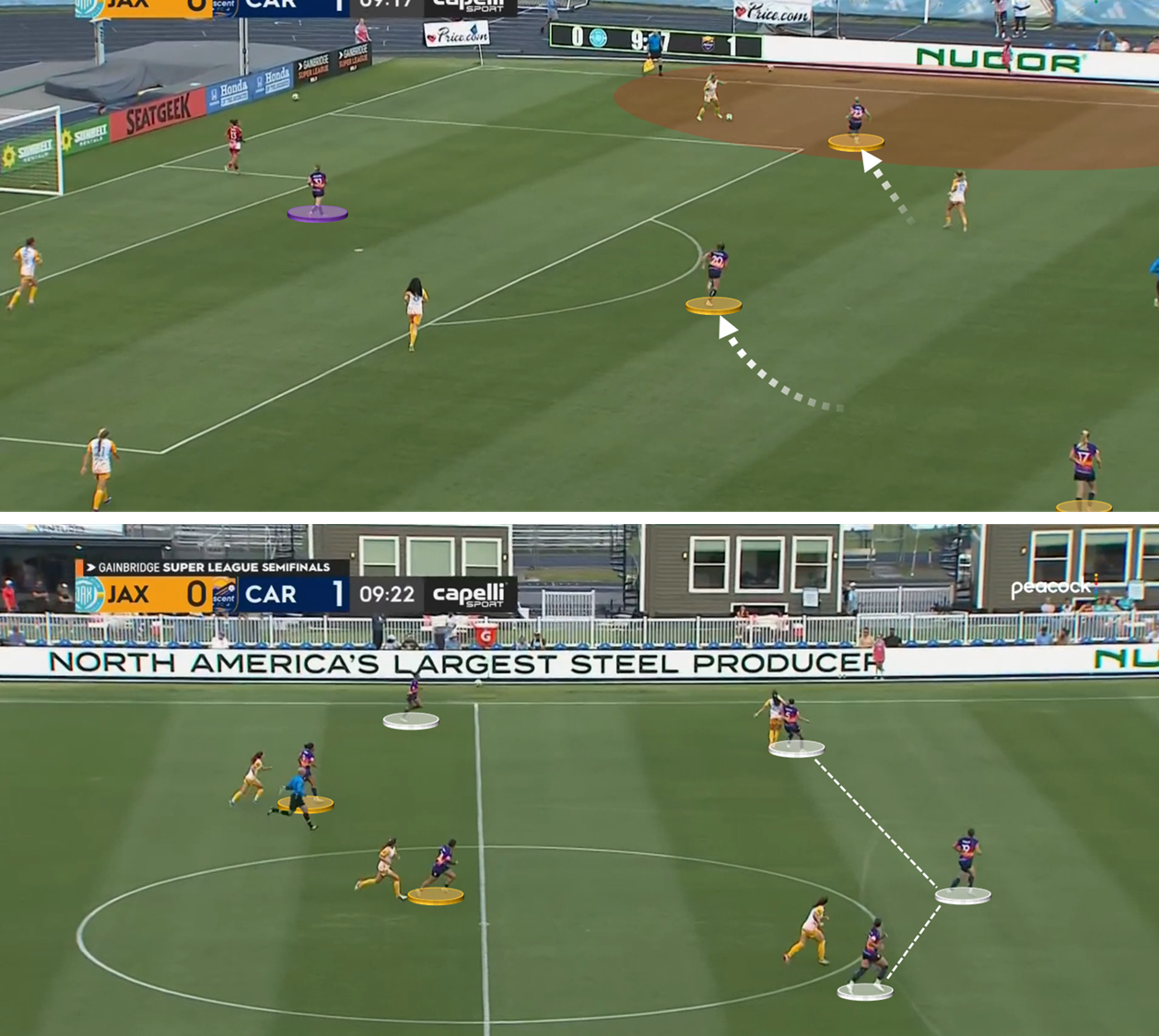
Here, the 4-2-3-1 plays out. In the first frame, Jacksonville is seen restarting in a “soft” back four with goalkeeper Kaitlyn Parks allowed to handle the ball. You see how Carolina bends their midfield, with Shea Groom (a No. 10) initially marking an opposing defensive mid but curling her closing run as the ball moves to her right. Simultaneously, Parker closes to Phillpotts and forces her to play long.
Yet more trapping ensues from there. Even though Sporting clears Merrick at right back, the rest of the defensive line – led by Jenna Butler – is in position. Likewise, the pivot of Corbin and Lily Nabet is sprinting to help out. (Nabet was key across phases; she basically sat in like a third center back in possession, maximizing the stability of Carolina’s resting shape.) The result here? Paige Kenton is pinned against the sideline on the end of the long ball.
That’s not to say Jacksonville was feckless. If they could shift a striker from atop their 3-5-2 into a channel, it forced Carolina into rotation and opened space for Ashlyn Puerta as a weak-side runner. Likewise, semi-transitional breaks tended to generate space behind Carolina’s wingers.
Still, it wasn't enough, even as Stacey Balaam brought on more forwards and essentially ended the game in a 3-3-4 or 3-1-6. Thus, the Ascent will travel to Kentucky next weekend with a trophy on the line. What should we be looking forward to? Across three matches this season, Lexington and Carolina drew once and defeated each other once a piece. LSC ended up with a +0.57 xG edge, but that's minimal in a three-game sample.
If nothing else, expect a defensive battle. LSC allowed just 0.86 goals per 90 in the regular season, while Carolina was at 0.96 and hasn’t allowed multiple concessions in a single match since February 14th. In their matches this year, both clubs underperformed their season-long xG averages.
There’s a distinction in how these teams want to attack. Lexington leads the Super League in passes per possession and, as we’ve seen, are highly structured. Carolina only held 48.8% of the ball on average this year, but they led the division in final-third regains and are an incredibly opportunistic side in transition. Notably, the introduction of the long ball is new; the Ascent only hoofed it 10% of the time in this year's three-game series against LSC.
Plays like this ought to decide the final. Here, in the reverse fixture between these clubs, Lexington is dispossessed off a throw-in by a Parker tackle. It’s off to the races when Groom receives from her, but there’s absolutely no oxygen. You can see the resting “3+1” base in action, with the center backs and a trailing Taylor Aylmer (5.8 recoveries per game, 54% duel win rate this year) shutting things down.
Carolina has a chance to switch play eventually, but Merrick isn’t making a crashing run that might test the weak side. Ultimately, there’s nothing going.
While the Ascent won this match 1-0, more than 90% of their xG came from a single penalty and post-penalty rebound sequence; they got nothing done in the face of Lexington’s defense. Still, we’ve seen players like Tyler Lussi click into gear as of late. The Ascent have only gotten sharper, and that’s why Saturday is thrilling to think about.
As the Players’ Shield winners and the home side, Lexington will be laden with expectations, but they’ve spent the season living up to a high standard. Their attacking system is more naturally suited to breaking down the Carolina back four than Jacksonville’s ever was. If nothing else, the tactical matchup next weekend will be a barn-burner.
What’s up with Louisville?
For Louisville City, this is a very bad play:
You’re seeing LouCity recover after an attack flames out, and their defensive shape is immediately under the gun. Wingback Aiden McFadden (black) is caught high after an attacking foray, and rotation from the sideline via center mid Evan Davila (purple) doesn’t arrive in time to make up for it. Thus, opposing Miami can play into space.
At no point is Louisville’s front line (white) able to assert itself. Instead, there’s trouble in rotation behind them. Kyle Adams can’t make a stop out of central defense, and Taylor Davila’s coverage into the back line won’t be enough. Miami has enough space and time to beat Josh Jones and Sean Totsch with a slick diagonal run into the box.
If you want to think about the main problem for Louisville in 2026, this is it. LouCity is allowing more than twice as much fast break xG year-over-year, and it’s these offense-to-defense failings that have caused the decline.
That said, it’s not all bad. Louisville is conceding a lot of high-value chances in a relative sense, but they’re only conceding 0.89 xG per 90 – the second-best mark in the USL. Most of the time, Simon Bird has been able to rally the troops into organized setups like this:
Here, Louisville is in proper pressing mode, not transition recovery. The forwards in the 5-2-3 are able to express themselves man-to-man against Miami’s back line, and both Davilas can shift toward the ball as markers against their rival No. 8s.
LouCity is able to pin Miami with waves of pressure at the sideline, eventually creating a turnover. As soon as the ball changes hands, Ray Serrano picks out a lower-seated Jansen Wilson on the weak side. Instantly, the press turns into a dangerous free kick for the reigning Players’ Shield winners.
Plays like this predominate for Louisville, so why are they in the middle of a historically poor run of results? For one, Bird's increased focus on possession as compared to Danny Cruz inherently creates more chances for opponents to counter. Louisville is keeping 56% of the ball this season, up from 46% last year – a mark that coincided with long spells of low-block, break-proof defending. This team's efficiency has declined as well; they've gone from a middling 84 final-third passes per expected goal down to 87, 18th ranked in the Championship.
When you're less effective at breaking defenses down, you're likelier to throw numbers upfield to try and change that. Consider McFadden's positioning in the first clip; that's a feature of the Louisville tactical system, but it's also a trade-off that weakens their defensive base.
This Louisville team is also taking more risks in the press. They're winning possession back 15% more often in the final third, and their PPDA is down from 6.8 to 6.2. Those are good outcomes, to be clear, but hyper-aggressive pressure gone awry means you'll be weak deeper downfield. It bears repeating: the more numbers and energy you commit upfield, the less of a backstop you've got when the press is broken.
Most of the time, Louisville is executing on their principles, but those issues in transition have been pervasive. There aren’t easy answers as Bird looks to snap out of a four-losses-in-five skid. Yes, the break is a problem, but should you upset the entire apple cart to get rid of one worm? Bird’s ability to answer that question will define the rest of 2026.
In other news…
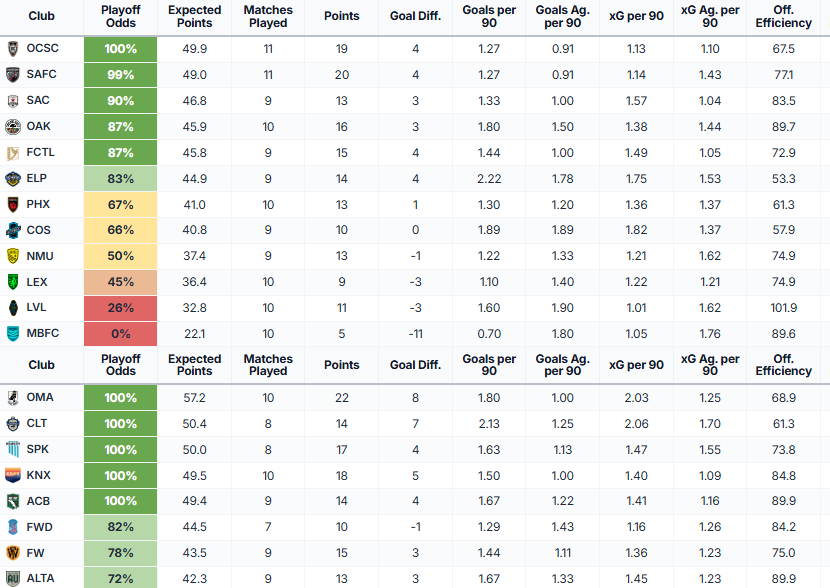
My weekly playoff odds machine is up and running, and I've added advanced stats for your perusal. Check that out:
If you want a full recap of League One, I wrote about all 17 teams on Backheeled. It’s like 4,000 words and you should go read it!
In the meantime, how about Charlotte? The Independence are putting up 2.13 goals per 90 on 2.06 xG per 90, and they kept up that sensational attacking against Madison over the weekend.
On paper, Charlotte’s 4-4-2 might’ve struggled against the Madison back five, but they were ruthless about creating overloads through the halfspaces. Between Clay Dimick’s overlapping from right back and a drift from Luis Alvarez, you see that play out above.
Alvarez – who was, on paper, the left winger in this game – initially receives and turns right, looking upfield to find Dimick, Prince Saydee, and Enzo Martinez proving against the left side of Madison’s back five block. Saydee was good for 19 carries on Saturday; he uses one here to draw the wingback and start breaking the Mingos down. Meanwhile, a supporting run arrives from Christopher Jaime at the No. 8 spot, allowing him to set the table once Saydee gives up the ball.
The end result? Jaime has multiple options against two remaining Madison defenders, and he’s able to play into the box. While Martinez is called offside in the end, this is a lovely encapsulation of what Charlotte has done so well in 2026.
Elsewhere, Fort Wayne is six games unbeaten in the league because of their ability to create breaks like this:
Fort Wayne is in 3-4-1-2 mode here if you count goalkeeper Bernd Schipmann, and that creates an edge against Boise’s man-centric high press. Boise has two forwards, two No. 8s, and both wingbacks involved, but a ping-ponging passing play between Schipmann, midfielder Jeremy Garay, and center back Tiago Dias slices by them like a hot knife through butter. Ultimately, Dias’ first-time pass can clear the Boise midfield and loose left back Michael Rempel on the run.
Fort Wayne loses momentum in what briefly looks like a four-on-three, but this caliber of build-up play is so good. Even if the break slows down, the end result – a switch of point and a cross from late-arriving Javier Armas – is still a win. Lovely work from one of League One’s most attractive soccer teams.
If you’re curious about how sticky team sponsors are in people’s minds, Luke Martin conducted a very scientific survey across the USL blogosphere.
Need to catch up on all things El Paso Locomotive? Duke Keith's back with another episode of Loco_Motive, and I was happy to help preview their upcoming games against AV Alta and Lexington SC.
Related: tune into Raising Anchor, where I'll be previewing Rhode Island FC's match against Indy Eleven on Thursday night.
I spent the entire weekend with Werner Herzog going “I would like to see the baby” dancing through my head, and I can report that The Mandalorian and Grogu is perfectly mid.