The Back Four: Super League Playoffs, USL Cup notes
Previewing the Super League semis, noting League One trends, and more

Welcome in to The Back Four!
As always, visit Backheeled for more USL content, including deep dives into all things Championship and League One. Also, listen to This League! and The USL Show to catch up in podcast form.
I'll also plug a new tool on the site: my Player Card generator. If you're a regular reader, you'll recognize my percentile-centric player graphics, and now there's an interactive way to create one for any player in any season since 2021.
 John Morrissey
Without further ado, let’s get to it.
Super League Playoff previews
After 31 weeks, we’ve got our USL Super League playoff field. Between Lexington’s last-minute heroics to claim the Players’ Shield, Carolina’s surge against Jacksonville, and a blowout win for Dallas to claim the #4 seed, everything was on the table in the final weekend. Still, that’s in the past. What should we be watching in the semifinal round?
Lexington and Dallas last played in mid-March, very early into Nathan Thackeray’s reign. Since then, LSC has completed their second-half defensive reinvention, sold Emina Ekic, and come out on the other side looking even stronger. For their part, Dallas has uncovered (or acquired) considerable depth in their midfield and attacking lines in the wake of that 2-2 draw.
Much will depend on Dallas’ ability to dictate possession. If Trinity can express themselves on the ball, bait their hosts out of shape, and break up the wings, they’ll have a puncher’s chance. However, Lexington’s shapely pressing 4-4-2 and resting back three (starring Ally Brown and Regan Steigleder) is designed to stop those things from happening.
Here, you’re seeing Lexington execute on those principles. This sequence comes in the run of play, but LSC is bent on preventing Dallas from resetting in possession. Left winger McKenzie Weinert closes to goalkeeper Tyler McCamey, forcing her to punt it long. Forward Addie McCain is trailing the play, and she wins the ensuing header to immediately put her side on the front foot.
Because Trinity have been rushed out of their comfort zone, Lexington can push forward into a four-on-four break against Dallas’s defensive line. As that parity develops, Alyssa Bourgeois crashes upfield from right back to overload the defense. She’s addressed in rotation by Heather Stainbrook – likely to miss Saturday’s semifinal due to an injury – but still manages to cut inside, attempt a shot, and tee up Catherine Barry on the bounce.
There’s a degree of risk-taking on display here, but it pays off for Lexington. Still, if their dominant win against Fort Lauderdale over the weekend was any indication, Trinity have taken a step up in the attacking phase over the last two months. Whether they’re teeing up Camryn Lancaster through lines or forcing mid-high turnovers to activate their forwards, Dallas is increasingly sharp.
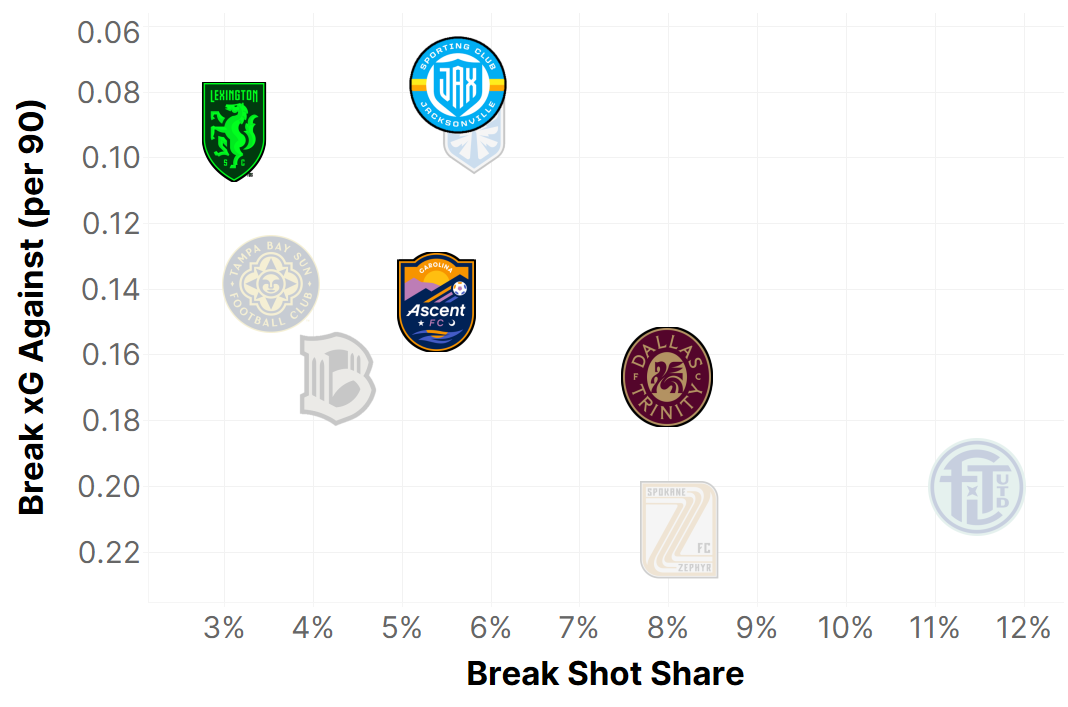
Who can control the tempo of the match? That's the big question. Lexington has generated barely 3% of their shots this year on the fast break, the lowest share in the Super League. Likewise, they're allowing less than 0.10 break xG per 90. Dallas, for their part, is considerably more reliant on transition opportunities and more willing to accept the defensive downsides of a more open match.
Carolina and Jacksonville aren't so distinct in their tempo preference, and the clubs are fresh in each other’s minds. Indeed, they met in the final weekend, with the Ascent walking away 3-1 winners. Sporting will benefit from a return to Hodges Stadium, but is that enough to reverse last Saturday’s result?
Notably, Phillip Poole leaned into the long ball to get the job done in Week 31. Carolina played 72 long passes, 23% of their total attempts. Both marks are among the three highest of the Ascent season. There isn’t one surefire way to break Jacksonville down, but Carolina weaponized the long ball to avoid the brunt of their guests’ press.
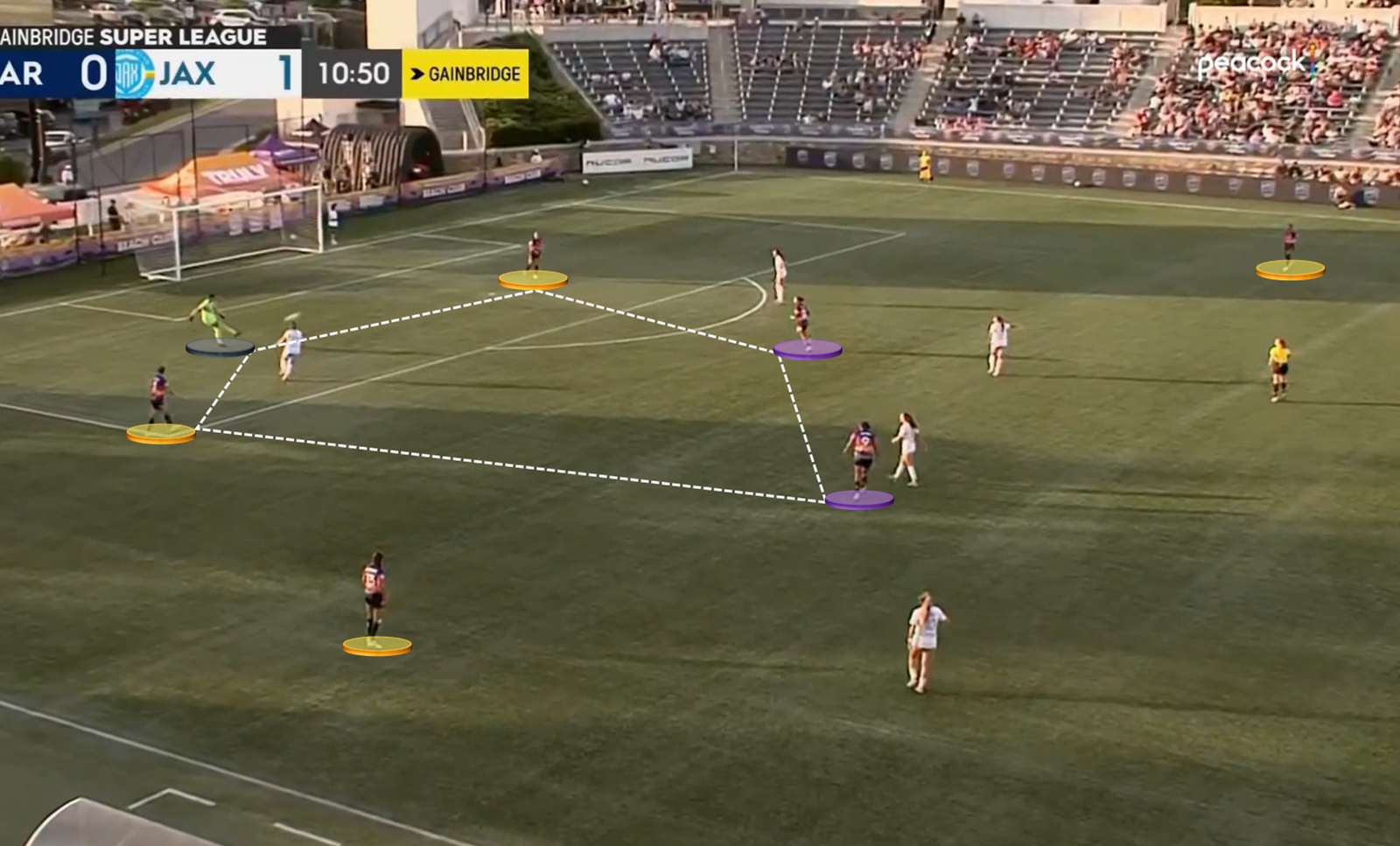
Carolina lined up in a 2-4-4ish shape in build, giving them parity against Jacksonville’s high 3-1-4-2 press. The goal was to force Sporting tight and work around the edges; left back Jill Aguilera put in nine carries in the defensive half, for instance. Still, the Ascent were equally able to bait the press, knock the ball back to goalkeeper Sydney Martinez, and hoof it over Jacksonville’s overdrawn defense.
Martinez has attempted 29 passes per game this year, going long on 60% of them. Against Jacksonville, that number was 96%. While it was a given that Martinez wanted to play over the top, she still beget pressure from an opposing No. 9 when receiving in the run of play, further helping to bend the press.
Because of that multi-layered build approach, Jacksonville made just three final-third recoveries – well below their season average. When Carolina went up 2-1, meanwhile, the move began with a Martinez long ball that cleared Sporting's left-tilted press. With wingback Meg Hughes upfield, Riley Parker could isolate against a central defender, link with drifting No. 9 Mackenzie George, and get into the box. There, she hit Tyler Lussi crashing to the far post to score.
Of course, Stacey Balaam's side still derived plenty of joy from Hughes' elevated positioning. Hughes has seven assists this year and has only been dribbled past 0.71 times per match, a top-third mark among Super League fullbacks. When Sporting opened the scoring in Charlotte, Hughes was at the heart of Jacksonville's full-tilt shape.
Boyan wasted NO TIME 🤯
— Gainbridge Super League (@GainbridgeSL) May 16, 2026
Abby Boyan opens her @sporting_jax account and opens the scoring in Charlotte in under SEVEN MINUTES! 🙌 pic.twitter.com/HmLstWSEAD
Jacksonville starts in a moderate posture here, adopting a truncated 3-1-4-2 with only about 20 yards between the center backs and No. 10s. Because they’re tight across the vertical and horizontal planes, Sporting are challenging what’s typically a dominant Carolina press.
That shapeliness lets Jacksonville break around the edge into Hughes’ feet. As that happens, right wingback Abby Boyan finds her trigger and flies up the opposite sideline. Suddenly, it’s a four-on-four against the Carolina defensive line. Hughes is able to cross, find an attacker in the box, and spark a side-to-side move that ends with Boyan scoring at the far post.
Moves like this were a regular sight; Jacksonville ended Saturday with a whopping 2.8 xG despite losing by a 3-1 margin. While their defense was susceptible to the long ball, their attack didn’t miss a single beat. Moreover, they’ll be ready for Carolina’s new approach come Sunday night. We’ll see what adjustments Balaam makes, but it’s yet another reason why both semifinal matchups are so fascinating.
League One’s fullback tweaks
On last week’s edition of The USL Show, we had a brief discussion of a League One trend toward wonky fullback deployments. Sami Guediri’s full-blown position change from the wide areas into the No. 6 spot is one thing, but clubs like Fort Wayne, Sarasota, and Westchester have all benefited from rethinking the use of their fullbacks from phase to phase.
Why manipulate your fullbacks? In a world where the 4-4-2 has become the defensive shape de rigueur, the back four is a potent tool to assure organization in block. Conversely, you’re often left with two locked-in rest defenders – your starting center backs – when pushing upfield and need to get creative around them.
For teams that run a back four, leaving one fullback low and pushing the other upfield is a valid alternative. Consider this play…
…where Westchester presses with their left back low but allows Jonathan Jimenez to fly ahead from right back. This clip is a few weeks old; since then, Jimenez has often been used as a substitute striker – he's an attacker by trade. By starting him at right back, Westchester leaned into a “defend in a flat back four, but flex into a pseudo-back three” construction.
Here, the fullback supports a 4-1-4-1 press with an aggressive burst into the central midfield. While Jimenez mostly played as a wide-hewing attacker in possession, you see him provide strong central support here. After forcing a turnover, he stays in the halfspace, pins Portland, and lets WSC create a one-on-one up the left.
Other clubs have mixed it up in that same vein. Antelope Valley, for instance, tends to shift from a 4-2-3-1 defensive base into more of a resting “3+1” on the ball. How they get there varies. Right back Nick Relerford almost always pushes up the sideline, but left back Cristian Ortiz can variously operate as a third center back, a tucked-in No. 6, or even an underlapping forward. If Ortiz pushes high, he’ll be replaced by a low-seated center mid in the recomposed back line.
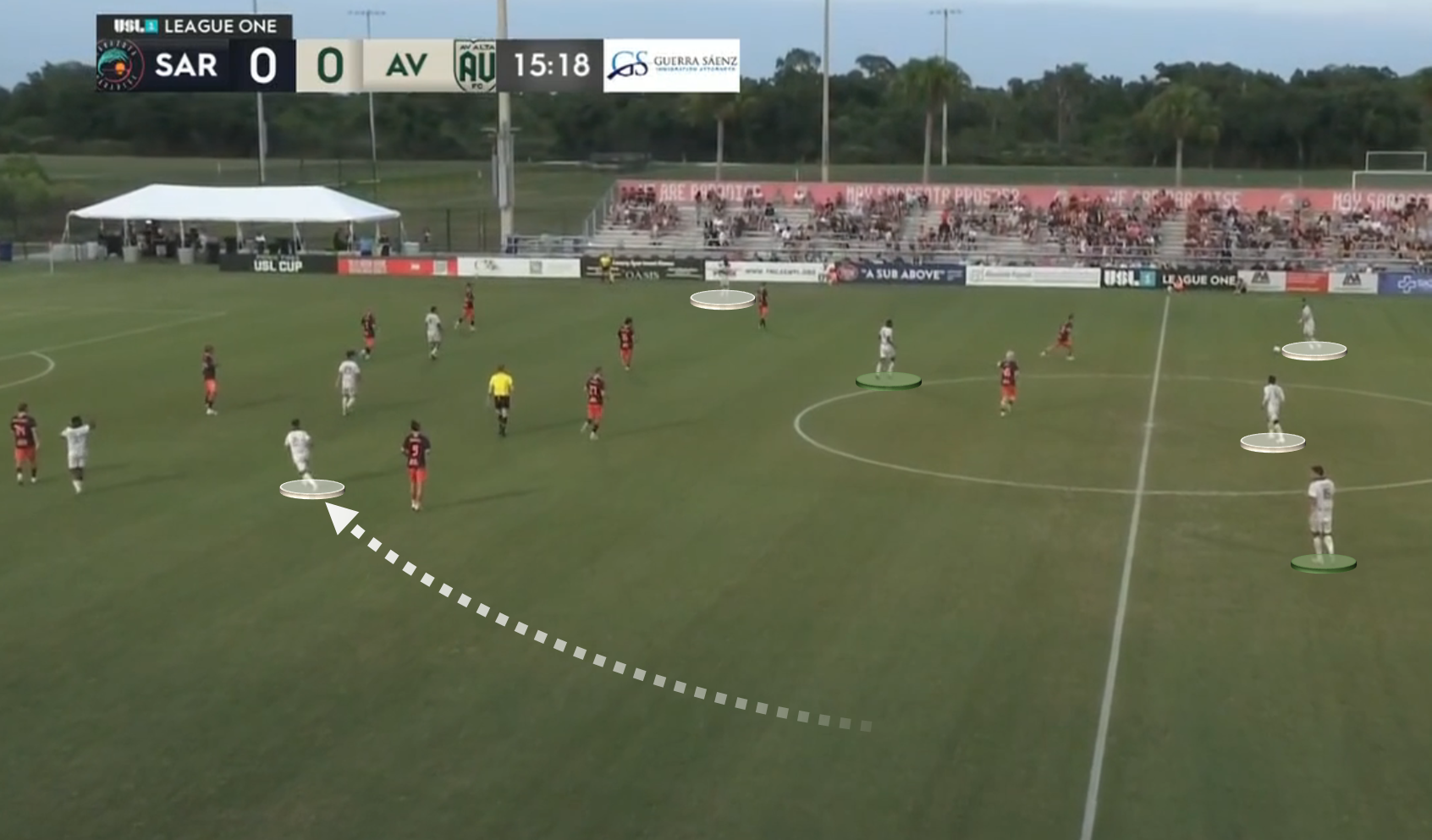
That’s the case here. You see Alta’s pivot (green) split to create that aforementioned rest defense base, while the back line (tan) is highly bifurcated. Relerford hugs the right sideline, Ortiz underlaps, and there’s a real sense of danger as a result.
The image you’re seeing is from Saturday’s 2-1 win over the Sarasota Paradise, yet another team that likes to mix it up with their fullbacks. That’s not a must-have for Mika Elovaara, but he’s happy to let Jorgen Pettersen shift from the right back spot into the pivot from time to time. In Sarasota’s case, the goal is typically to create central overloads – a distinct aim as compared to Alta’s wider-ranging offensive alignment.
Fort Wayne exists on the same continuum, regularly using right backs JP Jordan and Anthony Hernandez as extra support in the central midfield. You’ll often see this team build in a flatter back four against the press, but they shift into a “three-box-three” or 3-2-2-3 shape with that right back moonlighting in the double pivot.
That’s the case here. Hernandez tucks in, and that challenges opposing Charlotte’s 4-4-2. If Hernandez were to sit wider and deeper like a classic right back, it would allow the Independence to collapse to the ball; their left mid could rotate inside, giving their forwards and No. 8s greater leeway to press against Fort Wayne ball-carrier Juan Solis.
That’s not the case. Instead, Charlotte has to hedge against Hernandez as a possible receiver, and that gives Solis the time to think. With the Independence restricted, left back Michael Rempel can push on the overlap and create a mini overload alongside forward Lilian Ricol for the Bees. Eventually, that motion frees winger Daniel Oyetunde for a run over the top. The move isn’t necessarily successful, but it’s a positive sequence that wouldn’t happen without the subtle machinations at right back.
It’s apt that this play is coming against Charlotte given that they’re the godfathers of fullback-centric trickery in League One. By using Clay Dimick between the center back, right back, and wingback spots over the years, the Independence have long enjoyed the ability to fine-tune their approach from phase to phase. That flexibility has carried over into 2026, and we’re officially at the point where the rest of League One has begun to catch up.
Stray USL Cup thoughts?
There’s nothing more legible than a chart with 42 clubs mapped on it, so that’s as good an excuse as any to break out a USL Cup xG chart. Through two full match weekends, the landscape looks like this:
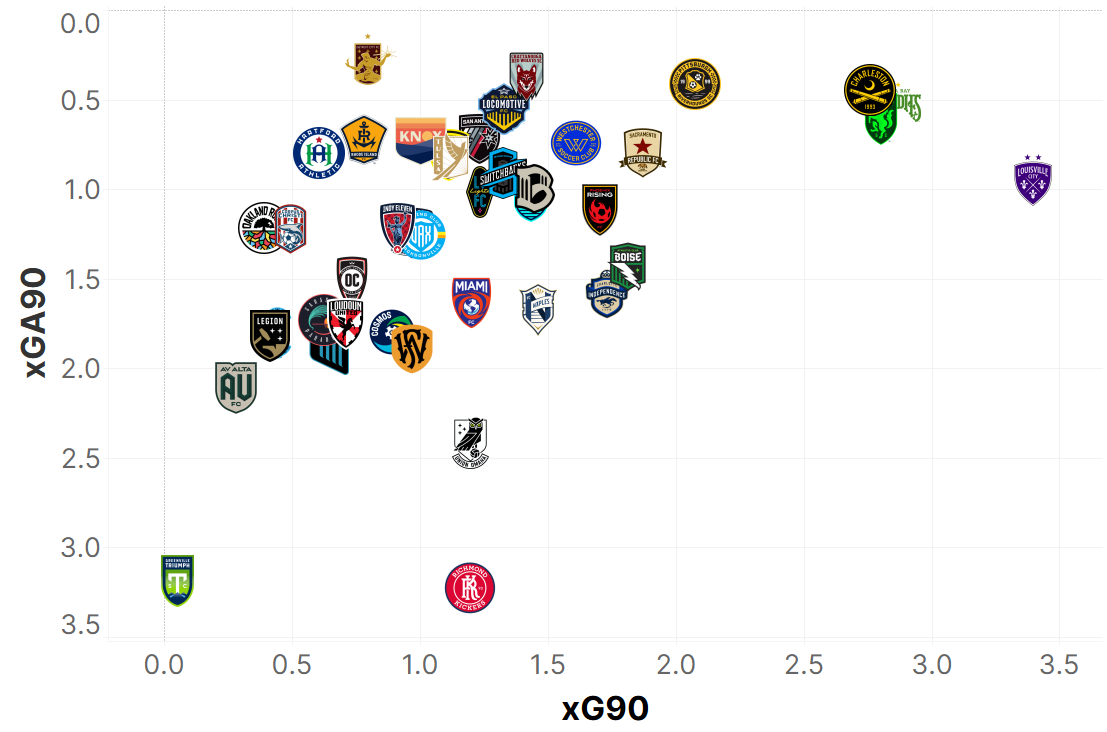
There aren’t any overwhelming surprises at the high end, where Charleston, Louisville, Tampa Bay, and a Lexington team that’s only played once are lapping the field. More interesting? Pittsburgh’s status as a top-five club in terms of xG and xG against.
The Riverhounds walloped Greenville in their group opener last month, and that’s a major reason why their numbers are so outstanding. While Pittsburgh fell on penalty kicks against Charlotte on Friday, Rob Vincent still pulled the right strings to create a number of dangerous chances. My favorite tweak? The use of Robbie Mertz as a late-game wingback.
Pittsburgh began the match in Charlotte in their oft-preferred system, one that defends like a 4-4-2 but keeps Lasse Kelp deep at left back in possession. As the match wore on and the ’Hounds needed an equalizer, complementing Kelp’s security with Mertz’s all-USL caliber creativity on the right was a clever way of getting past the Independence.
You see two examples of Mertz’s passing here. In the first, he’s looking upfield to find forward Albert Dikwa at the end of a through ball, setting up a cross that’ll meet Jorge Garcia for a finish. In the second case, Mertz starts in a proper right back’s position, but he’s got the vision to spot an opening upfield. An inch-perfect diagonal meets Dikwa, allows for a dink into forward Brigham Larsen, and nearly gives Pittsburgh a chance to win the game outright.
Elsewhere, Jacksonville finally earned a win largely due to the brilliance of Ahmad Al-Qaq up top. Sporting’s shift into a 5-1-2-2ish press didn’t necessarily shut down Sarasota and Naples – two League One opponents – but it set the table for Al-Qaq to shine in tandem with striker Emil Jaaskelainen.
Al-Qaq scored twice on four shots amidst the double matchweek, and he combined that sharp finishing with 25 carries and a strong sensibility for connecting play on the drop. His goal against Sarasota combined the two ideas. Al-Qaq’s ability to receive between lines and set the tempo on the break drew Paradise in, then his read on space allowed for a sharp finish toward the edge of the 18-yard box. Signs of life for Jacksonville!
While Portland has been comparatively sharp in the attacking third, they’re still finding their feet sans Masashi Wada. Given how strong their offense looked against Rhode Island on Saturday, it’s safe to say that Matteo Kidd is quickly emerging to fill that gap for Hearts.
Kidd only attempted 20 passes on 32 touches against RIFC, but every one of them was impactful. Here, Portland builds in 4-2-4 mode, and they’re manipulating space to let Kidd cook between the lines.
Initially, Michel Poon-Angeron is on the ball in the pivot and is attracting defensive attention. As he sits on the ball, you can see left back Josh Drack dropping to a lower position, further dragging RIFC out of their compact shape. As space opens up, Kidd skews into the left halfspace, dually making himself available while also boxing out an opposing No. 6.
Thus, when Kidd receives, he's essentially created a passing triangle between himself, winger Ollie Wright, and forward Titus Washington. Portland is able to work through a tight space, allowing Wright to play Washington in behind and create a dangerous chance. None of it happens without Kidd’s positioning and technique.
In other news…
My friends at Seriously Loco have a new Substack feed discussing all things El Paso Locomotive, so go check that out and subscribe.
As we put a bow on the Super League season, the good folks at 3rd Degree deserve a shoutout for their Dallas Trinity coverage. They’re an essential read for all things soccer in the Metroplex, but it’s awesome to see a Super League club get such committed attention.
Always read Nicholas Murray. Tiago Suarez has the goods!
In "what's John watching" corner, I'm back on my Akira Kurosawa bullshit. Related: I wish I had $3,250 to burn on vintage movie posters. I do have a 1960s High and Low poster, but it cost...uh...significantly less than that.