The Back Four: May Mailbag
Answering reader questions and perusing the Super League


Welcome in to The Back Four!
As always, visit Backheeled for more USL content, including deep dives into all things Championship and League One. Also, listen to This League! and The USL Show to catch up in podcast form.
Without further ado, let’s get to it.
The Super League’s home stretch
And then there were three. I went deep on Lexington and Carolina’s top-of-the-table bout in last week’s newsletter, but I’m turning my eye toward the bubble this time around. With two weeks to go, this is how my odds machine assesses the playoff race:
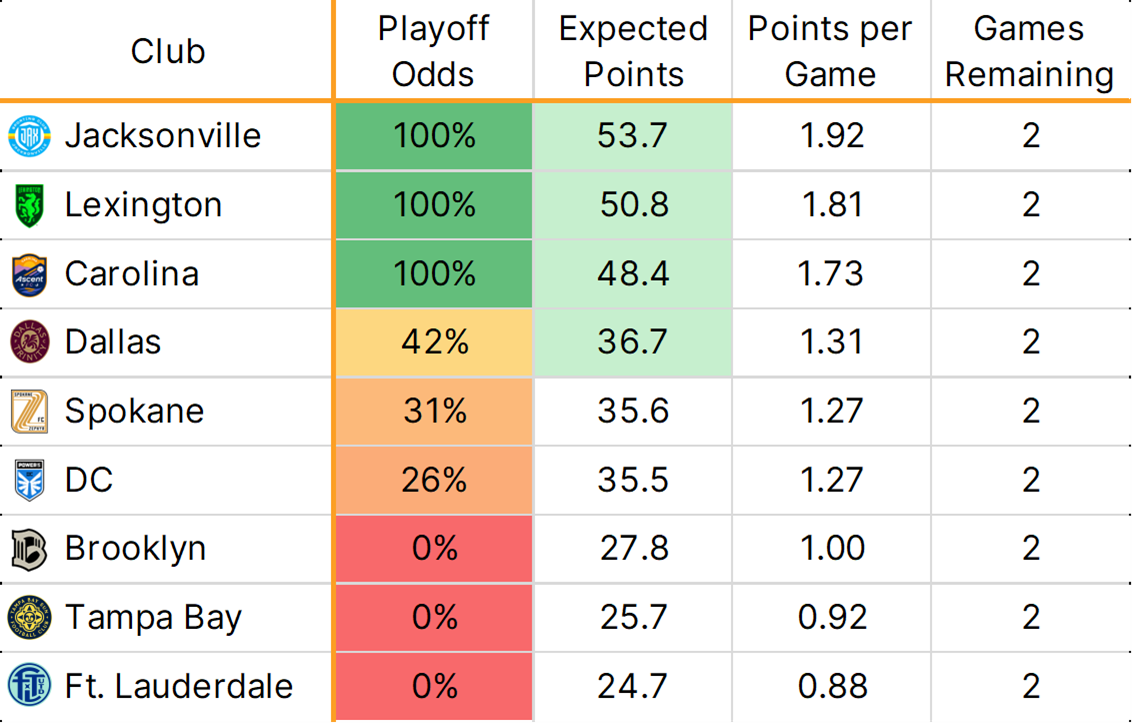
Of course, that means the Dallas Trinity, DC Power, and Spokane Zephyr are all alive. The latter two met on Friday; the former hosted Lexington on Saturday night. Each matchup had major ramifications in the Super League table.
For my money, DC was the stronger side at the start of the weekend, even though they had to scrape their way to a late draw. Omid Namazi's 4-2-3-1ish shape had the tools to slow Trinity down and create meaningful chances – even if a momentary flaw in said shape let Dallas get on the board.
The chemistry between Emily Colton and Justina Gaynor in the pivot was essential for Power. At best, DC could flex Colton (who attempted six tackles) upfield to bully the guests in the press while Gaynor screened as the lower-seated No. 6. In possession, both needed to be quick-thinking passers that could activate DC’s front four.
When settled in the attacking third, DC almost took on a 2-3-2-3 or 2-3-5 look with Colton and Dasia Torbert bobbing amongst the forward line. That’s seen above ahead of a Power chance.
As DC moves to the right through Gaynor, they let the defensive mid play catch with Madison Murnin at right back. That simple passing sequence doesn't create a real threat, but it forces Dallas to commit resources upfield. Meanwhile, there’s action in behind; Colton takes up a No. 9ish position and thus allows actual striker Alyssa Walker to form an overloading triangle with Torbert and Jaydah Bedoya.
When Gaynor receives the return pass, she’s got the space to split Trinity’s lines and activate that advanced trio. DC works into the box, and a dangerous cross nearly creates a goal at the far post. This was the best-case scenario for Power; conversely, the use of Gaynor as a single pivot proved problematic when Trinity opened the scoring.
There, the midfielder tried to dribble forward and push the issue in a similar setup to the one we just broke down. When Dallas made an interception in their defensive third, however, DC suddenly lacked their “2+1” central resting base. All it took was a through ball to Jasmine Hamid and one quick pass to Bethany Bos to take a lead.
After the concession, Namazi brought Alexis Theoret into a Gaynor-esque position as a deep-lying mid and used Gaynor almost like a third center back. That formulation kept DC from conceding again, and it set the table for a dramatic equalizer – one scored by Ellie Gilbert mere seconds after she subbed into the game. Power will’ve wanted (and deserved?) more, but they did what was needed to deny Dallas an all-important three points.
Knowing the result from the nation's capital by the time they kicked off on Saturday, Spokane had the chance to leapfrog into 4th place. Zephyr kept to a fairly typical 3-4-2-1ish shape to get the job done, prioritizing their defensive structure against a Lexington team that's made their money on the back of lethal attacking moves.
With that goal in mind, Nicole Lukic's side played to their strengths. Only 23% of LSC's final-third entries came up the central portion of the pitch, culminating in a return of merely 0.9 xG. Even when the guests broke through, Spokane had answers.
Here, you see how that pressing shape forced Lexington around the edges. In this case, an overeager close-down from wingback Maya Hansen lets LSC off the hook, but the rotations behind her are as clean as can be.
When center back Reese Tappan steps rightward, Emma Jaskaniec drops low from the pivot to cover her; the same idea applies when Haley Thomas hedges in the same direction. Eventually, the guests are slowed down, and Spokane can lock down the 18-yard box before any damage is done.
The Zephyr offense wasn't as sharp, but a few moments of ingenuity – mostly driven by quick switches of the point of attack – could've earned a winner. In the 30th minute, for instance, Spokane used a post-corner play to find Ginger Fontenot up the left and go to work. Within their reconstituted 3-4-3, Fontenot created an overload with Thomas on the sideline and Silano in the box; comparatively, LSC’s winger and fullback were outnumbered three-on-two. Naturally, a shot ensued after Fontenot dribbled to find an angle and play Silano through.
Spokane’s closest effort came in the 82nd minute, when Rapp rang a shot off the crossbar. There, Zephyr quickly broke lines up the left, played against the momentum of the rotating defense into the No. 9, and let her go to work. Ultimately, it was close but no cigar – a nice encapsulation of the entire weekend for the bubble teams, frankly.
Mailbag!
I consulted the good folks of Bluesky to collect some mailbag questions, and I’m circling back to answer them here. Big up to everyone who asked a question! Let’s get to it.
We’ll start with the most tactical question, courtesy of Naomi Infield, who wrote: "Hartford didn't score at all in April – are their goal-scoring woes an actual problem regarding chance creation (especially with some of their injuries and visa issues for creative talent), or is it just an issue of conversion?"
I think it’s useful to set the context for Hartford right off the bat. In the month of April, this team ranked 14th in the USL with 1.23 xG per 90, and 13th for attacking efficiency with 84 final-third passes per expected goal. In other words, you can make the case for conversion as the primary problem. Chances were there, but they weren’t finished off.
That said, I think there’s something deeper at play. For a Hartford team that often relied on their counterattack and their attacking-zone physicality in the 2025 season, 2026 has been a decisive break.
Year-over-year, Hartford’s fast break shots are down from 0.93 to 0.71 per 90. More importantly, their xG on the break is down 43% on a per-game basis. Some of that decline was already apparent in the post-Mamadou Dieng second half of last season, and it’s grown starker with Augi Williams providing a vastly different presence at the No. 9 spot. Williams’ scoring record precedes him in a historical sense, but he’s only got two goals in his last 13 USL games. Increasingly, he’s the kind of forward that does the off-ball dirty work – see his contributions during Pittsburgh’s title run – at the expense of volume scoring.
Hartford’s sense of timing has also changed. Last year, they ended the season with a +4 goal difference in first halves. Thus, opponents had to overextend and leave themselves open to the counter for long periods of time late in games. This year, they’re at a net-zero goal difference through the first 45 minutes of their matches. To put a cherry on top of it all, Hartford has been less effective off of dead balls; their set piece xG is down 17% in 2026.
Finally, there’s the depth piece to consider. Brendan Burke typically likes to use a small squad, and that can lead to wear and tear amidst a busy all-competitions schedule. In April, Hartford was tied for last place in the USL by using just eight substitutions – 2.3 changes out of a possible 5.0 on a per-game basis.
Not everything has been within Burke’s control. Emmanuel Samadia, the best left back in the USL last year amidst a return of 0.28 xA, 8.0 cross attempts, and 1.6 successful dribbles per 90, hasn't yet appeared because of visa issues. In his stead, Hartford has lacked their usual dynamism up the left.
All the themes I’ve discussed come together above. Hartford has to face down a relatively set mid-low block, and their ability to break upfield apace is limited. Their attack drives up the left side of a 3-4-3ish shape, but TJ Presthus – a natural center back recast in Samadia’s high-flying position – can’t receive cleanly. Hartford is able to recover off the counterpress, but they lack the one-on-one movement and off-ball spark to bend the opposing defense.
Do I think this team is going to get right? Probably! Improved health will go a long way, and Hartford is due for a regression to the xG mean, agnostic of their rotation issues. I’m skeptical of this club’s ability to compete for another trophy, but the offense isn’t broken broken.
Next up, via my The USL Show cohost Kaylor Hodges: "Who is your all-time 'pretty good' player? He was never in the conversation for Best XI, but he was always somebody that the fans adored because he was always a 7.0 every week."
This is an especially juicy prompt because it lets me do my favorite thing: remember some guys. My first instinct here was current Orange County SC midfielder Kevin Partida, but I was delighted to remember that he made the all-USL team in 2020 while with Reno. The same issue hamstrung Rafa Mentzingen, who made the all-USL cut in 2019 as a League Oner.
My best answer? Duke Lacroix. I’ve been a certified Lacroix fan since his rookie season with Indy Eleven in the NASL’s 2015 campaign, and he’s kept up that level ever since. The Haitian international has made nearly 300 appearances across the last decade, evolving from an attacking player into a hybrid fullback-center back option. While Lacroix is still settling for Colorado Springs in 2026, he’s a model of reliability.
Jake McGuire has long been a favorite of mine, the kind of goalkeeper that’s been a solid shot-stopper with the ability to adapt in terms of his sweeping and passing responsibilities over the years. McGuire was Bethlehem Steel’s primary starter across the 2017 and 2018 seasons, but he came to prominence (in my mind) beginning with his 2021 season in North Carolina. The 31-year-old posted a total goals prevented mark of -1.1 since then – a model of competent goalkeeping, statistically speaking. McGuire hasn’t yet played as Sporting Jax’s backup in 2026, but he’s still got the goods.
Derek Waldeck might be too good for this distinction, but he’s the prime League One pick for me. The left back is 10th in league history with more than 12,000 minutes played across stints with four different clubs. In Spokane, Waldeck’s poise has been a major asset from the Velocity since their very first match onward. He knows when to overlap, he’s capable as a deeper-seated resting presence, and he sets an example for what a cerebral defender can be in League One.
Some quick hits: I think Ethan Zubak is the platonic ideal of a “pretty good” striker. Bachir Ndiaye was consistently reliable in Charlotte as a No. 6, and it rocks that he’s succeeding in a varied role with Miami. Guys like Sam Gleadle, Zach Herivaux, and Clay Dimick also entered my mind.
We’ll wrap up with a delightful League One inquiry from Katherine Rzonca: "The most unserious question, but in your opinion, who should replace the losses in the Union Omaha Holy Trinity with Pato Botello Faz?"
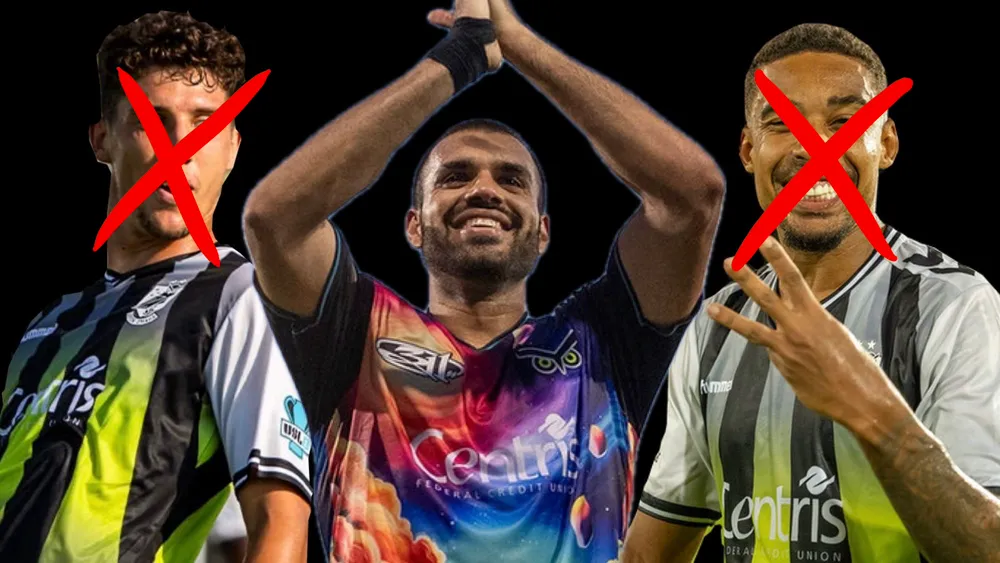
So, I think the magic of last year’s trio – namely, Botello Faz, Stefano Pinho, and Mark Bronnik – was the mix of vibes and ability. Bronnik was full of youthful fearlessness; Pinho, a joyful sense of verve and energy. In the 16 matches where all three players appeared in 2025, Omaha scored 2.1 goals per game. If one of them was missing, that rate went down to 1.3 goals per 90.
The trouble in drafting a new Holy Trinity™ is that Vincenzo Candela rotates his lineup a lot. Omaha’s biggest strength is that their attack is so hard to pin down! If I’m making hard decisions, I’m going for:
- Pato Botello Faz as Pato Botello Faz. Duh.
- Adrian Billhardt as Mark Bronnik. If we want a dribble-y guy, Billhardt is the pick. He entered Week 9 with 1.6 successful dribbles per match, ranking second on the Omaha roster with 22 box touches and third with 2.1 xG+xA.
- Kempes Tekiela as Stefano Pinho. This was tougher, but Tekiela was the answer. In less than 200 league minutes entering the weekend, the ex-One Knox star was tied for the Omaha team lead with 12 shot attempts. Naturally, he scored to beat Greenville in Week 9. Tekiela is a bit more industrious than Pinho, but he’s got the marauding play style that provides a close approximation.
With apologies to Sergio Ors Navarro, that’s my Holy Trinity.
In other news…
I had the pleasure of sitting down with Riley James to talk all things CBA on United Soccer Lounge, so go check that out for a succinct discussion of the framework deal.
As an addendum to last week's efficiency article, here's where we stand in the Super League after Week 29:
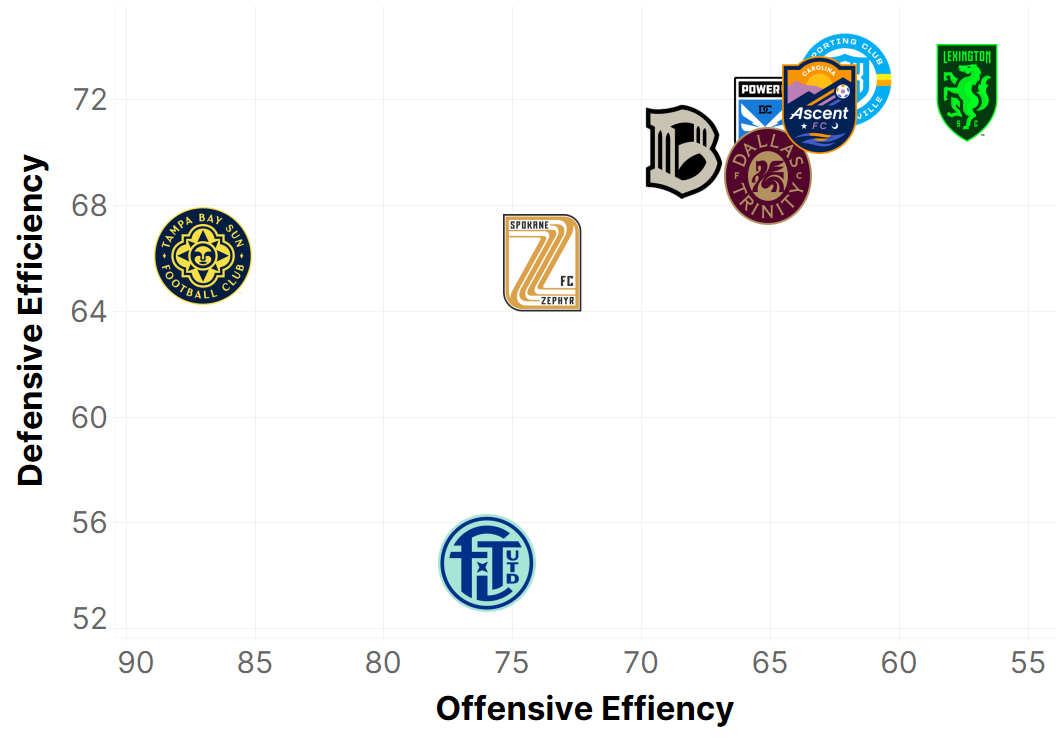
As I've repeatedly remarked, Super League charts are boring because every one has Lexington, Jacksonville, and Carolina in a top-right cluster. Still, the lower reaches of the efficiency landscape – and their tight relationship to the league standings – are remarkable. Tampa Bay's poor offense (87 final-third passes per xG) and Fort Lauderdale's sieve-like defense (54 final-third passes against per xG allowed) are the albatrosses around their respective necks; clubs like DC and Dallas have stayed in the playoff race by avoiding those shortcomings.
I feel like I've been an appropriate amount of Concerned™ about Charleston's up-and-down start in 2026, but this goal from Week 9...
...was so good. You start with the Battery possessing in what’s essentially a 2-2-6, get tackle from left back Nathan Messer in the counterpress, and then go right back to work. All four attackers (yellow) are given more space because of the gravity of the fullbacks (white); striker Miguel Berry understands that he should drop in to accommodate winger Maalique Foster’s run. It’s all so composed, and Charleston has the technique to do the job.
Be on the lookout for my forthcoming Backheeled piece on everyone’s favorite soccer topic: private equity investment.