The Back Four: Spengler spring
League One fast breaks, Championship line breaks, and the Super League

Welcome in to The Back Four!
As always, visit Backheeled for more USL content, including deep dives into all things Championship and League One. Also, listen to This League! and The USL Show to catch up in podcast form.
Without further ado, let’s get to it.
Attacking versatility in the Championship
Week 6 in the USL Championship was full of big results, but two matches have stuck in my mind. On Friday night, Loudoun United hung three goals on Louisville City by breaking through their press and challenging a relatively high defensive line. A day later, Detroit City did the same thing against Sporting Jax’s much less organized 3-4-3. Time will tell how Loudoun and Detroit continue to fare as contenders, but they each looked sharp this weekend.
Though Le Rouge have only scored six goals in five league matches, their 1.4 xG per 90 minutes ranks in the East’s top five. They’ve been an efficient offensive side with real patience in build all throughout 2026. In their own zone, Detroit’s average pass has traveled merely 13 yards upfield, the lowest mark in the conference.
Against Jacksonville, that formula didn’t necessarily change, but Detroit’s best breaks came with the ball in the air. Short passing still reigned in the first phase, but Le Rouge were willing to go direct once Jacksonville’s 3-4-3 committed upfield.
In the first case above, goalkeeper Carlos Herrera goes long, and you can see how high Jacksonville has pushed by the time he hits the pass. Up top, Detroit’s 4-2-3-1 is bent such that forward Darren Smith, winger Ates Diouf, and No. 10 Jeciel Cedeno are all in position to contest for possession.
Sporting’s weak clearance is batted back into the attacking zone thanks to a step by defender Devon Amoo-Mensah. The ricocheting ends with winger Alex Dalou finding a touch – creating a four-on-three against Jacksonville’s center backs along the way. Dalou plays Diouf through against the narrow center backs, Diouf fires to earn a corner, and seconds later it’ll be 1-0 to Detroit off the set piece.
The second sequence is similar. This time, left back Tommy Silva plays long to get himself out of trouble, and you’ll note that Jacksonville leaves an extra defender (left back Tyshawn Rose) deep to help solidify their base. However, one of the center backs is drawn to Dalou off a knockdown. Smith finds a touch, quick interplay ensues, and there’s another shot attempt after a four-on-three.
In each case, Jacksonville’s 3-4-3 lacks the midfield mettle to win second balls and shield their defense. The pressing scheme is valid in isolation, but it isn’t executed in a holistic way. Detroit takes advantage.
You wouldn’t characterize Louisville City in that same way, particularly in a match where Babacar Niang and Taylor Davila combined for 10 recoveries out of the 3-4-3’s pivot. As you see above, Simon Bird’s side often split their No. 6s high and low, using one player as a presser while the other stayed deeper. Still, overextension out of the back line proved ripe for Loudoun’s picking.
Loudoun is settling into a “three-box-three” attacking setup, which increasingly seems like Anthony Limbrick’s go-to. That look, which featured Richie Aman and Marcos Dias as the No. 10s on Friday, allowed for between-the-lines possession and a more vertical, layoff-happy alternative anchored around striker Thor Ulfarsson.
Above, Dias and Aman sit relatively deep and draw marks from Louisville’s outside center backs. That opens a long ball into Ulfarsson in a virtual one-on-one, allowing the No. 9 to receive over LouCity’s midfield structure. Ulfarsson lays off to Aman, the visiting defense collapses into its own box too vigorously, and late-arriving midfielder Pedro Santos can earn a shot.
If you think about Detroit’s 4-2-3-1 framework, their front end inherently came with four attackers to outnumber the opposing back three. Loudoun didn’t have that edge by default, but they used Santos’ movement from the No. 8 spot and smart runs from Pacifique Niyongabire up the right to try and create it. Both clubs knew how to forge matchup advantages and kept pushing the envelope.
Maybe I'm putting the cart before the horse, but there seems to be a greater tactical intelligence across the Championship in 2026. Teams like Loudoun and Detroit are inherently patient passing teams, but they’re baying their styles as the matchup demands. Such flexibility used to be the reserve of the USL’s crème de la crème, and now it’s driving the Championship’s ever-increasing parity.
The Cosmos and dynamism in League One
How can you get at a defense before they’re settled? Chattanooga tries to do so by blasting the ball long and trying to enter the box as quickly as possible. Portland gets it done with rampant counterattack and aggressive counterpressure. In 2026, the New York are using fast breaks and one-on-one dribbling toward that same end.
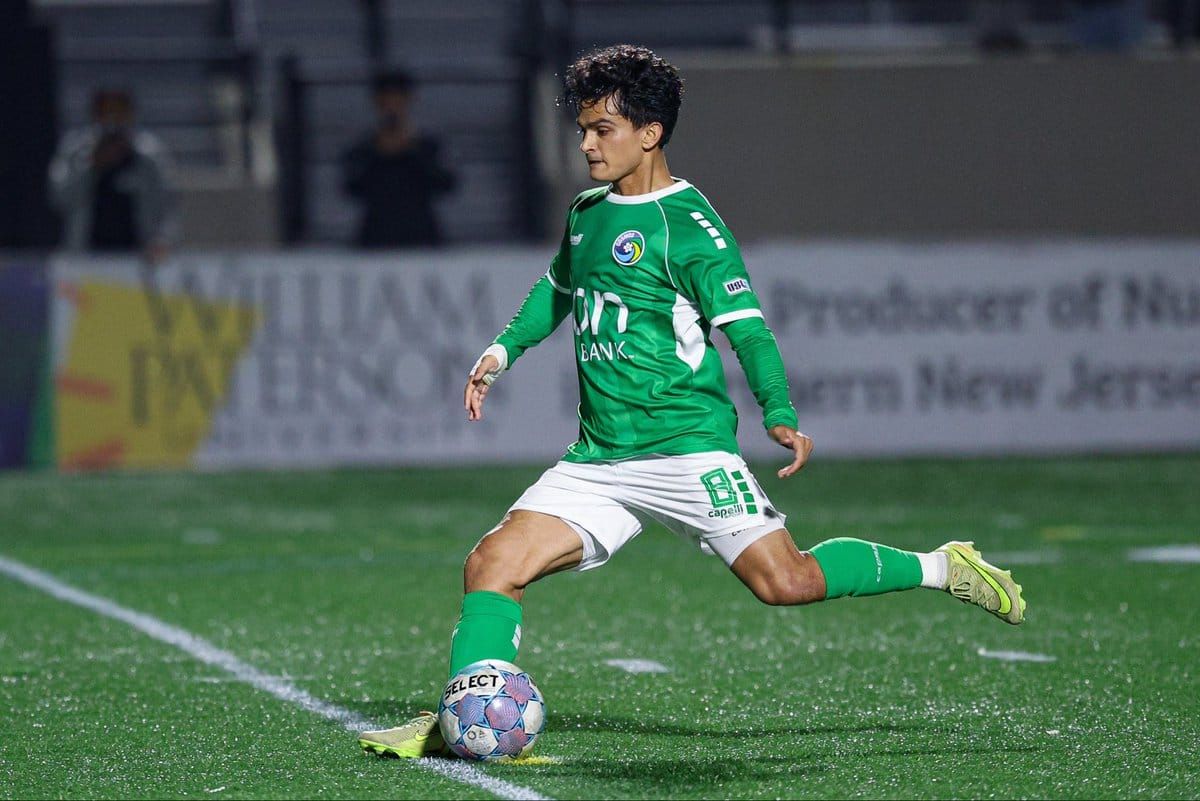
It would be easy to look at the Cosmos’ most recent result – a 3-2 win against Charlotte featuring three penalty goals for Ajmeer Spengler – and assume this team is coasting at the spot. That’s not necessarily true. New York is putting up 1.2 non-penalty xG per 90 to rank in the top half of League One. Penalties themselves are a byproduct of strong offensive production, particularly from teams like the Cosmos that are effective on the dribble.
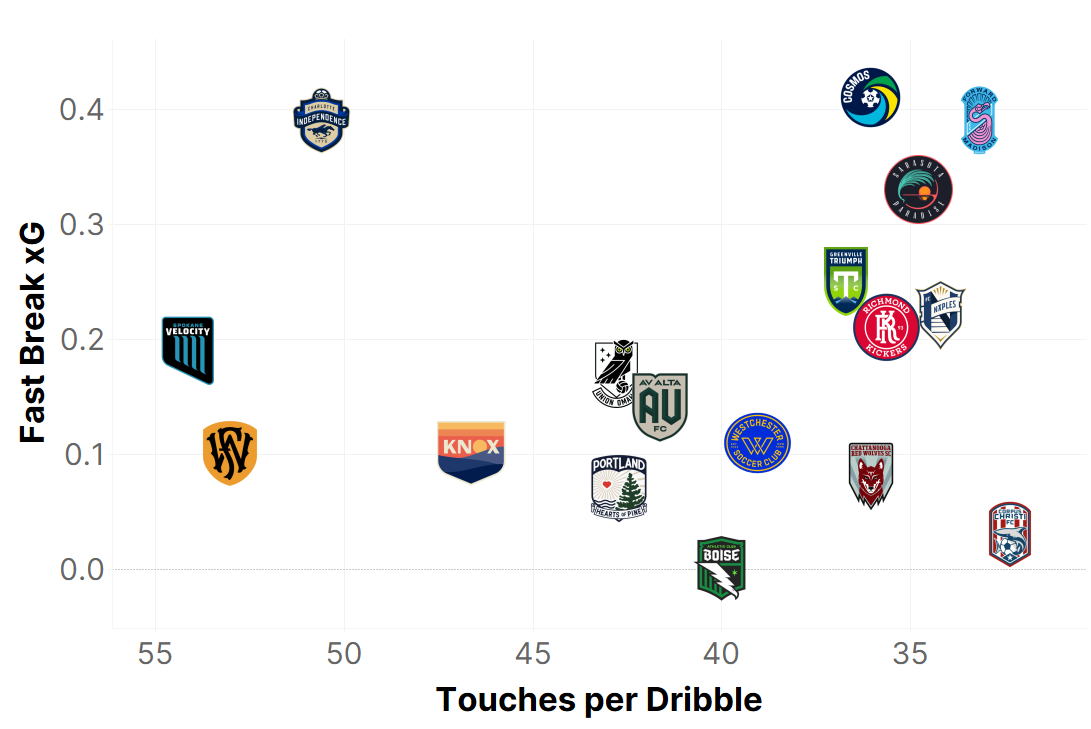
Within the League One landscape, we’ve seen plenty of variety this year. Madison’s revamped 3-4-3 is full of vertical spark, and wingbacks like Geni Kanyane are willing one-on-one threats. Sarasota is more possessive in nature, but they’ve got a one-man break in Jonathan Bolanos. (By the way: Bolanos is putting up 4.1 progressive carries per 90 this year. The next closest player is at 1.7.)
On the flip side, Boise hasn’t generated one single break in 2026, at least by Opta’s classification. They’re more hesitant on the dribble, too; you’ll get a handful of attempts out of Blake Bodily and Nick Moon, but this is a passing team first and foremost. Spokane and Fort Wayne, meanwhile, completely eschew potentially wasteful one-on-ones and are focused on possessive structure.
Within that landscape, Davide Corti’s Cosmos stand out. They’re the division’s most effective team on the break in terms of per-game xG, and they’re equally daring on the ball.
Spengler, who continues to make a leap in his third professional season, is at the heart of that identity. You see that in two examples above.
In the first sequence, goalkeeper Derrek Chan plays long and sets up winger David Galazzini – someone stern enough to have started multiple games as a defender this year – for a flick on. When that happens, Spengler immediately gloms onto the ball and drives forward. New York has a central presence thanks to striker Sebastian Guenzatti, and they’re able to earn a throw on the break. Obviously, this move generates zero xG, but it still captures the Cosmos’ pace of play.
Per American Soccer Analysis, Spengler has executed 51 carries and put up a dribbling g+ of 0.34 this season. He’s succeeding on more than five ground duels and putting up a stellar 0.29 xA per 90 to boot. As a play-driver, no one is doing it better.
Even when Spengler isn’t directly involved, that presence is forcing defenses to pay attention. That’s apparent in the second example, where Spengler’s gravity – bolstered by his one-on-one dribbling – opens up three runners on the weak side. Guenzatti, Galazzini, and Christian Koffi push forward, and the latter is able to receive and put a shot on goal amidst the transition overload.
New York still has to figure out the defensive end of the field, but they’ve already arrived as a dynamic attacking side. The fact that Corti immediately chose a stylistic lane is a major reason why the Cosmos have started fast with the ball, and it’s setting them up to be a playoff threat in 2026.
Super League!
Coming out of Week 26 in the Super League, two things are increasingly clear: Jacksonville is going to win the Players’ Shield, and Dallas has the inside track for the fourth and final playoff spot. Sporting Jax notched a resounding victory to bolster their case, suffocating Fort Lauderdale in a 4-1 rout. By contrast, Dallas continues to make it hard for themselves and lacked any continuity in a 3-0 shutout in Brooklyn.
As I wrote about two weeks ago, Fort Lauderdale has leaned into a short passing game as of late, drawing defenses out before connecting through their attacking midfield. Jacksonville – who ranks second in the Super League with over 6.0 final-third recoveries per game on the back of their 5-1-2-2 press – steadfastly stopped that from happening.
To understand how Sporting did it, it’s useful to contextualize what Fort Lauderdale has done well. Particularly in last Monday’s win against DC, Fort Lauderdale used a flexible build shape to break lines and then throw numbers forward. What began as a boilerplate 4-2-3-1 could turn into a 3-2-4-1, with left back Abi Hugh allowed to push upfield while right back Julia Grosso sat in as a third rest defender.
This play doesn’t look as graceful as that description might suggest, but it’s still evidential of Fort Lauderdale’s attacking spark. Under immense pressure from DC, left winger Emily Thompson and No. 8/No. 10 hybrid Kelli Van Treeck both drop in as possible receivers behind the elevated press. Striker Kiara Locklear receives off the long ball, but she’s instantly able to lay off into Thompson because of her one-step-ahead run.
Once that first line is broken, it’s off to the races. Locklear turns and pushes back upfield, and central midfielder Kathrynn Gonzalez does the same to replace Van Treeck. Before Power can recover, Fort Lauderdale switch toward the wide-open right flank and break into the attacking zone.
In that win in the nation’s capital, Fort Lauderdale ran up 2.6 xG, and that’s not even counting the quality of chance that forced an own goal in the 61st minute. In every sense, the system worked. With that strong showing in mind, Jacksonville’s domineering performance on Saturday – one where they allowed just 0.8 xG and a sub-average 70 passes in the final third – was even more impressive.
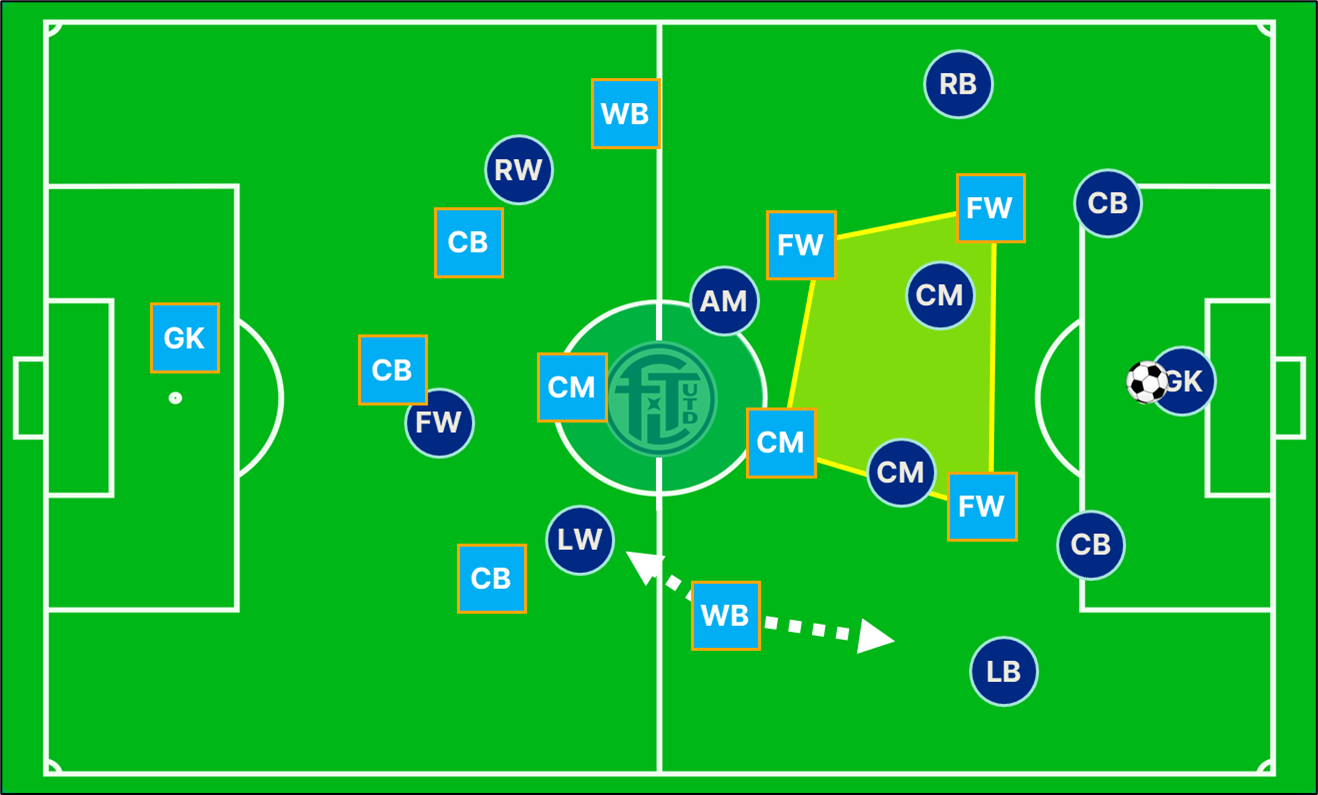
You see Fort Lauderdale’s build structure mapped out here, pitted against manager Stacey Balaam’s press on the Jacksonville side. Sporting has leaned into this 5-1-2-2 (or 3-3-2-2) look all season, but it proved especially effective in Week 26.
At the front end of the press, strikers Baylee DeSmit and Paige Kenton roved near the opposing center backs. If, say, Fort Lauderdale passed to their right-sided defender, Kenton would close to that player and DeSmit would curl into the box, cutting off a potential return pass to the goalkeeper. Meanwhile, Ashlyn Puerta and Sophie Jones paired as No. 10s to deny clean access to the pivot and use their pressing shadows to make line-skipping passes into Thompson and VanTreeck less viable.
Thompson still tended to take narrow positions and seek out space, but she only ended up with a modest 41 touches and didn’t complete a single pass in the final third. Hugh, meanwhile, couldn’t get forward on the overlap. The left back had to stay low as a makeweight, attempting to give Fort Lauderdale’s defensive line a four-on-two edge against the Jacksonville strikers.
That idea was good on paper, but it didn’t bear out. Jacksonville’s wingbacks – particularly right-sided Kacey Smekrud – did well to close on the fullbacks when United tried to break wide. If a No. 8 like Jones or Puerta made the closing run, smart rotations abounded; you’d see a wingback or center back step to re-create parity through the midfield. In every sense, it was a comprehensive defensive performance.
For Dallas, meanwhile, it’s been a tale of two weeks. Against Spokane in Week 25, Trinity thrashed Zephyr by a 3-1 margin and relished the ability to combine through the halfspaces. On Sunday amidst Maimonides Park’s narrow pitch, that changed. Dallas only managed to play 2.0 passes per possession, 33% less than in the Zephyr win.
Brooklyn deserve their flowers, of course. This team is the most direct in the Super League by a distance, posting a 22% long pass share – 4% higher than second-place Tampa Bay. That style leads to stop-start game states and helps Brooklyn to constantly stay compact.
You can see the impact of that tight-packed defensive posture on Dallas above. In the first play, Trinity are given time to pick out passes in their 2-4-4. Heather Stainbrook shepherds play out of the pivot, working with fullback Samar Guidry and winger Camryn Lancaster to bend a shifted Spokane back five. Constant interchange and underlapping movement abound, leading to a penalty kick.
The story couldn’t be more different in the second example. There’s no time to work in the midfield, and Dallas has to battle for every inch of territory. By the time they regain, Stainbrook and the fullbacks aren’t in any position to push forward.
Dallas is able to find Lexi Missimo as a potential creator between the lines, and there are runners ahead of her. Still, there’s no danger; Brooklyn has their entire back line behind the ball. Unable to find a lane, Missimo cuts back to a trailing Chioma Ubogagu and sets Dallas up for a low-percentage cross.
Most teams in the Super League have struggled to figure out Brooklyn and their frustration-first style, but that doesn’t make Sunday’s loss any less bothersome for Dallas. This team is still in the catbird seat in the playoff race, but they’re leaving the door open.
In other news…
This goal from Rhode Island FC...
...is so good. You can see their offensive 3-1-4-2 (and/or 3-5-2) here, with wingbacks Aldair Sanchez and Jojea Kwizera doing splendidly to stretch the defense. Rhode Island defended in a 4-4-2, but they let Sanchez play higher in possession and leveraged his field-stretching profile to quickly work from side to side; that’s evident above. If RIFC can marry this level of expansiveness with continued defensive excellence, I’ve got no doubts that they could finish top-three in the East.
I talked about Spokane's possession game in passing amidst the League One section, and I really liked what Shavon John-Brown brought from the striker spot last week. Consider a play like this...
...where the natural winger is able to curl around the edge and receive behind Richmond’s back five. John-Brown is quick and instinctive, offering the sharp movement that can bend defenses out of shape. I don’t know if he’s the long-term No. 9 pending Neco Brett and Anuar Pelaez’s health, but he’s a heck of an ace in the hole.
Lexington fact: their loss to Carolina over the weekend saw Kosuke Kimura's side post the highest passes per possession mark (4.5) of any Super League team in a match this season. Keeping the ball is often a good thing, but taking 600 passes to produce 1.23 xG isn't a great result. I say this mostly to credit the Ascent, who look so comfortable playing against the ball – even with Sydney Studer out. (More on all that in this week’s USL Show, by the way.)
I didn't watch Steven Soderbergh’s Contagion when it gained popularity in early 2020 for…uh…obvious geopolitical reasons, but what a movie! I typically think that “wow, this was predictive about the future” is the laziest form of criticism, but Contagion is harrowingly accurate relative to the COVID experience for a movie that came out in 2011.
More importantly, it’s cut together with unbelievable precision – unsparing, fast-paced, and deftly able to juggle plot lines of varying scopes – in classic Soderbergh fashion. I increasingly think his current run of low-budget indies where he’s director, editor, and camera operator are his best (or, certainly, his most formally daring) work, but Contagion and the Ocean’s trilogy are the peak of economical, suave studio filmmaking. (This aside is predicated on the fact that Soderbergh’s got a new movie out, meaning that I’m in retrospective mode.)