The Back Four: Playoff push, possession patterns
On the Super League, plus New Mexico and Omaha’s possession games

Welcome in to The Back Four!
As always, visit Backheeled for more USL content, including deep dives into all things Championship and League One. Also, listen to This League! and The USL Show to catch up in podcast form.
Without further ado, let’s get to it.
The Super League Bubble
And then there were two. Week 30 in the Super League began with DC, Dallas, and Spokane left standing in the playoff race. Wins for the latter pair and a tough double matchweek for Power thinned the field, but how’d it happen?
Sporting Jax struck a major blow at DC Power’s playoff hopes at midweek, securing a 1-0 win in a game that featured very limited chance creation going both ways. Stacey Balaam’s familiar system – 3-5-2ish shape, aggressive through the halfspaces, etc. – continued to shine, but it’s Jacksonville’s newer faces that stood out.
On the Power side, Alexis Theoret earned a starting role after an impact sub appearance last weekend; Emily Colton stepped up to the No. 10 spot to make room. There were a handful of moments where Colton’s ability to drop low to facilitate tested Jacksonville’s back line, earning space for forwards like Dasia Torbert and Alyssa Walker. Still, getting to those points was no mean feat.
Jacksonville’s midfield strenuously denied DC’s access through the central third, leaning into Ashlyn Puerta and Sophia Boman as elevated No. 8s in the 3-1-4-2 press. If they could aggressively dispossess Power before the overloads arrived – as happened in the run-up to Baylee DeSmit’s first-half winner – then the occasional moment of stress at the back was well worth the risk.
Consider this play, which starts with DC switching toward Jacksonville’s right side. Last Wednesday, that flanked featured Abby Boyan at wingback and Kacey Smekrud as the right-sided center back – just the second time those players have started together. You wouldn’t have known it given their instant sense of chemistry.
Immediately after the switch, Boyan and Boman hedge their bets; within the 3-1-4-2, they’re trying to contain a potential dribble without leaving Sophie Jones on an island as the holding mid. The moderation pays off, allowing Ashlyn Puerta – here, the weak-side No. 8 – to close on Theoret as a potential central receiver. Puerta’s closing angle limits what Theoret can do, funneling her into a crowded corridor.
From there, the rest is easy. Smekrud steps from the back line, Boyan supports her, and the midfield stays structured. DC has to turn tail, and there’s absolutely no danger to speak of. Sequences like this prevailed in what became a 1-0 result.
That scoreline and a win for Dallas on Saturday meant that DC was eliminated by the time they kicked off in Spokane that evening. Still, the mechanics of Zephyr's 1-0 win are worth a look – particularly given that Nicole Lukic's side could still pip their way into the #4 seed in Week 31.
With Power shifting into a 3-4-3 to match Spokane's shape, the onus was on Zephyr to get five-wide in the attacking zone to break DC down. Above, you see it happen.
Spokane isn’t quite at Jacksonville’s level when it comes to hyper-attacking movement from their wingbacks, but they showed a willingness to get bold on Saturday. Here, the sequence starts with forward Lena Silano settling the ball. By then, there’s already interchange afoot within Zephyr’s 5-3-2, given that midfielder Katie Murray has jetted to the left sideline. To fill her space in the midfield, wingback Maya Hansen cuts inside.
By the time Hansen receives, Spokane has five players taking up forward positions; both Murray and fellow midfielder Felicia Knox are taking up highly attacking-minded positions (as seen in the still frame). The gravity of that movement doesn’t break DC’s defense immediately, but it forces their back line tight. As such, Hansen can dribble toward the center of the pitch and a swing a pass around the edge. Quickly, a left-sided overload turns into a cross from wingback Ginger Fontenot.
Between those sorts of plays and terrific use of their bench, Spokane kept DC honest for the full 90 minutes. Lukic’s changes – namely, the introduction of Ally Cook as a target striker and Sophia Braun as a do-it-all No. 8 – have been similarly influential throughout the Super League’s home stretch, and they continued to be so on Saturday night. Cook attempted seven duels (six of which were aerial) in just 27 minutes against Power, assisting off a set piece to give Spokane their much-needed win.
Still, Zephyr are looking up at Dallas with one week to go, largely because of how Nathan Thackeray's side took care of business in Tampa Bay.
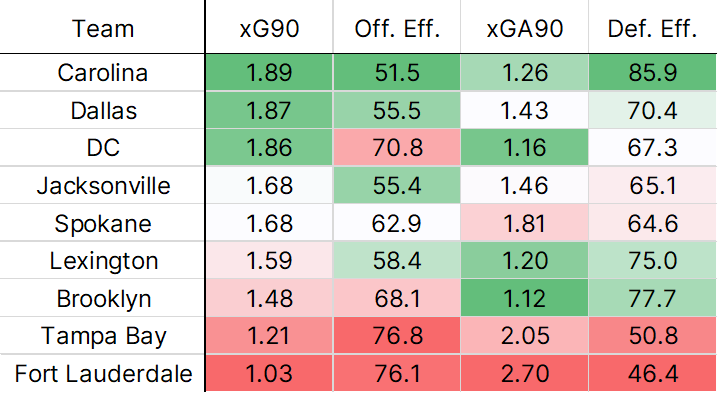
Over the last month-and-change, Dallas has been the Super League’s second-best offense in terms of xG and offensive efficiency. Moreover, they’ve posted moderate-to-good defensive returns along the way. Even while dealing with injuries on Saturday, Trinity continued that momentum.
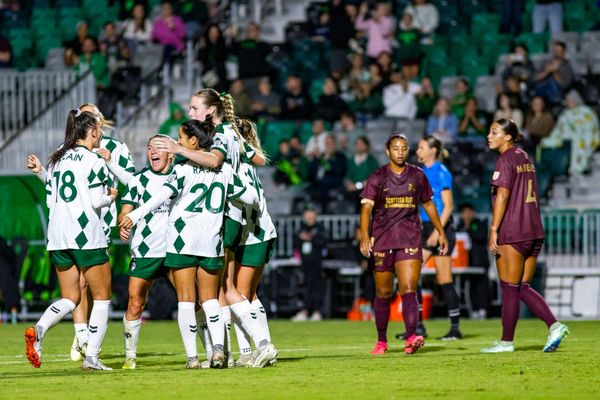
With neither Heather Stainbrook nor Wayny Balata in the mix, Thackeray used Sydney Cheeseman and Amber Wisner together in the midfield pivot. Frankly, there wasn’t a hint of a drop-off within Dallas’ 4-2-3-1. Within 120 seconds of opening kick, Dallas took a lead because of their pivot’s excellence; Cheeseman battled for a loose ball, Wisner – who mostly operated as a No. 6 last season – found space to play Camryn Lancaster up the wing, and the rest was history.
Saturday was a testament to Dallas’ second-half tactical overhaul in a lot of ways. Prior to the winter break, this team played merely 144 passes per game in the defensive third, with each traveling 14.3 yards on average. Under Thackeray, the attempts total is up to 190 a match, while Dallas’ distance has dropped to 9.6 vertical yards per attempt – the second lowest average in this calendar year. Trinity’s patience and pace modulation fueled their second goal, baiting the Sun high and freeing Lancaster in a one-on-one.
Between Thackeray’s flourishing system and Lukic’s blend of fluid starting setups with impact subs, whichever club nabs the #4 seed will be more than deserving. Now, it all comes down to Week 31.
New Mexico, meshing
Dennis Sanchez teams are at their best when they’re able to use possession as a tool for field control – and, at the same time, a tool for denying opponents the chance to do the same. We began to see that in a double matchweek, featuring a draw against El Paso and a win over Las Vegas.
Entering Week 10, New Mexico had conceded one expected goal for every 58 passes their opponents attempted in the final third. Across two games in Week 10 itself, that number ballooned to 78 – better than the USL average. It'd be easy to credit New Mexico's improving back line for the increasing solidity, but Sanchez teams inherently paint a more complicated picture.
At their least effective in 2026, New Mexico has struggled to break out of their own zone. I highlighted how Jake LaCava helped change that calculus in my Backheeled column, but you could say the exact same thing about Ousman Jabang – a powerhouse midfielder that actually got to be a midfielder as a knock-on of LaCava’s position change.
While New Mexico’s own-half passing accuracy is virtually unchanged year-over-year (down from 92.5% to 92.4%), it feels like there’s been a missing link. Maybe United’s beaten the first line of pressure, but they haven’t always looked connected when advancing into the opposing half within their 4-3-3ish structure.
The story is different above. As New Mexico work toward the El Paso zone from the halfway line, they’ve got their three center mids (Jabang, Zico Bailey, and Valentine Noel) arranged to pin the Locomotive narrow. Meanwhile, the fullbacks (LaCava and Chris Gloster) take up moderate positions and present themselves as potential receivers. It’s essentially a 2-5-3, and it puts immense pressure on the guests.
As New Mexico probes, you can see the give-and-take in action. Jabang drops low to show toward the ball, and he’s also dragging a midfielder out of position in the act. Meanwhile, LaCava sees Jabang’s run and makes an underlap toward a central space, essentially replacing the No. 8.
Because of all that off-ball movement, El Paso struggles to find their spacing; thus, Niall Reid-Stephen is open off the right side. While Reid-Stephen’s ensuing pass into LaCava doesn’t land, this is an effective passing move. United is all business in the final third, and they’re able to tilt the field without giving possession away cheaply.
Even when things got a bit sloppier against the Lights, Jabang’s steadying presence was a boon. Between the two games, the No. 8 made 11 recoveries and went 9/15 in ground duel attempts.
Here, that impact is especially evident. As New Mexico builds out, they’re pressed into a turnover by the Lights’ aggressive central midfield. There’s a real possibility that Las Vegas will be able to beat LaCava with a through ball and break toward goal, if not for a heroic stop by Jabang. By intercepting the killer pass, Jabang immediately turns the tables, plays Noel through, and puts New Mexico on the front foot.
The ensuing break features a clever run from Dayonn Harris, who cuts from the left wing and curls into the same between two Las Vegas defenders. Harris’ ingenuity was a major engine on Saturday, particularly in moments where Noel drifted toward the sideline and picked out spaces underneath him. For my money, that wouldn’t have been possible without the comfort provided by the Jabang/LaCava axis up the right.
Sanchez hasn't solved all his problems yet, and defensive transitions can still be problematic. Even so, Week 10 felt like a major stepping stone to get New Mexico United back into contention.
Union Omaha’s field control
On the sly, Union Omaha has passed up clubs like Boise and Alta to take League One’s possession mantle. Round up, and they’re the only team in the division that’s clearing a 60% possession average at the moment. We don’t typically think about Omaha as a patient, docile passing team – and that’s because they aren’t.
Watch Los Búhos play, and you’ll be struck by the level of control they exert by way of their counterpress. No team in League One has made more middle-third recoveries (176), and Omaha also ranks third in terms of defensive action height (44 yards).
The Vincenzo Candela system isn’t very different amidst the manager’s first full season in charge; Omaha ranked second in possession and first in middle-third recoveries last year, after all! Candela’s 2-2-4-2ish attacking shape has remained similar, too, though the personnel are different.
For the final month of 2025, Max Schneider and Brandon Knapp held down the Omaha pivot, while Charlie Ostrem and Dion Acoff starred at fullback. Three of those four players are now in Tampa Bay, and I’d argue that the best version of the Omaha pivot doesn’t include Knapp. The new faces – and particularly Sami Guediri, a do-it-all player that’s making the leap as a No. 6 – shone over the weekend against Portland.
Here, Omaha builds with Guediri and Laurence Wootton in the midfield, bearing down against a wildly deep-seated Hearts shape. In the face of that opposing block, Guediri quickly looks upfield to find right back Younes Boudadi on the overlap.
Boudadi is open because of the movement elsewhere in the Omaha attack. Rather than exclusively lean into a “dual No. 10” look, Candela has often used one of his forwards as a rover, creating more of a 2-2-5-1 in possession. Here, it’s Kempes Tekiela skewing right and, thus, occupying a fullback to open space for the switch.
Even though that initial entry pass into the final third doesn’t pay off, Omaha doesn’t sweat. They work the ball back inside, find Guediri anew, and keep pushing. As Guediri receives, you see Wootton curl up toward the right halfspace; he’s providing a counterbalance, making sure that Portland’s midfield can never get comfortable.
By this point, Portland is essentially forced to adopt a deep 6-3-1, a shape that won’t give them a springboard from which to counterattack. Yes, Hearts generated at least four dangerous breaks on Saturday by my count, but they spent most of the 90 minutes pinned like this. There’s yet another Guediri-to-Boudadi switch at the end of it all, putting a cherry on top of the patient side-to-side attacking.
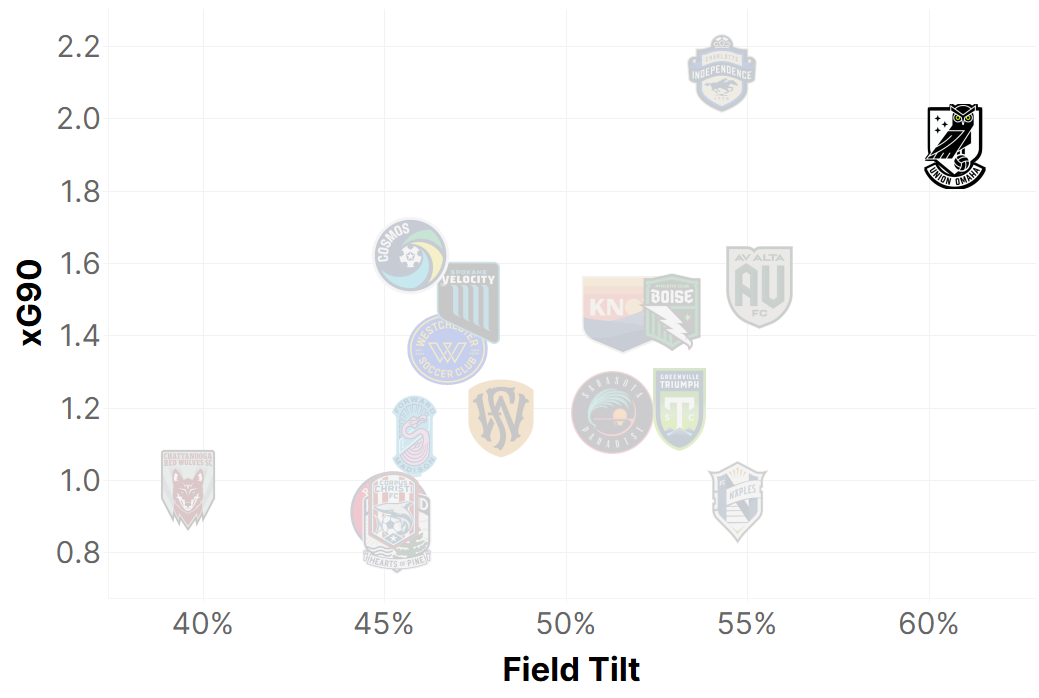
Watch Omaha, and you’ll see a million variations on this pattern. Boudadi might sit deeper, allowing Dylan Borczak to be the wide man off the right sideline. Wootton loves to make late-breaking runs toward the box. I wrote about Tekiela’s all-encompassing impact in Backheeled, and he’s only getting better.
The data bears all that out. Omaha’s comfortably lapping the pack in terms of field tilt, and they’re putting up a cool 1.96 xG per 90. For his part, Guediri is hitting 12.8 final-third passes and winning 6.1 duels a match. He’s a rangier passer than someone like Max Schneider, but he challenges defenses to an equal degree. There’s no better avatar for this club’s continued growth; Guediri is a major reason why Union Omaha will be in the title mix come November.
In other news…
Go subscribe to Alex Ashton’s new League One Updater site, which is now hosted on Ghost. No one knows League One better than Alex.
In case you were wondering which League One players have the most Dickensian names, Luke Martin has ya covered.
My friends at Raising Anchor pondered whether Rhode Island FC has already got through the toughest portion of their schedule (and left some points on the table along the way), a theory to which I subscribe. “Sleeping giant” is too gushing, but I’ve been impressed with Khano Smith’s game management throughout 2026 even in spite of the what-ifs.
Consider the Rowdies draw. There, RIFC started in their usual phase-based shape, meaning that Frank Nodarse was a tucked-in right back in a formation with a “3+1” or “3+2” base, depending on the positioning of Amos Shapiro-Thompson next to Hugo Bacharach in the pivot. While chasing the match, Smith pulled Nodarse for Nick Scardina and used Shapiro-Thompson as a lone No. 6; the resting base became a “2+1,” allowing far more bodies to flood forward. The result? Scardina set his season high with four cross attempts, including the game-tying assist.
In the continuing adventures of me being a Luke Biasi stan, I love this play. Here, Phoenix is in the process of recovering their shape post-restart, which means they’re trying to form up into a 3-4-3 with Biasi operating as a wingback. Initially, though, he’s the deepest player on the pitch. Once the defender passes the ball, he’s off to the races, tearing upfield to receive a diagonal in opposing San Antonio’s box.
Rising brought that level of spark and verticality until they earned a first-half red card, but even that didn’t stop Phoenix from gritting their way to a draw. Really good stuff, and Biasi is a major part of the calculus.
Widow’s Bay on Apple TV+ absolutely rules. It’s like if Parks & Rec was a John Carpenter horror movie, and I mean that as the highest compliment.