The Back Four: Efficiency Edition
A statistical look at the USL, plus Lexington’s Super League statement


Welcome in to The Back Four!
As always, visit Backheeled for more USL content. You can find 11,000 words about the USL Cup over there, and I'll have US Open Cup superlatives coming at the end of the week. Also, listen to This League! and The USL Show.
Without further ado, let’s get to it.
The USL’s efficiency landscape
I’ve been watching with interest as the inimitable Paul Harvey (he of American Soccer Analysis’ essential draft boards) talks about efficiency data in MLS, but what does that look like in the USL? That’s what we’re here to find out.
Let’s start by defining “efficiency.” The goal is to identify the amount of work needed to accomplish a certain end. In basketball, for instance, analysts often refer to points per 100 possessions to capture that idea.
In soccer, expected goals (xG) are the clearest measure of outcome, but possession – which is traded off one-for-one in basketball – is inherently tied to a tactical style. In order to prevent an innate bias against more pass-heavy teams, Thus, comparing xG against final-third passes is a better marker.
Efficiency, measured as final-third passes per expected goal, isn’t a “one size fits all” determinant of quality. Still, it paints a strong picture of how teams are (and aren’t) succeeding.
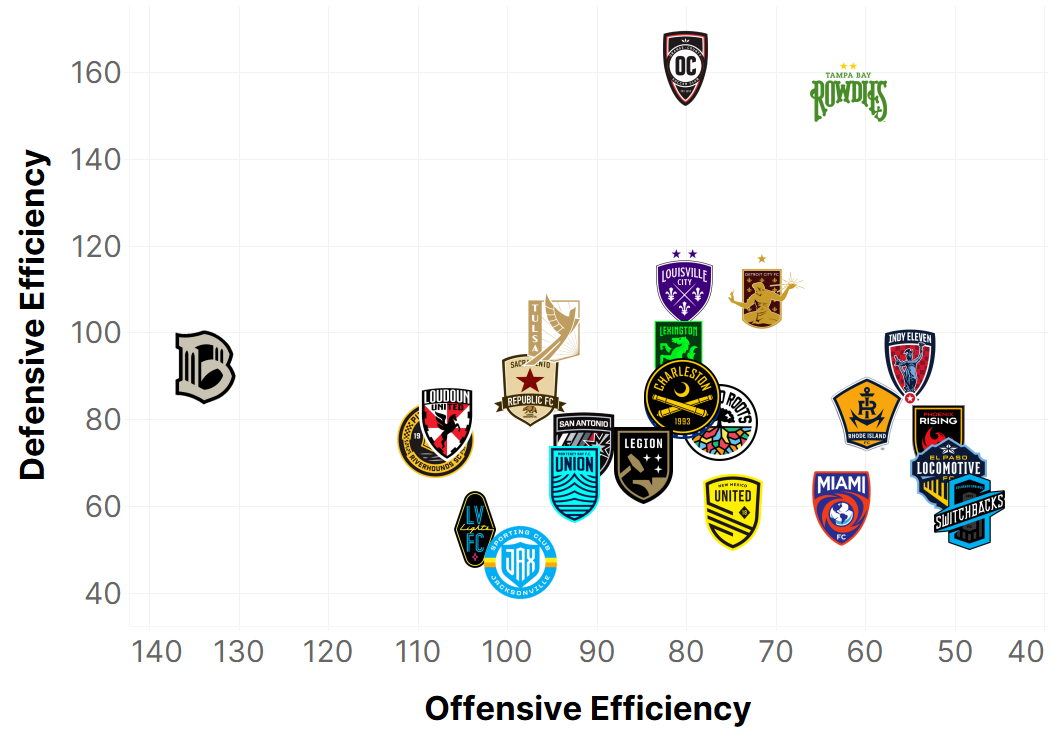
With that “total final-third passes divided by total xG” formula in mind, here’s how the USL Championship shakes out. The average team needs 78 passes in the final third to generate an expected goal – almost exactly the same as in MLS. Over a multi-year basis, that mark is down significantly from the nadir year of 2023, where it took more than 90 final-third passes to generate an expected goal. The downtick meshes with the USL’s trend toward more incisive, vertical styles in recent years.
Who stands out in this year’s landscape? For one, Orange County’s defensive record (161 final-third passes per xG allowed) is utterly remarkable. Readers of my Backheeled work will know how I’ve come around on Danny Stone’s defensive nous, and the numbers bear out OCSC’s excellence. Likewise, Colorado Springs and El Paso have been models of attacking quality, hovering around an efficiency mark of 50. In the Switchbacks’ case, an ability to turn press-driven turnovers into quick chances (and ample penalty kicks) is key; El Paso, meanwhile, makes due because of Amando Moreno, Rubio Rubin, and Alex Mendez’s ability to generate chances in tight spaces and across multiple phases.
By both offensive and defensive measures, the Tampa Bay Rowdies are in elite territory. Their defense (155) is of comparable quality to Orange County’s, and their attack (61) ranks 6th in the USL in terms of efficiency. The way that Dom Casciato has organized the Rowdies into a field-tilting 4-2-2-2 is making it happen.
That structure is clearly seen here, exemplified in Tampa Bay’s 2-0 win over Sarasota over the weekend in the USL Cup. In that match, the Rowdies skewed toward more of a 4-2-3-1, but their usual positional principles still reared around to challenge the Paradise block.
Here, Tampa Bay starts at the halfway line, with midfielder Lewis Hilton and defender Nathan DosSantos playing catch with the ball. Despite the shape change further ahead, you still see players like Evan Conway and Louis Perez (i.e., the starting wingers) flowing across lines to fill forward-esque positions alongside Karsen Henderlong.
Here, DosSantos finds Perez between the lines; the receiver instantly knows that Conway is available in close proximity, occupying a center back in Sarasota’s 5-2-3. Though fellow attacker Mattheus Oliveira is slightly offscreen, he’s still helping to create a boxy “front four” that keeps Sarasota pinned narrow. As Perez and Conway interplay within that shape and curl around one another, Sarasota is forced to get even tighter. Thus, fullback Charlie Ostrem is able to overlap into space, creating a passing triangle up the sideline.
There’s plenty of geometry at play, but the result is clear: Tampa Bay only needs a handful of final-third passes to find a serve across the 18-yard box. This exact sequence doesn’t yield any xG, but it shows the principles that’ve made the Rowdies a juggernaut.
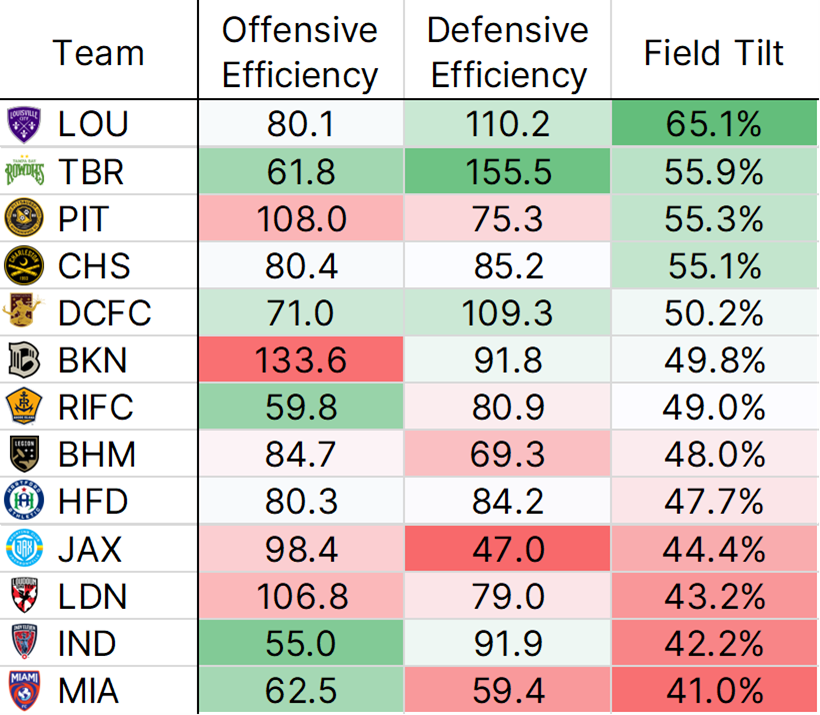
Still, how do you paint a more complete picture? Efficiency is great, but a team that’s playing less final-third passes and absorbing more of them can’t flex that mettle. By adding field tilt into the mix, it’s possible to understand (1) the extent to which a team controls the pitch and (2) how they fare at both ends. You see that here for the East…
…and here for the West…
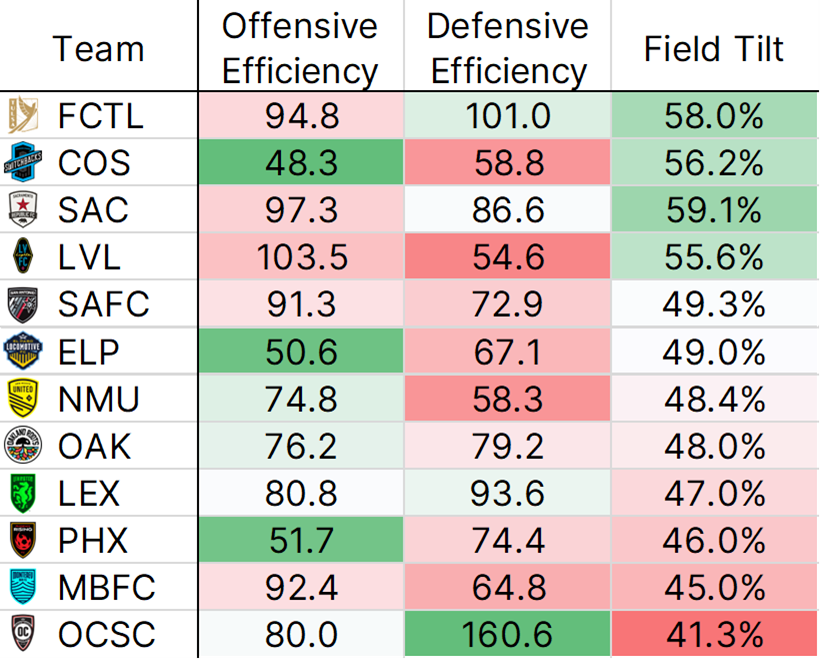
…to gain that holistic sense of understanding.
Suddenly, there's a more complex picture on display. Orange County, for instance, is a wonderful defensive team that's spending a ton of time in the act of defending. Tulsa, meanwhile, lives in the final third but is very inefficient while they're close to goal. Jacksonville doesn't control territory, doesn't make stops, and can't score when they're around the 18-yard box.
Lexington has been relatively underwhelming thus far in 2026, yet the numbers add complexity to that assumption. This team is 4th in the West for defensive efficiency (93.6) and 6th in offensive efficiency (80.8), yet they're nearer to the bottom of the table in terms of field tilt. LSC is good when they control the pitch, but they aren't great at attaining that control – at least not yet.
Over the weekend, Lexington took on USL League One's Forward Madison, a team that ranks 17th in their division with a 41.6% field tilt so far in 2026. This time around, LSC showed their full potential as an incredibly incisive, domineering side.
Take this sequence. On one side, Madison’s 5-2-3ish press is unable to disrupt possession, thus minimizing opportunities to regain the ball and potentially tilt the field in a positive manner. Likewise, there are issues in the defensive line. One of the Mingos’ center backs steps up against Malik Henry-Scott (here, serving as Lexington’s No. 10 in the left pocket) and loses track of striker Phillip Goodrum. As a result, LSC will be able to find Goodrum over the top and create a quick xG-generating shot.
On Lexington’s side, this is the kind of efficient sequence they’ve only been able to create in fits and starts throughout 2025. Their 2-3-2-3ish structure has enough safety at the back to withstand the press, but there’s an undeniable vertical threat that menaces Madison and challenges their back five’s positioning. Lexington hits a long ball here, but this “dual No. 10” construction would be equally conducive to a driven pass to an attacker’s feet.
A matchup across divisions isn’t the purest measuring stick, but this is the kind of chance that bodes well for Lexington’s ongoing improvement. For Madison, meanwhile, it’s a somewhat uncharacteristic allowance for a club that’s been fairly organized in spite of their poor field tilt.
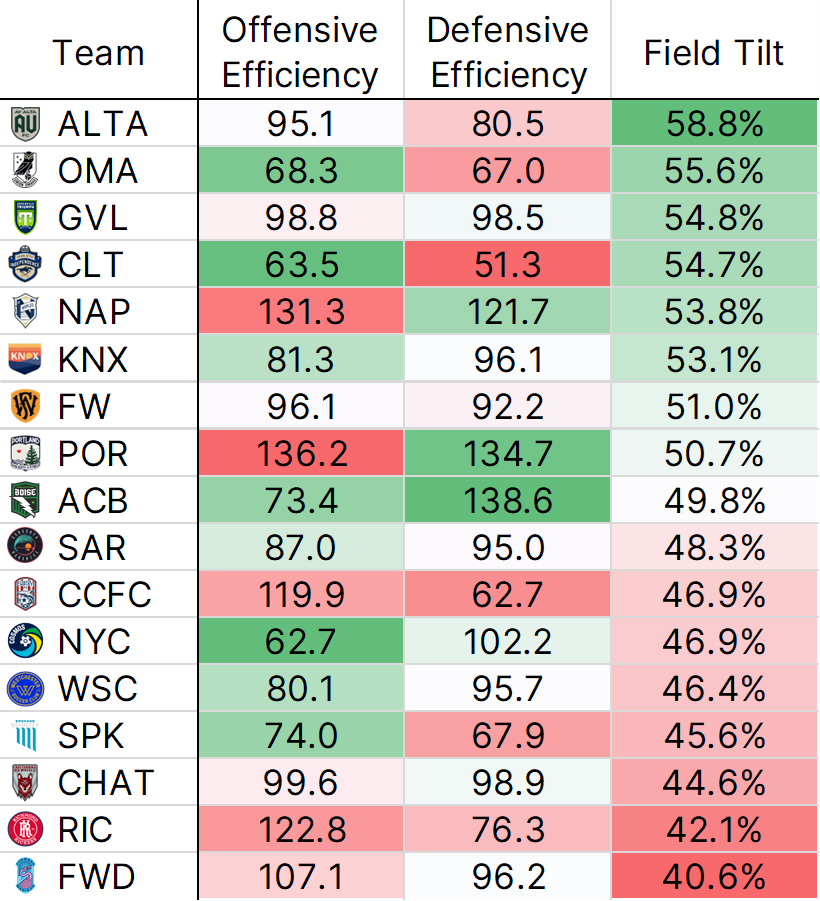
In League One play – where the average efficiency is 87 final-third passes per xG – Athletic Club Boise is the closest thing to a Tampa Bay-style triple threat, the kind of team that’s efficient at both ends and territorially dominant. Even so, their 50% field tilt is (obviously) closer to the median than the top of the table. You could make the case for One Knox as well. For now, they’re the only club with a positive field tilt and top-eight returns in both efficiency categories.
Portland stands out because of the extremity of their numbers. Bobby Murphy has stuck to a vertical, pressureful tactical system in 2026, but the returns have been downright weird. Almost no other team can match their defensive quality, but they’re dead last in League One because of the 136 final-third passes they’re taking to earn each expected goal.
While Hearts have mostly been able to control the pitch and slow down their opponents, Saturday’s USL Cup matchup against Westchester was a different story. George Gjokaj’s side took just 56 passes to generate each of their expected goals. While that number was aided by a Conor McGlynn penalty kick, the incisive nature of their offense was impossible to miss.
Westchester finished the weekend’s 2-2 draw with a 53% edge in terms of field tilt, allowing merely 0.79 xG along the way. Sequences like you’re seeing above are the reason why.
Westchester generally tends to keep four players (give or take) deep as stanchions in their rest defense, and that’s seen here. WSC’s 4-2-3-1 bends upfield through right back Jonathan Jimenez; meanwhile, left back Charlie Dickerson sits in as Daniel Bouman takes up a very moderate position at the No. 6 spot. Because of that solid base, there’s freedom to interchange further upfield.
There, midfielder Aidan Borra has pushed towards Portland’s defensive line, so winger Kyle Evans drops in to receive and potentially benefit off that run. Evans tries to initiate a sequence of one-touch passes into Borra by way of McGlynn at the No. 10 spot, but it doesn't quite come off. Still, WSC recovers into a strong counterpressing 4-2-3-1 immediately.
That transition recovery stops Portland from quickly getting into the final third and finding an efficient offensive chance – something that was their calling card across 2025. In the freeze frame, you see how Westchester gets it done as follows:
- Bouman (marked in blue as part of the 4-2-3-1's pivot) shadows the central area, preventing a driven pass up the middle.
- McGlynn (in yellow as an attacking mid) shadows Michel Poon-Angeron, Portland's tempo-setting No. 6, to prevent Hearts from recycling through one of their safest passers.
- Jimenez (in white as a defender) hugs tight to star winger Ollie Wright, cutting off a passing lane to USL League One's best transition player.
- Dean Guezen charges at the ball, putting the cherry on top of the off-ball coverage everywhere else on the pitch.
Because of that organization, Westchester regains almost immediately. Thereafter, it takes them just two passes to create a shot for Guezen.
"Efficiency" can take many forms. For a team like Westchester, vertical attacking soccer, strong resting structure, and the use of the counterpress make it happen. For Tampa Bay, ball control out of a strict 4-4-2 shape is the model. Some teams are happy to defy efficiency numbers, so long as they're still stifling opponents in low block. There isn't one right way to play the game, but efficiency is a useful lens to analyze where we're at in the USL this far into 2026.
Lexington’s win over Jacksonville
We’ve got ourselves a race in the USL Super League. After Lexington downed Jacksonville by a 2-1 margin over the weekend, bringing the gap between 1st and 2nd place – and, thus, home-field advantage in the postseason – down to a single point. When these clubs last met in February, Jacksonville’s ability to create transition chances defined a statement 3-0 win. This time around, Lexington flipped the script in a truly suffocating team performance.
Kosuke Kimura rolled out an unchanged lineup for a third consecutive week, and it’s clear that this group is finding chemistry. LSC allowed just 0.43 non-penalty xG on Saturday, even while leading for 67 minutes. Their 4-2-2-2 press was wonderfully organized, and their attacking shape – more like a 3-4-3 – was equally so.
Here, the 4-2-2-2 press is in focus. LSC starts in more of a proper 4-4-2, with Sarah Griffith and McKenzie Weinert sitting wider on the edges of the midfield. Jacksonville tends to build with a back three, so Lexington started in an alignment that could outnumber the opposing center backs and then pinch narrow.
You see that action as Sporting tries to pass into the pivot their 3-2-5ish offense. Off the left side, Weinert collapses against the receiver; a line ahead of her, forward Addie McCain is positioned to stop a point-switching pass toward the far sideline that Weinert has vacated. Griffith also hugs narrow, assuring that Jacksonville’s No. 8s will have no time to think.
With Sporting forced to the sideline as a result, another trap is sprung. Darya Rajaee closes from the Lexington pivot, and Alyssa Bourgeois steps from right back to deny Jacksonville a pressure-breaking pass into wingback Meg Hughes. The “front six” (i.e., the lines of two atop the 4-2-2-2) compresses to force a turnover – and it immediately grants LSC possessive structure after the regain.
Here, the ball routes toward Weinert against a scrambling defense once Lexington is in control. A similar defense-to-offense sequence set up another Weinert shot in the 14th minute. That threat was a constant for Kimura and company. As compared to the February match, LSC flipped the script and became the team that controlled post-turnover transitions.
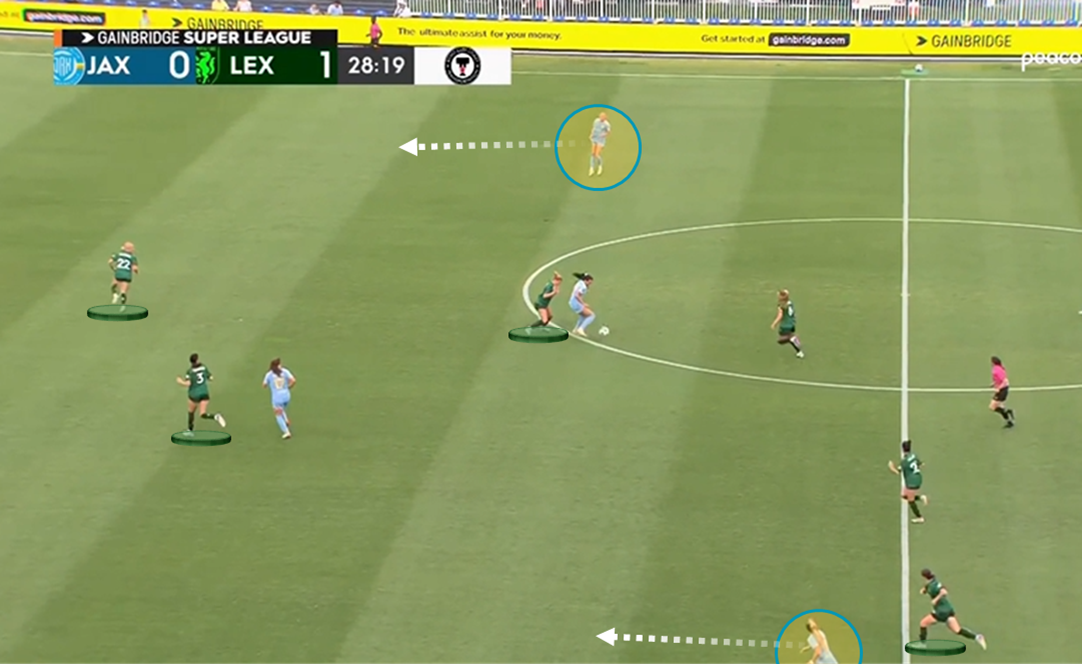
It wasn't all perfect for the away side. In general, Jacksonville's 3-2-5ish build shape is predicated around high wingback play, and that presented a real threat when the press was broken. LSC’s front lines mostly controlled the match, but they could overextend at the expense of their back line.
Here, you see the consequences of one such break. In this case, Stacey Balaam's side has dropped star attacker Ashlyn Puerta deep as an extra set of feet – she isn’t even visible in the frame. All the while, Bourgeois and the No. 8s are goaded upfield. A sequence of quick one-two passes breaks the 4-2-2-2 and, thus, can work into forward Paige Kenton at her feet (the moment seen in the frame).
With Bourgeois beaten and left back Ally Brown forced to tuck inside against Kenton, the wingbacks are in acres of space. Moments after this screenshot, Jacksonville will find Hughes up the left and earn their game-tying penalty.
Ultimately, that sequence was the exception that proved the rule. More often than not, Lexington frustrated Jacksonville's usual patterns. Those consistent personnel choices on Kimura's part clearly helped the matter. Last time these teams met, Darya Rajaee hadn’t yet made her post-transfer debut. Griffith wasn’t in the lineup in February, but her ability to tuck narrow was critical, too. The numbers reflected that performance, given that Griffith attempted 23(!) duels.
Here, both players are key in the wake of a build turnover. Lexington is seen in their 3-2-5ish attacking shape, with Brown tucking in like a third center back and Bourgeois flying high upfield. There’s an attempt at a line-breaking pass into Griffith, but it’s turned over.
Back in February, this might’ve spelled trouble. Here, though, the LSC response is perfect. Rajaee knows that there isn’t a right back present, so she sprints to fill out the defensive line. Meanwhile, Griffith recovers centrally to become a Rajaee-esque No. 6 and put stress on the ball. Their effort gives center back Allison Pantuso the confidence to step up, too, halting Jacksonville and forcing them into a wasteful shot from distance.
In terms of a transition defensive structure, you can’t do much better. Even the slickest offensive teams give the ball away occasionally, but few are defending like this after it happens.
As seen, breaking through Jacksonville’s 5-1-2-2 press had its difficulties. Even so, LSC trusted the process, using Addie McCain, Catherine Barry, and a tucked-in Griffith to receive between lines and quickly one-two their way into dangerous spaces. The offensive look was almost "Y"-shaped, defined by Weinert and Bourgeois’ ability to push up the sidelines and punish overcommitment on Sporting’s part.
When Lexington got on the board in the 18th minute, the sequence started with Griffith-to-Weinert zone entry. A chance didn’t arrive immediately, but Weinert’s choice to stay in the 18-yard box drew Jacksonville tight and mixed up their coverage. Thus, midfielder Taylor Aylmer could fill the left flank and pick out a cross to set up the go-ahead goal.
Right now, no other team in the Super League is playing with such clear principles. Lexington has enjoyed a sense of tactical vision throughout the 2025-2026 season, but they’ve never looked this assured in deploying them. That’s a credit to Kimura, but also to players like Griffith and Rajaee that have emerged as linchpins in the latter half of the campaign.
(Because this is the efficiency issue: Jacksonville's average offensive efficiency this season is 66 final-third passes per expected goal. Against Lexington's stifling defense, that number was 241.)
In other news…
Super League note: DC Power put up 4.59 non-penalty xG in their absolute drubbing of Fort Lauderdale last week, a full expected goal higher than any other team in a game this season. That's remarkable!
Pick it off ✅
— Gainbridge Super League (@GainbridgeSL) April 23, 2026
Pick up a goal ✅@LozaAbera bags her fourth goal in as many matches against Fort Lauderdale United to double @DCPowerFC's lead! 🔥 pic.twitter.com/lZ03onJNWY
Power has been a slick possession team in the 2025-2026 campaign, but it was their defensive intensity that overwhelmed United. Omid Namazi's 4-4-2ish press completely denied the central midfield while using takeaways as a springboard to create short-field chances. That's clear above, where the formation briefly sinks into 4-5-1 mode to create a takeaway before furnishing Loza Abera with a chance.
Emina Ekic's transfer to the Houston Dash in the NWSL is a big statement for the Super League, and it'll hopefully be a proof-of-concept that allows other high performers to get a shot at the highest level. In another sense, Ekic’s move is a very particular win for Lexington. This club is willing to sell, and they’ve built contingencies to feel comfortable in doing so. No one else in the Super League has a Sarah Griffith waiting to displace someone of Ekic’s caliber.
There’s more on the way, too. LSC has signed NCAA standouts like Ally Brown (currently starring at left back) and Gracie Falla (now on a pre-contract that’ll kick in after her college career ends) on multi-year deals that'll pay off in the short term and set the table for potential future transfers. That's a level of forethought that's unmatched anywhere else in the USL.
Across all USL competitions, your co-leaders in through balls (with four across 2026) are…
- Charleston’s Jeremy Kelly, which is probably very predictable. Kelly has been terrific on the Battery’s left, instantly connecting with Nathan Messer and picking spots to switch play for the dribble.
- Miami’s Rodrigo Da Costa, which is decidedly not predictable. Da Costa scored 42 goals between 2021 and 2024 while playing exclusively as a forward, but he’s been reinvented as a creative No. 6 at Pitbull Stadium. Very fun!
They're calling it the first good post in the history of Reddit.