The Back Four: Pre-Prinx
Featuring Week 7 takeaways and the Super League’s contenders

Welcome in to The Back Four!
As always, visit Backheeled for more USL content, including deep dives into all things Championship and League One. Also, listen to This League! and The USL Show to catch up in podcast form.
Without further ado, let’s get to it.
Shape-shifting in League One
Fort Wayne is sitting on one win and a minus-three goal difference at the moment, but I love when they do things like this:
You can see the Bees’ formation bend in real time, moving from an out-of-possession back four into something akin to a 3-2-5. Right back JP Jordan is the hinge piece. A former standout at the University of Louisville, Jordan mostly played as a No. 8 in his rookie season with Texoma FC. He’s played there in Fort Wayne already, but this clip sees the 23-year-old doing something different: he moves from a fullback spot into the defensive midfield to help achieve the shape change.
As Jordan slips into the pivot, his teammates boot the ball upfield and a chain reaction occurs. Jordan becomes a No. 6; Ryan Becher, marked in black as part of the 4-4-2’s off-ball pivot, slides ahead like a forward to connect play; the actual forwards (marked in white) probe beside him and help achieve a proper five-man front.
Eventually, Jordan is there to make a high recovery and keep an offensive sequence going as opposing Chattanooga is pinned hopelessly deep. There isn't a great chance at the end of it all, but the fact that the Bees creates an opportunity is a byproduct of their flexibility.
Fort Wayne isn't the only team in League One to mix it up. Portland has tried back threes and back fours in 2026, though they haven’t crossed the streams in a single match. Richmond is in a similar camp, often centered around Mujeeb Murana's hinging up the right. Charlotte has come closest to matching Fort Wayne’s flexibility through Clay Dimick, though their 4-2-3-1's ability to bend into a back-three attacking shape was limited in Week 7.
I don't think Madison wholly fits into this category of shape shifters, but their use of defender Collin McCamy is close enough to require examination. Whether used as a marker in situations like this...
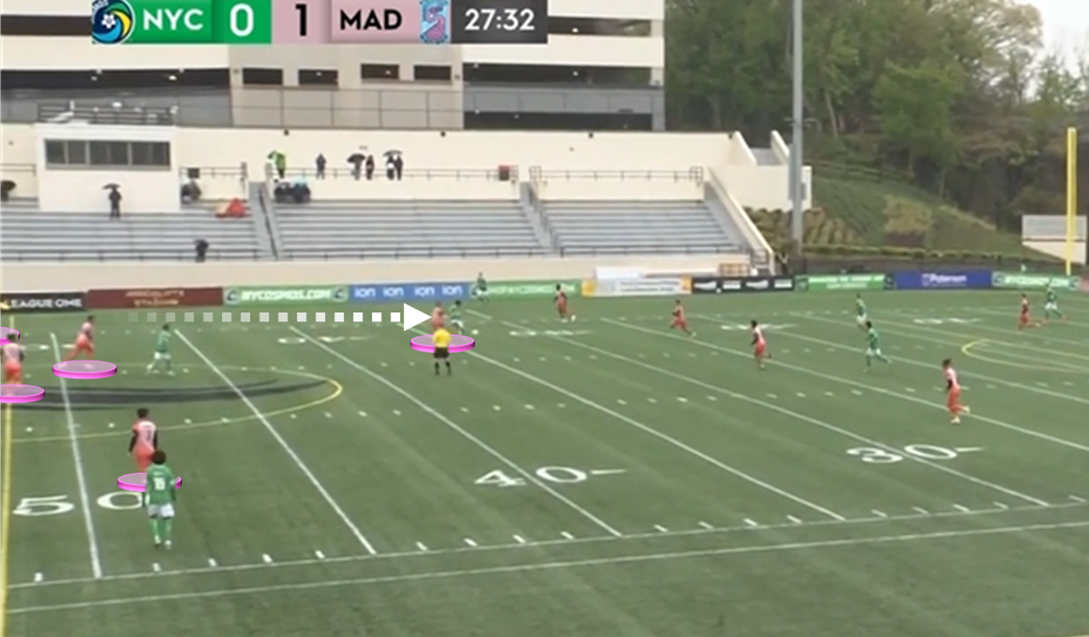
...or free to push ahead as a carrier amidst plays like this...
...McCamy allows Forward Madison to avoid the downsides of a flat 5-4-1. Consider the clip, where the Mingos start in more of a possession-minded 3-4-3. As play resets, goalkeeper JT Harms steps into the back line and essentially takes on the role of the third center back. Because of that shift, McCamy is allowed to flex upfield.
The defender receives after Madison breaks a line, carrying into the attacking zone. While McCamy is ultimately dispossessed, it’s easy to imagine an alternative where he finds a No. 10 at their feet or plays Geni Kanyane into space at wingback. More importantly, Madison’s structure isn’t broken after the turnover; both Roman Torres and Jacob Castro rotate from the pivot to stop a break, and center back Kevin Carmichael is there to backstop them.
That kind of variety between phases and positional flexibility isn’t the only way to win in League One, but it allows clubs like Fort Wayne FC and Forward Madison to stay fresh. The division’s increasing parity adds importance to matchup-specific tweaks, and every bit of malleability counts when the margins are so thin in 2026.
Brooklyn and maximizing the pitch
A week back, Brooklyn FC walked away with a 3-0 win over the Charleston Battery thanks to their marriage of a narrow defensive shape and razor-sharp counter. They doubled up with a draw-that-should've-been-a-win against Sacramento this week. Brooklyn’s is the kind of system that can work in many contexts, but it’s especially well-suited toward the baseball-turned-soccer confines of Maimonides Park.
In 2025, FC Tulsa and first-year manager Luke Spencer found themselves in a similar situation. ONEOK Field is a lovely venue, but it’s designed for baseball and yields a narrow pitch when adapted for the beautiful game. I don’t necessarily think Marlon LeBlanc is modeling his system off of Spencer’s; there’s plenty of distinction between Tulsa’s three-at-the-back, hyper-vertical look and Brooklyn’s more moderate back four. Still, the common bond is that ability to adapt to one’s environment.
Expansion side Brooklyn FC sits just outside the playoff spots in the USL Championship after a 3-0 win over Charleston. From this week’s TL! tactics board. Full segment below. 📺 tinyurl.com/4wh8hxkb 🎙️ tinyurl.com/2t6e2mk9 ➡️ tinyurl.com/4csvppbc
— Backheeled (@backheeled.com) 2026-04-14T17:41:36.422Z
In assessing the Brooklyn defense on This League! last week, we spotlit that optimization of system and environment. By pressing in a 4-1-3-2 and clogging the channels against the Battery, the expansion side proved utterly suffocating. Similar tenets applied versus the Republic.
Still, Brooklyn isn't one-note. They can play a narrow defensive game, but they're quick and expansive after regaining the ball. CJ Olney is progressive as a passer off the left; Jaden Servania’s off-ball movement is endlessly incisive. Most importantly, Markus Anderson – good for 86th percentile xA (0.16 per 90) 98th percentile dribbles (2.6 per 90) thus far – is consistently able to beat defenders as they track back.
That mix of talent lets LeBlanc's side shift from phase to phase with gusto. This season, Brooklyn’s spiritual predecessors in Tulsa have failed to find that same balance. Spencer and co. have still been absolutely dominant in a defensive sense, using a compact 5-4-1 shape to limit opponents to 0.8 xG per 90 this year. Red card hijinks aside, they looked as confident as ever in a 1-1 draw at Oakland over the weekend.
On the flip side, Tulsa hasn’t found an Anderson-like talisman to spearhead the counter – their system is inherently designed to tilt the pitch in a way that limits full-field breaks in the first place. Tulsa tends to restart long and prioritize vertically; they don’t spend much time in their low block. Spencer’s side entered the weekend fourth in the Championship with a 61% field tilt and have spent a lot of time against parked buses.
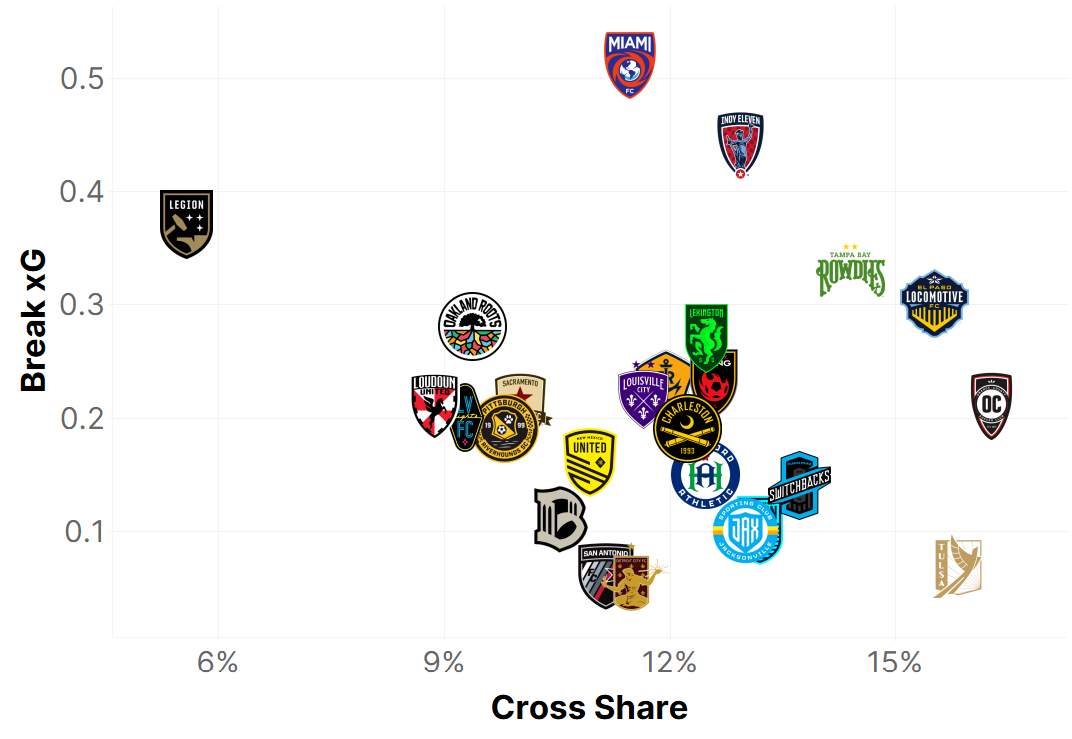
Tulsa led USL with 0.29 break xG per 90 last season; this year, they’re ranked 24th with 0.07 break xG per game. Moreover, they’ve become increasingly un-incisive in the attacking zone. More than 15% of Tulsa’s touches in the final third have been open-play crosses, a mark only exceeded by Orange County. In other words, the reigning Western Conference champs are settling for low-percentage wide service and failing to work the ball inside.
Now, that crossing share is only slightly higher than the club’s 2025 mark, but it pairs with the declining transition returns to paint a particular picture. Tulsa is getting bogged down, but they aren’t breaking up the dry spells with success in high-tempo moments. It’s not for lack of trying; on Saturday against Oakland, Spencer often shifted his press into more of a 5-3-2 iteration that sought to set the table in a Brooklyn-esque manner.
I’m still holding my Tulsa stock, but there’s an increasing sense their middling start to 2026 goes deeper than the loss of all-league striker Taylor Calheira. This organization knows how to get the job done, but they aren’t doing what’s needed to turn a suffocating defensive stance into the kind of attack that’ll fly at ONEOK Stadium – or anywhere else, for that matter.
Super League
Possession and field tilt – the share of a match’s final-third that your team controls, in other words – are linked to a certain degree, but the Super League shows that it isn’t always the case. How often you’re passing the ball is important, but where you’re winning it is equally crucial.
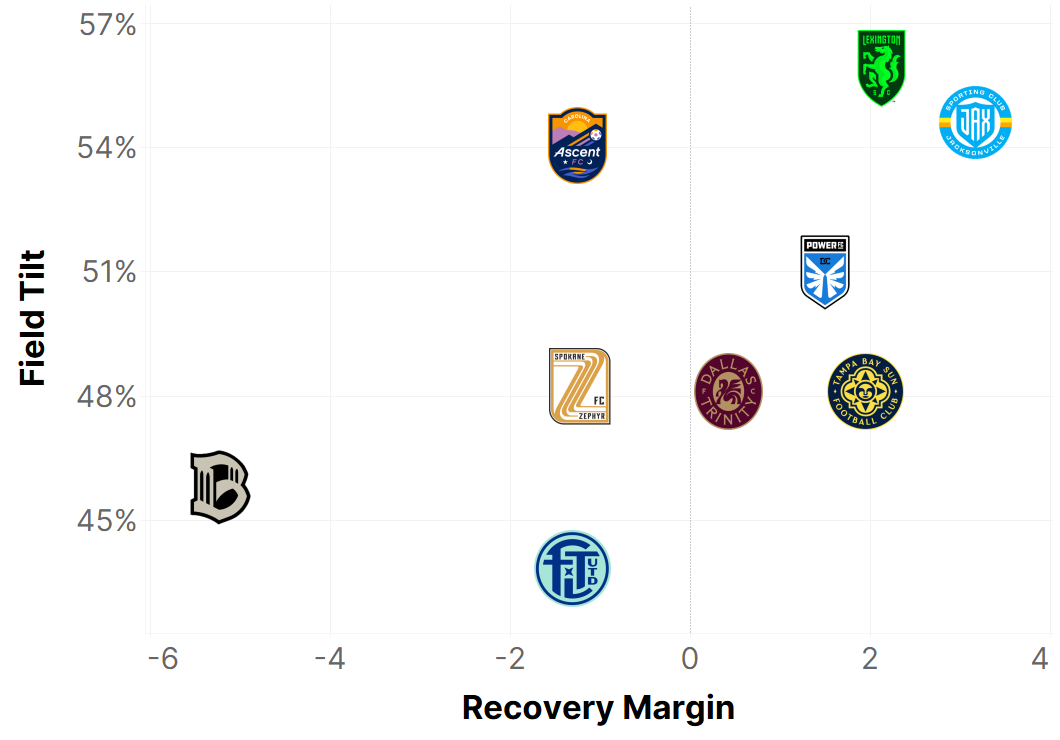
Clubs like Jacksonville do both things at a high level. They lead the division in recovery margin (+3.2 per 90) and possession (56%) while ranking second in field tilt. Lexington is comparable, yet they’re the most territorially dominant team in the Super League because players like defensive midfielder Taylor Aylmer (5.8 recoveries per 90) and center back Allison Pantuso (5.6) are elite in second-ball situations.
Still, it’s easy to oversimplify. The Carolina Ascent rank sixth in the Super League for possession, but their system is all about denial. Phillip Poole’s gritty 4-4-2 stops the opposition from finding rhythm. Carolina is toward the bottom of the league in terms of their recovery margin, yet they only allow 91 final-third passes per game – a number that ranks second in the division.
Those disparate ways to achieve the same end were all on show in Week 27. Jacksonville lost, but both Carolina and Lexington illustrated what’s gone right all year long.
In a game against Dallas that was tied for 89 minutes, the Ascent were firmly in bend-don't-break mode while conceding 60% of the ball. Still, Carolina successfully kept a clean sheet and limited Trinity to just 0.9 xG in the run of play – though, somewhat unexpectedly, set piece and fast break situations were problematic.
At times, Carolina left themselves vulnerable when pushing ahead into the attacking zone. Dallas’ Lexi Missimo was incredibly smart in zone-exit situations, popping up behind the Ascent pivot to receive or, alternatively, serve as a stalking horse to free up others. You can blame the absences of Sydney Studer and Jill Aguilera for some of the frailties, yet the Ascent’s back line did well enough to deny Dallas from scoring off any of those breaks.
In their 4-4-2 block, things were far more assured. The clip above doesn’t go perfectly for Carolina, but it shows how their all-hands-on-deck block has frustrated opponents.
Here, Dallas starts from the back and dribbles around the opposing No. 9s, quickly finding a passing lane toward Carolina’s right side. This was about as easy as line-breaking got against the Ascent, but the reaction is timely nonetheless. Right winger Tyler Lussi and defensive mid Lily Nabet both track deep in support; left winger Audrey Coleman skews inside, crowding the 18-yard box. Dallas is able to find Missimo with a cross, but she has absolutely no room to operate.
The Ascent’s ensuing clearance doesn’t eliminate the danger, but they’ve got enough numbers deep to continue frustrating Dallas. Another cross comes in, but this one sails over the jam-packed box and will eventually roll out for a Carolina throw.
These sequences don’t show how Poole’s side has been able to tilt the field, but they’re emblematic of Carolina’s relatively unique style of play as compared to the Super League’s other contenders. Lexington, for instance, set the tone in their 4-0 rout against Tampa Bay over the weekend by virtue of their high press.
Here, LSC skews their 4-4-2's midfield to get the job done. As the Sun take a throw-in, left winger McKenzie Weinert has drifted all the way to the opposite third of the pitch, supporting aggressive pressure from midfielder Darya Rajaee and ball-side winger Sarah Griffith. All the while, Aylmer sits low as a backstop in space.
When Griffith pokes the ball loose, a scramble ensues. There's a central 50/50, and Aylmer is one step ahead of it. The midfielder claims possession ahead of a Tampa Bay player, one-touching a pass into Weinert before the Sun have any chance to react. Immediately, that combination of field-tilting aggression and a high recovery furnish Weinert with a go-ahead goal.
In a game where Lexington led for 70 minutes, they still ended up at parity with the Sun in terms of attacking-half ball recoveries. This team is incredibly good at using their press to dictate where the game is played, and that 20th minute Weinert goal was a premier example. Still, Lexington’s style isn’t the only way to succeed, and that’s why the Super League’s top end has been so fascinating this season.
In other news…
I’ll be doing a mailbag in a week or two because of some scheduling whatnot, so be on the lookout for the question prompt in the near future.
Tyreek Magee’s return to Colorado Springs feels like a big deal. I’ve been fairly critical of the Switchbacks’ up-and-down attack in my weekly Backheeled pieces, but their hard-charging win over Sporting Kansas City (featuring Juan Tejada at striker) and ensuing league victory against Monterey feel illuminating. This team wants to press high and wreak havoc, but they need a technician at the No. 10 spot to turn those moments into attacking opportunities. Adrien Perez is the best player to do it, but Magee – who completed 13 final-third passes and succeeded on 2.7 dribbles per game in 2024 – is built to repeat the trick.
A point on which I will not elaborate: FC Naples’ Andres Ferrin should be playing in the USL Championship next year. (I previewed this take offline and was roundly shouted down, so do with that what you will.)
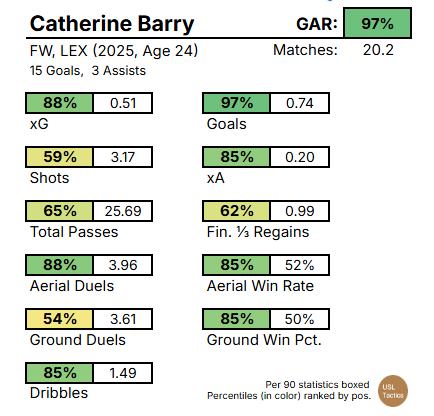
Speaking of Lexington, Catherine Barry is re-defining the Super League’s scoring records and, in my humble opinion, is neck-and-neck with Ashlyn Puerta in the MVP race. Barry’s mix of scoring, hold-up dominance, and intelligent pressing positioning is everything for this Lexington team – a hat trick against Tampa Bay over the weekend continued to prove as much.
Speaking of Puerta: go check out her excellent United Soccer Lounge interview and her profile by Catalina Bush in The IX Sports.
I’m quite pleased with Richmond’s choice to lower Dakota Barnathan into the defensive line and start Ali Sasankhah at the No. 6 spot, and my friends at River City 93 broke it down nicely.
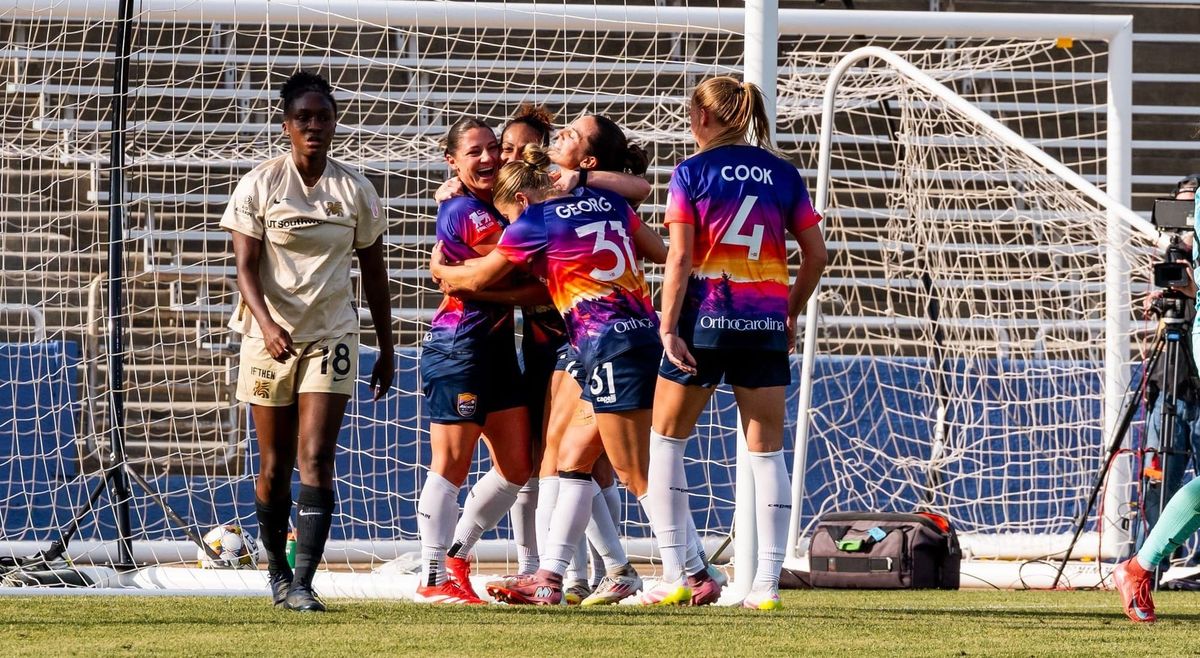
Cover Photo Credit: Carolina Ascent / Twitter