USMNTactics: On the Pochettino press
What did we learn about the Pochettino pressing structure against Senegal and Portugal?

There's been lots of good analysis on the USMNT's possession principles in the run-up to the World Cup, but what about the press? I wanted to dig into Mauricio Pochettino’s setup without the ball given what we saw against Senegal.
As Ben Wright explained on Backheeled, Pochettino has played around with three-, four-, and five-at-the-back formations throughout his tenure. In the United States’ most recent games, we’ve seen a defensive 4-4-2 shift into a 3-2-4-1 in possession. How one formation flows into another has varied. Pochettino got there by shifting a No. 6 into his deepest line against Belgium in March; a game later against Portugal (and in the Senegal win), he did it by hinging fullbacks Alex Freeman and Jedi Robinson high and low, respectively.
Since his Southampton days, Pochettino has been a fairly pressure-forward manager, but his version of the national team is still finding their footing in that regard. You can only learn so much when there’s a mid-game line change, but the USMNT’s performance against Senegal still added useful context to the approach we can expect to see in the World Cup.
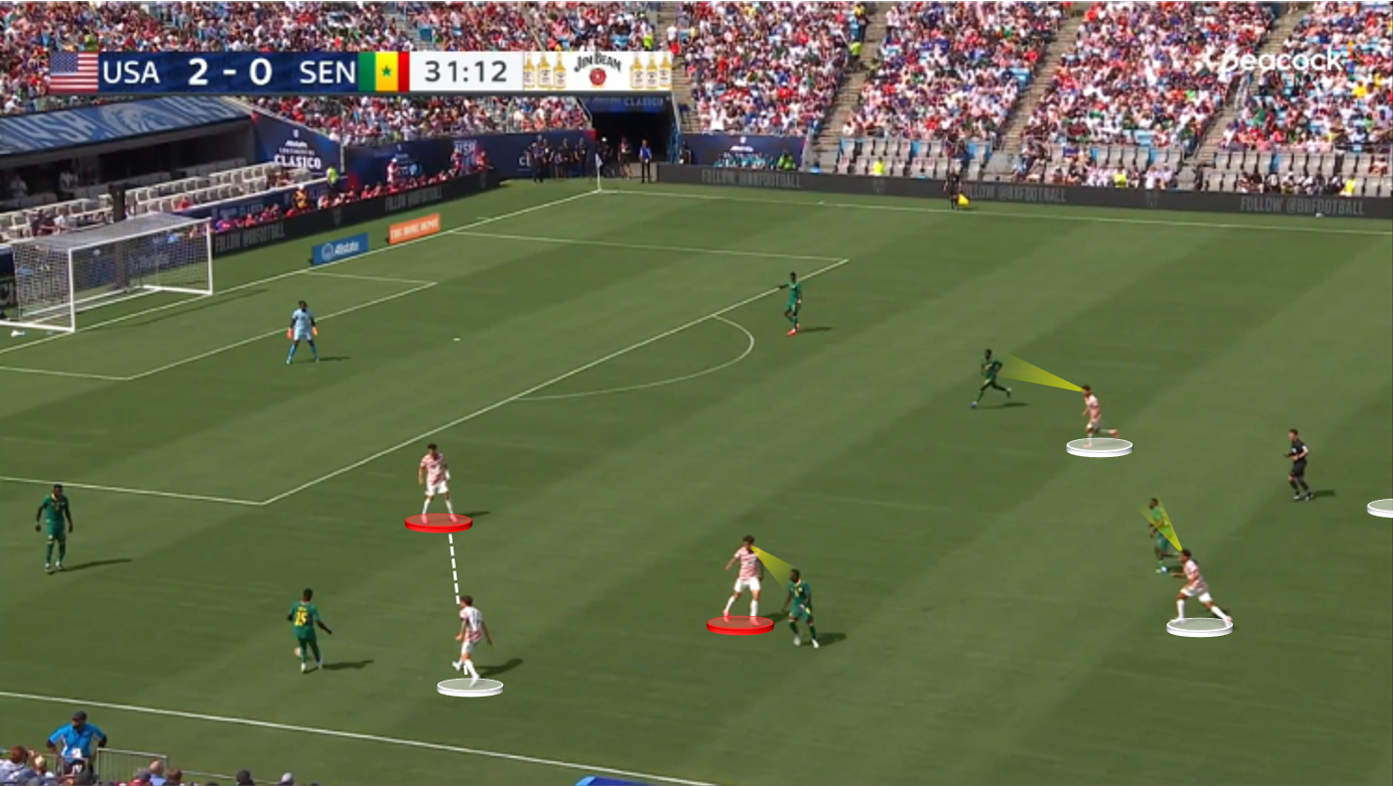
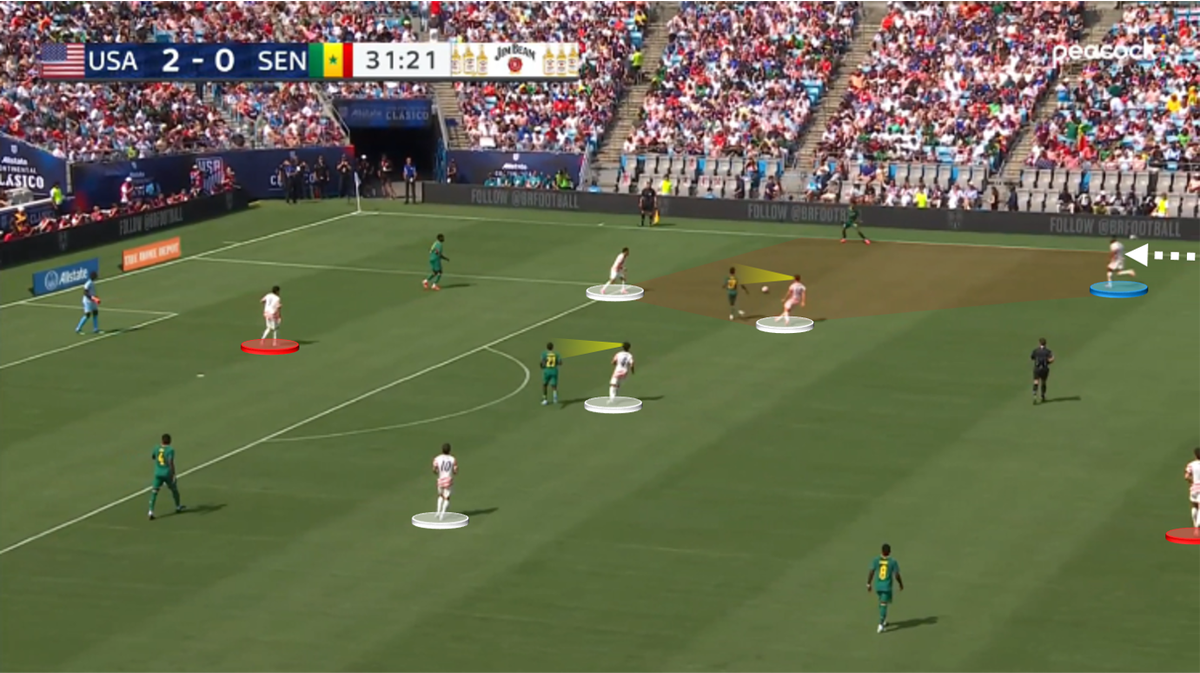
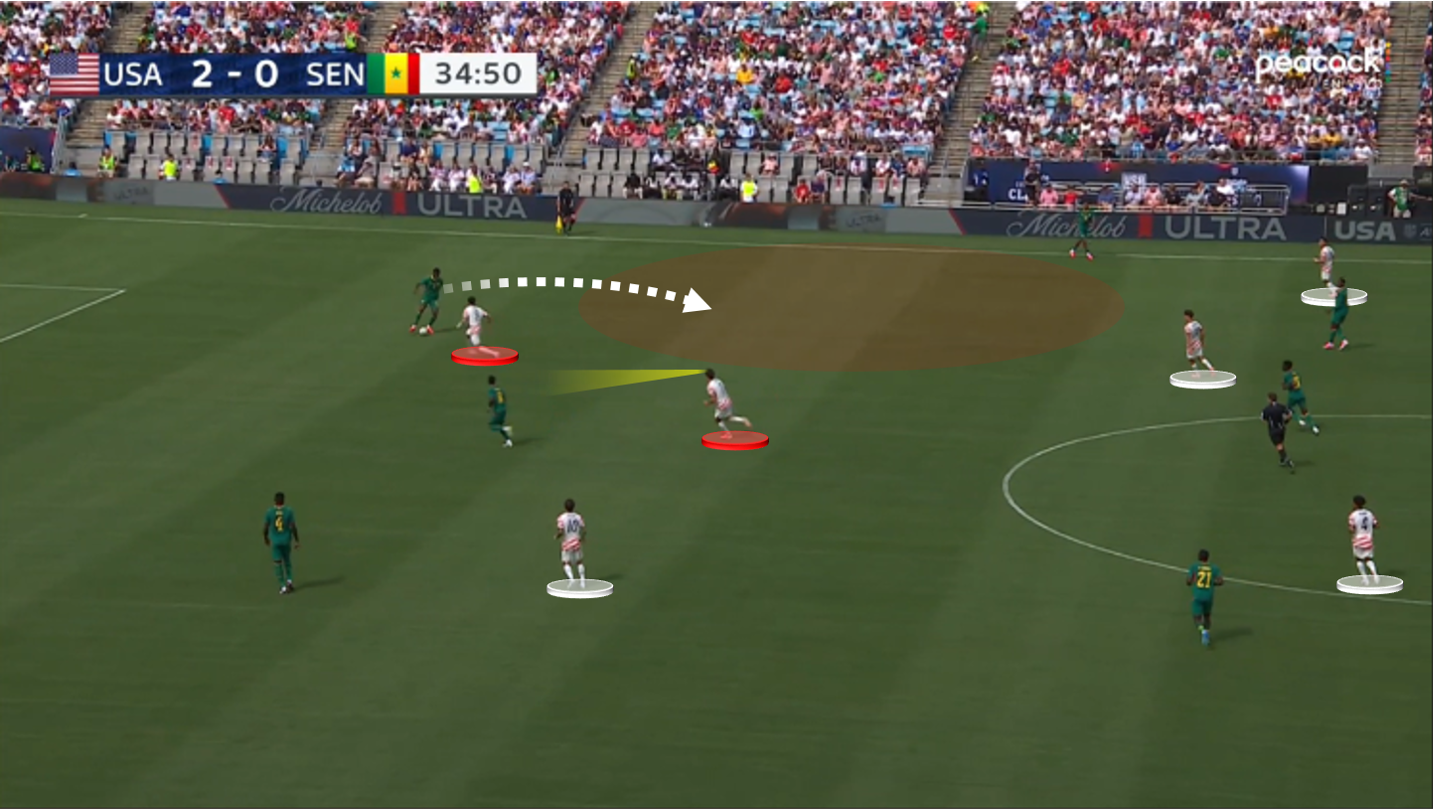
The best-case scenario for the high press looked like this against Senegal, with Gio Reyna (in a No. 10/right halfspace role on the ball) often slotted a level below striker Ricardo Pepi. The 4-2-3-1 operated on similar principles to a classic 4-4-2, aiming to drive play toward the sidelines; calling them different shapes is splitting hairs.
When Senegal restarted from the back, Pepi (red, as a forward) tended to curl his runs toward the opposing center backs, leaving only a sideline outlet available. This frame sees the consequence of that action. Senegal has been forced wide, so they come under pressure via Pepi and left winger Christian Pulisic (white, as a midfielder).
Because a pass has been hit toward the sideline, the American midfielders are triggered to tighten their man marks. Tyler Adams (lower right of the frame) chases a low-swooping attacker; Reyna edges downfield, pursuing one of Senegal’s No. 6s. Left without options, Senegal has to work through their goalkeeper and switch the point.
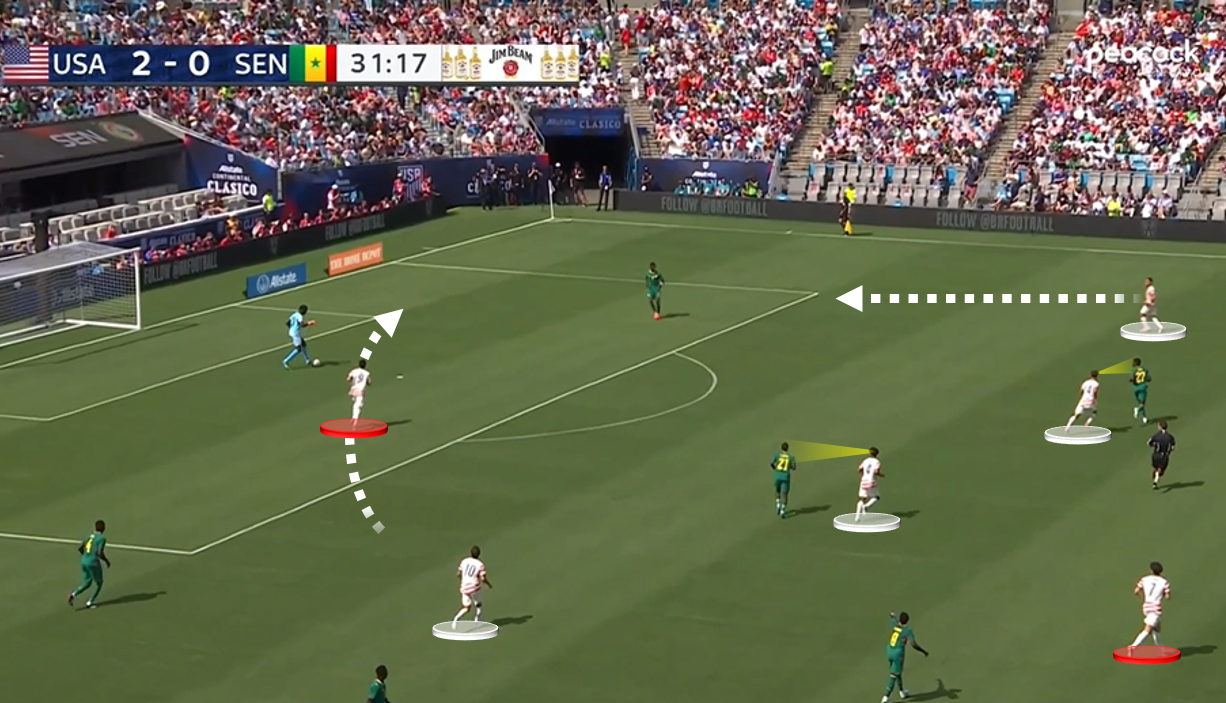
By the time the goalkeeper receives, you can see the press shifting. Pepi recovers to the weak side, curling again to pin the defender that’s about to receive. Through the midfield, Adams and Sebastian Berhalter stay tight to their marks. With that base of support in place, Sergino Dest will be able to fly up the right wing and double against the Senegal center back.
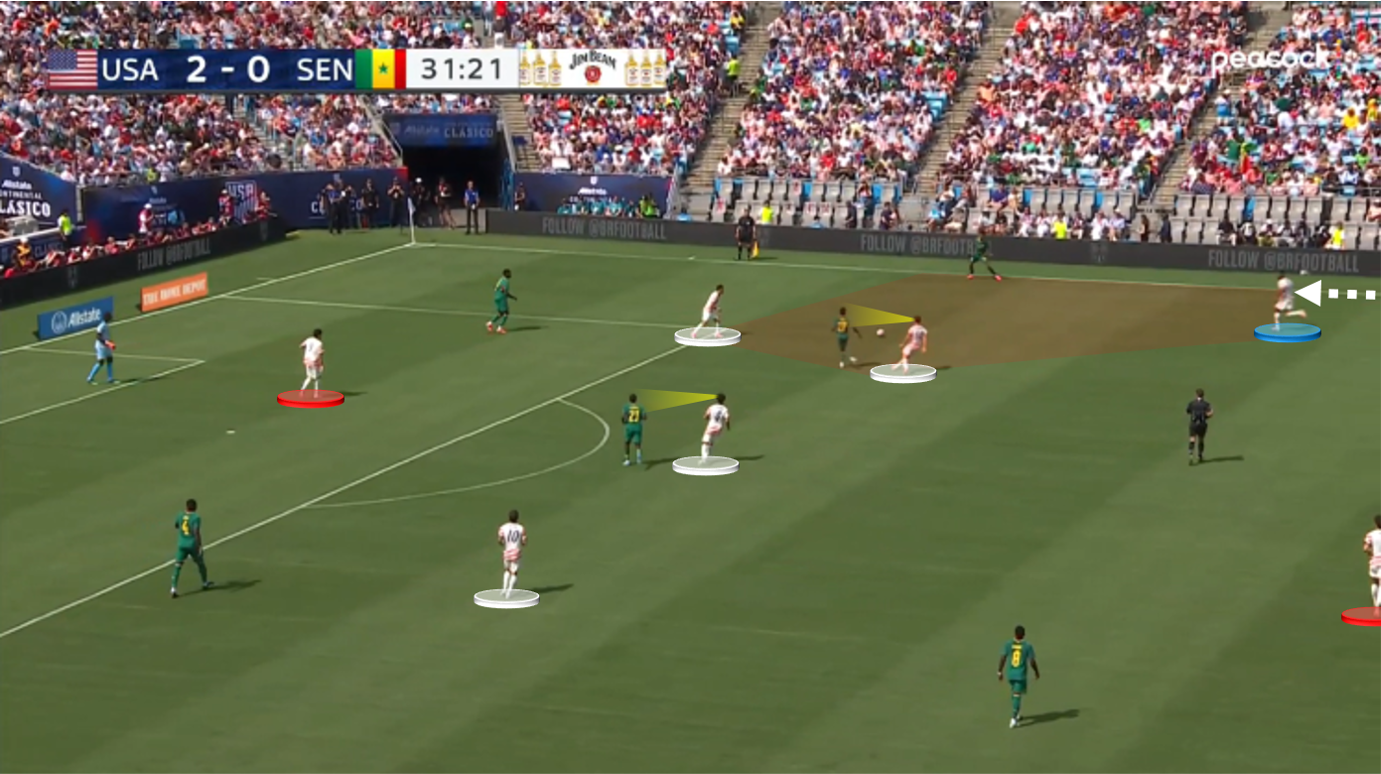
While Senegal will be able to bounce off one of their No. 6s toward the sideline, they’re playing into the trap yet again. This time, the USMNT get a closing run from Freeman (blue) to punctuate the midfield-driven press. The Villareal man will get touch-tight against Senegal’s fullback, denying them any chance to work up the flank. Meanwhile, you can see Reyna (red) barely in frame as he backstops the press as a makeweight No. 6.
Sequences like this will be music to Pochettino’s proverbial ears. His side denies central progression, stays organized as the ball moves from side to side, cleanly rotates, and knows when it’s time for Freeman to overload. It’s how the 4-4-2 is supposed to operate – and a tweak, compared to that 2-0 loss to Portugal where Freeman and Robinson were used far more conservatively at the fullback spots.
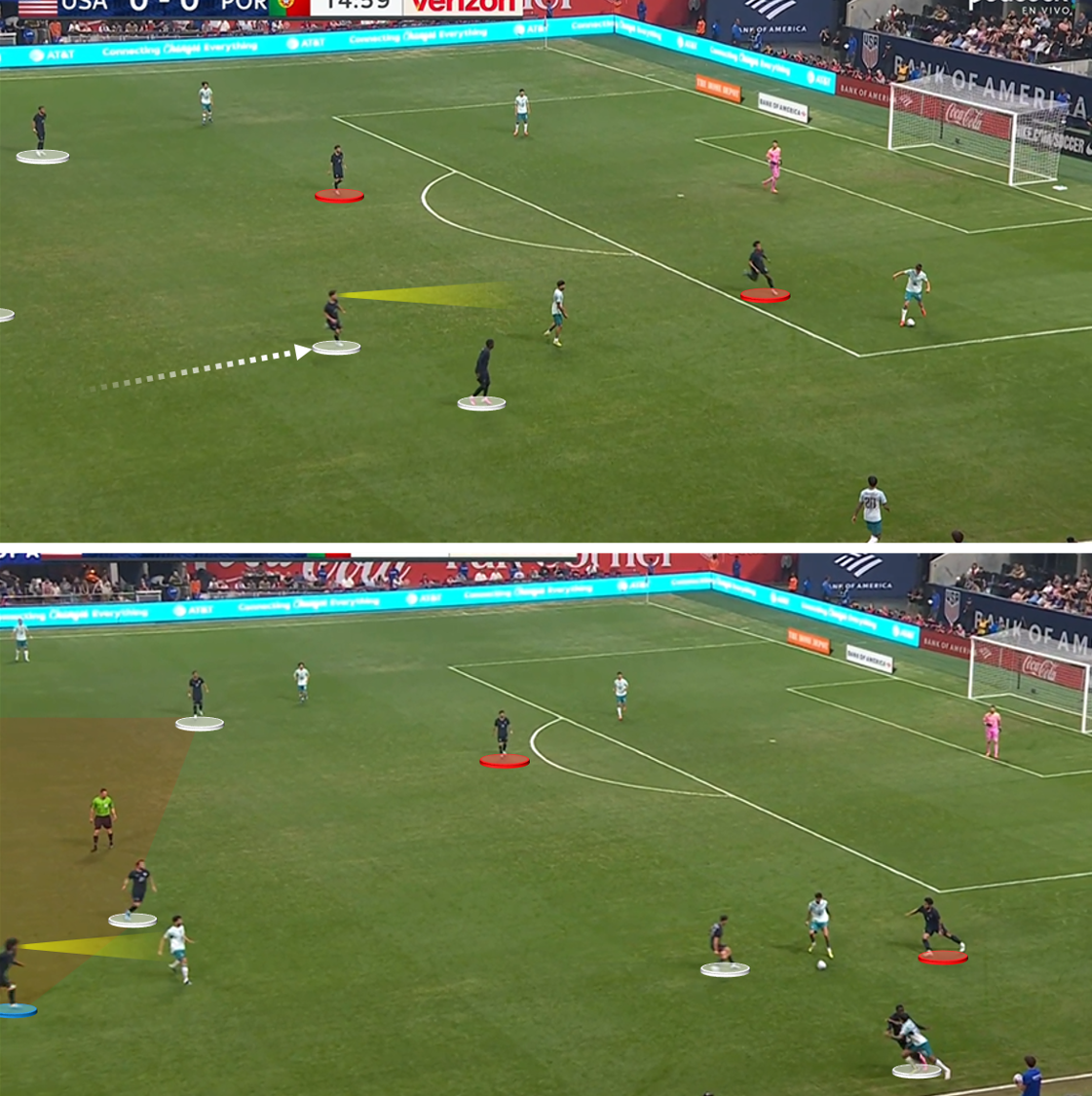
In that Portugal friendly, the USMNT used a far more standard 4-4-2 with Weston McKennie and Pulisic paired up top. Both pressing No. 9s were encouraged to push into the opposing box. Behind them, Aidan Morris and Berhalter shared the pivot. You’d occasionally see one of those No. 6s step as a marker, basically shifting the midfield shape into a diamond or 4-1-3-2.
That was all by design: as you see above, that orientation in the pressing phase accomplished the same end of driving the opposition to the sideline. Here, McKennie (red, a forward) and Timothy Weah (white, on the right wing) help pin Portugal across two frames.
Noticeably, there isn’t help from the fullbacks. In this match, Pochettino wanted Freeman and Robinson to sit deeper but granted center backs Chris Richards and Auston Trusty more freedom to step into the midfield. Doing so would help cover for the more elevated 4-1-3-2 moments, allowing the USMNT to deny Vitinha and Bruno Fernandes man-for-man between the lines.
Where have things gone wrong amidst Pochettino’s varied approaches? Against Senegal, there were a handful of moments where support behind the first phase of pressure didn’t arrive. Using Reyna as more of a No. 10 had its merits, but the USMNT didn’t always respond when he overstepped or was dragged out.
Here, for instance, Senegal’s No. 6 drops between the center backs, pulling a half-hearted Reyna with him. Right away, there are problems:
- Reyna wants to track the midfielder, but that player won’t actually be dangerous if he receives so deep.
- Pepi’s curled closing runs were predicated on the idea that Senegal’s center backs wouldn’t dribble against the direction of the pressure. Because there’s a resting backstop arriving, that center back is suddenly liberated to dribble.
- Berhalter and Adams are holding a deeper line in this mid-block scenario, and neither steps to cover under Reyna’s closing run.
No one knows what the response should be, and that means Pepi is easily dribbled past.
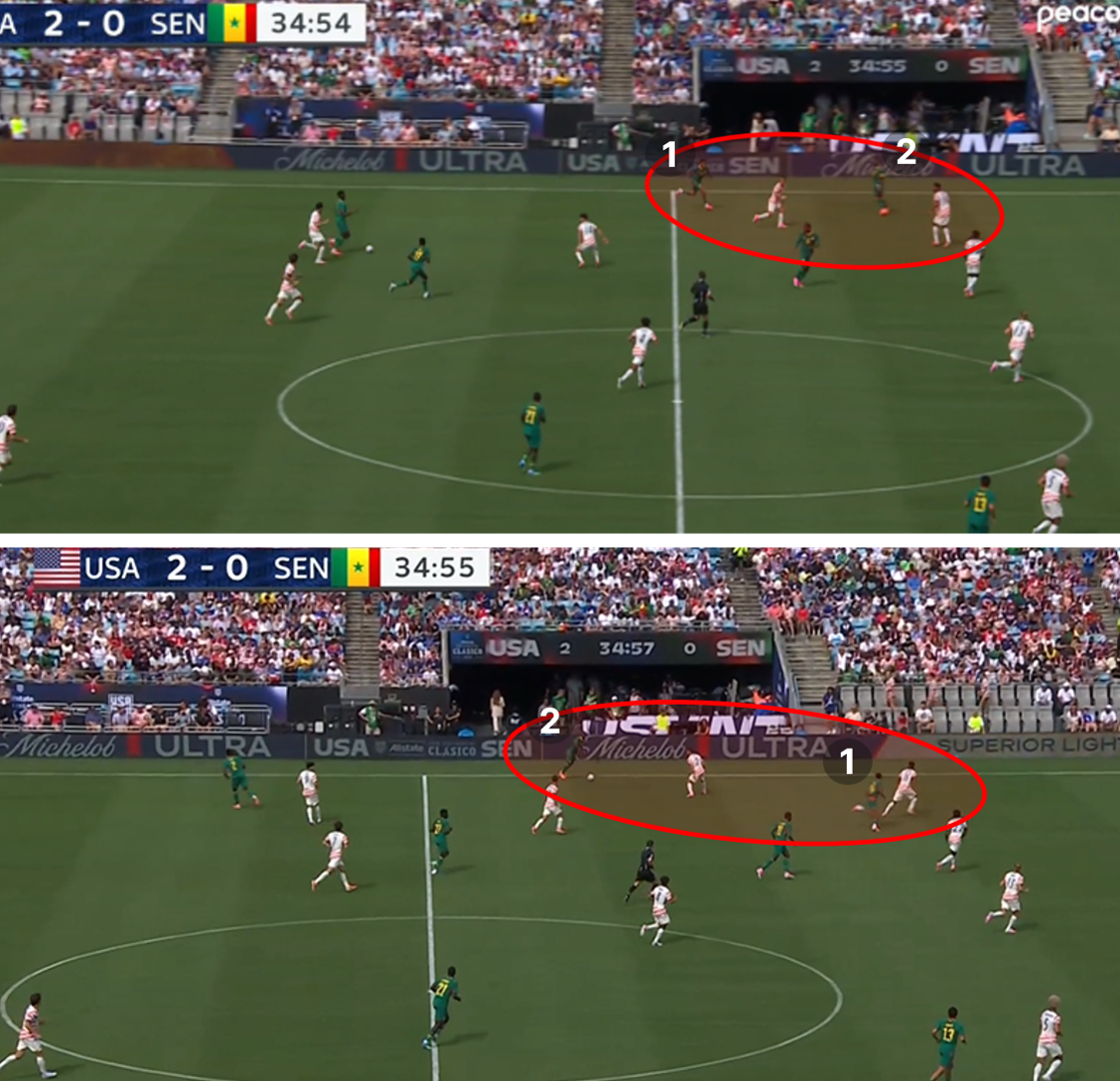
Behind the forward line, there’s trouble as Senegal dribbles around the edge. Berhalter still doesn’t close down, so Senegal has time to think. To challenge Freeman and Dest, they allow their left winger (#1 above) and left back (#2) to interchange and challenge the USMNT’s communication.
Instead of trading marks, Freeman holds his position at right back as Dest stays steady on the 4-4-2’s right wing. That’s a problem. Dest doesn’t close aggressively enough against that showing winger, so he can receive on the sideline. Meanwhile, Freeman doesn’t turn in time, so the underlapping fullback is able to sprint past him. This sequence will end with Senegal spraying a through ball past the United States defense to enter the box.
Fortunately, those kinds of sequences were the exception that proved the rule. The United States finished their 3-2 win with a 60% field tilt edge. They succeeded at pinning Senegal deep; 54% of the visitors’ passes ended in their own half. Both American concessions were rather transitional, and that’s an area where this team is a work in progress.
The man-centric tendencies of the USMNT’s press created vulnerabilities in second-ball situations, especially in the first half. Through the first 45 minutes of play, Senegal finished with roughly the same number of recoveries (20) as their hosts (21). At times, they found a soft underbelly by playing over the American midfield.
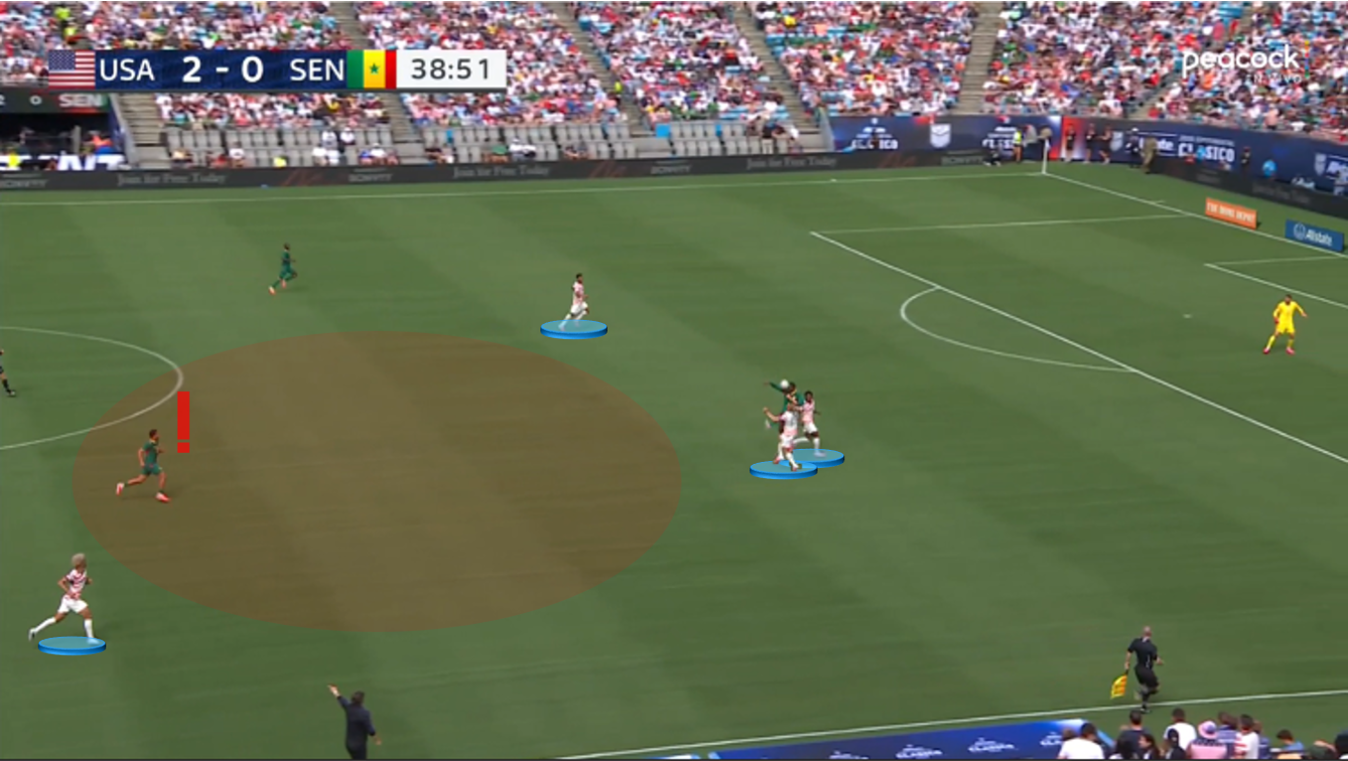
Here, Senegal’s right-sided center back elects to play long before the USMNT’s man-centric aggression can make its presence felt. Senegal takes advantage. Before they hit the long pass, they allowed their right winger to drop in and kept their entire central midfield group deep. Doing so bifurcated Pochettino’s 4-4-2 and also forced Jedi Robinson to step high.
The consequences are clear here, where the United States’ second-ball structure is nonexistent. There isn’t a single midfielder in frame; center backs Tim Ream and Mark McKenzie close on the same man. Senegal wins the ensuing knockdown unperturbed via that explorative right winger. Just after the frame, he’ll drive forward and find a pass into the box against the United States’ scrambled defense.
Any good press is backstopped by organization across the defensive line. In the best-case scenario, a team is able to get at least two players in front of and behind the ball ahead of a potential 50/50. Pochettino’s starting lineup wasn’t bad at doing so, but his rotated second-half unit was better at it. Substitute Malik Tillman claimed seven recoveries on his own, helping the United States to a +10 recovery margin in the final 45 minutes.
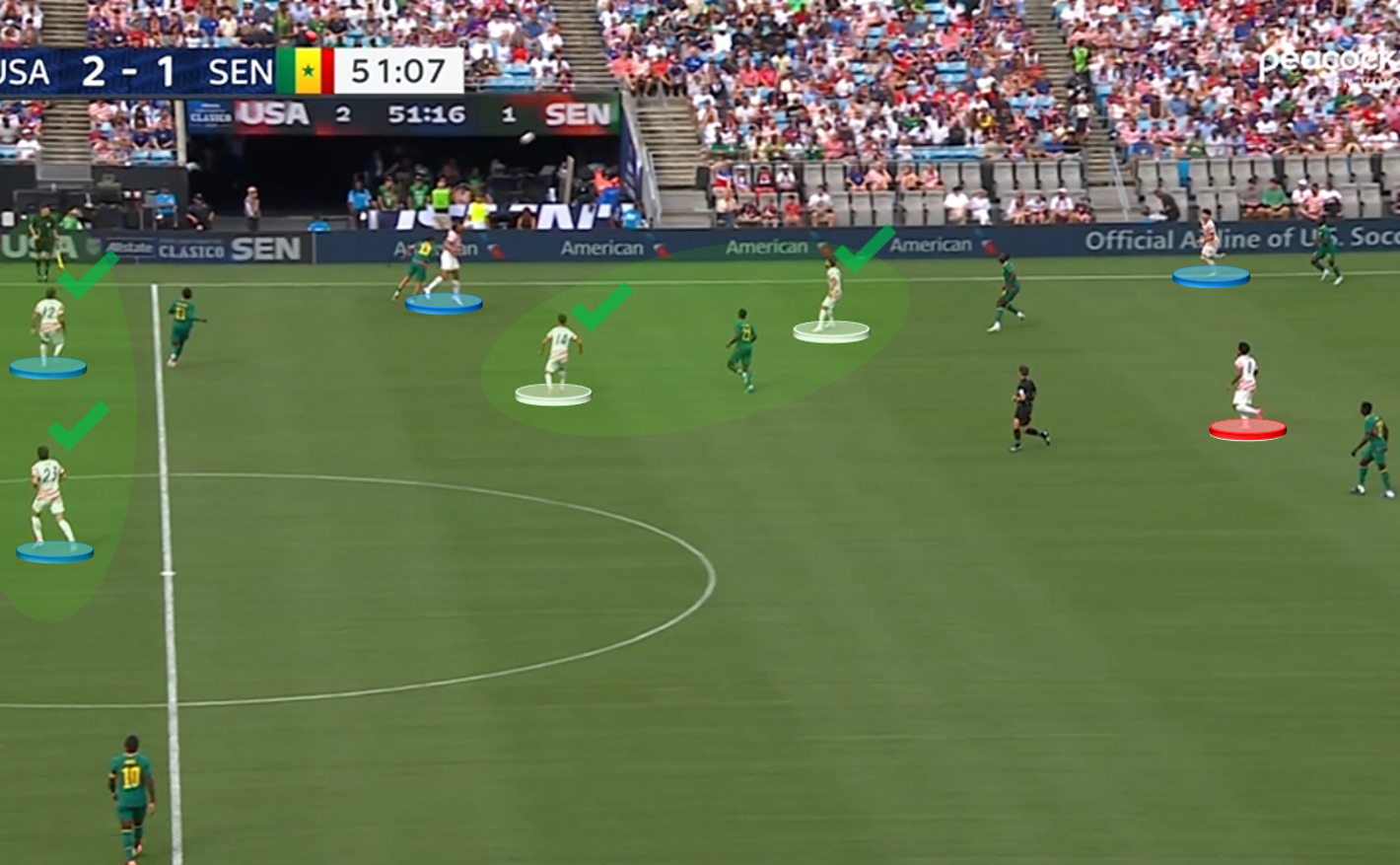
The thing that made it happen? Positioning like this. The scenarios aren’t exactly apples-to-apples given where Senegal’s long ball is aimed, but there’s still a greater sense of understanding at the back end of the shape.
With left back Max Arfsten having pressed upfield, center back Auston Trusty contests a header at the sideline. Behind him, Miles Robinson and Joe Scally space themselves intelligently should Senegal recover and break upfield. They’re the backstop behind Trusty; in front of him, Berhalter and substitute Christian Roldan also help to double up.
For Pochettino, finding this kind of balance will be paramount against Paraguay next Friday – and in every match thereafter. His penchant for formational flexibility has made the United States a more dangerous team, but it’s also introduced vulnerabilities. Structural issues in rest defense led to the opening concessions against Senegal and Portugal alike.
To make noise in the World Cup, Pochettino needs clarity in the first phase, communication between lines, and a nailed-on second-ball structure. As much attention as the USMNT’s attacking personnel get, they’ll matter little if the 4-4-2 press isn’t locked in.