The Back Four: Charlotte, Potpourri, and USMNT
The Independence attack, World Cup warm-ups, and more

Welcome in to The Back Four!
As always, visit Backheeled for more USL content, including deep dives into all things Championship and League One. Also, listen to This League! and The USL Show to catch up in podcast form.
Without further ado, let’s get to it.
Good Charlotte
The Charlotte Independence can beat you in a lot of ways. They’re scoring 2.5 goals on 1.9 xG per game in League One, and they’re doing so on the division’s second-best efficiency mark. Charlotte is generating 2.5 fast breaks per game; that’s 19% more than any other club in the USL. The Independence have an incredible understanding of when and how to accelerate the tempo of a match.
While Charlotte didn’t play in the Prinx Tires™ USL Cup over the weekend, they’re fresh off back-to-back offensive showcases that are worth a second look. Between a 3-2 win in Chattanooga and a 5-1 rout in Naples, the Independence showed why they’re the best team to watch in the lower leagues.
Charlotte isn’t leaning into the “defend in a back four, attack in a back three“ quite as heavily as they have in the past, to their benefit. Clay Dimick still has deeper moments, but he’s allowed to push from right back – hence why he assisted against Naples and received on the switch to find the winner against the Red Wolves. Still, there is a sense of designed imbalance that emanates from the left wing. In both of the recent wins, manager Mike Jeffries started Jon Bakero off the flank but let him roam, thus giving Joey Skinner room to overlap from left back.
The upside of that setup? Charlotte maintains side-to-side width while maximizing Bakero, Luis Alvarez, and Enzo Martinez in central interchange. The Independence’s fifth goal against Naples was a case in point, with Bakero skewing right and wreaking havoc as a halfspace threat far afield from his baseline deployment.
The thing that’s easy to miss amidst the flowing attacking is Charlotte’s ability to influence the game in the press. In both of those recent wins, the Independence’s best chances actually came when they could turn the ball over in elevated positions and break against an unready foe.
Here, you see Charlotte begin their press in 4-4-2 mode. From the striker spot, Souaibou Marou closes to the opposing goalie. Meanwhile, Bakero stays tight to a tucked-in fullback, ignoring a Naples No. 6 on the drop. Instead, midfielder Christopher Jaime closes on that player, while Skinner also flies ahead to mark a showing winger.
All across the sequence, Charlotte stays steady. They’re tight through the midfield, and they’re allowing their defensive roles to shift against Naples’ interchange. Eventually, Jaime's pressure drives the ball to the sideline, where the trap is on. Charlotte will regain, pass to the weak side, and let Martinez shoot from range to earn a free kick. Moments later, it'll be 1-0 off a Prince Saydee shot from the dead ball.
Here, Charlotte starts in 4-1-3-2 to encourage Chattanooga to play long. (Not that the Red Wolves need much encouragement, but nevertheless!) This time around, Jaime is deep in coverage and is prepared to close on a Red Wolves forward after the pass is hit.
Immediately, the Independence clamp down. Jaime’s there, Javen Romero steps from central defense, and the ball is driven toward Clay Dimick. Charlotte has created a kill zone, and they’re able to regain and work into Martinez yet again. Moments later, Marou will score off a lovely through ball.
That’s the beauty of Charlotte at the moment. They’re organized defensively, and they’re taking smart risks to regain in useful situations. As soon as they get the ball back, their offensive flow – driven by players like Martinez, Bakero, and Alvarez – shifts into high gear. The underlying defensive numbers (see 1.7 xG against) don’t love the Independence, but it’s hard to deny what they’re accomplishing right now.
Championship Grab Bag
Oakland is making 17% more final-third recoveries this season, which is a major reason why their average field tilt is up from 48% to 54%. The Roots have had real moments of inspiration in their possession game, but I'd argue that the breaks created by their advanced 4-4-2 press are every bit as valuable.
Take this sequence from the weekend's win in Las Vegas. Initially, you can see forward Tyler Lepley curling up from the right-sided No. 9 spot in tandem with Danny Trejo. That movement forces the Lights wide, where Trejo keeps closing. Las Vegas is painted into a corner, and they can't connect on a very tight pass into the central midfield.
From there, Oakland gets expressive. Trejo stays wide to stretch the defense, while winger Wolfgang Prentice – fresh off his contribution to the pressing trap – pushes inside. On the weak side, both Lepley and right-sided Bertin Jacquesson crash in, eying open space in the Las Vegas defense. A chance is on, and Jacquesson really should be making it 1-0. Finishing aside, this is exactly the kind of play that manager Ryan Martin has added to Oakland's system that simply wasn't there in 2025.
Louisville started to look like their old selves away to Birmingham last Wednesday, if only in a stylistic sense. With Babacar Niang in the pivot and Aiden McFadden in central defense, Simon Bird’s 5-2-3 had the athleticism and bite that’s often been lacking for this club.
What’s notable for LouCity is that their challenges per game (i.e., tackle attempts and interceptions) are at a five-year low. Meanwhile, they’re a majoritarian possession team for the first time since 2023. Against the Legion, Bird’s side was willing to sit against the ball and try to turn takeaways into breaks.
More than just a goal for Babacar Niang tonight, he's bringing bite back to the Louisville midfield. Best attacking transitions we've seen from this team for the better part of two months as a result. pic.twitter.com/8ypi5dlBvO
— John Morrissey (@USLTactics) June 4, 2026
Niang only played 45 minutes, but he scored a goal after a post-corner recovery, went 3/4 ground duel attempts, and added a tackle for good measure. His energy was infectious, extending to Taylor Davila. This was one of Davila’s most engaged defensive games; he attempted three tackles and contested 11 ground duels. Both were able to serve the sparkplug role, and McFadden’s athletic support from the right side of the back three helped the cause.
I’ll be fascinated to see how much of that system Bird reprises against Phoenix Rising on Wednesday night – and I’ll be there in person to see it.
If Louisville has felt entirely too same-y will trying to break down set defenses, Rhode Island has regularly riffed in that phase of play. Between last week’s loss to Indy and a more recent battle against Westchester, I liked the way Khano Smith kept experimenting.
RIFC wasn’t exactly rampant in Indianapolis, but they had moments of real tactical understanding. Indy wanted to stay tight through their No. 8s and tended to play their right winger very deep in a defensive stance; here, you see an effective response from Rhode Island.
At the start of this play, left back Aldair Sanchez isn’t even in frame and is challenging the Eleven’s right. Nick Scardina (blue, as a defender) is in the process of joining him from the opposite fullback spot. With Indy pushed back and widened out, RIFC can start laying groundwork from the back. Hugo Bacharach (orange-gold, as a midfielder) drops into the back line from the pivot; Amos Shapiro-Thompson descends into the pivot from the No. 10 spot. Those dual drops occupy Indy and, thus, create room to dribble around the edge.
As Bacharach pushes, he’s got the fullbacks stretching the field as Leo Afonso and JJ Williams operate as dual No. 9s. While Rhode Island stalls to a degree, they’re still able to outnumber Indy’s defense and find a trailing Shapiro-Thompson for a cross. It’s not the most efficient final ball, but the process to get there is tremendous.
It's a similar idea here, executed in tighter space. Again, Bacharach drops into the back line, but he's off the right this time around. Rhode Island's abundance of central numbers force opposing Westchester to tighten, and that gives Frank Nodarse – unexpectedly but effectively used off the left – the space to receive and look upfield.
There, WSC is vulnerable. With Sanchez spreading up the left, there's a seam between the opposing fullback and center back – one that Pity Rodriguez uses to his advantage. Filling the Afonso-esque role somewhere between a No. 9 and left halfspace player, Rodriguez will run into the open space, receive off Sanchez, and beat a man to enter the box. There, his cutback very nearly results in an assist.
It bears repeating: this is really good work from Rhode Island. This attack hasn't always been consistent in 2026, but things are quickly coming together on a more regular basis.
USMNTactics: The Germany Friendly
Last week, I wrote at some length about the US Men’s National Team in the press. That aforementioned concern about the defensive phase isn’t going away, but Saturday’s 2-1 loss against Germany – perhaps unexpectedly given the result – put me at peace to a certain extent.
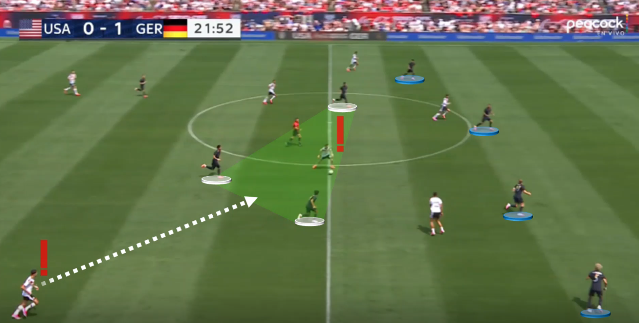
Let’s start with the press. Swapping Florian Balogun, Weston McKennie, and Malik Tillman into his advanced lines, Mauricio Pochettino still hoped to use a 4-2-3-1 or 4-4-2ish shape to deny the midfield and wreak havoc at the sidelines. Sequences like this…
…occasionally undercut the effort. Here, Tillman steps from the No. 10 spot to mark a German midfielder, and the United States are almost in 4-2-4 mode. Almost. Instead, Christian Pulisic sits off on the weak side, trying to deny a potential switch. He eventually closes, but not in time to prevent a turn into space toward the left sideline.
In theory, this shouldn't be problematic. The USMNT has forced the ball wide, and there ought to be coverage – at least if you're working off the pressing style we saw against Senegal, which relied on waves of closure in the wide spaces. Instead, there's no support.
Jedi Robinson sits deep at left back, occupied by a winger. From the left side of the pivot, meanwhile, McKennie points at a runner but doesn't support against the free man that's received behind Pulisic. By design, Pochettino's press needs a closing run, but one doesn't arrive. A pass will slice behind McKennie, allowing Germany to get forward and create a dangerous cross in the box.
Those kinds of opportunities were the exception that proved the rule in a fairly clean performance from the starting group, but they’ll be highly consequential when World Cup group play begins later this week. (Ditto for Robinson's tendency to lose runners and Tyler Adams' poor shielding, but I digress.) Conversely, I was heartened to see the attacking chemistry that’s developing in Pochettino’s flexible 3-2-4-1ish attack.
At best, that shape gave the USMNT the tools to break Germany’s press. You see that here, where flow across the back end of the shape challenges the opposing marking scheme. As the ball works to Alex Freeman at the right-central defensive spot, he's ready to dribble inside against the German left winger. Adams is attracting attention from their No. 10, and a drop in from Tillman overloads the space just below the halfway line.
As Freeman carries and Tillman stands ready to receive, Germany is frozen through the midfield. Their right winger has to hesitate, and their pivot is forced upfield against the Freeman-Tillman threat. A backpass to Tim Ream ensues, but it's a jumping-off point to access Jedi Robinson and drive at a fairly unprotected defense that’s been drawn up the middle.
Germany ably stops Robinson's ensuing cross from creating much danger, but this is what you hope to see out of the USMNT's flexible 3-2-5ish offense. When Robinson opened the scoring off a bangin' 37th minute volley, the chance arrived because Pulisic dropped in to create a Tillman-esque overload through the left halfspace, swooped all the way across the pitch on the dribble, and never looked back. The more of that kind of interchange we get to see, the better off the USMNT will be.
In other news…
Since I’m traveling and won’t have a chance to comment on it on The USL Show: kinda mixed on the Super League calendar change? In terms of roster-build considerations and the foundation of an eventual women’s national cup competition, I’m here for it. In terms of entering a crowded spring-summer soccer media environment and disadvantaging southern markets like Dallas, Tampa Bay, and Jacksonville with blazing weather? Not so much.
Speaking of the Super League, Dallas Trinity are already out with their first wave of player retention announcements. My modeling assesses the state of Nathan Thackeray’s roster as such:
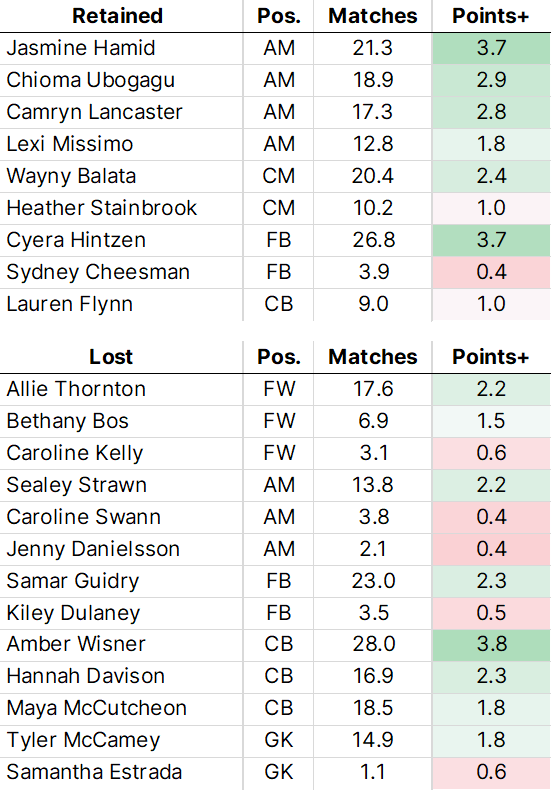
Dallas is obviously losing a ton of defensive quality, and they’ll need to find reliable starters at striker and in net. That said, no one else this side of Lexington will be returning an attacking midfield corps to rival Camryn Lancaster, Jasmine Hamid, Lexi Missimo, and (health-pending) Chioma Ubogagu.
Elsewhere, here's a look at DC Power:
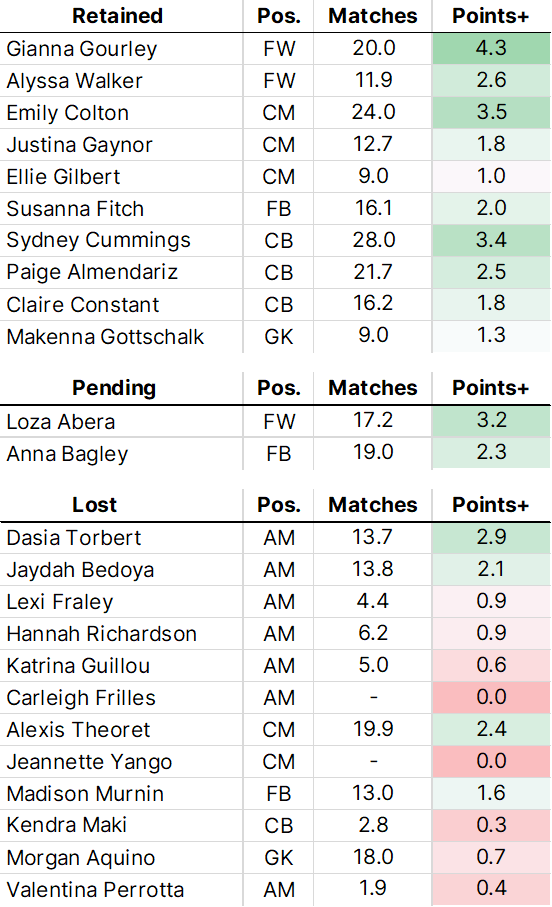
That's 10 viable starters back in action, including the attacking tandem of Alyssa Walker and Gianna Gourley that scored 44% of DC's goals last season. Moreover, much of the starting defensive group that anchored a near playoff run is there for more. Power will need a fairly significant revamp in the wide areas, but they've set a strong base for themselves.
Really good stuff from Alex Ashton about the evolution of League One, as always.
For the best coverage of the USMNT in the weeks to come, go subscribe to Backheeled. If you’re reading this, you really shouldn’t need reminding!