USL Super League, Week 5
On Dallas' major moves, a Brooklyn breakout, and more

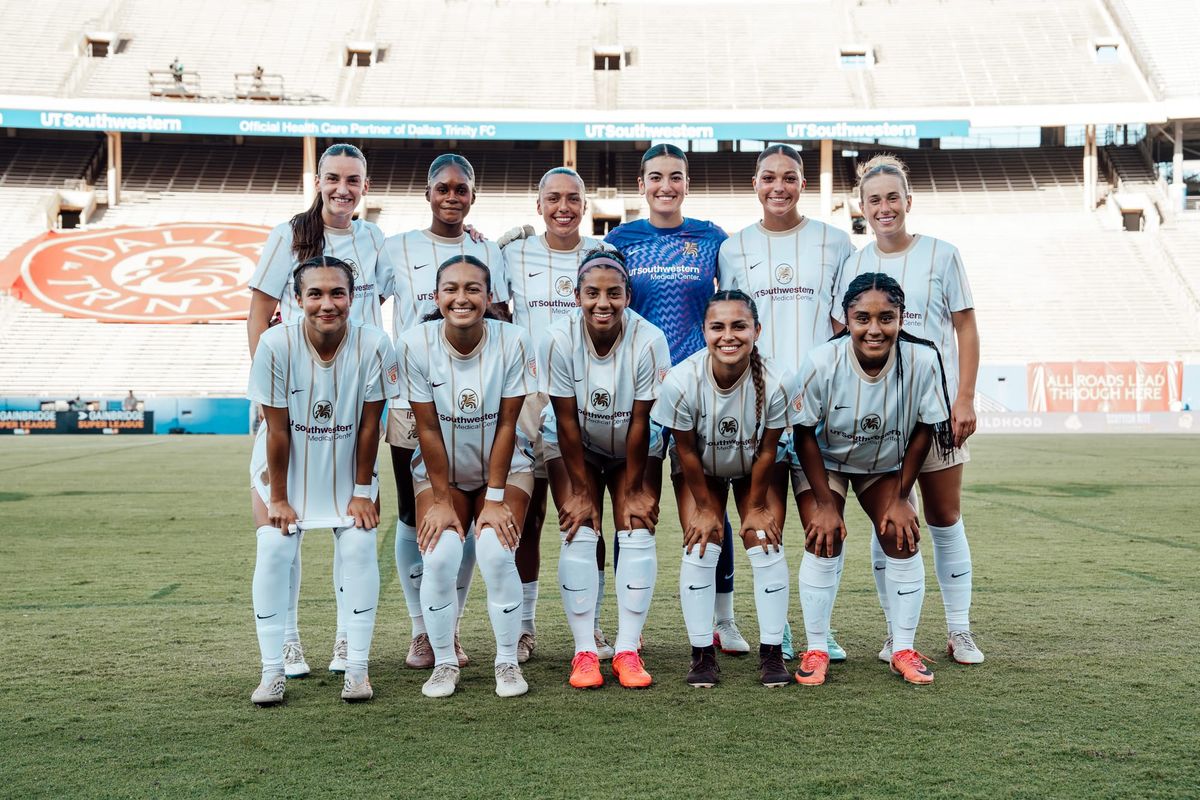
Meila Brewer is one of the best defensive prospects in the U.S. pipeline, and now she’s a member of Dallas Trinity.
The 17-year-old is the youngest player to every appear for any of UCLA's vaunted athletic teams. She scored in the U-15 CONCACAF Championships in 2024, started all four games in the 2025 U-17 World Cup, and curried those performances into a three-year contract with the NWSL's Kansas City Current. Brewer moving to Dallas through the end of the 2027 season is a big deal.
Even before the club's new ownership group took over ahead of the 2026 season, Trinity had shown ambition in terms of their roster building. Defender Sydney Cheesman was an all-conference star at LSU and stalwart of the U.S. youth setup through the U-20 level. Midfielder Lexi Missimo was a first-team all-American at Texas that was called up to the U.S. U-23 camp earlier this year; prior to opening day in the Super League, she was loaned to Marseille. Brewer may be the belle of the ball, but she's also part of a larger upward trajectory for the Super League's leading lights.
Lexington has actively pursued top-end NCAA talent. Jacksonville has played host to Ashlyn Puerta amidst her Brewer-esque “one year in college, then straight to the pros” arc. The more that clubs can push the envelope in their roster-building, the better off the Super League will be.
With that said, let's dig into a jam-packed matchweek.
Lexington (0) - Carolina (1)
In last year’s USL Super League championship game, Lexington SC and the Carolina Ascent essentially cancelled each other out, going press-for-press at each end of the field. Eventually, LSC broke through because of their excellence on set pieces to win a trophy. Friday night’s rematch was just as much of a chess match four months on – though it ultimately inverted the result of the 2025-2026 title bout.
Fresh off a week’s bye, LSC saw star defender Regan Steigleder (who scored the winner over Carolina in May) and midfielder Darya Rajaee (just recalled from a loan to Tampa Bay) enter their lineup. Against the league’s best press, tightrope-walking was the order day. By manipulating their 4-4-2, playing through lines, and then quickly hitting left winger McKenzie Weinert over the top, Lexington tried to string the Ascent along before instantly ratcheting up the tempo.
As always, 4-4-2 was a misnomer for the “three-box-three” in which LSC attacks. Reaching that point was, at times, a struggle. Moments where center mid Katie Murray dropped between the center backs rarely forced the Ascent’s own 4-4-2 to bite; instead, they left Lexington without a central presence and created turnovers.
This example is better. Kimura’s side stays disciplined in their shape, starting in a back three before, for all intents and purposes, reverting into a 4-4-2 mold to keep parity against Carolina’s six-player press. Here, right back Alyssa Bourgeois peels up the wing and isn’t in frame; in her place, Hannah White (neon green as a mid) drops in like a pseudo-defender (the rest of whom being marked in white).
As Steigleder receives, she carries the ball toward the left sideline in the face of pressure. There, left back Ally Brown holds steady in a deep position, forcing the Ascent’s midfield high and creating a gap through lines. By the time Brown receives and beats her marker, the Ascent’s back line is torn asunder; center back Reese Tappan and right back Addisyn Merrick have both stepped to fill space, creating a misalignment.
The result? Lexington is able to recycle into Rajaee as Tappan remains high against forward Addie McCain (dark green). Since fellow center back Jenna Butler is equally occupied by striker Catherine Barry, there’s room to play Weinert over the top. The winger receives, crosses to a crashing Bourgeois, and nearly earns her side a penalty.
That battle – containing Lexington’s “play medium passes to force reactions and open the long ball” offense – defined the game. It should be noted that Carolina had real success for the most part. Tappan (nine aerial duels) and Butler (four interceptions) did well to take up a more interventionist mantle. Beyond the occasional lapse, they ably protected their box when, say, Merrick stepped up within the bounds of manager Phillip Poole’s pressing system.
In their own right, Carolina struggled to find a reliable pattern to create chances (at least outside of press-driven breaks). At times, it seemed like halfspace-centric overloads – think Mackenzie George, a center mid, and a winger – bolstered by mid-height fullback play might do the trick against LSC’s 4-4-2. Even so, the vivacity and variability driven by Merrick and Jill Aguilera last week was far less viable against the Lexington press.
Here, you see why. With the fullbacks upfield, Carolina bend their build shape without actually creating an overload. The familiar use of Lily Nabet (orange) as a proxy defender should, theoretically, forge an edge on the opposing strikers; instead, LSC shift into a 4-2-3-1 where Barry goes at Nabet and the wingers can match the Ascent’s center backs.
Though Carolina drop wingers Rylee Baisden and Audrey Coleman into the middle third, the McCain-Rajaee-Murray trio mark those players out of viable existence. The Ascent try to squeeze a pass through their left channel, but Murray dislodges it and the break is on. That sequence was, ultimately, exceptional. Lexington stymied the Ascent to be sure, but Carolina was the team that made more high recoveries and caused more trouble close to goal. Poole’s side ended the night with eight recoveries in the final third against just one for LSC.
Kimura’s attempts to freshen his lineup as the match went on fell flat. Weinert’s exit in the 62nd minute cut out Lexington’s most reliable over-the-top option, and Hannah Richardson failed to match her verve. Carolina didn’t change the game with their changes, either, though substitute center mid Emily Morris would be crucial when the Ascent found their late winner.
There, Morris took a left-footed corner kick, swinging it in toward a crowded far post. There, Audrey Coleman and Riley Parker held steady as Butler curled between the two; free for a header, Butler would come good and beat goalkeeper Ryan Campbell.
That the match was decided in near-identical fashion to May’s title game created a real sense of rhyme, but it also goes to show just how even these two teams are. Lexington isn’t off to the start they’d want in 2026, but they can hang with the best of the best – a group that Carolina has firmly established themselves as being a part of.
Tampa Bay (2) - Fort Lauderdale (1)
The Tampa Bay Sun are the Hawaiian pizza of the USL Super League; the Sun’s direct, intense style isn’t for everyone; This team leads the Super League with 23.5 box touches per game, yet they’re simultaneously dead last with just 2.9 passes per possession. It’s an inherently risky style, but it’s working. (Like the Hawaiian pizza, the Sun are also secretly very Canadian given their reliance on midfielder Jordyn Listro, defender Vivianne Bessette, and manager Denise Schilte-Brown.)
In all seriousness, Tampa Bay’s pragmatism has been highly effective thus far in 2026, taking the Sun back into the thick of the playoff conversation. That held true in Week 5, which ended in a 2-1 victory over Fort Lauderdale and maintained their statistically improbable 10-game unbeaten run against United.
Against a Fort Lauderdale side that built short through center backs Haley Thomas and Ella Simpson, Tampa Bay usually began the pressing phase in a tight 4-1-3-2, splitting Listro and Alexis Theoret through their pivot. That alignment challenged the guests, creating an environment where the Sun held just 44% of the ball but achieved a 53% field tilt by dogmatically denying Fort Lauderdale comfortable access to the attacking zone.
Here, you see both Theoret and Listro (blue) step to mark the opposing Nicole Vernis-Kelli VanTreeck pivot, with forwards Erika Zschuppe and Shea Connors (yellow) offering face-up pressure against the opposing center backs. As goalkeeper Haley Craig lingers indecisively, the strikers execute a temporal pincer movement, forcing her to go long.
This seems like a bad outcome for Fort Lauderdale, but manager Tyrone Mears set up his 4-2-2-2 offense for these very situations. Normally, that shape descriptor involves two No. 6s, two narrow wingers, and two classic No. 9s. Instead, United set up with their strikers (Kiara Locklear and Grace Cutler) rather deep and their wingers high. As Locklear receives here, both Sh’nia Gordon and Farrah Walters blitz up the wings to try and get behind.
The rub? Center back Kelsey Hill tracks Locklear step-for-step, meaning that she can’t turn upfield and keep the move going. Paired with a very responsible rotation from Jordyn Listro, United has no choice but to turn tail and reset through Craig.
(Uniquely, Tampa Bay has been credited with just 39 pressing sequences and 41 high turnovers forced this year. No team has ever ended up with more of the latter than the former for an obvious reason: you force high turnovers by pressing! This play shows how it’s happening; the Sun are aggressive upfield, but they never put in a proper challenge to trigger Opta’s definition of “pressing sequence.”)
Admittedly, United eventually used that same pattern to open the scoring. In the 24th minute, Locklear received with her back to goal in a one-on-one against a stepping Bessette, which opened space for Walters to tear behind. Walters found an edge against fullback Taylor Chism, crossed to a crashing Gordon, and paid off Mears’ system to a tee.
All the while, Tampa Bay retained an ability to quickly work up the left through Sydny Nasello and a drifting Shea Connors. Rapid side-to-side moves up the sideline were the Sun’s lifeblood, allowing those two attackers to get out on the dribble and challenge United at a weak point; starting right back Maggie Mace had to go off after just 13 minutes due to an injury.
𝙏𝙝𝙚 𝙨𝙪𝙣 𝙟𝙪𝙨𝙩 𝙜𝙤𝙩 𝙝𝙤𝙩𝙩𝙚𝙧 ☀️ 🔥
— Gainbridge Super League (@GainbridgeSL) September 13, 2026
Tori Zierenberg finds the equalizer for @TampaBaySunFC 👏 pic.twitter.com/LtAM3bOAx7
You’d be hard-pressed to say that the Sun were the worse side, but they needed an injection of fresh blood to take control. Schilte-Brown’s substitutions couldn’t have been more effective in that sense. Sabrina McNeill replaced Leah Scarpelli at left back and almost tripled her final-third passing accuracy. Samar Guidry came onto the right side, going 3/6 on the dribble in just 33 minutes. Sam Kroeger, who spent much of the 2025-2026 campaign moonlighting as a fullback, replaced Theoret (making her very first start of the year) and added progressivity on the ball in her stead.
Most consequentially, Tori Zierenberg added a real veteran’s nous as a mover up top. That was especially clear when the Sun tied the match in the 65th minute.
There, Kroeger found the end of a knockdown and instinctively drove forward with the ball before Fort Lauderdale could settle. Keeping her head up, the former Brooklyn star played Nasello through. By that point, the left winger was part of a trident alongside Connors and Zierenberg; United couldn’t keep up, allowing Nasello to play across the box to set up a Zierenberg finish.
Connors got her just desserts in the 81st minute, dancing around the box and opening up a left-footed shot to beat Craig and win the match. The build-up to that deserved goal was all about Tampa Bay’s domineering style and Schilte-Brown’s considerate changes. This is the closest thing we’ve seen to the Sun’s title team since the end of 2024-2025, and it’s fitting that it came against the Fort Lauderdale side that Tampa Bay downed to win that trophy.
Brooklyn (3) - Jacksonville (2)
Entering Week 5, Brooklyn FC had scored just one goal in their first four matches. They bested that mark in the opening 10 minutes of Sunday’s battle against Sporting Jax. Blame personnel changes and odd tactical choices on Jacksonville’s part all you want, but it was absolutely refreshing to see manager Alex Smith’s Brooklyn side become the aggressor.
While Smith didn’t get away from the basic shape that he’s preferred throughout the young 2026 season, he finally found the players needed to execute his rope-a-dope possession style. Brooklyn entered the week with a 15% long pass share and a league-high 8.3 final-third recoveries per 90, yet they lacked the speed of thought and connectivity needed to turn verticality into production. That changed over the weekend.
At right back, ex-Melbourne Victory stalwart Sara D’Appolonia – who often played centrally as a No. 8 in Australia – provided a real sense of poise under pressure. Beside her within a 2-4-4ish build shape, the pivot pairing of Emma Loving and Jennifer Cudjoe offered real determination and cleanliness through the middle third. In the build phase, Brooklyn trusted goalkeeper Bre Norris to handle the ball to help create an edge on Jacksonville’s high 3-1-4-2 press; the aim was to start with Norris, work toward D’Appolonia to force a defensive reaction, and then play over the top into space against a panicked back line.
That Brooklyn established a 75% field tilt in the opening 30 minutes tells you how well that approach went. Even as Jacksonville restored last year’s pairing of wingback Meg Hughes and left-sided center back Grace Phillpotts as a tandem, they struggled mightily to stop Smith’s approach. In that sense, the absence of stalwart defender Georgia Brown and her replacement by little-used Parker Roberts was key.
You see how the attacking blueprint played out above. Brooklyn starts in 2-4-4 mode through D’Appolonia, forcing a closedown by Hughes. There’s still space up the sideline, and the fullback uses it to hit winger Jilly Shimkin on the drop – a drop that compels a mark out of Phillpotts.
Able to shrug off that backpressure, Shimkin plays back into Loving in the pivot, but the trap is sprung. Loving will look upfield, find forwards Jessica Garziano and Catherine Zimmerman making symbiotic runs in Roberts’ rotational zone, and play through for a chance.
The chance we just broke down came in the 3rd minute; a near-identical sequence seconds later put Brooklyn up a goal. There, Cudjoe was the midfielder that stirred the drink amidst D’Appolonia engagement and a drop in from Shimkin. The end result, a goal for Zimmerman, was wholly deserved – as was the follow-up from Tziarra King just five minutes later, a nice right-footed finish that relied on Garziano’s steadiness to help switch from left to right past Sporting’s overdrawn defense.
Now, consider this break with Brooklyn 2-0 up. Cudjoe is on the ball again with Brooklyn loosely in their usual build shape, but Hughes completely declines to close down. Instead, she drops deep into her own half despite the fact that the home side is obviously about to switch play her way. This was the impact of Brooklyn’s early success: Jacksonville got away from their usual tenets.
In this case, the ball to D’Appolonia sets up a dribble move and pass to Shimkin in the final third. Jacksonville clears the ensuing cross, but the heat remains on.
The elephant in the room for Sporting? Kaitlyn Parks’ wholly uninspiring return as the starting goalkeeper over a fit Jamie Gerstenberg. Parks was almost exclusively the starter across the 2024-2025 campaign, but her shot-stopping and in-box cross management were rusty on Sunday. Jacksonville's early deficit owed to their defensive issues, but Parks didn’t give a performance that helped the cause.
As the game went on, Sporting grew more vertical. Meanwhile, a terrific post-corner volley from forward Baylee DeSmit cut the deficit to one goal just 17 minutes in. Roberts (unsurprisingly) subbed off for the more veteran Ginger Fontenot at the half to help the Jacksonville cause, yet Shimkin’s carriage and Garziano’s movement never let Sporting tilt the field for too long.
For his part, Smith wisely declined to make any changes until the 80th minute, trusting the constant “4+2” base his defensive unit and pivot provided. Substitute Ashlyn Miller teed up Zimmerman for a game-sealing brace seconds after the change, a perfect cap on a near-perfect performance. Across the match, Brooklyn gracefully shifted from their ecstatic early stance into a more moderate posture to seal the game; in every sense, it was the complete kind of performance that this club was waiting for.
Dallas (2) - DC (1)
The Meila Brewer signing isn’t a long-term, “what if?” proposition; the 17-year-old went right into the lineup on Sunday night in the stead of heretofore reliable Sydney Cheesman. Brewer’s job was to play with composure against an elite DC Power defense – no small feat, given how manager Omid Namazi’s side has begun life in 2026.
On a 100° night at the Cotton Bowl, DC’s defensive shape set the tenor for the matchup. Power reverted to 4-1-4-1 mode, using that formation because it provided five high pressers (the four advanced mids and striker ahead of lone No. 6 Abby Boyan) to stymie Trinity’s build look. Still, DC wasn’t monolithic. Their shape inherently accepted some sense of risk, and the midfield’s bend changed from phase to phase. Namazi leaned into those choices, illustrating a clear cause-effect understanding.
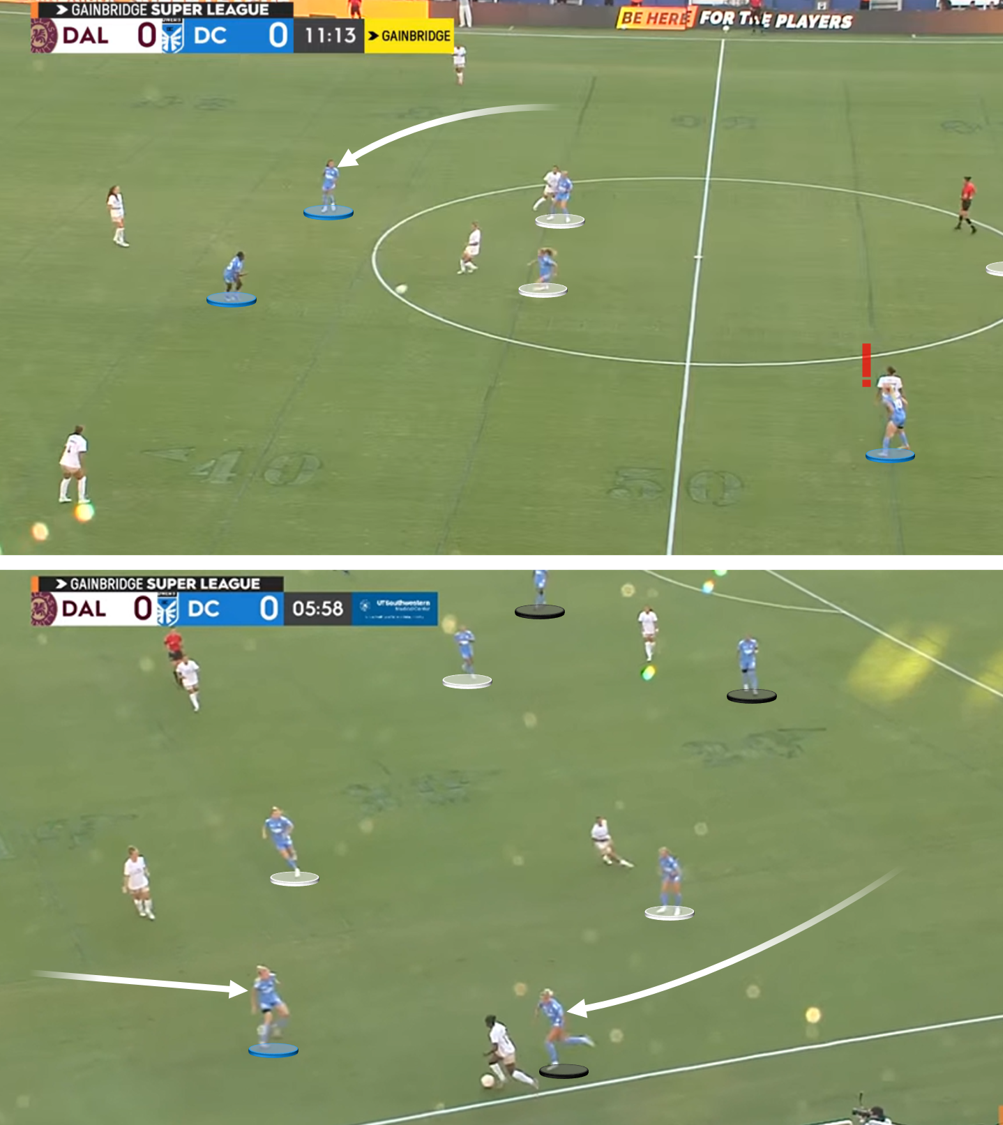
Here, that balance becomes evident. The first frame above illustrates DC’s baseline pressing shape, with wingers Tyler Lussi and Kayla Colbert noted on either side of striker Loza Abera (blue). What’s fascinating is the positioning of the wingers. Off the right, Colbert bends forward and almost becomes a second No. 9; she tended to do so as Dallas initiated through goalkeeper Neeku Purcell. Off the left, however, Lussi sits extremely low.
As we’ve seen again and again in 2026, Lee Nguyen-era Dallas started in a back four but allowed right back Carissa Boeckmann to step into the midfield like a third No. 8. Denying Boeckmann any air to breathe in the halfspace was Lussi’s job, and she filled the role with gusto.
Still, if you’ve got grade-school counting skills, you’ll note that Dallas (1) has a six-on-five and (2) pins Lussi inside. As you can see in that top frame, Power’s left flank is wide open. Namazi knew that Trinity would target that side, and Brewer’s passing from the wide-right spot actualized that threat. In response, DC tended to drop No. 8 Emily Colton low (i.e., let her drop off her higher mark) while blitzing left back Sam Cary Angel up the open sideline. That’s what’s seen in the second frame.
DC’s considerate defensive approach put them in control early, but their offensive lacked a clear path through Dallas’ own 4-4-2. Trinity played with a real sense of vertical compactness between lines, especially on the central axis separating the forwards (Camryn Lancaster and Seven Castain, reprising their partnership) and center mids (Sofia Cedeno and a fresh Felicia Knox). Inherently, that setup outnumbered Power’s three midfielders, often goading Abera low as a helper – and, thus, drawing her out of dangerous striker-esque positions.
A handful of diagonal, left-to-center runs from Lussi over the level of Abera cleverly made up for that shortcoming. The winger nearly scored off such a run over the top in the 14th minute, and she had another near-miss waved away from an offside call in the 34th. Even so, DC lacked attacking cohesion to match their defensive mettle. Indeed, Dallas – a team whose average pass this year had moved just 4.1 yards upfield, the lowest in USL history entering Week 5 – was far more successful at getting vertical.
At points, straight-up long balls toward wingers Jasmine Hamid and Onyeka Gamero helped Trinity get out of their zone; those kinds of passes felt novel. The play above represents more of a synthesis between Dallas’ doctrinal and pragmatic sides.
Purcell starts the play with the ball at her feet, and you can see DC shaping up as expected. This time, however, Brewer doesn’t play toward the sideline as expected. Skipping a line past Boeckmann, she hits Castain at her feet. It’s a terrific ball from the teenager – one that activates a four-on-three edge created because both Castain and Lancaster have dropped to the halfway line.
With both No. 9s low, DC overreacts in support of their isolated holding mid. Center back Sydney Cummings and fullback Anna Bagley both step inside, but that creates acres of space in behind. Suddenly, a breakaway and shot for Gamero are on.
A very similar sequence put Dallas up on the stroke of halftime. There, both Knox and Cedeno got touches, drawing attention and allowing the Lancaster-Castain duo to receive between lines once more. The ensuing drive upfield was a bit more slipshod, but it still let Gamero finish to take a 42nd minute lead.
Out of halftime, Namazi acted. Gianna Gourley, who led DC with eight goals last year, entered the match for Abera. Defender Justina Gaynor entered the game as well, allowing for a shape change into more of a 3-4-1-2 with Gourley and a right-shifted Lussi paired up top.
The changes added a new threat, but they also laid the groundwork for a fairly instant concession by, for all intents and purposes, taking away Lussi’s center-leaning defensive presence. Dallas ably shifted into a counter-centric mode, setting the table for the pass of the week: a stellar through ball from left back Cyera Hintzen that cleared a rotating Gaynor, found Hamid in behind, and made the lead 2-0.
Dallas’ increasingly robust offense as fueled by “Jasmine Hamid, but used as a winger again” was the theme of my breakdown last weekend. Again, it proved to be decisive. Nguyen deserves enormous credit for finding a happy balance; he hasn’t moved away from his possessive principles, but he’s used smart personnel decisions to make Trinity a more complete team.