The Back Four: Super League, Week 1
Super League opening weekend, plus Kwame Awuah, Collin McCamy, and more

Welcome in to The Back Four! Need more USL content? Make sure to:
- Visit Backheeled for 10,000+ words of analysis on the Championship and League One every matchweek.
- Check back with Backheeled for a topical end-of-week feature on big USL-wide stories (plus attendance and depth chart tracking).
- Listen to This League! and The USL Show to catch up in podcast form.
Without further ado, let’s get to it.
Super League Opening Weekend
That’s one match down, 13 to go for all eight clubs in the USL Super League, so what did we learn?
Some of the conclusions weren’t all that surprising. Lexington SC looks like they’ll be a juggernaut yet again after winning it all in 2025-2026, kicking off their year with a 3-0 drubbing of Brooklyn FC and new manager Alex Smith. Eight of 11 starters for LSC were key parts of that title effort, and they didn’t miss a beat under Kosuke Kimura on Saturday
In broad strokes, Lexington looked familiar. Their first chance of the year was a prime example. There, in the sixth minute, LSC pressed Brooklyn’s short build game in 4-4-2 mode, creating a relatively advanced takeaway. Instantly, wingers Sarah Griffith and McKenzie Weinert flexed into the channels and pushed toward the box as Catherine Barry – the reigning Golden Boot winner – received in zone 14. Barry would release a pass toward Griffith on her right side, Griffith would left-foot a chipped cross to the far post, and Weinert would very nearly score off the ensuing shot. In terms of defense-to-offense sharpness, you could’ve plucked the clip from any match that took place last spring.
Of course, the more interesting thing is how Lexington has evolved. In the pivot, Katie Murray (signed off gone-but-not-forgotten Spokane) looked livelier than she ever did in Washington. Perhaps emboldened by her partnership with Taylor Aylmer, Murray had a few nice plays where she dropped a shoulder and carried the ball forward out of the pivot.
Gracie Falla, a rookie out of South Carolina, was even better. Falla stepped into central defense with Regan Steigleder out and picked up where her fellow defender left off. Indeed, the ex-Gamecock's progressivity was immediately apparent. Falla attempted 20 passes into the starting No. 6s and nine more toward Addie McCain in the attacking line; with four progressive carries (i.e., dribbles of 10 yards or more), she led all Super League center backs across Week 1. That should be a frightening proposition for defenses moving forward.
So nice, they had to do it TWICE 😮💨@catbarry25 and @Addie_McCain net a goal apiece in just 3️⃣ minutes to give @LEXSCwomen a 2-0 lead! 👏 pic.twitter.com/gJonMhVx7S
— Gainbridge Super League (@GainbridgeSL) August 16, 2026
All that said, Smith's Brooklyn debut was full of bright spots – central defensive breakdowns notwithstanding. With Carlee Giammona leading the line and Jessica Garziano playing underneath her, Brooklyn’s 4-2-3-1 showed real gumption in the press. Giammona tended to wall off whichever center back was on the ball, while Garziano hewed to the closest available No. 6. For their troubles, Brooklyn put up seven final-third recoveries (second most of the weekend) and forced nine high turnovers (fourth).
Turning takeaways into chances was less assured, but that’s to be expected for a team that started three new players in their front four spots. Both Tziarra King and Ashlyn Miller had a great sense for breaking out into the channels, and both tried to play vertically into Giammona when they found touches. Still, overweighted passes and a lack of rhythm stymied the potential of the breakout moments; Brooklyn didn’t so much as attempt a shot until the 45th minute.
Then, there’s the defense to reckon with. Again, Brooklyn was mostly alright, but major breakdowns spoiled Smith’s debut. When they went down 1-0, Brooklyn allowed a chipped pass to clear King and left back Jackie Richards, creating a crossing opportunity. Through the middle, neither Shin Na-yeong nor Laila Booker – who combined for merely four clearances and went 0/4 in the air – were in position for the first challenge or the ensuing rebound. The same issue recurred in the 61st minute, when a simple pass over the top completely took Booker out of the play. Those kinds of mistakes are all too familiar from this Brooklyn organization, and eliminating them must be Smith’s priority. (That and too-slow build, but I digress.)
In their first match under Lee Nguyen, Dallas Trinity avoided many of the new-coach (and, for that matter, new defense) pitfalls that befell Brooklyn. Trinity fought to a 1-1 draw against the Tampa Bay Sun, overcoming an early barrage from a Sun side that brought an attitude akin to their 2024-2025 swagger.
Two things defined the match: Dallas’ ability to stay composed against the Sun’s long game, and Tampa Bay’s use of a wonky pressing shape to withstand a highly technical Trinity. By those criteria, each side had plenty to like on Saturday.
The Sun lined up in a 5-2-3 on paper, and their directness set the tone early on. Shea Connors and Kennedy White – who seemed like potential rivals for No. 9 minutes in the preseason – both started alongside Sydny Nasello, regularly finding space on the end of long balls and headed flicks. Connors was especially sharp in those situations; her tendency was to skew rightward, which created space for Nasello’s classic left-to-center dribbling.
Not to belabor the Brooklyn comparison, but the confidence with which Dallas managed breakdowns against that direct passing was admirable. Yes, Trinity gave up a handful of open runs up their right side by a virtue of a 4-4-2 shape that bent into a 3-2-5 through right back Drew Coomans. Still, Sophia Braun (3/4 in duels, four interceptions) and Sydney Cheesman (seven clearances) never gave up an easy look from central defense. Their lateral speed built a wall in front of Neeku Purcell’s net and limited the Sun’s chance quality; Tampa Bay only generated two run-of-play chances worth more than 0.10 xG.
The tactical intrigue was greater when Dallas kept possession. By virtue of the “bend Coomans upfield” gambit, Trinity split the difference between a proper front five and more of a three-box-three with Seven Castain and Sofia Cedeno (who combined for 17 final-third passes) connecting play from the No. 10 spots. Tampa Bay responded in kind, essentially pressing in a 4-3-3 with left wingback Leah Scarpelli low and right wingback Reagan Raabe tucking into the channel, level with the pivot.
Here, you see Castain (right channel; in red) and Cedeno (left; gold) drop between lines to stress the Sun’s dual No. 6s, who are supported by Raabe on the near side of the frame. In front of that muddle, center mid Jamie Shepherd receives in the pivot from Braun. Tampa Bay has no choice but to clamp down against the heavy central numbers, thus leaving Onyeka Gamero – the left winger and one of Week 1’s brightest performers – to drop low and receive on the now-open sideline.
Seeing central space, Gamero snakes her dribble inside as Cedeno, Castain, and striker Jasmine Hamid all charge at the Sun’s four remaining defenders. Those runs create space in zone 14, and Gamero uses it to rip a shot at goalkeeper Liz Beardsley. It’s a terrific example of Dallas’ capability to break the press.
The other standout feature of Dallas’ night? Carissa Boeckmann’s passing profile from the central midfield. A right-footer, Boeckmann tended to look off obvious through balls toward Coomans up the sideline, instead preferring to play against the grain whenever possible. Her vertical service into players like Hamid and Gamero didn’t always come off, but it looked promising. (Boeckmann got her just desserts; her through ball to Castain to open the scoring was otherworldly.)
If you put down the following numbers for two anonymized teams and were asked to pick a winner…
- Team A: 10 box touches, 66 final-third passes per xG, +5 recovery margin
- Team B: 12 box touches, 155 final-third passes per xG, -5 recovery margin
…that choice wouldn’t be so obvious. Viewed from that lens, Fort Lauderdale United’s (i.e., Team A’s) 1-0 loss to Sporting Jax this weekend should be taken as a sign of year-over-year progress.
As the numbers make clear, Tyrone Mears’ United side controlled second balls, kept their 18-yard box restricted, and forced Jacksonville into one of the least efficient showings in club history. Yes, Sporting found an 89th minute winner off a driven, bouncing free kick. Yes, every result matters in the short season. Nevertheless, there was a lot to like from Fort Lauderdale.
For one, Emily Thompson and Kiara Locklear might’ve been the best attacking duo of Week 1. Their sense of flowing movement powered United in transition, providing zhuzh through the heart of the midfield and up the left wing. The decisive build I talked about in my season preview was there in spades; twice, left back Kelsey Oyler was able to draw Jacksonville wingback Ginger Fontenot, play over her head, and grant Locklear a golden chance in behind. (The first such chance led to a cutback to Grace Cutler and got saved in the 35th minute; the second led to a close offside call in the 39th.)
Still, none of it would’ve been possible without the improved composure Fort Lauderdale showed in block. Together, Oyler and former Spokane teammate Haley Thomas paired with the returners Ella Simpson and Maggie Mace to create a genuinely trustworthy back four. United ended up with a mere 34% field tilt but were rarely caught sleeping.
Above, that's clear. There's nothing particularly sexy happening, but Fort Lauderdale doesn't waver. As Jacksonville dink a pass to the sideline, Thomas and Simpson don't flinch. Mace hedges toward the receiving wingback, but she doesn't fully commit until that player (the ever-threatening Meg Hughes) snakes inside; at that point, center mid Shea Moyer covers to the right to stop a potential pass against the defense's momentum. At the end of it all, Jacksonville give the ball away.
You can get a sense of Jacksonville’s close-but-no-cigar chemistry here – a confusing phenomenon for a team that featured nine returning starters among their 10 outfield players. The two big changes – Ginger Fontenot’s debut at right wingback and Jamie Gerstenberg getting the call in net – fell decisively flat.
Gerstenberg, as we just saw, wasn’t afraid to add length to her passes, especially as compared to 2025-2026 starter Kaitlyn Parks. On Saturday, Gerstenberg held down a 9.9% touch share and advanced play by 25.5 yards per attempt; Parks clocked in at 8.1% and 20.3 yards last year. Those shifts felt like a symptom of ineffective attacking rather than an intentional choice. Jacksonville struggled to break lines, passed backwards, and had to let their goalie hoof it to unsettle Fort Lauderdale.
Fontenot, meanwhile, attempted two dribbles but mostly felt ponderous. She took 60 touches and turned them into just 18 passes – a ratio so lopsided that it feels like an Opta data error. Like Gerstenberg, Fontenot was limited by extenuating circumstances. Right-sided center back Maggie Illig attempted just two passes to Fontenot before she subbed off in the 54th minute; substitute Mya Swinton bested that mark in merely 14 minutes. It’s no coincidence that Jacksonville came into the game late, particularly after Swinton entered the game and added a more varied passing profile to the defensive line.
Am I nitpicking a team that won a match? Yeah! Jacksonville has title aspirations, and they’ll be judged by that standard. Three points are three points, but Saturday was too lax.
The Carolina Ascent won the most manic match of the weekend, downing DC Power by a 1-0 margin at Audi Field. That game featured 39 pressing sequences, 50% more(!) than any other battle in Week 1. You could feel that energy across Carolina and DC’s performances.
I’d probably call the Carolina press a 2-2-3-3, and it played as extreme as it sounds. Manager Phillip Poole kept his lines narrow, adapting his baseline 4-2-3-1 so that, in most cases, wingers Audrey Coleman and Riley Baisden pressed as forwards and No. 10 Shea Groom aligned next to the pivot players. That shape let Carolina match DC’s back three man-for-man, and it also created a logjam through the middle of the park.
Carolina bolstered that press with a vertical approach in build. Goalkeeper Sydney Martinez kept her starting place over Hope Hisey, anchoring a fiercely direct style from the back. The Ascent went long 24.9% of the time on Saturday, 8% higher than any other club. If nothing else, that choice helped tilt the field and let the press set up close to the DC goal.
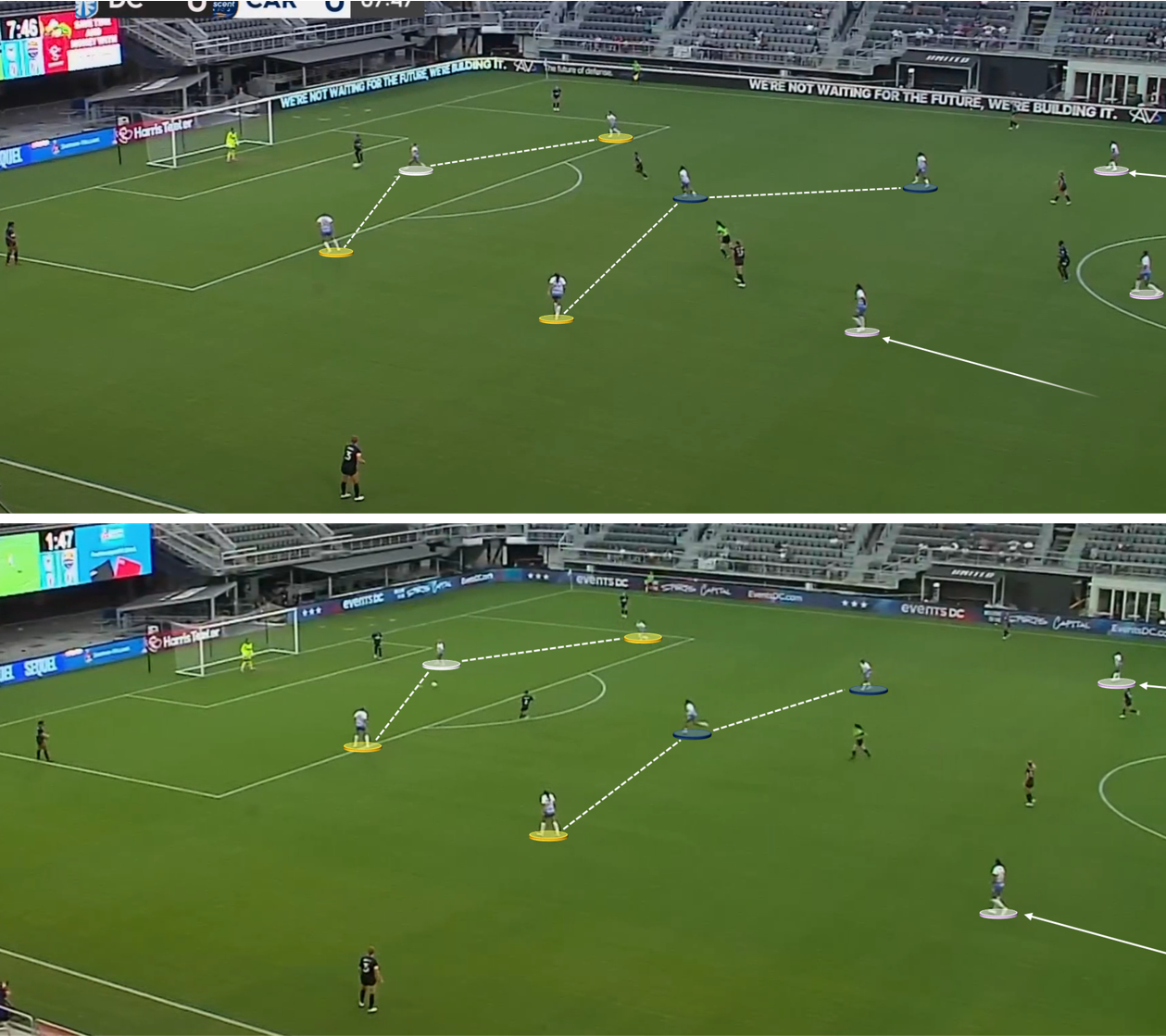
You see that setup reflected across two different pressing sequences here. Groom (orange) drops level with Lily Nabet and Mia Corbin (blue) in the pivot, whilst fullbacks Jill Aguilera and Addisyn Merrick (violet) also step high. Their job is to deny line-skipping passes into the DC forwards – or to someone like Emma Jaskaniec within Power’s high-low midfield.
You’ll note that the Ascent are leaving the sidelines open, at least at first. Carolina intended to shift wide in time to stop wide breaks, but DC produced a number of great opportunities by probing that weak spot. Forwards Loza Abera and Tatum Thomason did splendidly to run the channels and receive over lines; bouncing moves that worked from right-sided center back Claire Constant into wingback Susanna Fitch (who combined for a 22.4% touch share) gave the press fits. Once in the final third, DC also did well to work from side to side before Carolina could settle.
The problem? Power posted 1.4 xG, but they took 69 final-third passes to generate the average expected goal; that efficiency number ranked fifth in the Super League across Week 1. Viewed from another angle, Carolina center backs Jenna Butler and Reese Tappan (5/5 in ground duels, 11 clearances) did extremely well to limit Power on the break and lessen their shot quality.
Bend-don’t-break discipline let the Ascent survive a fairly lopsided opening half-hour, setting the table for Mia Corbin to score off a post-corner reset – the first goal of the 2026 season. DC had recourse thereafter. I liked the choice to move Jaskaniec to the base of the midfield and sub Tyler Lussi on as the right-sided No. 8/No. 10 type; Lussi put up four shots and 0.5 xG in just 27 minutes. Sydney Cummings nearly big-dawged her way to a game-tying header off a corner, only for that shot to ring off the post and for Kayla Colbert’s ensuing tap-in to be waved offside.
It’s easy to see that DC has untapped potential waiting to be discovered. Alyssa Walker, a star last year, went unused. Lussi will surely start in the near future. None of Paige Almendariz, Sarah McCoy, or Gianna Gourley made the matchday squad.
For Carolina, a win is a win. It’s hard to deny that Week 1 held some shaky moments, but the Ascent stuck to the Super League’s most extreme gameplan and were rewarded for it. More balance would be nice, but if Butler and Tappan keep performing at this level, few clubs will have an easy time scoring on Carolina.
Potpourri!
Barry Goldwater's 1964 campaign slogan was, famously, "in your heart you know he's right." Of course, Goldwater lost that election and is best known as the eponym for a terminal at Sky Harbor, but that phrase basically explains how I'm assessing Kwame Awuah's positioning this year in spite of the data.
The Loudoun left back is spending far more time this season tucking inside and engaging on the underlap – or that's what I'd tell you, at least. The heatmaps of Awuah's touches...
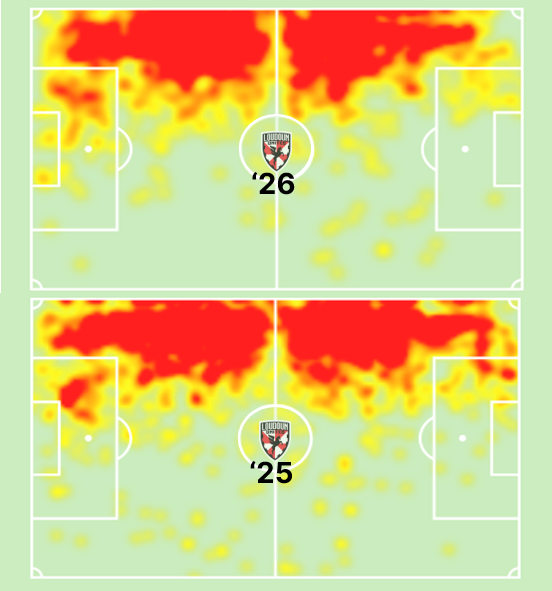
...over the last two years say otherwise. Indeed, you could hardly tell the difference between Awuah's role under Ryan Martin in 2025 and Anthony Limbrick in 2026.
The statistics paint a more complex picture. Awuah looks like he’s as involved as ever in the attacking zone, but he's completing 1.5 less final-third passes (down to 9.2 from 10.7) and attempting 70% less shots (0.17 from 0.62) per match – all while taking four extra touches. To me, those numbers are the signifier of a changing role.
What does the new Awuah look like? Here, Loudoun starts build through midfielder James Murphy, working ahead into the feet of Abdellatif Aboukoura on the drop. Aboukoura (marked in black) has started as a striker next to Eddy Davis over the last two weeks, and, in this case, he drops low to connect play. Meanwhile, Pedro Santos (white, as a mid) replaces his teammate in the forward line as Pacifique Niyongabire (red, as a defender) overlaps up the right.
Amidst all that movement, Loudoun put themselves into 2-2-4-2 mode. You can see Awuah almost working like a No. 10, playing to the left of Aboukoura. The left back continues his central run, and when he receives, he's able to hit a first-time ball into Niyongabire. As the play develops, Awuah keeps running; he's the target for a pass into the box at the end of the play.
We wouldn't have seen that kind of run from Awuah in 2025, and that's a sign of growth. Loudoun doesn't have it all together amidst a flurry of market activity, but they're continuing to find new patterns that hold real promise.
Speaking of defenders that take on a unique role within their club’s attack, I continue to be enamored with Collin McCamy for Forward Madison. I highlighted his role in my Backheeled column this week, but I want to be specific about the moments where he’s making a difference.
Across Week 24, McCamy held down a left-sided center back role (in a draw against Greenville) and that of a No. 6 (in a win over Portland). There’s not much of a difference across those two deployments when Madison is in possession; the 23-year-old is allowed to step into the midfield when he’s ostensibly starting in central defense. Though McCamy has posted a relatively low 9% touch share this year – compared to 12% for Roman Torres or 10% for Kevin Carmichael – he’s making an impact whenever he’s on the ball.
Because Madison has been so successful with long balls this season, they demand face-up pressure in the build phase. Skewing McCamy into the left halfspace adds variety to that threat, often drawing opposing wingbacks out of line. If he stayed low, the ex-NYCFC II standout could be addressed by a forward; that’s not the case given the positions he takes up a line higher upfield.
Above, Madison pushes that advantage. Opposing Greenville has to blitz their right wingback upfield as the ball swings to McCamy – who, it should be noted, is actually relatively deep here by his own standard. The rotational demand lets Jahlane Forbes (pink, as a midfielder) receive up the sideline. As Forbes cuts in, Greenville’s back three is forced to react, and that nearly allows Madison to play through into the box.
What’s remarkable is how replicable that template has proven to be. Madison’s opener against Portland on Sunday night, for instance, was a near-identical play featuring McCamy swinging the ball to an open wingback off his left. McCamy is terrific, and what he’s doing is a strong feature of the Mingos’ system.
Let's wrap up with some numbers. Since the start of July, here's the efficiency landscape in USL League One:
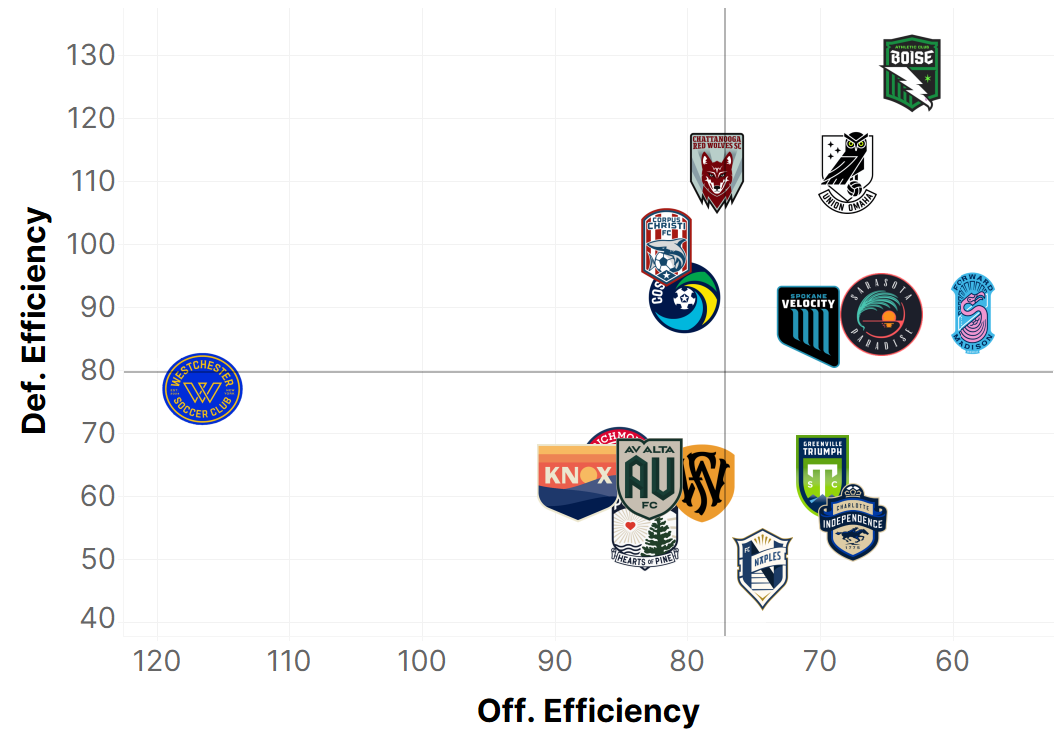
(For those who need reminding: efficiency measures final-third passes needed to generate one expected goal. Offensive efficiency is how many final-third passes you need to get there; defensive efficiency is how many you allow per expected goal.)
This is actually just an excuse to talk about Westchester, who added a player I love in the form of Piero Elias. To quote one of my own articles from the offseason:
Piero Elias...often defended in the center of NYCFC II’s off-ball 4-4-2 but stepped up as a dynamic No. 8 in a possessive 3-1-4-2 last season. Elias put in 2.5 tackles and 5.3 recoveries per game, but his slick right-footed passing in tight spaces produced 3.1 total xA in open play.
For a club like Westchester that's (1) been middling in terms of denying opposing chances and (2) sluggish around the box, Elias couldn't be a more important addition. He showed it on his debut against FC Naples, providing gritty ball carriage through lines, press-proof poise, and a stopper's instinct in the counterpress.
In the Naples match, Elias attempted 22 passes. 14 of them ended at the feet of attacking-minded midfielders Conor McGlynn and Dean Guezen – 64% of his attempts! Though he only played 45 minutes, Elias notched three progressive carries and went 3/3 in his take-ons. I don't want to get out over my skis, but he was the beating heart of Westchester's 4-4-2.
WSC keeps hovering on the edge of the bubble, and Elias could be the missing piece – one that makes Westchester far more efficient going both ways.
In other news…
As variously reported by Tom Bogert and Joe Lowery, Rhode Island FC's JJ Williams and the Charleston Battery's Colton Swan are, respectively, headed to Hearts and Hibernian in the Scottish Premiership. Taken in isolation, either transfer would be interesting. Taken together, they set a trend. The USL is coming up in the world, and that's going to meaningfully impact how the Championship can engage in the transfer market.
Comprehensive stuff from Dennis McGowan and the 3rd Degree team on Dallas’ draw against Tampa Bay.
Dan Creel has a good look at the League One playoff race in Protagonist.
Sebastian Cruz absolutely rules:
As always, loving what Sebastian Cruz is giving Tampa Bay across phases.
— John Morrissey (@USLTactics) August 12, 2026
Here, he and Lewis Hilton (green) both slide over from the pivot, making sure they've got a +1 edge as LouCity switch the point – the exact scenarios that were problematic when these teams met 11 days ago. pic.twitter.com/5eDByGCY58
I got recommended a house-tinged remix of a 1990s Chinese pop song on Twitter, so we're making that the song of the week.