The Back Four: Opening Week!
On Lexington, Westchester, Dallas, and more

Welcome in to The Back Four!
As always, visit Backheeled for more USL content. If a Championship or League One team played a game last week, I wrote about them. If you’re a podcast fan, check out This League! and The USL Show.
Without further ado, let’s get to it.
Lexington’s attacking hydra
For newer readers of my Backheeled power rankings, you might’ve been surprised to see Lexington fairly steady as the #3 team in the Championship after an opening day loss. There are two reasons for that. Firstly, I’m ranking on vibes and performances much more than results. Secondly, Lexington looked really good for long stretches of time.
Masaki Hemmi’s 4-2-3-1 fared well in the face of Louisville’s aggressive press, and that owed in large part to Aaron Molloy’s brilliance at the base of the midfield. Molloy has a deserved reputation as a press-proof passer, and he showed why in spades last Friday. Every time the former Charleston man got a touch, he was liable to turn upfield and spark a break with an inch-perfect, 40-yard pass through the lines.
Still, Hemmi didn’t rely solely on Molloy to make magic. In his deployments across the rest of the midfield and his manipulation of the right wing, the new LSC manager (new on the men’s side, at least) was extremely clever.
I love to throw the word “gravity” around to describe certain attackers. Lexington appeals to me because they’ve got points of gravity across the pitch. You see that above, where Louisville is forced to commit to in multiple spots and, thus, leave other spaces open across the pitch.
By my count, there are three key pressure points visible in the highlighted frame:
- Nick Firmino, who was allowed to roam from the No. 10 spot. Here, he’s skewing left and dragging a center back with him.
- Molloy, who sits central and draws a mark from one of Louisville’s No. 8s. Because the guests push their striker all the way up against LSC’s goalkeeper, there‘s space to manipulate behind the first line of pressure.
- Jacob Greene, tucking inside from right back. The movement of Firmino and Molloy skews LouCity in a certain direction, thus leaving Greene open as an intermediate option on the underlap.
As the play develops, the guests belatedly blitz Greene by way of center back Kyle Adams. When a long ball targets Phillip Goodrum at the No. 9 spot, another center back has to commit upfield. Goodrum's headed flick on is thus defended by Louisville's only two remaining defenders: wingbacks Jake Morris and Manny Perez.
Now, it's a testament to LouCity's bend-don't-break rotations and a terrific recovery from Adams that Lexington doesn't score here. Most USL defenses won't be as responsive. If you're a Lexington fan, that's good news with the rest of 2026 to look forward to.
A flat 1.0 xG on 93 final-third pass attempts isn’t spectacular, but Lexington felt like a juggernaut. On opening night, that’s meaningful.
Weighing Westchester
So, Westchester gave up three first-half goals in their season opener against Knoxville. The last time I checked, that ain’t good. Despite the fact that new manager George Gjokaj started eight fresh faces that weren’t on this roster last season, Westchester was still remarkably vulnerable to short-field breaks carving through the heart of their 4-2-3-1.
The deja vu stopped there. There’s obviously defensive tightening that needs to happen, but Gjokaj’s side generally showed class in possession. A return of 0.54 non-penalty xG off a 66% share of the ball is clear “work in progress” territory, but the ideas on offer are promising for Westchester’s 2026 hopes.
I’d loosely label WSC’s offensive shape as a 2-4-1-3, with the fullbacks holding a mid-low position to support the double pivot in build. Further ahead, rookie wingers Miguel Diaz and Kyle Evans aggressively ran off striker Daniel Burko, whilst Jonathan Jimenez – this club’s only Championship import of the winter – connected play between lines.
At best, that alignment challenged opposing Knoxville through the channels, pinning their fullbacks and allowing both Diaz and Evans to find useful one-on-ones. In less successful moments, you’d get situations like this…

…where mis-timed runs failed to draw One Knox out.
As WSC works from the right edge of the screen toward the left, center back Max Jennings (white) is on the ball and is about to swing a pass into fullback Stephen Payne with a potential edge up the sideline. Inside of Payne, Noah Powder’s pivot presence (blue) keeps Knoxville narrow. You can see a passing triangle developing…except the third vertex isn’t there.
Upfield, there’s a parallel set of runs in development. Evans – who would've been the third man ahead of Payne here – is streaking upfield as Burko countervails him on the drop. If Jennings was especially bold, he could play a chipped pass over Burko’s head and find Evans.
That doesn’t happen. Ultimately, the screenshot will yield a safe pass to Payne and a turnover well outside of the opposing box. You like the ideas, and you like that there’s activity on multiple planes. The trick is turning that energy into something more coherent, and that can only happen with time.
This sequence, which sees Westchester quickly drive from side to side, is better.
Initially, Payne plays a lateral ball toward Conor McGlynn in the pivot; Powder, positioned a few yards ahead, occupies multiple Knoxville midfielders while it happens. Upon receiving, McGlynn takes a touch left and quickly keeps play moving into the feet of left back Charlie Dickerson.
Dickerson knows he doesn’t have the edge on the opposing winger, but he spots Diaz upfield in a potential one-on-one. The fullback hits that pass and then streaks upfield, forcing Knoxville to devote attention his way in the process. As a result, Diaz – who attempted five dribbles on the night – is able to carve into the box and play a potentially dangerous cross.
The difference here? Westchester is locked into their structure at every level. No, they don’t create a chance, but the relationships in both a horizontal and vertical sense help bend the One Knox defense and facilitate entry into the 18-yard box.
If Westchester can keep building in this direction, they’ll be in fine shape. There are valid concerns to register about this team’s transitional defense after Week 1, but I’m choosing to buy into the flashes of offensive potential above all else.
A chart!
I’m not here to tell you that field tilt is an especially predictive metric for the season to come, but it is interesting – particularly when you look at it relative to a team’s build-out style. Already, Week 1 of the Championship season started to paint the picture of who’s going to control matches and how they’re going to make it happen.
(As a reminder: field tilt refers to the share of a match’s final-third passes that a team claims. For instance, if Lexington plays 93 passes in the final third and Louisville gets to 130, that’s a 42% share for LSC.)
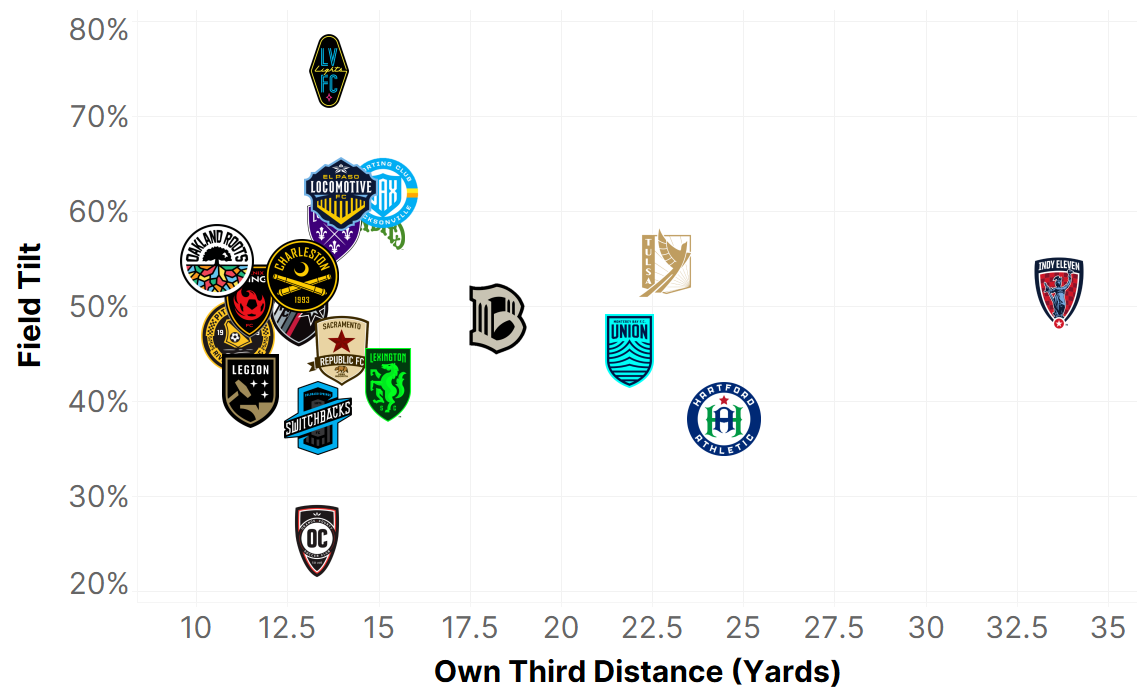
To no one’s surprise, the Oakland Roots were the shortest passers in the USL while working out of their own zone. Oakland tended to let defenders David Garcia and Michael Edwards work patiently alongside low-seated midfielder Tommy McCabe; a dearth of pressure from opposing Monterey helped that cause. The reward for that patience? A 55% field tilt, the sixth-highest in the Championship.
Indy hewed to the other extreme, going long from the back without a second thought. Their average pass in build travelled near 35 yards upfield, far and away the highest in the division. The Eleven ultimately ended up with a slight edge in field tilt terms, but that was somewhat misleading given that opposing Brooklyn spent 60-plus minutes defending a lead. In the first half, Indy posted a mere 34% field tilt.
The real surprise here? Las Vegas, who didn’t have their best creative and retentive midfielder (Kyle Scott) yet still controlled their match against Orange County. Once again, there was a “team scores early-ish and sits against the ball” factor, but the Lights looked very assured in Week 1.
Talking Trinity
How do you stop Lexington? Two weeks ago, Sporting Jax’s answer was to mark low-dropping forwards (i.e., Addie McCain and Catherine Barry) with their center backs and lock in on short-field breakout situations. Dallas, who put up just 0.4 xG in their away upset over LSC on Sunday, didn’t really feast in transition, but they did share that same forward-centric coverage philosophy.
Nathan Thackeray’s 4-1-4-1 wasn’t very different from Dallas’ usual approach, but the extent to which Wayny Balata honed in on McCain from the No. 6 spot stood out. Balata is winning 6.8 duels and putting in 5.1 defensive actions per 90 this season, and that grit was on full display against Lexington. Her ability to cover space between lines underpinned the Trinity system.
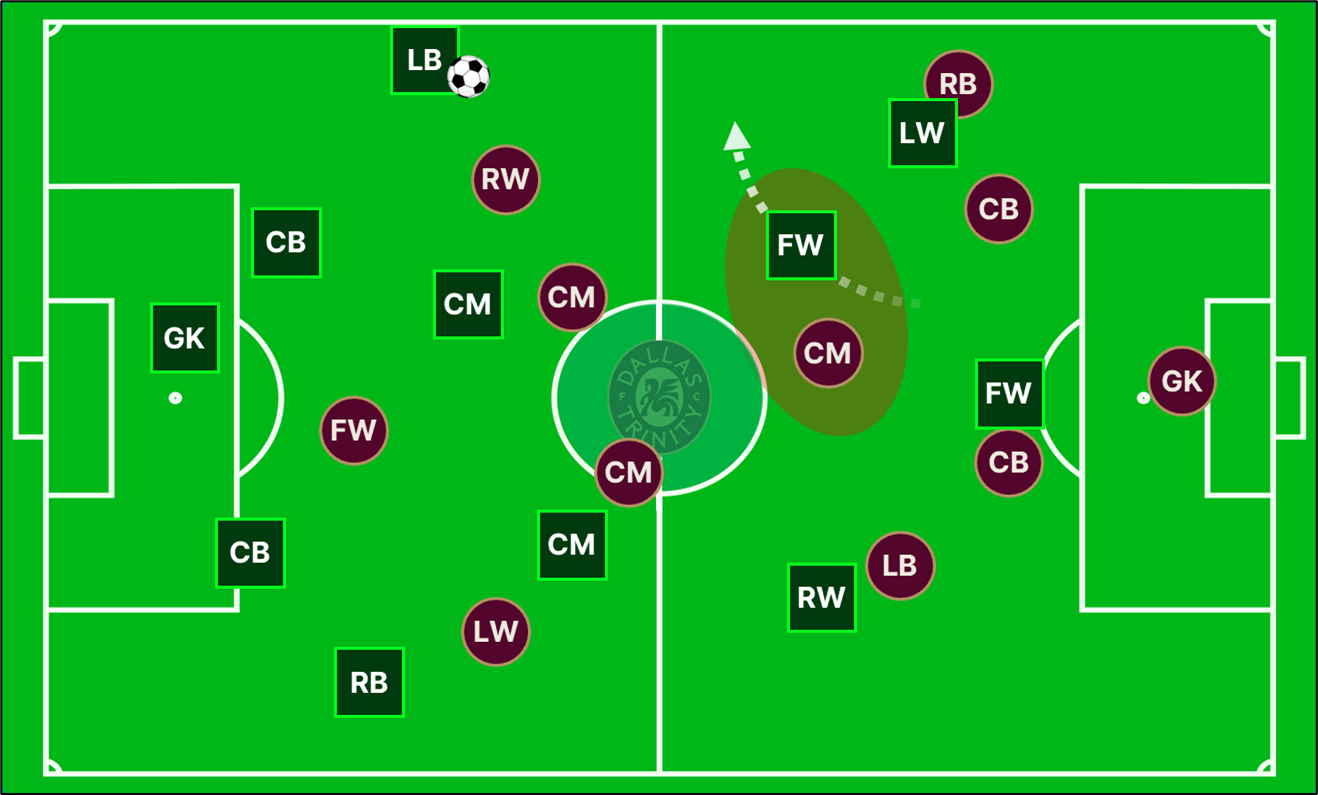
You see each side’s shape mapped here in a typical Lexington buildout scenario. Through the midfield, Dallas’ No. 8s – Lexi Missimo and Heather Stainbrook – mark the opposing pivot. The McCain/Balata dynamic is called out; here, the idea is that McCain is dropping for a touch to help progress play up the sideline, trying to create a triangle with fullback Ally Brown and winger McKenzie Weinert.
If Dallas could slow LSC in situations like this, it would allow them to gracefully shift into a more compact block shape. Trinity actually ended up with a majority of possession (50.1%) but a minority of the field tilt (39.3%), yet they also played more passes per possession than Lexington. For me, those numbers come together to paint a simple picture: Thackeray’s press tended to draw its line of confrontation somewhat deep (hence the field tilt disparity) but succeeded at disrupting Lexington’s flow.
Now, it’d be dishonest to paint this as a one-sided affair. McCain found her share of touches, half-turning into terrific through ball opportunities on more than a few occasions. LSC eventually began to skip her entirely, hitting ambitious passes up the flanks or into a diagonal-slicing Barry.
Even so, McCain didn’t register a shot and put up a mere 59% passing accuracy in the final third. In block, Trinity often assumed a flat 4-5-1, sitting Balata, Missimo, and Stainbrook level across zone 14 to stop LSC from moving the ball. At other points, Missimo stepped like a second No. 9, interrupting the home side’s ability to move from side to side. Variability was the name of the game, even if that “mark McCain” priority held firm.
DALLAS AT THE DEATH 🤯@dallastrinityfc's @hstainbrook7 finds the breakthrough in the 𝙛𝙞𝙣𝙖𝙡 𝙨𝙚𝙘𝙤𝙣𝙙𝙨 𝙤𝙛 𝙨𝙩𝙤𝙥𝙥𝙖𝙜𝙚 𝙩𝙞𝙢𝙚‼️ pic.twitter.com/hR2iJOZx27
— Gainbridge Super League (@GainbridgeSL) March 8, 2026
On the ball, Dallas’ setup was broadly familiar. Cyera Hintzen flexed up from left back, whilst starting right back Hannah Davison tucked in as a third resting defender (at least until she subbed out at the half). It wasn’t all so successful; the 3-1-5-1ish setup only generated five total shots for Trinity, and it often left Missimo uninvolved in her drifting No. 8/No. 10 role.
The upside? Forward Bethany Balcer proved to be a decent outlet for zone exits, holding off defenders and allowing Dallas to relieve themselves after spells of LSC possession. Allie Thornton did much the same after she subbed on in the second half. Her presence was key to Trinity’s last-second winner.
That 92nd minute effort began with Dallas’ most reliable final-third pattern: engagement between Hintzen and Chioma Ubogagu up the left flank. With Thornton drifting into the ball-side channel as a potential cutback option, LSC couldn't commit an extra defender to Hintzen to prevent that action. Thus, Hintzen could hit a cross into the 18-yard zone – one dummied by substitute attacker Caroline Swann into the feet of a waiting Stainbrook.
Where Missimo was somewhat inactive (hence Swann's entrance in her stead), Stainbrook was sublime once again. She took 48 touches on top of that goalscoring effort, mixing possessive involvement with keen midfield marking and a clear understanding of when to rotate low behind Balata. In every sense, she underpinned Dallas' 4-1-4-1.
Now, this Trinity team is just one win off of second place with a game in hand. Yeah, they've got a negative goal difference. Yeah, they're winning ugly. Still, you can't argue with the fact that Thackeray is setting Dallas up to frustrate their opponents and earn valuable points entering the home stretch of 2026.
In other news…
The format and timing of the newsletter this season are still a work in progress. I’d anticipate something about this length at any point between Wednesday and Friday, but we’ll see?
I wrote about Antelope Valley a bit in my League One recap on Backheeled, but Alta might’ve been my surprise team of the weekend. Plenty to like, but I’ll specifically shout out right back Nick Relerford as a statistical oddity. The rookie out of Cal State Fullerton basically looked like a hybrid No. 10/winger in Alta’s attacking 3-2-5ish look; his off-ball positioning was pitch perfect. Still, Relerford took just 19 touches and didn’t play a single final-third pass in a match where Alta held 77% of the ball. Kinda wild!
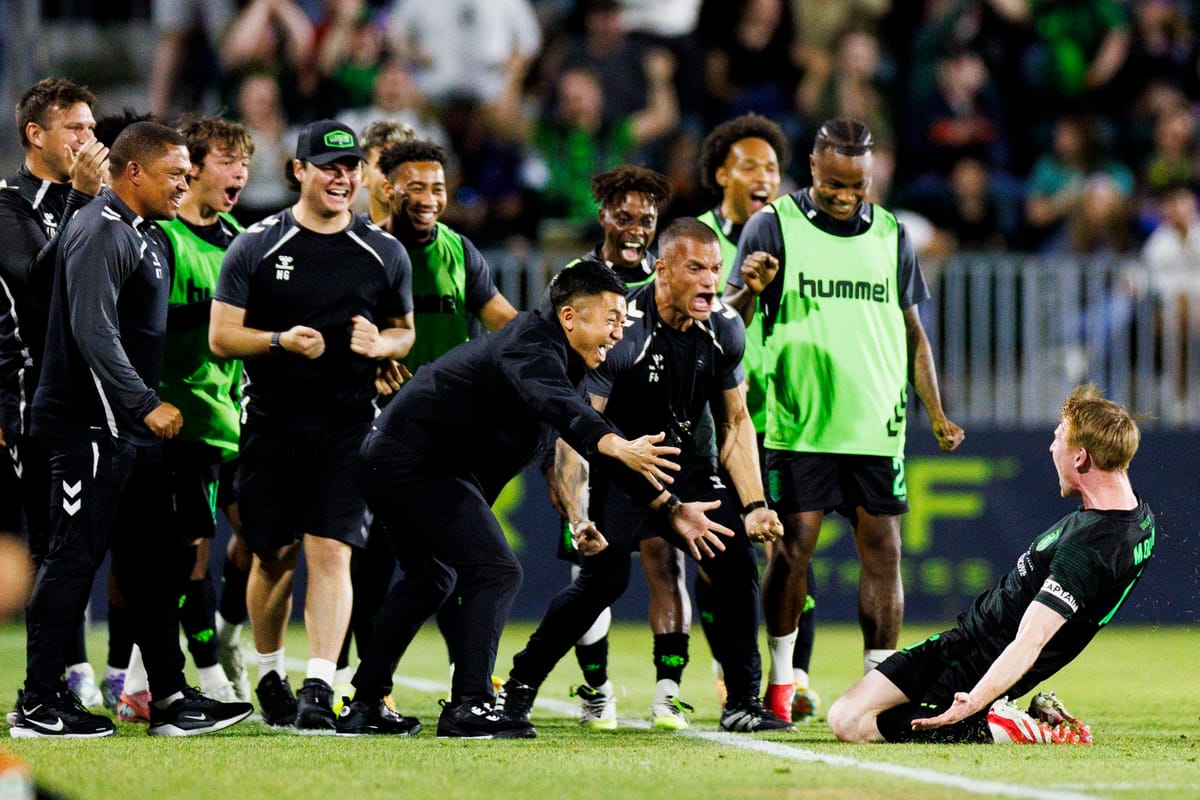
Mukwelle Akale provided one of the clearest “this is why you sign a player” moments I’ve ever seen in his Louisville debut, scoring just seven minutes into his first appearance for LouCity. This team needed a weapon that could be incisive close to goal; by dribbling through multiple Lexington lines, creating separation in the box, and dragging a left-footed shot against his body to score, Akale put on a clinic in doing so. He and Chris Donovan already look like they’ll be key in 2026.
Top Chef is back, and that brings me immense pleasure. This year's field includes a couple that co-owns a restaurant and a pair of identical twins who are near-impossible to tell apart. This season is set in the Carolinas, but I’m not holding out hope for a “cook a postgame meal for the Greenville Triumph” challenge.