The Back Four: New year, new wrinkles
On Madison, Hartford, DC, and more

Welcome in to The Back Four!
As always, visit Backheeled for more USL content, including my upcoming US Open Cup superlatives. Also, check out This League! and The USL Show for more on the week that was.
Without further ado, let’s get to it.
Madison’s new look
A few weeks back, I took a look at Forward Madison’s almost-all-new roster and tried to figure how they‘d play in 2026. After one week, it’s safe to say that a lot of Matt Glaeser’s expected changes have come to fruition. These Mingos are more pressureful, more vertical, and better-suited to making noise in League One.
Last year, Madison attempted 20 tackles or more in just one league match. Similarly, they tried less than 270 passes in one (separate) league match. Both of those things were true on Saturday, when Madison picked up a 2-1 win in Knoxville. Glaeser has already instilled an increased sense of verticality and interventionism within a familiar 3-4-3 structure.
The lack of high-volume passing was intentional, a byproduct of a direct style in build. Madison’s average pass from their own third traveled 27 yards upfield. That number was 46 yards for goalkeeper JT Harms, who showcased a booming-yet-accurate sensibility as a long distributor. Meanwhile, the Mingos also focused on quick breaks upon regaining in the defensive third, hoping to catch Knoxville out before they could find their structure.
You get a taste of that tendency here. Knoxville’s long pass is cleanly handled by the Madison back line, and Derek Gebhard picks up a touch in the pocket to quickly move play into the opposing zone. Around Gebhard, the other two forwards (Ryan Carmichael and Stephen Annor Gyamfi) and left wingback (Geni Kanyane) both streak ahead to put the hosts under pressure.
Kanyane’s eventual cross won’t find Carmichael at the far post, but the move is emblematic of Madison at their best. Gebhard was always willing to drop in as a creative hub; Carmichael and Annor Gyamfi only attempted three shots but were ceaselessly positive with their movement. Both Madison wingbacks chose the right moments to push forward. Combined, Kanyane and AJ Edwards took 99 touches and attempted six crosses.
In my weekly Backheeled column, I wrote about Collin McCamy’s freedom to set the table as a ball-playing center back from the left side. He forged an instant relationship with Kanyane, one that was aided by Gebhard’s intelligence as left-central mover. Already, that axis feels like a cornerstone for Madison in 2026.
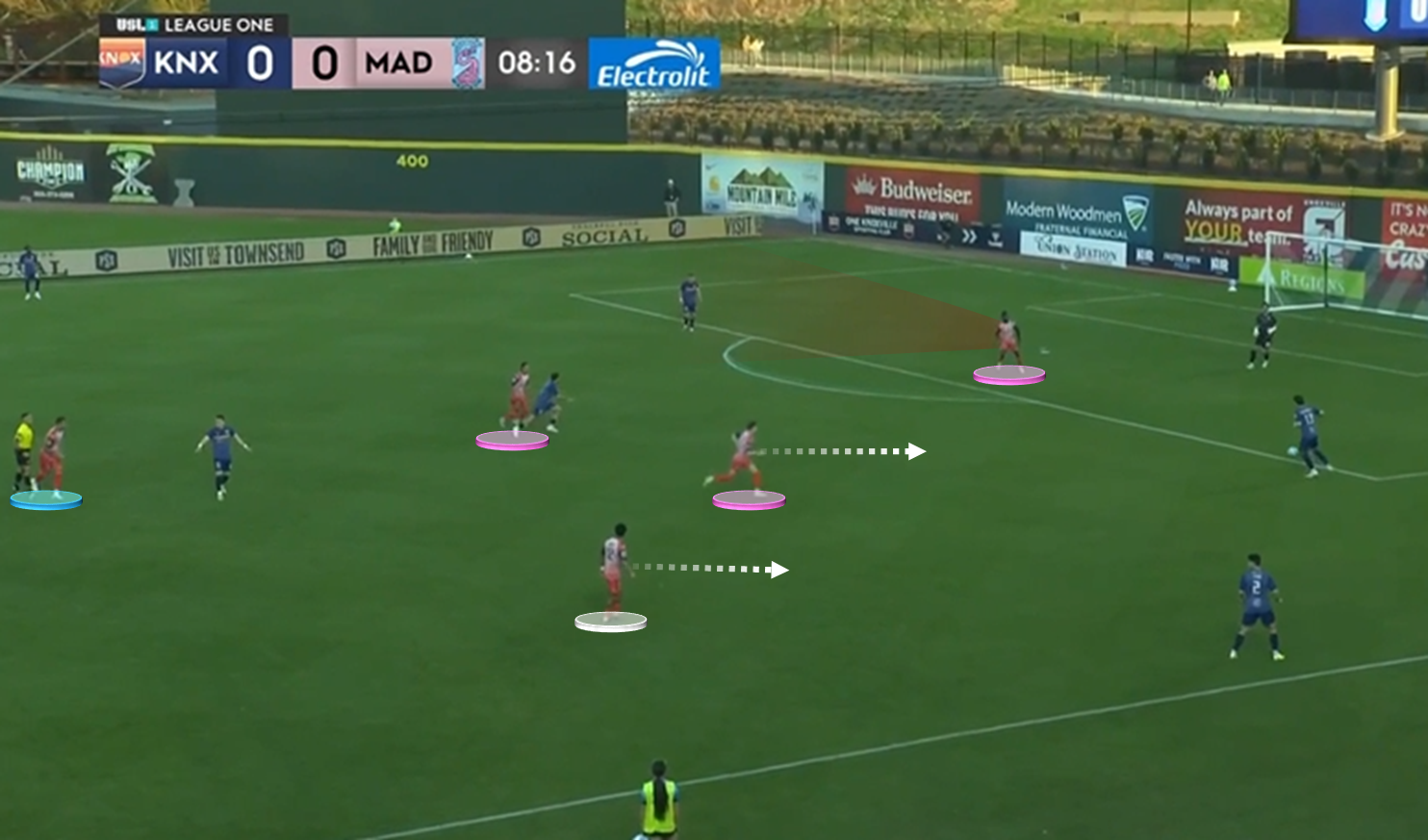
Over the years, Madison’s pressing numbers have sunk lower and lower, but Saturday represented a change. You can see that above, where the 3-4-3 pushes all the way toward Knoxville’s box and aggressively works against the ball.
In the screenshot, Madison is already in motion. Gebhard, one of three pink-marked forwards, has tucked low against the opposing No. 6. Since Knoxville has passed toward the Mingos’ right, Carmichael is triggered to close on the ball; at the same time, Annor Gyamfi hedges to cut off a point-switching passing lane.
The mix behind the attackers is equally interesting. To deny One Knox’s nearest fullback, central midfielder Roman Torres (white) hews wide toward the sideline. There’s one more Knoxville player to address between the lines, but Mark Segbers – Torres’ pivot partner – doesn’t pick him up. Instead, Segbers stays deep to shield the back line as central defender Kevin Carmichael (blue) picks up the mark.
That specific relationship in the midfield wasn’t always the go-to for Madison, but it embodies the aggression with which they played at the back. For his part, Torres attempted six tackles in this match; Enrique Machasen, Segbers’ halftime replacement, got to four. Time after time, Madison hoped to use their front three to force rushed passes that they could close on hard.
Tie the two examples here together, and you can see a clear picture. Madison wants to press more aggressively, break off the ensuing turnovers, and use longer initiation to keep the cycle going. They did it well enough to beat the defending champs in Week 2, and that’s as good a sign as any that Glaeser and co. mean business in 2026.
Hartford’s press
Last season was the best in Hartford Athletic history, and that’s a credit to Brendan Burke’s flexibility. It’s easy to forget how slowly Hartford started before changing shapes from a back four into a swashbuckling back three; a trophy and a playoff berth followed in the fall.
We’re seeing yet more variation in 2026, and that’s a good thing. Through two games, Hartford is allowing merely 0.94 xG per match. They’re also making 3.5 final-third recoveries per game, which would’ve ranked top-five in the Championship last year. A shifted 3-5-2 press that’s designed around sideline triggers is making it happen.
Take the example here from last week’s draw against Birmingham. You can see Hartford’s two forwards (in green) go one-to-one against the Legion’s two center backs. The goal is to deny passing lanes through the middle and force the ball wide; the shape of the press, which is really more of a 5-1-2-2 with the midfield (blue) matching Birmingham’s pivot, also helps the cause.
As soon as the Legion pass toward the sideline, the trap is sprung. The ball-side wingback for Hartford (white) crashes upfield, and the nearest forward and No. 8 also try and pin the receiver by using the sideline as an extra defender. Now, Birmingham is in a pickle. Do you play a risky pass upfield and risk a turnover, or do you pass backwards?
Legion right back Nico Brown eventually opts for the latter choice, but now Hartford is engaged. Beyond the initial wave of sideline-centric trapping, Hartford also used backpasses as a trigger to push toward the opposing box. Here, that means striker Augi Williams will rush the rival goalkeeper into an uncomfortable long pass.
Now, Birmingham wasn’t always phased by the press. Longer initiation occasionally prevailed, and defender Ramiz Hamouda – off to the Bundesliga in a few weeks – looked comfortable dancing through pressure. As the game wore on, the Legion focused on dropping numbers deep to make Hartford’s press even less effective.
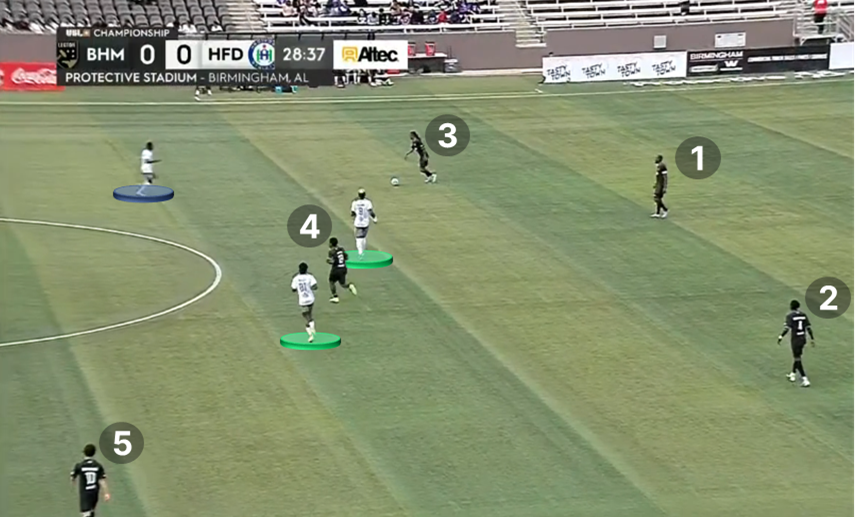
Here, the Legion start with their two-man center back base (#1 and #2) but drop midfielders deep to provide support. One member of the pivot (#3) sinks to the level of the center backs to stretch the Hartford forwards; the other (#4) occupies bodies centrally. There’s even an attacking mid (#5) coming low from the weak side. You can’t even see Birmingham’s fullbacks, and that’s because they’ve pushed upfield to occupy the opposing wingbacks and deny the aforementioned sideline traps.
Build patterns like that seen above allowed Birmingham to complete 56 more passes than their guests and attain a slim field-tilt edge. Still, what’s promising about Hartford is their ability to cause trouble in multiple ways. The press had its moments in Alabama, but this club’s identity lies in the counter-attack above all else.
Against Jacksonville in Week 1, Hartford was willing to absorb pressure in a 5-3-2 block and then break apace with Michee Ngalina leading the charge. Birmingham’s system presented a different challenge, but Hartford was no less effective at gumming up their tempo. Consider that screenshot again; yeah, the Legion have an edge, but they’re flexing three of their midfielders deep into the defensive zone just to beat one line of the press! Innately, that means Birmingham will be undermanned even if they reach the final third.
We didn’t see as much transition spark in Week 2 sans Ngalina, but that’ll come with time as players like second-year forward Adewale Obalola and Williams find their chemistry. For now, it’s notable just how connected and intentional Hartford looks from back to front – starting with the press, but in more ways than one.
Power, packing a punch
I've been impressed with DC Power's possession game throughout the 2025-2026 season, but it’s often been a one-woman show in the final-third. When the Super League’s winter break hit, Gianna Gourley had scored eight goals, while her next-closest teammate had scored two. Now, that’s changing.
Gourley hasn’t scored since December, but her Power side just ran off a six-match unbeaten streak* and is finding secondary offense in droves. Omid Namazi has trusted new additions like Justina Gaynor and Lexi Fraley in key positions, shifted his tactics as needed, and reaped the benefits because of it.
A weekend ago, DC eschewed their usual defensive 5-2-3 (or thereabouts) for a 4-2-3-1 away to Brooklyn FC. Within that shape, Gourley moved to the left wing, whilst Loza Abera and Alyssa Walker filled out the remainder of the attacking spots. The shape and deployment changes did two things: (1) keep DC solid in post-turnover situations against a rampant press while (2) maintaining a formidable threat up top.
The back end of the system depended on Susanna Fitch and Gaynor. Fitch, the right back, mostly sat low in build but often overlapped like a winger in possession. With Walker tucking into the halfspace, DC would find themselves in 3-2-4-1 mode at that point. Doing so wasn’t easy, hence why Gaynor – who made eight recoveries and attempted eight ground duels – was key as a ball-stopping No. 6 after giveaways.
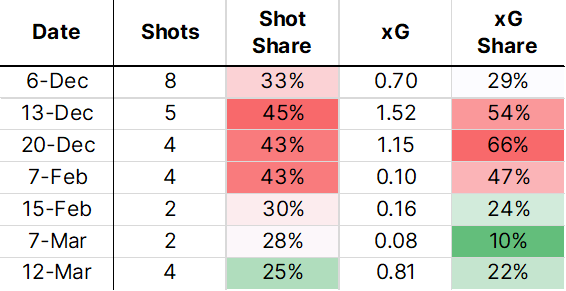
DC was in business whenever they could take the ball back, withstand the counterpress, and then drive forward. Versus Brooklyn, every press-resistant passage of play let Gourley anchor a break as Abera and Walker – who have eight goals between them in the 2025-2026 season – pushed toward goal. The latter two combined for 1.3 xG in that match.
Yes, both DC goals in a 2-0 win against Brooklyn came from dead balls, but the second chance arose because of Gourley’s presence as an outlet up the left wing in the 62nd minute. Gourley ultimately put up just two shots; on a rolling three-game average basis, her xG production hadn’t been lower all season long.
Last Thursday night’s win over Dallas was more familiar, but it underlined how imposing this front line has become. With Gourley up top, Abera to the left, and Walker to the right, DC had all the weapons necessary to break down a stout Trinity defense whenever lines were broken.
Nathan Thackeray’s side tended to press in a 4-1-3-2 with a rather narrow attacking midfield line. The aim was to deny tempo-setting passing between DC’s center backs and center mids, the kind of build-up that can bend opposing defenses out of shape. Instead, Dallas wanted to drive Power into wide traps.
DC is typically a possessive team, but they held merely 38% of the ball in that midweek bout. Trinity’s defensive timing was on point; every wide trap was well-supported by a roving Maya McCutcheon, who went 4/4 in tackle attempts out of the No. 6 spot, per Opta.
Still, DC wasn’t to be stopped. Here, you see them working wide to skirt the upper lines of the 4-1-2-3 press. When Fraley receives at the left wingback spot, she’s immediately under pressure by the opposing fullback. In turn, McCutcheon rotates to cover that now-open space.
Hole plugged…right? Instead, Fraley’s ensuing incompletion is followed up by instant counterpressure. The wingback reads the situations, regains, and creates a four-on-three against the remainder of the defense.
Dallas’ defenders collapse hyper-narrow against Gourley – typically, that’s how you stop a prolific No. 9! – but leave both Walker and Abera free in the process. Moments later, a rebound is tapped in by Abera.
DC only managed a draw against Dallas, but they held the xG edge and were full of bright ideas. Every time out, Power seems to be bringing a new wrinkle to the table. The clean “three-box-three” possession game that started the year had its appeals, but this version of DC is harder to pin down – and they’ve got there without throwing those basic positional principles out the window. That’s a testament to Namazi and this roster, and it could set Power up for a late run to the postseason.
(*Putting minimal stock in a loss to Carolina that took place at 11:30 AM on a Tuesday. DC didn't have Fitch or Walker, but they still outshot the Ascent and ended up with an xG edge.)
A post!
I don’t have a point to make here, I just love Owen Damm taking long throws. You’re getting three of those from the opening minutes of Tulsa’s weekend draw against San Antonio below; this fails to capture that Damm was taking throws from both sidelines on Saturday.
Owen. Damm. Long. Throws.
— John Morrissey (@usltactics.com) 2026-03-15T00:26:53.989Z
So far in 2026, there’ve been two goals off throw-ins in the Championship. That’s 3.9% of the total scoring output in the league, up a tick from last year’s 3.7% share. The numbers are similar in League One, where throws are in that same 3% range year-over-year.
To my eye, more clubs are trying to take advantage of throw-ins as legitimate set pieces. That should lead to a bigger jump, but time will tell if the trend bears out.
In other news…
A gentle reminder to folks: I’m doing like 3,000 words a week about League One for Backheeled. You’ll still get a point or two here, but I’m talking about every single team that played every Tuesday on the site.
The return of Delentz Pierre to the Tulsa midfield is an interesting indicator for where the defending Western Conference champs are at. First: Pierre is excellent in that position and kept a lid on San Antonio over the weekend. Second: this team is going to look different (and better!) when Boubacar Diallo and Giordano Colli are available and fighting for those minutes.
FC Naples keeps making plays like this…
…and I keep buying in more and more. There were concerns about this offense in the post-Henderlong era, but the freedom with which the Taylor Gray/Andres Ferrin pair is playing might carry Naples throughout 2026.
In the run-up to the Oscars last week, I caught up with F1 – the last Best Picture nominee I hadn’t yet seen. Tepid reviews be damned, I really liked it. Is the plot rote? Yep. Are the dramatic scenes dynamic? Sparingly. Did the fast cars go vroom with Hans Zimmer’s music blaring? You betcha. Sometimes a movie can just be a spectacle!
Related: deserved win for One Battle After Another. The number of bad internet reactions has been unsurprising and annoying in equal measure. It’s funny, poignant, and timeless. Whenever I think about One Battle, I come back to Benicio Del Toro’s subplot, which was apparently proposed by Del Toro on set and is the undeniable turnkey for what the movie is trying to say about activism.