The Back Four: Super League & San Antonio
On SAFC's big moves, Lexi Missimo, and more

Welcome in to The Back Four!
As always, visit Backheeled for more USL content, including a look at the league’s unique financial setup. Also, check out This League! for an audiovisual dive into the week that was – an actual episode is coming, for real.
Without further ado, let’s get to it.
San Antonio's splurge
When Mikey Maldonado signed for San Antonio FC on a multi-year deal last Tuesday, I was already locked in. Then, they went and added Akeem Ward – still one of my favorite fullbacks in the USL – to a multi-year deal of his own. You can’t do much better in this league.
Already, SAFC has addressed two primary positions of weakness from 2025. While Carlos Llamosa had plenty of options in his midfield and at the fullback spots in his debut season, availability was a never-ending concern. Ward and Maldonado have combined for more than 250 appearances across the last four years – they're cornerstones, and that’s before you consider their quality.
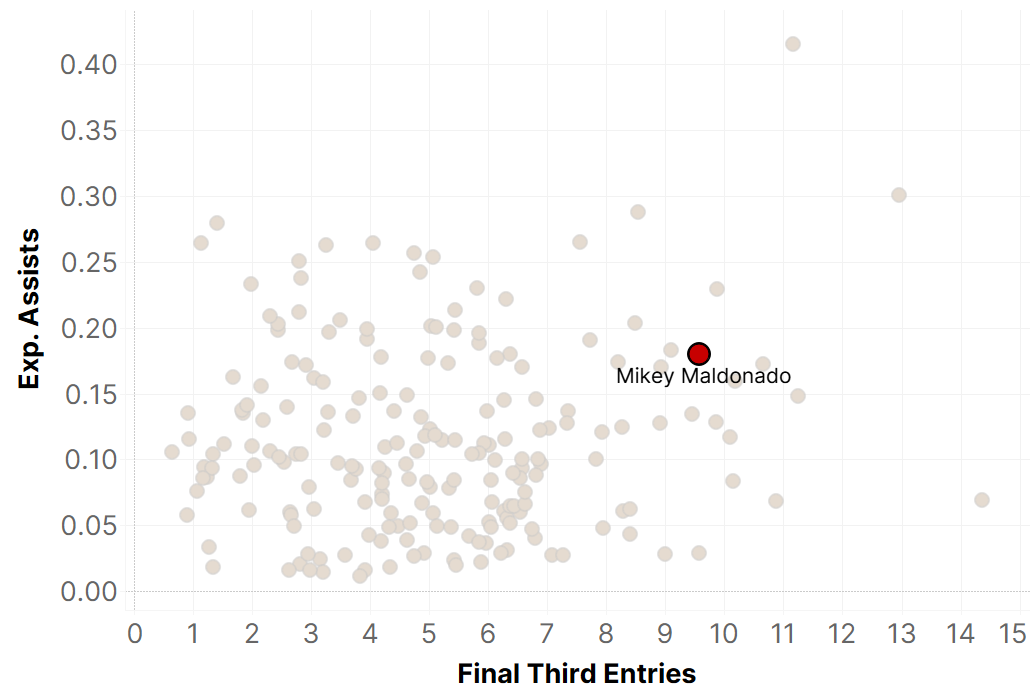
What does Maldonado add? Among all midfielders, only Rodrigo Lopez, Juan Torres, and (bizarrely) Cammy MacPherson exceeded his final-third entry passes and expected assists last season. The 27-year-old created 18 chances and 2.0 xA from set pieces, adding 33 more chances and 4.3 xA in the run of play. All were top-ten marks.
Especially late in the season, Maldonado tended to be the deeper midfielder in North Carolina's adjusted 4-4-2. Raheem Sommersall was the water-carrier who bounced from box to box like a platonic No. 8, whereas Maldonado was happy to sit in front of the defense. There, he served as a protector and quarterback in equal measure. No player did more with fewer opportunities to advance into the final third in settled possession.
SAFC's 22 run-of-play goals represented the fourth-lowest mark in the Championship in 2025, hence why Maldonado is so valuable. As one of the league’s premier long throwers, the San Antonio native will also provide a new dimension on set pieces. NCFC was tied for second in the Championship with four throw-in goals last year, while San Antonio recorded none.
What’s especially enticing about the Maldonado signing is how he might free Jorge Hernandez to damage further ahead. You see the proof of concept below, where Maldonado’s NCFC possesses under pressure up their right side. The midfielder doesn’t get a touch here, but his mere threat demands constant attention. The opposition marks Maldonado, and that allows North Carolina’s left winger to cut inside, receive, and advance play.
Given how Llamosa used Hernandez off the left last year, you can imagine this sort of sequence happening 10 times a match in 2026. While Hernandez was an all-leaguer and set a career high in goals, his expected assists (4.85) hit a San Antonio-era low. His touch share decreased from 12% to 9%, and his dribble success rate plummeted to 38% because so many of those touches came in traffic.
Thus, Maldonado’s gravity is a game-changer, no matter whether he starts next to Lucio Berron (very good in his rookie season) or if a classic No. 6 is on the way. Whoever plays in the pivot, they'll benefit from Akeem Ward's presence at fullback.
Ward is coming off a modest down year, having posted career-lows for xG+xA per 90 (merely 0.08) and recoveries (4.3) while also conceding career-high fouls (1.9). Still, it's hard to blame Ward in the context of a Switchbacks system with no No. 6 and inconsistent wing help. The star fullback – whose left- and right-sided versatility is immensely valuable – was still efficient enough to win 52% of his duels while being dribbled past just 0.79 times per game.
Meanwhile, Ward's xA numbers exceeded those of Harvey Neville and Rece Buckmaster; he forced more takeaways and made more clearances than any SAFC fullback. A “down” year for Ward is still excellent by most standards, and that should only improve in San Antonio. With Maldonado as a shield and the excellent Mitchell Taintor-Alex Crognale center back pair supporting him, the 29-year-old ought to have a far better time in 2026.
Tactical clarity is the real hill to climb at a macro level. Llamosa had bright ideas at various points in 2025, but the system swung from extreme to extreme with little cohesion. In March and April, San Antonio maintained a 53% possession average and 53% field tilt while making more than 21 upfield recoveries per match; a 4-2-3-1 was the shape of choice. The summer months saw SAFC get much more vertical, experimenting with a phase-based back three. Llamosa circled back to a 4-4-2 to end the year, but his side made 15% less pressing recoveries and posted a bad 45% field tilt in the final month-and-a-half.
In a 2026 USL Championship where 76% of the managers will have less than two years of tenure, Llamosa will begin on a relatively hot seat. He’s got the tools to cool things down; Maldonado and Ward assure as much. The challenge is to fit them into a system that can excel in a cutthroat Western Conference.
Power hour
When DC scores multiple goals this season, something they've done seven times, they put up 1.71 points per match. That number plummets to 0.33 when Power score one goal or less. It's probably obvious to see a drop-off – scoring is good! – but the numbers underline DC's particular conundrum in slower, more defensive games.
This is a team that, under Omid Namazi, has firmly established themselves as one of the slicker possession units in the Super League. Their average pass travels just 6.85 yards upfield, second only to Jacksonville. No team is closer to meeting their expected completion percentage. In build, DC often employs short- and mid-range passes meant to break lines and create overloads in a considerate manner.
Those tenets were put to the test this Saturday in Lexington, and Power acquitted quite well for themselves.
From the jump, DC's 3-4-3 build shape had a man advantage against LSC's high 4-4-2. Emily Colton and Loza Abera, who started as the No. 10s under striker Gianna Gourley, tended to drop into the midfield third, and that pattern prevented Lexington from executing their press as consistently as usual.
Consider this move, broken into two parts. At the start here, I've highlighted the overloads in two spots: one at the base of build (marked with a "1") and the other further upfield (marked with a "2") where black-marked Abera and Colton have dropped in.
Alexis Theoret, part of the double pivot within the blue-marked midfield of the 3-4-3, drops so low that she’s effectively creating a four-on-two against Lexington’s pressing strikers. Those strikers are already subdivided, with one skewing toward defender Claire Constant on Power’s right. As such, there’s a central lane through which Sydney Cummings can slip Theoret through between lines.
In the best case for Lexington, they’d be able to mark Theoret tightly and prevent her from turning. However, the use of the low No. 10s stops that from happening, as does a wider-skewing run from Anna Bagley out of the pivot. LSC can't commit to Theoret and Bagley, lest they allow a chip into the waiting creators.
The moral of the story? On both the vertical and horizontal planes, DC force their guests to stretch and can thus advance upfield.
Theoret actually rejects her chance at a line-breaking pass after receiving, but DC continues to work. Colton, Bagley, and wingback Susanna Fitch are able to create another overload – this time, a three-on-two against a rotating No. 8 and high-stepping fullback.
By the time Bagley receives, Lexington’s back line is pulled out of shape. She can look ahead to find Gourley at her feet; Gourley, leveraging a clever off-ball run from Colton, can then thread in Fitch for a chance-creating cross. In every sense, it’s a great embodiment of Namazi’s re-tool.
Now, I shouldn’t make it sound like a cakewalk. Lexington won the possession and field tilt battles, finished with a 1.5 to 1.0 xG margin, and forced a staggeringly high 11 recoveries in DC’s third. The commitment to short build could create chances like you’re seeing above, but it could also cause trouble – particularly as LSC bent into a 4-4-1-1 or 4-2-3-1 that was suited to shutting down Power’s three center backs.
In that sense, it's the lack of a "Plan B" that's the hold-up. DC is completing a modest 37% of their long passes, and they're contesting merely 22 headers per game – 20% less than first-ranked Brooklyn. The tendency to drop the No. 10s low limits the long game, and so does Gourley's skillset as a clever mover rather than a physical No. 9.
I've liked what I've seen from DC, but there's a real chance they enter the winter break second-from-bottom. The basic gameplan can be fun, but we need to see more growth across the board.
A Missimo missive
When Lexi Missimo joined Dallas Trinity, it was a big deal™ signing. Missimo was a star at the University of Texas, good for 56 goals and 70 assists in 92 appearances as a Longhorn. Coming out of school, she turned down offers from the NWSL and European clubs to join the Super League. Yes, her childhood ties to now-manager Chris Petrucelli mattered, but the move was also a proof of concept for the Super League’s ability to outmaneuver leagues with strict roster rules and pay schedules. (No, that doesn’t mean the Trinity Rodman thing is happening.)
Missimo started brightly in Dallas, but she went down injured toward the end of the 2024-2025 season and only returned to starting action this weekend. Against a vicious Carolina team, Trinity struggled to stay on the front foot. Missimo’s involvement ebbed and flowed. She ended Saturday's match with a modest 30 touches, after all.
When push came to shove, Missimo did what's required of a star attacker, scoring a 64th minute winner on what was Dallas’ only shot on target. That moment might've been exceptional, but the broader performance – if somewhat inconsistent – shows how impactful the 22-year-old could be at the Cotton Bowl.
Carolina ended up with 85 final-third entries against 41 for Dallas, culminating in a +1.1 xG margin. By the time Missimo scored, however, Trinity were winning the field tilt battle with a 51% edge. Much of that advantage relied on stingy defending at a team-wide level, and the star No. 10's two-way effort was key to stymying what the Ascent do best in possession.
The guests build out in their 4-4-2ish framework here, dropping midfielder Taylor Porter deep to create a three-on-two against Missimo and Tamara Bolt at the top of the Dallas shape. Porter typically likes to drop toward the opponent’s right side, and that puts Missimo under pressure here.
As Carolina circulates, Missimo never loses the plot. She’s always within a few steps of Porter or holding a body position that denies a pass into Porter's feet. As the Ascent are forced backward, Missimo spots the moment to press the opposing goalkeeper, at which point winger Allie Thornton smartly steps up from the midfield to tighten the screws. Dallas recovers, and Missimo instantly tries to work back toward Tamara in the center of the box – great idea, offside flag notwithstanding.
Dallas still showed some of the bend-don’t-break defensive solidity I highlighted a few weeks back, but their understatedly effective press necessitated less of that effort in the first place. Given some of Trinity's possession troubles, that ability to break the game's rhythm was especially important.
What went awry with the ball? In 147 minutes between them, the double pivot of Gracie Brian and Wayny Balata took a measly 69 touches. Dallas had to build out in a “four-two” base with their whole back line and dual No. 8s quite deep, but they still weren’t able to work through the Ascent’s fiery, man-centric press with any regularity.
Dallas tended to restart with short goal kicks taken toward Amber Wisner as the left-sided center back; most of the time, Wisner then came under immediate pressure and had to either pass into a sideline trap or go long. Missimo was a change of pace; if she could drop in like a No. 10, that gave Trinity the opportunity to break lines with extra control.
Likewise, Dallas succeeded when they could activate Thornton or Chioma Ubogagu in wide one-on-ones, and that’s what you’re seeing above. Thornton – having shifted to the left midway through the first half – is able to beat a defender and force Carolina into rotation, with Tamara’s presence also creating danger.
Missimo sees it happening, drifting toward the left to take advantage of an Ascent defense that’s dropping low into their own box. Given that space, the ex-Longhorn can cross in and nearly creates a chance. This sort of play was an exception in a match where the 22-year-old took 11 touches in her own half and just 10 in the final third, but it’s also a blueprint. The more that Dallas can break lines with control, the better off they’ll be; the more freedom Missimo gets, the more dangerous Trinity will look close to goal.
Expectations are high for Lexi Missimo, and she lived up to them over the weekend. Still, this has to be a jumping-off point. Dallas is up into a playoff spot for now, but they’re a consistent creative linchpin away from competing with the best of the best. Missimo has the talent to be that player.
Signing potpourri
What else stood out last week? Start in Kentucky, where Louisville added considerable juice to their attacking midfield. Between Quenzi Huerman and Mukwelle Akale, two of the West’s more interesting wingers are headed to Lynn Family Stadium – though their roles in this team aren’t immediately clear.
Huerman, imported from Colorado Springs, showed off left-footed scoring in the NCAA and put up a stellar 72% dribble success rate in 17 league starts in 2025. Akale, meanwhile, was the liveliest final-third creator for New Mexico United, the USL’s predominant possession team. Both played as inverted right wingers more often than not; both are excellent replacements for the outgoing Adrien Perez. For now, it’s an open question how their pieces fit into the LouCity puzzle.
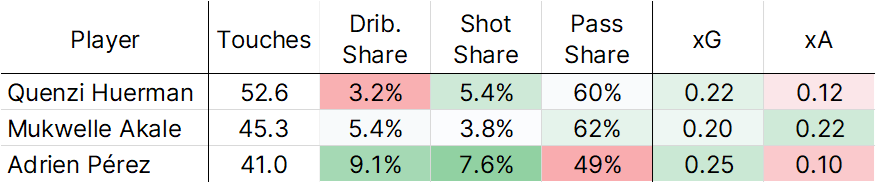
Perez was one of the Championship's most prolific double threats last season. At an extraordinarily high rate, he tended to put his head down to drive at opponents and create his own shot. By contrast, both Huerman and Akale used more of their touches to pass the ball and bring teammates into the match. (Note: any missing percentages above are giveaways. All three players were roughly in the same neighborhood retention-wise.)
Huerman, who occasionally started on the left and has some two-footed upside, is a safer – and, perhaps, less explosive – version of Perez. Akale, meanwhile, is a significantly better creator than either, and his experience operating in tight spaces feels like an obvious fit for Louisville. I’d be surprised to see him play anywhere but the right wing (maybe leading to more Jansen Wilson minutes as the No. 9?), but time will tell.
The moral of the story? Huerman, Akale, Wilson, Ray Serrano, and Sam Gleadle are a loaded group of attackers to select from underneath Phillip Goodrum.
Over in League One, Omaha made the signing of the week by poaching Gabriel Cabral from Tormenta. After winning a title in Statesboro and making a temporary jump up to Miami in the Championship, Cabral was a foundational part of the Mark McKeever turnaround in 2025. Now, his job is to run the show as Los Búhos’ star No. 8.
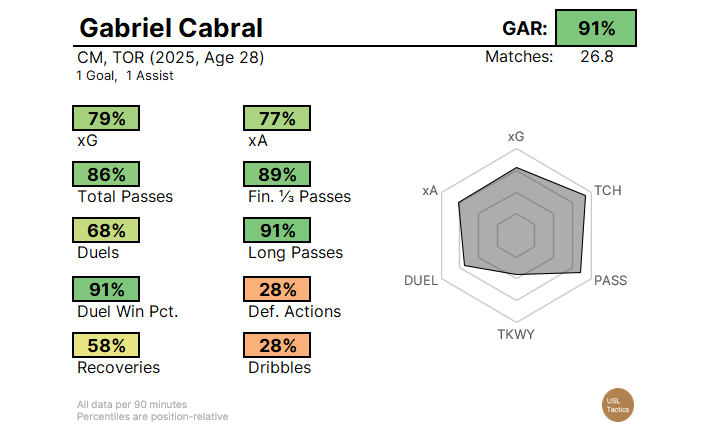
Cabral was somewhere between “good” and “terrific” in every phase of play, and his capability in second-ball situations set the tone for Tormenta’s late surge. You can nitpick a pedestrian return in terms of defensive actions, but the Brazilian was deployed as the offensive-minded midfielder next to a defensive partner throughout the year. At all times, Cabral knew what passing options were on offer, mixing shorter set-up passes with big, vertical swings toward a fiery attacking line.
In Omaha, where Cabral is the heir apparent to Max Schneider, the challenge is to become even more progressive. Schneider is a lofty measuring stick for any player, registering a 35% forward passing share over two seasons in Nebraska. Cabral, meanwhile, was at a good-not-stellar 27% last season – even while completing significantly more long passes per match than Schneider.
Schneider’s ability to drive play forward on the ground is impossible to recreate, but we’re talking about brilliant midfield options no matter what. How Vincenzo Candela fits Cabral into the mix and adjusts his system given numerous other losses will be fascinating to see.
Further south, I don’t have much to say about Sarasota, but I want to register my fascination about their ultra-Nordic roster build. At the time of writing, Paradise have four players: one is Garrett McLaughlin, and the other three are midfielders hailing from either Norway or Finland. Yes, Sander Roed attended the University of Louisville, but that’s still something. We saw Monterey tap into the Northern European talent pool in 2025 to mixed results, and I’m fascinated to see how it goes for Mika Elovaara in Florida.
One more shout for the Las Vegas Lights. I called them out briefly in the end notes of the last newsletter, but their choice to pick up Tampa Bay's outgoing pieces – namely Aaron Guillen and Manuel Arteaga – has me feeling very, very excited for Devin Rensing and company.
So far this winter, Las Vegas has added four players in Guillen, Arteaga, Ben Ofeimu, and Jared Mazzola that (a) are locked in on multi-year contracts and (b) probably would've been among the six or seven best pieces on the 2025 roster. There's more to come; sources in Las Vegas have confirmed that a few more moves (including an inbound European transfer) are on the way. Already, though, we can start to think about the relationship Arteaga might forge with Johnny Rodriguez.
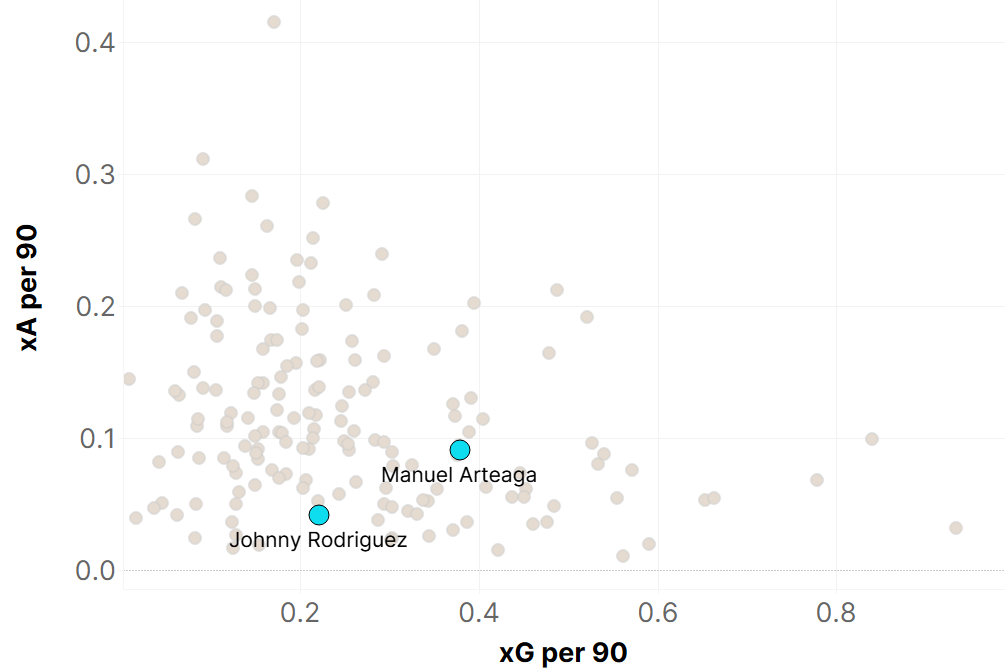
Last year wasn’t exactly an annus horribilis for Rodriguez, but he scored just eight non-penalty goals and saw his xG and xA bottom out. Much of the decline owed to Antonio Nocerino’s cluelessness and the need for Rodriguez to operate as Rensing’s left winger. Rodriguez was forced out of his natural No. 9 role.
Arteaga, meanwhile, weathered a coaching change in Tampa Bay to generate solid expected outputs. Still, he was in and out of the lineup for much of the summer. Arteaga is never one to lack confidence, but the unsure natures of the Rowdies' 2025 did him no favors. You can reasonably expect him and Rodriguez to benefit in a new, clarified environment starting in the preseason.
While Rensing is more than just a Ben Pirmann acolyte, it’s hard not to dream about the Arteaga-Rodriguez duo in the framework of Charleston’s MD Myers-Cal Jennings combo. Like Myers, Arteaga is willing to drop off the ball and play under a No. 9; like Jennings, Rodriguez is very good as a mover in the pockets while still knowing when to poach or lead a line.
We’ll see what the rest of the winter looks like in Nevada, and it’s important to highlight the magnitude of the rebuild. Even after Rensing took over, Las Vegas finished their last 11 matches with a -0.79 xG margin per game, the worst mark in the Championship. What we’ve seen so far is confidence-inducing, but the job isn't done.
Quick Hits
In other news this week…
- Any team that’s announcing new signings but hasn’t released info on renewals and releases is committing a sin.
- Last week, ESPN’s Jeff Carlisle wrote about the ongoing USL Championship CBA negotiations, describing a proposed $55,000-a-year compensation minimum for the new first-division league set to debut in 2028. Sources close to the talks underlined that the $55,000 number is hard and fast; there isn't extra cash on top of that for housing. Meanwhile, the existing Championship compensation floor (inclusive of housing and healthcare outlay) would jump from $26,000 to a number in the $30,0000s. While most of the player pool earns above that level – double-digit Championship clubs have no players at the minimum, which covers roughly 20% of the total talent base – a lower-budget contingent of the ownership refuses to push higher.
- Go read Nicholas Murray on Tampa Bay’s rebuild, which brings in the historical perspective you know and love from Mr. Murray.
- I don’t know if the Cosmos are going to run a 4-4-2 with Ajmeer Spengler and Sebastian Guenzatti up top, but that would be so, so, so, so, so fun. By the way, go check out Alex Ashton’s weekly notebook or more League One coverage.
- My local repertory theater is doing a series on the Alfred Hitchcock movies scored by Bernard Herrmann, which feels like something that got plucked from the inner depths of my brain. Naturally, that led to a Man Who Knew Too Much/Vertigo double feature for yours truly. Underrated: everything else Herrmann did! The Ghost & Mrs. Muir is one of my favorite first watches of the year, and his score to the debacle that is Truffaut’s Fahrenheit 451 nearly saves that movie.