The Back Four: Ride the train
On El Paso's uptick, plus more from across the USL

Welcome in to The Back Four!
Be sure to visit Backheeled for more work, including my weekly Championship and League One recaps and a look at coaching prospects across the USL. Also, check out This League! and The USL Show to catch up on the week that was.
Without further ado, let’s get to it.
Locomotive, full steam ahead
El Paso didn’t play in the league last week, but they took care of business against a sneaky good Laredo Heat team in the Open Cup by doing what they’ve done throughout 2026: controlling transitional moments. The Locomotive’s improved possession game has been a point of focus in my coverage, but it’s equally remarkable that Junior Gonzalez's side is conceding just 1.06 xG per match to date. The defensive leap feels real.
Much of it owes to organization in post-turnover moments. Between their draw against Colorado Springs and drubbing of Monterey Bay, the Locomotive are conceding just 0.10 break xG per match in the Championship. It's a tiny sample, but that's a meaningful improvement on an already-good 0.14 per game last year – a mark that ranked El Paso third in the West.
The big difference? Wilmer Cabrera set his team up to be conservative, particularly in the home stretch of 2025. Gonzalez is allowing for far more offensive freedom while still instituting a sense of resting surety.
Take the example here from the win against Monterey. Midfielder Alex Mendez – one of the stars of the 2026 season to date – turns the ball over at the halfway line, but he instantly puts a body on the tackler. In that simple act, Mendez stops the home side from executing an instant break.
Monterey is able to hit a longer pass toward winger Giorgi Lomtadze, but El Paso has recovered into their shape by the time he settles. You can see the four defenders (dark blue) and two mids (light blue) tracking back, with center back Noah Dollenmayer and left back Ricky Ruiz doubling against the ball. Ultimately, they’re able to recover possession and clear danger.
Even if Dollenmayer hadn’t been able to intervene, there’s structure behind him. Kofi Twumasi, the other starting center back, stays active and hedges against Monterey’s No. 9, while Robert Coronado drops into the box from the No. 6 spot to cover his teammates’ rotations. In every sense, it’s shapely transition defending.
I was a vocal worrier regarding this El Paso defense throughout the preseason, but Dollenmayer has changed the calculus. The 26-year-old ended 2025 on loan in San Antonio, but Gonzalez rightly identified his blend of athleticism with plus passing skills. His presence underpins much of the Locomotive’s improvement.
The change for El Paso hasn’t just come at the back. Here, it’s their counterpress that does the job.
Now, this isn’t a no-holds-barred pressing team. The Locomotive are tied for last in the league with just one final-third recovery to date. At the same time, they’re good about harrying opponents after turnovers and regaining the ball in the midfield – or, at a bare minimum, slowing opponents down while trying to do so.
You see the start to an El Paso passing move here, with midfielder Eric Calvillo hugging wide to receive. When he gives the ball away further upfield, a few things happen. Rubio Rubin closes down hard from the striker spot, halting an immediate break. As that happens, Coronado bursts up from the No. 6 spot to cut out the closest Monterey receiver.
By this point, El Paso is essentially in a 4-1-4-1 that walls off easy access through the central lane. Coronado keeps chasing the ball, the home side has to work wide, and breakout right back Kenneth Hoban steps up with a tackle. There’s simply no way through.
The best defenses are often the ones that do the least defending. By pairing a 54% possession average with the break-denying transition structure we’ve just seen, El Paso is keeping the ball away from their third. It’s impressive work so early in Junior Gonzalez’s reign, and it has the Locomotive looking like a legitimate contender.
Corpus Christi and League One‘s tactical molds
Reacting to a team off of 180 minutes of evidence is one of my favorite activities, so let’s talk Corpus Christi. The Sharks have two draws to date where chances have come at a premium – they’ve got a flat 1.0 xG thus far – but they’re already establishing a clear style.
Eamon Zayed rolled out a Northern Colorado-inspired midfield group in an opening 2-2 deadlock against Naples, and they helped reprise a familiar tactical approach. Corpus Christi didn’t press aggressively out of their 4-2-3-1 or 4-1-4-1 shape; instead, they focused on staying organized in a mid block. Corpus Christi also played quickly, sacrificing high-volume passing for a rapid combination play through the channels.
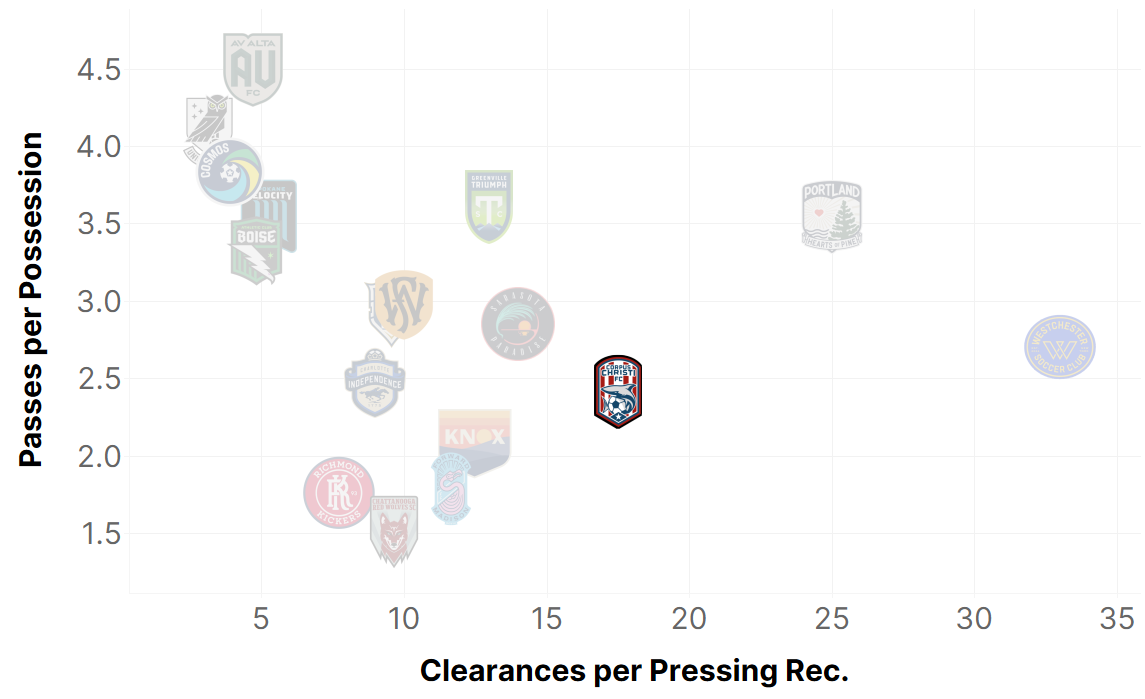
The result of those tendencies? Corpus Christi currently ranks as a bottom-five League One team in terms of passes per possession, hitting roughly 2.5 passes each time they’re on the ball. Likewise, the Sharks are 14th ranked in terms of clearances per final-third recovery – a back-of-the-napkin way to assess where you’re making your defensive stops.
There's already a stratification of styles across the League's 17 teams. AV Alta, Union Omaha, and the like have established themselves as clubs that want to possess for long periods of time and the press to win the ball back as quickly as possible. The Richmond Kickers and Chattanooga Red Wolves are similarly pressureful, but they're direct and unapologetic about keeping the ball.
Portland Hearts of Pines' numbers are skewed by a small sample size and an away trip to Alta, but they and Westchester SC are in a third category: teams that aren't very pressureful (or, in Portland's case, haven't been successful at executing the high press quite yet) but want to keep the ball on the ground. That's where Corpus Christi seems to be trending.
While the Sharks are essentially a 4-2-3-1 team without the ball, they often bend into a 2-4-4ish look with it. That setup creates a solid base at the back and forces opponents to devote resources upfield to disrupt build. There’s plenty of room for interchange between lines, but it doesn’t come at the cost of structure. Corpus Christi is able to play vertically without being reckless.
As we saw against Naples, there’s still room to grow. You see that in two possessive examples here.
In the first case (marked #1), Corpus Christi varies their shape and initially forms a 3-4-3, with Patrick Langlois dropping from the central midfield into the back line. Because Naples needs to address his presence and that of the Jackson Dietrich/Enock Kwakwa pivot, there’s room up the sideline to find fullback Shannon Gomez.
When Gomez receives, he does so as winger Nacho Abeal drops in to potentially receive. It’s a good run from the rookie winger, and it opens real space between the defense’s lines. The problem? There isn’t a third-man run to fill that space. Kwakwa stays home, and striker Christian Chaney calls for the ball over the top. Instead of continuing the momentum, Gomez has to pass backwards and reset.
Play #2 is closer to what Corpus Christi wants to be in terms of their high-tempo, vertical possession game. This time, there’s already a passing triangle in development behind Naples’ midfield. Winger Tomas Pondeca is the wide receiver, and he’s instantly got support from underlapping fullback Blake Bowen and a high-advancing Dietrich.
Because those two runners occupy the opposition, Pondeca can carry the ball forward into the final third. He’ll ultimately drive to the endline and set Corpus Christi up with a corner kick.
The Sharks were even less precious with the ball in the first phase of build on Tuesday night in their draw against Knoxville, leaning into more long balls and less back-to-front combination play. While it didn’t lead to rampant creation against a very good One Knox back line, it still set Corpus Christi up with a number of dangerous line breaks.
Here, goalkeeper James Talbot starts with a longer pass toward Gomez, who switched to right back in this match. Still, you’ll note Corpus Christi’s alignment as that pass is hit. The three forwards (blue) stay narrow, and the midfield (red) stacks itself around Gomez to help contest a second ball, no matter the angle it takes. With a little help from the back line, Corpus Christi is able to recover possession and drive upfield through Kwakwa.
Ideas like these were plentiful in Tennessee, even if end product wasn’t. As you’d anticipate from a group with only two months of experience together, things are still rough around the edges. Even so, there’s an identity coming together.
If, as the way-too-early numbers suggest, Corpus Christi ends up being a team that’s comfortable playing against the ball, they’ll need to keep gaining sharpness when they recover possession. We saw Zayed make that happen in Northern Colorado, and it’s the path forward for the Sharks as their 2026 season gets rolling in earnest.
Bygone Brooklyn?
Brooklyn FC is still in the hunt for a playoff spot as the Super League heads toward its home stretch, but their doubled-up Week 23 showed why it’s been close-but-no-cigar for Tomas Tengarrinha’s side this year. In a win against the Tampa Bay Sun, Brooklyn excelled at the things that’ve defined their best moments: dominate on set pieces, play vertically, and disrupt the opposition with upfield pressure. That was far less true against Carolina on Sunday.
Tengarrinha reinvented his formation against Tampa Bay, a necessary evolution in the wake of what was a four-game winless run. That streak peaked (or nadired?) in Spokane a weekend ago, where Brooklyn conceded a dismal 2.7 xG in a 3-0 loss. By contrast, they dimmed the Sun to the tune of 0.53 xG on Wednesday.
The big change? Using an almost diamond-esque midfield shape out of a four-at-the-back framework, eschewing a few months of back three soccer. Still, some things stayed the same amidst the formation change. After six minutes, Brooklyn found themselves 1-0 up after a long free kick turned into a Rebecca Cooke goal. Sam Kroeger’s serve was inch-perfect, testing the relationships between Brooke Hendrix and Carlee Giammona – two title-winning stalwarts – in the Sun box.
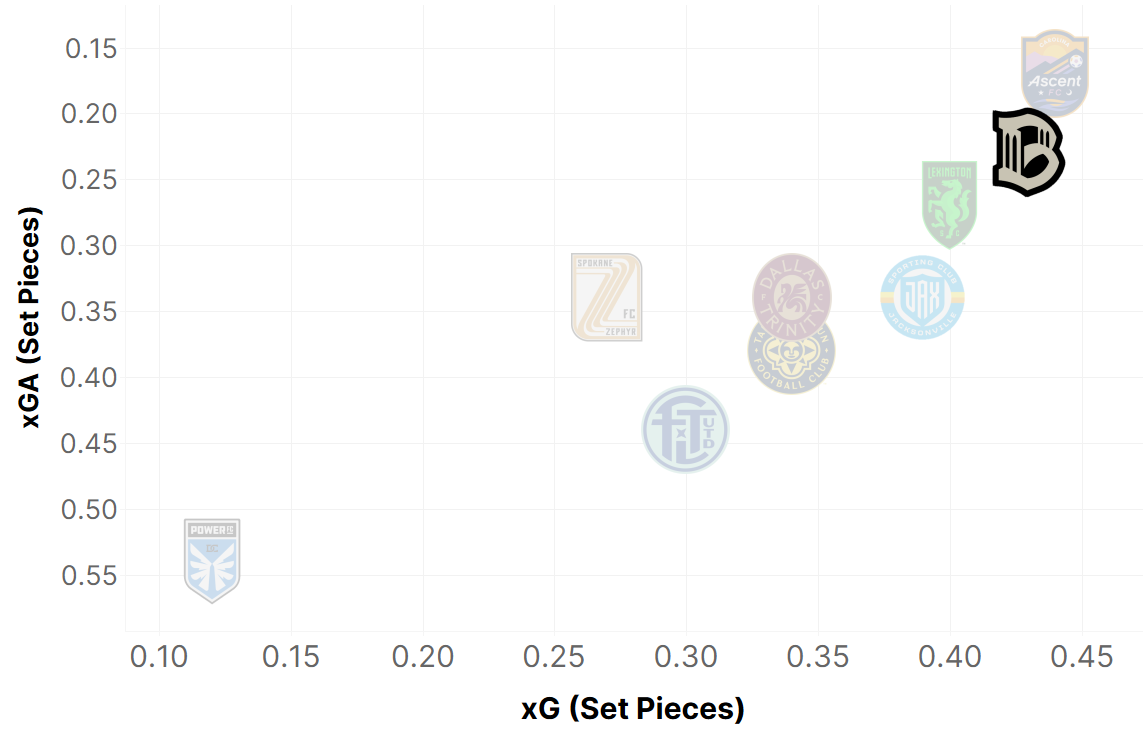
Over the course of the 2025-2026 season, Brooklyn ranks among the best teams in the division in dead-ball situations. Post-Sun win, they ranked as the second-most prodigious offense and the second-least spectacle defense on set pieces in xG terms.
That strength gives Brooklyn always informs their tactical approach. This team is comfortable in more of a stop-start game environment where dead balls are more common; they’re last in the Super League for passes per possession. Likewise, the New Yorkers are willing to play vertically in order to force rushed clearances that could yield advantageous field positions.
(Side note here: the very linear relationship between xG and xGA on set pieces in the Super League is unexpected! There was basically no correlation between the two in the Championship in 2025, for instance.)
Brooklyn also wants to use that direct passing as a launching pad for the counterpress. That remained true against Tampa Bay, and it came alongside the reinvented pressing shape that looked like a Frankenstein’s monster of a 4-2-3-1 and 4-4-2 diamond.
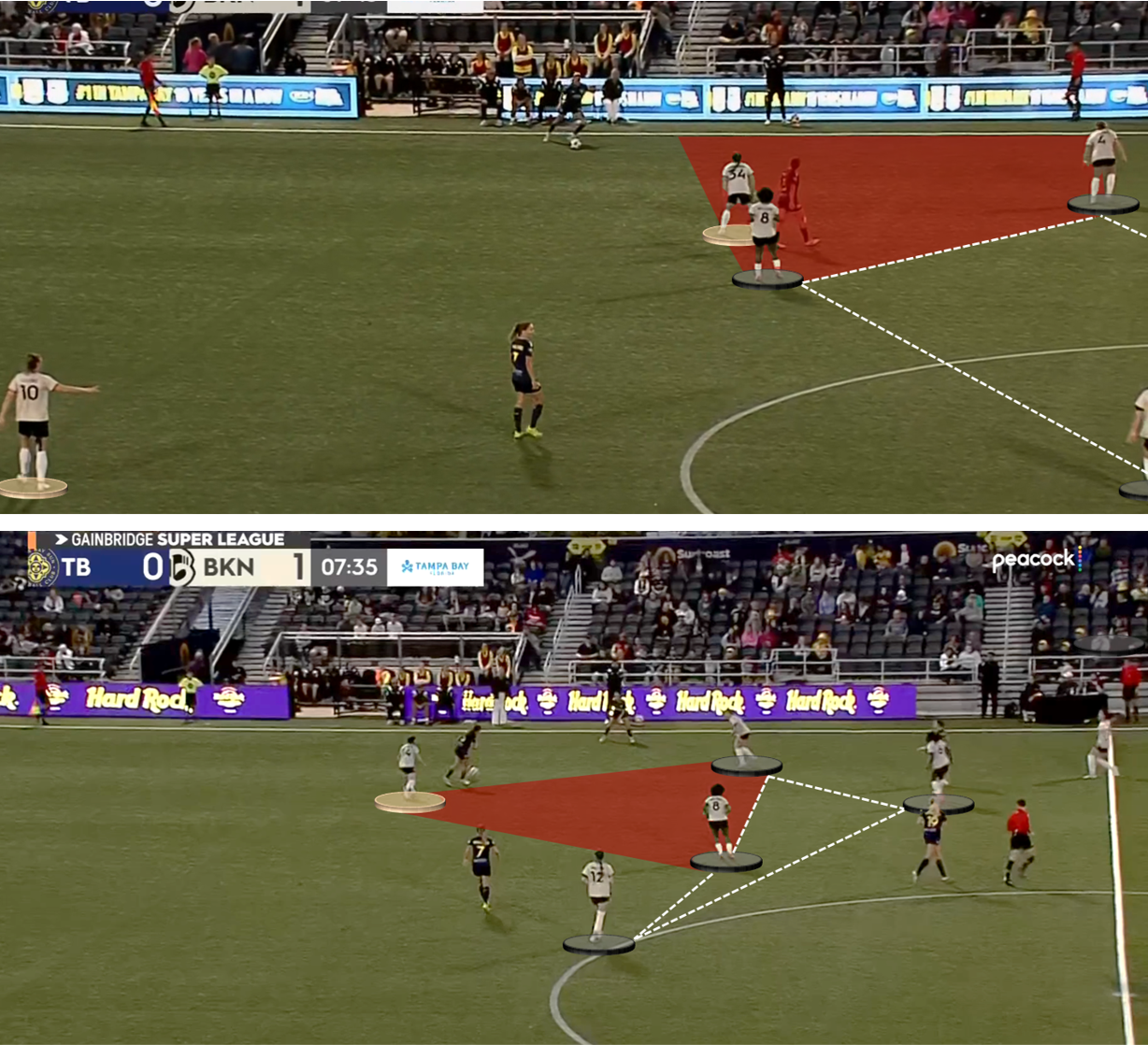
You see two examples of that look, with forwards Catherine Zimmerman and Rebecca Cooke highlighted in brown and the midfield in black. Cooke was crucial in this match, splitting the difference between a narrow left wing deployment and that of a No. 9. In each case here, she’s staying home on the weak side to protect against a switch.
On the ball side, you see how Brooklyn wanted to trap against the sideline. Zimmerman tracks the immediate ball carrier, whilst Mylena (at the tip of the diamond) and Emma Loving (right mid) close the angles up the sideline and through the midfield. In every sense, it’s the look you’d expect against a Tampa Bay team that’s reliant on wing-centric creation to break defenses down.
The Sun had some success switching out of those traps and engaging Sydny Nasello up the right, but in limited doses. The winger attempted just three dribbles and went five-for-14 in one-on-ones going both ways. Ultimately, she completed merely 14 passes on 53 touches. Tampa Bay could never find their rhythm; by contrast, Brooklyn used their on-ball speed to break the Sun’s lines and earn a statement 3-0 victory.
What changed against Carolina? For one, Tengarrinha's set-piece defense collapsed in on itself. Even excluding Mia Corbin's go-ahead penalty, Brooklyn conceded an eye-watering 1.97 xG from dead balls alone – far and away their worst mark of the season.
To get there in the first place, the Ascent gladly did something that Tampa Bay didn’t: ruthlessly play over the press. That mostly took the form of straight-line, vertical punts over a reprised 3-4-3, but Phillip Poole’s side grew cleverer as they felt out the Brooklyn shape.
This play is a prime example. Brooklyn pushes two of their forwards into the opposing box, and that means the left winger is committed almost at the level of the opposing endline. Carolina is under pressure, but they’re savvy enough to switch the point against Brooklyn’s overcommitted side.
The result? The Ascent’s 2-4-4ish build shape creates a localized three-on-two after switching toward the Brooklyn left. Corbin, fullback Ashlyn Merrick, and center back Jenna Butler use that edge to the fullest, dinking between the lines to push the ball upfield. Corbin’s follow-up pass after the breakthrough doesn’t clear the rest of the elevated Brooklyn defense, but it’s representative of the vigorous verticality Carolina used to break their hosts down.
With the loss on Sunday, Brooklyn finds themselves seven points back of fourth-place Dallas with an extra match played. They’re now 10 full points behind Carolina – a number that could’ve been four if Week 23 went differently. Despite the potential this team has shown, Brooklyn feels like a big “what if?” that can’t find a consistent formula.
A post
Ashlyn Puerta is doing incredible things in Jacksonville:
History for @sportingjax.bsky.social's Ashlyn Puerta, who has her 17th goal contribution to set a #GainbridgeSuperLeague single-season record on this assist to Baylee DeSmit. The 19-year-old #USWNT prospect has 11 goals and six assists in her first pro campaign, also leads the Golden Boot race.
— Nicholas Murray (@njemurray.bsky.social) 2026-03-22T22:02:03.958Z
This play is a blueprint for Jacksonville in their expansion season. The 3-1-4-2 press forces a long ball, and Sophie Jones cleans up from the pivot. Dallas is relatively shapely, but they're on the back foot because of Sporting's pace of play. That means Puerta can pull the strings between the lines, giving-and-going with forward Baylee DeSmit to set the table.
On the year, Puerta is putting up 0.57 xG+xA per 90 and ranks in the top quartile of attackers for dribbles, dribble success, final-third takeaways, and duel win rate. She does everything for Jacksonville and seems destined for a place at the highest levels of the game.
In other news…
Maybe I’m too cautious when considering the League One-to-Championship jump, but I didn’t expect Dion Acoff and Sebastian Cruz to look this good this quickly in Tampa Bay. Playing off the right side of the Rowdies’ 4-4-2 over the weekend, the duo combined for nine recoveries, five crosses, and nearly 100 touches in a suffocating win against Pittsburgh. There’s a lot going right at Al Lang; Acoff and Cruz are big part of it.
As a longstanding member of the Charlie Dennis fan club, I feel vindicated after Phoenix’s late comeback against Oakland over the weekend. Dennis showed in prior stints with the Rowdies and Roots that he’s the kind of creator you can genuinely build around, and he took over Saturday’s game when given the opportunity. The trick for Rising is to make that happen before they’re chasing the game while 2-0 down.
Despite their loss in Omaha, Boise is going to be a-okay. The more they can activate Jonathan Ricketts on the underlap, the better. The right-sided center back got an assist on Sunday night while going 34/44 as a passer, but it still feels like the expansion side is leaving meat on the bone with the ball. When Ricketts is able to underlap to Nick Moon’s inside and combine with a very skillful set of central technicians, good things happen.
I found the rock in Project Hail Mary to be grating, and I needed like 30 more minutes of Ryan Gosling and the pastry chef from The Bear doing science experiments.