The Back Four: Offseason, continued
On Westchester, Fort Wayne, and more

Welcome in to The Back Four!
As always, visit Backheeled for more USL content, including a preseason Championship power ranking and a CBA update. Also, check out This League! for an audiovisual dive into the offseason; of note for email subscribers, that'll be live tonight.
Without further ado, let’s get to it.
Daniel Burko and Westchester’s reload
After a disappointing debut season where a high-budget roster finished in last place, Westchester SC is learning the right lessons. Expensive veterans are out, and they’re being replaced by New York-centric prospects. New manager George Gjokaj – a St. John’s alum with deep local ties – is leading the charge, heading up a brain trust that’s hyper-aware of what the local market has to offer.
It’s easy to think about college or USL League Two recruits as being “lesser” than known pros, but that isn't true in League One. Rookies like Nico Rosamilia, Mikkel Goling, and Jaheim Brown were critical to One Knox’s title run in 2025. Connor Evans (Greenville), Sergio Ors Navarro (Omaha), Yaniv Bazini (Tormenta), and Titus Washington (Portland) were among the breakout stars of the year. Veterans can be useful, but there’s plug-and-play talent out there in the market. Entering 2026, Westchester is leaning into it.
Winger Miguel Diaz was the first addition, bringing experience with League Two’s Westchester Flames and at St. John’s. In his 2025 college season, Diaz put up 3.8 progressive carries per 90 and ranked in the 90th percentile for offensive duel wins per touch. Diaz is a sparkplug, and he’ll add verve to WSC’s wings while complementing another major signing: striker Daniel Burko.
What does Burko bring to the table? Per the inimitable Paul Harvey, writing about the No. 9 in his MLS SuperDraft preview:
Burko is the [class'] most pro ready striker, even if his ceiling is a little lower than [Junior] Diouf’s. The Norwegian forward is physically ready in all aspects for the pro game, as he has breakaway speed as well as the height and physicality to dominate in the box.
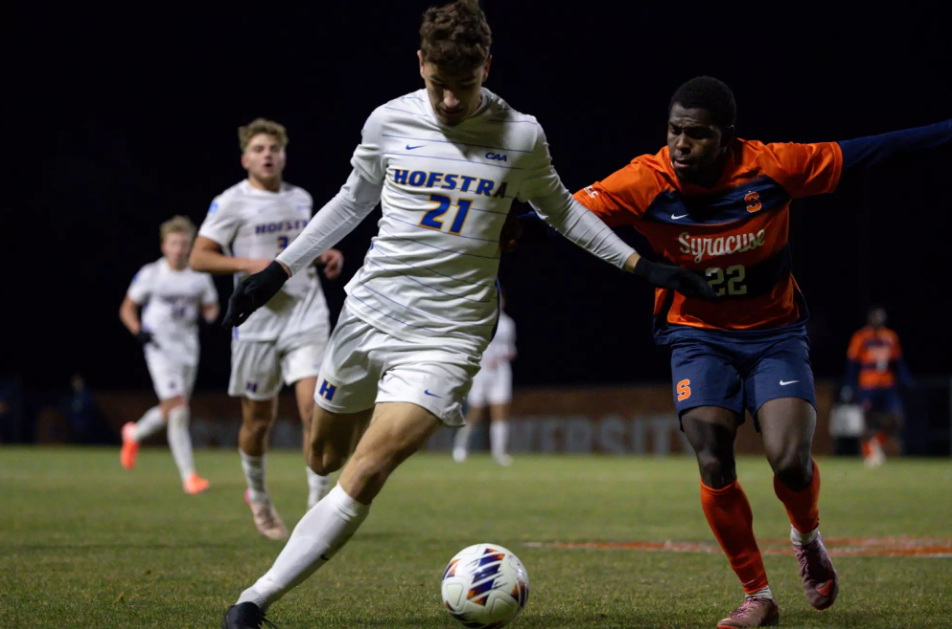
The numbers back that up. In school, Burko won 0.43 attacking duels per touch, generating 0.5 box touches per reception. The Hofstra product turned that preternatural ability to access the 18-yard box with 0.56 xG per 90 and 11 total goals. You can't ask for better instincts out of a No. 9.
Here, you see those tools come together. Burko is terrific about using his body close to goal, reading space and crashing toward the ball. The 6’3” forward is already adept in the air, and he has the vision of a poacher on the bounce.
These aren’t the most graceful finishes – Burko still has plenty of those, mind you! – but they illustrate a physical maturity that’ll pay off in the pro ranks. There were moments in 2025 where Westchester let the game come to them, and that should happen less in 2026. Burko will change this team as a scorer, but he’s also willing to battle for territory and do the dirty work.
Here, you see Burko proving as much against pro competition. The 23-year-old played for the Little Rock Rangers in last year’s Open Cup, leading the charge in an upset victory over the Birmingham Legion. Two of the Legion’s starting defenders from that match (Ethan Kos, Moses Mensah) will play in League One next year; another (Tiago Suarez) just landed in the Championship.
In that fierce setting, Burko tended to play with his back to goal to help with zone exits. In total, he attempted a whopping 17 duels and won 75% of his aerial battles. While the native Norwegian only tried one shot, he did what was required to get the win.
The synthesis of those two extremes is what makes Burko such an exciting prospect. He proved in the NCAA that he can score, and there’s a serious physical profile to come along with those offensive chops. I’ve been told that Burko had first-division offers in his home country, and it’s a coup for Westchester that they landed his signature.
Aleksei Armas, Burko's Hofstra teammate, will also join the League One club next season. Armas is fresh off a college campaign where he attempted 12.1 defensive duels per match and ranked in the 88th percentile by hitting a progressive pass on 21% of his total attempts. Aidan Borra (Sacred Heart) and Tim Timchenko (Iona) bring poise through the middle. WSC has at least two more NCAA standouts on the way, including a high-usage central creator and potential starting goalkeeper.
Together, this Burko-headlined class represents a new vision for Westchester. Under Gjokaj, this squad will be younger, fiercer, and better able to compete in League One. There's still a reliable core of veterans like defender Rashid Tetteh and midfielder Conor McGlynn to provide consistency, but the team around them has a far better ability to make noise in 2026.
A team grows in Brooklyn
When I spoke to Marlon LeBlanc, manager of Brooklyn FC, back in December, he explained his philosophy as follows:
"It’s flooding areas with numbers, creating overloads with the ball, creating overloads against the ball, trying to be really quick in transition, and trying to play as much in the attacking half as possible...a lot of people look at the [defensive] third as the 30-to-40 yards in front of your own goal, but the back third really could be at midfield if that's where you're playing."
Brooklyn wants to be structured, but they also want to pounce. LeBlanc's Philadelphia Union II teams successfully did so, leading MLS Next Pro with an average defensive action height 48 yards upfield and ranking fifth with 1.73 xG per 90 in the 2024 season. Now, Brooklyn has 10 players that'll help them repeat the trick.
Through the spine, midfielder Peter Mangione and defender Thomas Vancaeyezeele have the profiles you want amidst LeBlanc’s typical 4-4-2. Mangione blends No. 6 and No. 8 roles with decent one- and two-touch passing and excellent defensive awareness; he put up 2.9 takeaways per game last year. Meanwhile, the 31-year-old Vancaeyezeele is a veteran in the USL, one that’s played as a No. 6 and center back over his career. He’s still able to operate as a starting-level, modern piece in this league.
In that same vein, Gabriel Alves’ stern physical profile and excellent technique are an ideal fit at the left back spot. For one, you trust the former Marshall star in low block. If the midfield needs to focus on ball-winning – Brooklyn will prefer long, direct initiation – Alves can be a penetrating line-breaker in their stead. In the final third, he’s precise and takes smart risks.
We’ll see how the back end of the shape fills out, but the back-half pieces are encouraging. While it’s customary for expansion teams to lean into a defensive posture to get results, Brooklyn may be heading in an opposite direction. Adding League One’s reigning Golden Boot winner in JC Obregon and pairing him with Canadian Premier League standout Shaan Hundal gives this attack a higher ceiling.
Hundal brings a true No. 9’s movement, mixing curled runs to the posts with bursts at the back shoulders of opposing center backs. He’s sharp in transitional moments, occupying bodies to open space for others while remaining ready to receive. You see that instinct above, where Hundal’s nose for goal shines through.
That’s a great skillset in its own right, but it’s even better given the presence of Obregon. While the former Westchester man scored 17 times last year, his willingness to play with his back to goal and serve as a field-tilting outlet for zone exits was equally crucial. Obregon attempted more than 20 passes per 90 and ranked in the 72nd percentile for duel win percentage, paying off those supportive tendencies in an efficient manner. Hundal is the sharp edge of the sword, while Obregon is the hilt.
For now, Brooklyn is probably in “plucky dark horse“ territory, but we’ve only seen half their roster come together. Between the strong start in the outfield and a goalkeeping platoon (Jackson Lee, Lukas Burns) with safe hands, the sense of dependability is palpable. LeBlanc and Brian McBride have given this team a high floor; we’ll see what their ceiling can be.
On Fort Wayne
After three straight Valley Division titles in League Two, Fort Wayne FC did the only logical thing: make the leap up to League One and aim higher. Uniquely, as compared to their expansion classmates, Fort Wayne has retained multiple pieces from the pre-professional tier. If the past is any indication, that's something to be excited about.
In the 2025 season, manager Mike Avery tended to press in a 4-1-4-1, using that defensive setup as a springboard into a possessive 2-3-2-3 shape. This was modern soccer, with center backs Tiago Dias and Reid Sproat (the back "2" on the ball) allowed to confidently progress into tucked-in fullbacks (wide parts of the base "3") like Anthony Hernandez.
All three of those League Two stars are returning, representing key pieces from a build-from-the-back unit that held 58% of possession last season. Fort Wayne probably won’t be that dominant in the pro ranks, but they’ll undoubtedly look structured and confident with the ball.
Here, you’re seeing that 2-3-2-3 in action. As Fort Wayne resets on the edge of the attacking zone, their left back and right back (in black) operate as table-setting midfielders from the halfspaces. The opposing defense is tilted toward Fort Wayne’s left, so they swing toward the right – directly into the feet of Hernandez.
You can see the flexibility of the shape play out from there. Hernandez is confident enough to dribble into the channel, while the right winger (in white, part of the forward line) spreads the field. Meanwhile, the ball-side No. 8 (in gold) has the choice to skew toward Hernandez and create a passing triangle or stick closer to goal as a crossing outlet.
Fort Wayne doesn’t get a shot here, but you can see their offense working like a well-oiled machine. Given the continuity at the back and the new faces they’ve added in the midfield, there’s a real chance we’ll see similar things in 2026.
Taig Healy is the belle of the ball, for my money. Recruited from NC State, the No. 10 put up 0.36 xG+xA per 90 last season while operating as a best-in-class receiver and creator. The left-footed Healy pushed play forward on 36% of his passes (a 90th percentile rate) and finished in the 99th percentile for box entries. Imagine that clip from above, but with Healy as the midfielder roving ahead of Hernandez – that’s lethal.
While I like the bones of Fort Wayne as a possession team, they’ll live and die by their ability to survive defensive transitions and avoid sloppy turnovers. Another addition, MLS Next Pro standout Javier Armas, is built to make that happen.
Armas put up deceptively high xG and xA numbers because of his set piece contributions, but he’s a pure No. 6/No. 8 type at heart. The ex-Atlanta man brings steady marking, and he won 54% of his ground duels in 2025. Above, you get a sense for Armas’ intelligence between the lines.
Here, Armas’ side is building out in a double pivot. When the midfielder receives amidst light pressure, he sees a lane to make a progressive carry upfield. As soon as the opposition starts to close, Armas gives-and-goes to break a line. As he receives, the 26-year-old executes a subtle body fake that freezes a defender and sets up a continued drive toward the right.
It’ll be rare to find that much space in a League One midfield, but you’re still seeing useful habits that should make Armas a starter in Indiana. I suspect he’ll be the halfway point between Healy and another new recruit, midfielder Jeremy Garay. Still just 22 years old, Garay burst onto the scene at age 17 and earned more than 2,000 minutes in Loudoun’s midfield in 2021. Playing time has been inconsistent since then, but the 5’9” midfielder is nothing if not energetic at the No. 6 spot.
In his last full season in 2023, Garay completed 90% of his total passes, including a stellar 72% clip on long balls. He’s not a destructive presence by any means, but he may be the most retentive holding mid in League One. For the Avery game model, you couldn’t ask for much better.
I tend to judge expansion teams on their clarity of vision, and it's easy to make misjudgments from the outside looking in. Still, there’s an undeniable logic to the way Fort Wayne is doing business. I’m not saying this team will be competing for trophies – at least not yet – but Fort Wayne FC is doing all the right things to execute a positive vision in 2026.
Signing Potpourri, 6th Edition
When I hyped up Pittsburgh’s addition of striker Trevor Amann, Pittsburgh Soccer Now legend John Krysinsky flagged both his and Albert Dikwa’s drop in production last season. It’s a valid concern. That duo combined to score 46 league goals in 2023. In 2025, that count was down to seven.
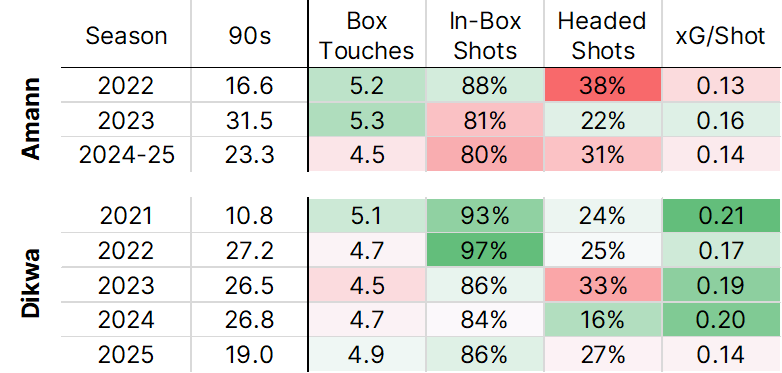
Still, there’s more to the drop-off than meets the eye. For one, Amann was dealt midseason in 2025 and barely played after joining FC Tulsa. Since jumping to the Championship, the 27-year-old has seen his box touches and shot quality fall off a cliff. Dikwa, meanwhile, put up the second-highest rate of headed shots and the lowest xG per shot of his last half-decade.
Strikers are responsible for making their own luck, of course. When you can only find bad shooting opportunities, that’s a skill issue. With Amann and Dikwa, however, we know elite performances are in there somewhere.
The latter has done it before at Highmark; the former excelled in a Northern Colorado side that spready the field, something Pittsburgh will do more of in 2026. Indeed, Amann's Golden Boot season featured the fourth-best receiving g+ (2.84) in League One history, which is nerd-speak for "the guy is good at finding the ball in the box." I’m bullish both No. 9s will get closer to that level in 2026.
Moving elsewhere in the East, I’m slowly warming up to Jacksonville’s midfield. They had an exceptionally busy week, adding no less than seven players – five of whom are offensive-leaning midfielders – with training camp commencing.
Some of the names are familiar, as with 19-year-old right-sider Zeke Soto (ex-Charleston, loaned to Greenville in 2025) and 23-year-old Ahmad Al-Qaq (ex-NCFC). Those two have plenty of upside, but I’m really amped about three MLS Next Pro imports. In ascending order of excitement, we’ve got:
- Wan Kuzain, who played for Rio Grande Valley before a four-year run with St. Louis City 2. Kuzain won 54% of his duels and 1.7 tackles per game last year, and he’s adept as a No. 8 or two-way right winger.
- Piero Elias, who often defended in the center of NYCFC II’s off-ball 4-4-2 but stepped up as a dynamic No. 8 in a possessive 3-1-4-2 last season. Elias put in 2.5 tackles and 5.3 recoveries per game, but his slick right-footed passing in tight spaces produced 3.1 total xA in open play.
- Jacob Evans, added from the Carolina Core. The midfielder put up a dazzling 0.16 xG and 0.27 xA per 90 in open play last year, operating as a left-leaning No. 8 or No. 10. Put him in a midfield next to Elias with the support of either Kuzain or defense-first Jordan Rossiter, and you’ve got a wonderfully balanced 4-1-4-1.
Between those three, striker Emil Jaaskelainen, and a good goalkeeping platoon, I’m convinced Sporting Jax won’t be bad. Good is a different story, but time will tell in Florida
As I first reported last week, Maalique Foster is the newest member of the Charleston Battery. Foster should be a familiar name to USL fans, whether that’s due to his panenka heroics in the Open Cup or consistent production in the league. Now, he’s yet another harbinger of Charleston’s changing style.
Foster excels in one-on-one situations, particularly up the right side. If that’s his role for the Battery, it’ll restore a connection between Foster and forward-turned-fullback Douglas Martinez that was first forged in Sacramento. Meanwhile, the idea of the Jamaican international pairing with Jeremy Kelly and Wilmer Cabrera, Jr. in a 4-2-3-1 is something that makes a whole lot of sense on paper.
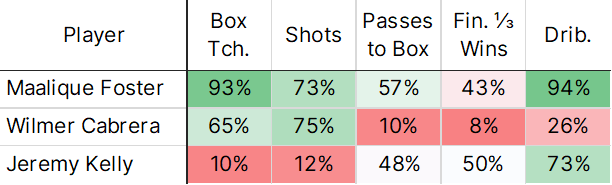
Here, the three midfielders’ per-game outputs in 2024 and 2025 are compared across a few categories. In terms of the key things you want out of your attacking mids, the Foster-Cabrera-Kelly trio has you (mostly) covered.
Foster is an elite dribbler in the wide spaces; Kelly matches that from the left or as a No. 10. Cabrera and Foster, meanwhile, are strong vertical runners that know how to get into the box and create their own shots. If there’s a question mark, it comes in terms of creativity and pressing intensity. I won’t argue the latter point, but Kelly is an elite producer that was crowded out by Aaron Molloy and Juan Torres last season. Across 2022 and 2023, he put up 0.16 xA per 90 in Ben Pirmann's system.
In terms of raw talent, it would be dishonest to argue this Battery midfield is as talented as last year’s. Still, this group has balance and a distinctly vertical orientation. That’s key for a team that’s re-oriented their defense to support a more swashbuckling style.
Quick Hits
In other news this week…
- Ryan Allen, The USL Show co-host extraordinaire, is back at it again with a look at which USL stadia are closest to a Taco Bell. I recently opined on the supremacy of the Crunchwrap Supreme, so we've clearly got a podcast-wide fixation developing.
- Nicholas Murray has a good piece on every Super League club's second-half needs. Meanwhile, the folks at 3rd Degree spoke to new Dallas Trinity manager Nathan Thackeray. Put the two strands together, and you're looking at a Dallas team that needs to hit the ground running by leaning into what worked: namely, letting Lexi Missimo – just called up to USYNT camp, putting up 0.28 xG per 90 this year – cook as their No. 10.
- Brendan Krueger, fresh out of High Point in the college ranks, looks like a player for Sarasota. His tape indicates an ability to play as a No. 9 or score-first winger, but that undersells a really advanced sense of right-footed creativity. Krueger put up a stellar 0.27 xA per 90 in his final season at High Point, and he's good about finding separation in tight spaces even if he isn't a prodigious dribbler.
- Teddy Baker is a terrific fit in the Knoxville midfield. Texoma was highly vertical last season, and Baker made it happen for them as a very progressive No. 8. The 24-year-old attempted 9.8 final-third entries per 90, but only 41% of those came from long balls; that's evidence of controlled incision. Baker is skillful enough to control tempo, and he put up a very strong 0.28 xG+xA to boot. I suspect he probably splits minutes behind Mikkel Goling and John Murphy on opening day, but he's got starter potential.
- I watched all three The Equalizer movies (because…what else should I do when I’m snowed in?) and can confirm that Denzel Washington is our greatest living actor. Half of that trilogy is just Denzel drinking tea, and that’s a compliment.