The Back Four: Guys I Like, 2026
Standouts from early 2026, plus a Super League check-in

Welcome in to The Back Four!
As always, visit Backheeled for in-depth USL recaps and more. Also, check out This League! and The USL Show to catch up on the week that was.
Without further ado, let’s get to it.
Guys I Like
The fun of a new USL season is discovering (or even re-discovering) standout players. There are stalwarts like Aaron Molloy in the Championship or Luis Alvarez in League One that you could set a watch to, but 2026 has already been defined by unexpected breakouts. That’s who I’m hoping to cover here: players that tickle my fancy, whether they’re a new face or someone that’s shown a new side to their game.
Following a week where Miami FC put the hurt on Jacksonville and Rhode Island, Tommy Musto deserves praise. Added from LAFC II, the 22-year-old has been the driving force in Gaston Maddoni’s system.
Here, you see Musto in action. Miami builds in a 3-1-5-1 framework, and Musto is the “one” at the base of the midfield that’s making play tick. Jacksonville has to respect his presence, meaning that their shape narrows and their pivot is drawn a step high.
The knock-on effect? Miami can break around the edge, slide a pass behind the pivot, and find Musto to start the cycle anew after gaining yards of territory. Back on the ball, the No. 8 can swing the ball upfield, setting up an opportunity to serve into the box. Musto is trying 55 passes per game in 2026, and he’s defining Miami’s system along the way.
Rhode Island FC has already been through frustrations of their own, but I remain deeply impressed with Pity Rodriguez at the No. 10 spot in what’s been a 3-4-1-2 offense in the Ocean State this year. While the Lanus loanee is taking 13 less touches per match than Maxi Rodriguez did in a comparable position last year, he’s making the most of them. Rodriguez is generating 0.31 xG+xA per 90 and shines whenever he’s moving without the ball.
We broke out the tactics board on This League! to explain that movement after RIFC’s close-but-no-cigar draw against Jacksonville, and what we discussed remains true. Rodriguez has been excellent about showing into the halfspaces to connect play and keep his offense going. Rhode Island has lacked sharpness this year, but Rodriguez has still been a standout.
The Oakland Roots finally dropped a match in Week 4, but they’re still getting all-USL levels of performance from Tommy McCabe and Bobosi Byaruhanga in their 4-4-2’s pivot. Longtime readers are familiar with my praise of McCabe, but it’s Byaruhanga who’s taken a major leap in 2026.
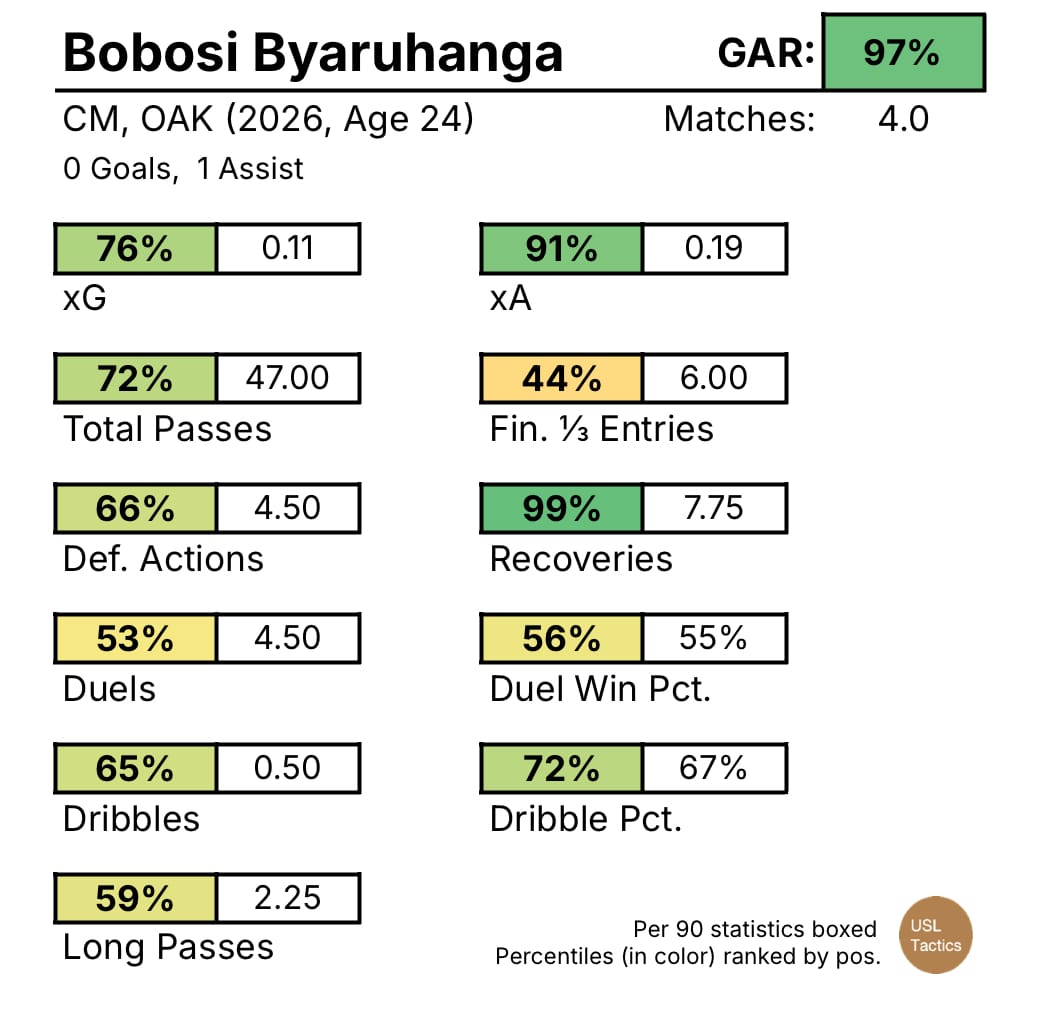
The Roots typically like one center mid to drop near the center backs, whilst the other has a bit more freedom to push upfield and influence attacking play. Byaruhanga has embodied that latter role, both as a connective passer and ball-winning counterpresser. The Ugandan is a ball of energy, but he’s highly intentional with his movements and actions – his numbers (99th percentile recoveries, etc.) are off the charts. Few, if any, USL midfielders have been as influential one month into the campaign.
Given the criteria at play here, loose as they might be, it’s probably underhanded to choose Devon Amoo-Mensah. Even so, he’s been excellent enough to earn a call-out.
Amoo-Mensah has long been the lifeblood of the Detroit system, but Danny Dichio is asking him to provide that excellence in new and different ways in 2026. Le Rouge are a back four team, and they need Amoo-Mensah as their right-sided center back after years of service on the left.
You see what that looks like across two examples. Detroit wants to build from the back as much as possible, but they need a quarterback that can draw defenses and then break lines. In one instance here, #30 dribbles to force a defensive collapse and then deftly dinks a pass into the open central midfield. In the second, Amoo-Mensah opts to chip his pass, but the result is the same: Le Rouge recover possession in space and switches leftward to approach the 18-yard box. In each case, it’s remarkably measured stuff from one of the Championship’s premier defenders.
Moving over to USL League One, it’s hard to deny what Pato Botello Faz – an ex-teammate of Amoo-Mensah’s in Detroit – has provided for Union Omaha. The striker has the look of a classic back-to-goal type, but he’s excelling in 2026 because of a deeply unselfish sensibility with and without the ball.
In Saturday’s win against Corpus Christi, Botello Faz notched a go-ahead assist by running the channel after Omaha forced a turnover, earning an assist by receiving and cutting back to a late-arriving midfield. The No. 9 is still putting up a respectable 2.2 shots per 90, but it’s everything else that’s popping. Botello Faz ranks in the 96th percentile with 0.25 xA per 90 and has been a willing one-on-one battler when called upon.
Omaha has been a vision of structure and organization this year; Westchester has been the opposite. Even as this team is figuring out their turnover and transition structure problems, they’ve got a burgeoning creative star in former Marist standout Kyle Evans.
ICYMI: Kyle Evans is that dude.
— John Morrissey (@usltactics.com) 2026-03-20T11:07:12.392Z
Evans is a daring dribbler that’s got the advanced vision and speed of thought required in a high-tempo, vertical Westchester offense. You don’t see Evans settle in the final third; if he can beat a man on the dribble to create a better window to cross, he’s going to do it. The 20-year-old is succeeding on seven duels per game and looks like a League One star in the making.
Somewhat bafflingly, Fort Wayne is winless through three games. At the same time, they’re keeping 57% of possession on average and relying on center backs Tiago Dias and Reid Sproat to make it happen.
Dias has typically held down left-central positions within Fort Wayne’s back three, and he’s ranked in the 90th percentile at his position with 10 final-third entry passes per game. Sproat has typically operated off the right, and while his passing numbers are less prodigious, he’s getting the better of Dias in terms of his ground (57%) and aerial (80%) duel win rates. Whenever Fort Wayne starts to click, it’ll owe to that duo’s ability to set the table from the back.
Elsewhere in expansion-land, Sarasota’s Anderson Rosa has been absolutely stellar. The left back went to school about two hours away from Sarasota at UCF and was perfectly solid as a rookie with the Colorado Rapids’ Next Pro affiliate. With Paradise, he’s taking 65 touches a match and doing a bit of everything in a tactically demanding role.
This clip is the textbook definition of a team goal, but it doesn’t happen without Rosa. You see Sarasota break lines into Ethan Bryant in the midfield, draw Portland in, and then switch toward Rosa’s left side. Winger Jonathan Bolanos is the actual receiver, and he’s immediately able to look upfield, find Rosa on the underlap, and let the left back hit a grounded cross into the box. Sarasota keep the pressure up until Aaron Walker can score from range.
Rosa’s ability to step inside and do borderline No. 8ish things is a crucial stabilizer for Sarasota. At the same time, he’s able to mix in sharp runs and provide genuine end product. This Paradise side has been the cream of the expansion crop for a lot of reasons, and Rosa is high on that list.
I’ll end here with goalkeeper Antony Siaha, my favorite loudmouth in the USL. The Hartford goalkepeer has racked up a mind-boggling 4.67 goals prevented already and is tied for the Championship lead with 16 saves. There’s a fearless, almost reckless streak to his coverage in the box, but it’s his aggression that gives Hartford an identity. I needed to get a goalkeeper in the mix here, and with an apology to Birmingham’s Jassem Koleilat, Siaha’s got an attitude that makes him undeniable.
Super League Check-in
My vaunted, always-100%-correct Playoff Odds machine isn't very high on Spokane or Fort Lauderdale. Of the two, Zephyr are far likelier to make the postseason, sitting on a 29% chance of qualification with an expected points total just one win back of fourth-place Dallas. Meanwhile, United is an also-ran – far closer to a wooden spoon than a push toward the top four.
What's fun about the Super League is that anything can happen, and we saw as much in Week 24. Spokane kept their hopes alive in a hard-fought draw against Sporting Jacksonville, while Fort Lauderdale played spoiler by splitting the points versus the Carolina Ascent.
The latter result was the more surprising of the two, and it came despite the fact that Carolina ran up a 2.7 to 0.6 xG edge. Even so, interim manager Paul Jennison continued to stick to his guns. Jennison hasn't overseen a win since taking charge in mid-February, but he's committed to a three-at-the-back, short-oriented system that centers on defender Laveni Vaka as a table-setter.
Dominican Republic international Kathrynn González scored a late equalizer for Fort Lauderdale United FC as it held Carolina Ascent FC to a 1-1 draw, ending the Ascent's four-game winning streak and shutout streak. #GainbridgeSuperLeague Full Highlights -> www.youtube.com/watch?v=1Tts...
— Nicholas Murray (@njemurray.bsky.social) 2026-03-29T13:27:21.258Z
Fort Lauderdale's average pass in their own third has travelled merely 10.6 yards upfield in the Jennison era, fourth-lowest in the division. At the same time, they're underperforming their expected completion rate on those passes by 4.4% – comfortably the worst in the league. Against Carolina's fearsome 4-2-4 press, those issues were exacerbated as Fort Lauderdale tried to build through their three central defenders.
When the gambit worked, United let their No. 10s – Jasmine Hamid and Emily Thompson – drop into the wide pockets. Doing so created triangular overloads against Carolina's wingers in the 4-4-2ms midfield line, thus allowing for progression up the edges.
A variant of that pattern is seen above for Fort Lauderdale's late equalizer. In this case, United eschews short build and goes directly into Thompson in the right halfspace. Able to break lines as a result, United can immediately engage wingback Sh'nia Gordon on the dribble and enter the box. A goal ensues, a testament to Fort Lauderdale's quality when they’re able to balance their preferred level of control with a real sense of tempo.
Spokane, meanwhile, looked far different than we've become accustomed to seeing. Entering Week 24, Zephyr had held 51% of the ball in their average match, doing so in a standard 4-2-3-1 or 4-1-4-1 shape. Both things changed in Florida. Spokane held a stunningly low 27% of possession in a game that was tied for 86 minutes, and they defended in a 5-2-3 meant to jam up Jacksonville's works.
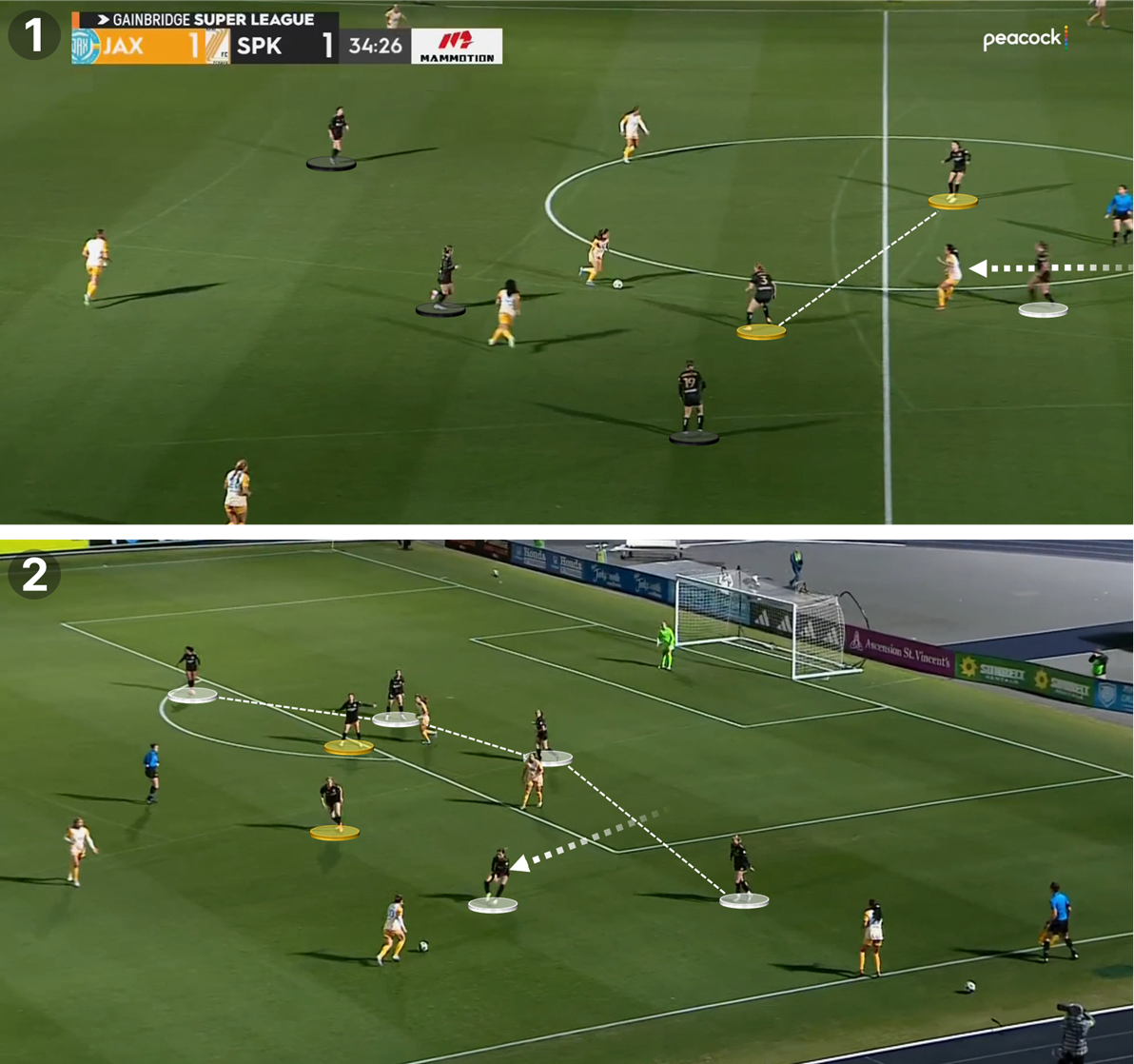
Nicole Lukic's side outperformed that headline possession number in terms of field tilt (37%) and box touch share (48%), indicative of an ability to frustrate Jacksonville before they could reach the final third and get into the 18-yard zone. Wrinkles within the 5-2-3 let it happen, making up for the fact that Spokane ostensibly faced a three-on-two deficit through the central midfield.
That’s clear in the screenshots above. In image #1, Sporting has just broken the Zephyr forward line (black) through one of their No. 8s. Space, however, is minimal. Lukic used her pivot combo (gold) of Felicia Knox and Emma Jaskaniec to equal Jacksonville’s two deepest mids, and she also allowed members of her back five (white) to step against Sporting’s extra man. Those tics stop the momentum in the screenshot.
The same idea applied in low block, as seen in screenshot #2. Jacksonville typically uses two strikers in the box, meaning that an organized defense can achieve parity with just two center backs. As in the first example, it’s defender Kelsey Oyler that pushes the issue. Trusting the center backs behind her, Oyler closes into the halfspace and makes sure that Jacksonville can’t play a clean pass into the box.
Staying aggressive while playing on the back foot is a precarious tightrope to walk, but Spokane did it well on Saturday. That’s a credit to Zephyr’s adaptability – a major reason why they’ve hung on in the playoff race while other clubs have fallen by the wayside.
In other news…
I’m obviously breaking format this week, and I may try more of that going forward. Given that I’m covering every single men’s USL game on Backheeled, I’m finding it less valuable (and fun, on my side of things) to be exclusively team-centric. We’ll see what gives!
I don’t know if I’m breaking news here, but legendary El Paso play-by-play man Duke Keith is starting a Locomotive podcast, and I’m guesting. Go check in! El Paso is a blast this year, and I was excited to be able to talk about it.
Courtesy of Peter Bloom and the RootsBlog team more broadly, some fun data...
Pulled this data from the awesome @gameflow.bsky.social. Roots have played 4 games, and in each have run a 2 cb system for part and a 3 cb system for part. In the first 3 changed late for defense marked with an orange arrow. In the most recent changed late to chase, marked with a purple arrow.
— Oakland Toots (@peterwbloom.bsky.social) 2026-03-30T04:55:41.634Z
…that highlights Oakland’s penchant for late-game changes into a back three shape. I wrote about that tendency after Ryan Martin brought Danny Trejo into a 3-5-2 to earn a win on opening day, and it’s fascinating to see the numbers after four weeks of the same schtick.
I'll have more on Charlotte's win against Charleston in my Open Cup recap on Backheeled, but this sequence...
...shows everything you need to know about the Independence's suffocating defense. I've got the players labeled according to their position in the deep 5-3-2 block; forwards in blue, midfielders in red, defenders in white. Of course, that shape looked far different in the high press, bending into a 4-2-3-1 here.
In the example, Christopher Jaime becomes the right winger with support from fullback Clay Dimick. As the play develops, Thabo Nare and center back Javen Romero get their turn to push up from the left. At every step, the Independence deny Charleston the room to work. Terrific stuff from Mike Jeffries and co. – and a strong follow-up to their statement win over Spokane in Week 4. The Independence nearly snatched defeat from the jaws of victory, but they gave up 0.02 in the first 60 minutes against what was nearly the Battery's best lineup.
The FIFA 13 soundtrack is a formative text in my life. No other notes.