The Back Four: CBA, etc.
CBA chatter, plus all-Super League picks, El Paso, and more

Welcome in to The Back Four!
As always, visit Backheeled for more USL content, including a breakdown of the best signings of the offseason to date.
Without further ado, let’s get to it.
Collective Bargaining (Dis)agreement
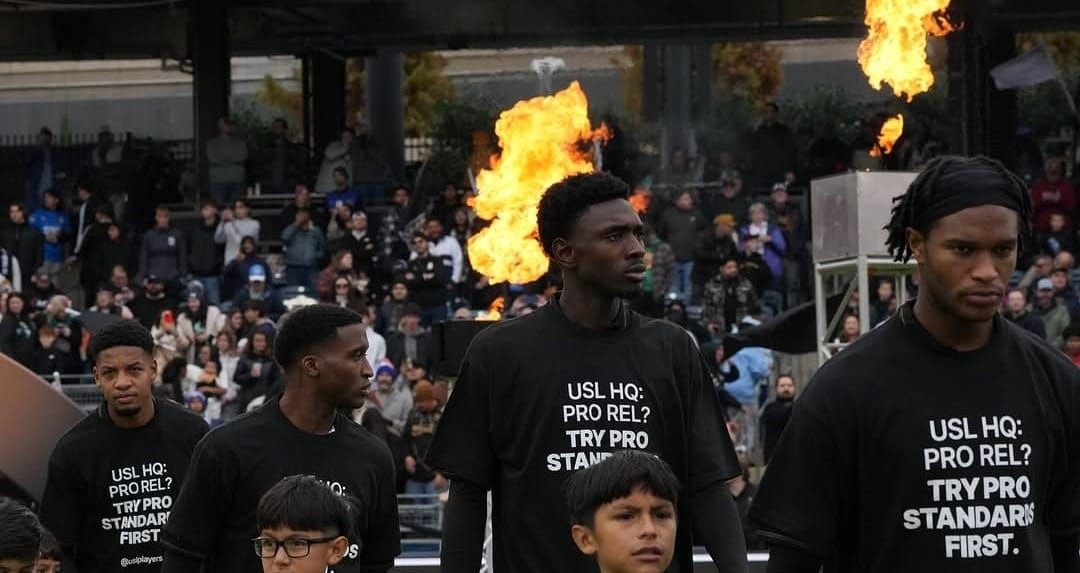
As of January 1st, the USL Championship's Collective Bargaining Agreement has officially expired. The prior agreement applies in continuation for the time being (i.e., signings and offseason business can continue until a strike or lockout is declared), but we’re a month away from training camps without a clear end in sight.
How’d we get here after 494 days of talks? As I’ve previously reported, the players are seeking increased minimum compensation from the current floor of $26,000, 12-month pay windows, and the option for club-provided health insurance. In a New Year’s Eve open letter, the USL Players Association noted that 38 separate bargaining sessions had failed to produce a new agreement on those points and more.
Two facets of the league’s organization make compromise difficult. For one, the Championship's 25 clubs can operate in vastly different ways. Take healthcare: some teams are generous, but sources say that at least one Championship club offers coverage with deductibles approaching $10,000. Others don’t even make insurance available; 25% of players don’t enjoy an employer-sponsored option. What do other soccer players get? The worst case (i.e., out-of-network, family coverage) per the MLS CBA is a $1,000 deductible, building to a $4,000 annual payment limit.
In terms of compensation, roughly half of the division – more than 10 clubs – pay all of their players above a minimum rate. Still, the bottom end of the wage table is a different story. Per that aforementioned open letter, a quarter of the Championship earns under $35,000 per year.
When you bring those distinct approaches together, agreement between the splashy and spendthrift becomes difficult.
You could use one hand (or even one finger!) to count the number of USL clubs that turn a profit; losing $4 million puts you in comparatively good standing. Some owners believe that, in the context of the 2026 World Cup moment and the USL's moves toward pro-rel and first-division sanctioning, you need to spend money to thrive. Look no further than Lexington SC's choice to drop six-digit fees on stars like Phillip Goodrum and Aaron Molloy. A vocal minority at the opposite end insists on minimizing costs.
On top of the diversity at the club level, there's a second hurdle to clear: USL HQ has its own incentives in the bargaining process. I've also written on the USL's unique setup, in which the league is a private company with the clubs as franchisees. That setup has numerous effects, including an absence of revenue sharing – a fact that affects the financial standing of clubs and affects the ability to fairly compensate players.
If USL HQ – owned by the Papadakis family, Robert Hoskins, and BellTower Partners – earns a profit, that profit stays in Tampa Bay. Clubs don't get a share, so they have less money with which to pay players, provide health insurance, or raise their professional standards.
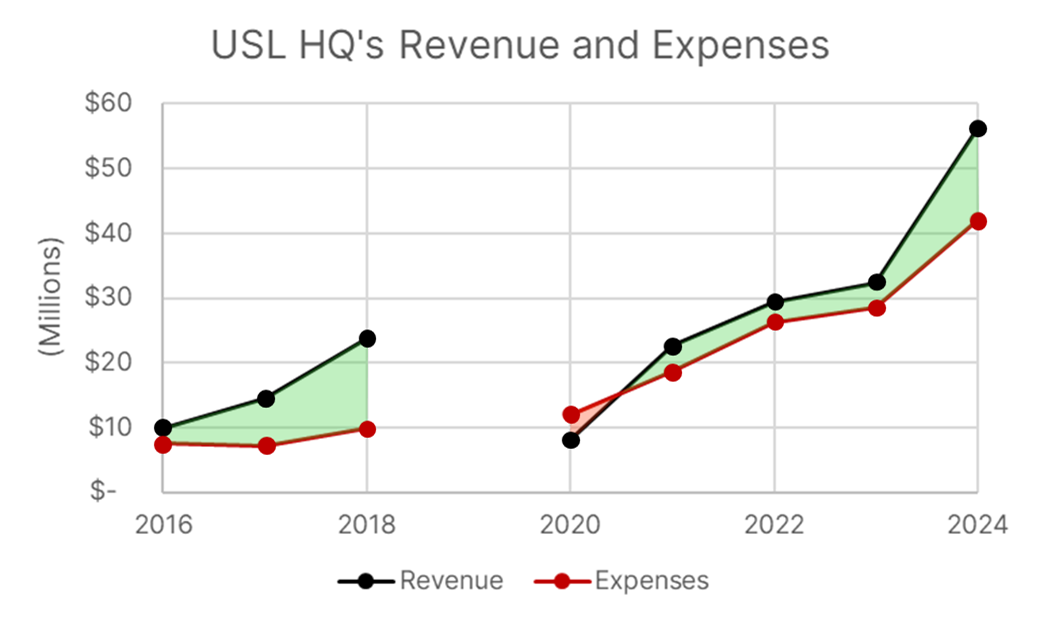
Per the financial statements included in the USL's latest franchise agreement, the league's revenue increased from $32.3 million to $56.4 million between 2023 and 2024 – a 74% leap. Expansion fee revenues more than doubled. Operating expenses increased in turn, but USL HQ’s profits increased by 374% to $14 million.
Structural reform almost certainly won’t figure into the ongoing CBA talks, though they cast a pall over the lofty aims of the USL down the line. In the meantime, more immediate discussions have progressed slowly. Sources close to the USLPA say that their side has shown a willingness to compromise, only to be met by intransigence as late as December 27th.
On issues like healthcare, the players have opened up toward a gradual increase in standards throughout the length of a new agreement. There’s precedent for that structure, as in the 2021 USL Championship CBA where minimum base compensation increased from $2,200 to $2,600 per month over the life of the deal.
Image and likeness compensation are also on the table. The USLPA sold those rights to the USL for just $10,000 in 2021, per sources. A month after the CBA was finalized, Konami paid more than $200,000 to include the USL and its players in its eFootball video game; none of that money trickled down. While the USLPA’s return has increased to $25,000 on a graduated scale, that pales in comparison to the $600,000 price that the PWHL – an upstart women’s hockey league – awards to its players.
How the negotiations will resolve is anyone’s guess, but the clock is ticking louder than ever before. The 2026 season is within sight, and it’s of the utmost importance to the future of the lower leagues. Whether there’s a CBA in place to make it happen is uncertain.
League One's best moves
If you check out my latest Backheeled column, you’ll find a deep dive into the premier signings of the USL offseason with a Championship bent. Now, I want to repeat the trick in League One.
Right off the bat, I’ll call out Brecc Evans, whose move to Portland was covered here the week it happened. Evans’ defensive surety and capability with the ball is exactly what Hearts of Pine need, and I imagine there’s more on the way there. Likewise, my Backheeled piece hit on the New York Cosmos’ Julien Lacher signing, but that’s a natural bridge into another addition….
Nick Zielonka (AM) to the New York Cosmos
If Lacher is the sort of winger that’s most dynamic in open spaces, then Nick Zielonka is a fascinating complement because of his ability in tighter positions. Having starred for the New York Pancyprian Freedoms in the 2025 US Open Cup, the 23-year-old is right-footed but comfortable anywhere from left wingback to forward. An expansion team’s lineup is always a mystery, but it wouldn’t be hard to imagine Zielonka and Lacher starting to either side of Ajmeer Spengler across an attacking midfield band.
You’ve got two examples of Zielonka going to work here, lifted from an Open Cup match against Westchester SC. In the first play, the former Kentucky Wildcat controls the ball after having drifted into the center of the park. From there, he jukes right, keeps his body position open while getting the edge, and executes a pass-and-go run toward the 18-yard box. The second clip is similarly instructive; Zielonka reads a knockdown, stays upfield while the No. 9 bursts left, and then fills the center lane to get a golden chance on the cusp of the net.
If Zielonka brings that instinct to the Cosmos, he’ll be a particularly useful resource in the club’s expansion campaign.
Gio Miglietti (FW) to Naples
To paraphrase myself off of Bluesky: with 0.52 xG+xA per 90 in about 1,500 minutes, Gio Miglietti's production between Huntsville and Tacoma was at the midpoint between Ollie Wright and Taylor Calheira in their MLS Next Pro finales. Now, expecting anything close to that return in 2026 would be unfair, but it illustrates the best-case potential for the 26-year-old.
With Karsen Henderlong off to Tampa Bay, FC Naples’ obvious hole is at the No. 9 spot. Miglietti blanked across the 2025 season, but he scored 14 times in his prior two campaigns and will be supported by an attacking core of Andres Ferrin, Ian Cerro, and Kevin O’Connor that’s largely been retained. This team needs a major refresh in their back half, but Miglietti feels like an astute addition to keep the attack humming in the meantime.
Younes Boudadi (RB) to Omaha
I’ve already hit on Adrian Billhardt and Gabriel Cabral's moves to Omaha, but the best addition of all may've come in the defensive line. Younes Boudadi has made more than 130 appearances in the USL Championship over the last five years, and he should be a premium fullback in League One.
In a dismal Las Vegas team, Boudadi wasn’t often asked to overlap in the style of, say, Dion Acoff. With that deployment in mind, he put up 3.4 tackles and interceptions per match while completing 48% of his long balls as a deep distributor. Given more freedom in his three prior seasons, Boudadi cumulatively ranked in the 60th percentile for xA while garnering two assists per year. No matter what he’s asked to do, the 29-year-old ought to be a key piece in 2026.
Joe Gallardo (AM) to Spokane
As recently as 2024, there was an outside argument for Joe Gallardo as League One’s MVP. Mostly relegated to “role player” status amidst an injury-ridden follow-up campaign, Gallardo still managed to stand out as one of the division’s premier creators from the wide areas.
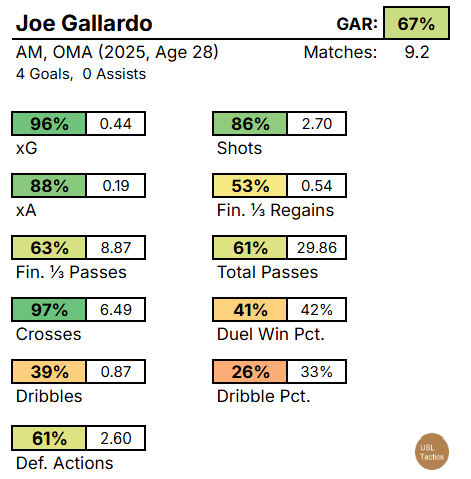
Gallardo’s versatility is his strength. With Omaha, he covered both wingback spots and excelled across the attacking line. In some sense, Gallardo’s grit (see 2.0 tackles per match) makes him a direct replacement for either-wing Pierre Reedy on the Spokane Velocity roster. I’d argue that he’s worth more than that: Spokane has never employed a legit wide scorer, so Gallardo’s return of 17 goals in the last three years is a boon. He'll provide huge gravitational value alongside stalwarts like Luis Gil and Neco Brett.
Andres Rodriguez (CM) & Sander Roed (CM) to Sarasota
Mika Elovaara has done nicely in building the Sarasota Paradise roster, tapping into his northern European ties (e.g., Maximus Taino, Jorgen Pettersen) and the League One bonds (Chandler O'Dwyer, Callum Stretch) he forged in Richmond. For now, I'm most fascinated by their midfield acquisitions with recent college experience.
Andres Rodriguez is a rookie out of VCU, and he’s got the profile of a useful No. 6 for Sarasota. In college, the 23-year-old was incredibly retentive in the defensive midfield on a high touch count, roughly 64 per match. Rodriguez’s positioning was consistently strong to boot; that preventive presence his defensive action volume, but it also set the table for a stellar 65% duel win rate.
It’s easy to imagine Rodriguez’s surety setting the table for Sander Roed as an offensive-minded No. 8 elsewhere in the midfield. Roed spent last year overseas after a standout University of Louisville run; in his final college season, he put up 0.33 xG+xA and 98th percentile progressive passes on an 83% overall completion rate. That’s very good.
Now, projecting college and recently-post-college talent can be tricky. The Mikkel Golings of the world might hit from the jump, while the Ivan Agyaakwahs will ease their way into contribution. I’m not saying Rodriguez and Roed will be nailed-on from opening day, but they’ve got that caliber of upside.
Andrew Booth (CM) to Tormenta
Since he left the Greenville Triumph to become a USL Championship midfielder after the 2021 season, Andrew Booth has ranked in the 80th percentile for xG and the 70th for duel attempts (both per 90) in three out of four possible seasons. It’s important to note how different that is from Gabriel Cabral, whose profile of progressive running and edge-of-the-zone facilitation as a No. 8 is the yin to Booth’s yang. Still, on sheer quality Tormenta has moved from strength to strength.
Much will depend on what Mark McKeever builds elsewhere across the roster. Booth is a core piece; Yaniv Bazini and Lucca Dourado bring hold-up ingenuity and shoulder-running guile as the No. 9s ahead of him. In goal, Sean Lewis is the sort of netminder that raises your floor by a good handful of points. We’ll see where it all lands, but Andrew Booth ought to be a major part of the refreshed identity in Statesboro.
The El Paso Locomotive are weird
The chronically online among us spent Boxing Day wondering if El Paso’s coaching hire – which the club teased on December 22nd – had inadvertently been leaked. Instead, that was a false alarm. By the time it was done and dusted, the Locomotive waited until December 29th to name Junior Gonzalez their manager, nearly two full months after Wilmer Cabrera was let go.
A masterclass in communication it wasn’t, but that’s par for the course in 2025. If you look back at the results, 2025 was a massive rebound for the Locomotive. Cabrera revitalized the club after a disastrous 2024 and earned a home playoff game on the back of strong underlying numbers; what’s not to like? El Paso's +4.65 expected goal difference was comfortably third-best in the West.
The eye test spoke differently. El Paso did well to generate home-run chances into Amando Moreno and Andy Cabrera, but the club spent the latter portion of the year feeling rudderless. A first-round playoff exit featuring one of the worst offensive showings in playoff history (0.1 xG on three total shots!) was a case in point. After that letdown, changing horses was a valid – if bold – response, but handling it like this has dulled the sense of forethought behind it all.
Even if you let the past be the past, there’s still a burning question as we turn the calendar to 2026: is Junior Gonzalez up to the challenge after four years away from the USL?
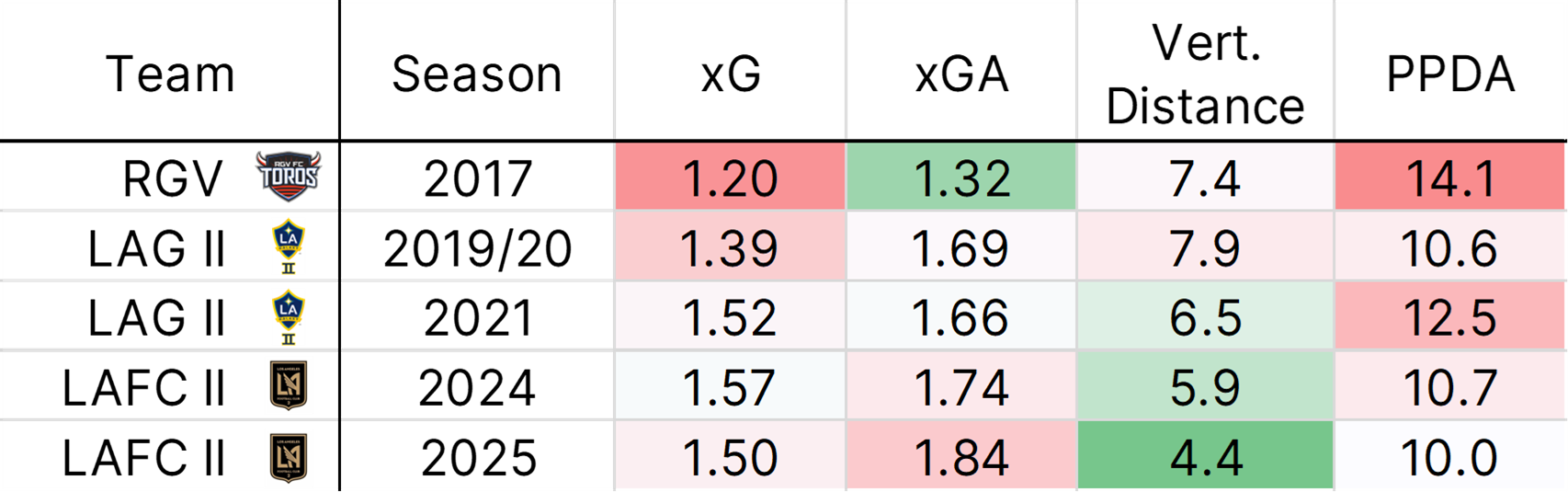
Historically, Gonzalez has never managed a side with a positive expected margin. He's done well to sneak into the playoffs, but barely so. His three postseason qualifiers – Galaxy II in 2019 and 2020, then LAFC II in 2024 – each finished their seasons with a matching goal difference of -3.
What Gonzalez does offer is a classically possessive game model, one suited to the specific tendencies of El Paso’s carryover core.
Across his stops, Gonzalez has preferred a shorter passing style (see a 52% possession share with LAFC II last season and the miniscule distances charted above) based out of a back-four formation. It’s a philosophy familiar from the Locomotive's Mark Lowry-led peak; Lowry reportedly preferred Gonzalez as his eventual successor while at the club.
Structurally, Gonzalez bases his shape in something like a 4-2-3-1. Out of possession, that shape can stay true or move into a 4-1-4-1 with a hinging member of the pivot pushing up; that’s especially true against avowed possession teams or while playing against the ball in a compact structure while protecting a lead. In any case, Gonzalez isn’t an especially press-forward manager, having posted a career passes against per defensive action (PPDA) of 11.6. Structure-centric denial is the goal, not wanton aggression.
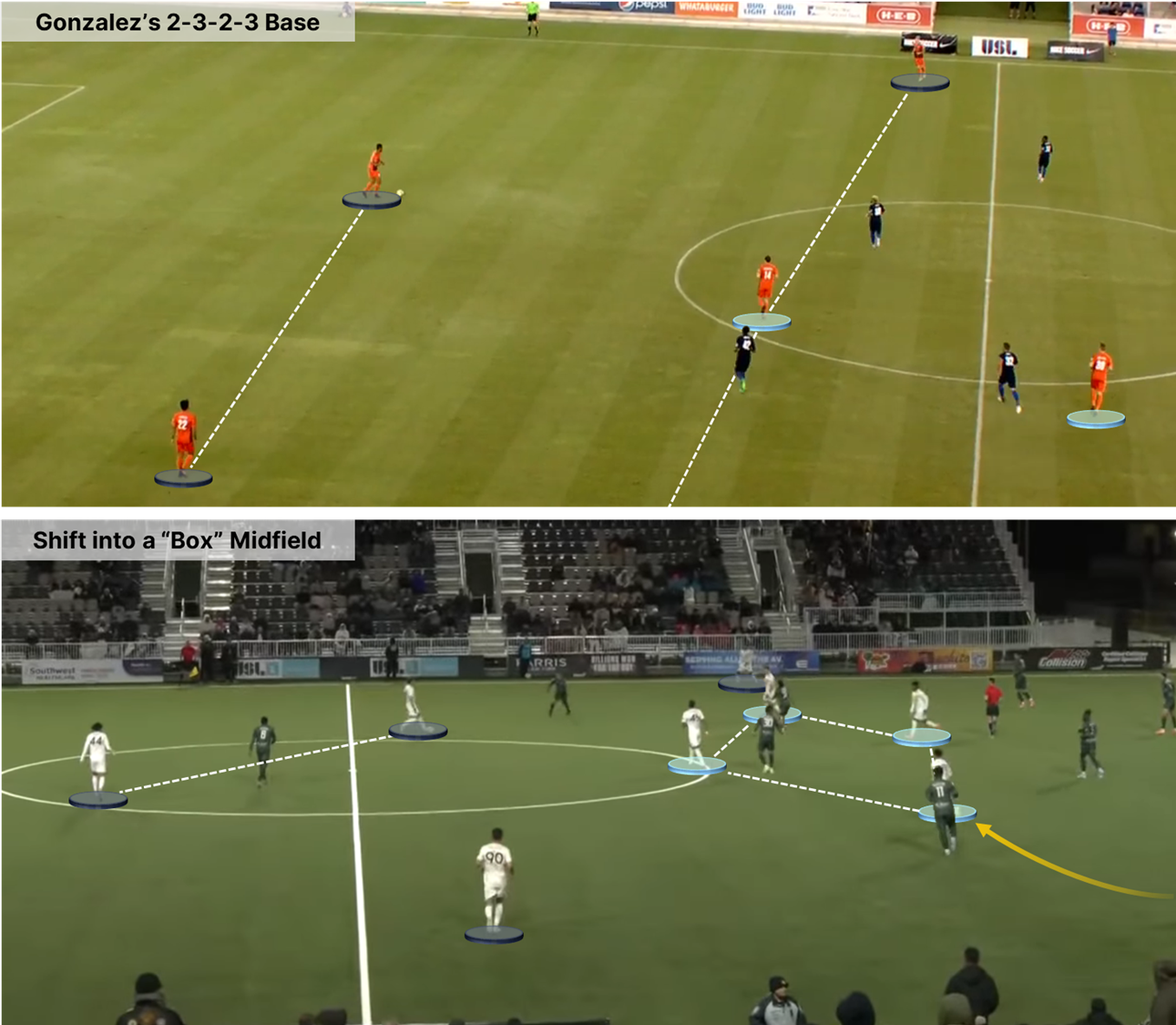
In possession, the shape tends to be more of a 2-3-2-3 with a single pivot, like you’re seeing above from Gonzalez’s 2017 RGV team. Even so, there’s variability; one of the No. 10s is dropping to form a 2-4-1-3 in that top screenshot. Either way, the emphasis is on keeping a strong resting shape while using elevated wingers to stretch the defense.
The second frame comes eight years later, spotlighting LAFC II’s upset over AV Alta in the most recent Open Cup. The base shape is the same, but you’ll notice how the right winger tucks next to the No. 10 above the level of the pivot. That run creates a “box” midfield. The goal? Set up a central breakthroughs or, failing that, an opportunity to break up the sideline against a narrowing opponent.
Now, think about those tenets relative to the Locomotive squad. Amando Moreno is made for a scoring-first wing role. Gabi Torres is the USL’s best choice for a “ostensibly a wide player but can tuck in as an overlapping No. 8” slot. Eric Calvillo is a model No. 8/No. 10 hybrid. Memo Diaz has the intelligence and passing ability to be a table-setting right back.
Adding Rubio Rubin may be the pièce de résistance. In Charleston last season, the 29-year-old forward primarily operated as a center-right forward or second striker, nabbing four goals and three assists on 80th percentile xG and 98th percentile xA. As a physical outlet able to receive at his feet, Rubin was among the league's elite. Given how Gonzalez likes to bait presses and then skip lines into a do-it-all No. 9, Rubin feels like a stunningly good fit.
There’s plenty of work to do, of course. Losing Frank Daroma is a hammer blow; he was made to be the No. 6 in the Gonzalez system. I don't have any trust in the Locomotive's center backs, and Carl Sainte ain't helping the cause. Gonzalez himself, for all the on-paper synergies, is a question mark given the track record. The heat will be on from opening day because of the way this saga was handled in El Paso.
Still, the potential is there. The Locomotive have struggled to find consistency ever since Lowry left the organization, but the table has been set for sustained success in 2026.
All-Super League, Halfway Edition
We're in the heart of the Super League's winter break, so I'm taking the opportunity to name an all-USL roster at the halfway point of the season. To the best of my ability, I’ve tried to represent every club in the division. Naturally, you’re going to see more players from juggernauts like Lexington and Jacksonville, but there have been exceptional performances across the table.
Without further ado, let's dig in.
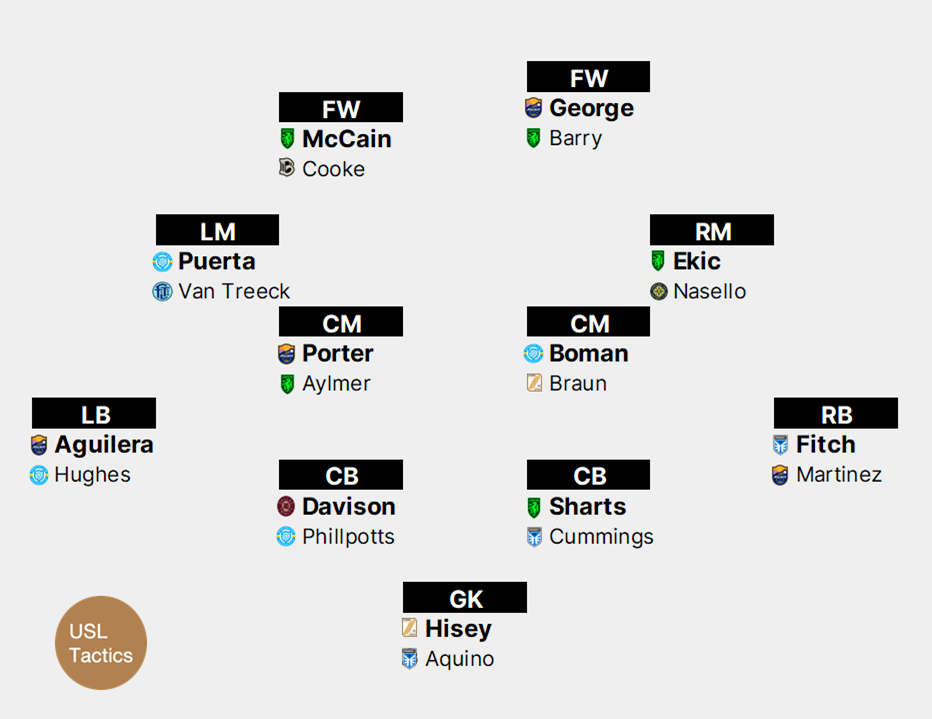
The forward spots were among the most difficult to decide, but I ultimately went for two non-traditional strikers: Addie McCain and MacKenzie George. McCain was one of Lexington’s many star additions entering the 2025-2026 season, and she’s (maybe?) been the best of the bunch. Pressing like a classic forward but dropping in as a connective, left-sided No. 10, McCain already has seven goals and two assists. Meanwhile, George was signed by Carolina as a winger but taken a star turn as a No. 9. She’s putting up a stellar 1.5 final-third recoveries and 0.36 xG+xA per game, giving the Ascent an identity going both ways.
The honorable mentions here were impossible. Rebecca Cooke (0.48 xG per 90, 84th percentile dribbles) has been a floor-raising striker in Brooklyn and earned a nod; her movement is remarkably heady. Lexington’s Catherine Barry is one of the league’s best set piece threats and might be the most “dominant” No. 9 out there. You could flip a coin and I’d have DC’s Gianna Gourley or Jacksonville’s Paige Kenton in those roles.
On the wings, Ashlyn Puerta and Emina Ekic were shoo-ins. Start with Ekic, another one of Lexington’s galácticos. Inverted onto the right wing, Ekic is putting up 0.30 xA and 2.55 dribbles per 90; she leads the Super League in crosses. I try not to throw around words like “unstoppable” lightly, but there’s nary a better descriptor. On the opposite flank, I am aware that Puerta isn’t a traditional winger, but you try denying a player that’s got double-digit goals, 78th percentile xA, and nearly five duel wins per game. Jacksonville’s system depends on Puerta to carve through the center-left pocket, and she’s been the best player in the Super League because of her success in doing so.
I’m representing Florida with my honorable mentions here, with Fort Lauderdale’s Kelli Van Treeck and Tampa Bay’s Sydny Nasello as my second-teamers. Van Treeck is a bit of a zag, and she’s split time between right wing, left wingback, and a handful of other spots; in the process, she’s putting up 73rd percentile defensive actions and 0.30 xG per match. Nasello, meanwhile, hasn’t been able to elevate the Sun solely on her shoulders, but she's been brilliant individually. She leads the division with an eye-popping 3.24 dribbles per game and has six goal contributions to boot.
In the pivot, I’ve gone for Taylor Porter and Sophia Boman. In Carolina, Porter is the tempo-setter at the base of the midfield, combining a constant resting presence with strong retentive skills. She’s posted an 88th percentile pass volume, adding 4.7 recoveries per 90 as an edge-of-the-zone maestra. Boman, meanwhile, leads all center mids with 10.8 final-third entries per game, adding 0.15 xA per 90 on top of that. Complementing Puerta et al., she tends to anchor the right side of Jacksonville’s midfield.
Taylor Aylmer, Lexington's metronomic center mid, is a model of efficiency, having won a very strong 57% of her duels in a demanding No. 6 deployment. Sophia Braun deserves a shout as well, having provided a little bit of everything through the Spokane midfield. She’s putting up 2.6 tackles and interceptions per match; American Soccer Analysis’ modeling rates her as the third-best interrupter in the entire Super League.
As we move to fullback, I'd like to put a full statistical spotlight on left-sided Jill Aguilera:
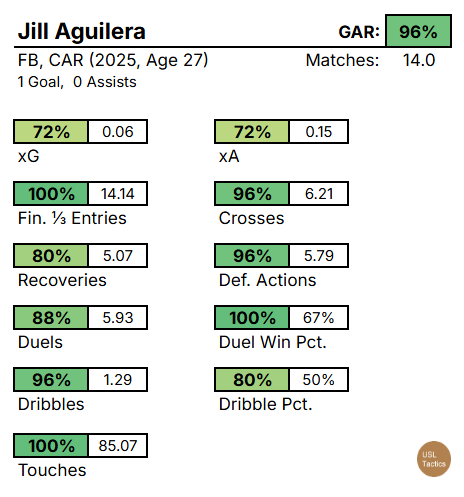
I mean, c'mon! On paper Aguilera is as offense-first as you can get at left back, but she’s unmatched in that deployment and still manages to anchor the Ascent press. Susanna Fitch, DC’s right wingback, is cut from a somewhat different cloth. Her primary strength comes in strong defensive activity (see 5.2 recoveries per 90) and table-setting combination play (7.9 final-third entries) up the sideline. She’s vitally important to the Power formula.
Brooklyn’s Sam Kroeger was a near miss at left back, as was Jacksonville’s Megan Hughes – a regular subject of praise on the blog. At right, Lexington’s Alyssa Bourgeois has been utterly crucial as a phase-based hinge, and Brianna Martinez (0.26 xG+xA per 90) is a terrific complement to Aguilera for the Ascent.
Central defense was knotty, but Dallas’ Hannah Davison is a worthy choice. She’s winning more than 60% of her ground duels, providing 3.5 takeaways per game, and doing so in a system that’s been increasingly comfortable in low block. Meanwhile, Davison remains a slick mover with the ball. Hannah Sharts was a must-have out of the Lexington back line. She’s the best long-throw taker in the division, capably elbows right in possession as needed, and wins a strong 54% of her duels. There might not be a better import to the Super League in the 2025-2026 season.
Grace Phillpotts made the cut in my first draft, having done incredible things as an underlapping menace on the left side of Jacksonville’s back three. Next to her, Georgia Brown's combo of stay-at-home surety (see 6.3 clearances per game) with left-leaning coverage was also a hard snub. Lastly, I've been enamored with Sydney Cummings' combination of high-volume passing (52.1 attempts per match) and physical dominance (70% aerial win rate) in the DC back three.
We end in net, where Spokane's Hope Hisey – the league leader with 2.3 goals prevented and 1.2 catches per match – was a lock. I tend to yield to the numbers with goalkeepers, but Hisey's combination of shot-stopping and box control is obvious even to the untrained eye. Behind her, DC's Morgan Aquino is my pick. Her -0.19 goals prevented mark is pedestrian, but she's got strong catch and clearance numbers and leads all Super League goalkeepers with a 52% long completion rate on more than nine attempts per game.
Quick Hits
In other news this week…
- Niall Reid-Stephen to New Mexico is excellent. I have no clue what that transfer fee might look like, but it's awesome to see (a) Tormenta developing a player for money and (b) New Mexico paying for a guy that's a stellar tactical fit. More on that from me in the near future, probably?
- We talked CBA on a New Years' Eve edition of The USL Show, and USLPA head Connor Tobin also did an interview with the Morning Kickaround gang.
- We’ll (hopefully) be live on the airwaves with another episode of This League! on Friday evening. Blame me having a day job for the delay.
- Every once in a while, I’ll get blitzed by a movie that’s very intentionally trying to be a tear-jerker. Song Sung Blue, with Hugh Jackman and Kate Hudson as a Wisconsin couple that performs as a Neil Diamond tribute act, is that movie. I have absolutely no history with Diamond’s music, but the craft of the movie – long takes as you’re building Jackman and Hudson’s chemistry, second-perfect editing of their musical performances, etc. – does wonders to win you over. That sets up a gut-punch of a second half, one that brought me to tears an embarrassing number of times in an absolutely empty Regal at 9:30 AM.