The Back Four: Boise, Monterey, and more
On Boise's expansion roster, promising Monterey, and more


Welcome in to The Back Four!
As always, visit Backheeled for more USL content, including my predictions for the league in 2026. Also, This League! will be going live this week to review offseason news.
Without further ado, let’s get to it.
Boise begins
Welcome to the market, Athletic Club Boise! There’s symbolic value to a team’s first signings, whether you’re trying to build a bridge to the past (i.e., Fort Wayne signing Tiago Dias off their League Two roster, the Cosmos adding Sebastian Guenzatti) or highlight local talent (i.e., Jacksonville signing Luc Granitur from the University of North Florida). This week, Boise took their shot to communicate title-contending aspirations, emphasize Idaho, and forge ties to manager Nate Miller’s highly successful past.
Blake Bodily became Boise's inaugural addition on Monday after having spent two seasons with the Tampa Bay Rowdies. An Idaho native, Bodily was a natural pick given his ties to Miller – and given that the 27-year-old is among the best wingbacks in the USL at any level. His three-year contract term is a statement of intent in and of itself.
Across his last two seasons, the new Boise man has started 48 league matches, picking up two goals and eight assists. When he played in 2025 (roughly two-thirds of the Rowdies' minutes), Tampa Bay's goal difference improved by +0.30 per 90. At an individual level, Bodily put up 0.17 xG+xA a match and ranked in the 73rd percentile for both cross attempts (3.5 per 90) and defensive actions (4.2). That level of both-ways quality has always defined his game.
Charlie Adams, another ex-Loyal man, was next up. Often used as a deep-lying tempo piece at the No. 6 spot, Adams thrived under Miller and Landon Donovan in San Diego. There, the Englishman was allowed to drift into the halfspace pockets and proved to be an elite long-range crosser. That sensibility ought to recur in League One, though Adams' health is still a question.
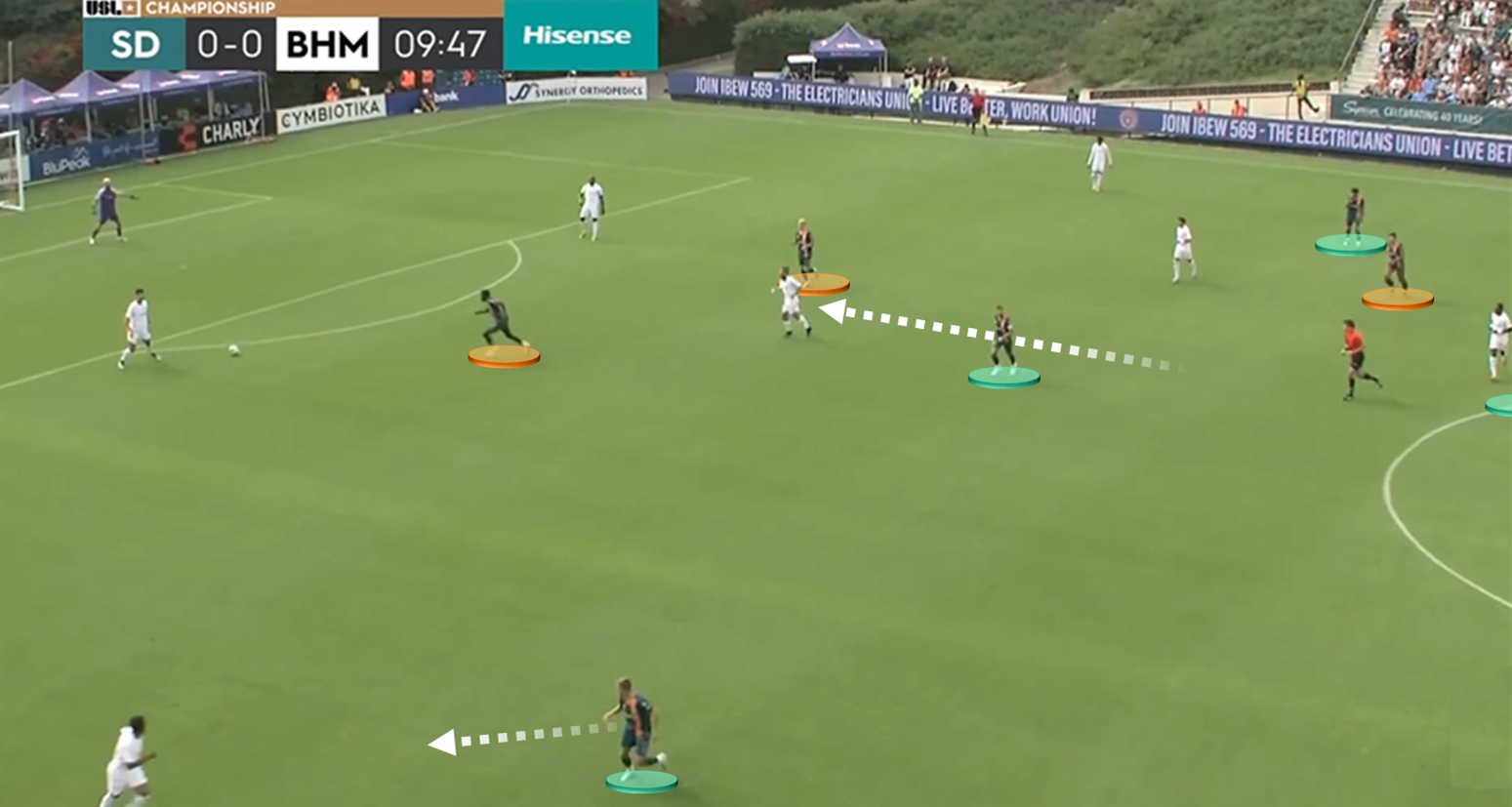
Still, that shared history in San Diego creates real upside. Bodily and Adams already have a built-in relationship that ought to pay dividends.
Here, you’re seeing Loyal bent into pressing mode, hinging their 3-4-3 to limit their opponent’s passing options. At the near sideline, Bodily is seen closing toward the ball-side fullback, whilst Adams has stepped high to mark an opposing No. 6. San Diego wasn’t an especially audacious pressing team in 2023 – their PPDA and defensive action height were basically at the USL median – but they picked moments to press the issue. Bodily and Adams already have those triggers down.
During Lansing Ignite’s lone League One season and during his time in San Diego, Miller preferred a 3-4-3 with one of his center backs elbowed up the sideline. Grant Stoneman often took up that responsibility in Michigan, whilst Carlos Guzman was the man for the job in California. It’s Boise’s third-ever signing, Jonathan Ricketts, that may do so in 2026.
Ricketts mostly played right back for Miami last year, though he shifted to the left at times and has operated as a wingback in prior stops with Sacramento and Rio Grande Valley. Across nearly 2,600 minutes in 2025, Ricketts ranked in the 97th percentile for defensive actions, won 58% of his duels, and completed 5.5 final-third entries per match. Miami directed Ricketts to play so deep that he might as well’ve been an elbow defender – and it’s a terrific use case for what might come in Idaho.
Ricketts' profile is particularly encouraging because of the other right back Boise signed: Nick Moon, yet another former San Diego player. Moon actually starred for Miller in Lansing, and he's got an attack-first profile that Boise's putative system will require.
What might the system look like? Above, Miller’s side is ensconced in the attacking zone, shifting from 3-4-3 into 3-2-5 with the wingbacks – Bodily and Moon – joining the forward line. Behind them, the wider center backs also push up, almost creating a 1-4-5 to fully tilt the pitch. The elevated defenders allow San Diego to reset in possession without giving up territory, setting the table for a through ball to Bodily. Upon receiving, he'll whip a cross toward Moon and earn an assist for his efforts.
That play is a model for how Boise might look next season, but you can't succeed in League One without a trustworthy defense. Thus, Saturday's signing of Jake Dengler might've been the most important of all. The three-time all-USL selection has won 60% of his duels during his four seasons in League One, amounting to 4.4 successful duels per 90. He's a functional long passer to boot, mixing 6'5" size with no-nonsense stability.
We don’t know a whole lot about this Boise roster, but the first five moves combine to make a major statement. Miller is among the best coaches in the USL, and he’s assembling a team that wouldn’t be out of place in the Championship. Boise has done everything right off the pitch, and they're shaping up to match that excellence on it.
Monterey’s method
When I was drafting my 2026 predictions column, I wrote a blurb about Monterey winning this year’s Wooden Spoon. Something held me back, and I'm especially glad after the club's business on Friday.
Why was I so skeptical in the first place? In Jordan Stewart’s first full season, Monterey rode goalkeeper Nico Campuzano and striker Ilijah Paul to a strong start, but that was an apparition. MBFC finished 2025 with the 11th-ranked expected goal difference in the Championship (-0.58) while deploying the division’s fifth-youngest roster, but they won two of their final 19 games in USL competition. It was hard to know which team – the statistical darling or the also-ran – was the real Monterey.
The exits of Campuzano, Mayele Malango, and Xavi Gnaulati added to those worries, but they came in service of what’s become a clearer and clearer vision. Campuzano was streaky; why not build a reputation as a player-friendly club by letting him return to Pittsburgh, the city where he played college soccer? Malango and Gnaulati showed flashes but weren’t match-winners in the Stewart system; why not recoup transfer fees for both?
On Friday night, Monterey signed goalkeeper Fernando Delgado to a multi-year contract after his release from the Birmingham Legion and paid to add midfielder Facundo Canete from MLS Next Pro’s Carolina Core. Together, they’re indicative of a dual strategy that’s trying to balance win-now value from the lower leagues with developmental-first projects.
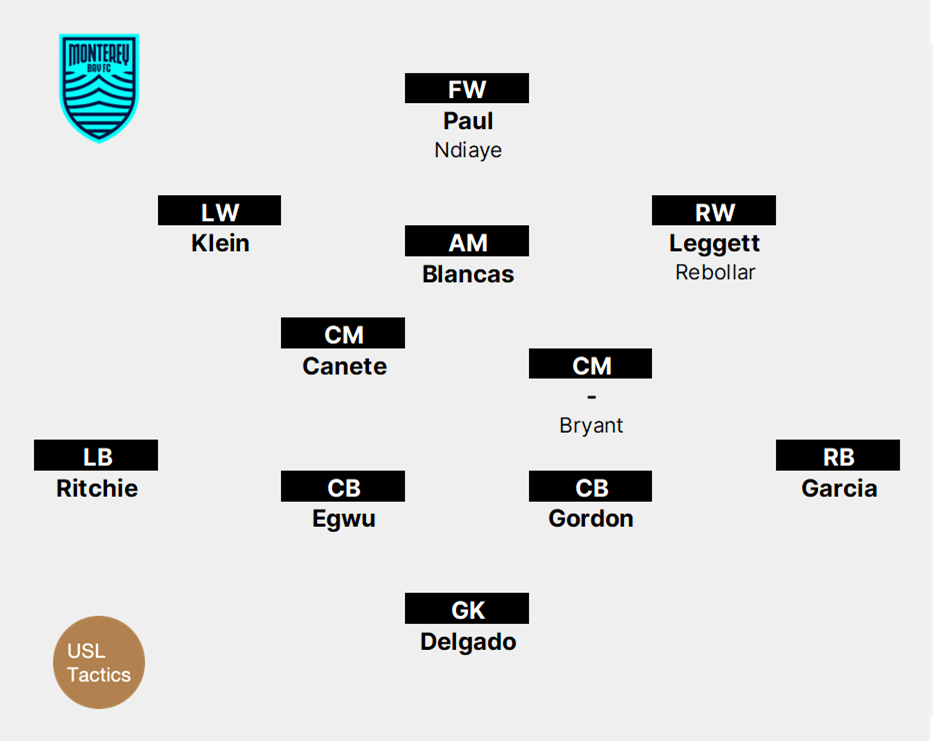
Monterey’s best additions this offseason, including Canete, Eduardo Blancas, and Stuart Ritchie, all arrived from the third division. Wesley Leggett and Delgado were spot starters at the Championship level, not regulars. It’s easy to fixate on clubs like Tampa Bay or Lexington that are building star-laden rosters rife with Championship headliners, but MBFC and their lower-end budget necessarily need to do things differently.
Canete is a chief example of what that strategy ought to entail. In two seasons with Carolina, the 25-year-old scored 12 goals and notched eight assists as a box-to-box midfielder. Out of that central slot, he won more than 50% of his duels, forced more than 2.5 takeaways per 90, and completed two-thirds of his long balls. You’d be hard-pressed to find a more complete option.
Likewise, Blancas looks like a burgeoning star at this level. Primarily a winger with The Town in Next Pro, Blancas put up eight goals in 2024 but felt like he was leaving something on the table. An ultra-possessive AV Alta centered the 24-year-old in 2025, using him as a No. 10 with the freedom to explore the attacking third. The result? 11 goals, five assists, and 11.6 final-third completions per match.
For now, my gut instinct is that Blancas will press next to Paul atop a defensive 4-4-2 but take on a deeper role in possession. Stewart’s offensive approach was fairly moderate last year, with Monterey ranking middle-of-the pack in terms of their vertical passing (7.5ish yards per attempt) and possession share (48%). The addition of a highly technical goalkeeper like Delgado – who, mind you, may not end up as the #1 – hints at a renewed commitment to short build from the back.
If Stewart is especially clever, he’ll take a note from Ritchie’s old club in Knoxville. On a way to a League One title, One Knox defended in a 4-4-2ish framework but bifurcated their fullbacks after regaining the ball. The result was a 3-2-5, with Ritchie popping high as a proxy winger and the right back dipping low into a resting back three. Now, consider a version of Monterey running an attacking 3-3-4, and you’d get:
- Ritchie pushing high, reprising the deployment that allowed him to attempt 5.2 crosses per 90 in League One
- Center back Kelsey Egwu, a 6’5” unit with fullback-caliber speed, elbowing left to cover Ritchie
- Canete and Blancas, players that combine for 0.67 xG+xA per 90 last year, as paired No. 10s between the lines
What’s not to like, particularly with Wesley Leggett and Johnny Klein filling out the front line? I’ll cease the “armchair manager” bit, but that’s one of a few possible permutations that Monterey could deploy.
Now, there are still questions to answer. Delgado might be good with the ball at his feet, but he posted a 53% save percentage last year and conceded 4.8 goals above expected. This team badly needs a starting-caliber No. 6, the kind of player that can initiate through lines and provide destruction in front of the back line. It's hard to understate how badly this team needs a muscular presence in the holding midfield; Monterey will miss the playoffs unless they find a rock in the pivot.
Still, things are making far more sense than they did a week ago. Stewart hasn’t had an easy time since joining Monterey toward the end of 2024, but we finally might be seeing light at the end of the tunnel.
(Also: Monterey trying to do the Mamadou Dieng thing by signing a mysterious academy forward from Senegal – Youssou Ndiaye – is a good gamble. As my friends at The Union Report noted, “a random Instagram user called him a new Romelu Lukaku.” What more do you want?)
Floors and Ceilings
On Thursday, two major moves shook up the Championship’s Western Conference. First up, the Las Vegas Lights acquired Kyle Scott, adding one of the USL’s premier deep-lying creator and a long-time linchpin for Orange County. Shortly thereafter, the Colorado Springs Switchbacks announced a paid transfer for New Mexico United’s Talen Maples.
I often talk about signings as raising a team’s floor or ceiling, and these two signings are prime examples of what I’m getting at. Scott is a ceiling-raiser, the kind of player that vastly expands Las Vegas’ contention potential. Maples, meanwhile, raises Colorado Springs’ floor significantly.
Start in Nevada. Last season, the Lights were shockingly bad at controlling possession and moving the ball upfield. Las Vegas took 369 box touches in Championship play; no other club was under 450. They finished dead last in final-third completions and mustered just 0.81 xG per 90, miles away from the second-to-last finisher. Adding Giorgio Probo was a good first step toward patching that hole with a pivot-based quarterback, but he came too late to save a sunken ship.
You see Scott’s patience here, where he’s mixing longer balls with around-the-edge service. His deeper presence forces defenses to stretch and elevates the rest of a roster – exactly what Las Vegas missed last year.
— John Morrissey (@usltactics.com) 2026-01-08T20:51:54.871Z
Now, Scott enters the mix as one of the premier initiators in the USL – perhaps only bested by Lexington’s Aaron Molloy. Before being sold to Crawley Town last summer, the Englishman put up 95th percentile touches (70.7) and final-third entry passes (10.1) per game. Scott is defined by his erudition; he knows when to push upfield, but he also knows when a sideways pass is necessary. His 87% touch retention rate in 2025 was among the USL's highest.
When you consider the rest of Las Vegas’s winter haul, there’s been plenty to like. Shawn Smart and Johnny Rodriguez are back to provide spark; Ben Ofeimu, Aaron Guillen, and Jared Mazzola have improved the defensive base; Manuel Arteaga is a new anchor at the No. 9 spot. That group assured the Lights a far higher floor than they enjoyed in 2025, but it’s Scott that can elevate Las Vegas into legitimate contention. He’s defined by his upside.
Now, let’s turn to the Switchbacks. This was a team that made the playoffs last year, yet their performances paled in comparison to 2024’s title run. Hence, manager James Chambers lost his job.
The best version of Colorado Springs two years ago relied on a high back line to support the press. They had “ceiling raisers” like Ronaldo Damus and Jairo Henriquez up top, but the floor was set by their defense. Entering 2025, Matt Mahoney returned as an anchor within the Switchbacks’ 4-2-3-1, but his primary partners didn't. Delentz Pierre decamped for Tulsa, while Duke Lacroix often had to cover at left back. Balance never arrived, and Colorado Springs placed last in the USL by conceding 32 shots and 8.3 expected goals on the fastbreak.
Talen Maples changes that in an instant. I imagine he’ll play to the left of Mahoney, thereby giving the Switchbacks the Championship’s best zone-retaining center back duo. While his New Mexico side allowed 6.5 break xG, that came amidst an extreme possession system that invited risk; I'd argue that Maples did a terrific job at stopping that number from being even higher.
Now, manager Alan McCan may tweak Colorado Springs' look, but his starting center backs point toward renewed execution of familiar ideas. Maples and Mahoney combined for nearly nine recoveries and 16 final-third entries per game last year, and they’re the most modern defensive pairing we’ve ever seen in the USL. By adding Maples, the Switchbacks have guaranteed a baseline level of performance.
Not every signing fits the floor/ceiling framework. Sometimes a role player is just a role player! Still, when you’re taking big swings in the transfer market like Las Vegas and Colorado Springs did, you need to understand the outcome you’re pursuing. For my money, Kyle Scott and Talen Maples fit that bill.
Signing potpourri, 5th edition
After a brief hiatus in this series, we're back at it with some shorter capsules about pertinent signings. Let's start with Eliot Goldthorp, who's a fresh member of the Pittsburgh Riverhounds.
Still just 24 years old, Goldthorp stole the show with 10 goals and five assists with Vancouver's MLS Next Pro affiliate in 2024. Signed by Lexington ahead of 2025, Goldthorp struggled to earn minutes and was loaned to Tulsa. There, he made 16 appearances but wasn’t a part of the club's Western Conference playoff run.
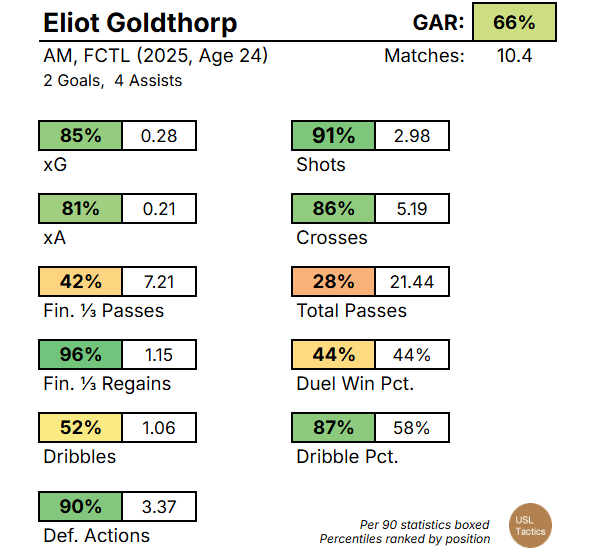
Even if last year didn’t go to plan, Goldthorp put up terrific underlying numbers, and now he'll join the club that bested Tulsa in the championship game. Pittsburgh is likely to use Goldthorp like more of a midfield-oriented Bertin Jacquesson, but there’s a world where his skillset invites a different deployment.
Last season, Vincent shifted the Riverhounds' 3-4-3 so that his wide players "were probably playing 10 to 15 yards higher...to discourage early-release passes to the wingback, which generally are pressing triggers for the other team." In other words, Vincent turned his wingbacks into upfield weapons that could challenge defensive organization – the kind of thing Goldthorp excels at. That’s not a guarantee, but it's a terrific ace in the hole for a Pittsburgh team that’s keeping Robbie Mertz and Charles Ahl.
(Of course, I’m burying the lede by talking about Goldthorp when Pittsburgh went out and paid a fee to bring Albert Dikwa home! We know Dikwa is going to come good, and I can’t help but dig into the “what if?” potential of Goldthorp.)
Elsewhere, I owe Forward Madison some air. The club hasn't announced the full list of their returning players yet, but they’ve begun to announce a slew of new signings.
I've been on the record about loving Mark Segbers for as long as I've been covering this league. Injuries and personal issues kept the former Wisconsin Badger to roughly 500 minutes last year, but Segbers still put up 0.15 xA per 90 and won 56% of his duels while occasionally moonlighting as a No. 8. Presuming a return to fullback, he may pair with Ryan Carmichael up the sideline. Carmichael posted 21 goal contributions in two seasons with Atlanta United 2, but his 2024 campaign (where he played like a No. 9) featured 76% of them. He’s operated on the right, but we’ll see what gives.
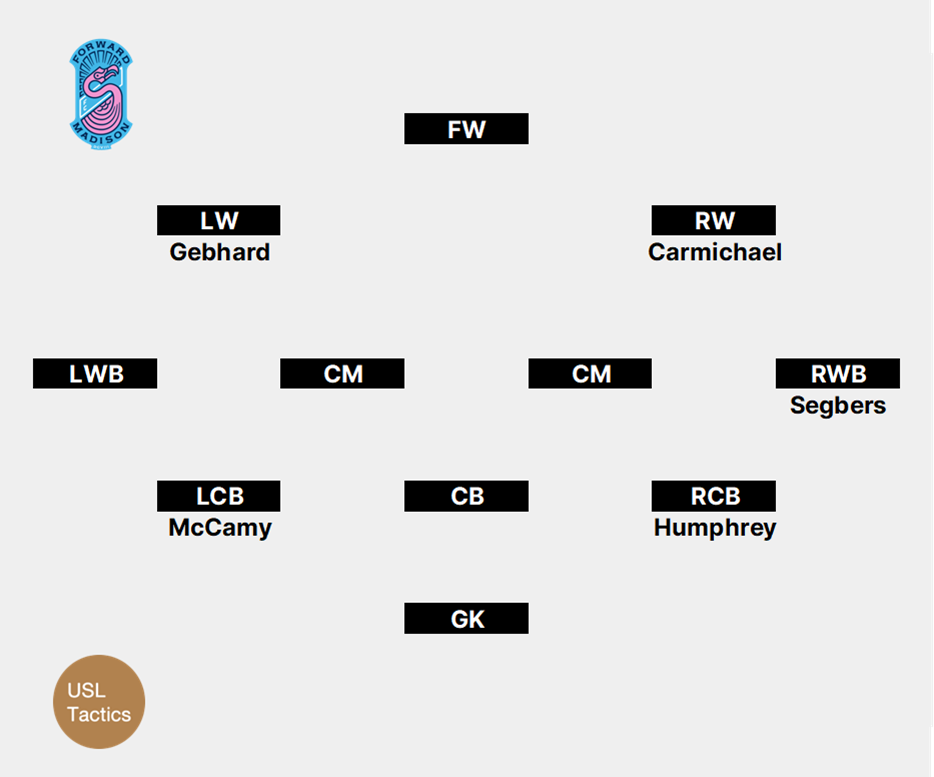
This week, dual defensive signings entered the fray, and they're potentially portentous as to the direction of the Madison offseason. Collin McCamy, a combo left-sided center back and No. 6, and Turner Humphrey, a right-sider, may hint at a serious rethink for the ‘Mingos at the back end.
This club has been defined by a Crull-Osmond-Mehl triumvirate for a number of years, but the wheels fell off the carriage in 2025. Matt Glaeser’s side allowed 1.43 goals per game, tied for seventh-best in League One and representative of a steep decline from a 0.81 mark in 2024. We don’t know what’ll become of the old faces, but the new signings may be their replacements.
McCamy played nearly 2,000 minutes for NYCFC II last season after a decorated college career at Northwestern. In Next Pro, his count of successful tackles (20) nearly doubled the times he was dribbled past (11). To me, that's the sort of stabilizer Madison missed in 2025. Meanwhile, Humphrey only played about 200 minutes in Las Vegas after a title-winning rookie season in North Texas, but he still managed to put up a majoritarian duel win rate and post 7.2 clearances per 90. Together, they can fuel a younger, healthier revival of Glaeser’s back three.
Back up in the Championship, Tarik Scott's jump to Lexington is a great depth acquisition. For one, his brother Malik Henry-Scott is on the team, and that just rules. For another, the younger Scott put up a sizzling 0.42 xG per 90 on loan with Monterey last season and is a good mover at the No. 9 spot. For a team that didn't have a quick striker off the bench last year, Scott fits the bill and provides the "yang" to Phillip Goodrum's "yin" in the starting lineup.
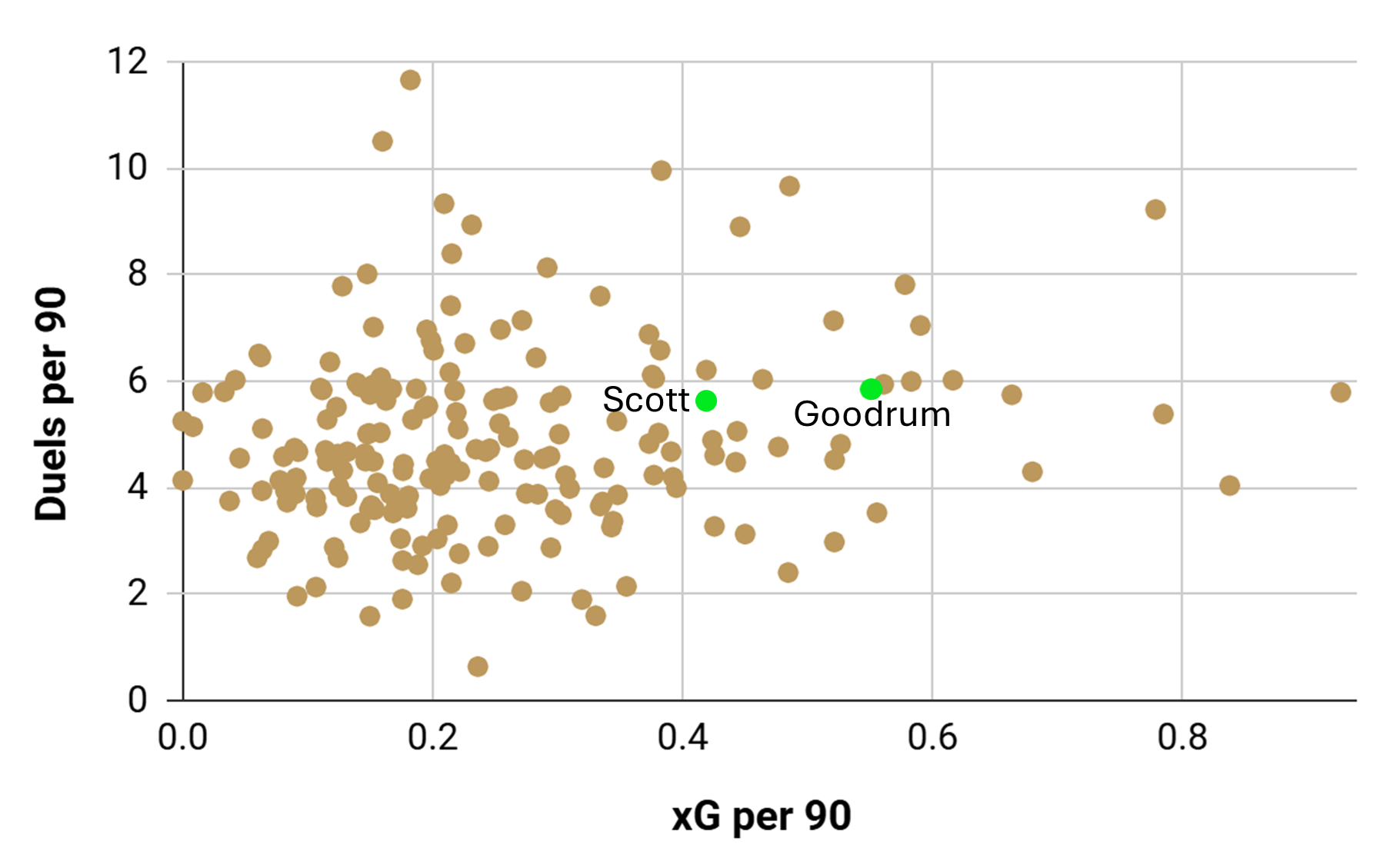
Scott might've played in a Monterey system that didn't emphasize the press in the same way Louisville spotlit Goodrum, but he still showed off the mentality of a dynamic, aggressive weapon. That quality likely endeared Scott to LSC, and that’s before you consider the 20-year-old’s obvious potential.
Quick Hits
In other news this week…
- My reaction to Jacksonville's roster build has been the Jose Mourinho "if I speak I am in trouble" GIF, but I quite like the Tyshawn Rose signing? The left back put up a very solid 0.18 xG+xA per 90 in about 1,600 minutes with Huntsville last year, and he’s a nice complement to Mo Traore on that side of Liam Fox’s defense. (Also, I’m into Jordan Rossiter as an experienced destroyer.)
- Fascinated by the New Mexico angle as far as the Maples transfer goes. The good: United got on fine as Maples ended the season at right back, and they’ve got Kipp Keller returning to anchor the back four. The less good: Kalen Ryden was really crucial after Maples’ position change, and he’s retired now. I’m one big defensive signing away from buying in – and you’d assume the transfer fee Colorado Springs paid would be enough to make it happen.
- A Tormenta midfield of Andrew Booth, Angelo Kelly, and Conor Doyle isn’t a definite upgrade on last season’s central corps, but it’s pretty darn close. Kelly fell out of the mix during Knoxville’s title run, but he still played nearly 1,700 minutes while posting 6.1 duel wins, 5.5 recoveries, and 0.17 xG+xA per 90 – the two-way quality this team needed in their revamped spine.
- In case you missed it, Joe Lowery and I co-reported on the ensuing exit of Mark Briggs from the Birmingham Legion:
BREAKING: Mark Briggs, head coach of the Birmingham Legion, is departing the club, sources tell me and @joeclowery.bsky.social. Briggs is expected to join the staff at FC Dallas, where he’ll serve under former New Mexico United manager Eric Quill.
— John Morrissey (@usltactics.com) 2026-01-11T20:09:25.474Z
- Apropos of nothing, more people need to recognize the Crunchwrap Supreme as the king of fast food items.