In Conversation: Marlon LeBlanc, Brooklyn FC
On Marlon LeBlanc, Brooklyn's first-ever Championship manager

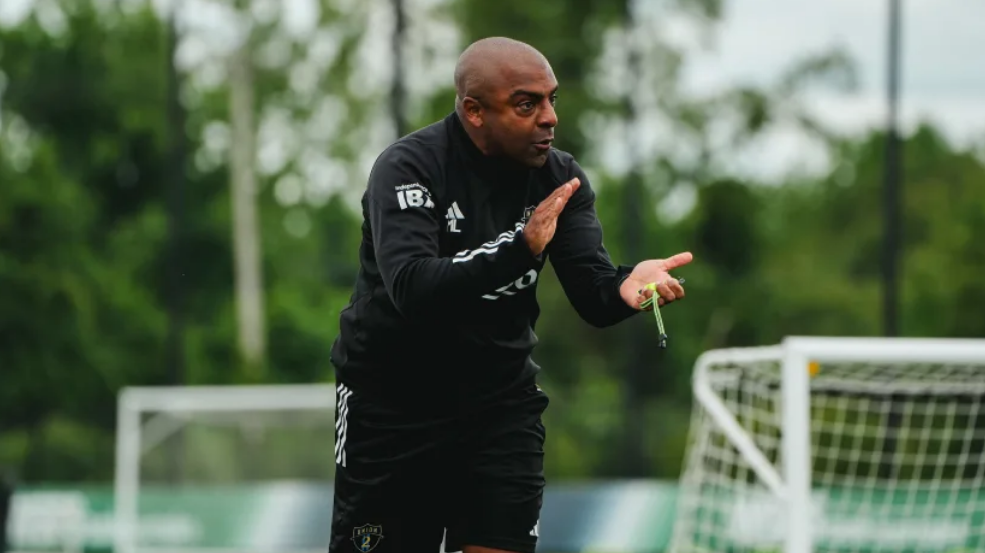
Hiring a coach is never easy; hiring one for an expansion club is that much harder. Khano Smith, a former pro with USL Championship assistant experience, succeeded in Rhode Island by instilling a stout system with a premium counterattack. Bobby Murphy forged Portland Hearts of Pine as a fast-paced, pressureful side after moving over from MLS Next Pro. Matt Poland's FC Naples found their spine in the Midwest Premier League!
There’s not a single correct answer that defines a great expansion manager, but Marlon LeBlanc has the chance to become one for Brooklyn FC. As Brooklyn approaches their first Championship campaign, LeBlanc spoke to USL Tactics about his experiences and vision.
LeBlanc’s resume covers large swathes of the American game. After having spent nearly 20 years in college soccer, the New York native took over as the manager of Philadelphia Union II in 2020 – their last season in the USL. Thereafter, LeBlanc led the club for three years in MLS Next Pro. During that run, Union II’s underlying numbers and practical results improved each year, culminating in an Eastern Conference title in 2024.
“What I liked so much about the job that I had was the opportunity to develop the future for the Union in terms of their first-team players. That, for me, was the inspiring goal,” said LeBlanc. “My next opportunity, I wanted it to be something that was different. I had a couple opportunities that I turned down, and then the national team came in.”
LeBlanc – who left Philadelphia once his son graduated to the Next Pro level – took over the US U-18s earlier this year. Under his stead, the youth national team won a UEFA Friendship Cup title. In the manager’s mind, development and winning are mutual goals, and that showed with the U-18s. For LeBlanc, the idea that growth comes at the expense of success is an “excuse.”
That improvement-first balance is a through-line in the manager‘s career. At West Virginia in the NCAA, he helped turn players like Jack Elliott, Ray Gaddis, and Peabo Doue into professionals. In Philadelphia, he led sides with an average age of just 19 to the top of the table, supporting burgeoning stars like Cavan Sullivan along the way. LeBlanc’s adaptability made it happen.
With Philadelphia, the expectation was that Union II would run a pressureful system that reflected the first team’s identity. That philosophy matched LeBlanc’s tenets, but it didn’t allow for a full expression of his tactical nous. That changed with the national team, where he molded an unfamiliar group of teenagers into a unit with clear principles but genuine tactical flexibility.
“A lot of times you can lose your identity because you're adapting to your opponents. Yes, you can't play France in a full press – they’d kill you with space in behind – but you still need to understand who you are,” he explained. “How can we still make the game be played on our terms? We might not completely press in your back third, but we'll find that trigger maybe 30, 40 yards up the field and then have a quick transition moment.”
Pressure has always been at the heart of LeBlanc’s game, and that held with the U-18s and Union II alike. Philadelphia ranked in Next Pro’s top-ten with a stingy 9.1 passes against per defensive action (PPDA) in both 2023 and 2024; in the latter year, their average defensive action came a staggering 48 yards upfield to easily lead the league.
That pressure was supported by a vertical, pitch-tilting passing style. Philadelphia launched 80% of their goal kicks in LeBlanc’s final two seasons, finishing with less than 300 passing completions per match while still posting 1.61 xG per game. In every sense, it was territorially dominant soccer akin to the winning formulas used by clubs like Louisville, Pittsburgh, and Tulsa in the 2025 USL Championship season – the kind of style that relies on “collective effort.”
“When I say ‘collective,’ it’s flooding areas with numbers, creating overloads with the ball, creating overloads against the ball, trying to be really quick in transition, and trying to play as much in the attacking half as possible, whether we're defending or not. I'm a big believer that thirds of the field move with you,” he explained. “A lot of people look at the [defensive] third as the 30-to-40 yards in front of your own goal, but the back third really could be at midfield if that's where you're playing. You understand the risk and responsibility that you have on the ball.”
Those ideas – moving the field, being adaptable, and using pressure to stay on the front foot – are clear when you watch LeBlanc’s teams play.
In this example, you see that theory about the thirds of the pitch in action. Here, in a 2024 visit to Toronto FC II, LeBlanc’s side presses in their trademark 4-1-3-2 – something akin to a midfield diamond. Because the back line sits so high, the field is functionally compressed. What might be considered the “defensive zone” has a new geometry.
The Union pressure the ball up the sideline, using their ball-side forward to spring a trap. Thus, Toronto has to reverse and switch the point. That’s exactly what Philadelphia wants.
As Toronto passes along the back, Philadelphia's weak-side forward and right winger close on the opposing receivers, rushing passes and re-creating a trap at the opposite sideline. The result is a turnover, one that allows the Union’s No. 10 to recover in the attacking zone and set up a scoring move.
By comparison, watch how a flatter 4-4-2 operates in that aforementioned matchup against France. The US U-18s took some chances to press backpasses and used curling runs from the wings to wreak havoc in this match, but the overall approach was less in-your-face. Still, though, you see how LeBlanc’s side holds a high back line in order to change the accessible geometry of the field.
There’s no more than 25 yards separating the highest presser from the deepest defender, and the entire 4-4-2 flows as a unit. The aggression against the sideline isn’t as marked, nor is the pursuit of the ball. Still, the result is similar: the opposition can’t do anything useful.
The examples share DNA but, more than anything else, illustrate LeBlanc’s ability to establish clear principles that can be adapted to specific match-ups.
“I consider my adaptability to be a strength – and my ability to really unify groups, similar to what we're gonna have to do this year, right? In terms of building a roster and building a team without any type of previous history with the players,” he said. “A lot of things that we're going to do fit the mold in terms of the way that the USL has evolved. The question is whether we can maybe do it a little bit better than everybody else.”
Building this Brooklyn team won’t be a solo act. Before the club named a men’s coach, they appointed USMNT legend Brian McBride as general manager.
McBride, who most recently served as the general manager of the US men’s national team, is the sort of name that immediately demands respect in the American game. Formally, he’ll lead Brooklyn’s Championship and Super League sides in terms of squad building, coaching hires, and other sporting activities – a proposition that excites LeBlanc.
“I have a more collaborative approach to the way I do things. I love a sporting director that can sit at the top of the stands, come and give me feedback at halftime, and know that I can trust that feedback,” said the manager. “It's his eye for talent, the way that he wants to play – adaptability, tactical flexibility, understanding how we want to build this team. All of those things are right in sync.”
Together, LeBlanc and McBride are tackling one of the biggest challenges an expansion team will face: roster building. Brooklyn hasn’t yet announced any signings at the time of publication, but they’ll have roughly 25 players raring to go when preseason camps begin in February. The hard work is well underway; LeBlanc joked he isn’t sleeping because of blue light exposure from late-night WyScout sessions.
What’s driving Brooklyn’s strategy? LeBlanc cited technical passing through the lines and an ability to push the tempo as target traits. That’s largely expected; three of the four most direct passing seasons in Next Pro’s history belong to LeBlanc’s Union sides, whose average pass traveled 10.0 yards upfield throughout his tenure.
At the same time, pure skill can’t be the only criterion.
“Talent is important. We want good players, but we want to build something that's special that's going to be around for a long time. We know that the players we bring in this year, they are going to be the ones laying the foundation for that,” LeBlanc argued. “And so character remains at the top of the list. We need characters that are willing and flexible and able to execute our principles, more so than any one given formation.”
It would be easy for a manager in New York City to rely on the glitzy market in recruiting prospective players; Brooklyn is expensive, but it’s a highly attractive landing spot in a league like the USL that predominates in mid-size cities. Instead, Brooklyn FC’s brain trust is trying to make development and improvement a key part of their pitch.
Even for USL teams without star prospects, continued growth at the senior level is paramount. In 2025, 10 Championship clubs posted an average age above 27 years old; half of them missed the playoffs. By contrast, the league title game was contested by Pittsburgh and Tulsa teams closer to an average of 25. Brooklyn’s approach is suited for that environment.
“We're really big on investing in people and investing in the players – not so much talking about what we can do for them, but more like, 'we believe in you and what you bring to the table as a player,'” he explained. “How can I help you, and how can we get better? Maybe that's a little bit of the development profile that I've had over the last number of years, but I feel that way even with senior players.”
Given LeBlanc's resume, it's a convincing sales pitch. His Philadelphia Union II teams turned prospects like Paxton Aaronson, Jack McGlynn, and Matt Freese into international-caliber players, but they also molded Boubacar Diallo, Stefan Stojanovic, and Matt Real into premier contributors within a USL context. Growth and development are never one-size-fits-all, and no one understands that better than Brooklyn's new manager.
LeBlanc is a New York City native, and he spent summers with his grandparents in Brooklyn. This is a homecoming, and LeBlanc wants his club to be a home for players looking to take a step forward. He knows there are cutthroat expectations to meet (“I'm not naive to that, and I certainly want to win"), but he has larger aspirations for what Brooklyn FC can be a program and an institution.
“When I finished up with Philadelphia, I could literally look my bosses in the eyes and say, ‘it's better today than when I found it,’” said LeBlanc. “I think I was chosen for this project not just for my coaching, but for the thought process of who can help us build something sustainable and long-lasting. We want to be that team for Brooklyn, and we want to bring this community together.”