The Back Four: Winter wonderland
Super League 2025 wrap-up, extended signings analysis, and more


Welcome in to The Back Four!
As always, visit Backheeled for more USL content, including a humiliation ritual review of my 2025 predictions. Also, check out This League! for an audiovisual dive into the big stories of the 2025 offseason.
Without further ado, let’s get to it. It's a three-section week, by the way – I had a long chunk about a signing that didn't get announced, so enjoy a lengthier potpourri instead.
Signing potpourri, 4th edition
Another week, another set of fascinating moves. Let’s start off with the Sacramento Republic, who continued their streak of smart additions by signing Pierre Reedy from the Spokane Velocity.
Reedy made his USL debut as a 25-year-old in Ben Pirmann’s first season with Charleston, and he followed then-assistant Leigh Veidman to Spokane thereafter. Up-and-down health meant that Reedy made merely 35 appearances over two seasons in League One, but he was a locked-on starter for most of 2025. The winger posted six goal contributions last year, but that felt secondary to his premium speed and terrific pressing abilities from the left side.
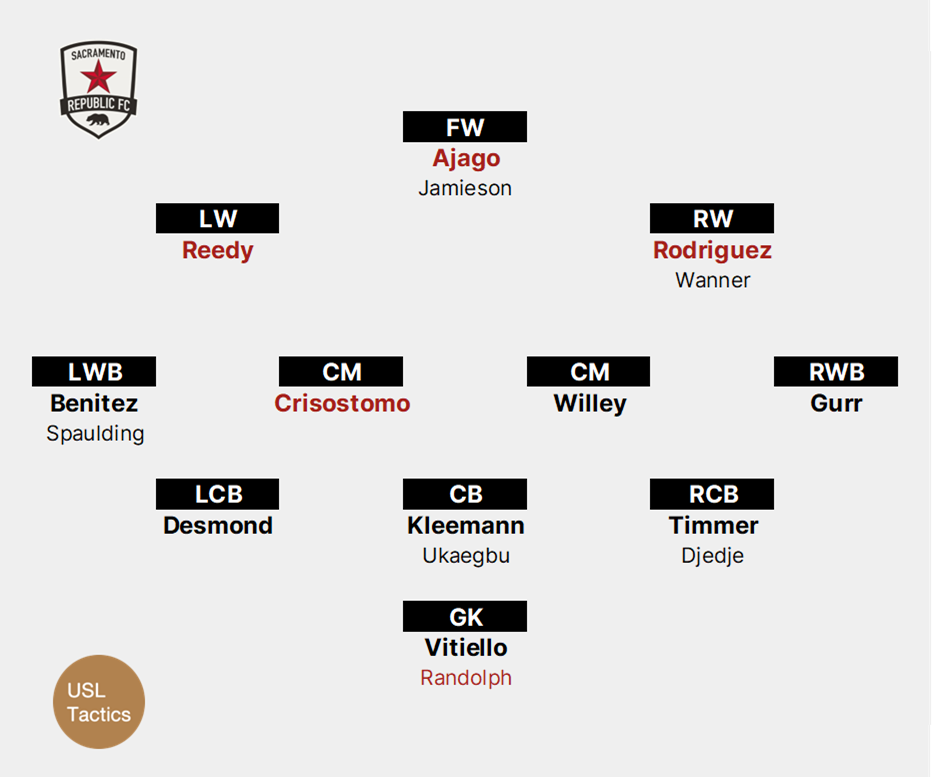
I’ve heard that Sacramento has a notable intra-league transfer coming, and that likely means Reedy will be a role player on the left side come opening day; consider the depth chart above to be a work-in-progress suggestion. Even so, Reedy's presence bolsters the sense that Neill Collins’ Republic are getting younger and faster in a meaningful way.
Up top, Forster Ajago is something of a coin flip, but he’s got more raw talent than any striker in the Championship. Over his last two years (including a loan spell with Lexington), the No. 9 has 13 goals on 13.7 xG in roughly 2,500 minutes. Ajago is a quick but imposing 6'2", though he won just 39% of his duels in 2025; by comparison, Khori Bennett was at 41% while nearly doubling Ajago's per-90 scoring.
It's the midfield where the Republic have really made gains. Danny Crisostomo, arriving from Tampa Bay, and Arturo Rodriguez, in from Charleston, combine to give Sacramento ground coverage, technical passing, and excellent creative upside. Now 28 years old, Crisostomo put in 89th percentile takeaways and 62nd percentile recoveries last season while operating as a No. 6-No. 8 type in the Rowdies' midfield, and he figures to be the solidifying presence. Rodriguez, meanwhile, put up a stellar 0.35 xG+xA per 90, adding 89th percentile final-third takeaways. The former League One MVP is a difference-maker in big moments.
Put it together and add the returning Blake Willey to the mix, and it’s easy to see this midfield operating with a real sense of balance. Unless Rayan Djedje reprises the No. 6 minutes he earned during his time with the Charlotte Independence, this team probably needs a destroyer for good measure, but the new faces have already gone a long way in making up for the losses of Rodrigo Lopez and Cristian Parano. Sacramento isn’t straying from the profiles that defined last year’s 3-4-3 template; they’re doubling down with well-chosen replacements tailored to that system.
Over in Nebraska, Union Omaha’s addition of another 2022 title-winner also caught my eye. After last week’s Gabriel Cabral signing, Adrian Billhardt has entered the fray in the wake of two seasons spent with the Richmond Kickers.
Health has been a question for Billhardt, who’s something of a journeyman with stops at Tormenta, Detroit, Richmond, and now Los Búhos between 2022 and 2026. Still, there’s hardly a better final-third dribbler in the entire USL. In his two years in Virginia, the 28-year-old put up 92nd percentile dribbling, beating opponents with the ball 2.4 times per 90 minutes.
It’s likelier than not that Billhardt, who started only seven matches last year across 22 league appearances, will be a reserve option behind Prosper Kasim on the right wing. Still, you can imagine the German international becoming the best super sub in the division – particularly because of his proven chemistry alongside Cabral.
Above, you see Cabral (in neon) and Billhardt (black) as part of a positively Vincenzo Candela-esque 4-2-4 attacking shape for Tormenta. Cabral is carrying the ball forward between the lines, bending the opposition to his whims. When the defense overcommits toward Tormenta’s left, Billhardt makes a stellar run into the center of the box to receive and score off a cutback.
For an Omaha program that’s made hay off a “build through the middle, overload the wide areas to find crossing lanes, and feast on the cutback” pattern for years, you couldn’t ask for much better. As with every other League One club, there’s more to come, but I’m already liking the start of Omaha’s reload.
Back in the Championship, I’ve continued to like Las Vegas’ business, and I only feel stronger in that conviction in the wake of the Abraham Okyere signing this week. A 23-year-old with experience everywhere from India to Finland, Okyere is on a two-year deal with a 2028 option and looks like a powerhouse of a No. 8.
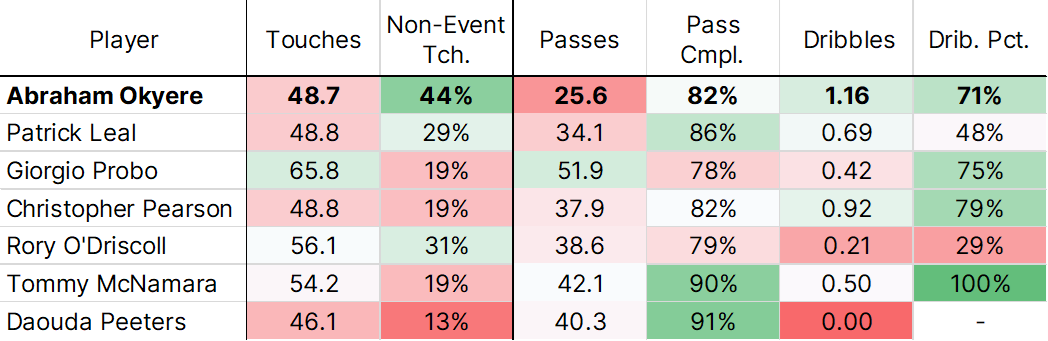
In terms of his statistical profile, Okyere’s tendencies are closer to someone like a Hope Avayevu (i.e., mid-low touches but high shot and dribble returns) rather than a traditional box-to-box center mid. That’s because the native Ghanaian is uniquely driven on the ball. If you port his Veikkausliiga numbers to the Championship, there’s only one single player that took more touches without an “event” – a shot, pass, or take-on attempt.
If that’s muddy, let me clarify: when Abraham Okyere receives, he’s extremely likely to push with the ball at his feet and draw defenders his way. What’s more, he’s unlikely to give the ball away in those scenarios. Okyere completed more than 80% of his pass attempts and 70% of his dribbles in Finland last season, combining the efficiency with progressive left-footed passing.
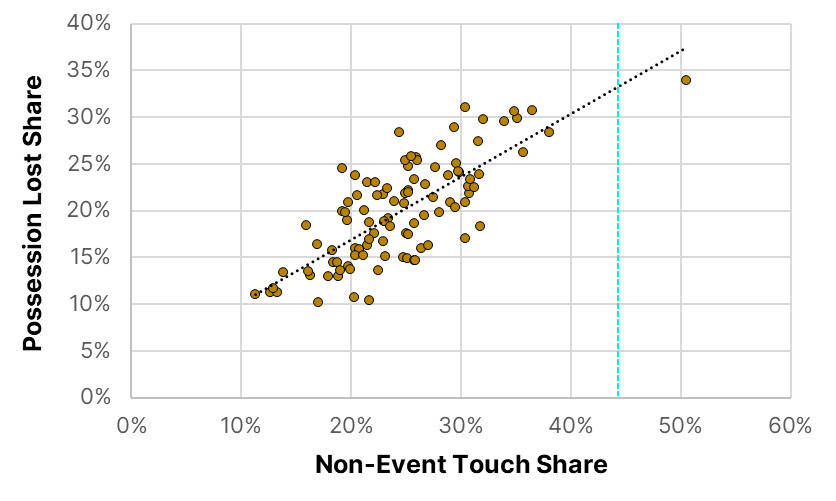
Now, there is a strong correlation between those sorts of touches and possession losses – but predicting someone's return isn't a sure thing, considering an R-squared value of 0.57. Consider the examples of Pierce Rizzo, a young center mid-cum-right back for Phoenix Rising, and Giordano Colli, an energetic No. 10 type for FC Tulsa. Those two turned in identical non-event touch shares (31%) but differed in their turnover rates by a whopping 12%. Both players served a specific role in their club’s system in a way that defied simple statistics.
We can broadly expect Okyere to be an impact progressor with modest passing numbers, but much will depend on the system Devin Rensing builds around him. I like the idea of Aaron Guillen and Ben Ofeimu as entry passers into the pivot; it’s easy to see Okyere emerging as the 2026 version of Wesley Fonguck, someone I loved in Monterey last year. For a Las Vegas team that badly needed a quarterback in the midfield in 2025, that’s exactly what the doctor ordered.
(By the way, Adrian Rebollar is that wild outlier on the far right in the second chart, even further along than the blue line denoting Okyere's numbers. I have no idea what’s up? Rebollar somehow only completed 13 passes a match on a sub-50% dribble success rate, yet my eye test would deem him to be “good.”)
Another shout to the Oakland Roots, who I intend to address in more detail soon enough. For now, let's talk about Jesus De Vicente, a left back just signed out of the University of Virginia. Extrapolating from Paul Harvey's indispensable NCAA draft board, De Vicente put up...
- 94th percentile passes into the box (2.1 per 90)
- 87th percentile progressive completions (7.5 per 90)
- 80th percentile completion percentage (79.9%)
If you think about the Roots in the mold of last year's Ryan Martin-led Loudoun United, then De Vicente is cut from a somewhat different cloth than Kwame Awuah – the starting left back for Loudoun's first-ever playoff team. While statistically more likely to burst forward for a shot than Awuah, De Vicente's real strength lies in his mid-to-long range passing; my friends at RootsBlog have the GIFs to prove it. Awuah complemented a dribble-first left winger last year with his overlapping and crossing, whilst De Vicente can hit the longer-range throughs that Danny Trejo and Peter Wilson feast on.
Julian Bravo will likely start the season at left back, but he and De Vicente ought to excel with Trejo serving as the new-age Abdellatif Aboukoura in 2026. It’s an exciting proposition for the Roots, who haven't won a playoff match since 2022 but feel as dangerous as at any point since then.
In transfer news this week, Aaron Molloy and his $100,000+ fee stole the show, but Detroit City's ongoing business – particularly the purchase of Maxi Rodriguez – deserves a note. Rodriguez didn’t truly settle in Rhode Island, appearing for just 16 minutes per game in the club’s final eight matches. Still, he adjusted to a more advanced deployment admirably, adding 10 goal contributions in USL play.
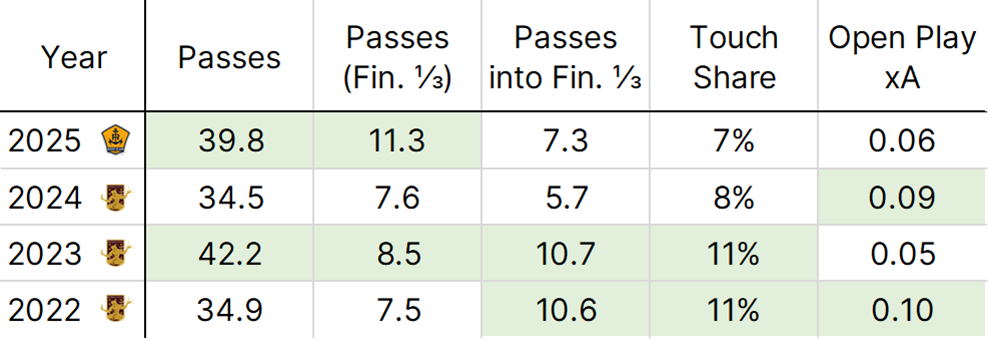
The changing usage was clear in the numbers. Often deployed as a second striker-esque piece in a 3-4-3, Rodriguez took a larger share of his touches in the attacking zone but was much less involved than in his Detroit peak. Meanwhile, his underlying progression and creation numbers declined. That ought to change back at Keyworth – particularly because of Le Rouge’s other business.
On the left, Aedan Stanley gives Detroit the best wingback they’ve ever had in their USL era, provided he recovers from a season-ending injury suffered with Indy in 2025. Further ahead, Alex Dalou is fresh off a key role in FC Tulsa’s run to the title game, and he’s got goalscoring drive and pressing energy in spades. It’s easy to imagine Le Rouge in a 3-2-4-1 attacking mode, with a deeper Rodriguez pulling strings toward Stanley, Ates Diouf, Dalou, and Haruki Yamazaki across the attacking band.
There’s more business to complete, particularly given the losses of Stephen Carroll and Shane Wiedt at back. Still, if the goal is to moderate toward a less defensive, more offensively controlling style, Detroit has splashed on the right pieces to try and make it happen.
A winter break send-off
It'll be January 31, 2026 the next time we get any Super League action, so I want to contextualize the state of affairs after Saturday’s ultimate quadruple-header.
Entering the break, it remains remarkable how well the league’s more restrained systems have performed. Clubs like Lexington, Jacksonville, and Carolina are, in terms of their passing profiles, the most controlling in the division – all are completing roughly 420 passes per game, and they’ve combined to post a +23 goal difference. At the same time, the last matchweek of 2025 illustrated how things are tighter than they might seem, even for those top-of-the-table contenders.
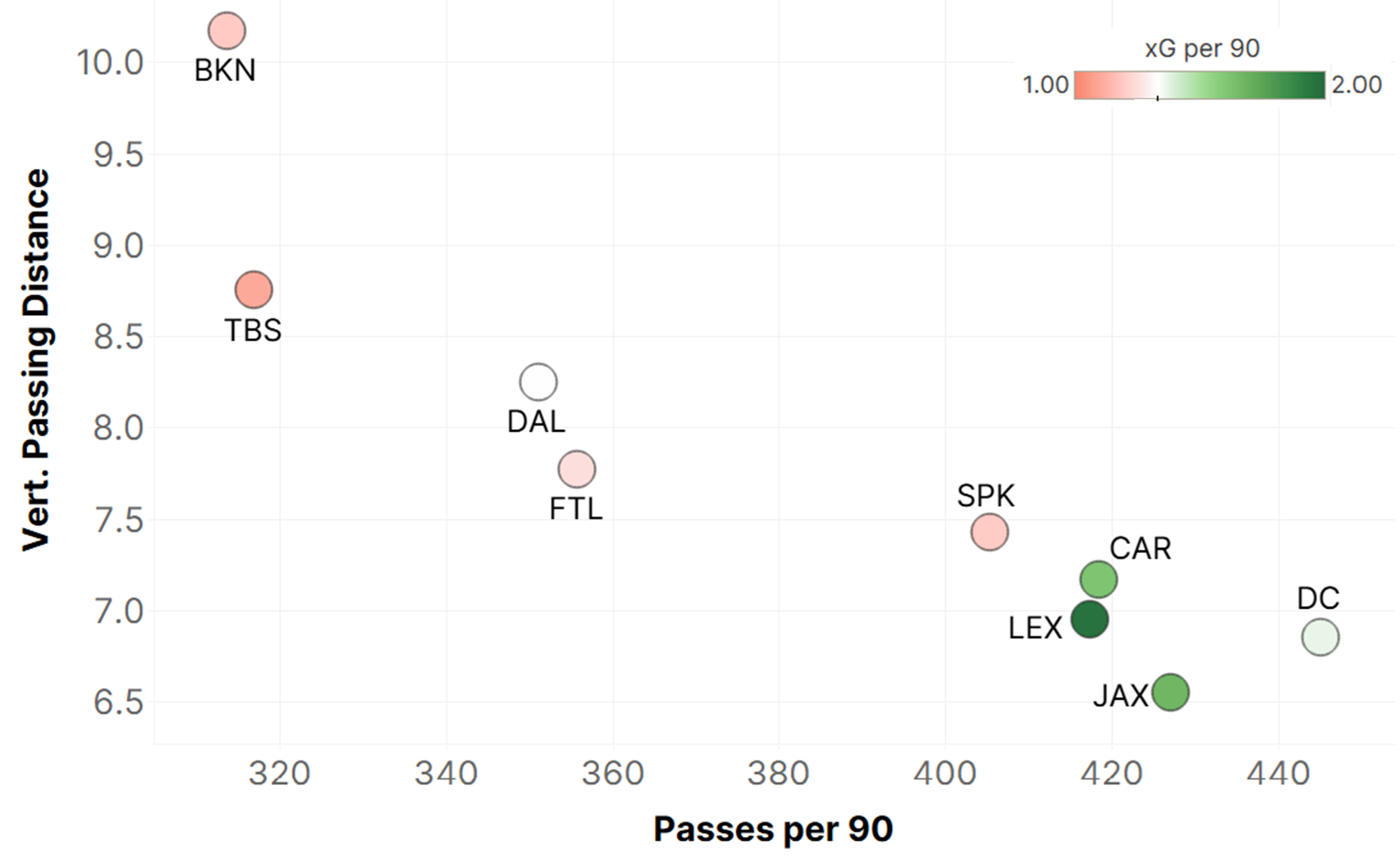
I've covered this ground before, so I won't tarry; the Super League’s most effective offenses are defined by short passing on paper. As we’ll see, however, that’s an oversimplified treatment of clubs like Lexington and Carolina. Moreover, that’s a conclusion where the tail (i.e., Brooklyn and Tampa Bay are at the bottom of the table) is wagging the dog (i.e., Brooklyn and Tampa Bay play fewer, longer passes).
That counterpoint is clear when you consider similar teams. For instance, there isn't much tactical daylight between the high-pressing 4-4-2s that Phillip Poole's Carolina Ascent and Denise Schilte-Brown's Tampa Bay Sun are employing despite their positions in the table. Actually executing is the most important factor of all, and the Super League's big three have done just that. Everyone wants to hit the final third and then control the match with short passing: it’s the ability to make it happen that’s decisive.
Consider Carolina more deeply. Against a fellow short-leaning team in the form of DC Power, the Ascent's bifurcated possessive approach came under fire. Still, Poole and co. weathered an early barrage until their principles shone through. The result was a draw, but one where Carolina ended with a slight xG edge to solidify a top-four position.
Typically, this team is good about building short from the back with goalkeeper Megan McLelland getting involved, almost basing their possession game out of a "3-4-4” where McLelland is allowed to knock it around like a proxy outfield player. That style of initiation draws opposing pressure, at which point vertical progression into forwards like MacKenzie George becomes an option. If it goes right, the Ascent’s attacking outlets can receive, outmuscle defenders, and allow for a second wave of short attacking closer to goal.
Executing that style will hopefully create extended spells in the attacking zone. Failing stable control in the final third, the Ascent can still shift into an organized press closer to the opposing goal. Against DC's back three on Saturday, Poole's advanced defensive shape looked like this...
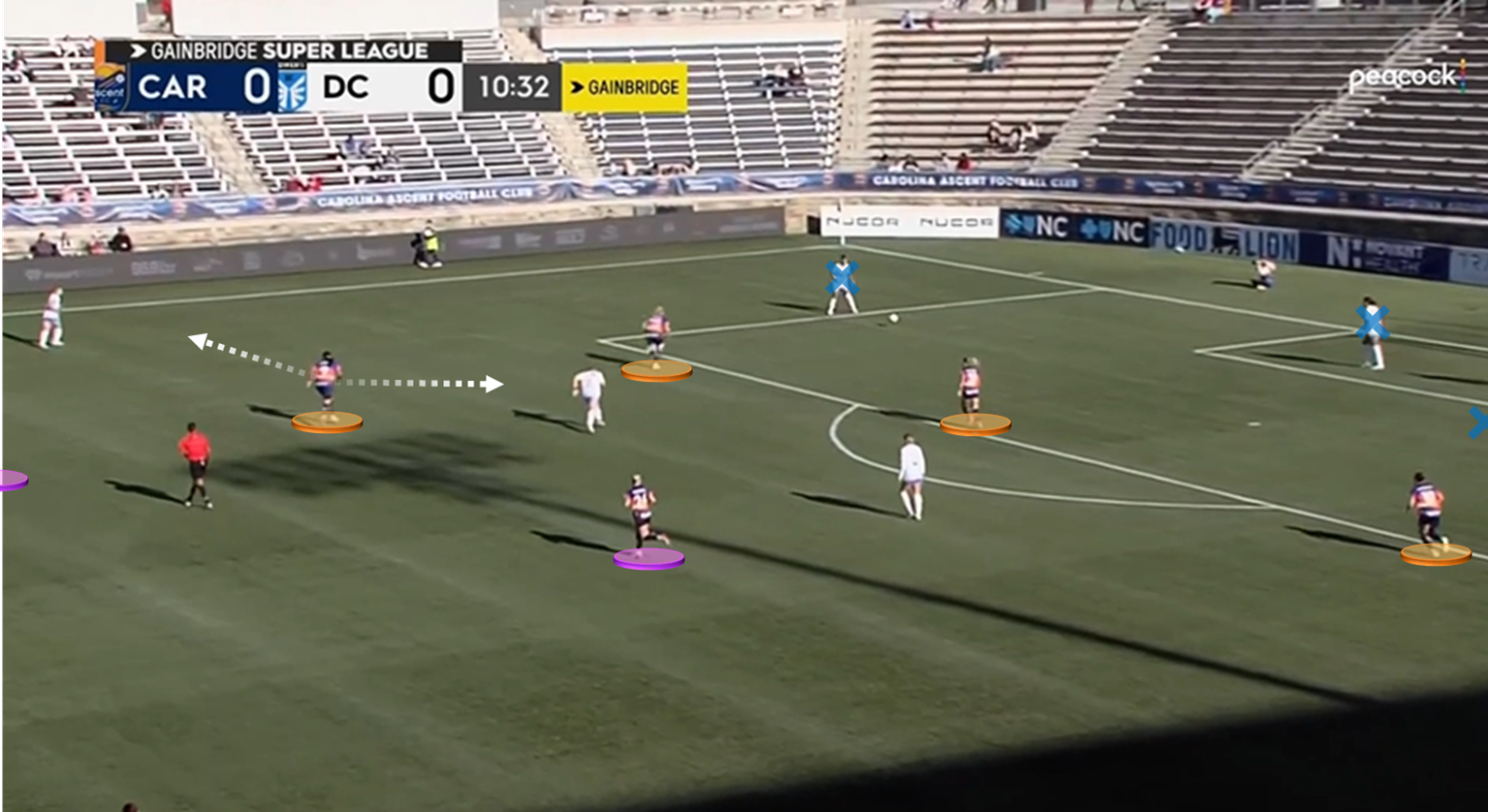
...with both wingers (Rylee Baisden on the right, Riley Parker on the left, both in orange) shifting high to create parity against the rival back line. Meanwhile, you see forward Mia Corbin (also in orange) tucking inside like a No. 8, giving Carolina three central presences against a Power side known to drop their No. 10s low to create overloads.
The progression from an attacking ideal into a defensive posture didn't always pan out this weekend. Loza Abera, one of those No. 10s for DC, seemed utterly unfazed by the crowding in the midfield. The visitors were, as usual, astute about climbing the ladder and overloading at the sidelines or in the halfspaces; at that point, Carolina's mid-low block had the tendency to overextend and allow DC to work back toward open pockets.
Still, it's a testament to the totality of Carolina's roster – namely through players like George and Jill Aguilera, a table-setting fullback that knows how to push forward in the attacking third – that they overcame a slow start to take control on Saturday. 45% of DC’s xG came in the opening 15 minutes, after which the Ascent held a 1.3 to 0.7 edge.
Likewise, Lexington went into a tough matchup at the Cotton Bowl and looked as assured as they have all year. Masaki Hemmi isn’t long for this Super League world, but his ability to instill positional principles to support an attractive passing style shone through again.
This sequence isn’t even particularly neat from LSC, yet it shows their ability to use the short passing game as a Trojan horse. The positional tenets are obvious: you see the back four (in green) and attacking line (in white) bend to adopt the possessive 3-4-3, with Alyssa Bourgeois pushing up from right back and Cassie Rohan dropping down the left. The pivot (pink) remains an anchor throughout.
Hemmi’s “Plan A” shape, defined by its use of four central players in a boxy alignment, is clear. The passing to activate that formation is far less slick. Still, Lexington are able to stay in control and work rightward, where Amber Nguyen drops from the right-sided No. 10 spot as the left side loses coherence.
Initially, Nguyen’s low drop is a stabilizer. Both members of the LSC pivot have shifted left, so the winger's presence is key in re-creating the "wide defender, wingback, No. 6" triangle by proxy. The ball swings toward Nguyen's side with enough pace that Dallas is still committed toward the opposite channel, and the structure is still clean enough that Bourgeois can receive and go one-on-one up the sideline.
By that point, LSC is out of the lurch, and Nguyen’s job is to get back upfield like a proper attacker. Because she knows what’s required in each phase, #9 is able to find a dangerous look in the box – one that comes off a pragmatic long ball, earned by goading Dallas forward with low-seated overloading.
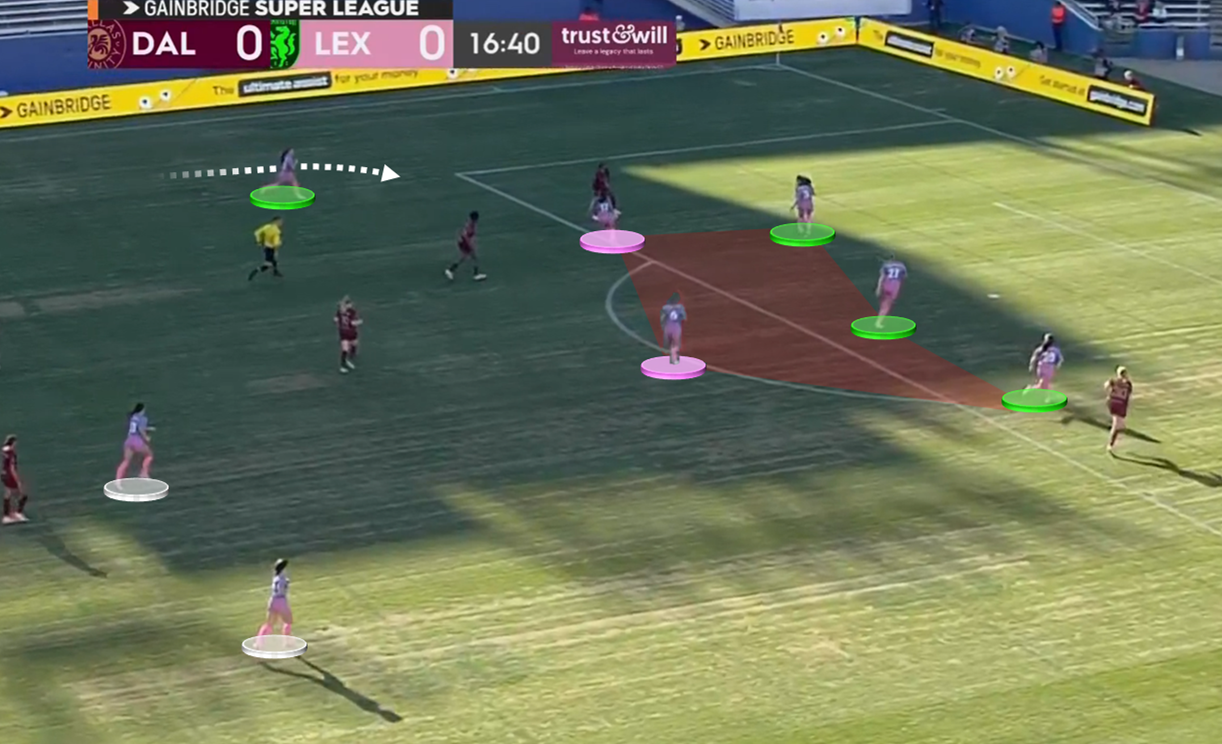
Here, you see Lexington recover in the wake of a less successful press-breaking long ball. An incompletion allows Dallas to break after recovering, yet there's no daylight; the "3-2" resting base of Lexington's shape holds firm, with defensive midfielder Tati Fung shifting deep to cover behind Bourgeois.
The clubs atop the Super League table can ride out the difficult moments while sticking to a philosophy. Passing data paints a certain picture, but the gulf between teams – in terms of tactical style and performance alike – is remarkably small in the 2025-2026 season.
Over the last two months of the fall slate, every single team in the league fell between an xG margin of +3.7 (Jacksonville) and -3.3 (Tampa Bay). That's not nothing, but it's indicative of the Super League's parity. I highlighted Lexington and Carolina here, but they only managed draws this weekend; I’m about to praise last-place Brooklyn in the next section. There's a lot to like across the board, and there's still everything to play for as we carom toward 2026.
Bright Brooklyn
I didn't check in after Brooklyn FC's 2025-ending rout against Tampa Bay last time around, so let's circle back. When I last covered Tomas Tengarrinha and friends, they were seemingly rounding into form with a sharp counterpressing and reset defense structure; because this blog is a curse, Brooklyn didn't win another game between that newsletter and the 3-0 win against the Sun.
So, what went right?
Start with Jennifer Cudjoe, the No. 6 at the base of Brooklyn’s 3-5-2ish concept. With Hope Breslin and Jessica Garziano as the higher No. 8s, the onus fell on Cudjoe – who’s attempting a stellar 8.5 duels per 90 and winning 61% of them since coming to Maimonides Park – to clean up ahead of the back line. Tampa Bay’s soul-searching lineup changes made that easier, but Cudjoe seemed to cover every blade of grass within her own half.
Likewise, Sam Kroeger continued to impress as a somewhat tight-tucked wingback on the left. That’s not to say she isn’t key as a possessive hub; Kroeger led all Brooklyn players with 69 touches and withstood the brunt of the Sun’s press. Still, the ex-Rutgers star is only attempting 0.8 crosses per match in open play since the position change out of the pivot and serves as a steadying presence more than anything else.
In other words, Brooklyn relied on Cudjoe and Kroeger to keep a lid on the guests before Tengarrinha did his usual halftime thing. Out of the break, his side swapped Na-Yeong Shin out for Jordan Thompson, adding an interventionist presence to their back three that helped tilt the pitch. The result? 0.34 run-of-play xG and no goals in the first half, versus 0.78 second-half expected goals in open play to seal that 3-0 rout against the defending champs.
Consider the example here, where Brooklyn begins by muscling the ball upfield and backs up the verticality with a higher-tilting defensive mien. Initially, a quick pass into Kroeger up the left leads to trouble, but she’s quickly able to recover the ball. Where #3 might’ve slowed down in a similar position in the first half, she speeds up here and tries an ambitious pass into the forward line.
You can see Brooklyn maintain their shape after that attempt goes wanting. Kroeger follows up her pass with a hard charge upfield, whilst the entire midfield stays firm. Tampa Bay will be forced toward Brooklyn’s right, where Thompson – representative of the enhanced aggression from central defense – and substitute wingback Mylena doggedly force the Sun backward.
As Tampa Bay is pushed toward their own net…
…Brooklyn continues to elevate the line of confrontation upfield.
The Sun are able to switch the point toward the opposing left, and they even squeak a pass past Kroeger. Still, center back Lauren Gogal – matching Thompson’s prior aggression – steps up, cuts a pass out, and immediately dribbles upfield. Gogal will earn a hockey assist for her efforts, allowing Brooklyn to take a 1-0 lead.
Mere seconds after this goal, Tengarrinha’s side earned another chance because of their hard-charging positivity. Rebecca Cooke out-battled the Sun’s back line for a long ball, Mylena crashed upfield on the weak side to create a virtual three-on-two, and it should’ve been 2-0. That single missed opportunity didn't really matter, of course; Brooklyn’s combination of vertical initiation and elevated center back play had a domino effect that the Sun couldn’t overcome.
Consistency remains the issue for Brooklyn, but when they’re on, they’re really on. We’ll see how robust the winter market looks and whether Tengarrinha gets reinforcements, but you couldn’t ask for more momentum and positivity heading into the break.
Quick Hits
In other news this week…
- Speaking of Brooklyn, check out my interview with Marlon LeBlanc, the club's first-ever USL Championship manager.
- Adrian Pelayo to Phoenix: good signing. Even before he hit legal adulthood, Pelayo had plus-level technique that let him serve as a quarterback from central defense in the Portland youth ranks and with North Carolina FC. While a transfer to Chivas was less successful, Pelayo re-emerged in MLS Next Pro in 2025 with excellent defensive efficiency (see a 69% duel win rate) and those familiar passing chops (5.5 long completions per game, +0.1% pass completion against expected). He won’t start for Rising on opening day, but he’s got the tools to be terrific.
- I owe the Cosmos a deeper dive at some point, but getting 18-year-old Julien Lacher off of NYCFC II is a coup. In nearly 2,000 minutes last year, the teenager completed 0.67 crosses on 35% completion and 2.56 dribbles with a 58% success rate; all were top-quarter numbers among Next Pro wide players. His goal contribution numbers were equally enticing, and they came on a sustainable 10.1 xG+xA sum. I imagine he'll be the starter on the right wing, adjacent to Ajmeer Spengler? Exciting stuff.
- Marty Supreme is commendable because (1) there’s a chunk in the middle that’s basically The Hustler but with ping pong and Tyler, the Creator, (2) scoring a 1950s period movie with 1980s pop is good, and (3) it produced a Timothy Chalamet rap song where he’s rhyming “four-door” with “Mordor.” I do think Marty's character arc ends too conveniently, and I'm not wholly into the Safdie style (too much manufactured tension, excessively tight camerawork for my taste, etc.), but it's also a blast.
- Better because it's achingly earnest: Bradley Cooper's Is This Thing On?